


 Скачать презентацию Waste Prevention Pat Keating Senior Executive Officer June
9268d6cea0cab393b566ac29aec8a857.ppt
- Количество слайдов: 23
 Waste Prevention Pat Keating Senior Executive Officer June 2013
 Why worry about waste? Every business generates waste – ranges from paper to hazardous waste ¡ Regardless of the type or volume of waste your company generates, it is all the same in one respect - it is costing you money! ¡ You are paying for it twice - once when you buy it and the second time when you throw it away. “Preventing waste will save you money”. ¡
 ¡ ¡ By consuming and throwing away less, you can reduce the need to handle, treat and dispose of waste. Waste prevention can take many forms: - Reducing the amount of packaging; - Striving to eliminate raw materials that are not included in your end product /service - Using products that are free of toxic materials - Purchasing durable, long lasting materials - Conserving water/energy; - Implement in-process recycling.
 Waste Management – General Legal Obligations. ¡ Waste is: Anything a holder /person that discards, intends ¡ Only transfer your waste to someone who has a Waste Licence, Collection permit and that your waste is going to an authorised facility to discard or is required to discard. Waste management licence ¡ ¡ Landfills Large scale composting Hazardous waste recovery/disposal Etc. Collection permits: Waste management permits ¡ ¡ ¡ Composting Transfer stations Etc.
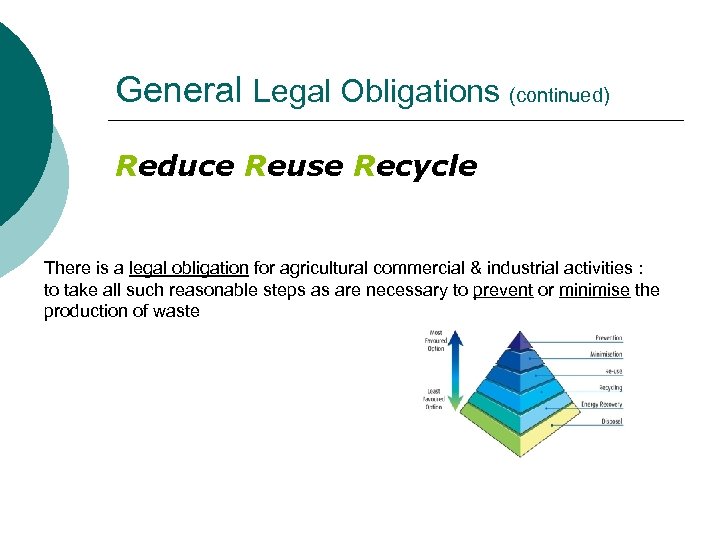 General Legal Obligations (continued) Reduce Reuse Recycle There is a legal obligation for agricultural commercial & industrial activities : to take all such reasonable steps as are necessary to prevent or minimise the production of waste
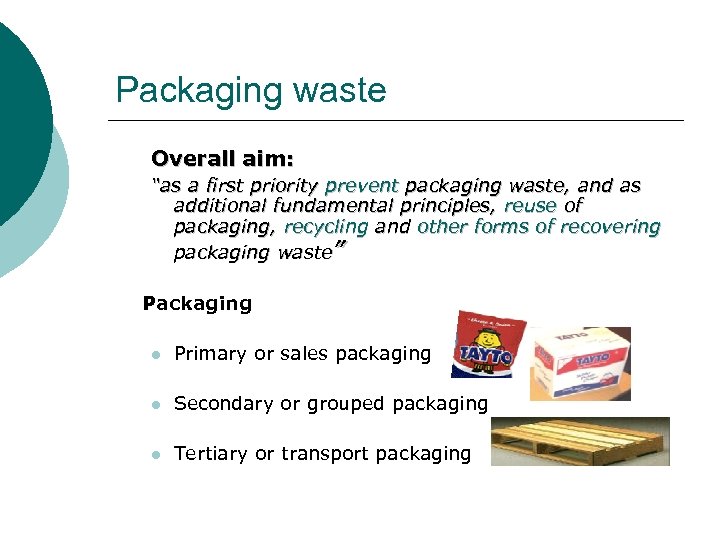 Packaging waste Overall aim: “as a first priority prevent packaging waste, and as additional fundamental principles, reuse of packaging, recycling and other forms of recovering packaging waste” Packaging l Primary or sales packaging l Secondary or grouped packaging l Tertiary or transport packaging
 Packaging waste Producer: l a supplier of packaging material, packaging or packaged products to the Irish market ¡ major ¡ ¡ all ¡ producers >10 tonnes p. a. on Irish market (ex. packaging destined for reuse) annual turnover > € 1 M. other producers Producers can include: l shops, pubs, hotels, supermarkets, fast-food outlets, wholesalers, retailers, manufacturers, importers
 Packaging waste ¡ ¡ Obligations for major Producers: ¡ Join REPAK or ¡ Self comply (collect back packaging waste & register with & report to the local authority) Obligations for all Producers: ¡ Display Certificate of Compliance l l l Segregate and recycle specified back-door packaging waste. Provide the weights of the packaging materials supplied to customers, if requested. Provide statistics to the local authority, as requested
 Obligations for all Producers ¡ Specified Streams: all producers must: l Segregate from other wastes the following uncontaminated packaging waste streams arising on their premises: l l l l aluminium cardboard glass paper plastic sheeting steel wood Ensure such streams are collected by authorised waste collectors and that the final destination of such waste is a recovery or recycling facility.
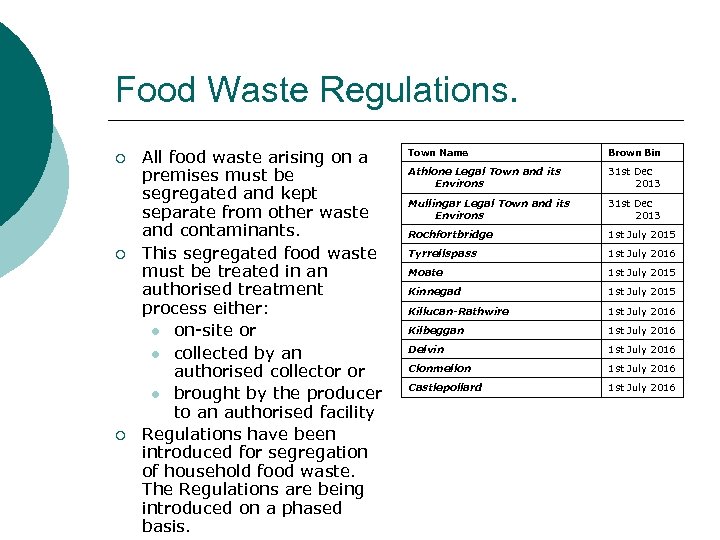 Food Waste Regulations. ¡ ¡ ¡ All food waste arising on a premises must be segregated and kept separate from other waste and contaminants. This segregated food waste must be treated in an authorised treatment process either: l on-site or l collected by an authorised collector or l brought by the producer to an authorised facility Regulations have been introduced for segregation of household food waste. The Regulations are being introduced on a phased basis. Town Name Brown Bin Athlone Legal Town and its Environs 31 st Dec 2013 Mullingar Legal Town and its Environs 31 st Dec 2013 Rochfortbridge 1 st July 2015 Tyrrellspass 1 st July 2016 Moate 1 st July 2015 Kinnegad 1 st July 2015 Killucan-Rathwire 1 st July 2016 Kilbeggan 1 st July 2016 Delvin 1 st July 2016 Clonmellon 1 st July 2016 Castlepollard 1 st July 2016
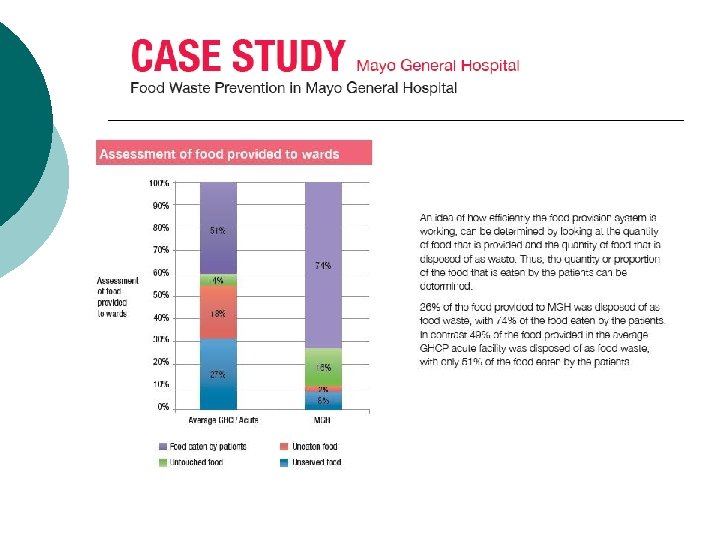
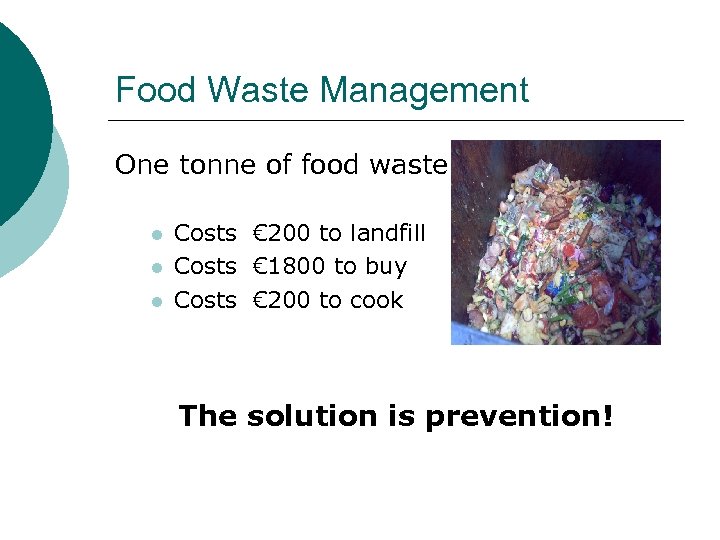 Food Waste Management One tonne of food waste l l l Costs € 200 to landfill Costs € 1800 to buy Costs € 200 to cook The solution is prevention!
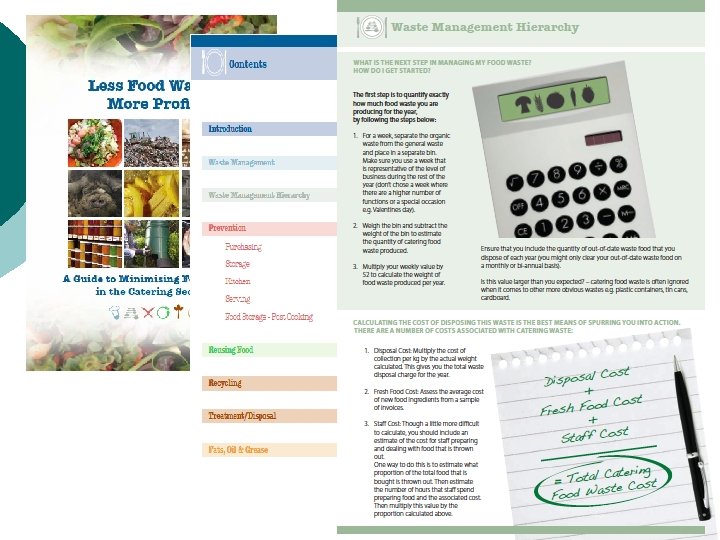
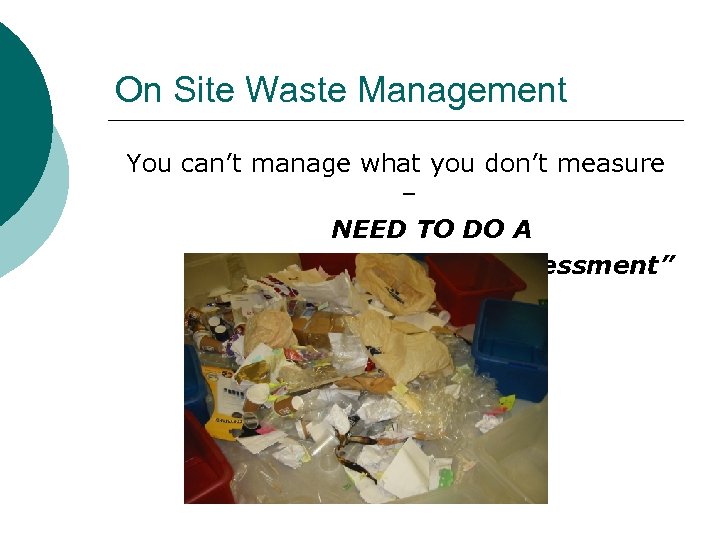 On Site Waste Management You can’t manage what you don’t measure – NEED TO DO A “Waste Audit or Assessment”
 Waste Audit WHY? l To identify ¡ sources, quantities and types of wastes being generated, ¡ consumption/production patterns of the site or process; ¡ areas or processes that are inefficient; ¡ the potential improvements;
 Information you will get ¡ ¡ ¡ Calculate total waste arising on-site Provide a breakdown of the areas generating that waste Generate an accurate profile of the types of waste produced These figures can be used as a baseline from which to monitor progress Draws together all the on-site information on the waste disposal system On-site waste management facilities often just evolve – can be inefficient in use of space and time
 Waste Audit Methodology 1. On-site check 2. Planning 3. Collection of waste 4. Sorting 5. Analysis 6. Solutions!
 Case Study 1 - retail ¡ ¡ ¡ - Large supermarket; daily customer base 3, 200; floor area 2, 000 m 2; staff 120; retailing large variety of goods including delicatessen, butcher, grocery and offlicence. 244 tonne per annum reduced to 181 tonne- equates to reduction from. 17 kg of waste arising per footfall to. 13 kg. Achieved through: Improved waste segregation; Removal of compactor and replaced with receptacles for recyclables and landfill waste; Improved efficiencies through preparation of food; More efficient use of balers Delivery containers returned for reuse Education and awareness.
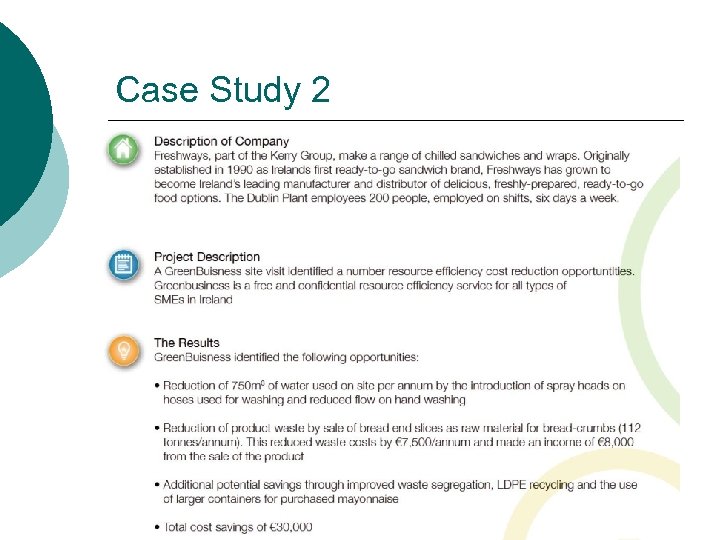 Case Study 2
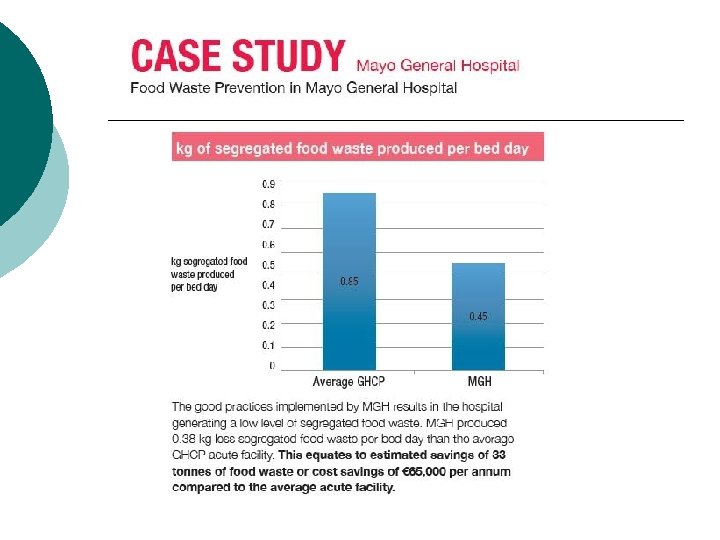
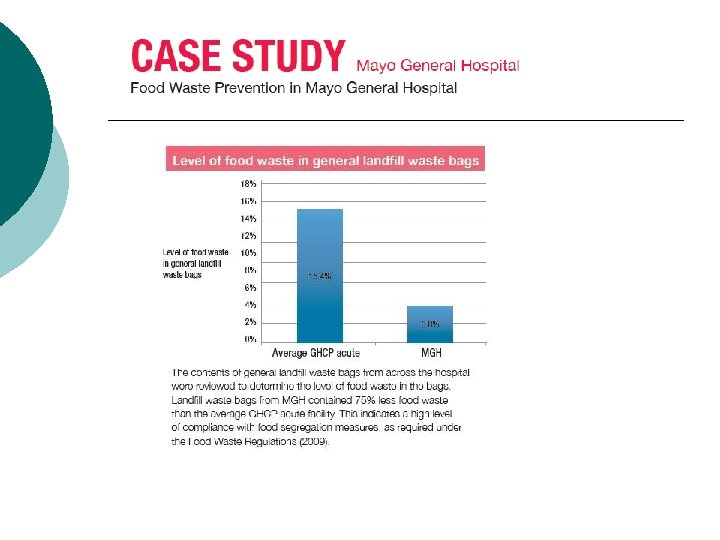
 Who can help? ¡ ¡ Green. Business It is a Free and confidential resource efficiency service for all types of SMEs in Ireland l l Advise on resource efficiency improvements and cost savings through waste prevention and reductions in water and energy consumption Give a free site assessment- assessments carried out by professional Environmental Consultants. Shall produce reports and recommendations for low-cost and no-cost resource efficiency savings. All information is treated as confidential and is not passed to any other party.
 Waste Management Tips ¡ ¡ ¡ Start a Green Team Use Clear Plastic Bags Provide enough bins internally Create a covered waste area Get your Disposal Company involved – play hard ball! Train your staff in procedures Get rid of or lock your skip Start the programme – get through the initial problems – 2 weeks Set Tonnage Diversion targets and give weekly/monthly/yr feedback - € results are for management initially Reward success Refine programme But remember – you must first start measuring!