


 Скачать презентацию Waste Management in Oregon Part 2 — Office
6d6e95d4851b9104f30a5160a8ee56c9.ppt
- Количество слайдов: 11
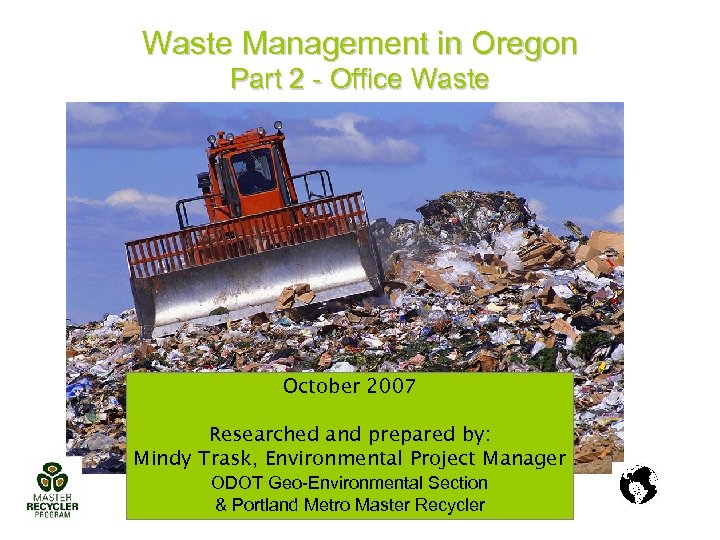 Waste Management in Oregon Part 2 - Office Waste October 2007 Researched and prepared by: Mindy Trask, Environmental Project Manager ODOT Geo-Environmental Section & Portland Metro Master Recycler
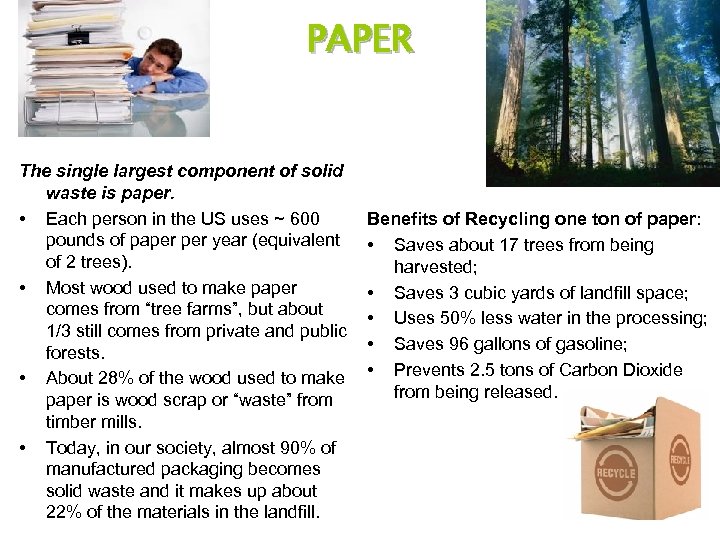 PAPER The single largest component of solid waste is paper. • Each person in the US uses ~ 600 pounds of paper year (equivalent of 2 trees). • Most wood used to make paper comes from “tree farms”, but about 1/3 still comes from private and public forests. • About 28% of the wood used to make paper is wood scrap or “waste” from timber mills. • Today, in our society, almost 90% of manufactured packaging becomes solid waste and it makes up about 22% of the materials in the landfill. Benefits of Recycling one ton of paper: • Saves about 17 trees from being harvested; • Saves 3 cubic yards of landfill space; • Uses 50% less water in the processing; • Saves 96 gallons of gasoline; • Prevents 2. 5 tons of Carbon Dioxide from being released.
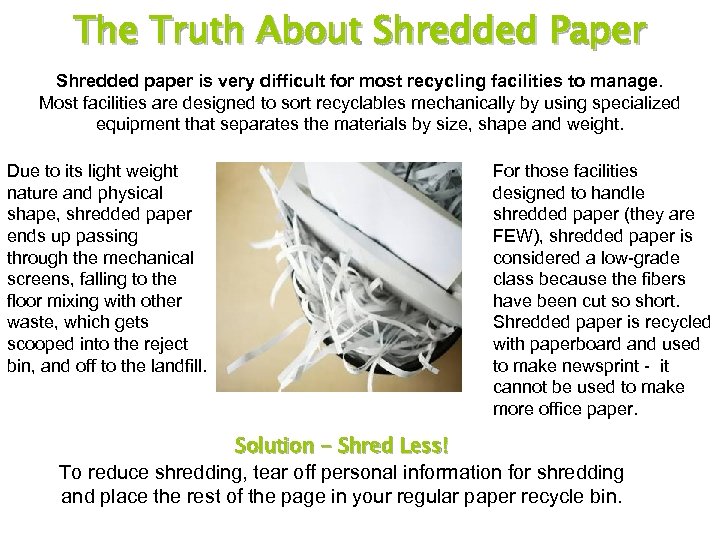 The Truth About Shredded Paper Shredded paper is very difficult for most recycling facilities to manage. Most facilities are designed to sort recyclables mechanically by using specialized equipment that separates the materials by size, shape and weight. Due to its light weight nature and physical shape, shredded paper ends up passing through the mechanical screens, falling to the floor mixing with other waste, which gets scooped into the reject bin, and off to the landfill. For those facilities designed to handle shredded paper (they are FEW), shredded paper is considered a low-grade class because the fibers have been cut so short. Shredded paper is recycled with paperboard and used to make newsprint - it cannot be used to make more office paper. Solution - Shred Less! To reduce shredding, tear off personal information for shredding and place the rest of the page in your regular paper recycle bin.
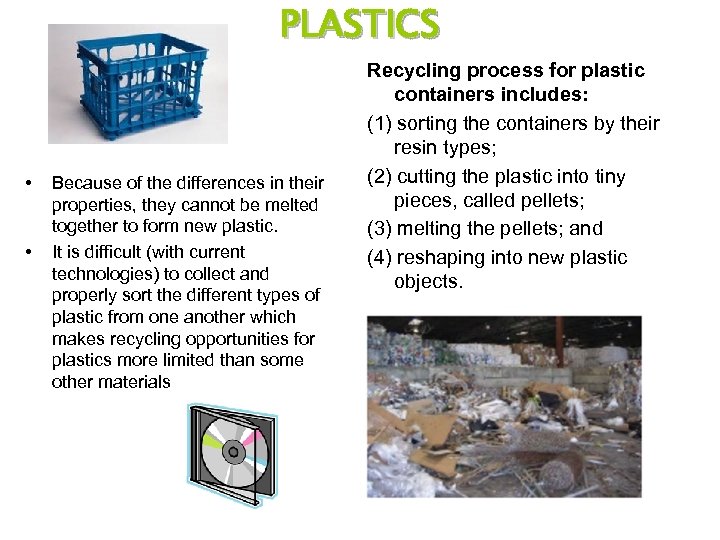 PLASTICS • • Because of the differences in their properties, they cannot be melted together to form new plastic. It is difficult (with current technologies) to collect and properly sort the different types of plastic from one another which makes recycling opportunities for plastics more limited than some other materials Recycling process for plastic containers includes: (1) sorting the containers by their resin types; (2) cutting the plastic into tiny pieces, called pellets; (3) melting the pellets; and (4) reshaping into new plastic objects.
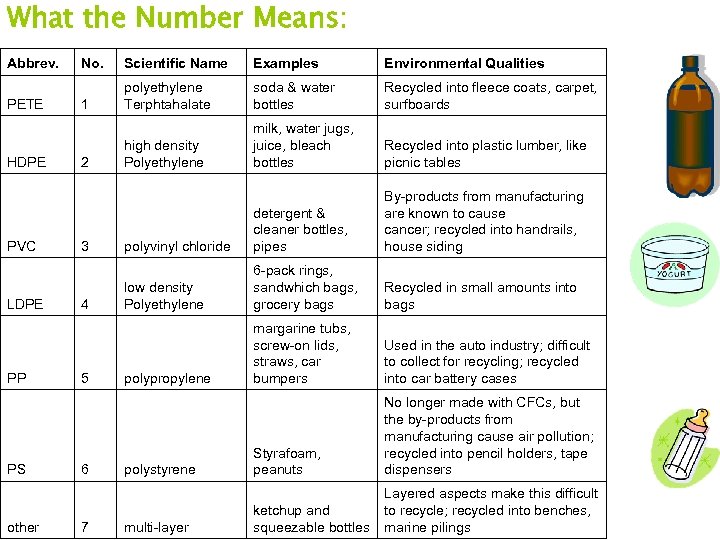 What the Number Means: Abbrev. PETE HDPE PVC LDPE PP PS other No. Scientific Name Examples Environmental Qualities 1 polyethylene Terphtahalate soda & water bottles Recycled into fleece coats, carpet, surfboards high density Polyethylene milk, water jugs, juice, bleach bottles Recycled into plastic lumber, like picnic tables polyvinyl chloride detergent & cleaner bottles, pipes By-products from manufacturing are known to cause cancer; recycled into handrails, house siding low density Polyethylene 6 -pack rings, sandwhich bags, grocery bags Recycled in small amounts into bags polypropylene margarine tubs, screw-on lids, straws, car bumpers Used in the auto industry; difficult to collect for recycling; recycled into car battery cases Styrafoam, peanuts No longer made with CFCs, but the by-products from manufacturing cause air pollution; recycled into pencil holders, tape dispensers ketchup and squeezable bottles Layered aspects make this difficult to recycle; recycled into benches, marine pilings 2 3 4 5 6 7 polystyrene multi-layer
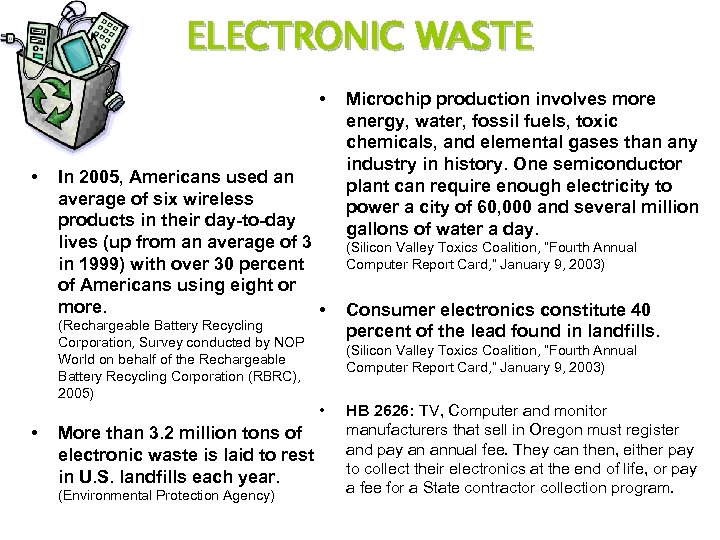 ELECTRONIC WASTE • • In 2005, Americans used an average of six wireless products in their day-to-day lives (up from an average of 3 in 1999) with over 30 percent of Americans using eight or more. • (Rechargeable Battery Recycling Corporation, Survey conducted by NOP World on behalf of the Rechargeable Battery Recycling Corporation (RBRC), 2005) More than 3. 2 million tons of electronic waste is laid to rest in U. S. landfills each year. (Environmental Protection Agency) (Silicon Valley Toxics Coalition, “Fourth Annual Computer Report Card, ” January 9, 2003) Consumer electronics constitute 40 percent of the lead found in landfills. (Silicon Valley Toxics Coalition, “Fourth Annual Computer Report Card, ” January 9, 2003) • • Microchip production involves more energy, water, fossil fuels, toxic chemicals, and elemental gases than any industry in history. One semiconductor plant can require enough electricity to power a city of 60, 000 and several million gallons of water a day. HB 2626: TV, Computer and monitor manufacturers that sell in Oregon must register and pay an annual fee. They can then, either pay to collect their electronics at the end of life, or pay a fee for a State contractor collection program.
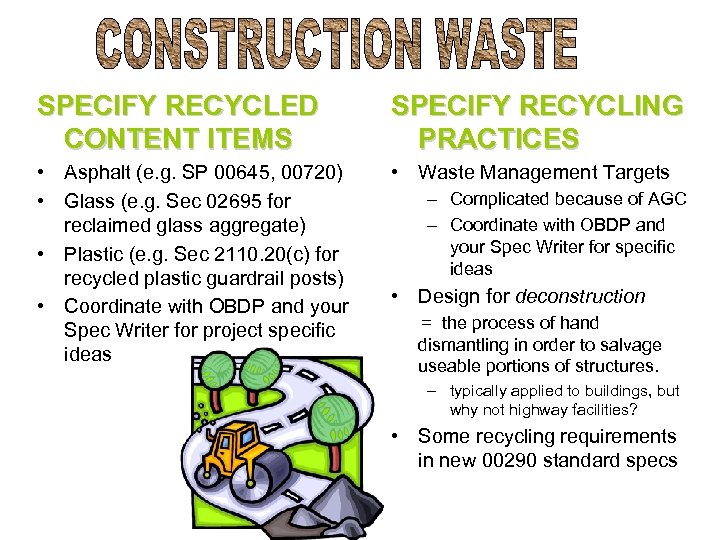 SPECIFY RECYCLED CONTENT ITEMS SPECIFY RECYCLING PRACTICES • Asphalt (e. g. SP 00645, 00720) • Glass (e. g. Sec 02695 for reclaimed glass aggregate) • Plastic (e. g. Sec 2110. 20(c) for recycled plastic guardrail posts) • Coordinate with OBDP and your Spec Writer for project specific ideas • Waste Management Targets – Complicated because of AGC – Coordinate with OBDP and your Spec Writer for specific ideas • Design for deconstruction = the process of hand dismantling in order to salvage useable portions of structures. – typically applied to buildings, but why not highway facilities? • Some recycling requirements in new 00290 standard specs
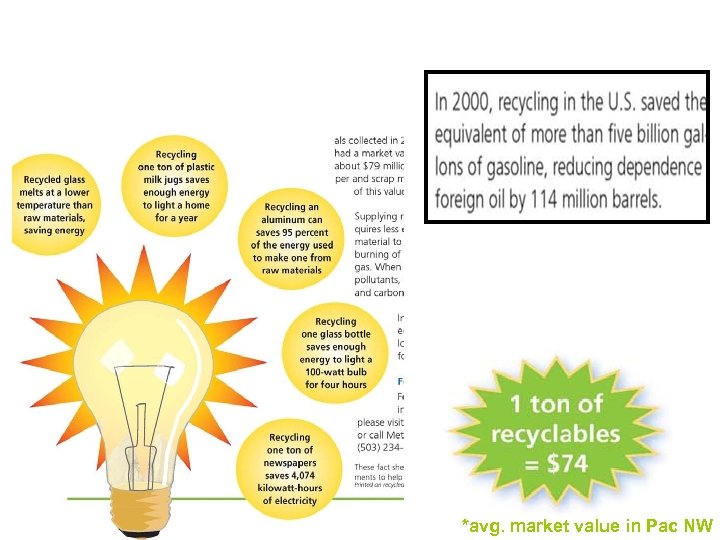 *avg. market value in Pac NW
 DRIVE LESS • Carpool, bike, or bus • Carpool to meetings – Requires a little more planning • Teleconference more often – ask meeting facilitator to provide all presentation materials on web or ftp in advance Why Bother? • Reduces ADT – Less road maintenance – Less frequent paving projects – Less congestion – Improves air quality – Less stormwater runoff – Uses less fuel • Less Road Rage!
 USE LESS • Re-use office supplies like folders, binders - create a re-use station • Purchase high content recycled products - especially printer paper - be pro-active - coordinate with office supply manager • Practice "Precycling" even at work Why Bother? • Fewer Trucks to Deliver Goods – Less road maintenance – Less frequent paving projects – Improves air quality – Less stormwater runoff – Uses less fuel • Save $ and natural resources
 PRECYCLING = the practice of reducing waste by attempting to avoid purchasing wasteful products • Carry a "precycling kit" with you (reusable container, silverware, cloth napkin or handkerchief and reusable water-bottle, all within a cloth bag that can double as a grocery/shopping bag) • Fix rather than toss broken products (especially electronics) • Chose products that are durable, reusable, recyclable and not overpackaged • Buy locally made products and food whenever possible Buyer’s Choice Checklist: ü Do I really need this? ü Is the product or packaging recyclable or reusable? ü Is the product made of recycled materials? ü How far did the product have to travel to get to me?