 Скачать презентацию Washington State Budget Overview October 2003 OFFICE OF
49f52a1d61e91a3be3773ac939f6cb26.ppt
- Количество слайдов: 43



Washington State Budget Overview October 2003 OFFICE OF FINANCIAL MANAGEMENT
Part 1 Description of the Budget Process OFFICE OF FINANCIAL MANAGEMENT
The Biennial Budget Process v Like 22 other states, Washington uses a biennial budget process. v The two-year budget takes effect on July 1 of odd-numbered years. (e. g. 2003 -05 represents 7/1/03 through 6/30/05) v The Legislature meets in annual sessions, creating the option to enact a “supplemental” budget that incrementally changes the original. v Supplemental budgets usually address more technical needs; such as new assumptions of caseload and enrollment, and unanticipated costs that cannot be absorbed within the current budget. v However, it is not unusual to see a limited number of policy initiatives in a supplemental budget. OFFICE OF FINANCIAL MANAGEMENT
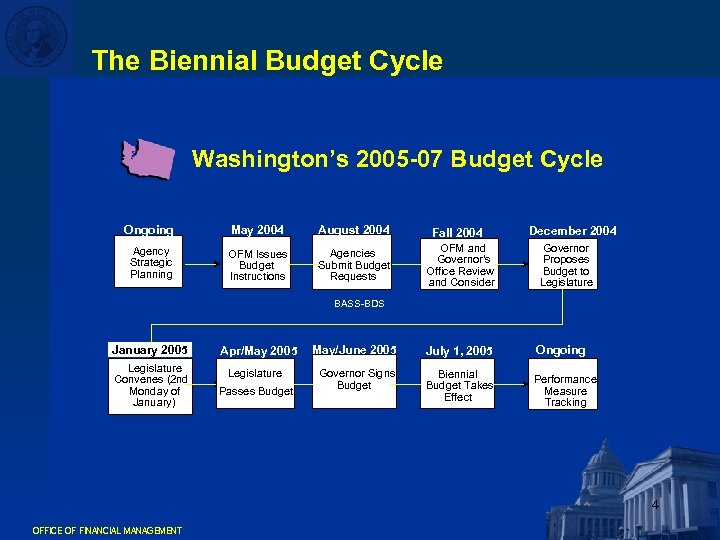
The Biennial Budget Cycle Washington’s 2005 -07 Budget Cycle Ongoing Agency Strategic Planning May 2004 August 2004 Fall 2004 OFM Issues Budget Instructions Agencies Submit Budget Requests OFM and Governor's Office Review and Consider December 2004 Governor Proposes Budget to Legislature BASS-BDS January 2005 Legislature Convenes (2 nd Monday of January) Apr/May 2005 Legislature Passes Budget May/June 2005 July 1, 2005 Governor Signs Budget Biennial Budget Takes Effect Ongoing Performance Measure Tracking 4 OFFICE OF FINANCIAL MANAGEMENT
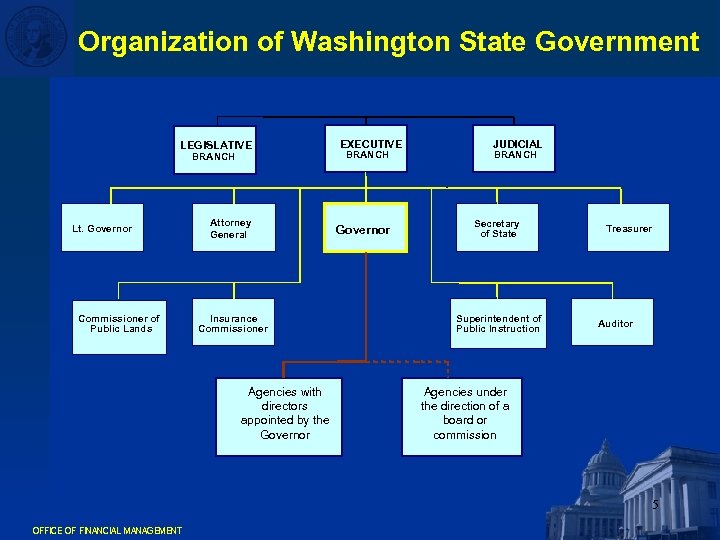
Organization of Washington State Government LEGISLATIVE BRANCH Lt. Governor Commissioner of Public Lands Attorney General Insurance Commissioner Agencies with directors appointed by the Governor EXECUTIVE BRANCH Governor JUDICIAL BRANCH Secretary of State Superintendent of Public Instruction Treasurer Auditor Agencies under the direction of a board or commission 5 OFFICE OF FINANCIAL MANAGEMENT
Other Budget Roles: Legislative fiscal committees: Perform a similar role to OFM, on behalf of the Legislature v House and Senate Transportation policy and budget committees v Senate Ways and Means Committee v House Appropriations, Finance, and Capital committees Others legislative and bipartisan committees: v Joint Legislative Audit and Review Committee (JLARC) v Legislative Evaluation and Accountability Committee (LEAP) v Economic and Revenue Forecast Committee v Caseload Forecast Council v 601 Expenditure Limit Committee OFFICE OF FINANCIAL MANAGEMENT
Spending Limits that Apply to the Budget Expenditure Limit Initiative 601, passed in 1993, places a limit on state general fund expenditures Debt Service Limit The state constitution limits debt to 9 percent of general state revenues. A statutory limit restricts this percentage to 7 percent 7 OFFICE OF FINANCIAL MANAGEMENT
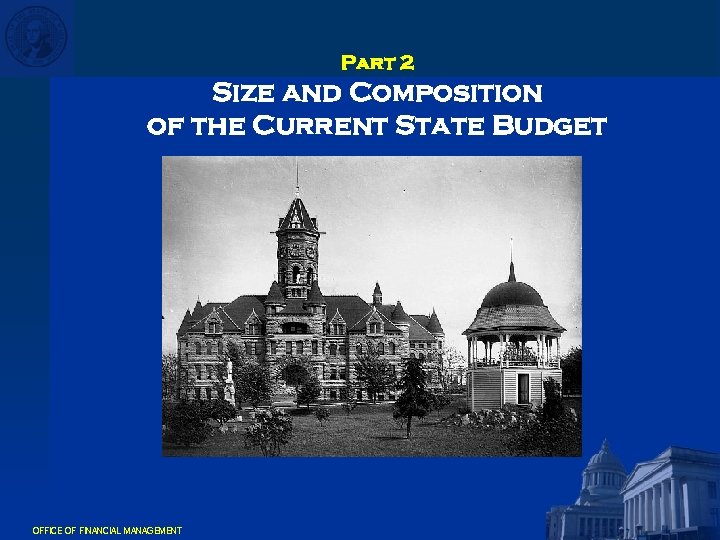
Part 2 Size and Composition of the Current State Budget OFFICE OF FINANCIAL MANAGEMENT
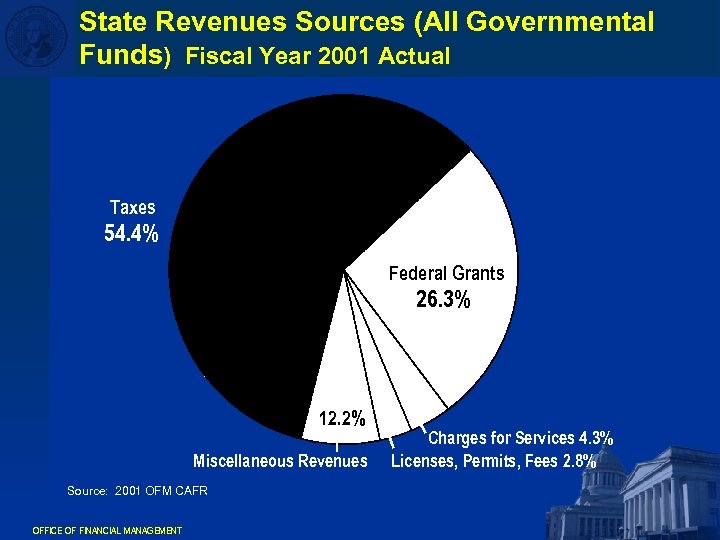
State Revenues Sources (All Governmental Funds) Fiscal Year 2001 Actual Taxes 54. 4% Federal Grants 26. 3% 12. 2% Miscellaneous Revenues Source: 2001 OFM CAFR OFFICE OF FINANCIAL MANAGEMENT Charges for Services 4. 3% Licenses, Permits, Fees 2. 8%
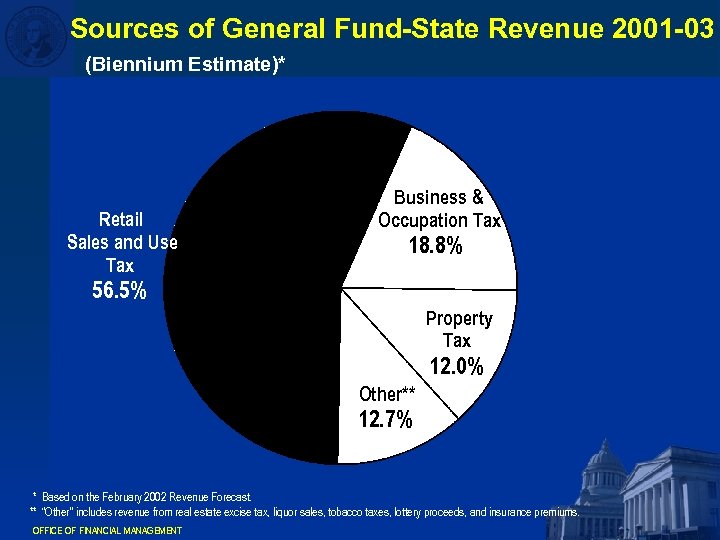
Sources of General Fund-State Revenue 2001 -03 (Biennium Estimate)* Retail Sales and Use Tax Business & Occupation Tax 18. 8% 56. 5% Property Tax 12. 0% Other** 12. 7% * Based on the February 2002 Revenue Forecast. ** “Other” includes revenue from real estate excise tax, liquor sales, tobacco taxes, lottery proceeds, and insurance premiums. OFFICE OF FINANCIAL MANAGEMENT
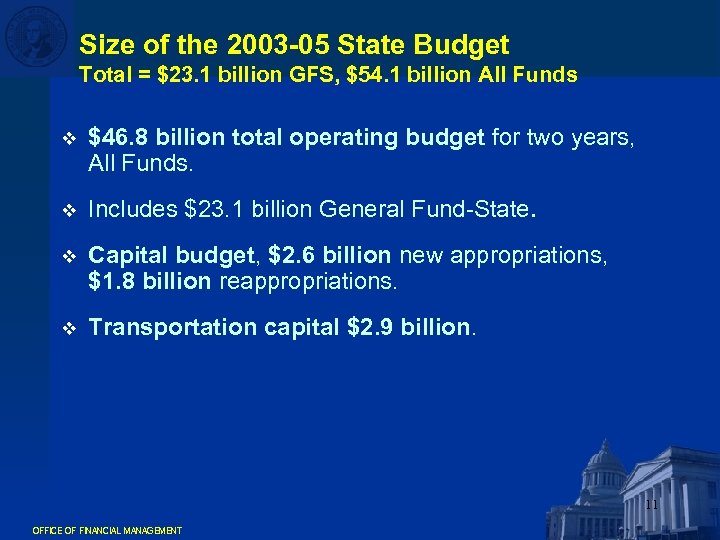
Size of the 2003 -05 State Budget Total = $23. 1 billion GFS, $54. 1 billion All Funds v $46. 8 billion total operating budget for two years, All Funds. v Includes $23. 1 billion General Fund-State. v Capital budget, $2. 6 billion new appropriations, $1. 8 billion reappropriations. v Transportation capital $2. 9 billion. 11 OFFICE OF FINANCIAL MANAGEMENT
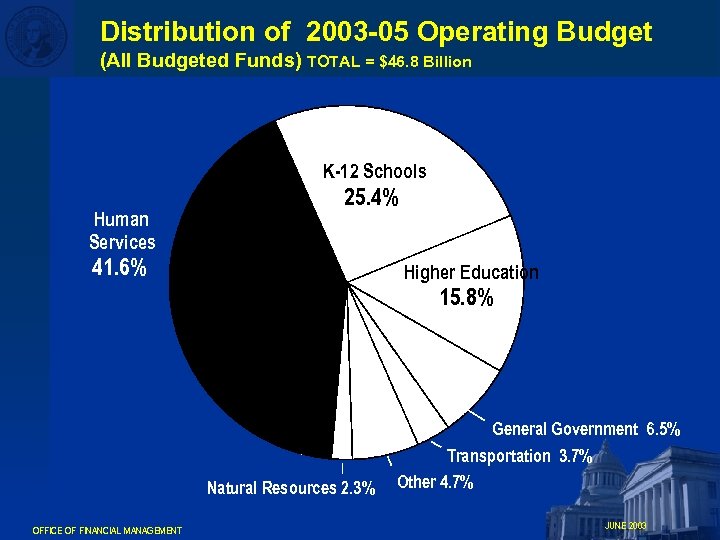
Distribution of 2003 -05 Operating Budget (All Budgeted Funds) TOTAL = $46. 8 Billion K-12 Schools Human Services 25. 4% 41. 6% Higher Education 15. 8% Natural Resources 2. 3% OFFICE OF FINANCIAL MANAGEMENT General Government 6. 5% Transportation 3. 7% Other 4. 7% JUNE 2003
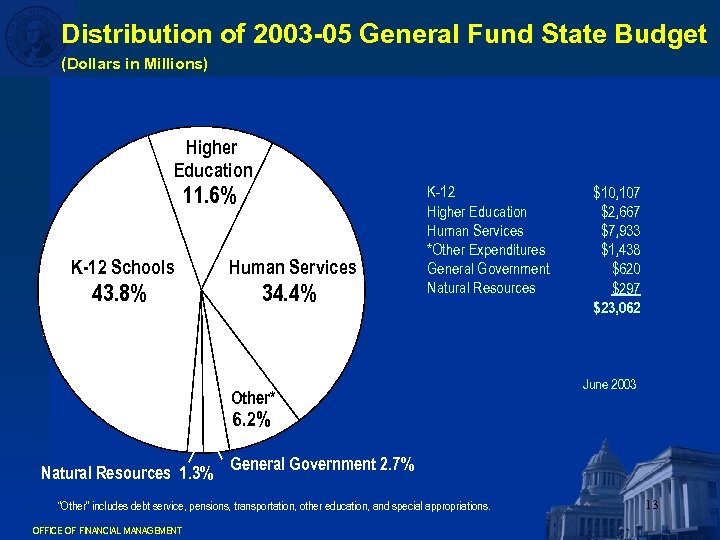
Distribution of 2003 -05 General Fund State Budget (Dollars in Millions) Higher Education 11. 6% K-12 Schools 43. 8% Human Services 34. 4% K-12 Higher Education Human Services *Other Expenditures General Government Natural Resources Other* $10, 107 $2, 667 $7, 933 $1, 438 $620 $297 $23, 062 June 2003 6. 2% Natural Resources 1. 3% General Government 2. 7% “Other” includes debt service, pensions, transportation, other education, and special appropriations. OFFICE OF FINANCIAL MANAGEMENT 13
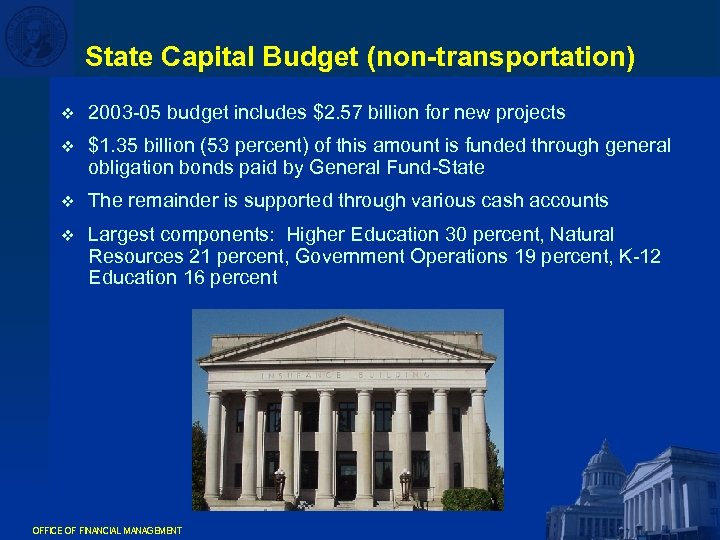
State Capital Budget (non-transportation) v 2003 -05 budget includes $2. 57 billion for new projects v $1. 35 billion (53 percent) of this amount is funded through general obligation bonds paid by General Fund-State v The remainder is supported through various cash accounts v Largest components: Higher Education 30 percent, Natural Resources 21 percent, Government Operations 19 percent, K-12 Education 16 percent OFFICE OF FINANCIAL MANAGEMENT
Part 3 Budget Decision Environment OFFICE OF FINANCIAL MANAGEMENT
Theoretical Worst Case Budget Scenario “The Perfect Storm” Revenues are Low at the same time that Service Demand Unit Costs are High v Slow growth (or drop) in revenues due to economic conditions. v More citizens need government services because of the state of the economy. v Demographics drive increases in those segments of the population that use most state services. v High inflation and service costs. 16 OFFICE OF FINANCIAL MANAGEMENT
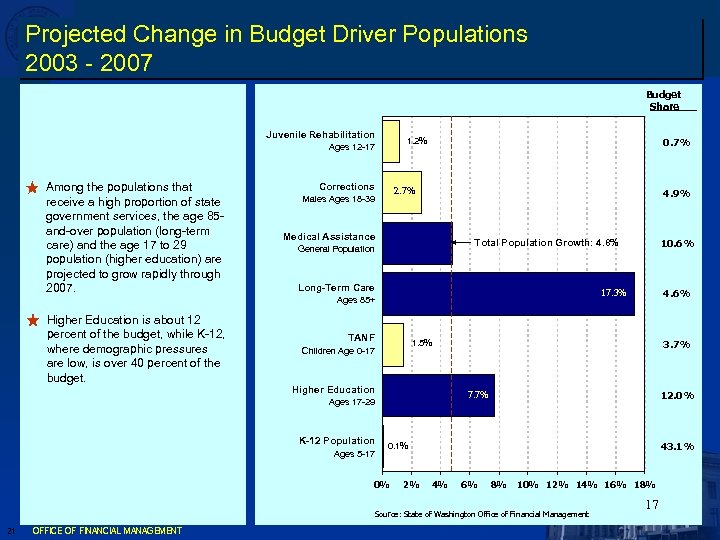
Projected Change in Budget Driver Populations 2003 - 2007 Budget Share Juvenile Rehabilitation Among the populations that receive a high proportion of state government services, the age 85 and-over population (long-term care) and the age 17 to 29 population (higher education) are projected to grow rapidly through 2007. 0. 7% 1. 2% Ages 12 -17 Corrections 2. 7% Males Ages 18 -39 4. 9% Medical Assistance Total Population Growth: 4. 8% General Population Long-Term Care TANF Higher Education 12. 0% 7. 7% Ages 17 -29 Ages 5 -17 3. 7% 1. 5% Children Age 0 -17 K-12 Population 43. 1% 0% 2% 4% 6% 8% 10% 12% 14% 16% 18% Source: State of Washington Office of Financial Management 21 OFFICE OF FINANCIAL MANAGEMENT 4. 6% 17. 3% Ages 85+ Higher Education is about 12 percent of the budget, while K-12, where demographic pressures are low, is over 40 percent of the budget. 10. 6% 17
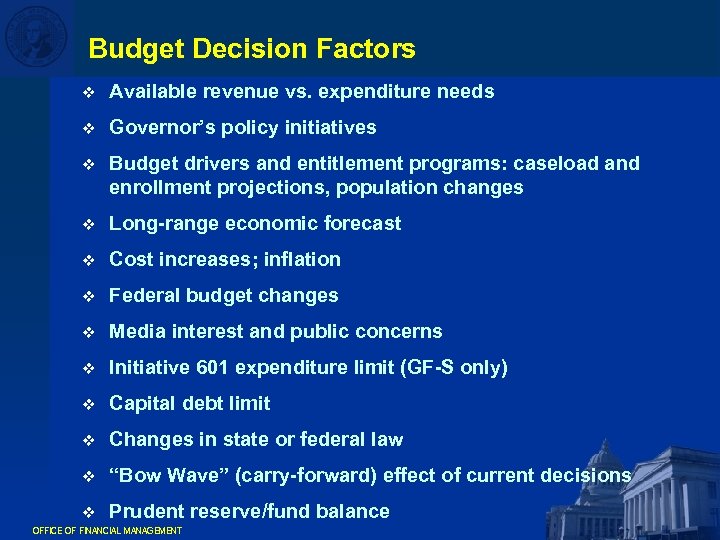
Budget Decision Factors v Available revenue vs. expenditure needs v Governor’s policy initiatives v Budget drivers and entitlement programs: caseload and enrollment projections, population changes v Long-range economic forecast v Cost increases; inflation v Federal budget changes v Media interest and public concerns v Initiative 601 expenditure limit (GF-S only) v Capital debt limit v Changes in state or federal law v “Bow Wave” (carry-forward) effect of current decisions v Prudent reserve/fund balance OFFICE OF FINANCIAL MANAGEMENT
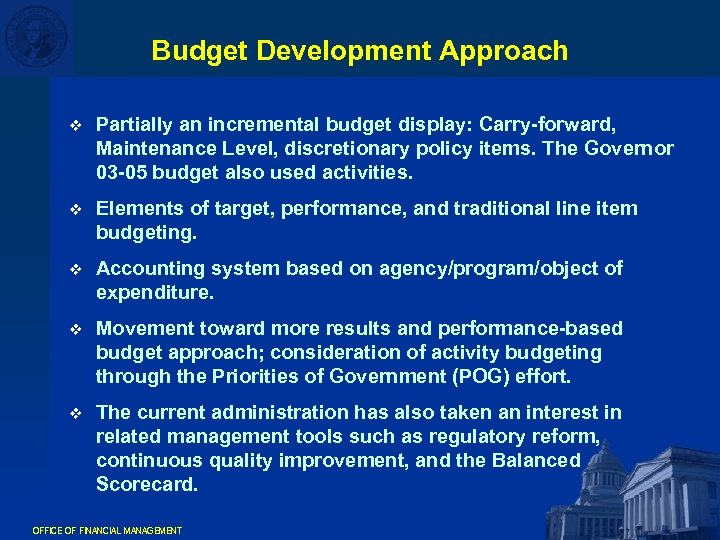
Budget Development Approach v Partially an incremental budget display: Carry-forward, Maintenance Level, discretionary policy items. The Governor 03 -05 budget also used activities. v Elements of target, performance, and traditional line item budgeting. v Accounting system based on agency/program/object of expenditure. v Movement toward more results and performance-based budget approach; consideration of activity budgeting through the Priorities of Government (POG) effort. v The current administration has also taken an interest in related management tools such as regulatory reform, continuous quality improvement, and the Balanced Scorecard. OFFICE OF FINANCIAL MANAGEMENT
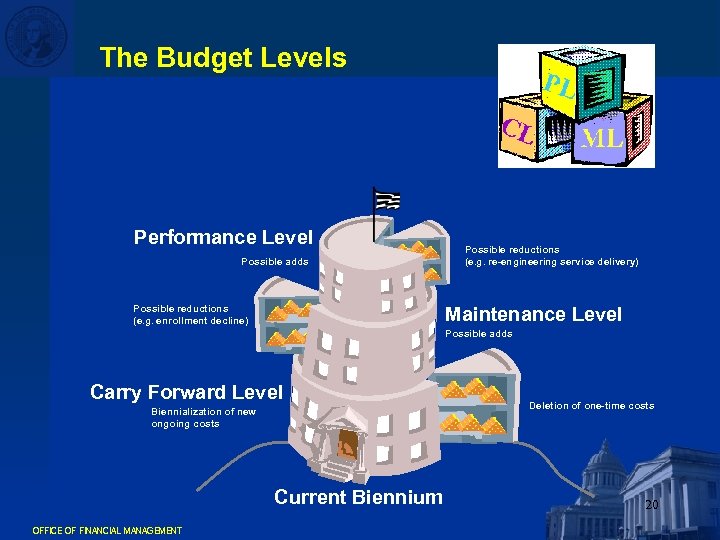
The Budget Levels Performance Level Possible adds Possible reductions (e. g. re-engineering service delivery) Maintenance Level Possible reductions (e. g. enrollment decline) Possible adds Carry Forward Level Biennialization of new ongoing costs Current Biennium OFFICE OF FINANCIAL MANAGEMENT Deletion of one-time costs 20
Part 4 “Priorities of Government” and Beyond OFFICE OF FINANCIAL MANAGEMENT
Priorities-of-Government (POG) Approach to Budget Decisions § Washington’s effort began in August, 2002 § Overall process was facilitated by a consultant – Public Strategies Group, from Minnesota – with experience in working with state and local governments on fiscal and management issues § Premise of the consultant’s approach to the Price of Government was to prioritize state government services by starting with some basic questions: Ø How much money does the state have to spend? Ø What results does it expect to achieve? Note: http: //www. psgrp. com/ contains several descriptions of the approach 22 OFFICE OF FINANCIAL MANAGEMENT
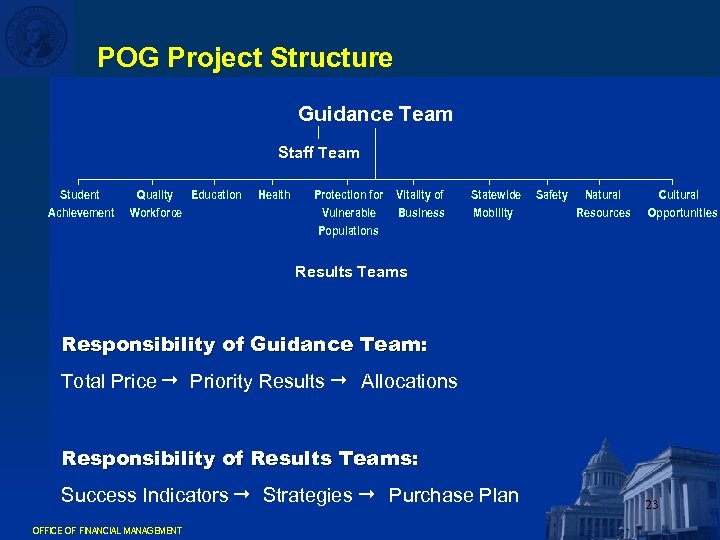
POG Project Structure Guidance Team Staff Team Student Achievement Quality Education Workforce Health Protection for Vitality of Vulnerable Business Populations Statewide Mobility Safety Natural Resources Cultural Opportunities Results Teams Responsibility of Guidance Team: Total Price 4 Priority Results 4 Allocations Responsibility of Results Teams: Success Indicators 4 Strategies 4 OFFICE OF FINANCIAL MANAGEMENT Purchase Plan 23
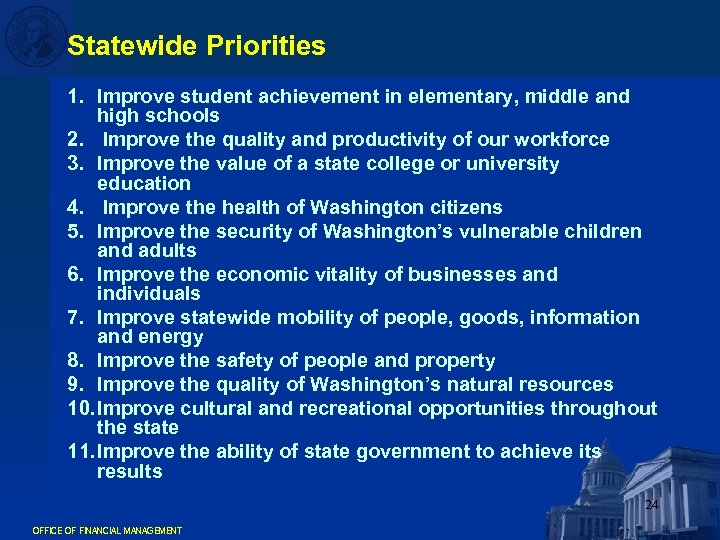
Statewide Priorities 1. Improve student achievement in elementary, middle and high schools 2. Improve the quality and productivity of our workforce 3. Improve the value of a state college or university education 4. Improve the health of Washington citizens 5. Improve the security of Washington’s vulnerable children and adults 6. Improve the economic vitality of businesses and individuals 7. Improve statewide mobility of people, goods, information and energy 8. Improve the safety of people and property 9. Improve the quality of Washington’s natural resources 10. Improve cultural and recreational opportunities throughout the state 11. Improve the ability of state government to achieve its results 24 OFFICE OF FINANCIAL MANAGEMENT
How POG Integrated with the Rest of the Budget Decision Process v POG informed the budget process about activity and strategy priorities, not dollar allocations. v POG helped focus the budget on priorities and services that were most directly linked to statewide results, even though that might mean that some good programs went away. v POG helped the budget be more conscious of the logic of all revenue needing to go to the highest priorities. v Agency priorities and requests had to be considered in the context of statewide results. v The POG process tends to focus on direct service programs and their relationship to results. It does not directly answer questions about whether the program is appropriately priced, or what administrative costs should be. 25 OFFICE OF FINANCIAL MANAGEMENT
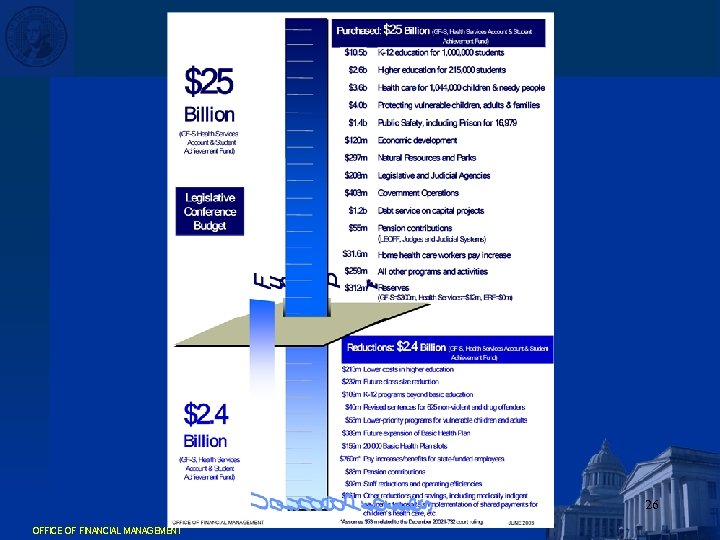
26 OFFICE OF FINANCIAL MANAGEMENT
Budget Context: Short Term • In June 2003, the Revenue Forecast Council lowered the General Fund-State revenue forecast by $150 million, reflecting a sluggish U. S. economy and a “jobless” recovery. • In June, the Caseload Forecast Council issued upward revisions to the medical assistance and general assistance- unemployable forecasts. • These and other caseload-related forecasts could cost up to $60 million in the Supplemental Budget. Fire expenses, legal settlements, non-GFS revenue shortfalls, etc. must also be considered. • Based on a continuation of a slow and “jobless” economic recovery, the Revenue Forecast Council’s September forecast left the June estimate of revenues essentially unchanged. • As a result, the projected ending balance for the 2003 -05 Biennial budget is $482 million, or about 2 percent of the total budget. 27 OFFICE OF FINANCIAL MANAGEMENT
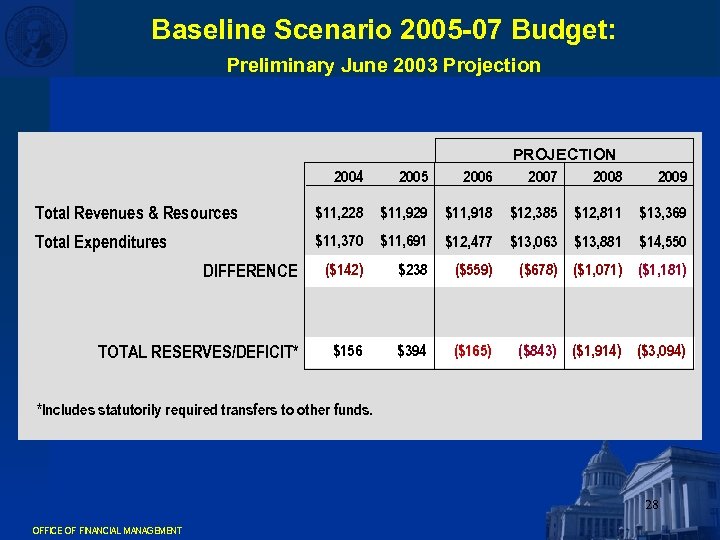
Baseline Scenario 2005 -07 Budget: Preliminary June 2003 Projection PROJECTION 2007 2008 2004 2005 2006 2009 Total Revenues & Resources $11, 228 $11, 929 $11, 918 $12, 385 $12, 811 $13, 369 Total Expenditures $11, 370 $11, 691 $12, 477 $13, 063 $13, 881 $14, 550 DIFFERENCE ($142) $238 ($559) ($678) ($1, 071) ($1, 181) TOTAL RESERVES/DEFICIT* $156 $394 ($165) ($843) ($1, 914) ($3, 094) *Includes statutorily required transfers to other funds. 28 OFFICE OF FINANCIAL MANAGEMENT
Executive Policy Office 29 OFFICE OF FINANCIAL MANAGEMENT
Executive Policy Office What the Policy Office Does: – Advise the Governor on Policy Issues – Engage in Legislative Process – Work with Agencies in Implementing Legislation and Programs – Liaison to Stakeholder Groups and Constituents – Regulation Reviews 30 OFFICE OF FINANCIAL MANAGEMENT
Executive Policy Office 3 Carol Jolly – Director, Local Government, Minority Commissions, Women’s Issues 3 Chris Rose – General Government, Licensing and Insurance, Emergency Management, Homeland Security 3 Dick Van Wagenen – Criminal Justice, Gambling, Substance Abuse 3 Fred Morris – Information and Technology 31 OFFICE OF FINANCIAL MANAGEMENT
Executive Policy Office 3 David Danner – Energy, State Finances, Telecommunications, Elections, DFI 3 Andrew Johnsen – Transportation 3 Sheila Martin – Economic Development, Community Development, LCB 3 Robert Hamilton – International Trade 3 Claire Hesselholt – Regulatory Issues 32 OFFICE OF FINANCIAL MANAGEMENT
Executive Policy Office 3 Bob Nichols – Water Quality, Fish & Wildlife, Natural Resources and Radiation 3 Ron Shultz – Agriculture, Growth Mgmt, Forest Practices, Hazardous Materials, Parks and Recreation, Flooding 3 Lynn Helbrecht – Sustainability Practices 33 OFFICE OF FINANCIAL MANAGEMENT
Executive Policy Office 3 Robin Zukoski – Child Care, Early Learning, Public Assistance 3 Judy Hartman – Education K-12 3 Debora Merle – Higher Education, Workforce Training 3 Jamila Thomas-Roberts – Apprenticeship Programs, Labor Issues, Employment Security 34 OFFICE OF FINANCIAL MANAGEMENT
Executive Policy Office 3 Jenny Hamilton and Mic’l Prentice Needham – Department of Health, Long Term Care, Veteran’s Health, Tobacco 3 Ree Sailors – Basic Health Plan, Health Benefits and Insurance, Medicaid, Prescription Drug Costs 3 Vicki Wilson – Health Resources and Services Planning Grant 3 Kari Burrell – Child Welfare, Developmental and Physical Disabilities, Services for the Blind and Deaf, Homeless, Mental Health, Vocational Rehab, Human Services 35 OFFICE OF FINANCIAL MANAGEMENT
Agency Request Legislation Process: – Legislation Requires Governor’s approval – Prepare a statement of need, draft bill, fiscal note, document stakeholder positions – Deadline in early September – Governor’s Decision by December – Agency finds sponsors, advocates for bill 36 OFFICE OF FINANCIAL MANAGEMENT
Agency Request Legislation What we look for: – What is the problem, and how critical is it? – Can the agency address the issue without legislation? – Does the legislation as drafted solve the problem identified? – Is the solution the best solution? – What is the impact on other agencies, stakeholders? 37 OFFICE OF FINANCIAL MANAGEMENT
Agency Request Legislation Common Problems With Legislation: – Problems poorly defined – or aren’t a problem – Piecemeal solutions – or solutions that don’t solve the problem – New duties or programs – but no funding – Duplicative boards, agencies – Unintended consequences – Benefits special interests 38 OFFICE OF FINANCIAL MANAGEMENT
Regulatory Review Process: – RCW 34. 05. 330 allows individuals to appeal rules to the Governor – Governor may direct agencies listed in RCW 43. 17. 010 (15 large agencies) to initiate a rule making process – Governor may recommend to other agencies to initiate a rule making process 39 OFFICE OF FINANCIAL MANAGEMENT
Regulatory Review What we look for: – Whether the rule is legislatively authorized – Whether the rule is needed – Whether the rule conflicts with or duplicates other laws – Whether better alternatives exist – Whether the rule applies differently to public and private entities 40 OFFICE OF FINANCIAL MANAGEMENT
Regulatory Review What we look for (cont. ): – – – Whether the rule serves its purpose Whether the costs are unreasonable Whether the rule is clearly and simply stated Whether the rule is different than federal law Where the rule was adopted using proper procedures 41 OFFICE OF FINANCIAL MANAGEMENT
Contacts Peter Antolin, Senior Budget Assistant to the Governor Office of Financial Management PO Box 43113 Olympia, WA 98504 -3113 360 -902 -0551 Peter. Antolin@ofm. wa. gov Chris Rose, Executive Policy Advisor to the Governor Office of Financial Management PO Box 43113 Olympia, WA 98504 -3113 360 -902 -0640 Chris. Rose@ofm. wa. gov 42 OFFICE OF FINANCIAL MANAGEMENT
The End 43 OFFICE OF FINANCIAL MANAGEMENT
Скачать презентацию Washington State Budget Overview October 2003 OFFICE OF
49f52a1d61e91a3be3773ac939f6cb26.ppt