


 Скачать презентацию Washington-Lee High School A High Performance School Case
3dc41a527005ad8885e54300e2b54111.ppt
- Количество слайдов: 22
 Washington-Lee High School: A High Performance School Case Study Presented by Sandra Leibowitz Earley, RA, LEED AP High Performance Schools Symposium April 24, 2006
 Introduction – SDC Founder and Principal – Offices in Richmond, VA and Silver Spring MD – Small woman-owned business – Focus on greener solutions for the built environment – Consult primarily to architects, developers and builders – Combined experience with over 80 LEED-related projects to date www. sustaindesign. net
 Green Public School Experience • Montgomery County Public Schools – Green Schools Charrette – Greening Facility Standard Specifications • MCPS Northwest # 7 Elementary School – LEED consulting for new construction 79, 000 sf bldg. • PGCPS Laurel-Beltsville Elementary School – LEED consulting for new construction 81, 000 sf bldg. • APS Washington-Lee High School – LEED Consulting for new 350, 000 sf high school
 Green Independent School Experience • Calverton Lower School, Huntington, MD – Green building consulting for lower school addition • Garrison Forrest Middle School, Baltimore, MD – LEED consulting for 30, 000 sf of new and renovated construction • All make use of current green schools resources • None make use of LEED Application Guide for K-12 Schools
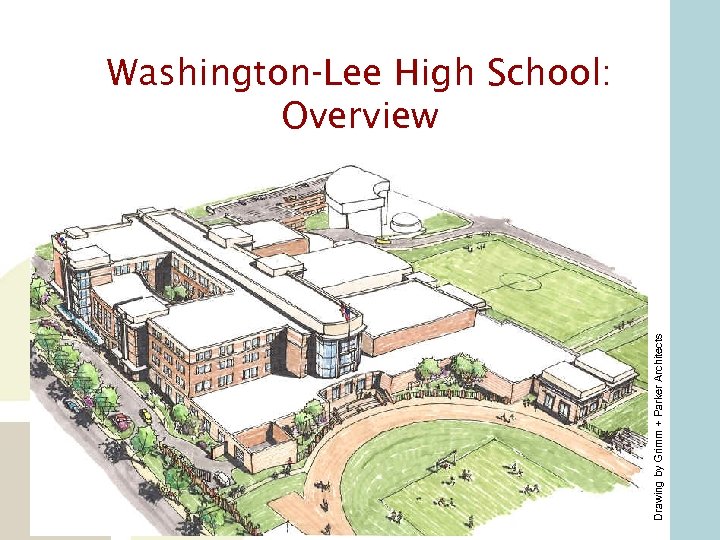 Drawing by Grimm + Parker Architects Washington-Lee High School: Overview
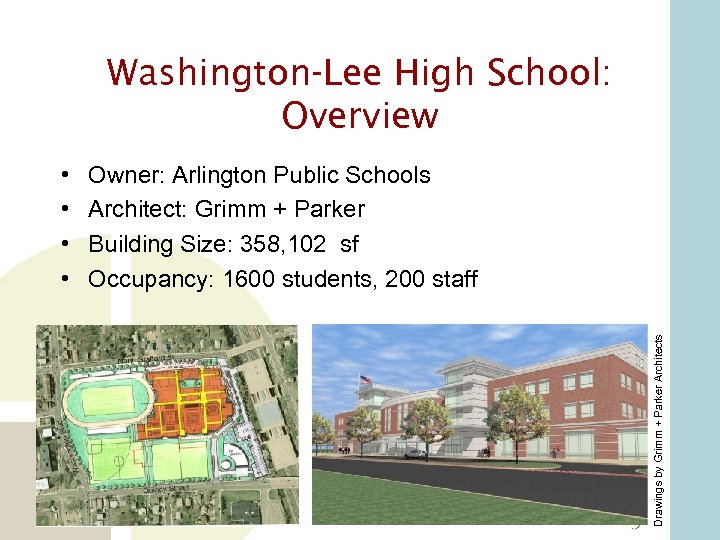 Washington-Lee High School: Overview Owner: Arlington Public Schools Architect: Grimm + Parker Building Size: 358, 102 sf Occupancy: 1600 students, 200 staff Drawings by Grimm + Parker Architects • •
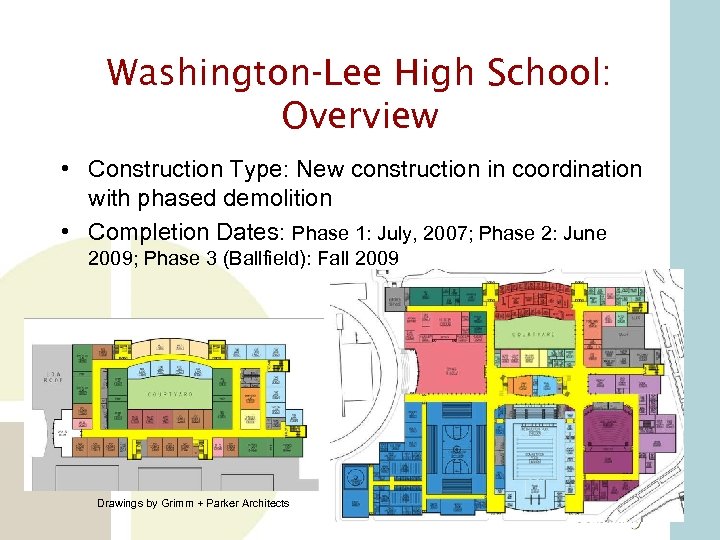 Washington-Lee High School: Overview • Construction Type: New construction in coordination with phased demolition • Completion Dates: Phase 1: July, 2007; Phase 2: June 2009; Phase 3 (Ballfield): Fall 2009 Drawings by Grimm + Parker Architects
 Washington-Lee High School: LEED Silver certification • LEED-Registered in 2004 (LEED-NC v 2. 1) • APS made the early commitment, with funding behind it, to LEED Silver certification • A large-scale, long-term project, Washington-Lee has taught its design team many lessons in applying LEED to this particular building type. • Project is sticking with version 2. 1 in the absence of a LEED Application Guide for K-12 Schools
 What does LEED Certification Cost? • The cost to achieve LEED certification can depend upon a variety of factors and assumptions, including: – Type and size of project; – Timing of introduction of LEED as a design goal or requirement; – Level of LEED certification desired; – Composition and structure of the design and construction teams; – Experience and knowledge of designers and contractors or willingness to learn; – Process used to select LEED credits; – Clarity of the project implementation documents; – Base case budgeting assumptions. (Source: Managing the Cost of Green Buildings, October 2003)
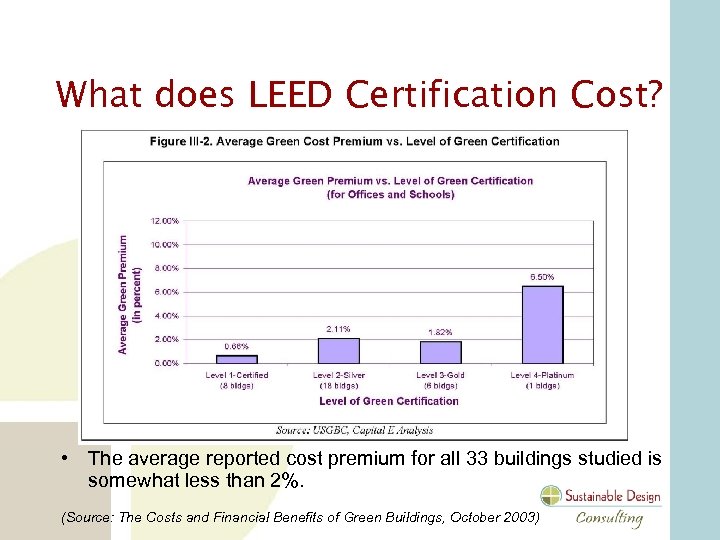 What does LEED Certification Cost? • The average reported cost premium for all 33 buildings studied is somewhat less than 2%. (Source: The Costs and Financial Benefits of Green Buildings, October 2003)
 What does LEED Certification Save? • An upfront investment of < 2% of construction costs yields life cycle savings of over 10 times the initial investment. – For example, an initial upfront investment of up to $100, 000 to incorporate green building features into a $5 million project would result in a savings of at least $1 million over the life of the building, assumed conservatively to be 20 years. (Source: Costs and Financial Benefits of Green Buildings, October 2003)
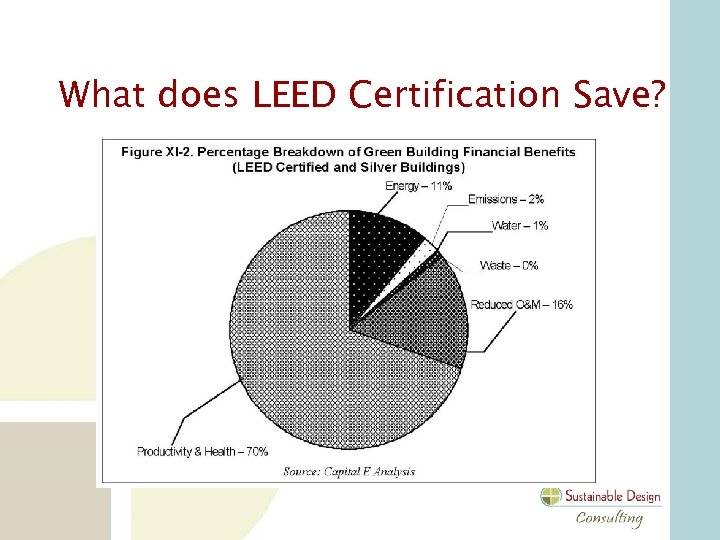 What does LEED Certification Save?
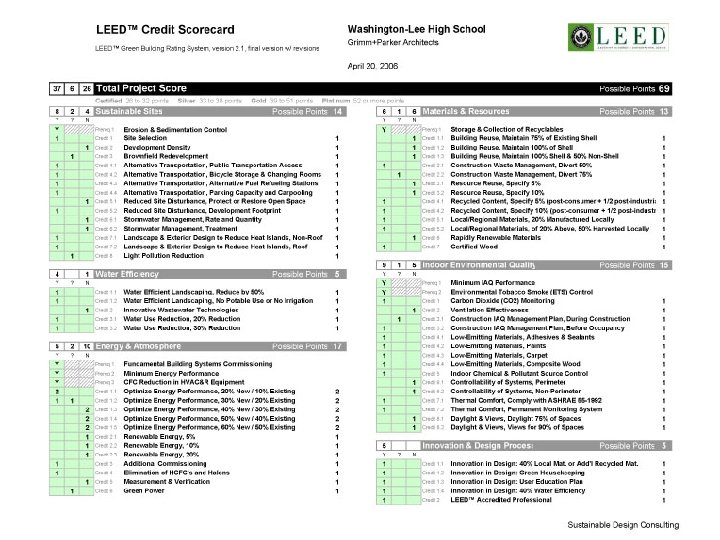 Washington-Lee High School: LEED Silver certification
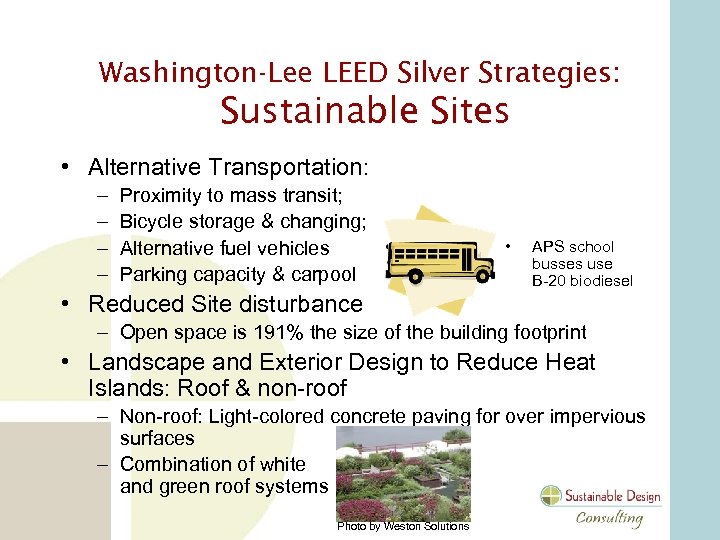 Washington-Lee LEED Silver Strategies: Sustainable Sites • Alternative Transportation: – – Proximity to mass transit; Bicycle storage & changing; Alternative fuel vehicles Parking capacity & carpool • APS school busses use B-20 biodiesel • Reduced Site disturbance – Open space is 191% the size of the building footprint • Landscape and Exterior Design to Reduce Heat Islands: Roof & non-roof – Non-roof: Light-colored concrete paving for over impervious surfaces – Combination of white and green roof systems Photo by Weston Solutions
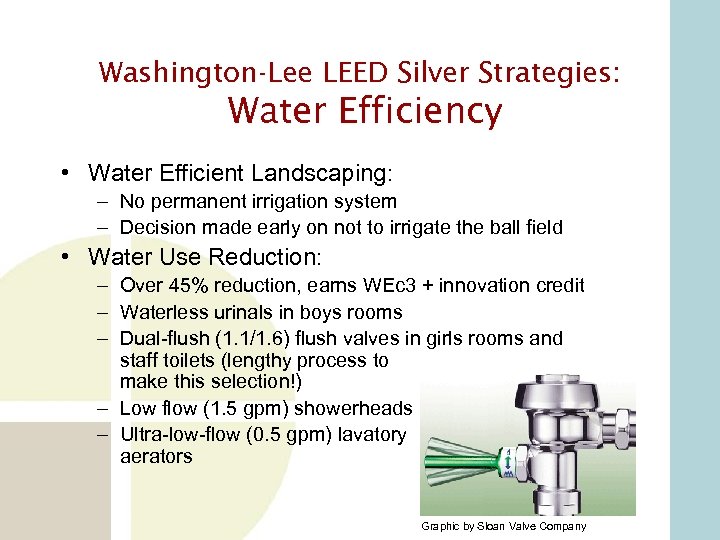 Washington-Lee LEED Silver Strategies: Water Efficiency • Water Efficient Landscaping: – No permanent irrigation system – Decision made early on not to irrigate the ball field • Water Use Reduction: – Over 45% reduction, earns WEc 3 + innovation credit – Waterless urinals in boys rooms – Dual-flush (1. 1/1. 6) flush valves in girls rooms and staff toilets (lengthy process to make this selection!) – Low flow (1. 5 gpm) showerheads – Ultra-low-flow (0. 5 gpm) lavatory aerators Graphic by Sloan Valve Company
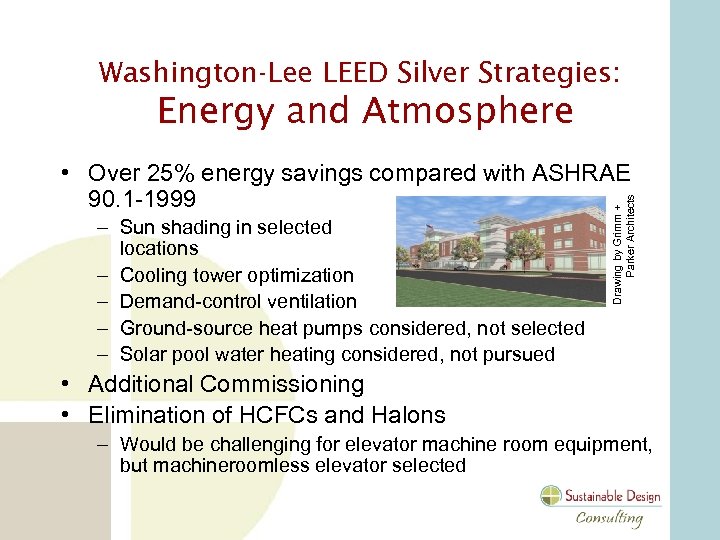 Washington-Lee LEED Silver Strategies: Energy and Atmosphere – Sun shading in selected locations – Cooling tower optimization – Demand-control ventilation – Ground-source heat pumps considered, not selected – Solar pool water heating considered, not pursued Drawing by Grimm + Parker Architects • Over 25% energy savings compared with ASHRAE 90. 1 -1999 • Additional Commissioning • Elimination of HCFCs and Halons – Would be challenging for elevator machine room equipment, but machineroomless elevator selected
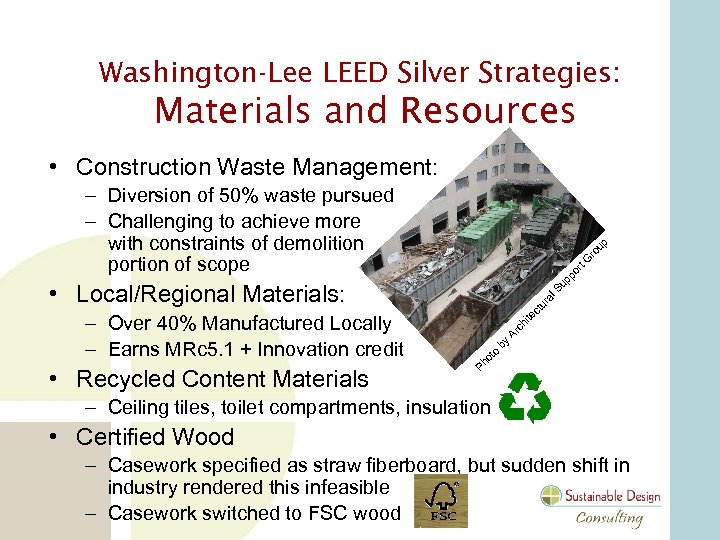 Washington-Lee LEED Silver Strategies: Materials and Resources • Construction Waste Management: Su pp or t. G ro up – Diversion of 50% waste pursued – Challenging to achieve more with constraints of demolition portion of scope • Recycled Content Materials ct ite Ar ch by ot o Ph – Over 40% Manufactured Locally – Earns MRc 5. 1 + Innovation credit ur al • Local/Regional Materials: – Ceiling tiles, toilet compartments, insulation • Certified Wood – Casework specified as straw fiberboard, but sudden shift in industry rendered this infeasible – Casework switched to FSC wood
 Washington-Lee LEED Silver Strategies: Indoor Environmental Quality • CO 2 Monitoring – Included in assembly spaces – Add alternate approved to add in classrooms • Construction IAQ Management Plan – MERV-13 issue creating difficulties – Baseline IAQ testing before occupancy is specified • Low-Emitting Materials: All – Sudden infeasibility of strawboard required ureaformaldehyde-fee wood products instead • Indoor Chemical and Pollutant Source Control • Thermal Comfort – ASHRAE 55 -2004 compliance with permanent monitoring
 Washington-Lee LEED Silver Strategies: Innovation and Design Process • User Education Program – To be tied into curriculum – APS champion to be identified to spearhead program • Green Housekeeping Program – To be the same or similar plan as used at Langston Brown • Exemplary performance Innovation credits • LEED-Accredited Professionals Contractor training sessions will lead to a smoother construction phase effort
 The LEED Process Takes a Team • Owner: Raise and enforce expectations of team and its product. Remind them of the opportunity they have before them. Spread the word so others will catch on. • Design Team: Rise to the occasion of designing green and keep LEED and other green criteria on the front burner. • LEED Coordinator: Integrate with and support team’s efforts while tracking compliance with LEED and other green criteria. • General Contractor: Rise to the occasion of building green and keep LEED and other green criteria on the front burner. • Commissioning Authority: Help ensure Owner’s requirements are met. • Facility Manager: Help ensure that the building stays green. • Occupant: Interact with building and provide feedback to managers
 The Team that Play Together Wins • Successful team integration can only lead to better buildings, now and in the future. • Successful team integration responds better to the challenges of innovation. • Successful team integration can itself help transform the market by evolving the project process. • Schools buildings offer teams the unique opportunity to establish precedent and raise standards system-wide.
 Q&A (a. k. a. “Never assume with LEED”) ? ? Sustainable Design Consulting, LLC 1606 West Grace Street Richmond, VA 23220 P: 804 -254 -3880 F: 866 -589 -7790 www. sustaindesign. net ?