


 Скачать презентацию Washington Death with Dignity Act Helene Starks Ph
076eb68c55b2ea10eb30c633c2344fb5.ppt
- Количество слайдов: 43
 Washington Death with Dignity Act Helene Starks, Ph. D MPH Assistant Professor University of Washington Dept. of Bioethics & Humanities tigiba@u. washington. edu Updated: 03 -31 -09 Helene Starks, Ph. D MPH
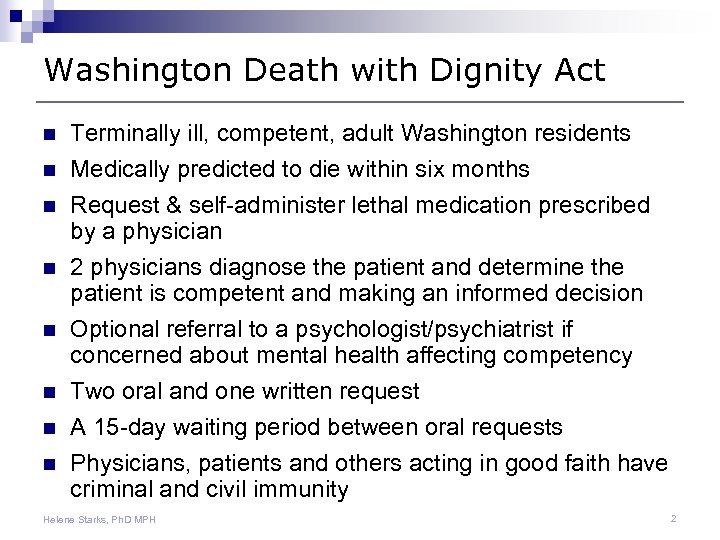 Washington Death with Dignity Act n Terminally ill, competent, adult Washington residents n Medically predicted to die within six months Request & self-administer lethal medication prescribed by a physician 2 physicians diagnose the patient and determine the patient is competent and making an informed decision Optional referral to a psychologist/psychiatrist if concerned about mental health affecting competency Two oral and one written request A 15 -day waiting period between oral requests Physicians, patients and others acting in good faith have criminal and civil immunity n n n Helene Starks, Ph. D MPH 2
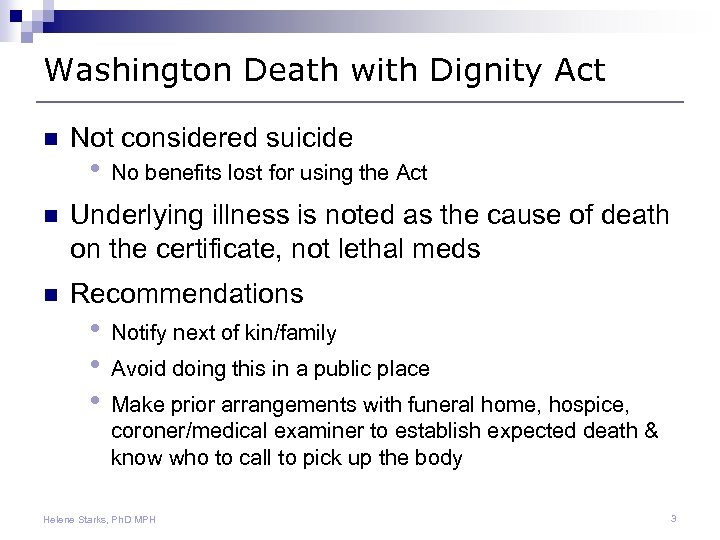 Washington Death with Dignity Act n Not considered suicide • No benefits lost for using the Act n Underlying illness is noted as the cause of death on the certificate, not lethal meds n Recommendations • • • Notify next of kin/family Avoid doing this in a public place Make prior arrangements with funeral home, hospice, coroner/medical examiner to establish expected death & know who to call to pick up the body Helene Starks, Ph. D MPH 3
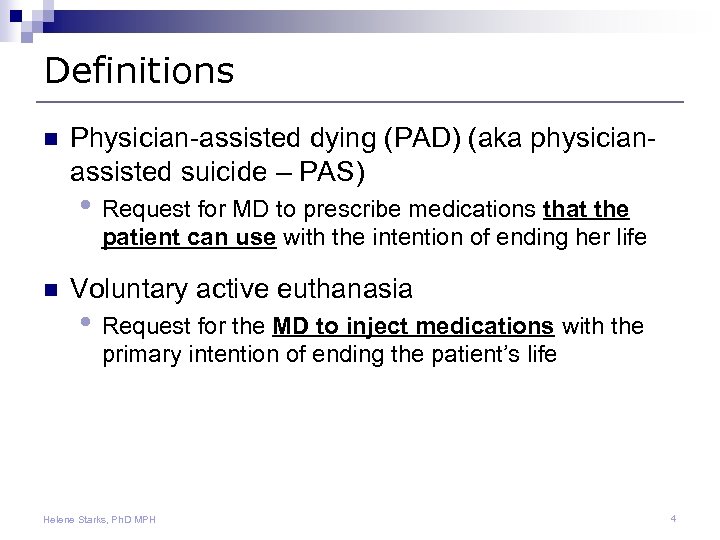 Definitions n Physician-assisted dying (PAD) (aka physicianassisted suicide – PAS) • Request for MD to prescribe medications that the patient can use with the intention of ending her life n Voluntary active euthanasia • Request for the MD to inject medications with the primary intention of ending the patient’s life Helene Starks, Ph. D MPH 4
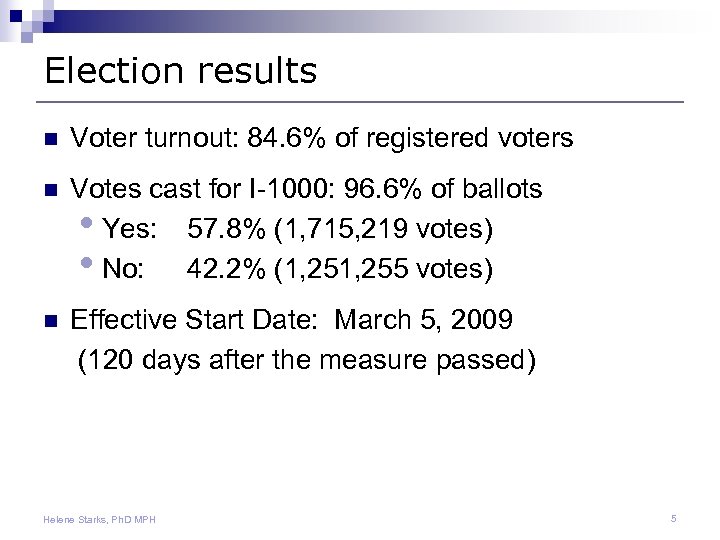 Election results n Voter turnout: 84. 6% of registered voters n Votes cast for I-1000: 96. 6% of ballots • Yes: 57. 8% (1, 715, 219 votes) • No: 42. 2% (1, 255 votes) n Effective Start Date: March 5, 2009 (120 days after the measure passed) Helene Starks, Ph. D MPH 5
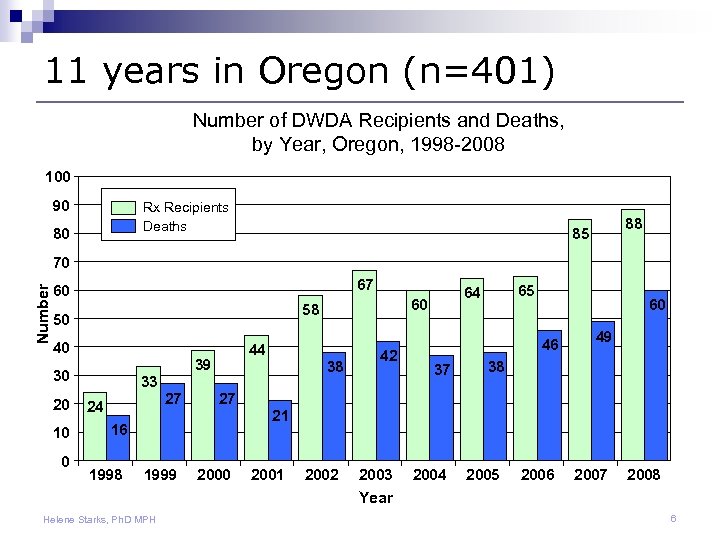 11 years in Oregon (n=401) Number of DWDA Recipients and Deaths, by Year, Oregon, 1998 -2008 100 90 Rx Recipients Deaths 80 88 85 Number 70 67 60 58 50 40 39 30 20 10 0 44 38 33 27 24 60 46 37 49 38 27 21 16 1998 42 65 64 60 1999 2000 2001 2002 2003 2004 2005 2006 2007 2008 Year Helene Starks, Ph. D MPH 6
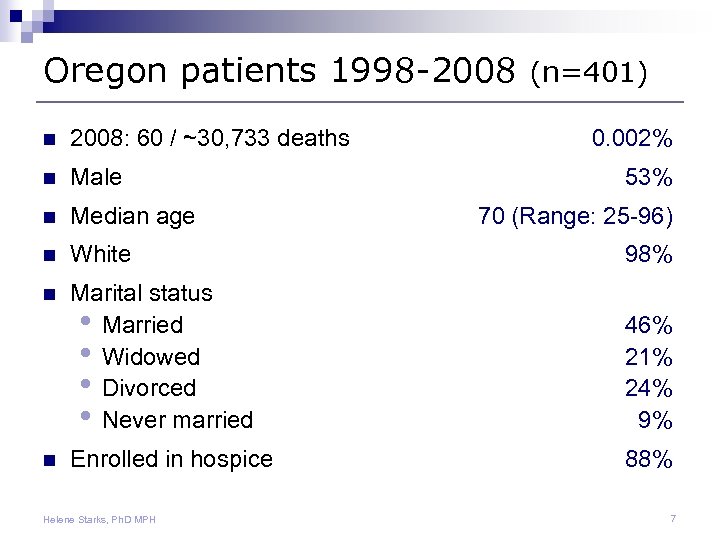 Oregon patients 1998 -2008 (n=401) n 2008: 60 / ~30, 733 deaths n Male n Median age n White 98% n Marital status • Married • Widowed • Divorced • Never married 46% 21% 24% 9% Enrolled in hospice 88% n Helene Starks, Ph. D MPH 0. 002% 53% 70 (Range: 25 -96) 7
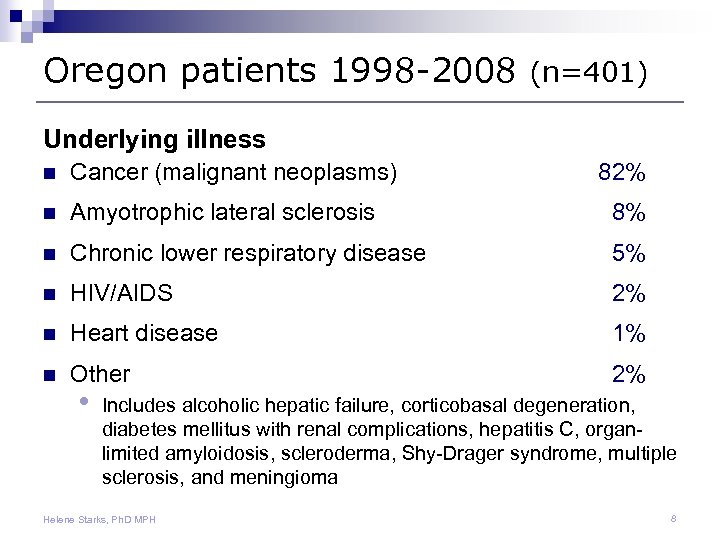 Oregon patients 1998 -2008 (n=401) Underlying illness n Cancer (malignant neoplasms) n Amyotrophic lateral sclerosis 8% n Chronic lower respiratory disease 5% n HIV/AIDS 2% n Heart disease 1% n Other 2% • 82% Includes alcoholic hepatic failure, corticobasal degeneration, diabetes mellitus with renal complications, hepatitis C, organlimited amyloidosis, scleroderma, Shy-Drager syndrome, multiple sclerosis, and meningioma Helene Starks, Ph. D MPH 8
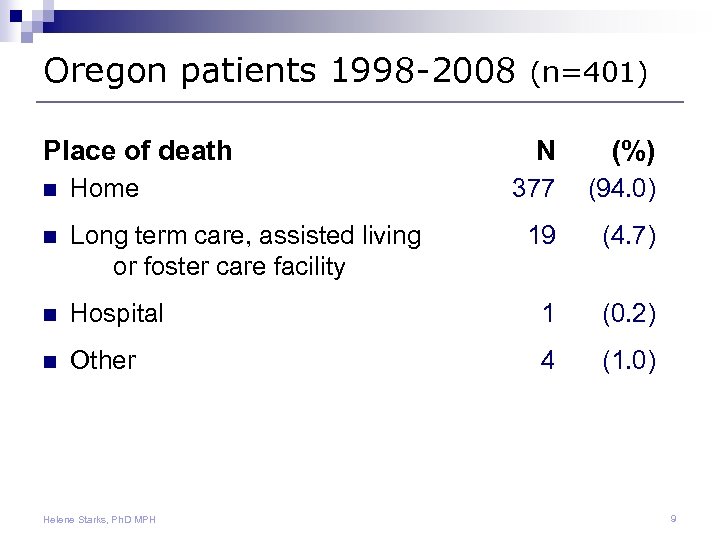 Oregon patients 1998 -2008 (n=401) Place of death N (%) 377 (94. 0) 19 (4. 7) n Home n Long term care, assisted living or foster care facility n Hospital 1 (0. 2) n Other 4 (1. 0) Helene Starks, Ph. D MPH 9
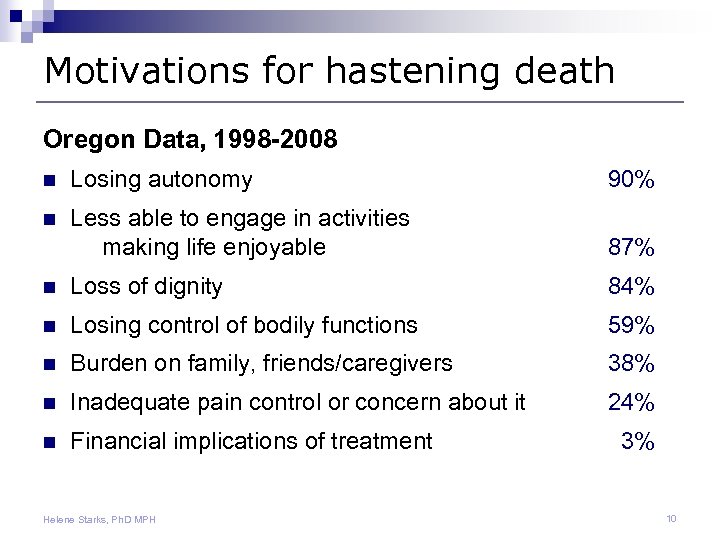 Motivations for hastening death Oregon Data, 1998 -2008 n Losing autonomy 90% n Less able to engage in activities making life enjoyable 87% n Loss of dignity 84% n Losing control of bodily functions 59% n Burden on family, friends/caregivers 38% n Inadequate pain control or concern about it 24% n Financial implications of treatment Helene Starks, Ph. D MPH 3% 10
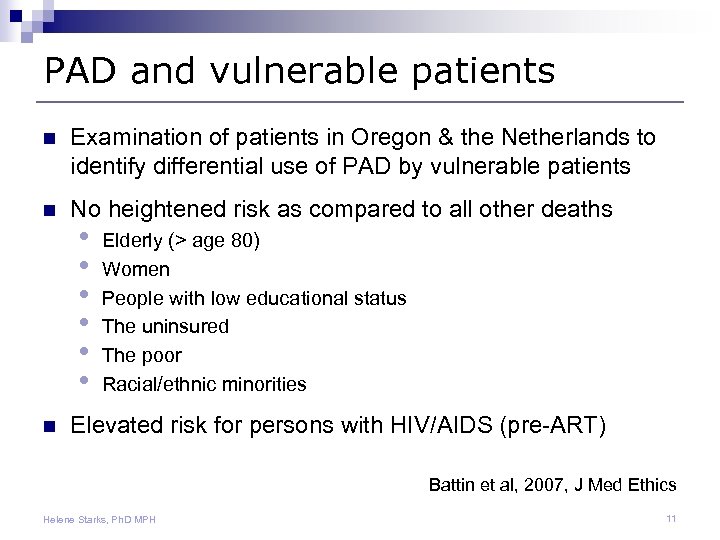 PAD and vulnerable patients n Examination of patients in Oregon & the Netherlands to identify differential use of PAD by vulnerable patients n No heightened risk as compared to all other deaths n • • • Elderly (> age 80) Women People with low educational status The uninsured The poor Racial/ethnic minorities Elevated risk for persons with HIV/AIDS (pre-ART) Battin et al, 2007, J Med Ethics Helene Starks, Ph. D MPH 11
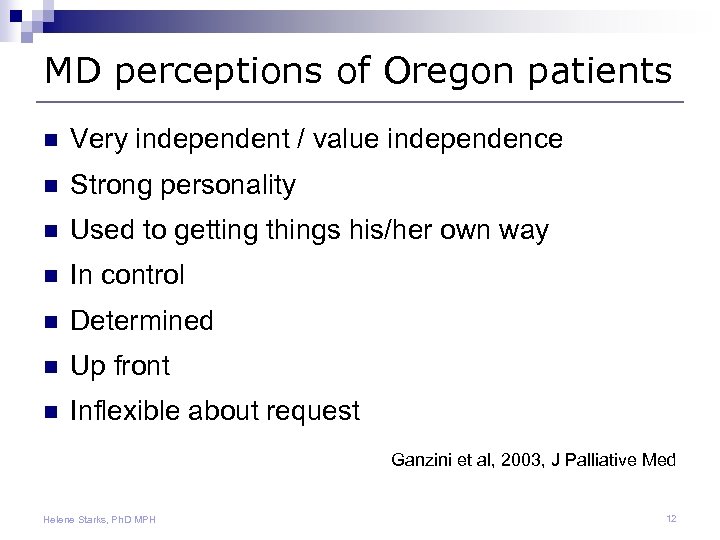 MD perceptions of Oregon patients n Very independent / value independence n Strong personality n Used to getting things his/her own way n In control n Determined n Up front n Inflexible about request Ganzini et al, 2003, J Palliative Med Helene Starks, Ph. D MPH 12
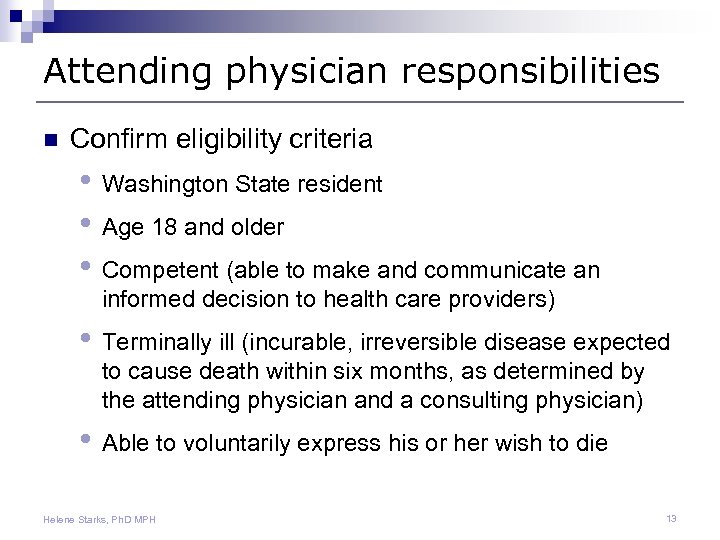 Attending physician responsibilities n Confirm eligibility criteria • Washington State resident • Age 18 and older • Competent (able to make and communicate an informed decision to health care providers) • Terminally ill (incurable, irreversible disease expected to cause death within six months, as determined by the attending physician and a consulting physician) • Able to voluntarily express his or her wish to die Helene Starks, Ph. D MPH 13
 Attending physician responsibilities n Assure that it is an informed decision An appreciation of the relevant facts, after being fully informed about • Medical diagnosis • Prognosis • Potential risks associated with taking the prescribed • • medication Probable result of taking the prescribed medication Feasible alternatives including, but not limited to, comfort care, hospice care, and pain control Helene Starks, Ph. D MPH 14
 Attending physician responsibilities n Evaluate request • Assess reasons • Explore and recommend alternatives (palliative care, hospice, pain/symptom management, psychosocial and/or spiritual counseling, palliative sedation) n Counsel patient • Opportunities to rescind request at any time • Recommend notifying next of kin • Importance of having another person present and not taking medications in a public place Helene Starks, Ph. D MPH 15
 Attending physician responsibilities n Refer to a consulting physician for medical confirmation of the diagnosis, competency and voluntariness of the request n Refer to a counselor if concerned about a psychiatric or psychological disorder or depression causing impaired judgment (optional) n Work with pharmacists to prescribe/get medications Helene Starks, Ph. D MPH 16
 Attending physician responsibilities n Medical record documentation of all steps n Sign the death certificate • List the underlying terminal disease as the cause of death n Send a copy of the dispensing record to DOH within 30 days Helene Starks, Ph. D MPH 17
 Consulting physician responsibilities n Examine the patient and his or her relevant medical records n Confirm, in writing the patient’s • Prognosis • Competency • Choice is informed and voluntary Helene Starks, Ph. D MPH 18
 Protections for physicians n No civil or criminal liability or neglect for providers acting in good faith, including being present when patient takes the medication n No censure, discipline, loss of license, privileges, or membership, or other penalties to members of professional organizations for either participating or not participating Helene Starks, Ph. D MPH 19
 Opting out n Providers may opt out because they are unable or unwilling to participate n Not required to refer but must transfer relevant medical records at the patient’s request, to the new provider of choice n Can continue to provide other patient services (evaluate requests, address concerns, etc) while abstaining from fulfilling the request Helene Starks, Ph. D MPH 20
 Institutional prohibitions allowed n Institutions may prohibit employees from participating in the act n Must provide written notice to the employees and the general public regarding its policy n Policy allows providers to give all other services (evaluate requests, address concerns, etc) while abstaining from participation in fulfilling the request Helene Starks, Ph. D MPH 21
 Role of other health care providers n Nurses, Social Workers, Spiritual Care • Educate about all end-of-life options • Evaluate patient and family psychosocial concerns, reasons for request • Address health, social, spiritual concerns • Counsel and support patients and family members • Facilitate family meetings, expect differences of opinion and willingness to participate n Pharmacists • Educate about medications Helene Starks, Ph. D MPH 22
 Evaluating requests n Clarify which question is being asked before responding n Support the patient n • • Reinforce your commitment to find a mutually acceptable solution Continue to work through the process Evaluate the patient’s decision-making capacity • • • Is s/he seeing the medical condition clearly? Is the request proportionate to the level of unrelieved suffering? Are there dominating aspects of anhedonia, worthlessness, guilt? Is the capacity for pleasure and joy preserved in some small ways? Is this request consistent with the patient’s past values? Quill & Arnold, J Pall Med, 2008 Helene Starks, Ph. D MPH 23
 Evaluating requests n Explore all potential dimensions of the patient’s unbearable suffering • n Could be from physical, emotional, psychological, social, spiritual, or existential sources Recognize and respond to the associated emotions for the patient and you • • May be strong and conflicted Distinguish your own feelings and reactions from your patient’s Quill & Arnold, J Pall Med, 2008 Helene Starks, Ph. D MPH 24
 Evaluating requests n Intensify treatment of any potentially reversible elements • Be creative and brainstorm potential solutions with your multidisciplinary team n Respond directly to the request only after completing this multidimensional evaluation • Re-explore exactly what is being requested • Look for mutually acceptable ways to respond Quill & Arnold, J Pall Med, 2008 Helene Starks, Ph. D MPH 25
 Responding to requests n Reflect on your personal feelings about the request • n n Discuss with other professionals Seek out consultation/second opinion • Utilize palliative care and ethics consult services Learn about the alternatives • • • Withholding/withdrawal of life-sustaining treatments Voluntary withdrawal of oral intake Palliative sedation for severe intractable symptoms Quill & Arnold, J Pall Med, 2008 Helene Starks, Ph. D MPH 26
 Responding to requests n n n Have a detailed conversation regarding the risks and benefits of the different possibilities Counsel on what to expect, how to prepare meds, involve family, avoid public places Balance integrity and non-abandonment • • • Be as specific as possible about what you can/cannot do, explain why Search in earnest with the patient and family for alternative options that might be mutually acceptable Refer to other clinicians for what you cannot do Quill & Arnold, J Pall Med, 2008 Helene Starks, Ph. D MPH 27
 Insights into Hastened Death Study Investigators: n Robert Pearlman, MD MPH n Judith Gordon, Ph. D n Helene Starks, Ph. D MPH n Tony Back, MD n Clarissa Hsu, Ph. D n Ashok Bharucha, MD Services Geriatrics, Ethics & Health Psychology Health Services & Ethics Oncology Anthropology Geropsychiatry Funded by Greenwall & Walter & Elise Haas Foundations between 1997 -2001 Helene Starks, Ph. D MPH 28
 Insights into Hastened Death Study n n Recruitment in Washington (n=29) & Oregon (n=6) • Intermediaries: Advocacy & hospice organizations 23 retrospective cases • After death interviews with 28 family members • Before death interviews with 12 patients and 20 family members 12 prospective cases Demographics similar to Oregon patients • • Cancer (n=21, 60%) AIDS (n=6, 17%) Neurologic (n=5, 14%) Other (n=3, 9%) Helene Starks, Ph. D MPH 29
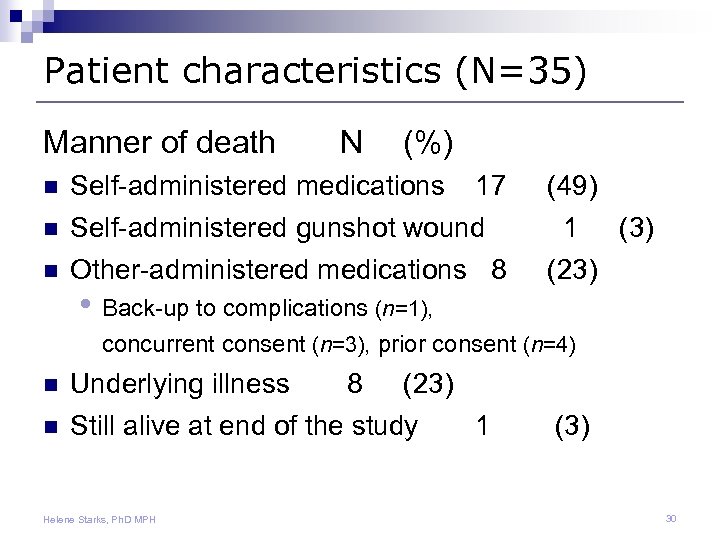 Patient characteristics (N=35) Manner of death N (%) n Self-administered medications n Self-administered gunshot wound Other-administered medications 8 n 17 • Back-up to complications (n=1), (49) 1 (3) (23) concurrent consent (n=3), prior consent (n=4) n n Underlying illness 8 (23) Still alive at end of the study 1 Helene Starks, Ph. D MPH (3) 30
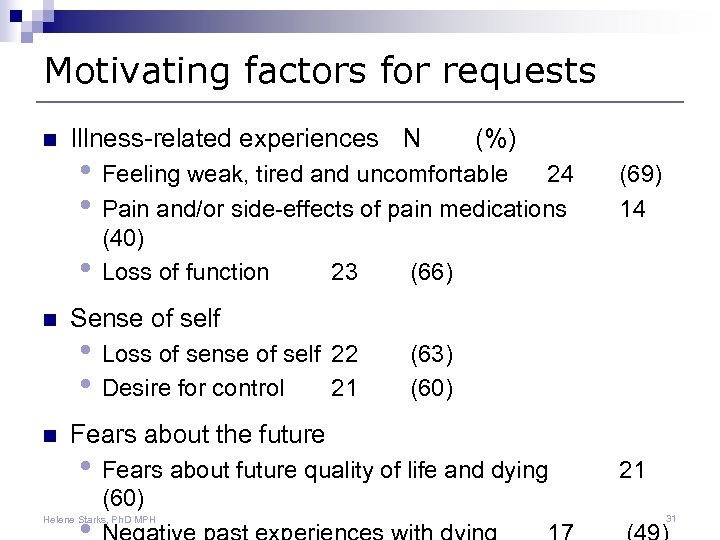 Motivating factors for requests n Illness-related experiences N • Feeling weak, tired and uncomfortable 24 • Pain and/or side-effects of pain medications • n n (%) (40) Loss of function 23 (66) • Loss of sense of self 22 • Desire for control 21 (69) 14 (63) (60) Sense of self Fears about the future • Fears about future quality of life and dying 21 (60) Helene Starks, Ph. D MPH 31
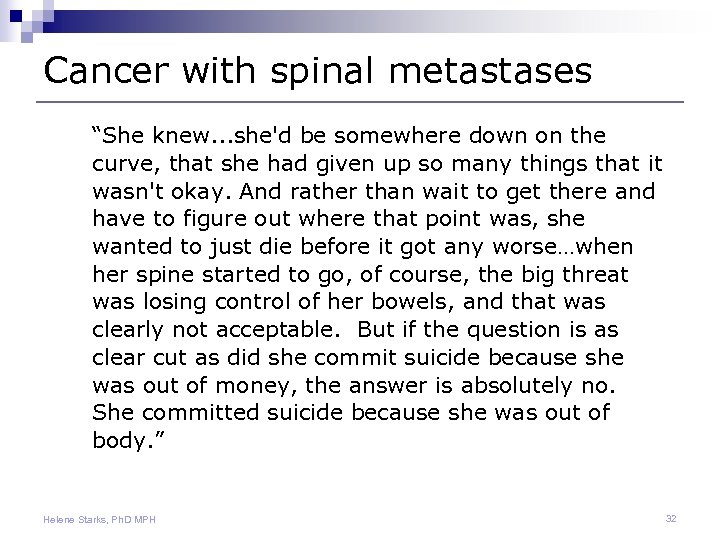 Cancer with spinal metastases “She knew. . . she'd be somewhere down on the curve, that she had given up so many things that it wasn't okay. And rather than wait to get there and have to figure out where that point was, she wanted to just die before it got any worse…when her spine started to go, of course, the big threat was losing control of her bowels, and that was clearly not acceptable. But if the question is as clear cut as did she commit suicide because she was out of money, the answer is absolutely no. She committed suicide because she was out of body. ” Helene Starks, Ph. D MPH 32
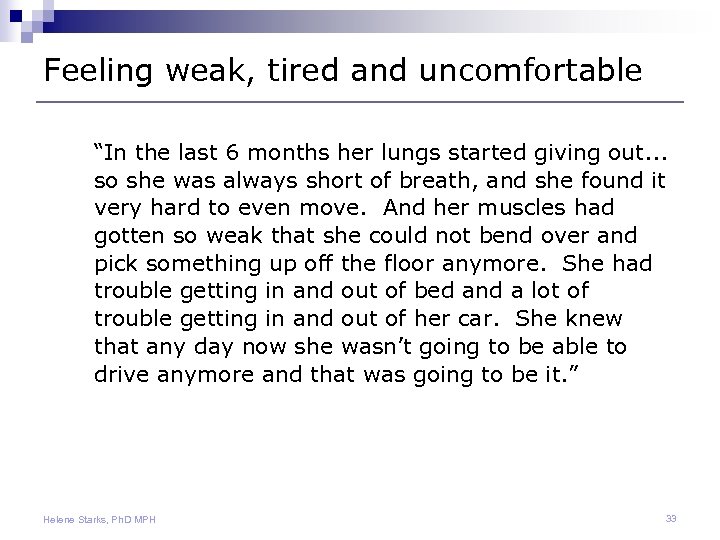 Feeling weak, tired and uncomfortable “In the last 6 months her lungs started giving out. . . so she was always short of breath, and she found it very hard to even move. And her muscles had gotten so weak that she could not bend over and pick something up off the floor anymore. She had trouble getting in and out of bed and a lot of trouble getting in and out of her car. She knew that any day now she wasn’t going to be able to drive anymore and that was going to be it. ” Helene Starks, Ph. D MPH 33
 Pain and side-effects of medications “He had been taking Roxicet for months, and so by that time his body had built up a tremendous tolerance. [Hospice] could knock him out; he could be a vegetable, but that was not what he wanted. I mean, if he couldn't function and at least think somewhat clearly, life wasn't worth it. But it got to a point where the pain was just intolerable. ” Helene Starks, Ph. D MPH 34
 Loss of sense of self “The things that were meaningful to her in her life were her art, her ability to do her art, her friends and spending time with her friends, and cooking and eating. And she was very convinced that when she couldn't do any of those things anymore, her life would be meaningless, and she wouldn't want to live anymore. ” Helene Starks, Ph. D MPH 35
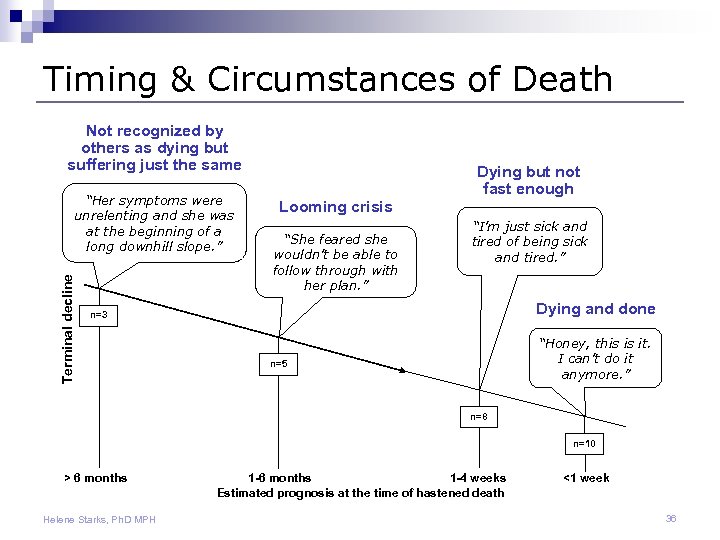 Timing & Circumstances of Death Not recognized by others as dying but suffering just the same Terminal decline “Her symptoms were unrelenting and she was at the beginning of a long downhill slope. ” Dying but not fast enough Looming crisis “She feared she wouldn’t be able to follow through with her plan. ” “I’m just sick and tired of being sick and tired. ” Dying and done n=3 “Honey, this is it. I can’t do it anymore. ” n=5 n=8 n=10 > 6 months Helene Starks, Ph. D MPH 1 -6 months 1 -4 weeks Estimated prognosis at the time of hastened death <1 week 36
 Lessons from this study n Qualities valued by patients & families • Openness to discussion about aid-in-dying • Expertise in dealing with the dying process • Maintaining a therapeutic patient-clinician relationship —even when patients and clinicians disagree n Aid-in-dying is the most taboo topic • Clinicians open to discussions about this are probably open to talking about any/all concerns about dying Helene Starks, Ph. D MPH 37
 Lessons from this study n Patients have long-held beliefs about hastened death • Some seek this as an option before they are in a terminal stage of illness n Multiple reasons for wanting to hasten death • Most can be addressed & managed • Usually require a cumulative set of circumstances before they reach their threshold Helene Starks, Ph. D MPH 38
 Lessons from this study n Lack of openness to discuss PAD may result in a “don't ask, don't tell” policy for both patients & clinicians • Could result in less-than-optimal care and the exploration of other possible options n Acknowledge own discomfort with the process • Examine where you draw the line • What influences your moral deliberation Helene Starks, Ph. D MPH 39
 Implications for Health Care Providers n Patients & families appreciate expertise with the dying process • • n Good communication skills Setting reasonable expectations Individualizing pain control Knowledge about the lethal potential of commonly used medications Explore experience with & tolerance for suffering • • Physical, psychological, existential Need for control & maintaining independence Comfort with the pace of dying Fears about the future Helene Starks, Ph. D MPH 40
 Implications for Health Care Providers n Possible stigma for clinicians if they become known as a willing provider n Networks needed for support and referral • ARNPs not allowed to write Rx • May want to involve a team to assure compliance with the law Helene Starks, Ph. D MPH 41
 Resources n Washington State Dept of Health • www. doh. wa. gov/dwda/ n OHSU Guidebook • www. ohsu. edu/ethics/guidebook. pdf • Washington supplement in the works n Compassion & Choices • www. candcofwa. org/ n Washington State Hospital Association • www. wsha. org/ Helene Starks, Ph. D MPH 42
 Conclusions n Many more will request a Rx than use it • ‘Insurance’ aspect of access to medications gives many patients courage to keep living n You have time to talk and explore options n Involve others as required and desired • Patients are rarely in a hurry to die • Median time from initial request to death = 43 days Helene Starks, Ph. D MPH 43