 Скачать презентацию Warm-up What do you know about the process
42a0f16fb219a940d9c1b9d9fbb2cc4e.ppt
- Количество слайдов: 9



Warm-up What do you know about the process by which we elect the President of the United States of America?
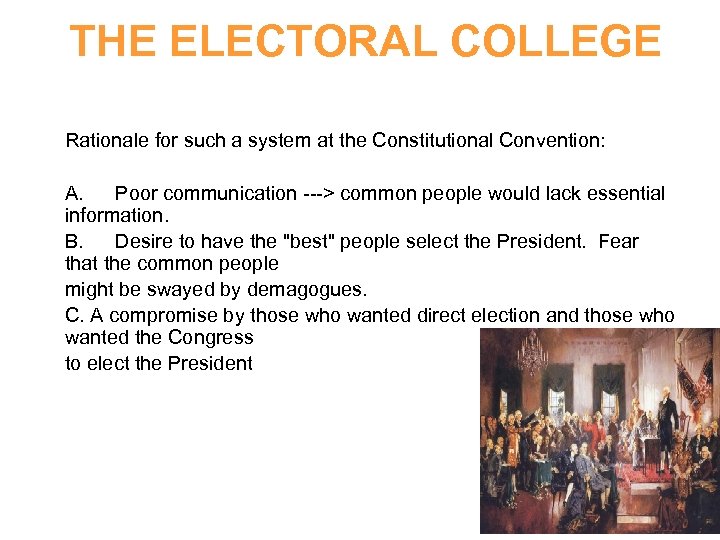
THE ELECTORAL COLLEGE I. Rationale for such a system at the Constitutional Convention: A. Poor communication ---> common people would lack essential information. B. Desire to have the "best" people select the President. Fear that the common people might be swayed by demagogues. C. A compromise by those who wanted direct election and those who wanted the Congress to elect the President
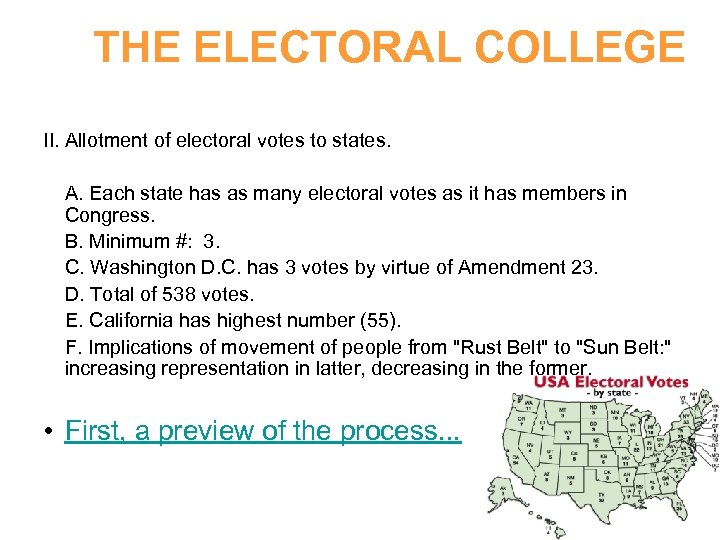
THE ELECTORAL COLLEGE II. Allotment of electoral votes to states. A. Each state has as many electoral votes as it has members in Congress. B. Minimum #: 3. C. Washington D. C. has 3 votes by virtue of Amendment 23. D. Total of 538 votes. E. California has highest number (55). F. Implications of movement of people from "Rust Belt" to "Sun Belt: " increasing representation in latter, decreasing in the former. • First, a preview of the process. . .
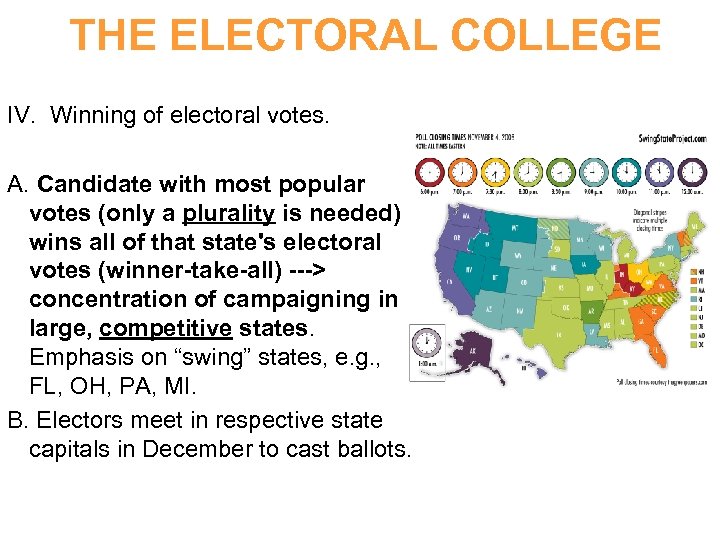
THE ELECTORAL COLLEGE IV. Winning of electoral votes. A. Candidate with most popular votes (only a plurality is needed) wins all of that state's electoral votes (winner-take-all) ---> concentration of campaigning in large, competitive states. Emphasis on “swing” states, e. g. , FL, OH, PA, MI. B. Electors meet in respective state capitals in December to cast ballots.
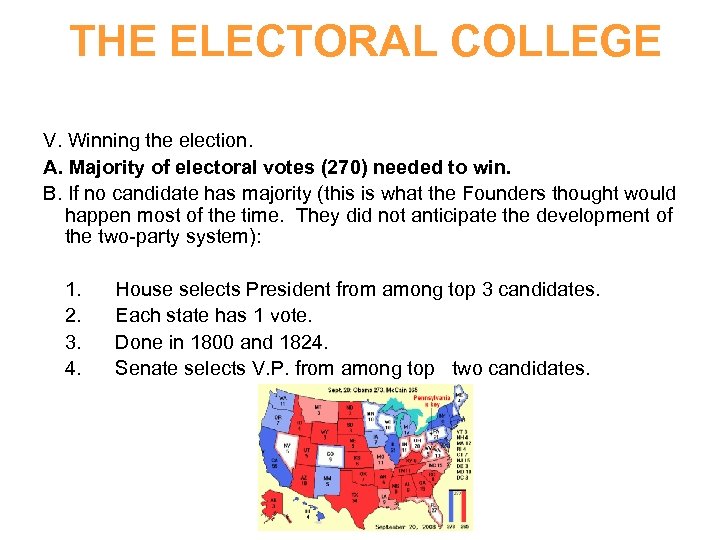
THE ELECTORAL COLLEGE V. Winning the election. A. Majority of electoral votes (270) needed to win. B. If no candidate has majority (this is what the Founders thought would happen most of the time. They did not anticipate the development of the two-party system): 1. House selects President from among top 3 candidates. 2. Each state has 1 vote. 3. Done in 1800 and 1824. 4. Senate selects V. P. from among top two candidates.
THE ELECTORAL COLLEGE ØThe rest of the story. . . VI. Criticisms. A. President can be elected w/only a plurality, rather than a majority, of popular votes, esp. w/presence of strong 3 rd party candidates. B. Possibility of a minority President (1824, 1876, 1888, 2000). This is due to the winner take all feature that distorts margins of victory within states. C. "Faithless electors: " no fed. law requires electors to vote the way they are "supposed" to vote.
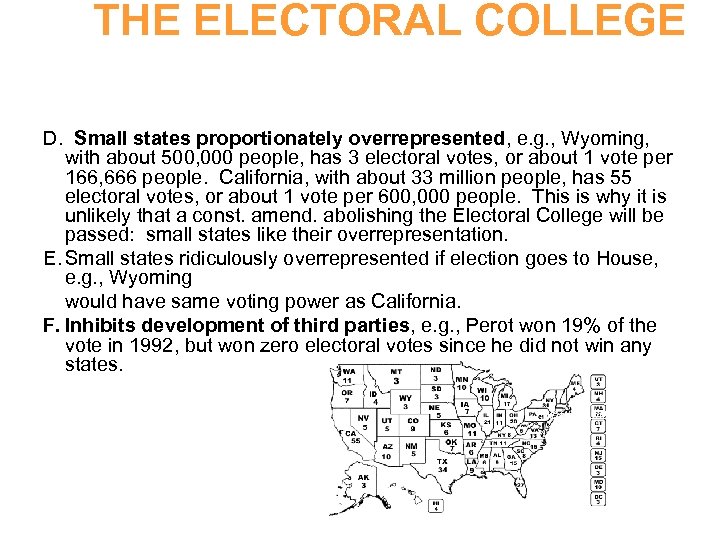
THE ELECTORAL COLLEGE 1 vote for 166, 000 people D. Small states proportionately overrepresented, e. g. , Wyoming, with about 500, 000 people, has 3 electoral votes, or about 1 vote per 166, 666 people. California, with about 33 million people, has 55 electoral votes, or about 1 vote per 600, 000 people. This is why it is unlikely that a const. amend. abolishing the Electoral College will be passed: small states like their overrepresentation. E. Small states ridiculously overrepresented if election goes to House, e. g. , Wyoming would have same voting power as California. F. Inhibits development of third parties, e. g. , Perot won 19% of the vote in 1992, but won zero electoral votes since he did not win any states. 1 vote for 600, 00 people
THE ELECTORAL COLLEGE VII. Alternatives. A. Direct election: each person’s vote would count as much as every other person’s vote B. District system (candidate who wins a congressional district wins that district's electoral vote). Overall winner in a state would get the two “bonus” electoral votes by virtue of its senate seats. C. Proportional system (candidate gets same % of electoral votes as popular votes). D. Keep electoral votes but abolish the electors themselves
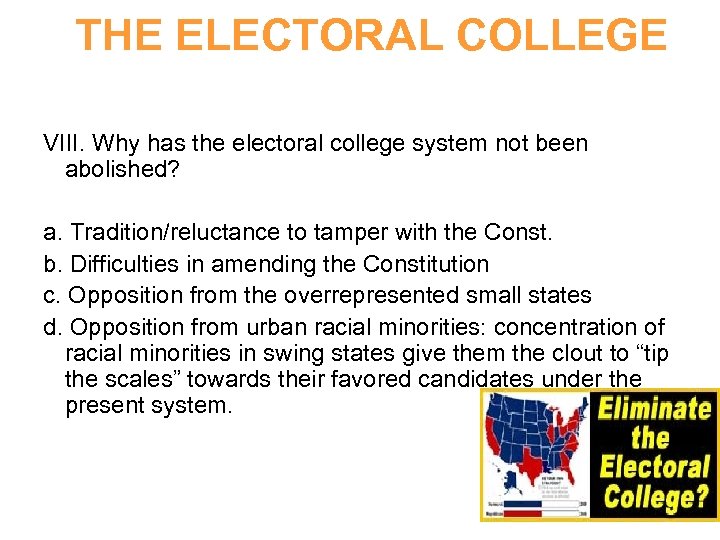
THE ELECTORAL COLLEGE VIII. Why has the electoral college system not been abolished? a. Tradition/reluctance to tamper with the Const. b. Difficulties in amending the Constitution c. Opposition from the overrepresented small states d. Opposition from urban racial minorities: concentration of racial minorities in swing states give them the clout to “tip the scales” towards their favored candidates under the present system.
Скачать презентацию Warm-up What do you know about the process
42a0f16fb219a940d9c1b9d9fbb2cc4e.ppt