 Скачать презентацию Warm-up Turn to your neighbor and explain the
45537dd24ff4ad04db2ef7f8302faf7d.ppt
- Количество слайдов: 19



Warm-up: Turn to your neighbor and explain the following: (Guess if necessary!!!) n n Cost-push inflation (Person with the longest hair does the talking) Demand-pull inflation (Person with the shortest hair does the talking)
Aggregate Demand IB Economics
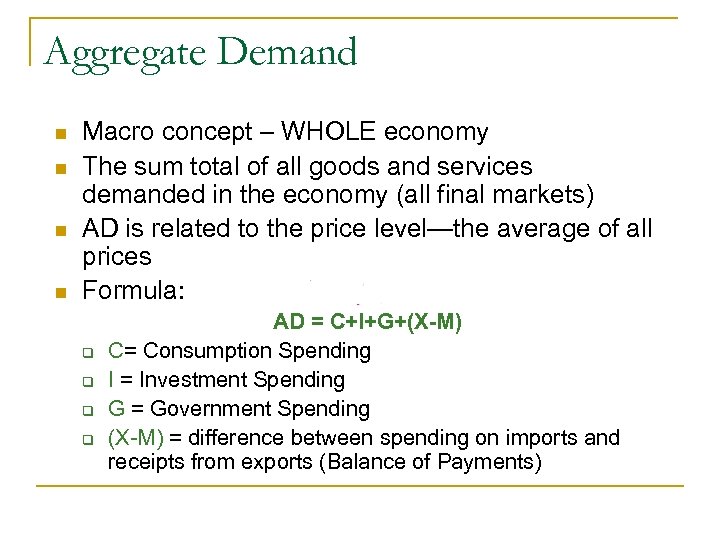
Aggregate Demand n n Macro concept – WHOLE economy The sum total of all goods and services demanded in the economy (all final markets) AD is related to the price level—the average of all prices Formula: q q AD = C+I+G+(X-M) C= Consumption Spending I = Investment Spending G = Government Spending (X-M) = difference between spending on imports and receipts from exports (Balance of Payments)
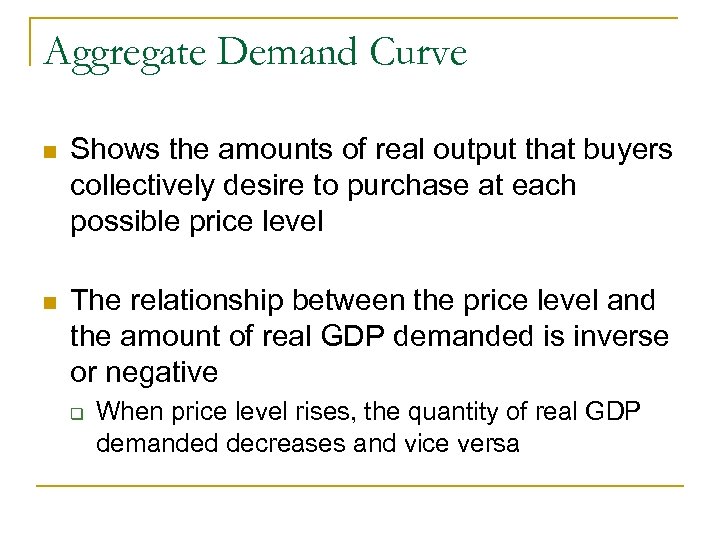
Aggregate Demand Curve n Shows the amounts of real output that buyers collectively desire to purchase at each possible price level n The relationship between the price level and the amount of real GDP demanded is inverse or negative q When price level rises, the quantity of real GDP demanded decreases and vice versa
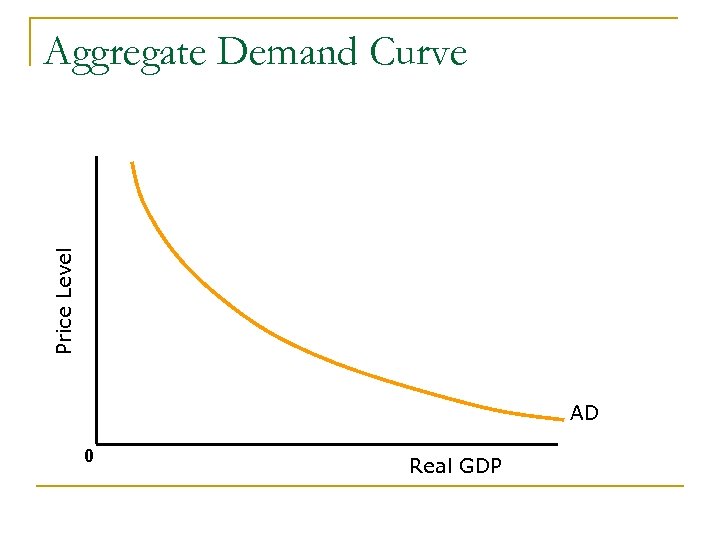
Price Level Aggregate Demand Curve AD 0 Real GDP
The Downward Sloping Aggregate Demand Curve-overview n n n Real-balance effect (a. k. a. Real Wealth Effect) Interest-Rate effect Foreign Purchases Effect
Aggregate Demand Curve Shape 1. Real-Balances/Wealth Effect n As prices rise the value of bank balances fall. n Because the public is poorer in real terms, they will reduce their spending q q n Purchase a new car or LCD TV if savings has purchasing power of $50, 000 If inflation erodes the purchasing power of its asset balances to say $30, 000, then the household may wait to make its purchases Higher price level = less consumption spending as people act to maintain their real money balances q Conversely, lower price levels = more consumption spending
Aggregate Demand Curve Shape 2. Interest-Rate Effect n Assume supply of money to be constant or fixed when drawing the AD Curve n However, when price level increases, consumers need more money for purchases and businesses need more money to meet their payrolls and to buy other resources n Higher price level increases the demand for money q Fixed supply of money an increase in money demanded = increase in the price paid for its use Ø INTEREST RATE
Aggregate Demand Curve Shape 2. Interest-Rate Effect continued. . . n Higher interest rates reduce investment spending and interest-sensitive consumption spending n If 6% rate of return is expected on capital, then: q At 5% interest rate investment is made q At 7% interest rate the investment is not made n Increasing the demand on money & consequently the interest rate, a higher price level reduces the amount of real output demanded
Aggregate Demand Curve Shape 3. Foreign Purchases Effect (a. k. a. Net Export Effect) n When U. S. price level rises relative to foreign price levels, then: q q Foreigners buy fewer U. S. goods (X), & Americans buy more foreign goods (M) U. S. Imports Rise U. S. Exports Fall n Rise in the price level reduces the quantity of U. S. goods demanded as net exports
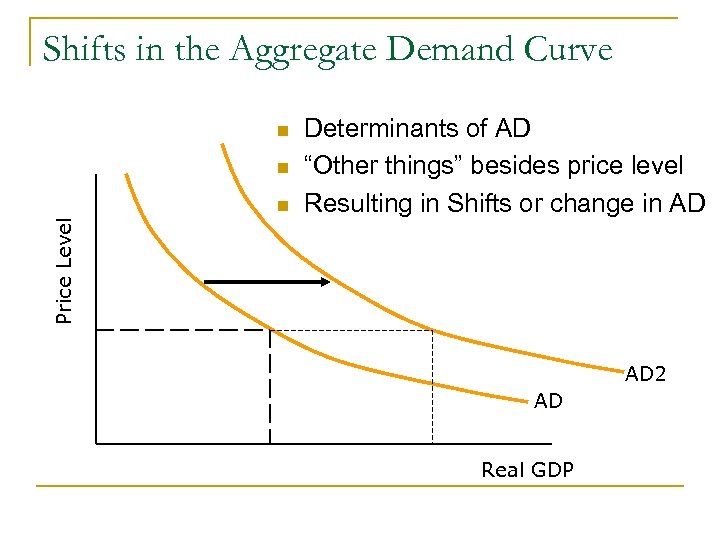
Shifts in the Aggregate Demand Curve n n Price Level n Determinants of AD “Other things” besides price level Resulting in Shifts or change in AD AD 2 AD Real GDP
Factors causing AD to SHIFT - Overview n n n Fiscal Policy Monetary Policy Foreign Income Changes & Exchange Rates Future Expectations External Shocks

AD Shift – Fiscal Policy n Definition: Taxes n Government Spending n
AD Shift - Monetary Policy n Definition: Assume increase MS n Investment n Consumer Durables n Savings
AD Shift -Foreign Income Changes n n Income of foreigners is major determinant of demand If NI of country A increases then X of country B will increase.
AD Shift - Exchange Rates n Value of $ decreasing n Value of $ increasing
AD Shift – Future Expectations n Future prices n Business outlook n Future income changes
AD shift – Demand side shock (aka external shocks) n National, international, social, and natural events can effect consumers, firms, government and thus AD.
Aggregate Demand Exercise n Complete the exercise for Aggregate Demand
Скачать презентацию Warm-up Turn to your neighbor and explain the
45537dd24ff4ad04db2ef7f8302faf7d.ppt