 Скачать презентацию WARM UP QUESTIONS Biology B Mrs Rhodes Spring
8580688eeac1842469e9f62cdde6eced.ppt
- Количество слайдов: 8



WARM UP QUESTIONS Biology B Mrs. Rhodes Spring 2014 These are completed on a blue page, due each week
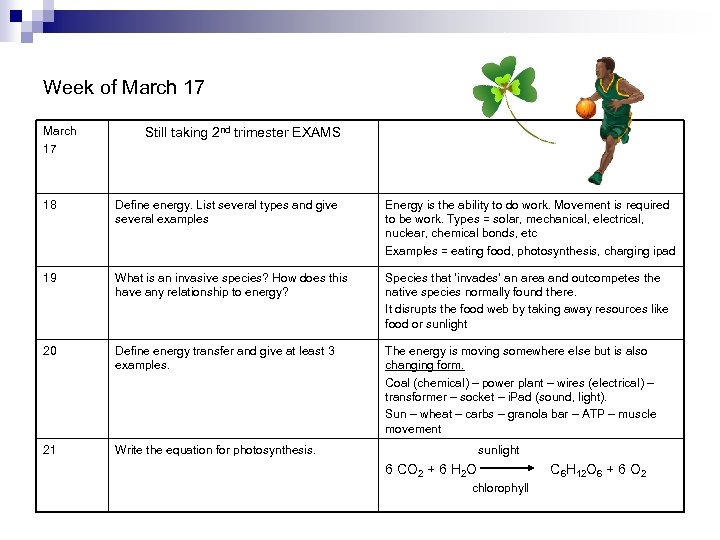
Week of March 17 Still taking 2 nd trimester EXAMS 18 Define energy. List several types and give several examples Energy is the ability to do work. Movement is required to be work. Types = solar, mechanical, electrical, nuclear, chemical bonds, etc Examples = eating food, photosynthesis, charging ipad 19 What is an invasive species? How does this have any relationship to energy? Species that ‘invades’ an area and outcompetes the native species normally found there. It disrupts the food web by taking away resources like food or sunlight 20 Define energy transfer and give at least 3 examples. The energy is moving somewhere else but is also changing form. Coal (chemical) – power plant – wires (electrical) – transformer – socket – i. Pad (sound, light). Sun – wheat – carbs – granola bar – ATP – muscle movement 21 Write the equation for photosynthesis. sunlight 6 CO 2 + 6 H 2 O chlorophyll C 6 H 12 O 6 + 6 O 2
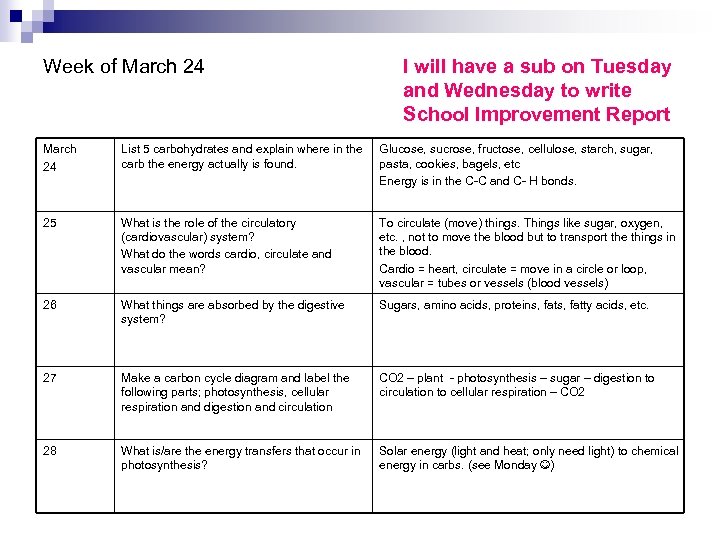
Week of March 24 I will have a sub on Tuesday and Wednesday to write School Improvement Report March 24 List 5 carbohydrates and explain where in the carb the energy actually is found. Glucose, sucrose, fructose, cellulose, starch, sugar, pasta, cookies, bagels, etc Energy is in the C-C and C- H bonds. 25 What is the role of the circulatory (cardiovascular) system? What do the words cardio, circulate and vascular mean? To circulate (move) things. Things like sugar, oxygen, etc. , not to move the blood but to transport the things in the blood. Cardio = heart, circulate = move in a circle or loop, vascular = tubes or vessels (blood vessels) 26 What things are absorbed by the digestive system? Sugars, amino acids, proteins, fatty acids, etc. 27 Make a carbon cycle diagram and label the following parts; photosynthesis, cellular respiration and digestion and circulation CO 2 – plant - photosynthesis – sugar – digestion to circulation to cellular respiration – CO 2 28 What is/are the energy transfers that occur in photosynthesis? Solar energy (light and heat; only need light) to chemical energy in carbs. (see Monday )
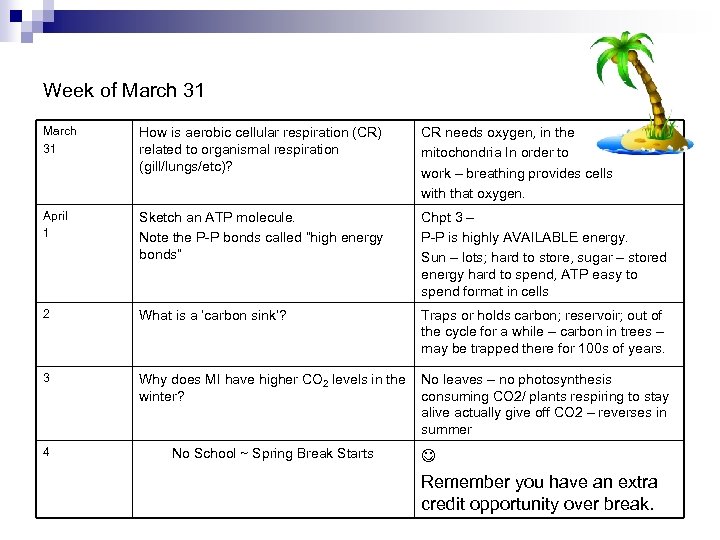
Week of March 31 How is aerobic cellular respiration (CR) related to organismal respiration (gill/lungs/etc)? CR needs oxygen, in the mitochondria In order to work – breathing provides cells with that oxygen. April 1 Sketch an ATP molecule. Note the P-P bonds called “high energy bonds” Chpt 3 – P-P is highly AVAILABLE energy. Sun – lots; hard to store, sugar – stored energy hard to spend, ATP easy to spend format in cells 2 What is a ‘carbon sink’? Traps or holds carbon; reservoir; out of the cycle for a while – carbon in trees – may be trapped there for 100 s of years. 3 Why does MI have higher CO 2 levels in the winter? No leaves – no photosynthesis consuming CO 2/ plants respiring to stay alive actually give off CO 2 – reverses in summer 4 No School ~ Spring Break Starts Remember you have an extra credit opportunity over break.
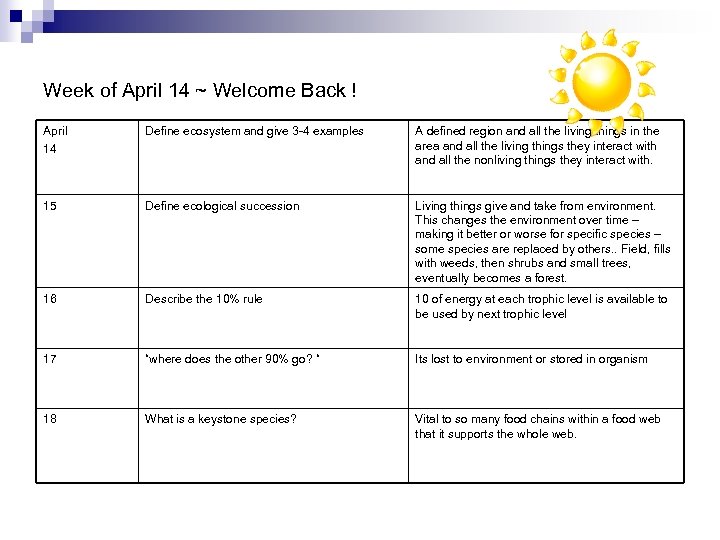
Week of April 14 ~ Welcome Back ! April 14 Define ecosystem and give 3 -4 examples A defined region and all the living things in the area and all the living things they interact with and all the nonliving things they interact with. 15 Define ecological succession Living things give and take from environment. This changes the environment over time – making it better or worse for specific species – some species are replaced by others. . Field, fills with weeds, then shrubs and small trees, eventually becomes a forest. 16 Describe the 10% rule 10 of energy at each trophic level is available to be used by next trophic level 17 “where does the other 90% go? “ Its lost to environment or stored in organism 18 What is a keystone species? Vital to so many food chains within a food web that it supports the whole web.
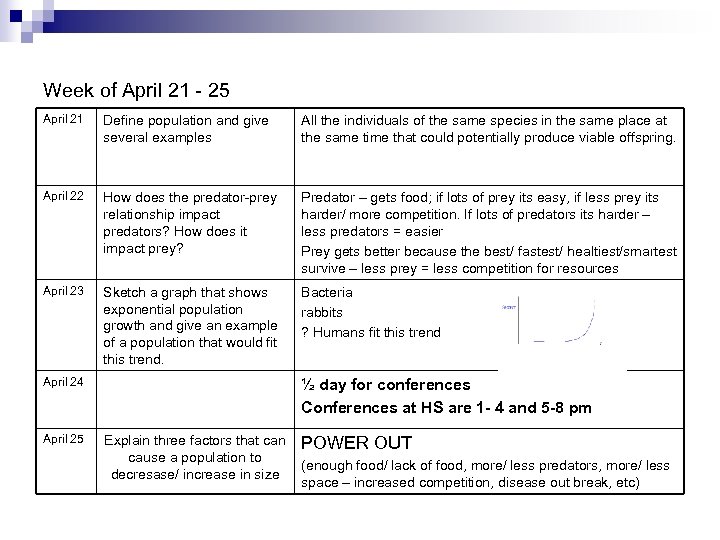
Week of April 21 - 25 April 21 Define population and give several examples All the individuals of the same species in the same place at the same time that could potentially produce viable offspring. April 22 How does the predator-prey relationship impact predators? How does it impact prey? Predator – gets food; if lots of prey its easy, if less prey its harder/ more competition. If lots of predators its harder – less predators = easier Prey gets better because the best/ fastest/ healtiest/smartest survive – less prey = less competition for resources April 23 Sketch a graph that shows exponential population growth and give an example of a population that would fit this trend. Bacteria rabbits ? Humans fit this trend April 24 April 25 ½ day for conferences Conferences at HS are 1 - 4 and 5 -8 pm Explain three factors that can cause a population to decresase/ increase in size POWER OUT (enough food/ lack of food, more/ less predators, more/ less space – increased competition, disease out break, etc)
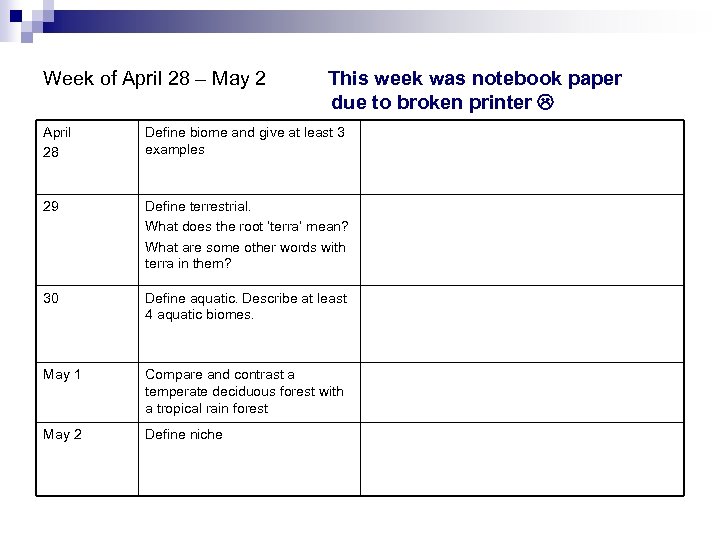
Week of April 28 – May 2 This week was notebook paper due to broken printer April 28 Define biome and give at least 3 examples 29 Define terrestrial. What does the root ‘terra’ mean? What are some other words with terra in them? 30 Define aquatic. Describe at least 4 aquatic biomes. May 1 Compare and contrast a temperate deciduous forest with a tropical rain forest May 2 Define niche
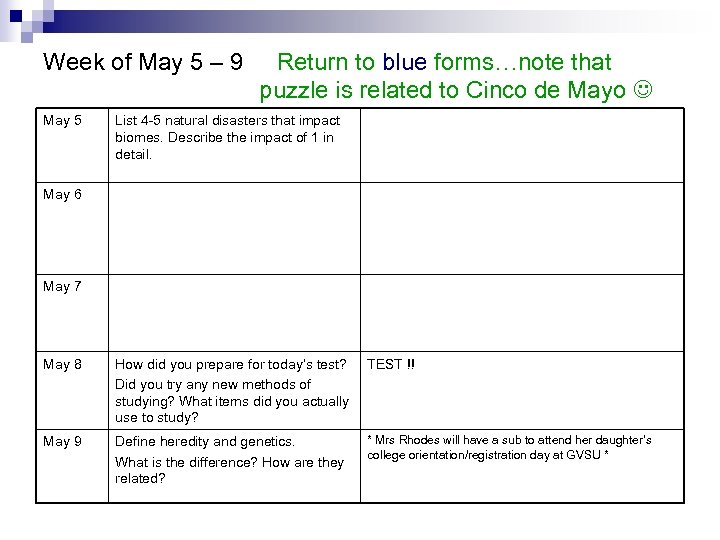
Week of May 5 – 9 May 5 Return to blue forms…note that puzzle is related to Cinco de Mayo List 4 -5 natural disasters that impact biomes. Describe the impact of 1 in detail. May 6 May 7 May 8 How did you prepare for today’s test? Did you try any new methods of studying? What items did you actually use to study? TEST !! May 9 Define heredity and genetics. What is the difference? How are they related? * Mrs Rhodes will have a sub to attend her daughter’s college orientation/registration day at GVSU *
Скачать презентацию WARM UP QUESTIONS Biology B Mrs Rhodes Spring
8580688eeac1842469e9f62cdde6eced.ppt