


 Скачать презентацию Warm-Up Day 1 Complete Unit 8 Pre-Test quietly
2743b35b64413a1a3dd098829d418536.ppt
- Количество слайдов: 74
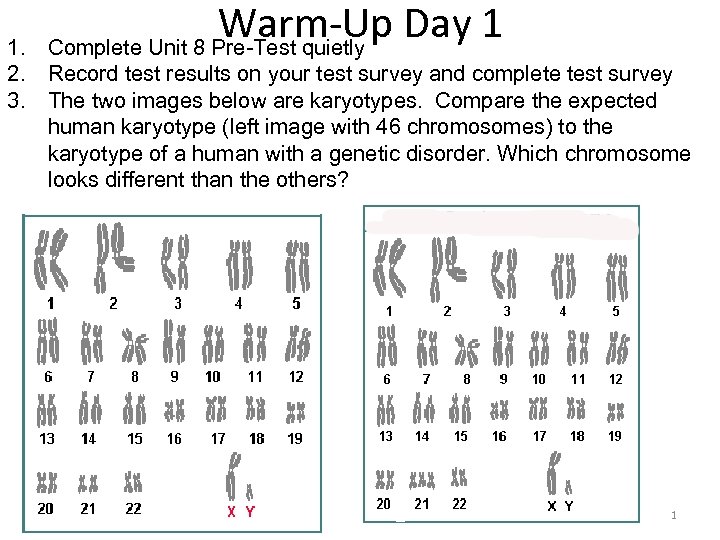 Warm-Up Day 1 Complete Unit 8 Pre-Test quietly 1. 2. Record test results on your test survey and complete test survey 3. The two images below are karyotypes. Compare the expected human karyotype (left image with 46 chromosomes) to the karyotype of a human with a genetic disorder. Which chromosome looks different than the others? 1
 Warm Up 1. Calendars with HW questions and cut and paste out 2. Test surveys in bin? 3. Color code cut and paste: 1. Color one chromosome in each homologous pair blue to demonstrate that one came from the individual’s father. 2. Color one chromosome in each homologous pair pink to demonstrate that one came from the individual’s mother. 3. Color the centrioles orange. 4. Outline the nuclear membrane in red. 5. Begin cutting and pasting the phases and descriptions in the appropriate location. You will have until 1: 00 PM! 2
 Warm Up 1. Get out your Genetics reading and calendar! 2. Answer the following in your warm-up section: 1. What phase does not occur in Meiosis II? 3
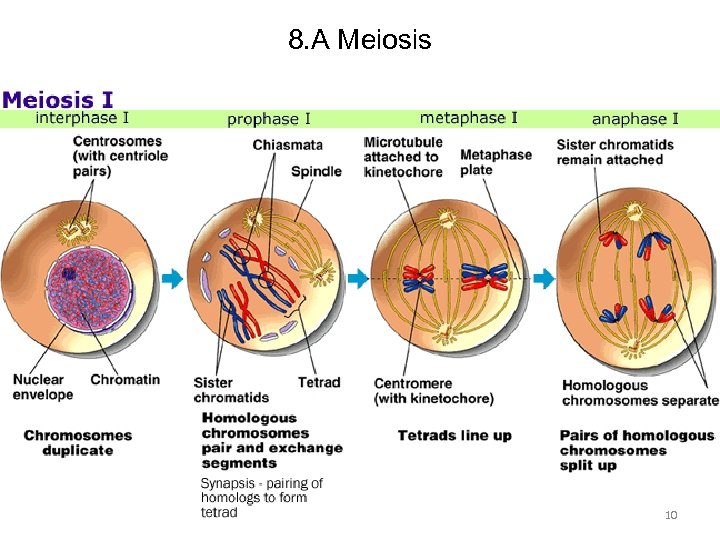
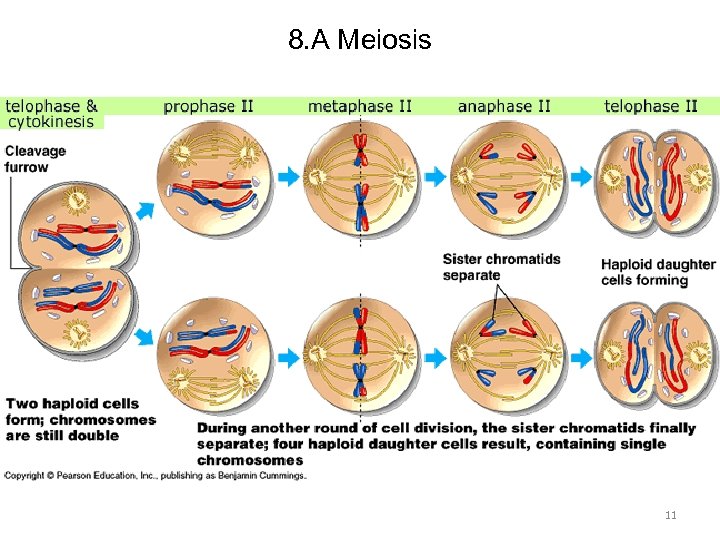
 Unit 8 Notes: Genetics 8. A Meiosis • Genetic Variation – the variety of genes (DNA) or why everyone looks different Meiosis – the double cell division to produce eggs and sperm. 4
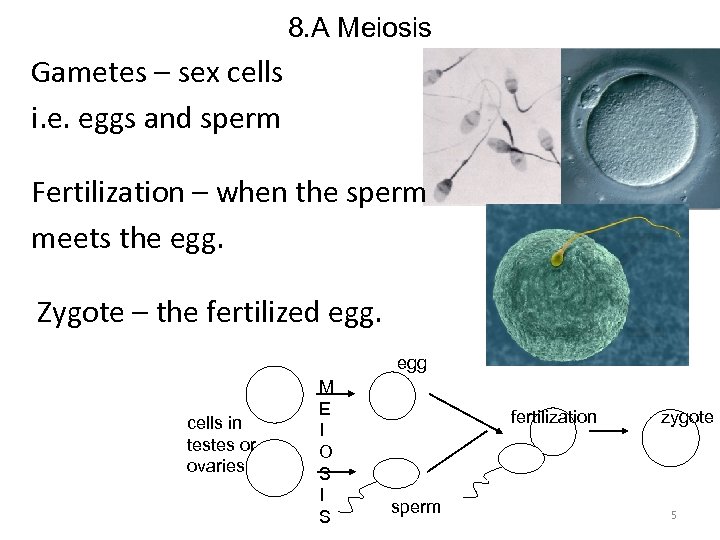 8. A Meiosis Gametes – sex cells i. e. eggs and sperm Fertilization – when the sperm meets the egg. Zygote – the fertilized egg cells in testes or ovaries M E I O S I S fertilization sperm zygote 5
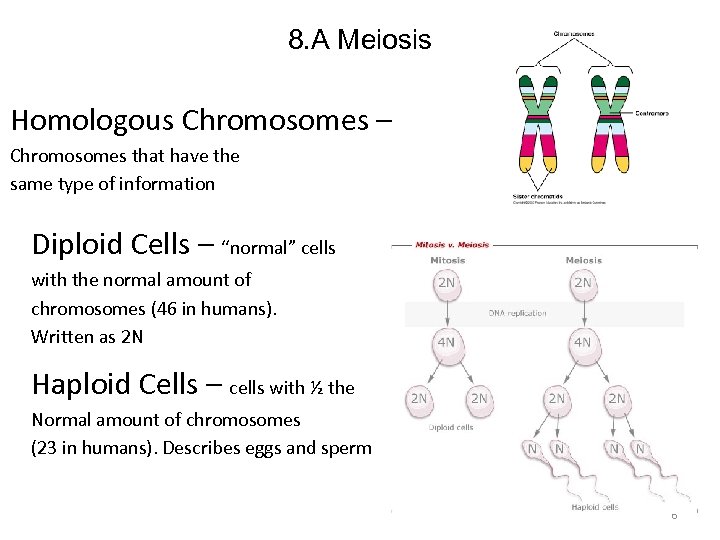 8. A Meiosis Homologous Chromosomes – Chromosomes that have the same type of information Diploid Cells – “normal” cells with the normal amount of chromosomes (46 in humans). Written as 2 N Haploid Cells – cells with ½ the Normal amount of chromosomes (23 in humans). Describes eggs and sperm 6
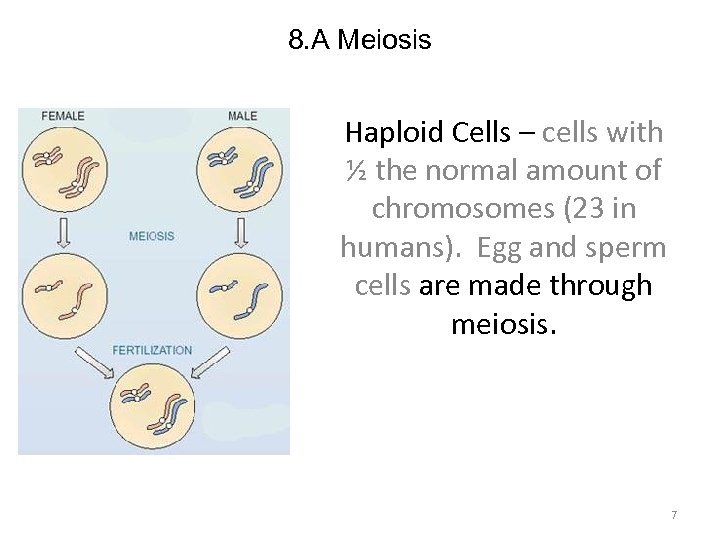 8. A Meiosis Haploid Cells – cells with ½ the normal amount of chromosomes (23 in humans). Egg and sperm cells are made through meiosis. 7
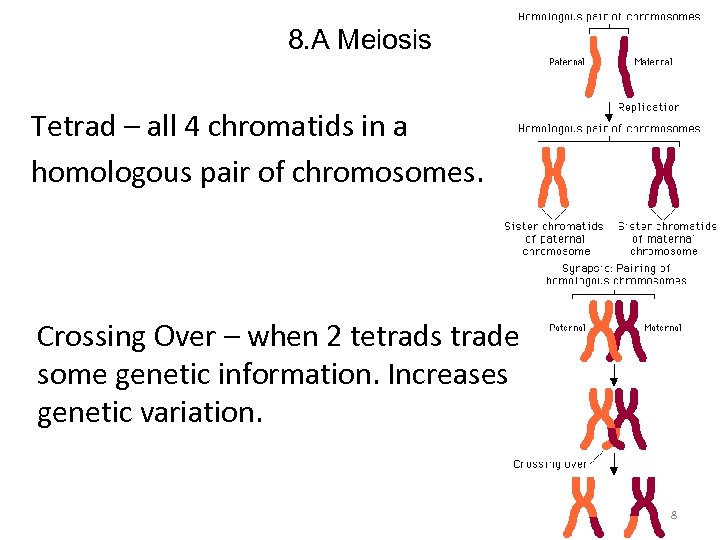 8. A Meiosis Tetrad – all 4 chromatids in a homologous pair of chromosomes. Crossing Over – when 2 tetrads trade some genetic information. Increases genetic variation. 8
 9
9
 8. A Meiosis 10
 8. A Meiosis 11
 Amoeba Sisters Meiosis https: //www. youtube. com/watch? v=to. WK 0 f Iy. Fl. Y 12
 When you finish your quiz, • DRAW: One partner should draw the diagram that is on the back cabinets and write the sentences summaries leaving out the highlighted spaces to fill in the blanks. • READ: The other partner should read the gold instruction sheet and make note of when it says to draw. • Once everyone turns in their quiz, you can model meiosis with your pipe cleaners and string 13
 Period 1 1. Finish your yellow lab sheet for Meiosis Modeling from yesterday. 2. To the best of your ability, complete the Bikini Bottoms Punnett square worksheet. If you have a questions, raise your hand. 3. Work on your homework genetics reading until we come back together! 14
 Warm-Up • Get out your reading and calendar to be stamped! • What event in meiosis increases genetic variation? Explain this event and specify which phase it occurs in. 15
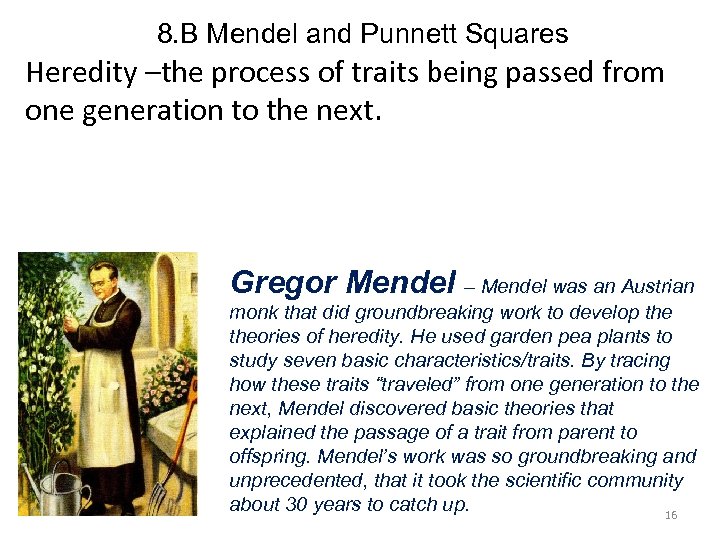 8. B Mendel and Punnett Squares Heredity –the process of traits being passed from one generation to the next. Gregor Mendel – Mendel was an Austrian monk that did groundbreaking work to develop theories of heredity. He used garden pea plants to study seven basic characteristics/traits. By tracing how these traits “traveled” from one generation to the next, Mendel discovered basic theories that explained the passage of a trait from parent to offspring. Mendel’s work was so groundbreaking and unprecedented, that it took the scientific community about 30 years to catch up. 16
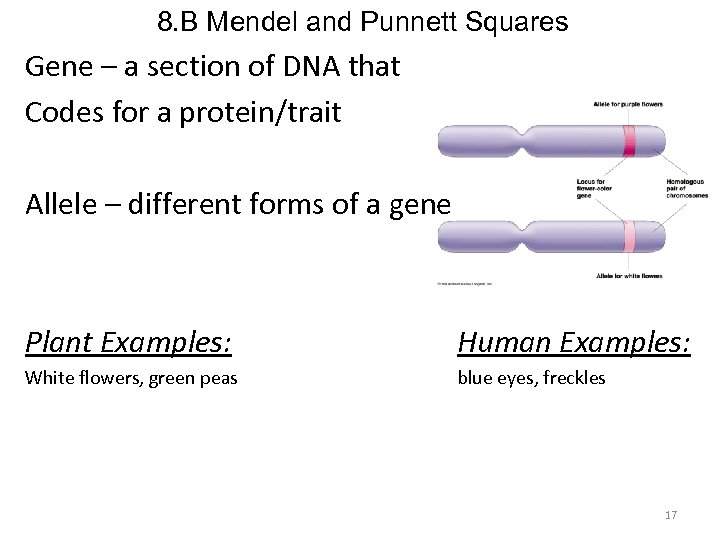 8. B Mendel and Punnett Squares Gene – a section of DNA that Codes for a protein/trait Allele – different forms of a gene Plant Examples: Human Examples: White flowers, green peas blue eyes, freckles 17
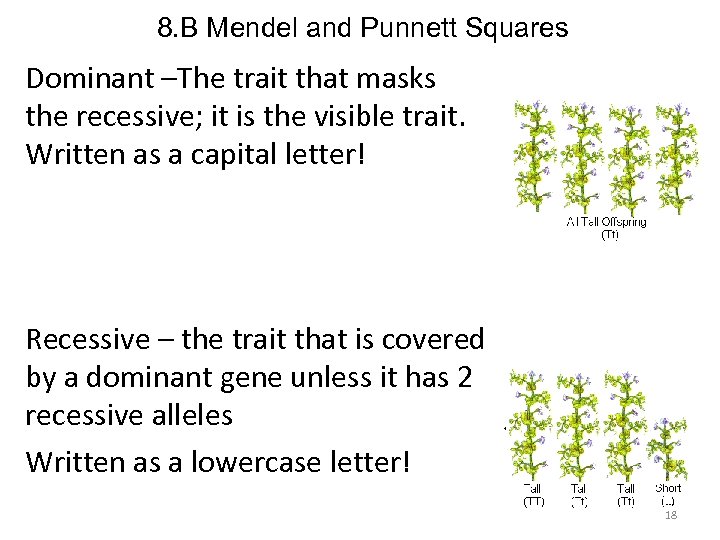 8. B Mendel and Punnett Squares Dominant –The trait that masks the recessive; it is the visible trait. Written as a capital letter! Recessive – the trait that is covered by a dominant gene unless it has 2 recessive alleles Written as a lowercase letter! 18
 8. B Mendel and Punnett Squares Homozygous – both alleles carry the same information. Written as two capital letters or two lowercase letters. Ex. BB or bb Heterozygous – one allele of each kind. Written as one capital and one lower case letter. Ex. Bb 19
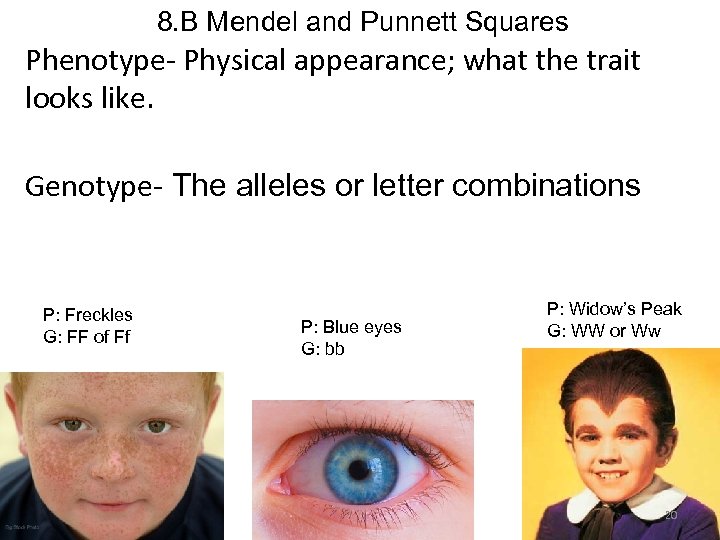 8. B Mendel and Punnett Squares Phenotype- Physical appearance; what the trait looks like. Genotype- The alleles or letter combinations P: Freckles G: FF of Ff P: Blue eyes G: bb P: Widow’s Peak G: WW or Ww 20
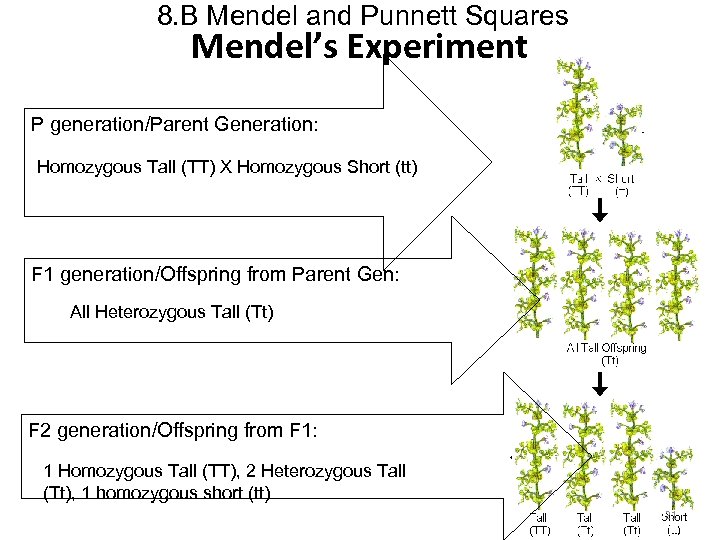 8. B Mendel and Punnett Squares Mendel’s Experiment P generation/Parent Generation: Homozygous Tall (TT) X Homozygous Short (tt) F 1 generation/Offspring from Parent Gen: All Heterozygous Tall (Tt) F 2 generation/Offspring from F 1: 1 Homozygous Tall (TT), 2 Heterozygous Tall (Tt), 1 homozygous short (tt) 21
 Brainstorm with your partner! • Law of Segregation • Law of Independent Assortment • Law of Dominance 22
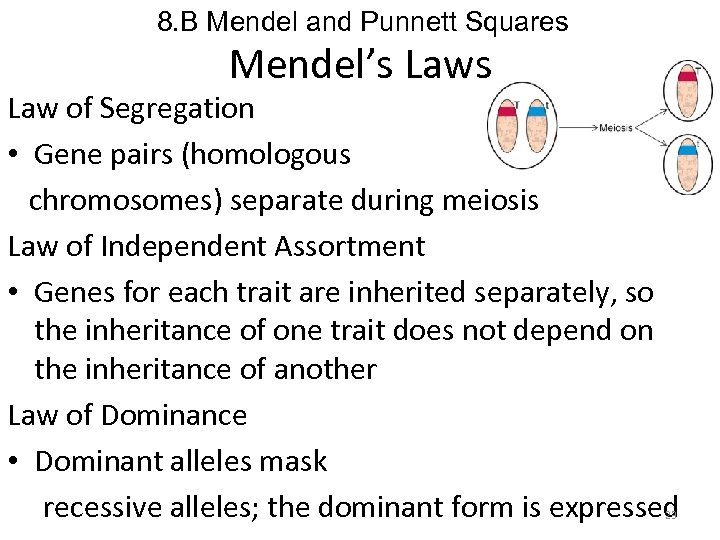 8. B Mendel and Punnett Squares Mendel’s Law of Segregation • Gene pairs (homologous chromosomes) separate during meiosis Law of Independent Assortment • Genes for each trait are inherited separately, so the inheritance of one trait does not depend on the inheritance of another Law of Dominance • Dominant alleles mask recessive alleles; the dominant form is expressed 23
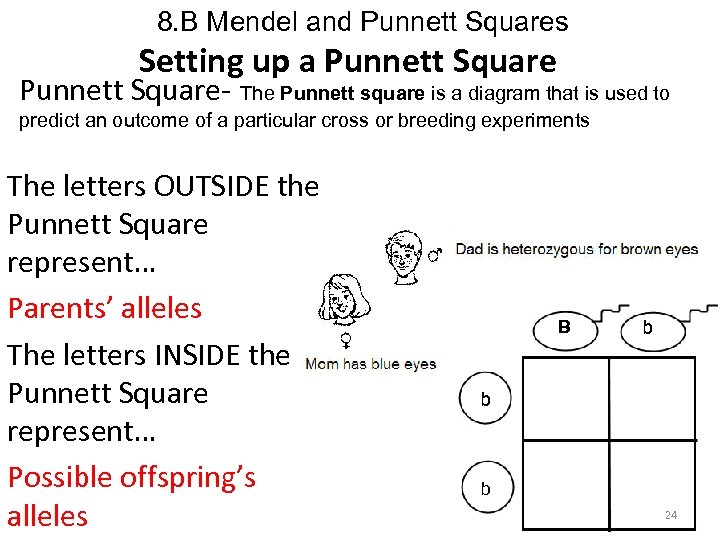 8. B Mendel and Punnett Squares Setting up a Punnett Square- The Punnett square is a diagram that is used to predict an outcome of a particular cross or breeding experiments The letters OUTSIDE the Punnett Square represent… Parents’ alleles The letters INSIDE the Punnett Square represent… Possible offspring’s alleles B b b b 24
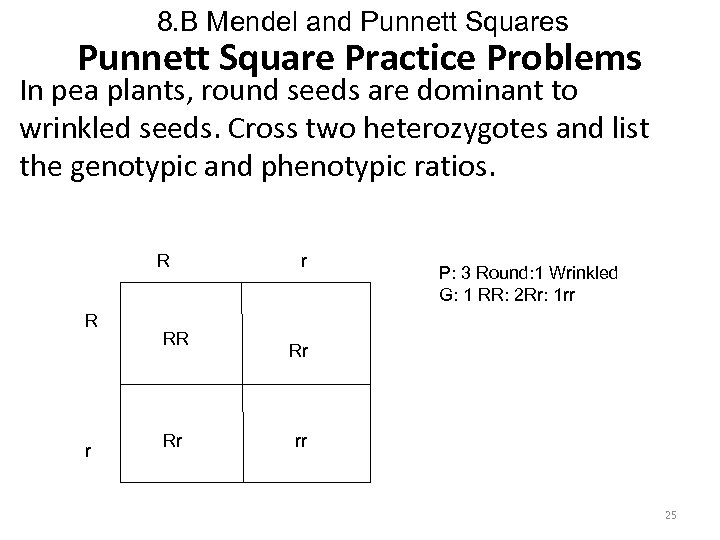 8. B Mendel and Punnett Squares Punnett Square Practice Problems In pea plants, round seeds are dominant to wrinkled seeds. Cross two heterozygotes and list the genotypic and phenotypic ratios. R R r RR Rr r P: 3 Round: 1 Wrinkled G: 1 RR: 2 Rr: 1 rr Rr rr 25
 Heredity Video https: //www. brainpop. com/health/geneticsgro wthanddevelopment/heredity/ 26
 Period 1 Warm-Up • Get out HW questions and calendar! In your warm-up section: In pea plants, round seeds are dominant to wrinkled seeds. Cross two heterozygotes and list the genotypic and phenotypic ratios. 27
 Warm-Up Homework questions and calendar out! On your notes 8. B that you picked up on the way in, read the problem below and solve: A brown eyed woman has a father with blue eyes. The woman marries a man with blue eyes. If the couple has children, what percentage of their children will have blue eyes? *Send one person from your group to hang your poster from last class on the back cabinets 28
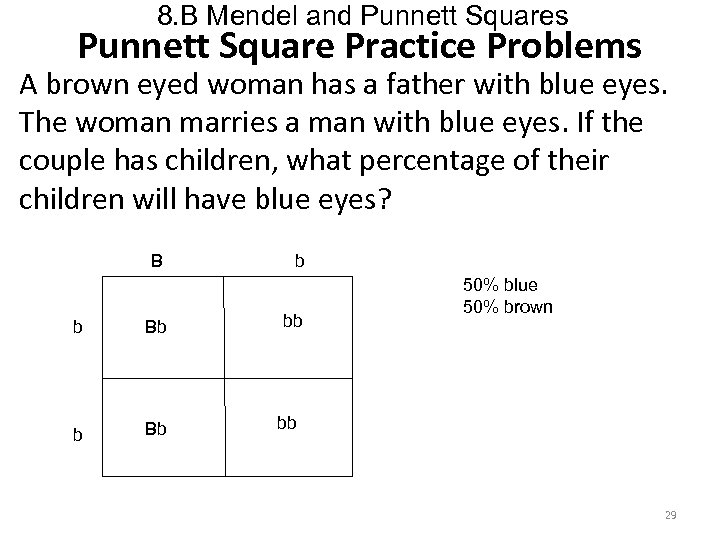 8. B Mendel and Punnett Squares Punnett Square Practice Problems A brown eyed woman has a father with blue eyes. The woman marries a man with blue eyes. If the couple has children, what percentage of their children will have blue eyes? B b Bb b bb 50% blue 50% brown bb 29
 8. B Mendel and Punnett Squares Monohybrid Cross vs. Dihybrid Cross Monohybrid Cross- using a punnett square to determine probability of one trait Dihybrid Cross-using a punnett square to determine probability of two traits 30
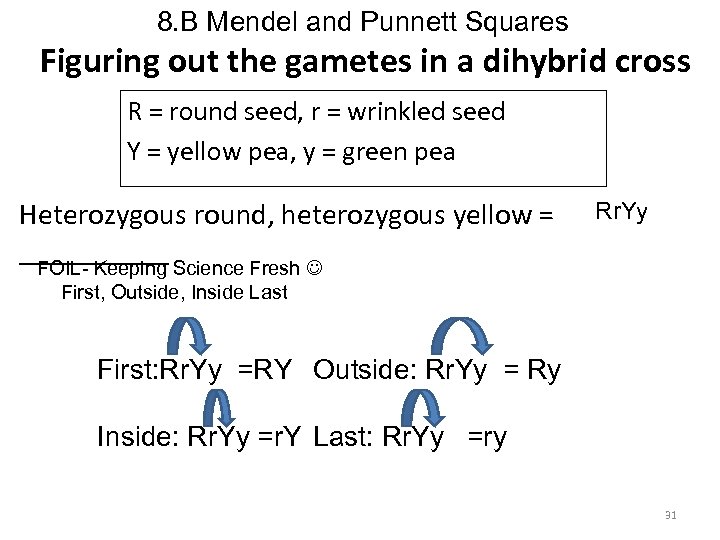 8. B Mendel and Punnett Squares Figuring out the gametes in a dihybrid cross R = round seed, r = wrinkled seed Y = yellow pea, y = green pea Heterozygous round, heterozygous yellow = _____ Rr. Yy FOIL- Keeping Science Fresh First, Outside, Inside Last First: Rr. Yy =RY Outside: Rr. Yy = Ry Inside: Rr. Yy =r. Y Last: Rr. Yy =ry 31
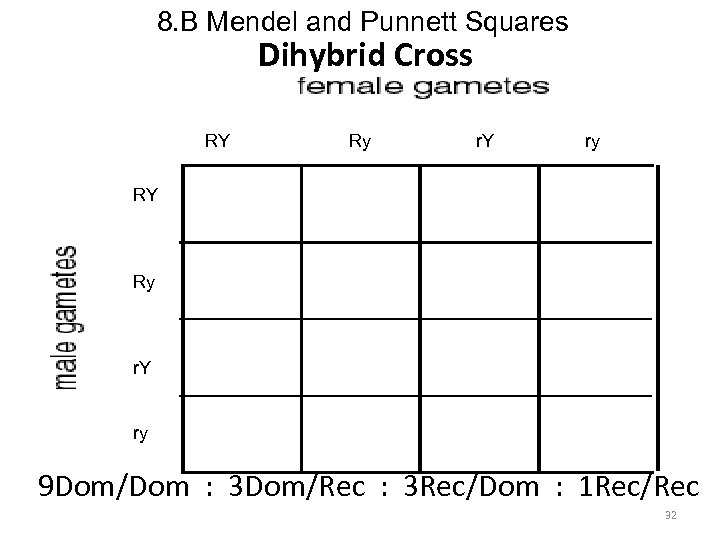 8. B Mendel and Punnett Squares Dihybrid Cross RY Ry r. Y ry 9 Dom/Dom : 3 Dom/Rec : 3 Rec/Dom : 1 Rec/Rec 32
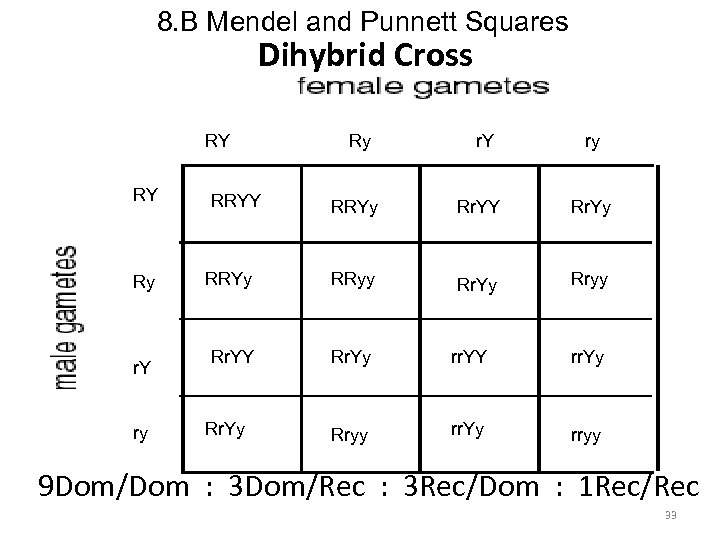 8. B Mendel and Punnett Squares Dihybrid Cross RY RY Ry r. Y ry RRYy Rr. YY Rr. Yy RRyy Rr. Yy Rryy Rr. YY Rr. Yy rr. YY rr. Yy Rryy rr. Yy rryy Rr. Yy 9 Dom/Dom : 3 Dom/Rec : 3 Rec/Dom : 1 Rec/Rec 33
 Warm-Up – HW and calendar out. Quiz today Write ALL in you warm up: In starfish, pink body color (P) is dominant to orange (p), and thick eyebrows (T) are dominant to thin eyebrows (t). Patrick, who is heterozygous for body color but purebred for thick eyebrows, has met Patti, who is recessive for both traits. A. What is Patti’s phenotype? _______ B. Is it possible for the new couple to have offspring that resemble their mother? Explain. C. Before Patrick commits to this relationship, he would like to guarantee that his offspring would have his thick eyebrows as he thinks they make him smarter! You need to provide evidence for or against the marriage with regards to eyebrows ONLY! 34
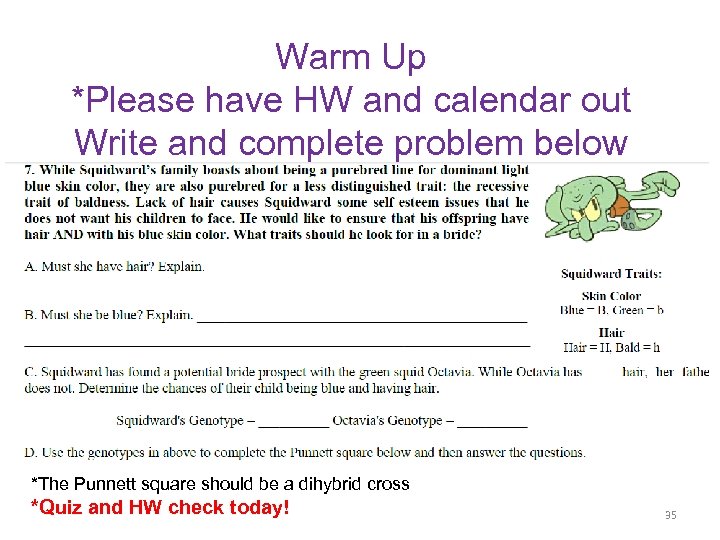 Warm Up *Please have HW and calendar out Write and complete problem below *The Punnett square should be a dihybrid cross *Quiz and HW check today! 35
 Amoeba Sisters: Dihybrid Crosses https: //www. youtube. com/watch? v=q. IGXTJLr. Lf 8 36
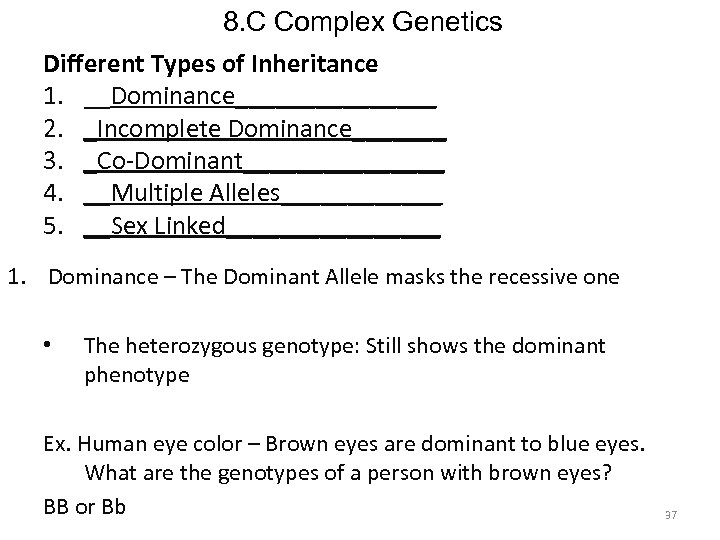 8. C Complex Genetics Different Types of Inheritance 1. __Dominance________ 2. _Incomplete Dominance_______ 3. _Co-Dominant________ 4. __Multiple Alleles______ 5. __Sex Linked________ 1. Dominance – The Dominant Allele masks the recessive one • The heterozygous genotype: Still shows the dominant phenotype Ex. Human eye color – Brown eyes are dominant to blue eyes. What are the genotypes of a person with brown eyes? BB or Bb 37
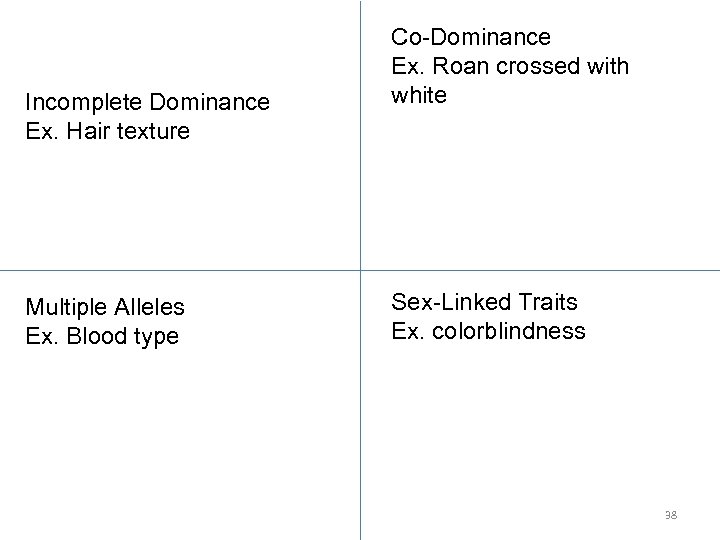 Incomplete Dominance Ex. Hair texture Multiple Alleles Ex. Blood type Co-Dominance Ex. Roan crossed with white Sex-Linked Traits Ex. colorblindness 38
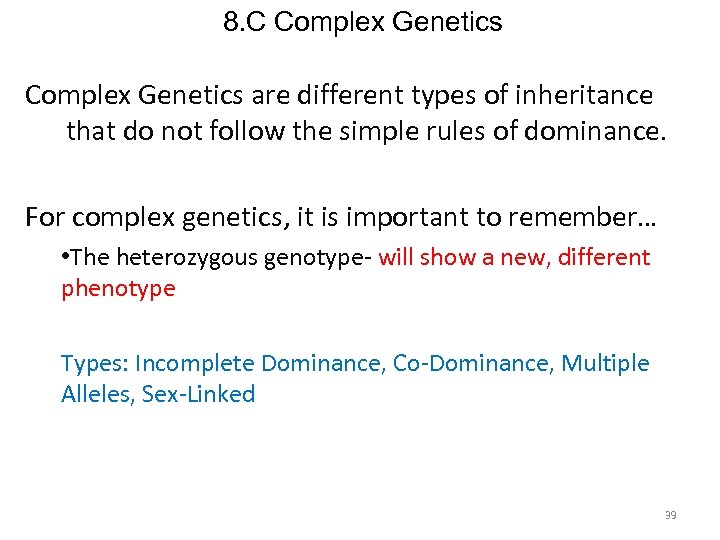 8. C Complex Genetics are different types of inheritance that do not follow the simple rules of dominance. For complex genetics, it is important to remember… • The heterozygous genotype- will show a new, different phenotype Types: Incomplete Dominance, Co-Dominance, Multiple Alleles, Sex-Linked 39
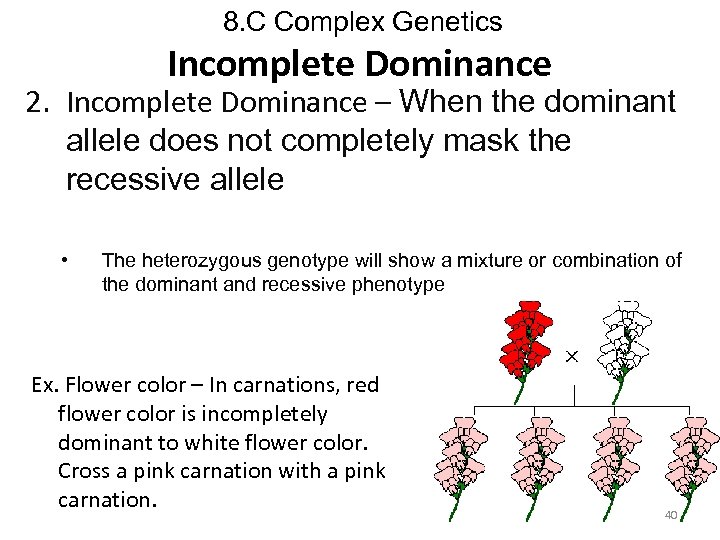 8. C Complex Genetics Incomplete Dominance 2. Incomplete Dominance – When the dominant allele does not completely mask the recessive allele • The heterozygous genotype will show a mixture or combination of the dominant and recessive phenotype Ex. Flower color – In carnations, red flower color is incompletely dominant to white flower color. Cross a pink carnation with a pink carnation. 40
 8. C Complex Genetics Incomplete Dominance Practice Ex. Human hair texture – Curly hair is incompletely dominant to straight hair. Write the genotypes for curly, straight and wavy hair. If two wavy haired people have babies, what type of hair could their children have? 41
 8. C Complex Genetics Incomplete Dominance Practice Ex. Human hair texture – Curly hair is incompletely dominant to straight hair. Write the genotypes for curly, straight and wavy hair. CC, Cc and cc If two wavy haired people have babies, what type of hair could their children have? Curly, wavy or straight 42
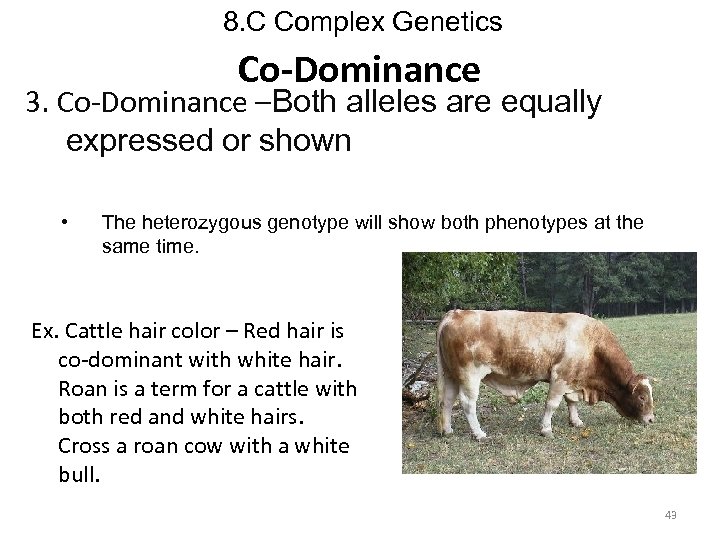 8. C Complex Genetics Co-Dominance 3. Co-Dominance –Both alleles are equally expressed or shown • The heterozygous genotype will show both phenotypes at the same time. Ex. Cattle hair color – Red hair is co-dominant with white hair. Roan is a term for a cattle with both red and white hairs. Cross a roan cow with a white bull. 43
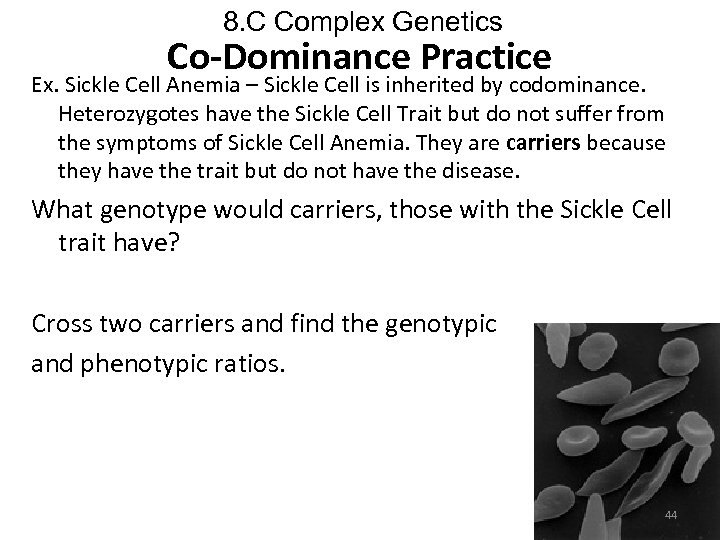 8. C Complex Genetics Co-Dominance Practice Ex. Sickle Cell Anemia – Sickle Cell is inherited by codominance. Heterozygotes have the Sickle Cell Trait but do not suffer from the symptoms of Sickle Cell Anemia. They are carriers because they have the trait but do not have the disease. What genotype would carriers, those with the Sickle Cell trait have? Cross two carriers and find the genotypic and phenotypic ratios. 44
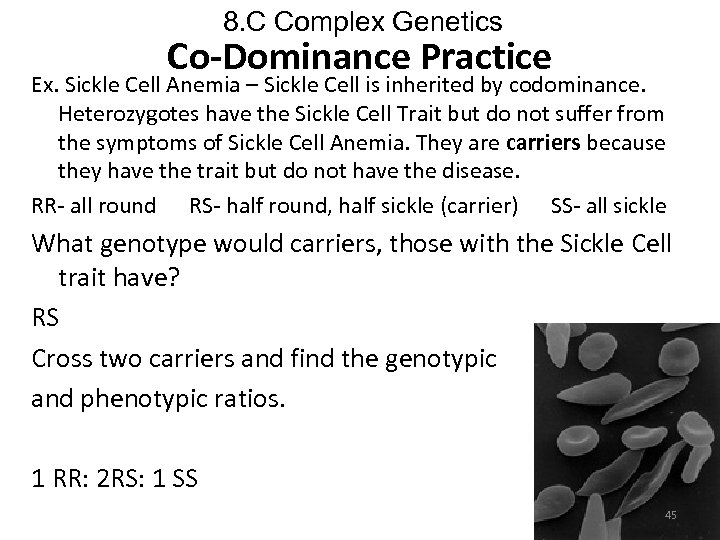 8. C Complex Genetics Co-Dominance Practice Ex. Sickle Cell Anemia – Sickle Cell is inherited by codominance. Heterozygotes have the Sickle Cell Trait but do not suffer from the symptoms of Sickle Cell Anemia. They are carriers because they have the trait but do not have the disease. RR- all round RS- half round, half sickle (carrier) SS- all sickle What genotype would carriers, those with the Sickle Cell trait have? RS Cross two carriers and find the genotypic and phenotypic ratios. 1 RR: 2 RS: 1 SS 45
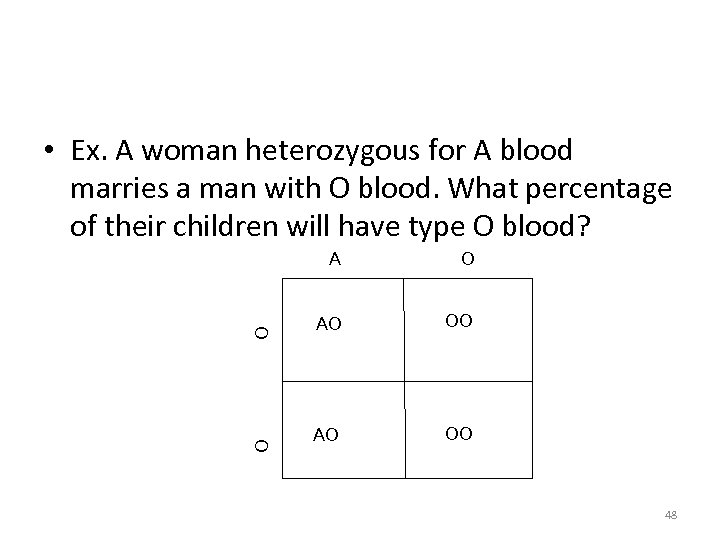
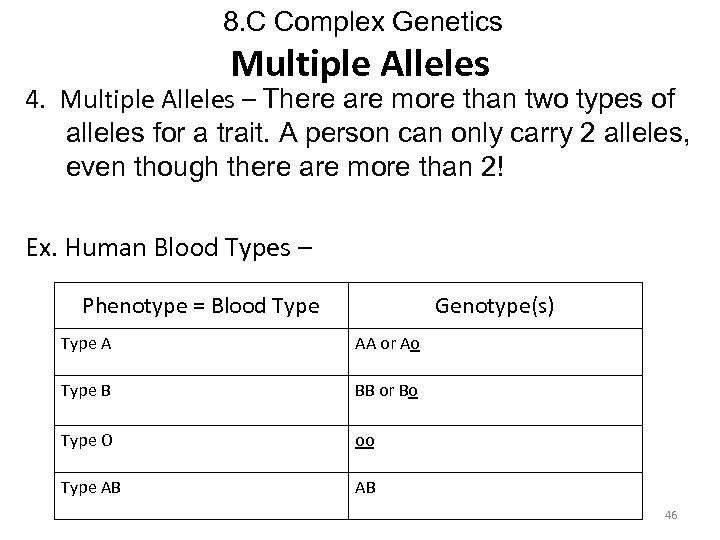 8. C Complex Genetics Multiple Alleles 4. Multiple Alleles – There are more than two types of alleles for a trait. A person can only carry 2 alleles, even though there are more than 2! Ex. Human Blood Types – Phenotype = Blood Type Genotype(s) Type A AA or Ao Type B BB or Bo Type O oo Type AB AB 46
 8. C Complex Genetics Multiple Alleles Practice Ex. A woman heterozygous for A blood marries a man with O blood. What percentage of their children will have type O blood? 47
 • Ex. A woman heterozygous for A blood marries a man with O blood. What percentage of their children will have type O blood? A O O AO OO 48
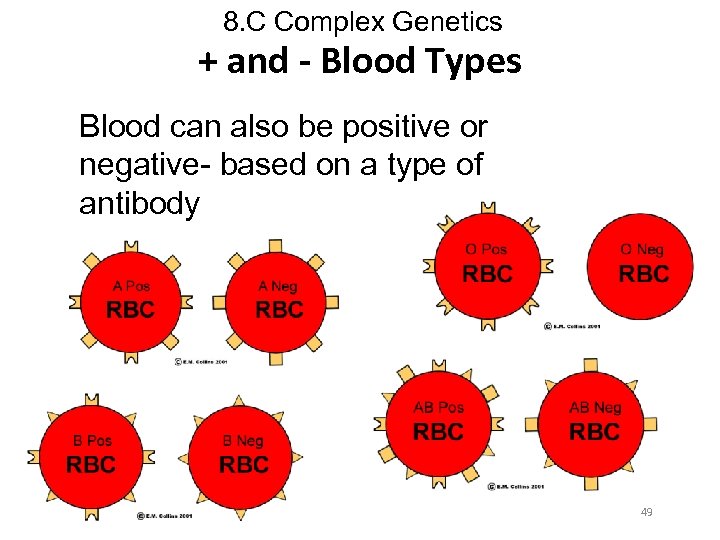 8. C Complex Genetics + and - Blood Types Blood can also be positive or negative- based on a type of antibody 49
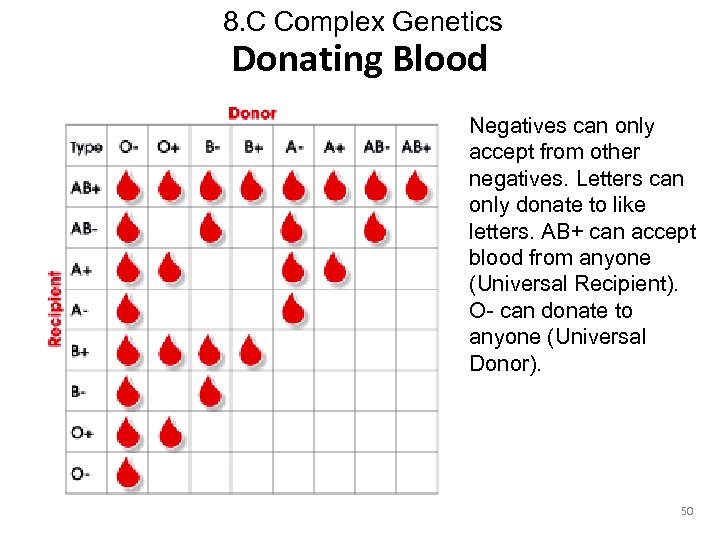 8. C Complex Genetics Donating Blood Negatives can only accept from other negatives. Letters can only donate to like letters. AB+ can accept blood from anyone (Universal Recipient). O- can donate to anyone (Universal Donor). 50
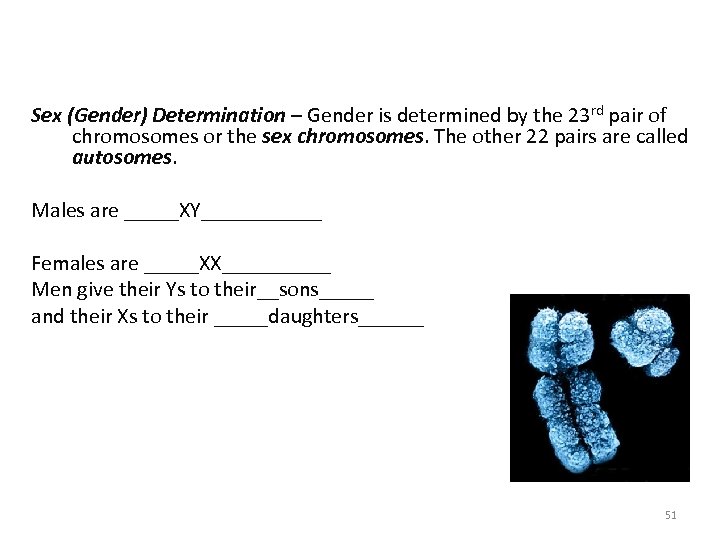 Sex (Gender) Determination – Gender is determined by the 23 rd pair of chromosomes or the sex chromosomes. The other 22 pairs are called autosomes. Males are _____XY______ Females are _____XX_____ Men give their Ys to their__sons_____ and their Xs to their _____daughters______ 51
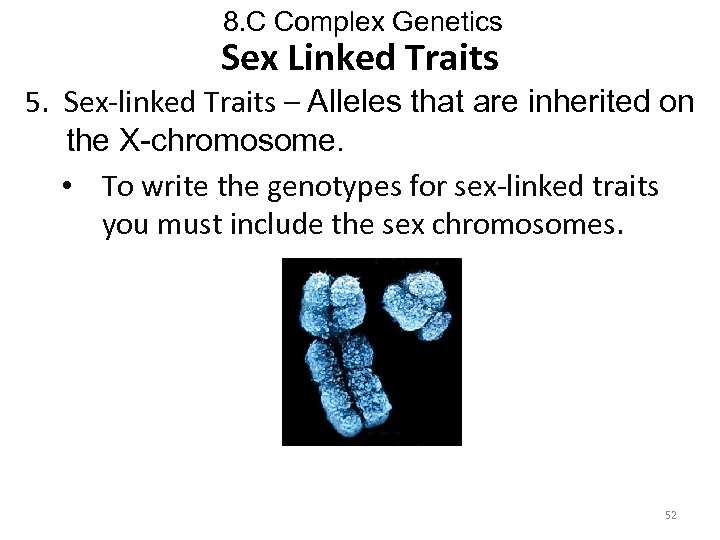 8. C Complex Genetics Sex Linked Traits 5. Sex-linked Traits – Alleles that are inherited on the X-chromosome. • To write the genotypes for sex-linked traits you must include the sex chromosomes. 52
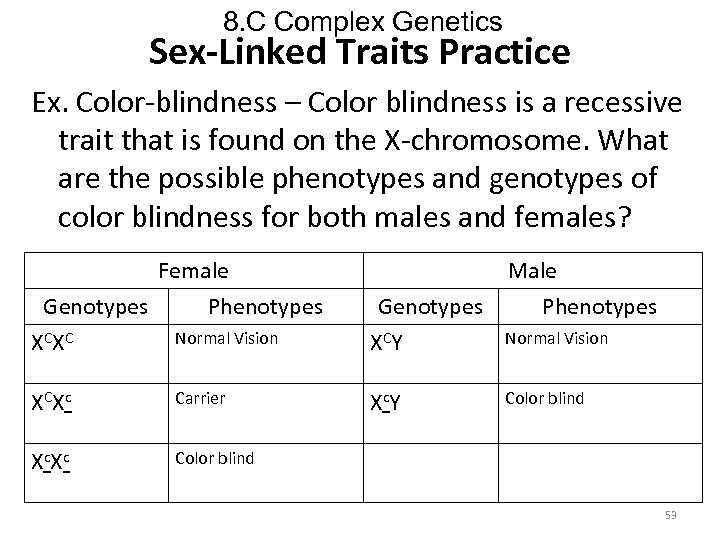 8. C Complex Genetics Sex-Linked Traits Practice Ex. Color-blindness – Color blindness is a recessive trait that is found on the X-chromosome. What are the possible phenotypes and genotypes of color blindness for both males and females? Female Genotypes Phenotypes Male Genotypes Phenotypes XC XC Normal Vision XC Y Normal Vision XC Xc Carrier Xc Y Color blind Xc Xc Color blind 53
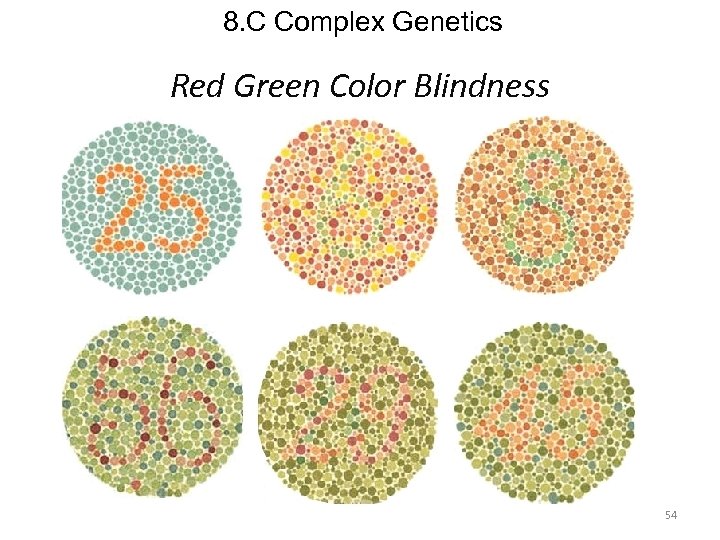 8. C Complex Genetics Red Green Color Blindness 54
 8. C Complex Genetics Sex-Linked Traits Practice Ex. A woman is a carrier for color blindness and she marries a man that is color blind. What percentage of their sons will be color blind? What percentage of their daughters will be color blind? 55
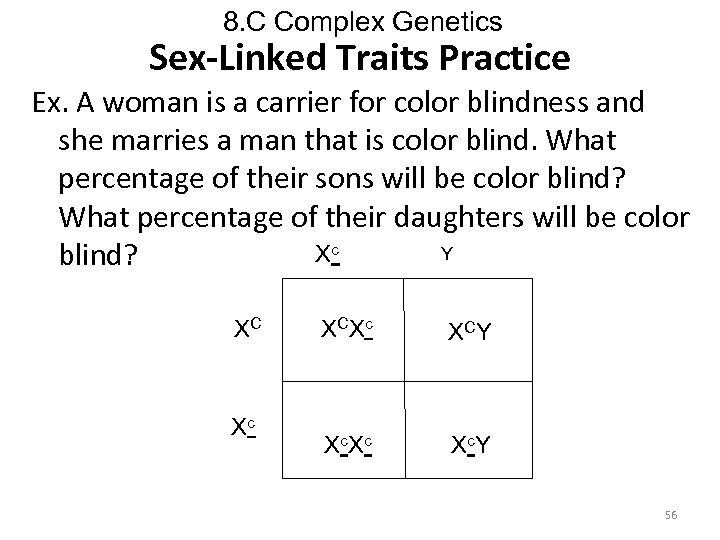 8. C Complex Genetics Sex-Linked Traits Practice Ex. A woman is a carrier for color blindness and she marries a man that is color blind. What percentage of their sons will be color blind? What percentage of their daughters will be color Y Xc blind? XC Xc X CX c X CY X c. Y 56
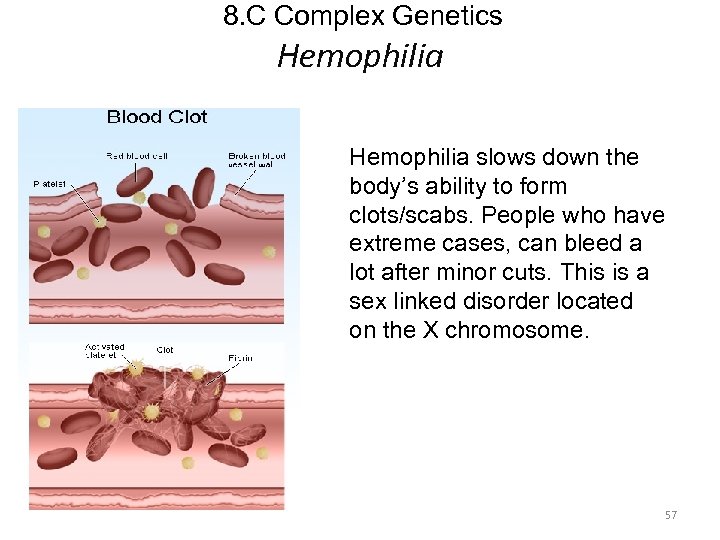 8. C Complex Genetics Hemophilia slows down the body’s ability to form clots/scabs. People who have extreme cases, can bleed a lot after minor cuts. This is a sex linked disorder located on the X chromosome. 57
 8. C Complex Genetics Sex-Linked Traits Practice Ex. A normal man whose father was a hemophiliac marries a woman who is a carrier. What is the probability that their sons will be hemophiliacs? Their daughters? 58
 Amoeba Sisters: Complex Genetics https: //www. youtube. com/watch? v=YJHGfb. W 55 l 0 59
 Warm-Up is on whiteboard today! 60
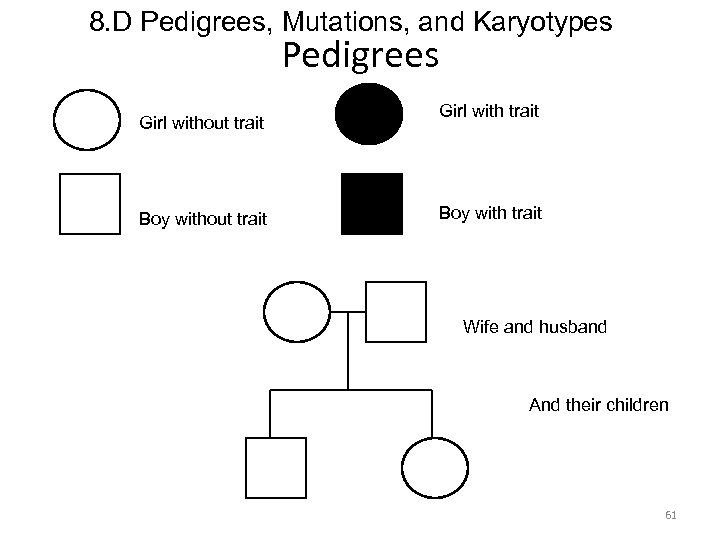 8. D Pedigrees, Mutations, and Karyotypes Pedigrees Girl without trait Boy without trait Girl with trait Boy with trait Wife and husband And their children 61
 8. D Pedigrees, Mutations, and Karyotypes What can you tell from a pedigree? 1. Number of Generations: 2. Relationships: 3. Dominant or Recessive: 4. Sex Linked or Autosomal: 62
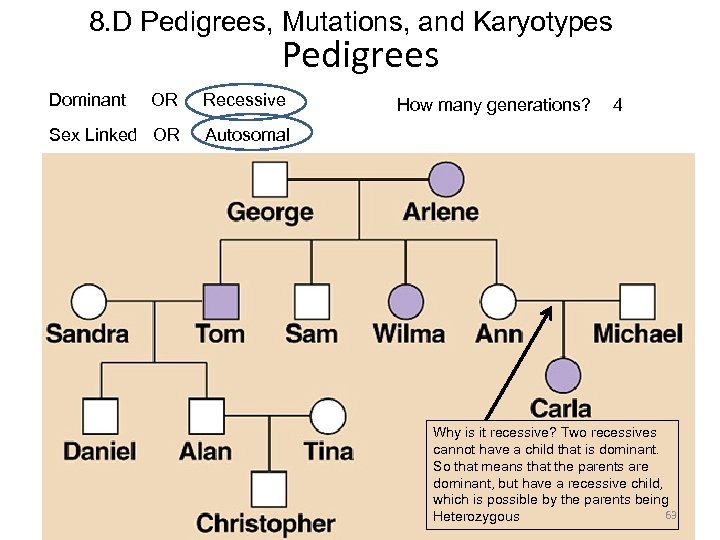 8. D Pedigrees, Mutations, and Karyotypes Pedigrees Dominant OR Recessive Sex Linked OR Autosomal How many generations? 4 Why is it recessive? Two recessives cannot have a child that is dominant. So that means that the parents are dominant, but have a recessive child, which is possible by the parents being 63 Heterozygous
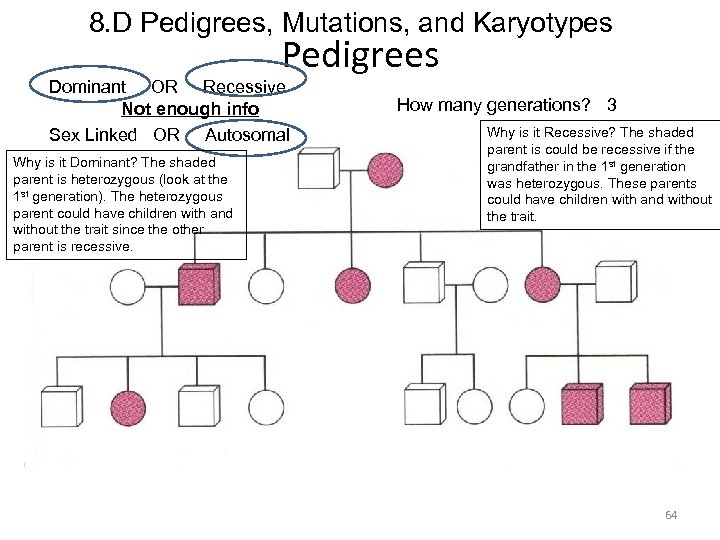 8. D Pedigrees, Mutations, and Karyotypes Pedigrees Dominant OR Recessive Not enough info Sex Linked OR Autosomal Why is it Dominant? The shaded parent is heterozygous (look at the 1 st generation). The heterozygous parent could have children with and without the trait since the other parent is recessive. How many generations? 3 Why is it Recessive? The shaded parent is could be recessive if the grandfather in the 1 st generation was heterozygous. These parents could have children with and without the trait. 64
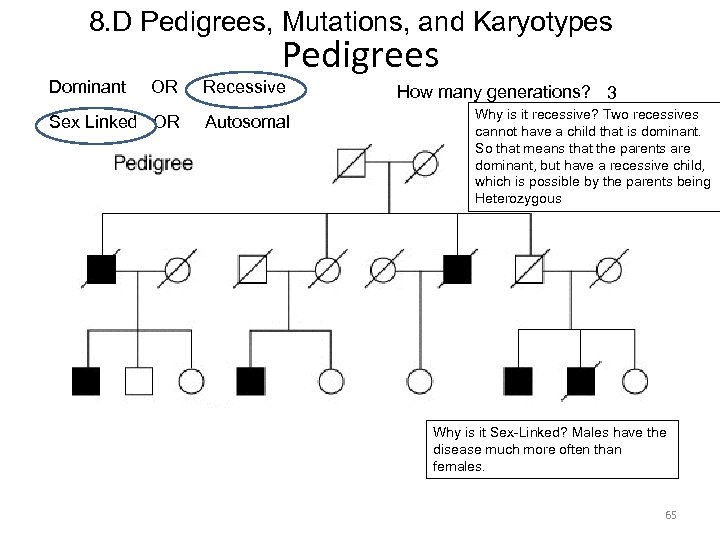 8. D Pedigrees, Mutations, and Karyotypes Dominant Pedigrees OR Recessive Sex Linked OR Autosomal How many generations? 3 Why is it recessive? Two recessives cannot have a child that is dominant. So that means that the parents are dominant, but have a recessive child, which is possible by the parents being Heterozygous Why is it Sex-Linked? Males have the disease much more often than females. 65
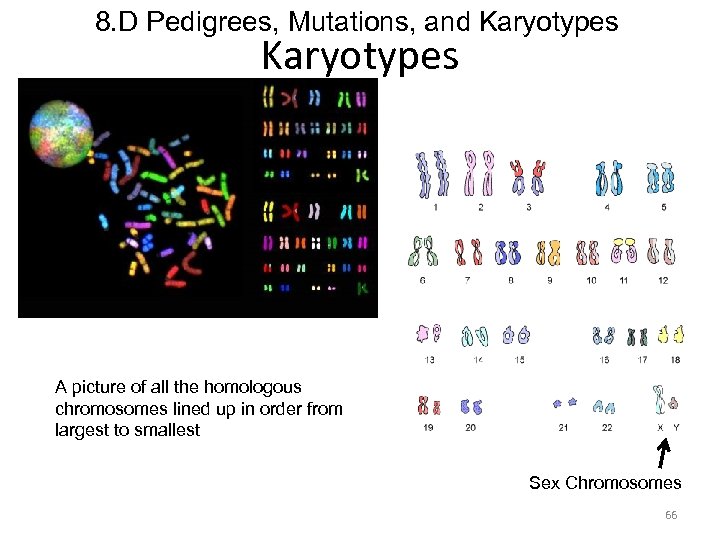 8. D Pedigrees, Mutations, and Karyotypes A picture of all the homologous chromosomes lined up in order from largest to smallest Sex Chromosomes 66
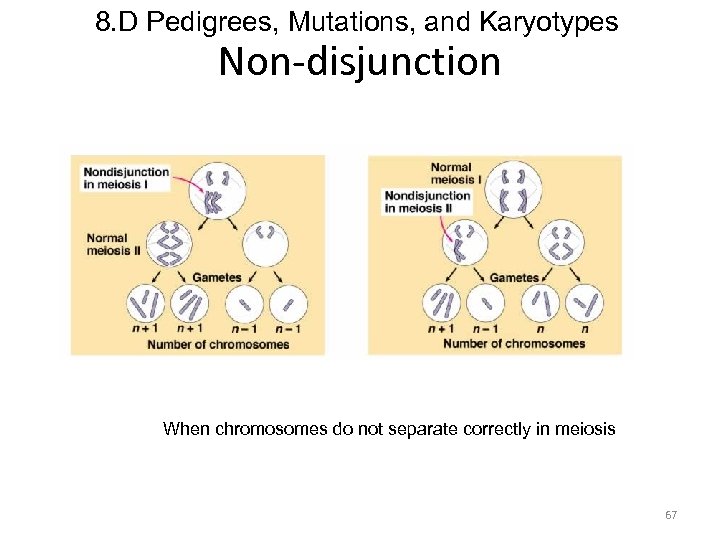 8. D Pedigrees, Mutations, and Karyotypes Non-disjunction When chromosomes do not separate correctly in meiosis 67
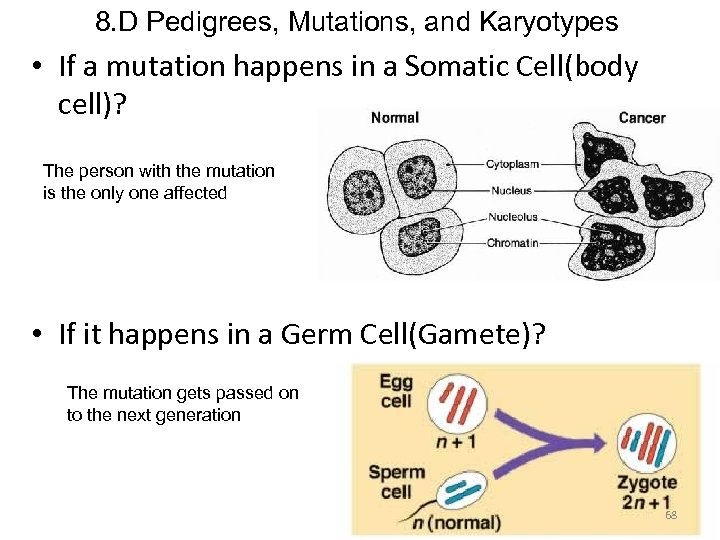 8. D Pedigrees, Mutations, and Karyotypes • If a mutation happens in a Somatic Cell(body cell)? The person with the mutation is the only one affected • If it happens in a Germ Cell(Gamete)? The mutation gets passed on to the next generation 68
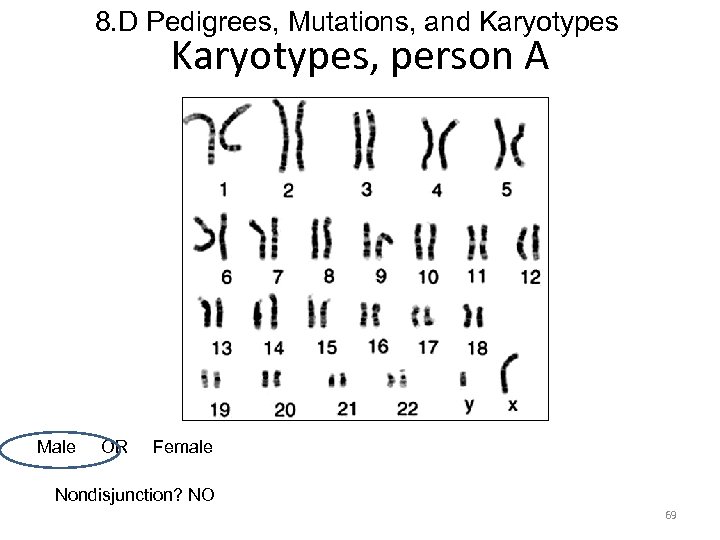 8. D Pedigrees, Mutations, and Karyotypes, person A Male OR Female Nondisjunction? NO 69
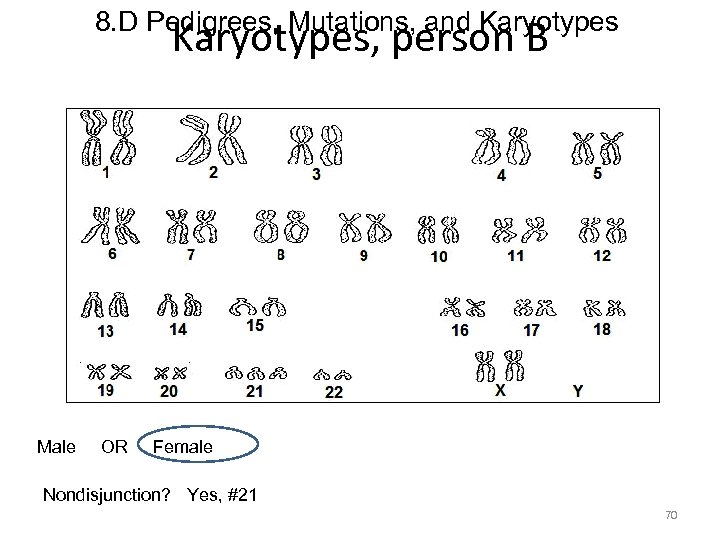 8. D Pedigrees, Mutations, and Karyotypes, person B Male OR Female Nondisjunction? Yes, #21 70
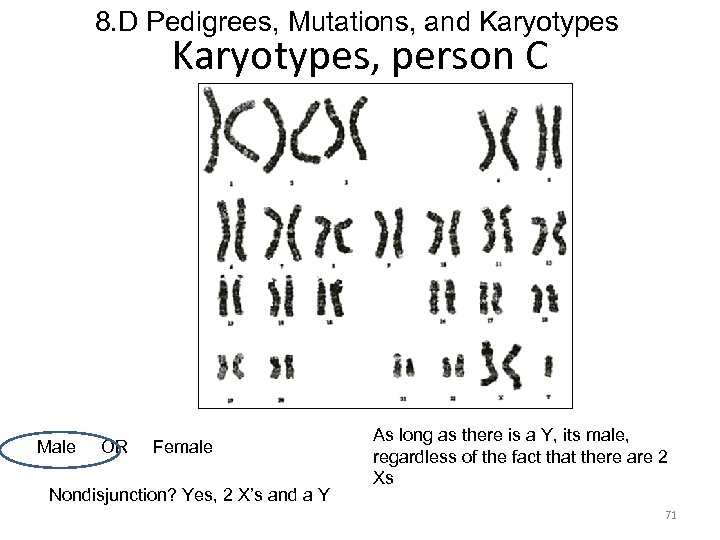 8. D Pedigrees, Mutations, and Karyotypes, person C Male OR Female Nondisjunction? Yes, 2 X’s and a Y As long as there is a Y, its male, regardless of the fact that there are 2 Xs 71
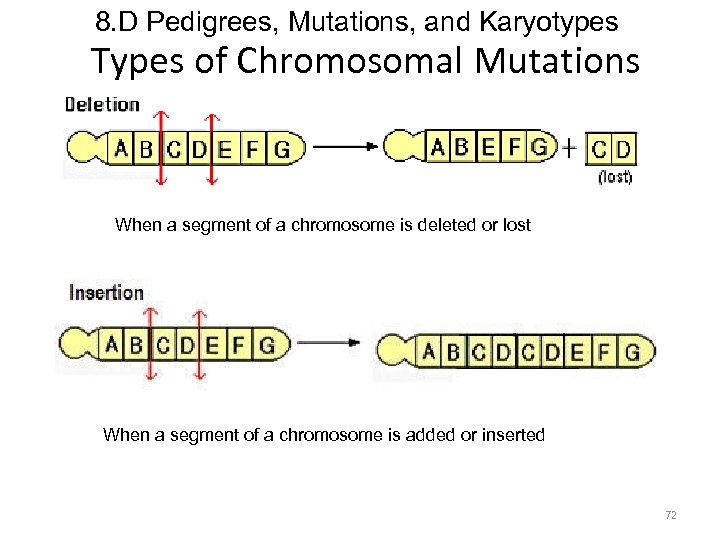 8. D Pedigrees, Mutations, and Karyotypes Types of Chromosomal Mutations When a segment of a chromosome is deleted or lost When a segment of a chromosome is added or inserted 72
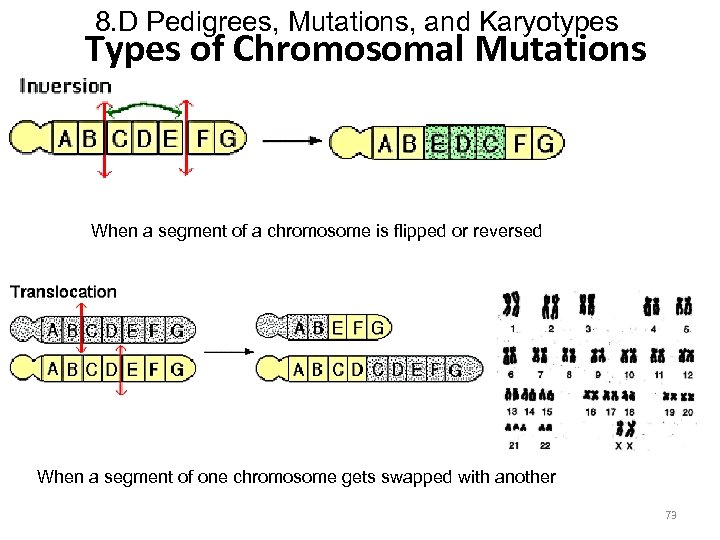 8. D Pedigrees, Mutations, and Karyotypes Types of Chromosomal Mutations When a segment of a chromosome is flipped or reversed When a segment of one chromosome gets swapped with another 73
 Warm-Up 1. Get out your HW and calendar 2. In your warm up section, write the questions and answer each: – How many chromosomes are found in a normal body cell? – How many chromosomes are found in an egg cell? – What process produces sperm and egg? 74