


 Скачать презентацию Warm Up Compare life in Athens and
e71baf615cfa7e361bd6b519febbdd44.ppt
- Количество слайдов: 41
 Warm Up: • Compare life in Athens and Sparta.
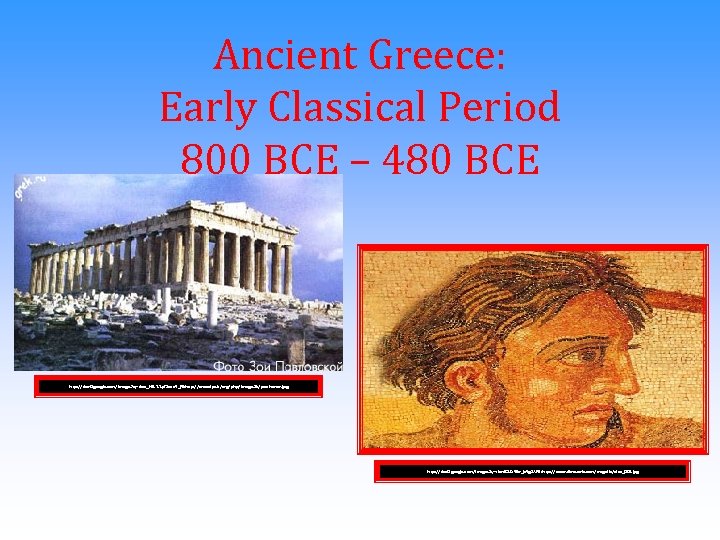 Ancient Greece: Early Classical Period 800 BCE – 480 BCE http: //tbn 0. google. com/images? q=tbn: _HZZZyf 2 exn 4_M: http: //www. ipc. lt/wg/php/images 26/parthenon. jpg http: //tbn 0. google. com/images? q=tbn: 9 XLt. Bkr_b 4 g 8 AM: http: //www. dinosoria. com/tragedie/alex_007. jpg
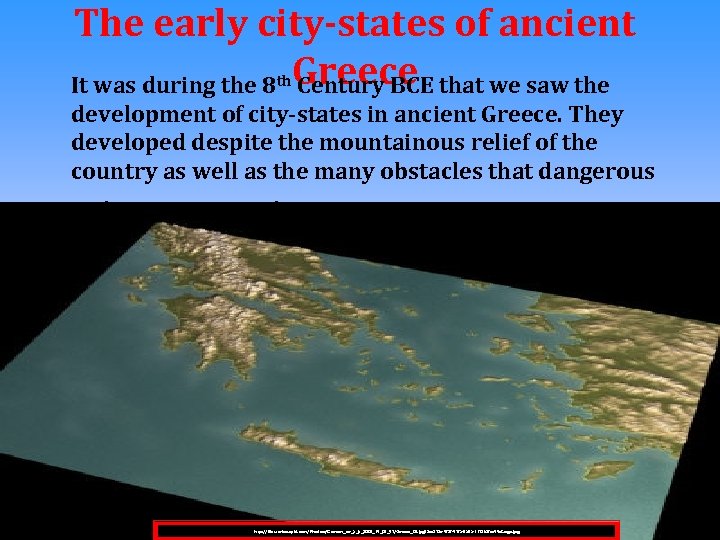 The early city-states of ancient It was during the 8 Greece that we saw the Century BCE th development of city-states in ancient Greece. They developed despite the mountainous relief of the country as well as the many obstacles that dangerous waterways present. http: //files. turbosquid. com/Preview/Content_on_5_6_2004_14_03_47/Greece_03. jpg 98 ea 372 a-4 f 8 f-47 f 5 -9595 -117263 fca 44 a. Large. jpg
 The Early Classical Period of ancient Greece Political, Cultural and Technological/Economic advancements of the Period: Ø First Greek colony in the Bay of Naples (750 BCE) Ø The Persian Wars (550 – 480 BCE); Battles of Marathon, Thermopylae, Salamis Ø Greeks adopt the Phoenician alaphabet Ø First Olympic Games (776 BCE) Ø Acropolis in Athens is begun Ø Metal currency becomes common Ø The Greeks learn how to use iron
 The Persian Wars 550 BCE – 479 BCE Before the Persian Wars (between Greece and the Empire of Persia, to the west) Greece was not an overly unified country. They did share: 1. The same culutre, 2. The same language, and 3. The same religion. However, in spite of these commonalities, each city-state was faithful/loyal to itself, and there often wars or disputes amongst the city-states. 1. 2. There were two major city-states in Greece: Sparta, and Athens each with their own set of allies.
 The Persian Wars 550 BCE – 479 BCE What follows are two slides that will show the immensity of the Persian Empire (versus which the Greeks fought the Persian Wars) as well as the sites of the five main battles of the Persian Wars: 1. Marathon – land battle 2. Thermopylae – land battle 3. Salamine – naval battle 4. Platea – land battle
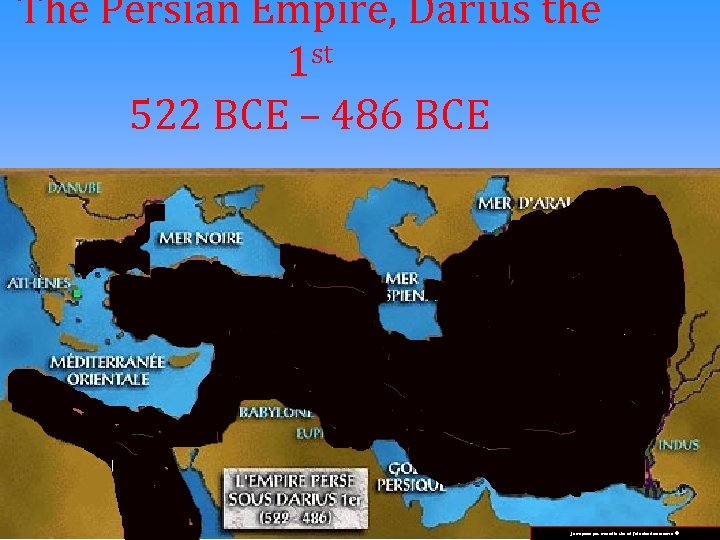 The Persian Empire, Darius the st 1 522 BCE – 486 BCE Je ne peux pas trouvé le site où j’ai enlevé cette carte
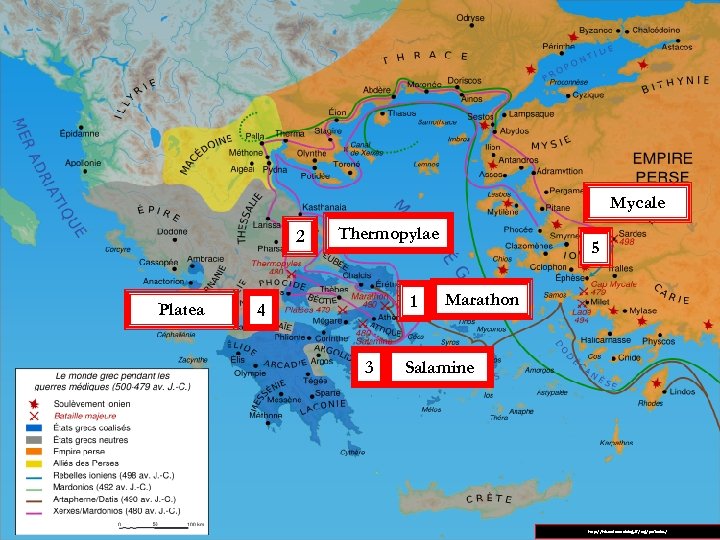 Mycale 2 Platea Thermopylae 1 4 3 5 Marathon Salamine http: //historien. unblog. fr/tag/periodes/
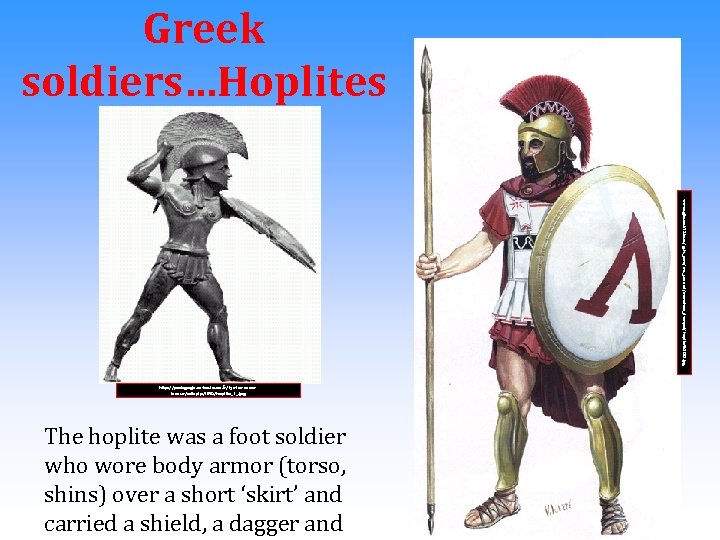 Greek soldiers…Hoplites www. sgibson. k 12. in. us/gshs_new/ms_socstud/marathon_dwmpnl/hoplite%2065. jpg http: //pedagogie. ac-toulouse. fr/lyc-las-caseslavaur/cdispip/IMG/hoplite_1_. jpg The hoplite was a foot soldier who wore body armor (torso, shins) over a short ‘skirt’ and carried a shield, a dagger and
 The Battle at Marathon Athens vs. The Persian Empire 490 BCE 1. 2. 3. 4. Ø Ø One of the most celebrated military engagements in the history of warfare. One of the first historically recorded battles. The Greek victory over the Persian invaders gave the Greeks confidence in their army, their culture and their society. The battle, then, is a defining moment in the development of european culture (for if they’d lost, asian influences would have abound) September, 490 BCE – a 600 boat Persian armada with 20 000 infantry and cavalry came ashore just north of Athens. Their mission: crush the Greek city-states in retaliation for the support of the Ionian revolt (the western banks of Turkey). Undaunted by superior numbers, 10 000 hoplites mobilized to defend Athens and the two armies met on the plains of Marathon, 26 miles north of Athens. The battle field was flat, surrounded by hills and the sea…ideal for the Persians. Seeing this the Greeks hesitated.
 The Battle at Marathon Athens vs. The Persian Empire 490 BCE Ø Miltiades commanded his hoplites to form a single line and to attack on a dead run. Ø In the melee that followed, the middle of the Greek line weakened but the flanks engulfed the Persians and slaughtered them. Ø 6 400 Persians dead; 192 Greeks. Ø The Persians who were not killed escaped by boat and attempted to attack the city of Athens, but the Greeks double-timed it back to the city and fought them off once again. Winner: The Greeks
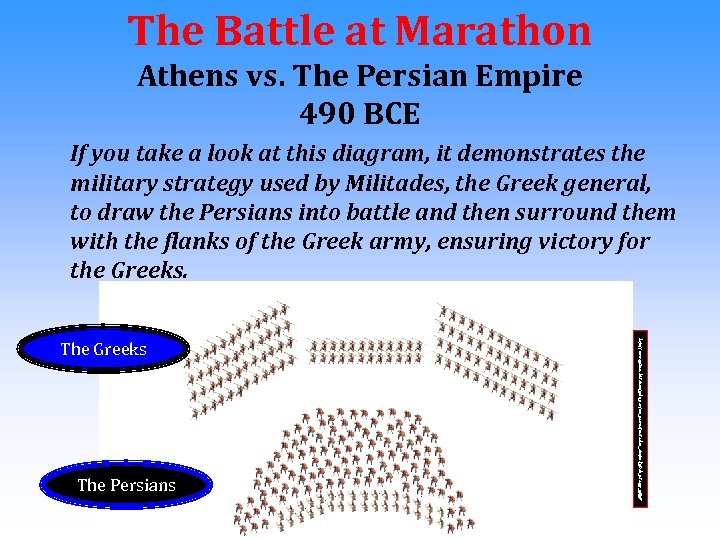 The Battle at Marathon Athens vs. The Persian Empire 490 BCE If you take a look at this diagram, it demonstrates the military strategy used by Militades, the Greek general, to draw the Persians into battle and then surround them with the flanks of the Greek army, ensuring victory for the Greeks. The Persians http: //www. sgibson. k 12. in. us/gshs_new/ms_socstud/marathon_dwmpnl/greek_strategy_gif. gif The Greeks
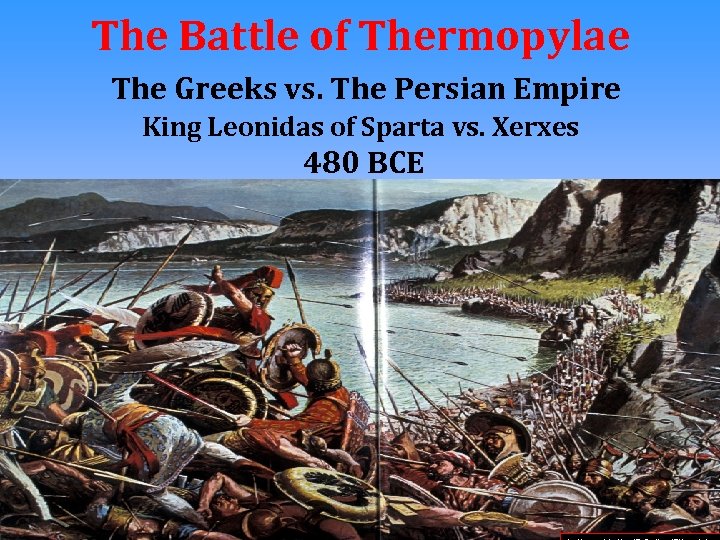 The Battle of Thermopylae The Greeks vs. The Persian Empire King Leonidas of Sparta vs. Xerxes 480 BCE
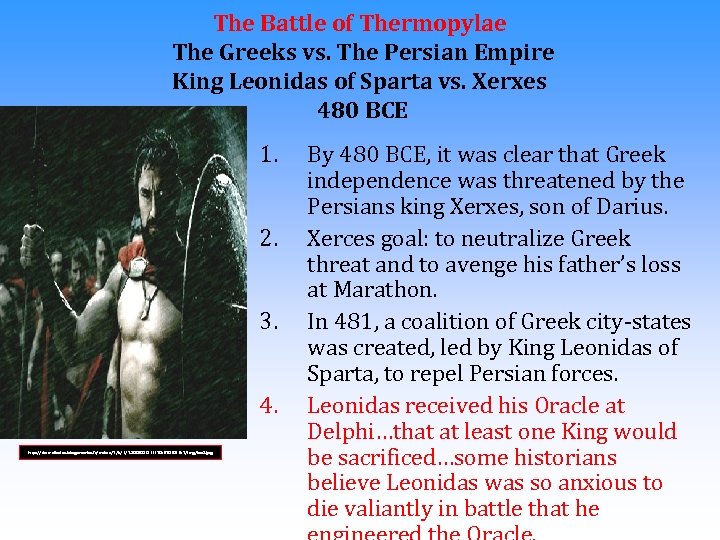 The Battle of Thermopylae The Greeks vs. The Persian Empire King Leonidas of Sparta vs. Xerxes 480 BCE 1. 2. 3. 4. http: //data-allocine. blogomaniac. fr/mdata/7/6/1/Z 20010212111706970102167/img/leo 2. jpg By 480 BCE, it was clear that Greek independence was threatened by the Persians king Xerxes, son of Darius. Xerces goal: to neutralize Greek threat and to avenge his father’s loss at Marathon. In 481, a coalition of Greek city-states was created, led by King Leonidas of Sparta, to repel Persian forces. Leonidas received his Oracle at Delphi…that at least one King would be sacrificed…some historians believe Leonidas was so anxious to die valiantly in battle that he
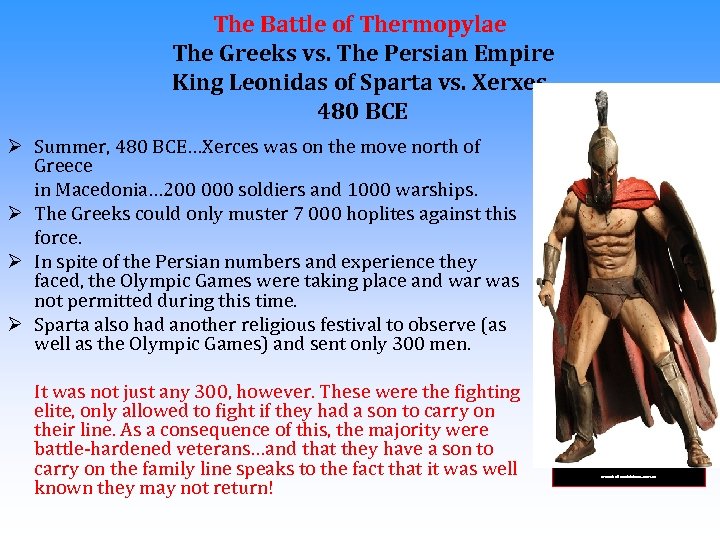 The Battle of Thermopylae The Greeks vs. The Persian Empire King Leonidas of Sparta vs. Xerxes 480 BCE Ø Summer, 480 BCE…Xerces was on the move north of Greece in Macedonia… 200 000 soldiers and 1000 warships. Ø The Greeks could only muster 7 000 hoplites against this force. Ø In spite of the Persian numbers and experience they faced, the Olympic Games were taking place and war was not permitted during this time. Ø Sparta also had another religious festival to observe (as well as the Olympic Games) and sent only 300 men. It was not just any 300, however. These were the fighting elite, only allowed to fight if they had a son to carry on their line. As a consequence of this, the majority were battle-hardened veterans…and that they have a son to carry on the family line speaks to the fact that it was well known they may not return! www. kollectablekaos. com. au
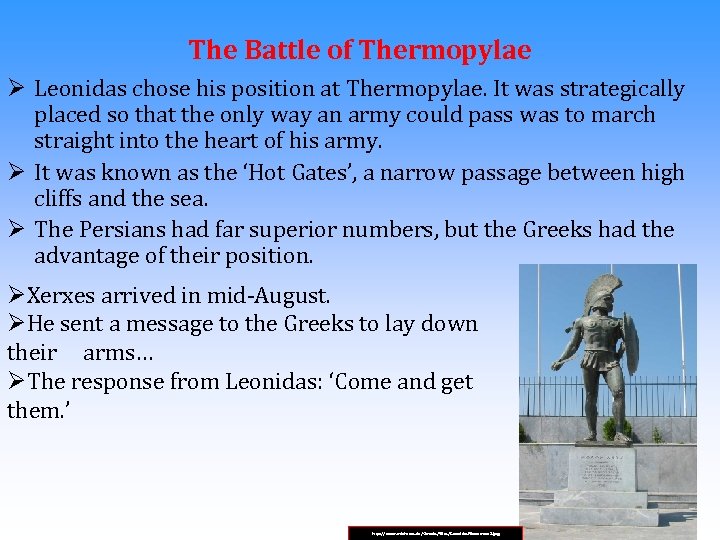 The Battle of Thermopylae Ø Leonidas chose his position at Thermopylae. It was strategically placed so that the only way an army could pass was to march straight into the heart of his army. Ø It was known as the ‘Hot Gates’, a narrow passage between high cliffs and the sea. Ø The Persians had far superior numbers, but the Greeks had the advantage of their position. ØXerxes arrived in mid-August. ØHe sent a message to the Greeks to lay down their arms… ØThe response from Leonidas: ‘Come and get them. ’ http: //www. mlahanas. de/Greeks/Bios/Leonidas. Monument 2. jpg
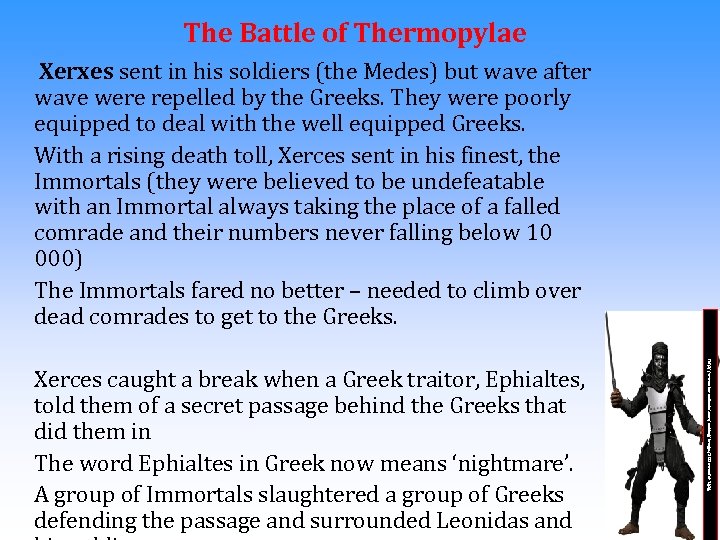 The Battle of Thermopylae Xerxes sent in his soldiers (the Medes) but wave after wave were repelled by the Greeks. They were poorly equipped to deal with the well equipped Greeks. With a rising death toll, Xerces sent in his finest, the Immortals (they were believed to be undefeatable with an Immortal always taking the place of a falled comrade and their numbers never falling below 10 000) The Immortals fared no better – needed to climb over dead comrades to get to the Greeks. http: //www. cine-collector. com/catalog/images/300 immortel-1. jpg Xerces caught a break when a Greek traitor, Ephialtes, told them of a secret passage behind the Greeks that did them in The word Ephialtes in Greek now means ‘nightmare’. A group of Immortals slaughtered a group of Greeks defending the passage and surrounded Leonidas and
 The Battle of Thermopylae For Spartans, there was no choice of surrender – they fought to the death. It is said that the 300, led by Leonidas himself, fought with reckless abandon, when they lost their arms (swords, etc. . ) they fought with their bare hands and their teeth. Before the final Spartan was killed, 20 000 of Xerces men, including two of this brothers, were dead. He commanded that Leonidas be decapitated and quickly had his own dead buried to protect the loss from the rest of his army. The battle was technically a loss for the Greeks, however extraordiary courage of Leonidas and his men allowed for valuable time for the Athenian fleet to build up and protect Athens. The valiant effort of the 300 at Thermopylae gave the entire Greek county the resolve needed to face and conquer the Perians. Because of this the Greek way of life, with their democratic ways, survived to be the cornerstone of modern western civilization. If the Greeks had been victorious our life could easily be very different with influences from Persia for the last 2000 years. Winner: Persia
 The Battle of Thermopylae The Battle Of Thermopylae 1 The Battle Of Thermopylae 2 The Battle Of Thermopylae 3
 The Battle of Salamine Themistocles vs. Xerxes 480 BCE Large naval battle at Salamine fought between the Greeks and Persians in 480 BCE Strait of Salamine and Attica. One of the last battles of the Perisan Wars Greece was led by Themistocles, and Athenian (responsible for the strategy used in the battle) It was Eurybiades (a Spartan) who led the Greeks into battle versus Xerxes. During the battle, Xerces observed from a distance. His boats outnumbered the Greeks 3: 1 The Greeks, however, had the advantage of speed an intimate knowledge of the waters in which they would battle. The Greeks could also swim; when the Persians ships went down, the men drowned.
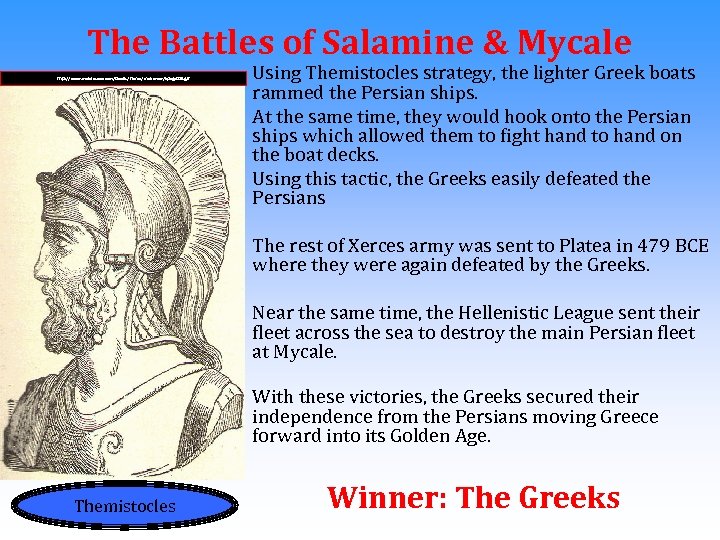 The Battles of Salamine & Mycale http: //www. mainlesson. com/books/horne/statesmen/zpage 029. gif Using Themistocles strategy, the lighter Greek boats rammed the Persian ships. At the same time, they would hook onto the Persian ships which allowed them to fight hand to hand on the boat decks. Using this tactic, the Greeks easily defeated the Persians The rest of Xerces army was sent to Platea in 479 BCE where they were again defeated by the Greeks. Near the same time, the Hellenistic League sent their fleet across the sea to destroy the main Persian fleet at Mycale. With these victories, the Greeks secured their independence from the Persians moving Greece forward into its Golden Age. Themistocles Winner: The Greeks
 After the Persian Wars, there were changes in Ancient Greece…
 The Delian League After the Persian Wars, the Greeks made a maritime association to protect themselves against further Persian invasions. 1. 2. 3. This was the Delian League. Each city-state was to contribute: A sum of money Boats, or soldiers. The problem: Athens was the center of the League and used the funds to build its city-state and not towards a common defense, as the money was to be used for. Result : the Peloponnesian Wars
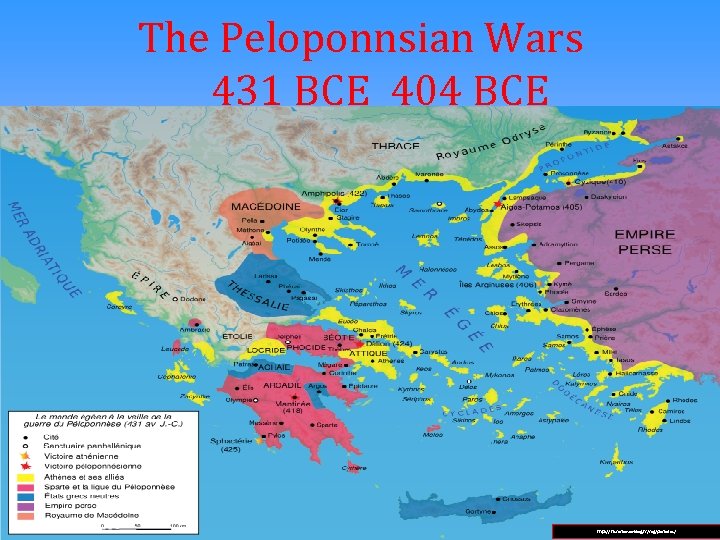 The Peloponnsian Wars 431 BCE 404 BCE http: //historien. unblog. fr/tag/periodes/
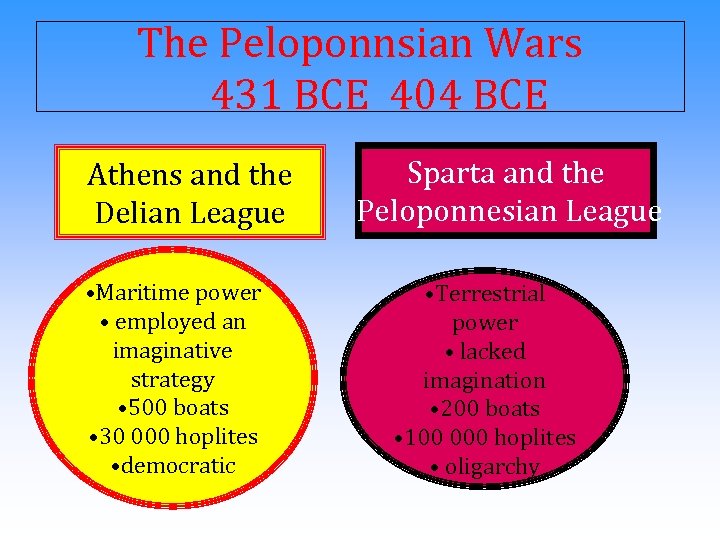 The Peloponnsian Wars 431 BCE 404 BCE Athens and the Delian League • Maritime power • employed an imaginative strategy • 500 boats • 30 000 hoplites • democratic Sparta and the Peloponnesian League • Terrestrial power • lacked imagination • 200 boats • 100 000 hoplites • oligarchy
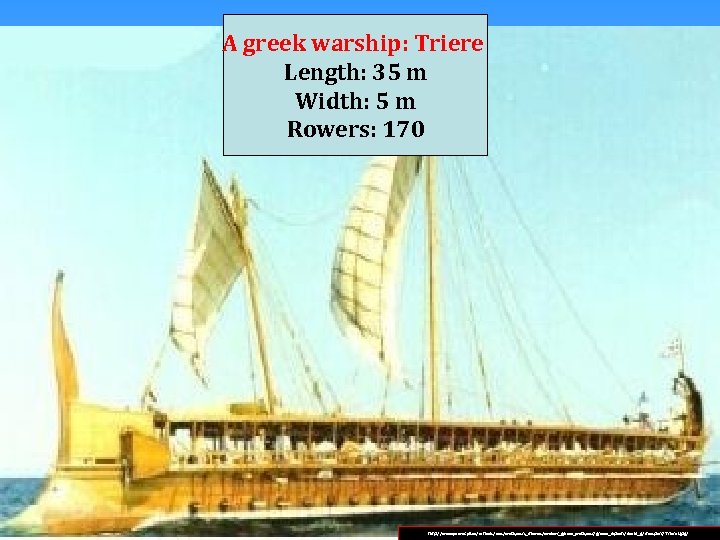 A greek warship: Triere Length: 35 m Width: 5 m Rowers: 170 http: //www. yesnet. yk. ca/schools/webquests_themes/ancient_greece_webquest/greece_reports/david_g/transport/Triere 1. jpg/
 The Peloponnsian Wars The period of Peace (peace treaty signed in 421 BCE called the Peace Nicias) lasted about 5 years. Sparta was suspicious of Athens and also jealous of them.
 Sparta wins the war War ended in 404 BCE (27 yeas of war) Two results: 1. Greece was very much weakened 2. Macedonia (a country to the north) used this weakness to take direction of the country
 King Phillip of Macedonia King Phillip II (359 -336 BCE) led Macedonia to become the biggest European power of the day, after the submission of three of its neighbours - Illyrians, Thracians, & the Greeks. The battle of Chaeronea where the Macedonians defeated the Greeks (2 August, 338 BCE) marked the end of the Greek era and the beginning of the Macedonian era. The strength of Phillip’s army came from a formation known as the Phalanx. .
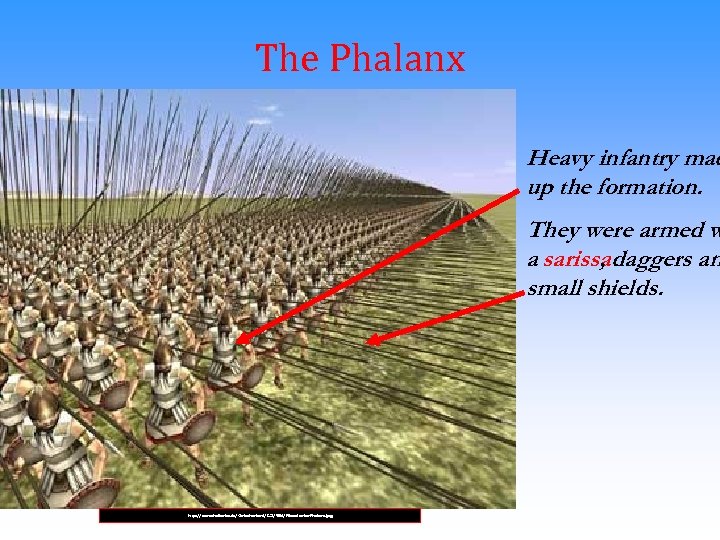 The Phalanx Heavy infantry mad up the formation. They were armed w a sarissa daggers an , small shields. http: //www. hellenica. de/Griechenland/LX/Bild/Macedonian. Phalanx. jpg
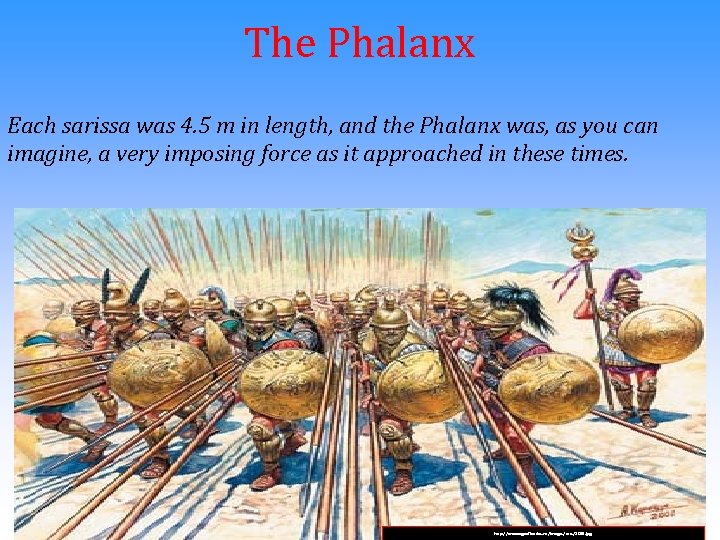 The Phalanx Each sarissa was 4. 5 m in length, and the Phalanx was, as you can imagine, a very imposing force as it approached in these times. http: //www. ageofbattles. ru/images/sets/8019. jpg
 King Phillip II Goal of Phillip II: He was determined to defeat all of Persia using his Phalanx as his weapon to gain wealth and unlimited power. His military force was based on two factors: • his use of the ingenious phalanx as his main tool • his cavalry The ferocity of his army led all city-states in Greece to sign non-aggression pacts with Phillip, except Sparts. This was known as the Corinthian League. He did not meet his goal, as he was killed at the marriage of his daughter…his son, Alexander became King.
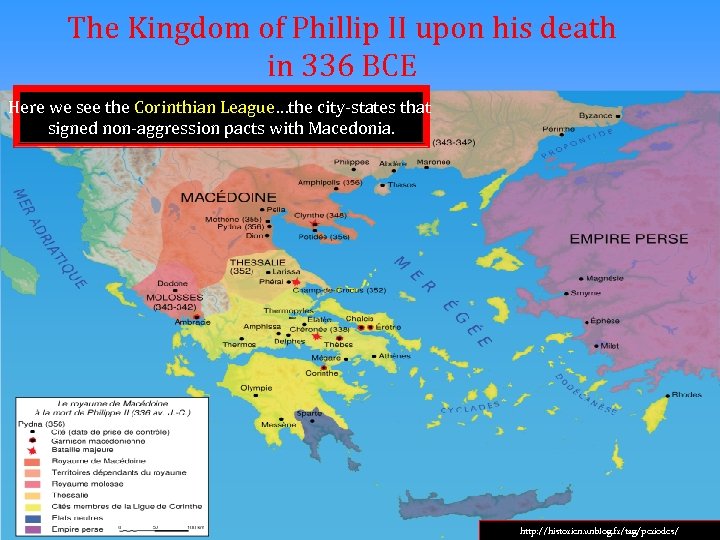 The Kingdom of Phillip II upon his death in 336 BCE Here we see the Corinthian League…the city-states that signed non-aggression pacts with Macedonia. http: //historien. unblog. fr/tag/periodes/
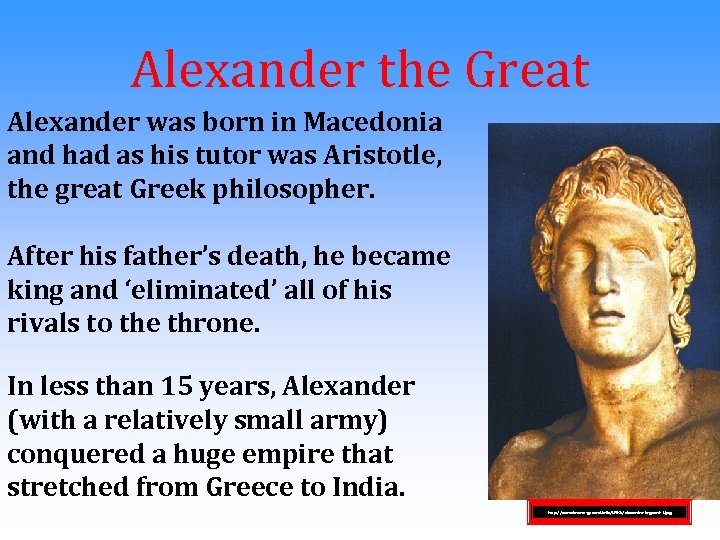 Alexander the Great Alexander was born in Macedonia and had as his tutor was Aristotle, the great Greek philosopher. After his father’s death, he became king and ‘eliminated’ all of his rivals to the throne. In less than 15 years, Alexander (with a relatively small army) conquered a huge empire that stretched from Greece to India. http: //www. interet-general. info/IMG/alexandre-le-grand-1. jpg
 Alexander the Great Ø Left Macedonia in the spring of 334 BCE (and never returned) Ø In 333 BCE, he battled Darius III. Darius fled leaving Alexander his Empire, his wife and his children. ØHe then moved onto Egypt. ØIn 331 BCE Alexander left Egypt to defeat, once and for all, at Gaugameles ØHe escaped but was later assassinated (Darius III). The Persians had 5: 1 soldiers, but they lost 40 000 soldiers, while Alexander lost only 500. ØAlexander continued his conquests and entered India. ØBy 326 BCE, he was taking on Poros, a strong king. Despite his elephants, he was defeated by Alexander. ØAlexander’s favorite horse, Bucephale, was killed in this battle.
 Alexander the Great He wished to continue, however his soldiers were exhausted and refused. The return to Macedonia was horrible…his army followed him across the desert and many of his men died of hunger and thirst. As he was prepared to conquer Arabia, Alexander died at a banquet (reason unknown)
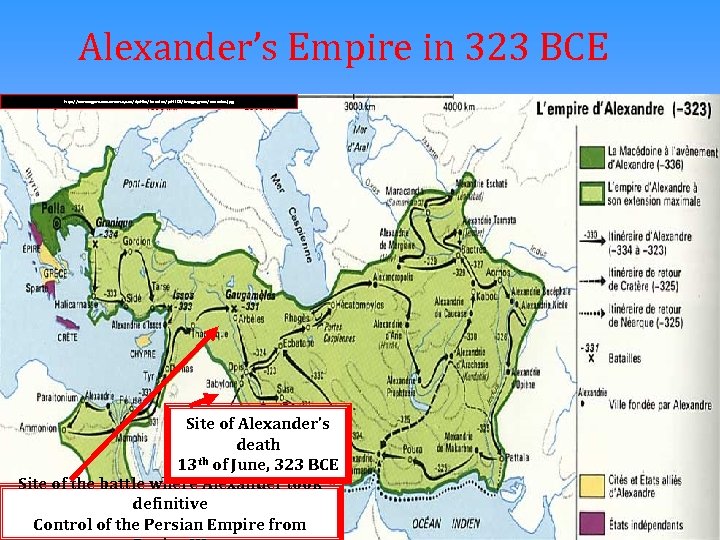 Alexander’s Empire in 323 BCE http: //www. agora. crosemont. qc. ca/dphilo/intradoc/phi 103/imagesgrece/cartealex. jpg Site of Alexander’s death 13 th of June, 323 BCE Site of the battle where Alexander took definitive Control of the Persian Empire from
 The genius of Alexander the Great Ø He absorbed the greek and persian armies, allowing the cultures to blend and learn from one another. Ø He respected the laws and customs of the places he conquered, taking the greek culture to the far reaches of the empire. Ø He even married the daughter of Darius III (Roxane) and encouraged his soldiers to do the same (10 000 soldiers actually married Persian women)
 The legacy of Alexander … In spite of his death at a young age, his influence on the history of the world was profound: His empire provided a large base for the diffusion of greek culture and began a cultural exchange between artists and artisans. He founded 70 cities, many of whom bear his name that became cultural centers and commercial centers He founded universities that taught subject close to his heart: military and war, medicine, botany, zoology and astronomy.
 Reading and Questions
 FISS 10 – Les civilisations anciennes La Grèce Présentation II – La Grèce …des Cité-États à Alexandre le Grand M. Bridgeo, WHS Répondez aux questions ci-dessous utilisant l’information présentée contenu dans la presentation powerpoint© La Grèce …des Cité-États à Alexandre le Grand. 1. Nommez cinq avancements dans la culture grecque durant La Période Classique de la Grèce. 2. Les grecs n’avaient pas un pays uni. Mais ils ont tous partagé deux choses qui les ont lié ensemble. Lesquels? 3. Même avec ces similitudes, les cité-états ont fait la guerre avec l’un l’autre. Quels étaient les deux cite-états les plus puissants? 4. Vers 500 av. J-C, l’Empire Perse situé à l’est de la Grèce dominait le monde connu. Les grecs ont fait la guerre avec l’Empire Perse pendant 20 ans. Quel nom donnait-on aux guerres entre l’Empire Perse et les grecs? 5. Quels sont les plus grands batailles entre les grecs et les perses? 6. Récapitulez chacune des trois batailles. n'oubliez pas d'inclure les noms principaux des individus et des endroits, aussi bien que des dates. 7. Qu’est-ce que La Ligue de Délos? 8. Qu’est-ce qui a causé la guerre du Péloponnèse? 9. Quelles sont les dates du début et la fin de la guerre? 10. Quels sont les deux résultats de la guerre? 11. Pourquoi la date 338 av. J-C est-elle importante dans l’histoire de la Grèce? 12. Qui sont Philip II, Alexandre le Grand et qu’est un Phalynx? Comment sont-ils reliés ensemble?