


 Скачать презентацию Warehousing An Overview Module 8 Packagin
be28308e70211f2b281c821791e69905.ppt
- Количество слайдов: 25
 Warehousing – An Overview Module 8
 Packagin g A & B Items Components
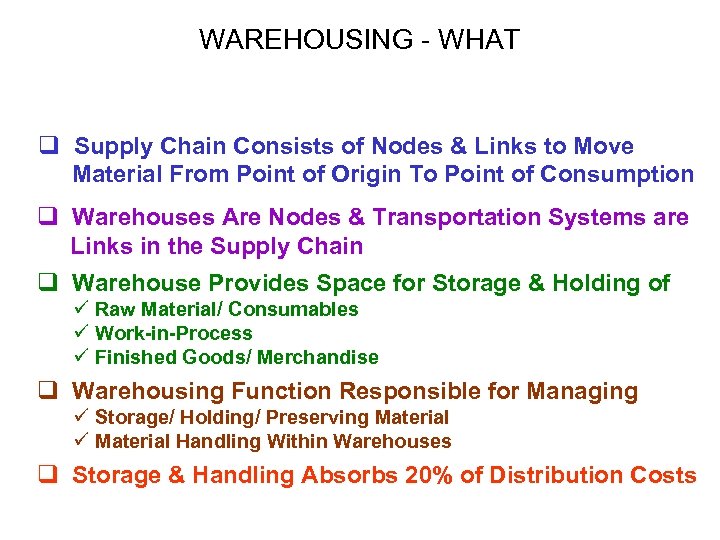 WAREHOUSING - WHAT q Supply Chain Consists of Nodes & Links to Move Material From Point of Origin To Point of Consumption q Warehouses Are Nodes & Transportation Systems are Links in the Supply Chain q Warehouse Provides Space for Storage & Holding of ü Raw Material/ Consumables ü Work-in-Process ü Finished Goods/ Merchandise q Warehousing Function Responsible for Managing ü Storage/ Holding/ Preserving Material ü Material Handling Within Warehouses q Storage & Handling Absorbs 20% of Distribution Costs
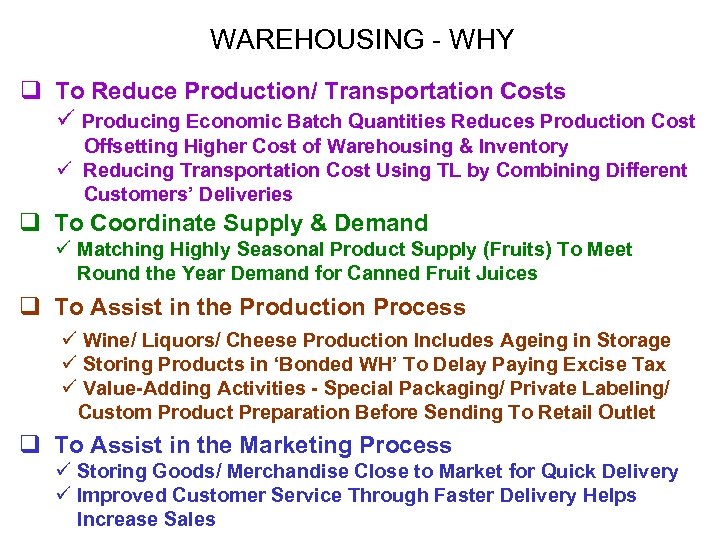 WAREHOUSING - WHY q To Reduce Production/ Transportation Costs ü Producing Economic Batch Quantities Reduces Production Cost Offsetting Higher Cost of Warehousing & Inventory ü Reducing Transportation Cost Using TL by Combining Different Customers’ Deliveries q To Coordinate Supply & Demand ü Matching Highly Seasonal Product Supply (Fruits) To Meet Round the Year Demand for Canned Fruit Juices q To Assist in the Production Process ü Wine/ Liquors/ Cheese Production Includes Ageing in Storage ü Storing Products in ‘Bonded WH’ To Delay Paying Excise Tax ü Value-Adding Activities - Special Packaging/ Private Labeling/ Custom Product Preparation Before Sending To Retail Outlet q To Assist in the Marketing Process ü Storing Goods/ Merchandise Close to Market for Quick Delivery ü Improved Customer Service Through Faster Delivery Helps Increase Sales
 WAREHOUSING - WHY q Creates TIME Utility for Raw Material/ Industrial Goods/ Finished Products/ Merchandise q Market-Oriented Warehouses Situated Close to Market Allows Firms to Serve Customers Faster q Warehousing Increases Utility of Goods for Prospective Customers by Broadening their Time Availability q Warehousing Allows Company’s to Provide Higher Customer Service By Making Goods Available WHEN and WHERE Customers Demand Them q Importance of Warehousing Increasing as Companies Use Customer Service As A Dynamic/ Value-Adding Competitive Tool
 BASIC WAREHOUSING OPERATIONS q Warehouse Management ü Material Handling/ Movement of Material ü Inventory Holding/Storage q Material Handling Activities ü Loading/ Unloading ü Moving Product To/ From Various Locations Within Warehouse ü Order Picking ü Order Assembly q Storage/ Inventory Holding Activities ü Accumulation of Inventory Over Time ü Different Locations/ Lengths of Storing Time Based On Purpose of Storage q Short-Distance Product Movement in W/H Operations ü Receiving – Bringing in Goods from Transport Network ü Put Away - Moving From Receiving Dock to Pre-Storing Area ü Order Picking – Selecting Products For Filling Customer Order ü Collating - Staging/ Packaging/ Preparing for Shipping ü Shipping - Loading Goods for Shipping To Customer
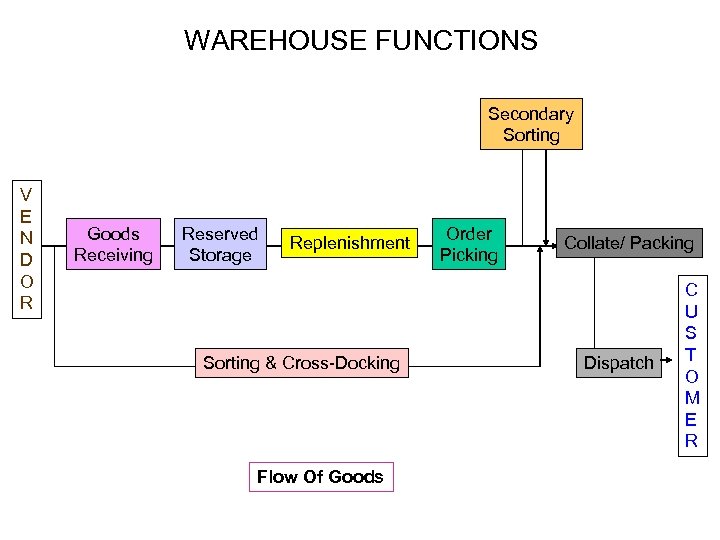 WAREHOUSE FUNCTIONS Secondary Sorting V E N D O R Goods Receiving Reserved Storage Replenishment Sorting & Cross-Docking Flow Of Goods Order Picking Collate/ Packing Dispatch C U S T O M E R
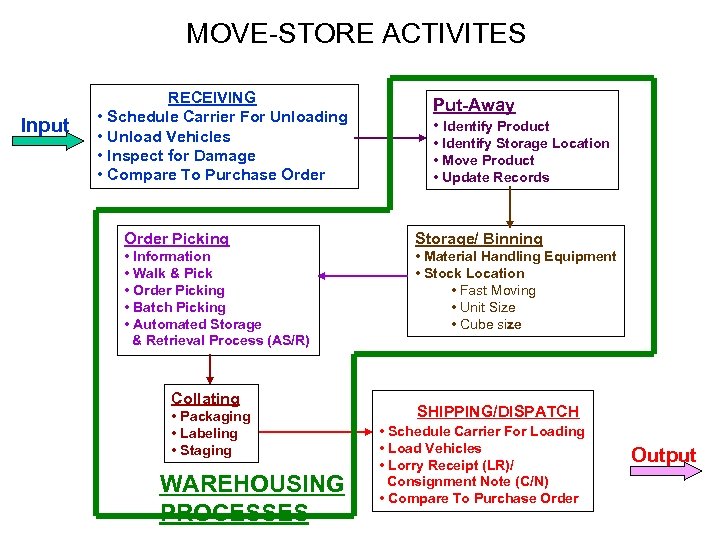 MOVE-STORE ACTIVITES Input RECEIVING • Schedule Carrier For Unloading • Unload Vehicles • Inspect for Damage • Compare To Purchase Order Put-Away • Identify Product • Identify Storage Location • Move Product • Update Records Order Picking Storage/ Binning • Information • Walk & Pick • Order Picking • Batch Picking • Automated Storage & Retrieval Process (AS/R) • Material Handling Equipment • Stock Location • Fast Moving • Unit Size • Cube size Collating • Packaging • Labeling • Staging WAREHOUSING PROCESSES SHIPPING/DISPATCH • Schedule Carrier For Loading • Load Vehicles • Lorry Receipt (LR)/ Consignment Note (C/N) • Compare To Purchase Order Output
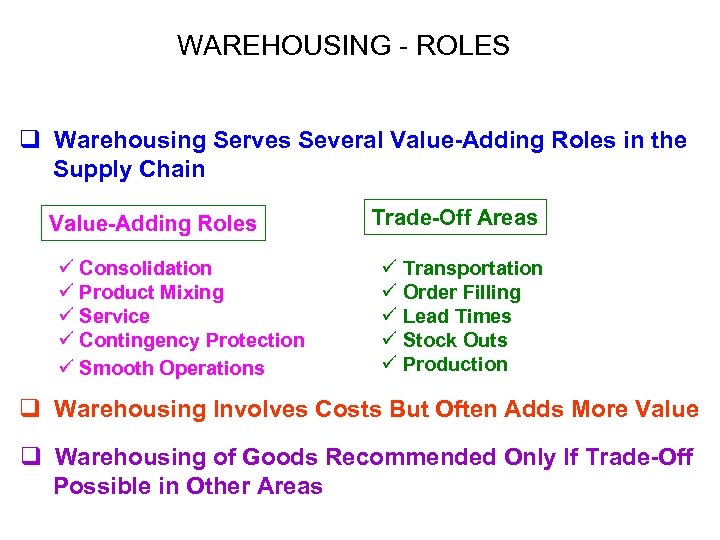 WAREHOUSING - ROLES q Warehousing Serves Several Value-Adding Roles in the Supply Chain Value-Adding Roles ü Consolidation ü Product Mixing ü Service ü Contingency Protection ü Smooth Operations Trade-Off Areas ü Transportation ü Order Filling ü Lead Times ü Stock Outs ü Production q Warehousing Involves Costs But Often Adds More Value q Warehousing of Goods Recommended Only If Trade-Off Possible in Other Areas
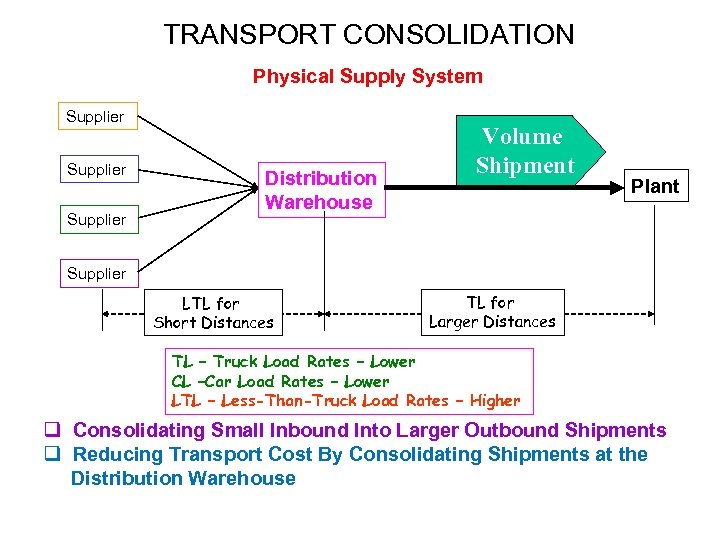 TRANSPORT CONSOLIDATION Physical Supply System Supplier Distribution Warehouse Volume Shipment Plant Supplier LTL for Short Distances TL for Larger Distances TL – Truck Load Rates – Lower CL –Car Load Rates – Lower LTL – Less-Than-Truck Load Rates – Higher q Consolidating Small Inbound Into Larger Outbound Shipments q Reducing Transport Cost By Consolidating Shipments at the Distribution Warehouse
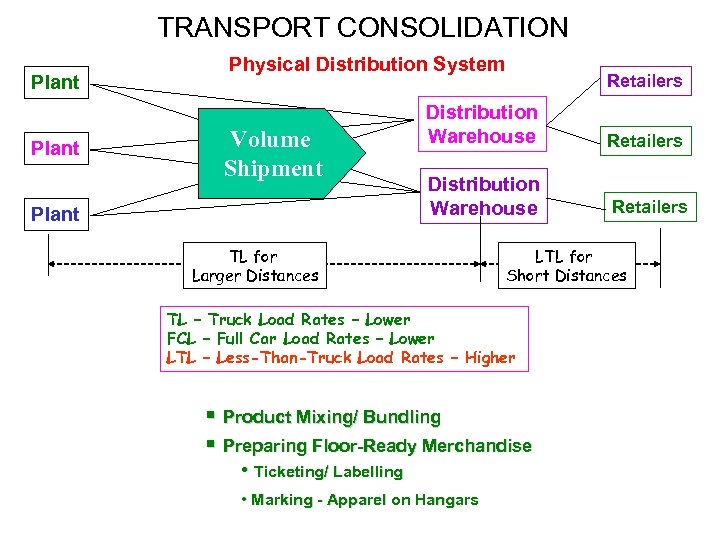 TRANSPORT CONSOLIDATION Plant Physical Distribution System Volume Shipment Plant Retailers Distribution Warehouse Retailers TL for Larger Distances LTL for Short Distances TL – Truck Load Rates – Lower FCL – Full Car Load Rates – Lower LTL – Less-Than-Truck Load Rates – Higher § Product Mixing/ Bundling § Preparing Floor-Ready Merchandise • Ticketing/ Labelling • Marking - Apparel on Hangars
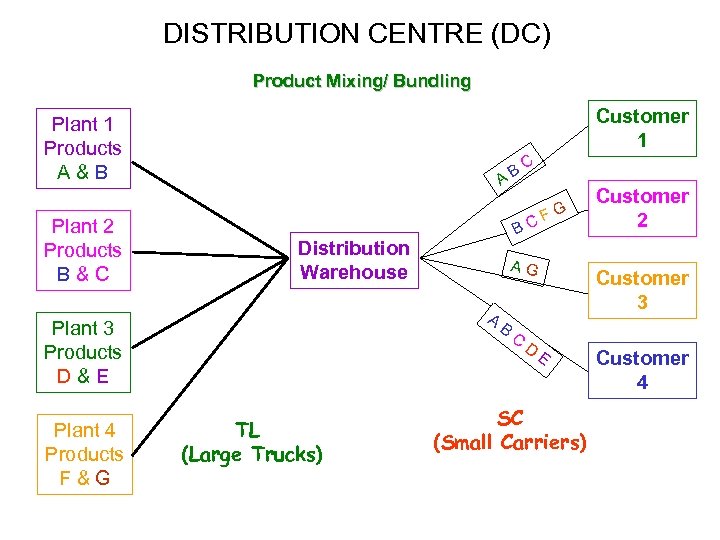 DISTRIBUTION CENTRE (DC) Product Mixing/ Bundling Customer 1 Plant 1 Products A&B Plant 2 Products B&C A Plant 4 Products F&G FG AG A TL (Large Trucks) C BC Distribution Warehouse Plant 3 Products D&E B B C D E SC (Small Carriers) Customer 2 Customer 3 Customer 4
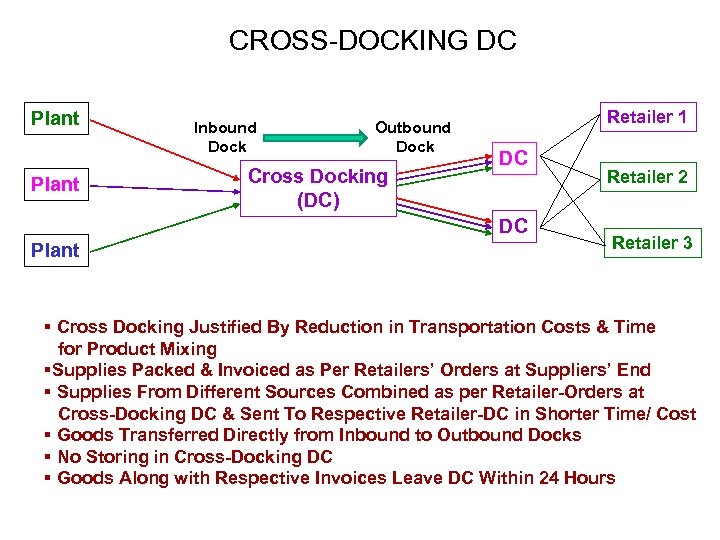 CROSS-DOCKING DC Plant Inbound Dock Outbound Dock Cross Docking (DC) Retailer 1 DC DC Plant Retailer 2 Retailer 3 § Cross Docking Justified By Reduction in Transportation Costs & Time for Product Mixing §Supplies Packed & Invoiced as Per Retailers’ Orders at Suppliers’ End § Supplies From Different Sources Combined as per Retailer-Orders at Cross-Docking DC & Sent To Respective Retailer-DC in Shorter Time/ Cost § Goods Transferred Directly from Inbound to Outbound Docks § No Storing in Cross-Docking DC § Goods Along with Respective Invoices Leave DC Within 24 Hours
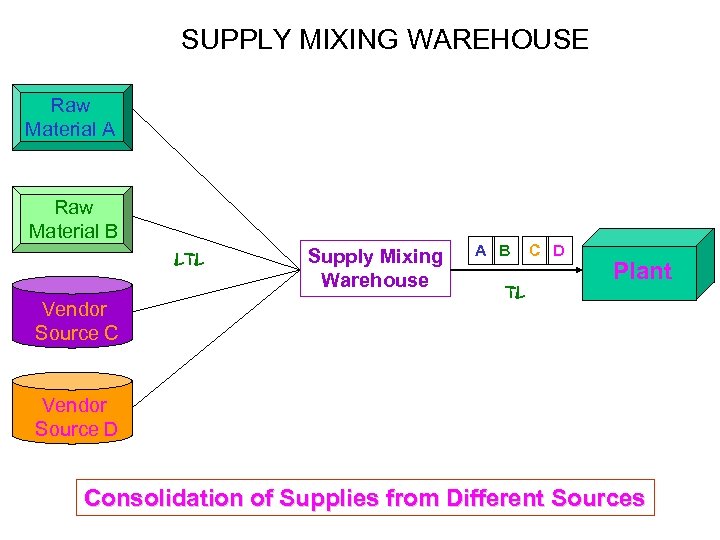 SUPPLY MIXING WAREHOUSE Raw Material A Raw Material B LTL Vendor Source C Supply Mixing Warehouse A B TL C D Plant Vendor Source D Consolidation of Supplies from Different Sources
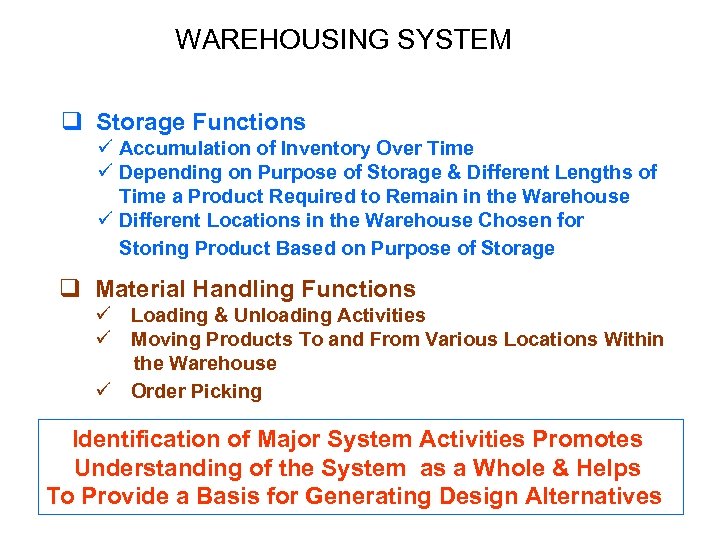 WAREHOUSING SYSTEM q Storage Functions ü Accumulation of Inventory Over Time ü Depending on Purpose of Storage & Different Lengths of Time a Product Required to Remain in the Warehouse ü Different Locations in the Warehouse Chosen for Storing Product Based on Purpose of Storage q Material Handling Functions ü Loading & Unloading Activities ü Moving Products To and From Various Locations Within the Warehouse ü Order Picking Identification of Major System Activities Promotes Understanding of the System as a Whole & Helps To Provide a Basis for Generating Design Alternatives
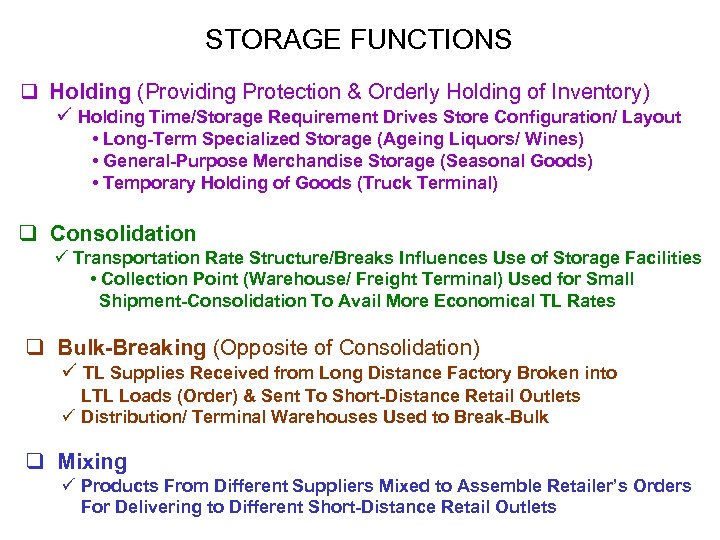 STORAGE FUNCTIONS q Holding (Providing Protection & Orderly Holding of Inventory) ü Holding Time/Storage Requirement Drives Store Configuration/ Layout • Long-Term Specialized Storage (Ageing Liquors/ Wines) • General-Purpose Merchandise Storage (Seasonal Goods) • Temporary Holding of Goods (Truck Terminal) q Consolidation ü Transportation Rate Structure/Breaks Influences Use of Storage Facilities • Collection Point (Warehouse/ Freight Terminal) Used for Small Shipment-Consolidation To Avail More Economical TL Rates q Bulk-Breaking (Opposite of Consolidation) ü TL Supplies Received from Long Distance Factory Broken into LTL Loads (Order) & Sent To Short-Distance Retail Outlets ü Distribution/ Terminal Warehouses Used to Break-Bulk q Mixing ü Products From Different Suppliers Mixed to Assemble Retailer’s Orders For Delivering to Different Short-Distance Retail Outlets
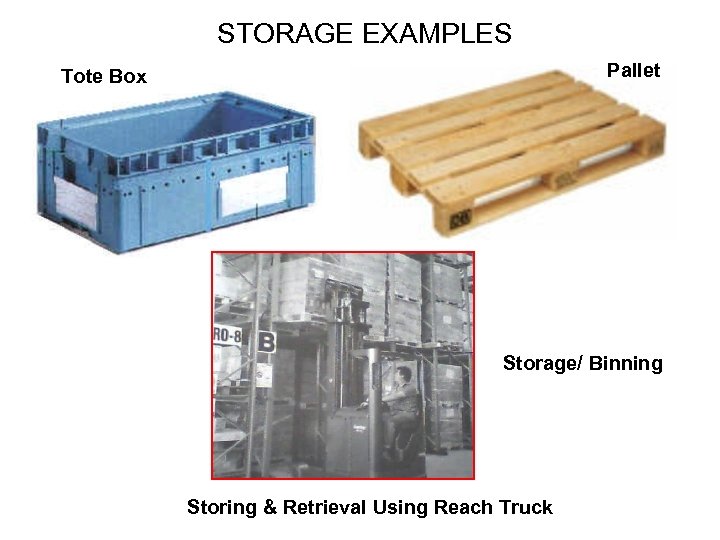 STORAGE EXAMPLES Pallet Tote Box Storage/ Binning Storing & Retrieval Using Reach Truck
 MATERIALS HANDLING FUNCTIONS q Loading & Unloading ü On Arrival at Warehouse Goods Are Unloaded from Trucks ü Packed Goods are Loaded on Outgoing Trucks ü Often Special Equipment are Required for these Operations ü Involves Various Activities of Checking Order Contents/ Order Sequencing etc. q Movement Within Warehouse ü From Unloading Point to Storing Area ü Storing Area to Picking Area ü Picking to Staging Area ü Staging to Packing Area ü Packing to Docking Area q Order Filling/ Picking ü Selection of Stocks From Storage Areas To Build Customer Order ü Order Selection May Take Place Directly From Semi-Permanent/ Bulk Storage Area (Order Picking Areas) ü Often the Most Critical Material Handling Activity due to Small. Volume Orders
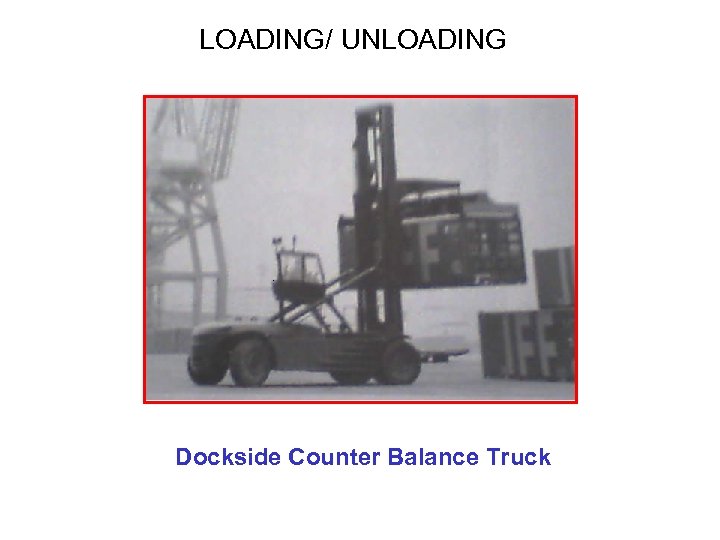 LOADING/ UNLOADING Dockside Counter Balance Truck
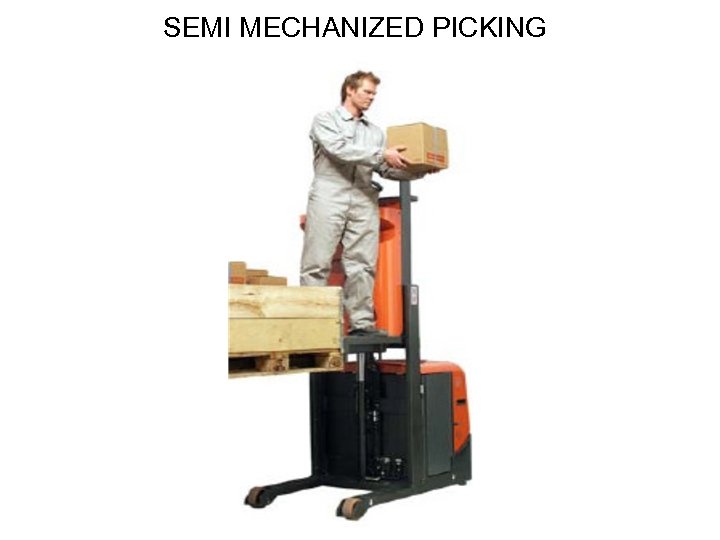 SEMI MECHANIZED PICKING
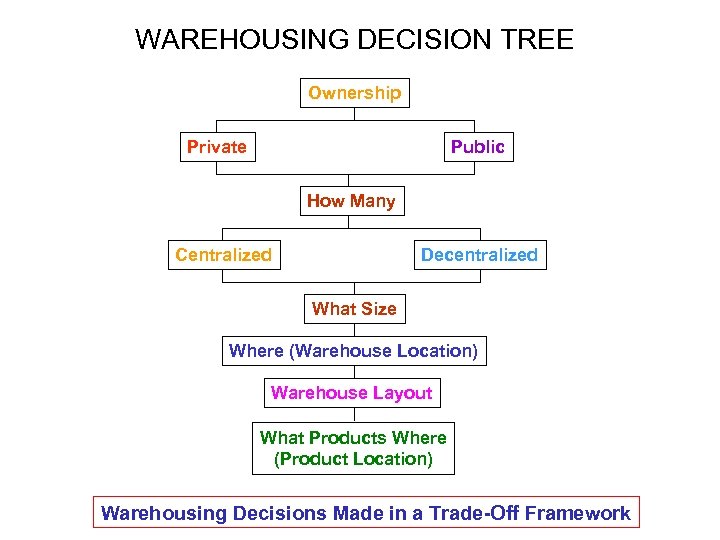 WAREHOUSING DECISION TREE Ownership Private Public How Many Centralized Decentralized What Size Where (Warehouse Location) Warehouse Layout What Products Where (Product Location) Warehousing Decisions Made in a Trade-Off Framework
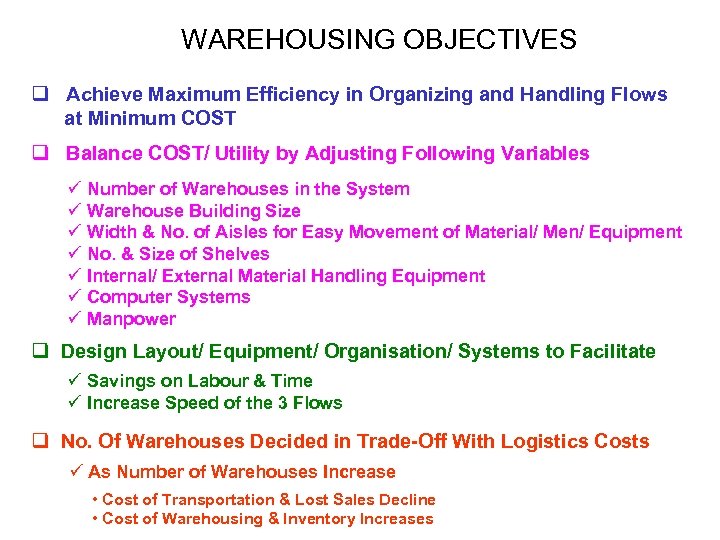 WAREHOUSING OBJECTIVES q Achieve Maximum Efficiency in Organizing and Handling Flows at Minimum COST q Balance COST/ Utility by Adjusting Following Variables ü Number of Warehouses in the System ü Warehouse Building Size ü Width & No. of Aisles for Easy Movement of Material/ Men/ Equipment ü No. & Size of Shelves ü Internal/ External Material Handling Equipment ü Computer Systems ü Manpower q Design Layout/ Equipment/ Organisation/ Systems to Facilitate ü Savings on Labour & Time ü Increase Speed of the 3 Flows q No. Of Warehouses Decided in Trade-Off With Logistics Costs ü As Number of Warehouses Increase • Cost of Transportation & Lost Sales Decline • Cost of Warehousing & Inventory Increases
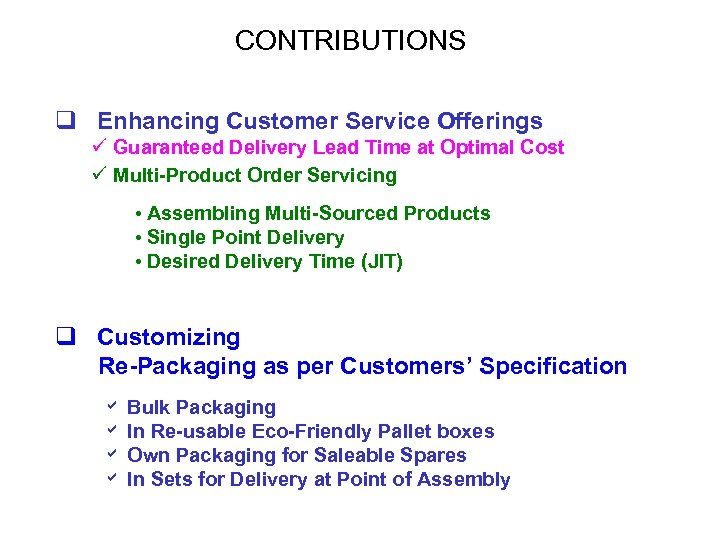 CONTRIBUTIONS q Enhancing Customer Service Offerings ü Guaranteed Delivery Lead Time at Optimal Cost ü Multi-Product Order Servicing • Assembling Multi-Sourced Products • Single Point Delivery • Desired Delivery Time (JIT) q Customizing Re-Packaging as per Customers’ Specification a Bulk Packaging a In Re-usable Eco-Friendly Pallet boxes a Own Packaging for Saleable Spares a In Sets for Delivery at Point of Assembly
 CHANGED WAREHOUSING OBJECTIVES Warehouses Increasingly Becoming VALUE ADDING CENTRES In the FLOW of Goods Rather than Just STORING This is Achieved by Bringing in Goods Just In Time for JIT Deliveries
 Any Questions Please?