


 Скачать презентацию Walter Gropius 1883 — 1969 German Architect
20th c. Architects.ppt
- Количество слайдов: 21
 Walter Gropius (1883 - 1969) • German Architect • Worked under Peter Behrens • Influenced by Frank Lloyd Wright • FOUNDED THE BAUHAUS • Migrated to the US and taught at the Harvard School of Architecture
 “Architects, sculptors, painters, we must all return to the crafts! For art is not a ‘profession. ’ There is no essential difference between the artist and the craftsman. The artist is the exalted craftsman. ” -GROPIUS CHARACTER OF WORKS: • Simple geometry, often rectangular • Use of modern materials like steel and glass • Smooth surfaces • Primary colors • Linear and horizontal elements
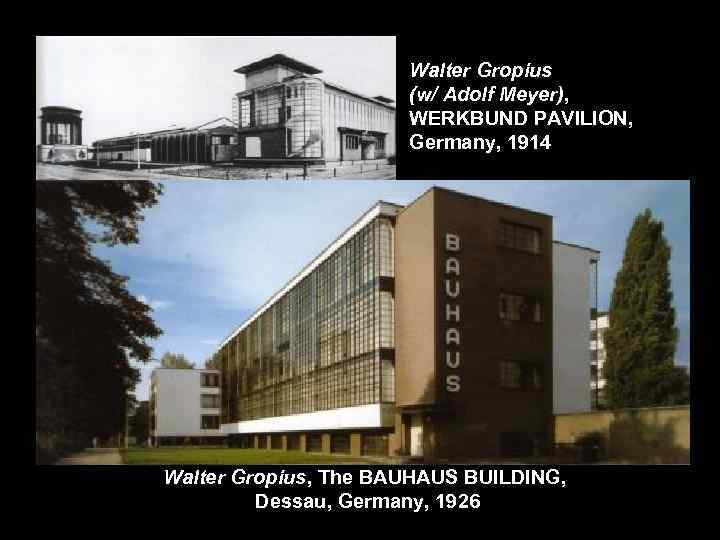 Walter Gropius (w/ Adolf Meyer), WERKBUND PAVILION, Germany, 1914 Walter Gropius, The BAUHAUS BUILDING, Dessau, Germany, 1926
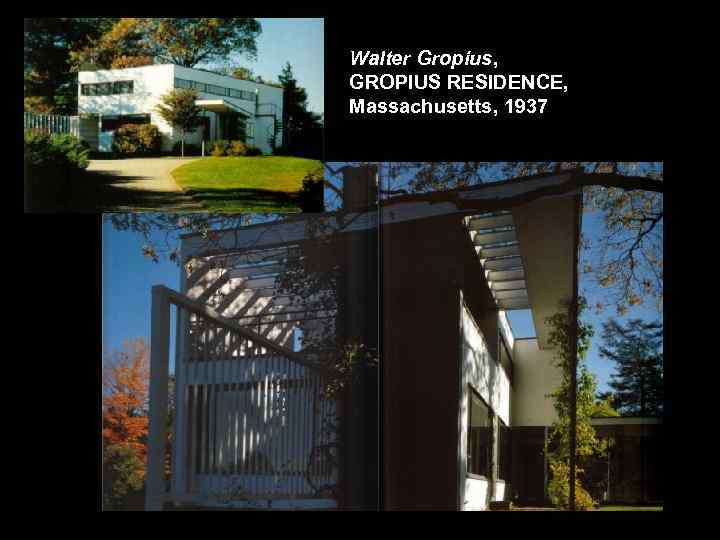 Walter Gropius, GROPIUS RESIDENCE, Massachusetts, 1937
 Ludwig Mies van der Rohe (1886 - 1969) • German Architect • No formal training in architecture • Worked under Peter Behrens • Succeeded Gropius as Bauhaus Director • Migrated to the US and taught architecture at the Illinois Institute of Technology • Designed SKYSCRAPERS OF STEEL AND GLASS which became models of skyscraper design throughout the world
 “Less is more. ” -van der Rohe CHARACTER OF WORKS: • Simple rectangular forms • Open, flexible plans and multi-functional spaces • Widespread use of glass to bring the outside in • Mastered steel and glass construction • Exposed and very refined structural details
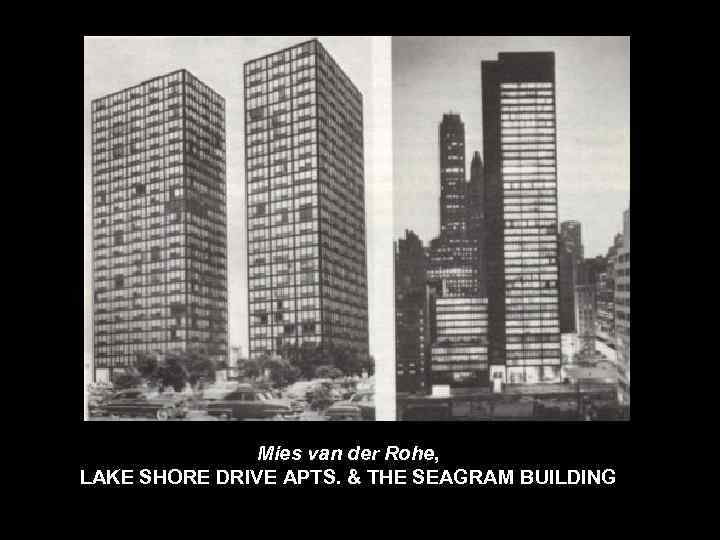 Mies van der Rohe, LAKE SHORE DRIVE APTS. & THE SEAGRAM BUILDING
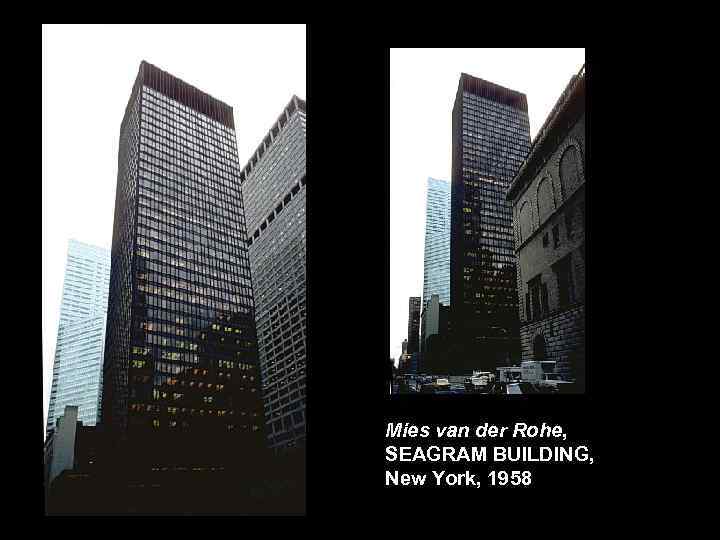 Mies van der Rohe, SEAGRAM BUILDING, New York, 1958
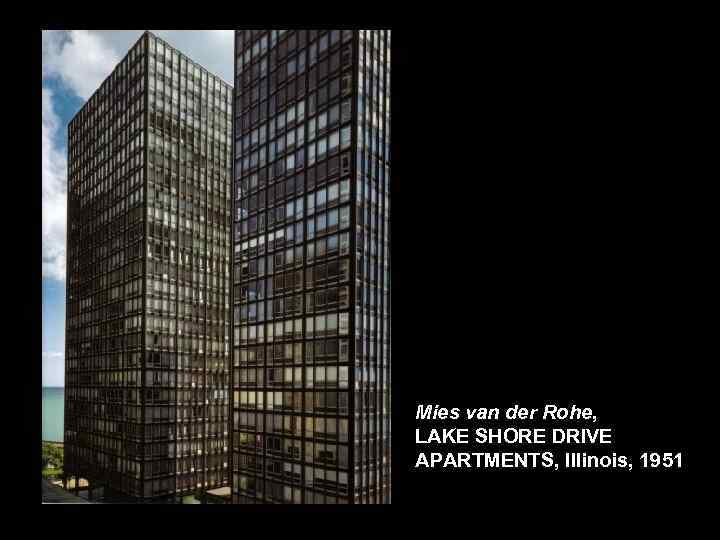 Mies van der Rohe, LAKE SHORE DRIVE APARTMENTS, Illinois, 1951
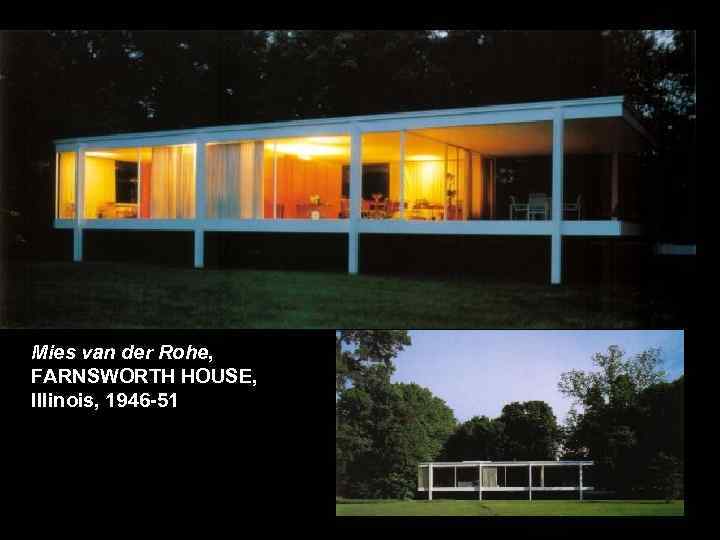 Mies van der Rohe, FARNSWORTH HOUSE, Illinois, 1946 -51
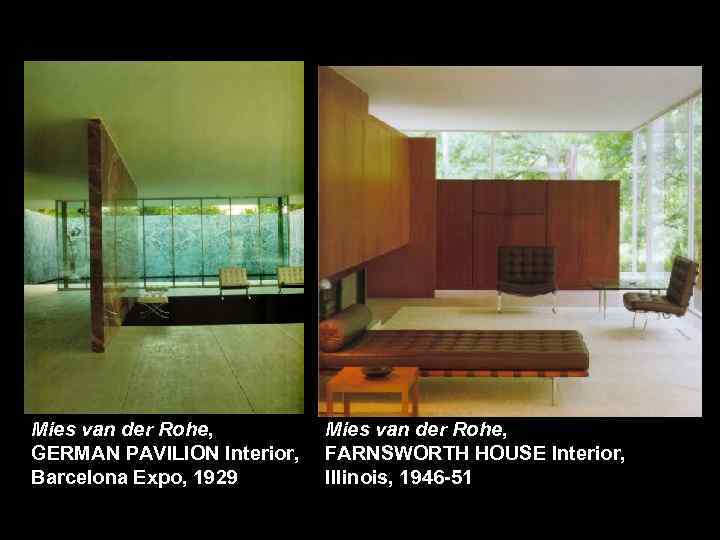 Mies van der Rohe, GERMAN PAVILION Interior, Barcelona Expo, 1929 Mies van der Rohe, FARNSWORTH HOUSE Interior, Illinois, 1946 -51
 Frank Lloyd Wright (1867 - 1959) • American Architect • Worked under Louis Sullivan • Influenced by the British Arts and Crafts Movement and traditional Japanese Architecture • Influenced European modern architects • created the philosophy of ORGANIC ARCHITECTURE, which maintains that the building must develop out of its surroundings. • known for the Prairie Houses, characterized by asymmetrical plans and low, wide overhanging eaves.
 CHARACTER OF WORKS: • strong eastern influences • use of natural materials like bricks, stone and wood • use of textured concrete • designs that blend well in its environment • focused more on residential designs
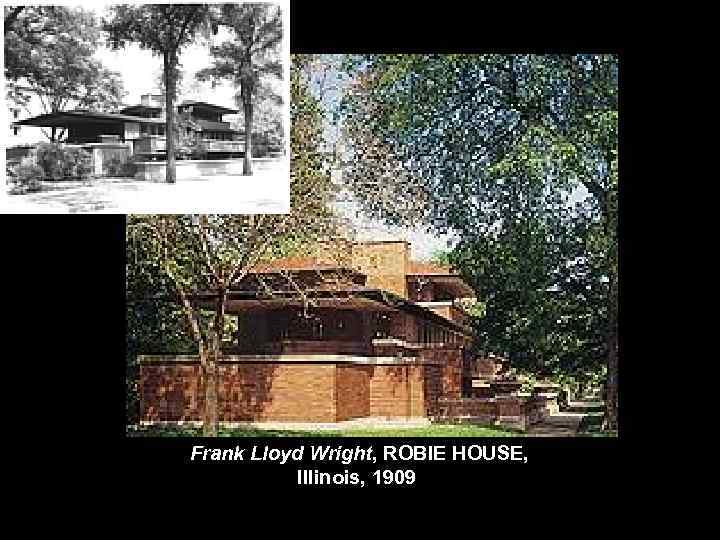 Frank Lloyd Wright, ROBIE HOUSE, Illinois, 1909
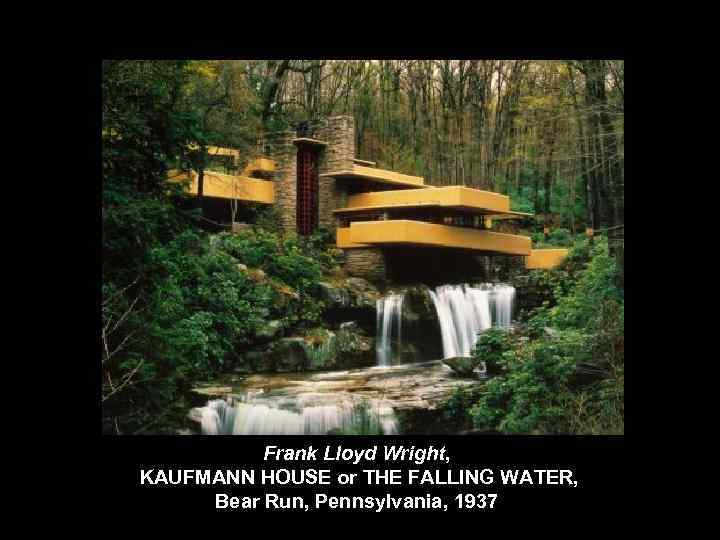 Frank Lloyd Wright, KAUFMANN HOUSE or THE FALLING WATER, Bear Run, Pennsylvania, 1937
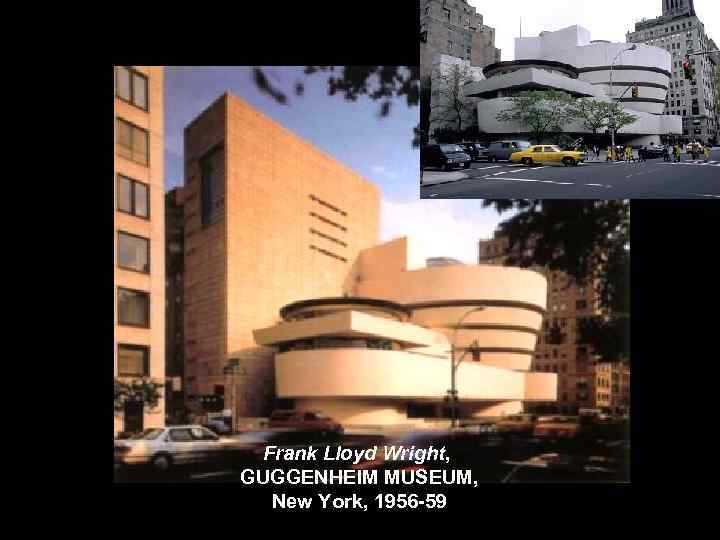 Frank Lloyd Wright, GUGGENHEIM MUSEUM, New York, 1956 -59
 Louis Kahn (1901 - 1974) • important figure in the transition from International Style Modernism to Postmodernism • first convincing rebel against the dull, glass boxes produced by modernists • designed contemporary and monumental architecture of massive geometrical forms in contrast to the usual rectangular glass and steel designs during his time. • taught architecture at Yale University and at the University of Pennsylvania • Influenced postmodernists Robert Venturi & Charles Moore
 CHARACTER OF WORKS: • simple, Platonic forms and compositions • use of brick and poured-in place concrete • dramatic spaces • use of natural light Several elements of Kahn's architecture came together in the RICHARDS MEDICAL RESEARCH BUILDING, elements that were used before, independently of each other: • a clear articulation of servant and served spaces; • the problem of light; • the integration of spatial, structural, and utility elements; and, • the integration of form, material, and process. As a result, this building represents a significant turning point in contemporary architecture.
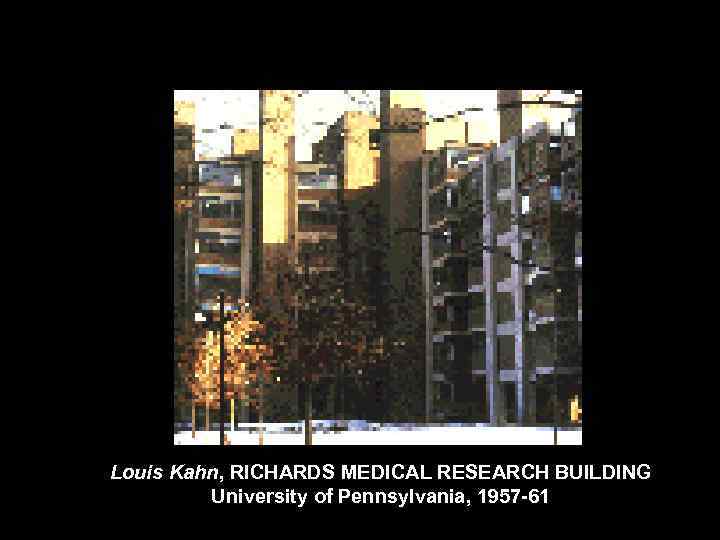 Louis Kahn, RICHARDS MEDICAL RESEARCH BUILDING University of Pennsylvania, 1957 -61
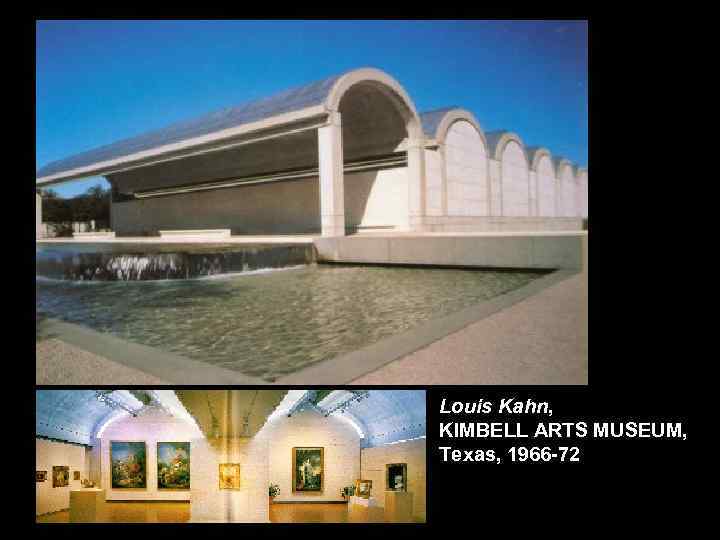 Louis Kahn, KIMBELL ARTS MUSEUM, Texas, 1966 -72
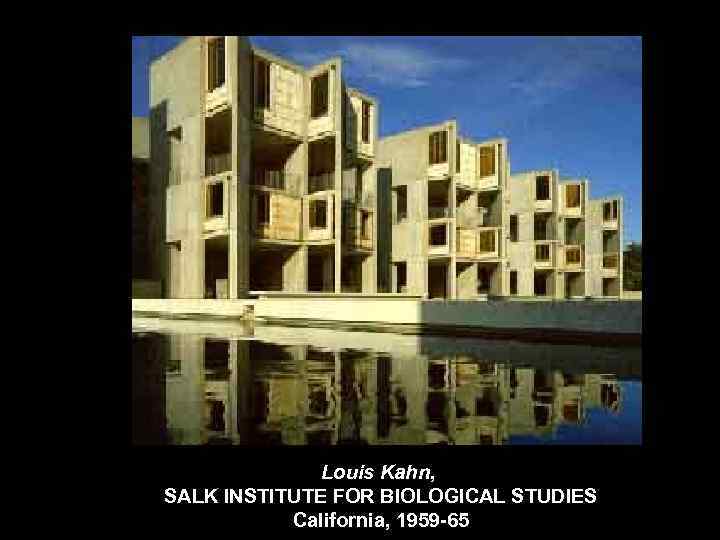 Louis Kahn, SALK INSTITUTE FOR BIOLOGICAL STUDIES California, 1959 -65