


 Скачать презентацию WALCE Women Against Lung Cancer in Europe and
871c2d0a093faf1befa7613824824c27.ppt
- Количество слайдов: 1
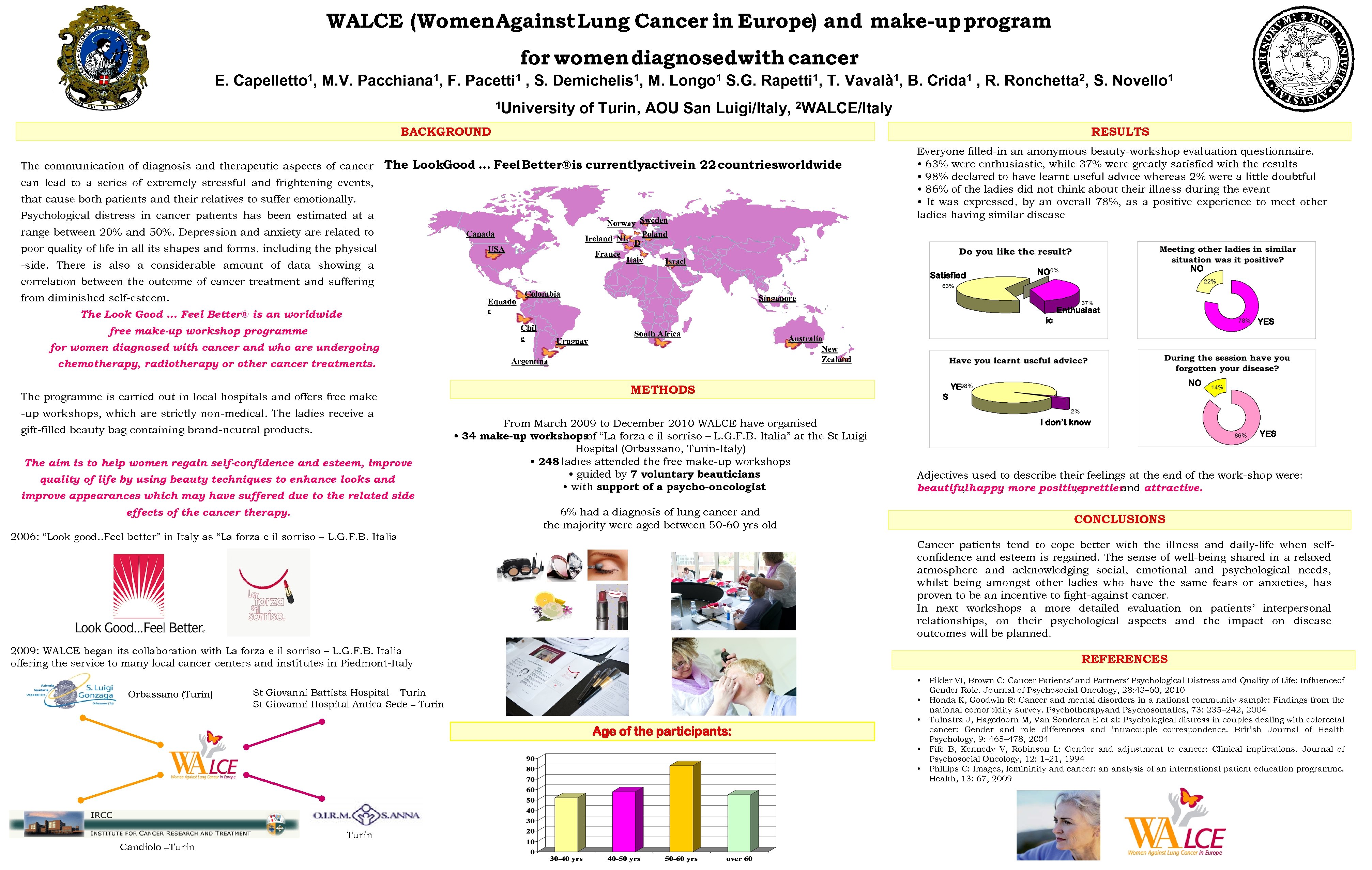 WALCE (Women Against Lung Cancer in Europe) and make-up program for women diagnosed with cancer E. Capelletto 1, M. V. Pacchiana 1, F. Pacetti 1 , S. Demichelis 1, M. Longo 1 S. G. Rapetti 1, T. Vavalà 1, B. Crida 1 , R. Ronchetta 2, S. Novello 1 1 University of Turin, AOU San Luigi/Italy, 2 WALCE/Italy BACKGROUND RESULTS The communication of diagnosis and therapeutic aspects of cancer The Look. Good. . . Feel Better® is currentlyactivein 22 countriesworldwide can lead to a series of extremely stressful and frightening events, that cause both patients and their relatives to suffer emotionally. Psychological distress in cancer patients has been estimated at a range between 20% and 50%. Depression and anxiety are related to poor quality of life in all its shapes and forms, including the physical Norway Sweden UK Poland Ireland NL D CH France Italy Israel Canada USA -side. There is also a considerable amount of data showing a Everyone filled-in an anonymous beauty-workshop evaluation questionnaire. • 63% were enthusiastic, while 37% were greatly satisfied with the results • 98% declared to have learnt useful advice whereas 2% were a little doubtful • 86% of the ladies did not think about their illness during the event • It was expressed, by an overall 78%, as a positive experience to meet other ladies having similar disease Satisfied correlation between the outcome of cancer treatment and suffering from diminished self-esteem. Equado Colombia Singapore Enthusiast r The Look Good. . . Feel Better® is an worldwide free make-up workshop programme for women diagnosed with cancer and who are undergoing chemotherapy, radiotherapy or other cancer treatments. The programme is carried out in local hospitals and offers free make -up workshops, which are strictly non-medical. The ladies receive a gift-filled beauty bag containing brand-neutral products. The aim is to help women regain self-confidence and esteem, improve quality of life by using beauty techniques to enhance looks and improve appearances which may have suffered due to the related side effects of the cancer therapy. ic Chil e Uruguay South Africa Argentina From March 2009 to December 2010 WALCE have organised • 34 make-up workshopsof “La forza e il sorriso – L. G. F. B. Italia” at the St Luigi Hospital (Orbassano, Turin-Italy) • 248 ladies attended the free make-up workshops • guided by 7 voluntary beauticians • with support of a psycho-oncologist. S I don’t know YES Adjectives used to describe their feelings at the end of the work-shop were: beautiful happy more positiveprettier , , , and attractive. CONCLUSIONS Cancer patients tend to cope better with the illness and daily-life when selfconfidence and esteem is regained. The sense of well-being shared in a relaxed atmosphere and acknowledging social, emotional and psychological needs, whilst being amongst other ladies who have the same fears or anxieties, has proven to be an incentive to fight-against cancer. In next workshops a more detailed evaluation on patients’ interpersonal relationships, on their psychological aspects and the impact on disease outcomes will be planned. 2009: WALCE began its collaboration with La forza e il sorriso – L. G. F. B. Italia offering the service to many local cancer centers and institutes in Piedmont-Italy REFERENCES • St Giovanni Battista Hospital – Turin St Giovanni Hospital Antica Sede – Turin • Age of the participants: • • • Candiolo –Turin NO YE 6% had a diagnosis of lung cancer and the majority were aged between 50 -60 yrs old Turin YES Australia New Zealand METHODS 2006: “Look good. . Feel better” in Italy as “La forza e il sorriso – L. G. F. B. Italia Orbassano (Turin) NO NO Pikler VI, Brown C: Cancer Patients’ and Partners’ Psychological Distress and Quality of Life: Influenceof Gender Role. Journal of Psychosocial Oncology, 28: 43– 60, 2010 Honda K, Goodwin R: Cancer and mental disorders in a national community sample: Findings from the national comorbidity survey. Psychotherapyand Psychosomatics, 73: 235– 242, 2004 Tuinstra J, Hagedoorn M, Van Sonderen E et al: Psychological distress in couples dealing with colorectal cancer: Gender and role differences and intracouple correspondence. British Journal of Health Psychology, 9: 465– 478, 2004 Fife B, Kennedy V, Robinson L: Gender and adjustment to cancer: Clinical implications. Journal of Psychosocial Oncology, 12: 1– 21, 1994 Phillips C: Images, femininity and cancer: an analysis of an international patient education programme. Health, 13: 67, 2009