 Скачать презентацию W 3 C Workshop The Multilingual Web Where
967cc116f84edfcf52c22f5ed5ae9ebb.ppt
- Количество слайдов: 17



W 3 C Workshop: The Multilingual Web Where Are We? Key Aspects of Multilingual Web Content Life Cycles: Present and Future 26 -27 October 2010 | Madrid, Spain Pedro Luis Díez-Orzas Giuseppe Deriard Pablo Badía Mas
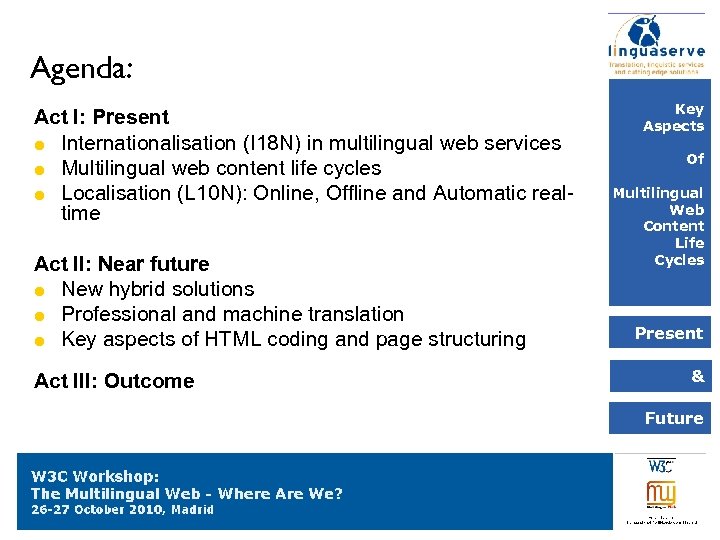
Agenda: Act I: Present Internationalisation (I 18 N) in multilingual web services Multilingual web content life cycles Localisation (L 10 N): Online, Offline and Automatic realtime Act II: Near future New hybrid solutions Professional and machine translation Key aspects of HTML coding and page structuring Key Aspects Of Multilingual Web Content Life Cycles Present & Act III: Outcome Future 2
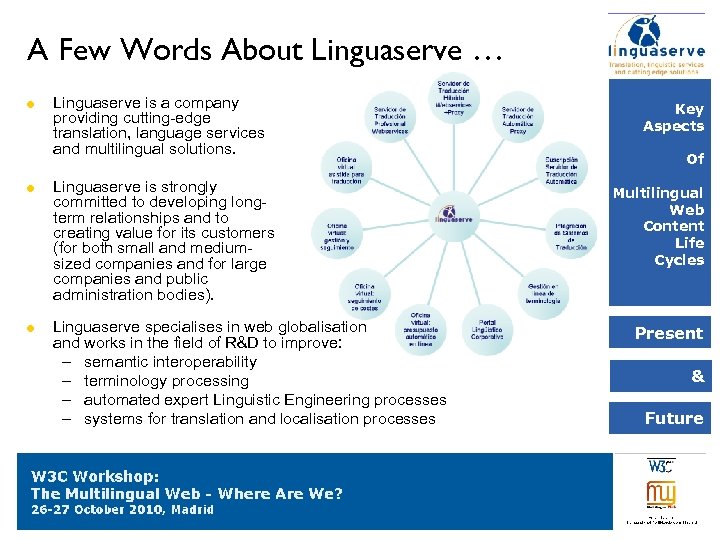
A Few Words About Linguaserve … Linguaserve is a company providing cutting-edge translation, language services and multilingual solutions. Key Aspects Of Linguaserve is strongly committed to developing longterm relationships and to creating value for its customers (for both small and mediumsized companies and for large companies and public administration bodies). Linguaserve specialises in web globalisation and works in the field of R&D to improve: – semantic interoperability – terminology processing – automated expert Linguistic Engineering processes – systems for translation and localisation processes 3 Multilingual Web Content Life Cycles Present & Future
Act I: Present 26 -27 October 2010 | Madrid, Spain
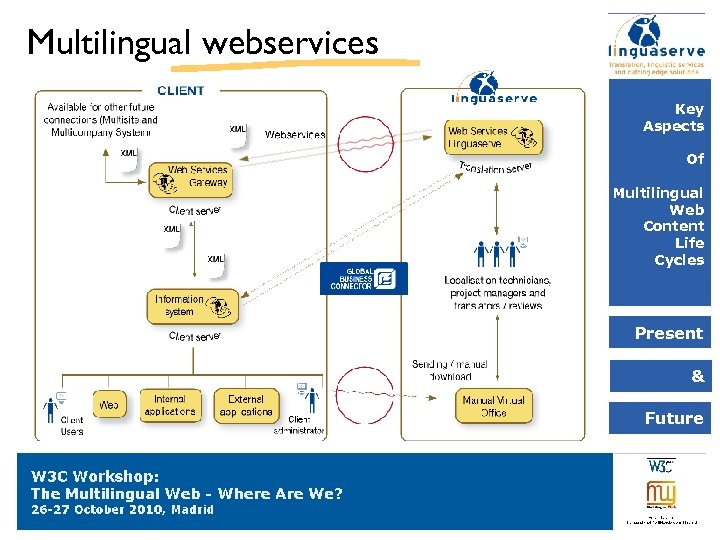
Multilingual webservices Key Aspects Of Multilingual Web Content Life Cycles Present & Future 5
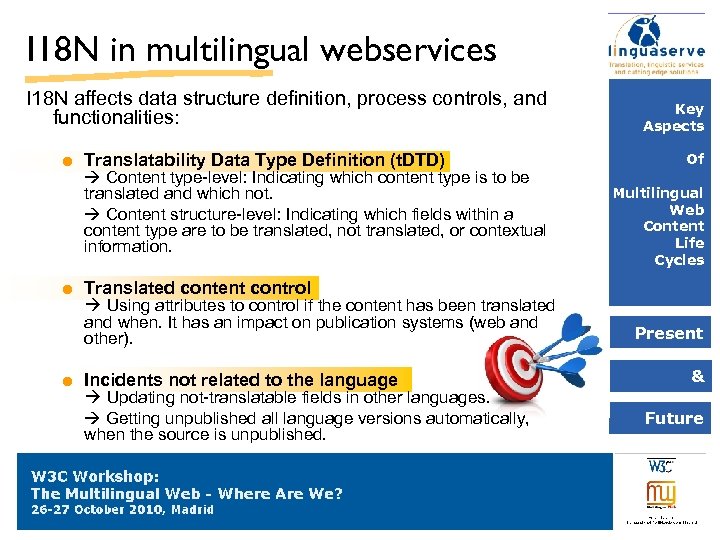
I 18 N in multilingual webservices I 18 N affects data structure definition, process controls, and functionalities: Translatability Data Type Definition (t. DTD) Content type-level: Indicating which content type is to be translated and which not. Content structure-level: Indicating which fields within a content type are to be translated, not translated, or contextual information. Of Multilingual Web Content Life Cycles Translated content control Using attributes to control if the content has been translated and when. It has an impact on publication systems (web and other). Key Aspects Incidents not related to the language Updating not-translatable fields in other languages. Getting unpublished all language versions automatically, when the source is unpublished. 6 Present & Future
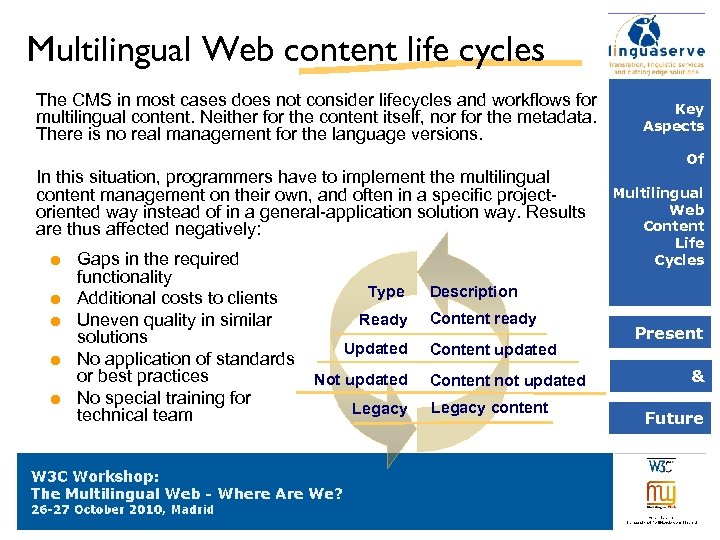
Multilingual Web content life cycles The CMS in most cases does not consider lifecycles and workflows for multilingual content. Neither for the content itself, nor for the metadata. There is no real management for the language versions. In this situation, programmers have to implement the multilingual content management on their own, and often in a specific projectoriented way instead of in a general-application solution way. Results are thus affected negatively: Gaps in the required functionality Additional costs to clients Uneven quality in similar solutions No application of standards or best practices No special training for technical team 7 Type Ready Updated Not updated Legacy Key Aspects Of Multilingual Web Content Life Cycles Description Content ready Content updated Content not updated Legacy content Present & Future
L 10 N: Online/Offline Online: translation and localisation by translators who access the CMS directly. – Positive aspects: Simplicity in the implementation of the solution – Negative aspects: Insufficient control of access, volume, and status. Key Aspects Of Multilingual Web Content Life Cycles Offline: exchange of files between machines (B 2 B). – Positive aspects: Centralisation of the management of L 10 N with all the profits for the work going to a specialised company of the sector. – Negative aspects: The solution is complex to implement. Present & Future 8
L 10 N: Automatic real-time In the application of Machine Translation for real-time L 10 N, the quality of the machine translation system needs to be combined with a prior and continuous intervention of a team of translators and professional terminologists for there to be the necessary level of revision. The disconnection between the CMS, machine translation and the language version visualisation system allows for a reduction of implementation costs for the client. Existing free real-time translation and localisation systems entail: – No data privacy, security or confidentiality – No possibility for customisation – Volume limits 9 Key Aspects Of Multilingual Web Content Life Cycles Present & Future
Act II: Near future 26 -27 October 2010 | Madrid, Spain
New hybrid globalisation solutions “Hybrid” in Globalisation means combining different interoperability connections, like webservices, proxy web and https spiders… as part of the same solution. “Hybrid” in Localisation means combining different production systems, like offline L 10 N and real-time L 10 N. “Hybrid” in Translation means combining Rule Based MT, Statistical MT, Segment Translation Memories and Page Translation Memories. 11 Key Aspects Of Multilingual Web Content Life Cycles Present & Future
Professional and machine translation The new generation solutions must be quick and inexpensive, but must also offer quality translation to handle huge volumes and fast updates. Key Aspects Of Pre-editing and Post-editing Machine Translations improves quality, especially for specific texts, contents and clients. Combining several translation methodologies and tools is the most promising approach in the short and medium term: – Machine Translation + Professional Post Editing – Translation Memories + Machine Translation + Professional Pre and Post Editing – … Quality and approach depend on the language pairs, e. g. , Spanish – Portuguese vs Spanish - German. 12 Multilingual Web Content Life Cycles Present & Future
HTML coding and page structuring Real-time L 10 N solutions can also deal with HTML code, making the LSP (Language Service Provider) responsible for publishing the language versions of the website. If creators take into account certain good practices, results are faster and better: DON’T. The generalised use of the following is not recommended: – SSL (Https) throughout the whole portal (it decreases the speed of the communications). – Javascript (This also improves the WAI quality). – Images, Flash applications with texts. DO. The following is recommended: – XHtml – WAI – Well structured templates where, if possible, the aspect changes but not the structure. – Texts that are, as far as possible, free from errors (clear sentences and grammar and spelling checked). 13 Key Aspects Of Multilingual Web Content Life Cycles Present & Future
Act III: Outcome 26 -27 October 2010 | Madrid, Spain
Fundamentals For a Creator!!! I 18 N affects data structures, workflow and functionalities. The L 10 N provider should be part of the Web implementation team from the beginning, not simply at a later stage. þ Best practices and standardisation for lifecycle and workflow for the multilingual content are needed and to be considered by CMS or by general implementation strategies. þ Offline and real-time L 10 N are, and will be, the two common approaches. Online L 10 N seems to be valid only for small websites or websites with very few authors. þ Clients need to be aware of their linguistic assets (terminology and TMs) in terms of quality, volume and coverage in order to shorten the learning curve for automatic and assisted translation systems. þ 15 Key Aspects Of Multilingual Web Content Life Cycles Present & Future
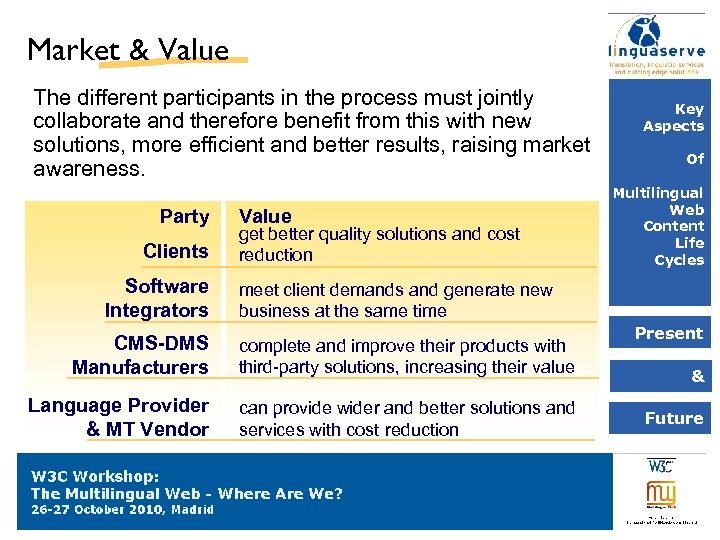
Market & Value The different participants in the process must jointly collaborate and therefore benefit from this with new solutions, more efficient and better results, raising market awareness. Party Clients Software Integrators Value get better quality solutions and cost reduction Key Aspects Of Multilingual Web Content Life Cycles meet client demands and generate new business at the same time CMS-DMS Manufacturers complete and improve their products with third-party solutions, increasing their value Language Provider & MT Vendor can provide wider and better solutions and services with cost reduction 16 Present & Future
Thank you very much Muchas gracias Moltes gràcies Eskerrik asko Moitas grazas 26 -27 October 2010 | Madrid, Spain pedro. diez@linguaserve. com giuseppe. deriard@linguaserve. com pablo. badia@linguaserve. com
Скачать презентацию W 3 C Workshop The Multilingual Web Where
967cc116f84edfcf52c22f5ed5ae9ebb.ppt