 Скачать презентацию VWID Variable-Width Channels for Interference Avoidance Brad Karp
d98b0c89fe9d54fef57a260e7d7475b2.ppt
- Количество слайдов: 11



VWID: Variable-Width Channels for Interference Avoidance Brad Karp UCL Computer Science CS M 038 / GZ 06 26 th January, 2009
Context: Sharing of Spectrum • Finite RF spectrum available for use by nodes in a wireless network • MACAW/802. 11 approach to sharing of spectrum: – Each node uses serializing (full width, in Hz) by Alternatives to entire channel transmissionsfor each packet transmission mutually interfering nodes? – Try to schedule Alternatives to senders that entire channel to devoting interfere so that they don’t send concurrently each node’s transmissions? • Interference plagues 802. 11 -style sharing in mesh networks – MAC can’t perfectly serialize interfering senders – Result: interference reduces throughput (evidence: Roofnet’s ETT overpredicts throughput…) 2
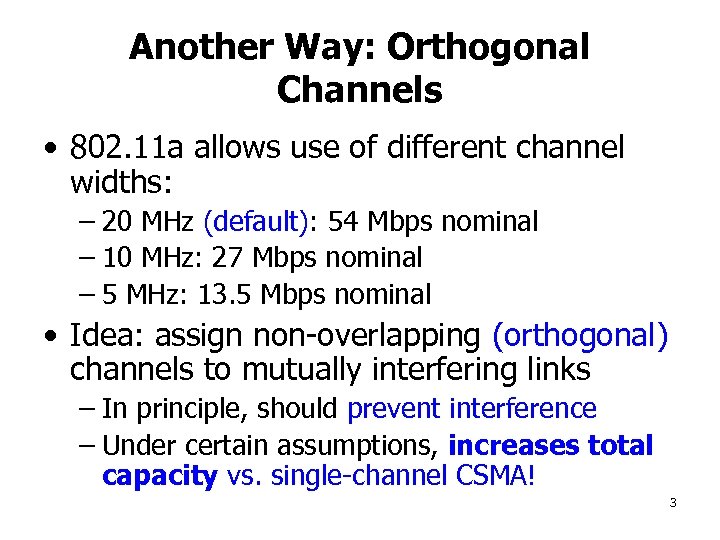
Another Way: Orthogonal Channels • 802. 11 a allows use of different channel widths: – 20 MHz (default): 54 Mbps nominal – 10 MHz: 27 Mbps nominal – 5 MHz: 13. 5 Mbps nominal • Idea: assign non-overlapping (orthogonal) channels to mutually interfering links – In principle, should prevent interference – Under certain assumptions, increases total capacity vs. single-channel CSMA! 3
Modeling Capacity: Assumptions • Consider 2 -client 802. 11 network with one base station, all traffic from clients to base station • Base station has one radio, one antenna • Clients each have one radio, one antenna • All nodes in mutual range • Both clients send continuously • Client 1 received at BS with power P 1, client 2 received at BS with power P 2 4
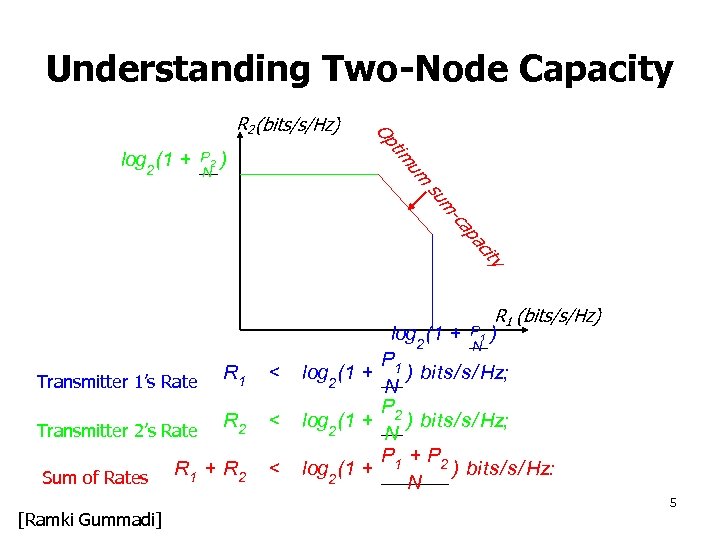
Understanding Two-Node Capacity ) um P 2 N tim log 2 (1 + Op R 2 (bits/s/Hz) cit a ap -c m su y Transmitter 1’s Rate R 1 < Transmitter 2’s Rate R 2 < R 1 + R 2 < Sum of Rates [Ramki Gummadi] R 1 (bits/s/Hz) ) log 2 (1 + P log 2 (1 + 1 ) bits/s/ Hz; N P log 2 (1 + 2 ) bits/s/ Hz; N P + P 2 log 2 (1 + 1 ) bits/s/ Hz: N P 1 N 5
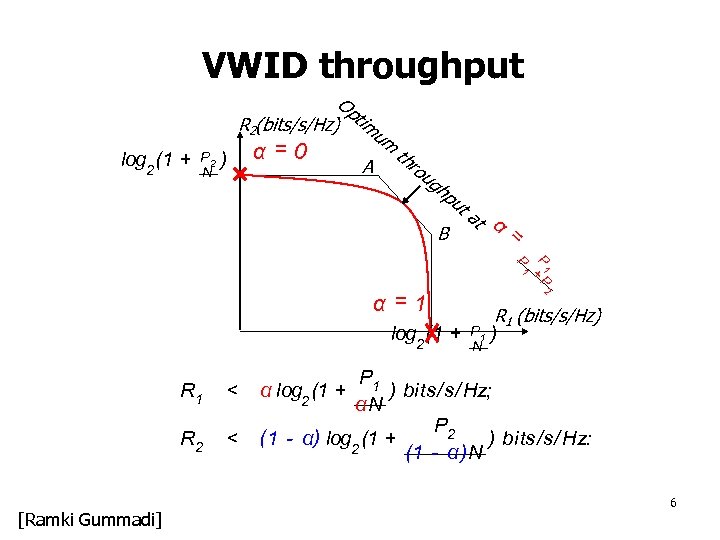
VWID throughput α =0 A ut hp ug ro ) th P 2 N um log 2 (1 + im pt O R 2(bits/s/Hz) α at B = P 1 2 α =1 log 2 (1 + R 1 R 2 [Ramki Gummadi] < < P 1 +P P 1 N R 1 (bits/s/Hz) ) P 1 α log 2 (1 + ) bits/s/ Hz; αN P 2 ( 1 - α) log 2 (1 + ) bits/s/ Hz: (1 - α)N 6
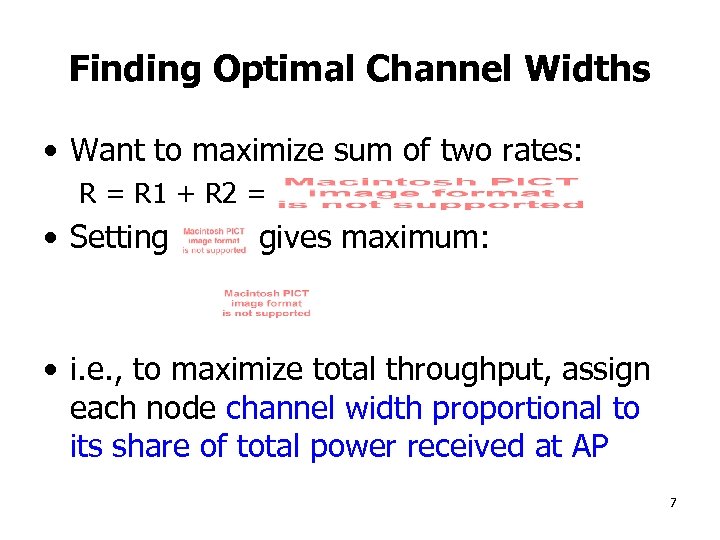
Finding Optimal Channel Widths • Want to maximize sum of two rates: R = R 1 + R 2 = • Setting gives maximum: • i. e. , to maximize total throughput, assign each node channel width proportional to its share of total power received at AP 7
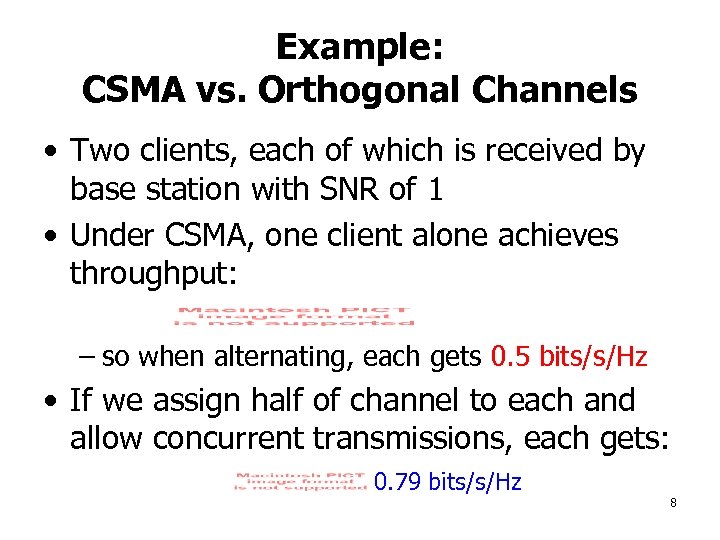
Example: CSMA vs. Orthogonal Channels • Two clients, each of which is received by base station with SNR of 1 • Under CSMA, one client alone achieves throughput: – so when alternating, each gets 0. 5 bits/s/Hz • If we assign half of channel to each and allow concurrent transmissions, each gets: 0. 79 bits/s/Hz 8
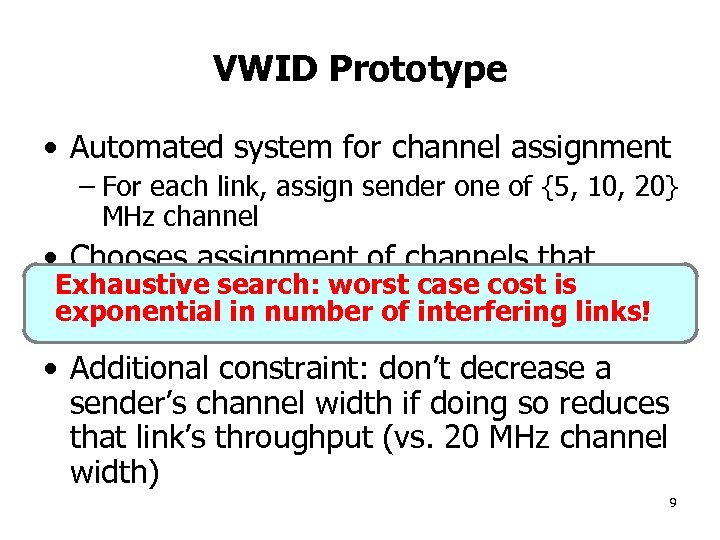
VWID Prototype • Automated system for channel assignment – For each link, assign sender one of {5, 10, 20} MHz channel • Chooses assignment of channels that Exhaustive search: worst case costacross all maximizes aggregate throughput is exponential in number of interfering links! links • Additional constraint: don’t decrease a sender’s channel width if doing so reduces that link’s throughput (vs. 20 MHz channel width) 9
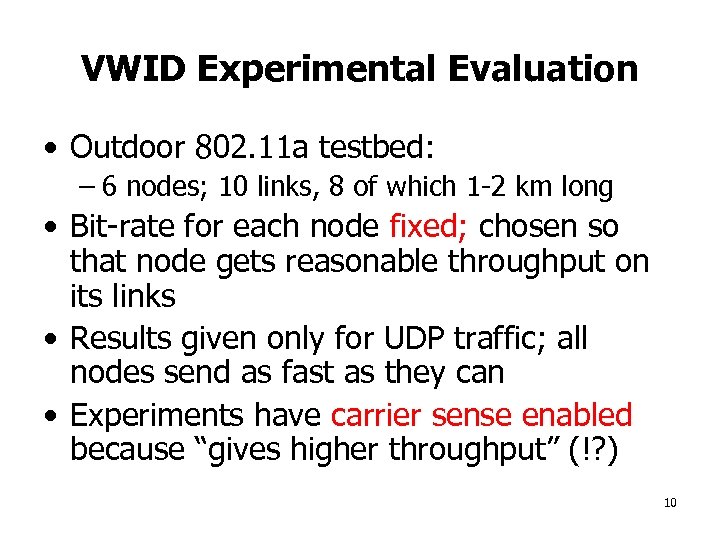
VWID Experimental Evaluation • Outdoor 802. 11 a testbed: – 6 nodes; 10 links, 8 of which 1 -2 km long • Bit-rate for each node fixed; chosen so that node gets reasonable throughput on its links • Results given only for UDP traffic; all nodes send as fast as they can • Experiments have carrier sense enabled because “gives higher throughput” (!? ) 10
![Link Throughput Improvement: Point-to-Point Links no VWID with VWID [Ramki Gummadi] 11](https://present5.com/presentation/d98b0c89fe9d54fef57a260e7d7475b2/image-11.jpg "Link Throughput Improvement: Point-to-Point Links no VWID with VWID [Ramki Gummadi] 11")
Link Throughput Improvement: Point-to-Point Links no VWID with VWID [Ramki Gummadi] 11
Скачать презентацию VWID Variable-Width Channels for Interference Avoidance Brad Karp
d98b0c89fe9d54fef57a260e7d7475b2.ppt