 Скачать презентацию VULNERABILITY AND SOCIAL PROTECTION IN GHANA RESEARCH FINDINGS
9fb6cfe851d4813b4da6aec92eebd03f.ppt
- Количество слайдов: 30



VULNERABILITY AND SOCIAL PROTECTION IN GHANA RESEARCH FINDINGS CDD-GHANA Presentation by CDD-Ghana @ the NOPOOR Policy Conference, March 10 – 13 2016, New Delhi, India
Contents v Background and Objectives v Methodology, including Sampling v Findings v Conclusions v Recommendations
Background • Cash transfers are being recognized as “magic bullet” in development (Slater, 2011; DFID, 2011; UNICEF, 2009). • Although Ghana has made considerable progress in reducing poverty, major issues still prevail. • Ghana adopted the Livelihood Empowerment Against Poverty (LEAP) – a cash transfer scheme in 2008 as propoor program to alleviate extreme poverty. • While evidence from other countries such as Brazil suggest the effectiveness of cash transfers in reducing household poverty and vulnerability, little is known about the case of Ghana.
Background • It is within this context that CDD-GHANA sought to assess the case of the LEAP program as a better policy alternative to address poverty and vulnerability in Ghana on three dimensions: - Social services, - Asset accumulation and - State legitimacy and citizenship dimensions
Background • The LEAP program employs a community-based targeting approach in selecting beneficiaries. • It was piloted in 2008 as a means-tested program in 21 districts covering about 30, 000 beneficiary households. • Currently, it has been expanded and covers about 90, 785 beneficiary households in 144 districts (GOG, 2015).
The context of LEAP cont. The breakdown of the cash payments are: one eligible member in a household receives GH¢ 48. 00 ($12), household with two (2) eligible members receive GH¢ 60. 00 ($15), with three eligible beneficiaries GH¢ 72. 00 ($18) and household with four (4) eligible beneficiaries or more receive GH¢ 90. 00 ($23).
Objectives • The overarching goal of the research was to ascertain the influence of LEAP cash transfers on the living conditions of beneficiary households in the following areas: o Access to basic education o Access to health care services o Household food security and asset accumulation o Civic participation and social relationships
Methodology and Sampling • Multi-stage sampling procedure • Data on LEAP beneficiaries obtained from the Ministry of Gender, Children and Social Protection served as the sampling frame. • Random sampling technique was used to select a total of 40 districts spread across the 10 regions of the country. • Systematic sampling was used to select a total of 160 beneficiary communities across the 40 selected districts (i. e. 4 communities per district).
Methodology • In each community, random sampling procedure was used to select 15 beneficiary households yielding a total of 2, 400 beneficiary households across the country (15 households x 4 communities x 40 districts). • In a given selected household, purposive sampling was employed to select the Cash Transfer Recipient (CTR) within that household for interview.
FINDINGS: ACCESS TO BASIC EDUCATION
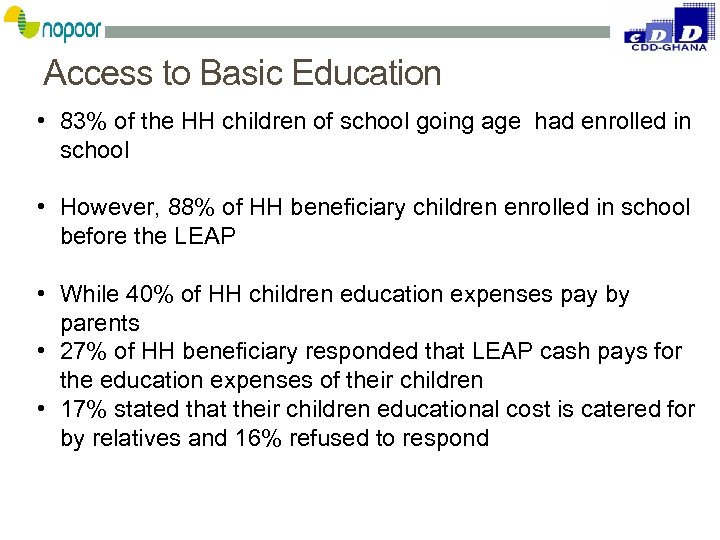
Access to Basic Education • 83% of the HH children of school going age had enrolled in school • However, 88% of HH beneficiary children enrolled in school before the LEAP • While 40% of HH children education expenses pay by parents • 27% of HH beneficiary responded that LEAP cash pays for the education expenses of their children • 17% stated that their children educational cost is catered for by relatives and 16% refused to respond
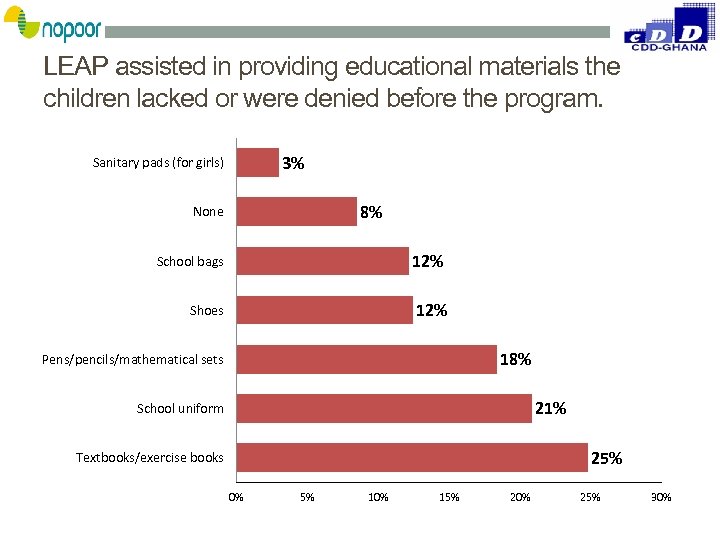
LEAP assisted in providing educational materials the children lacked or were denied before the program. 3% Sanitary pads (for girls) 8% None School bags 12% Shoes 12% 18% Pens/pencils/mathematical sets 21% School uniform 25% Textbooks/exercise books 0% 5% 10% 15% 20% 25% 30%
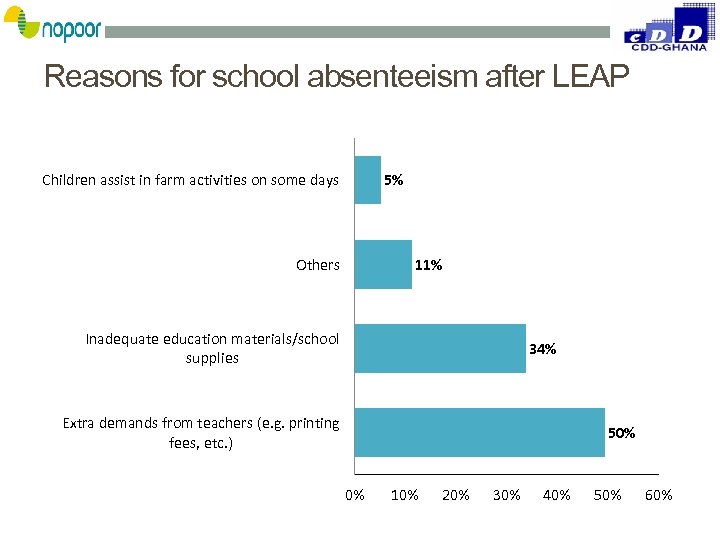
Reasons for school absenteeism after LEAP Children assist in farm activities on some days 5% 11% Others Inadequate education materials/school supplies 34% Extra demands from teachers (e. g. printing fees, etc. ) 50% 0% 10% 20% 30% 40% 50% 60%
ACCESS TO HEALTH AND HEALTH OUTCOMES
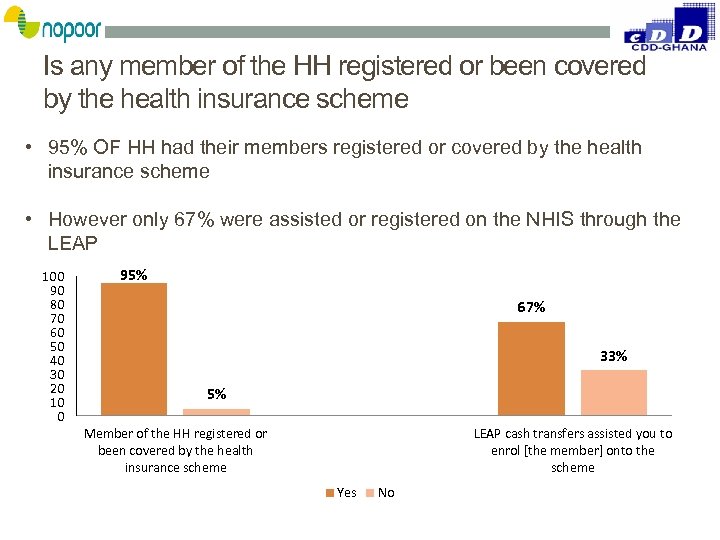
Is any member of the HH registered or been covered by the health insurance scheme • 95% OF HH had their members registered or covered by the health insurance scheme • However only 67% were assisted or registered on the NHIS through the LEAP 100 90 80 70 60 50 40 30 20 10 0 95% 67% 33% 5% Member of the HH registered or been covered by the health insurance scheme LEAP cash transfers assisted you to enrol [the member] onto the scheme Yes No
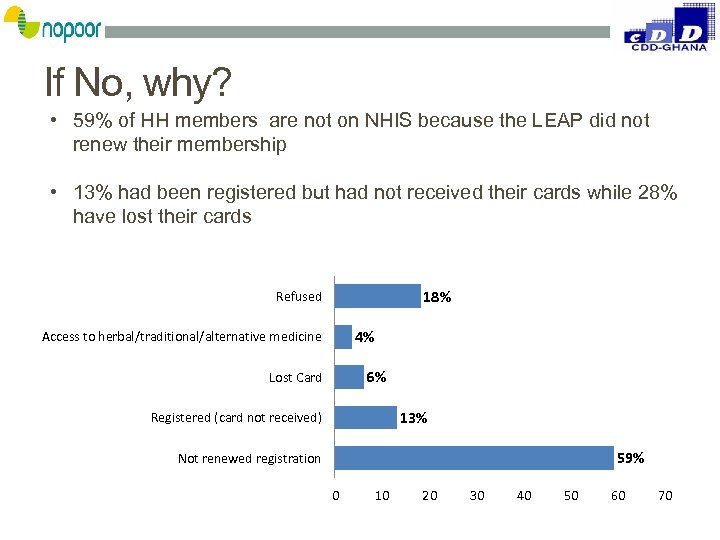
If No, why? • 59% of HH members are not on NHIS because the LEAP did not renew their membership • 13% had been registered but had not received their cards while 28% have lost their cards 18% Refused 4% Access to herbal/traditional/alternative medicine 6% Lost Card 13% Registered (card not received) 59% Not renewed registration 0 10 20 30 40 50 60 70
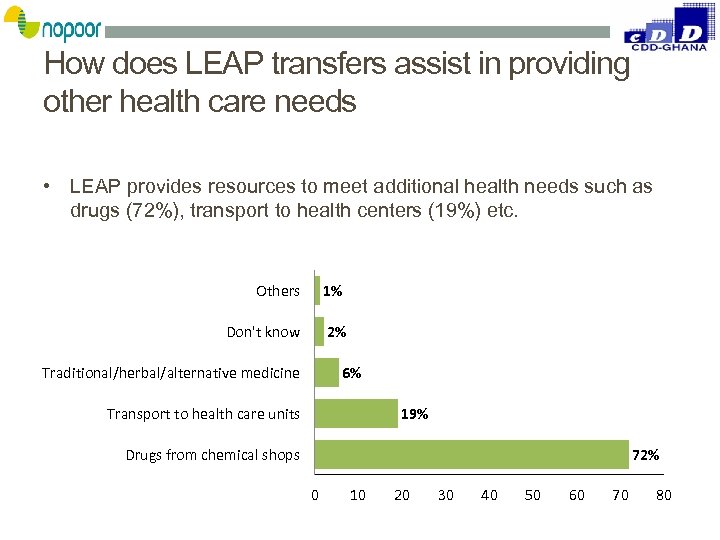
How does LEAP transfers assist in providing other health care needs • LEAP provides resources to meet additional health needs such as drugs (72%), transport to health centers (19%) etc. Others 1% Don't know 2% Traditional/herbal/alternative medicine 6% Transport to health care units 19% Drugs from chemical shops 72% 0 10 20 30 40 50 60 70 80
HOUSEHOLD FOOD SECURITY
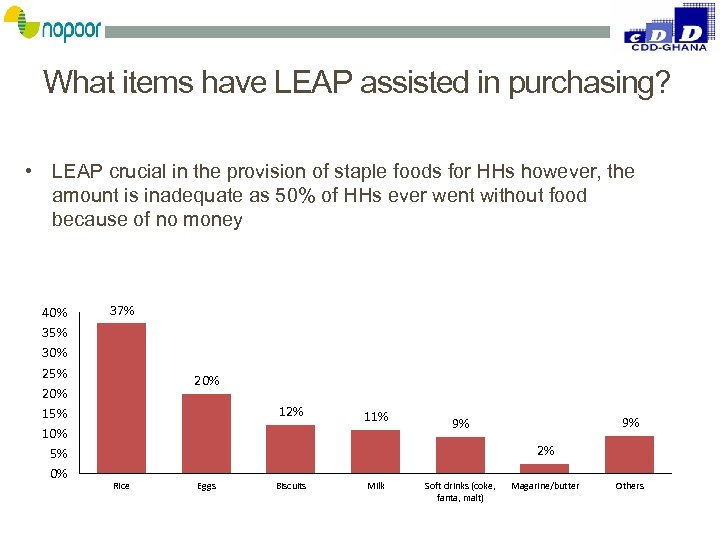
What items have LEAP assisted in purchasing? • LEAP crucial in the provision of staple foods for HHs however, the amount is inadequate as 50% of HHs ever went without food because of no money 40% 35% 30% 25% 20% 15% 10% 5% 0% 37% 20% 12% 11% 9% 9% 2% Rice Eggs Biscuits Milk Soft drinks (coke, fanta, malt) Magarine/butter Others
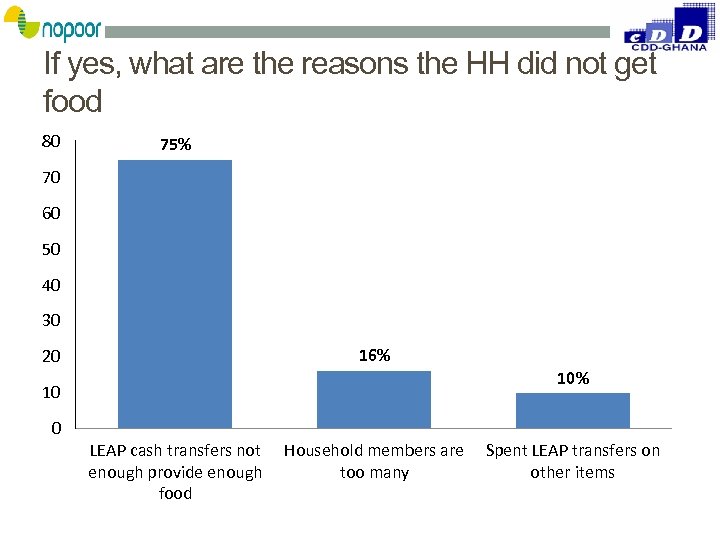
If yes, what are the reasons the HH did not get food 80 75% 70 60 50 40 30 16% 20 10% 10 0 LEAP cash transfers not enough provide enough food Household members are too many Spent LEAP transfers on other items
HOUSEHOLD ASSET ACCUMULATION
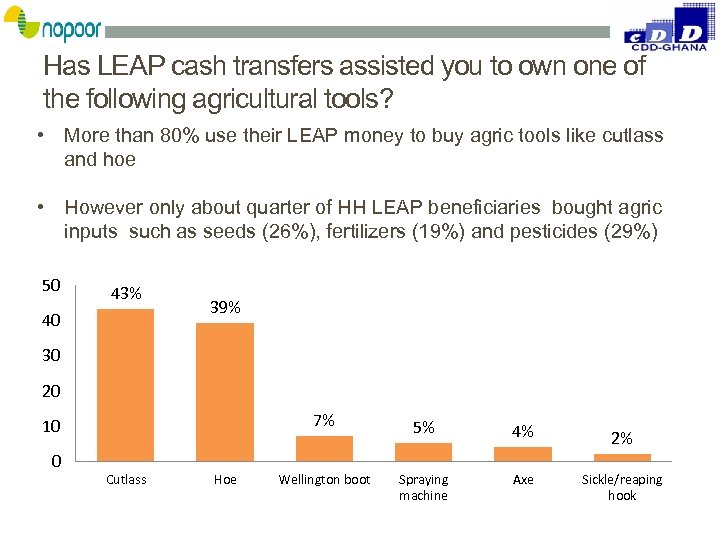
Has LEAP cash transfers assisted you to own one of the following agricultural tools? • More than 80% use their LEAP money to buy agric tools like cutlass and hoe • However only about quarter of HH LEAP beneficiaries bought agric inputs such as seeds (26%), fertilizers (19%) and pesticides (29%) 50 43% 40 39% 30 20 7% 10 0 Cutlass Hoe Wellington boot 5% 4% Spraying machine Axe 2% Sickle/reaping hook
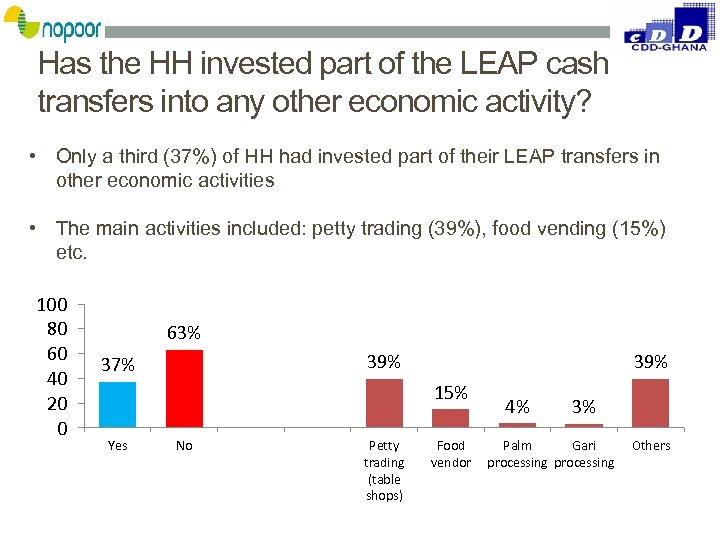
Has the HH invested part of the LEAP cash transfers into any other economic activity? • Only a third (37%) of HH had invested part of their LEAP transfers in other economic activities • The main activities included: petty trading (39%), food vending (15%) etc. 100 80 60 40 20 0 63% 39% 37% 39% 15% Yes No Petty trading (table shops) Food vendor 4% 3% Palm Gari processing Others
CIVIC PARTICIPATION AND COMMUNITY RELATIONS
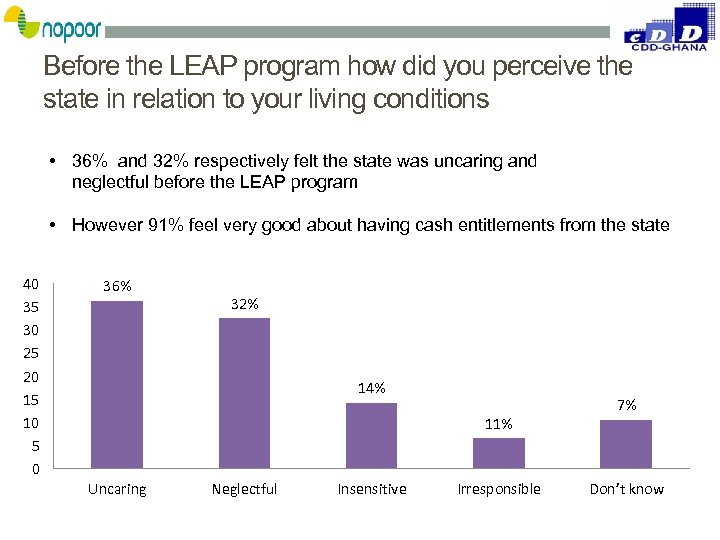
Before the LEAP program how did you perceive the state in relation to your living conditions • 36% and 32% respectively felt the state was uncaring and neglectful before the LEAP program • However 91% feel very good about having cash entitlements from the state 40 35 30 25 20 15 10 5 0 36% 32% 14% 11% Uncaring Neglectful Insensitive Irresponsible 7% Don’t know
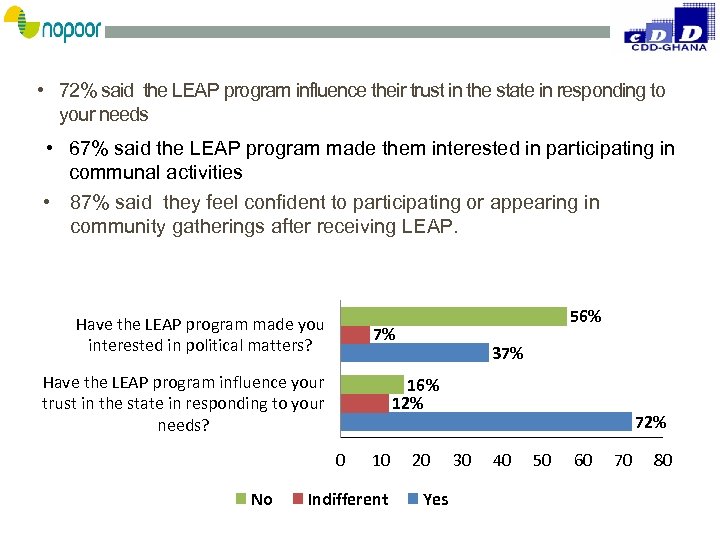
• 72% said the LEAP program influence their trust in the state in responding to your needs • 67% said the LEAP program made them interested in participating in communal activities • 87% said they feel confident to participating or appearing in community gatherings after receiving LEAP. Have the LEAP program made you interested in political matters? 7% Have the LEAP program influence your trust in the state in responding to your needs? 37% 16% 12% 0 No 56% 10 Indifferent 20 Yes 72% 30 40 50 60 70 80
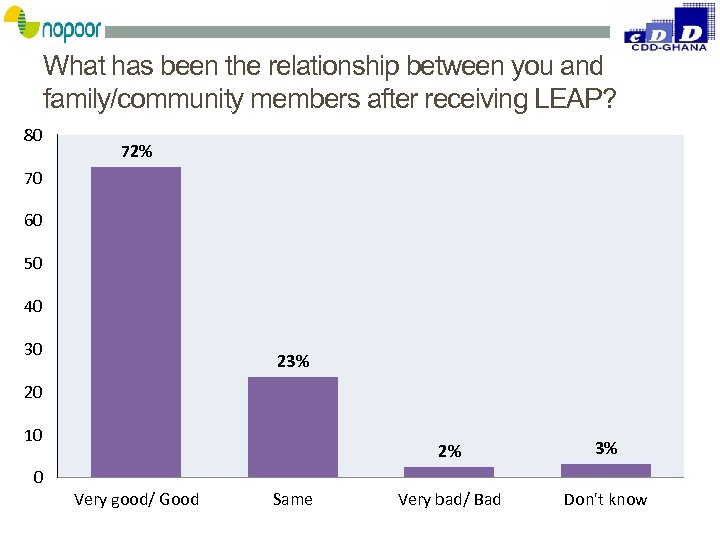
What has been the relationship between you and family/community members after receiving LEAP? 80 72% 70 60 50 40 30 23% 20 10 0 2% Very good/ Good Same 3% Very bad/ Bad Don't know
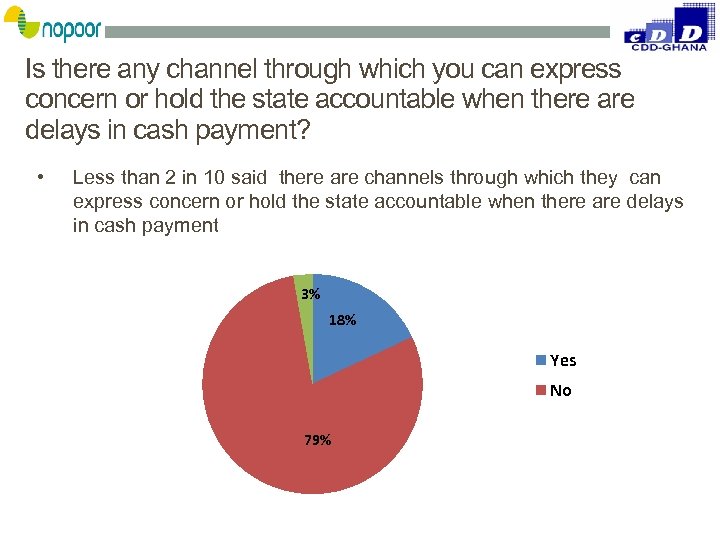
Is there any channel through which you can express concern or hold the state accountable when there are delays in cash payment? • Less than 2 in 10 said there are channels through which they can express concern or hold the state accountable when there are delays in cash payment 3% 18% Yes No 79%
Conclusions and Policy Implications • Minimum contributions to poverty alleviation from the LEAP • From the findings, LEAP to some extent is making a difference in the lives of the poor on various dimensions of human development in the short-term: improvement in children’s school attendance, children are incentivized to be in school, health insurance coverage, community involvement and trust in government which is good for effective statebuilding etc. • However, there is no guarantee for sustained poverty alleviation in a much a longer term. • This is because the survey also revealed that the LEAP amounts were not enough to cater for household needs for food, health and agric inputs.
Policy Recommendations • Increase in cash transfer amount. • This should be done simultaneously with strategies or programs that would help cash recipient to diversify household resources into productive sectors. • Establish feedback and accountability mechanisms. • The Ministry of Gender, Children and social Protection that has the oversight responsibility should institute feedback and accountability mechanisms to promote inclusiveness and transparency in use and disbursement of the cash transfers • Sustainable mechanism for poverty reduction in addition to case transfers • There should be a system to provide subsidies on agriculture input to LEAP beneficiaries engaged in agriculture to promote longer term poverty alleviation
Скачать презентацию VULNERABILITY AND SOCIAL PROTECTION IN GHANA RESEARCH FINDINGS
9fb6cfe851d4813b4da6aec92eebd03f.ppt