 Скачать презентацию VTPBi S Coordinators as Coaches Learning Networking
97136805d3297005869fb1c5077f24b2.ppt
- Количество слайдов: 57



VTPBi. S Coordinators as Coaches Learning & Networking Workshop Presented by the VTPBi. S State Team
Agenda • • Introductory Warm-up and Overview Identifying Specific Outcomes Using the TFI to Generate Priority Actions Intentional Integration of PBIS and SEL Peer Networking Updates Next Steps
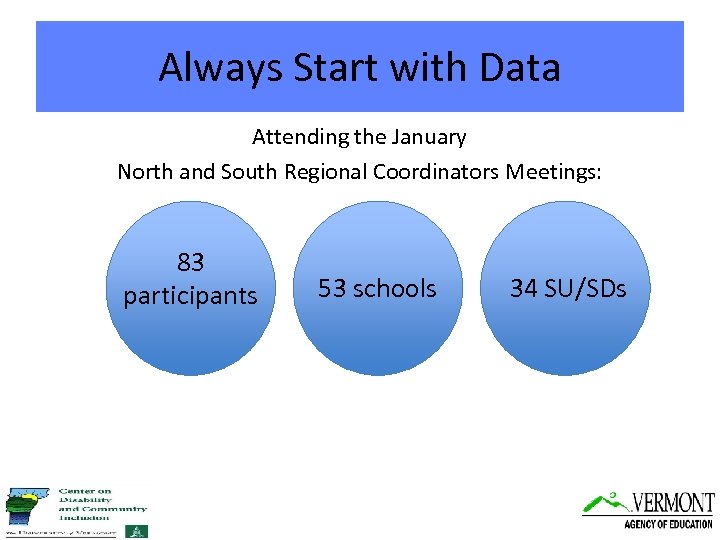
Always Start with Data Attending the January North and South Regional Coordinators Meetings: 83 participants 53 schools 34 SU/SDs
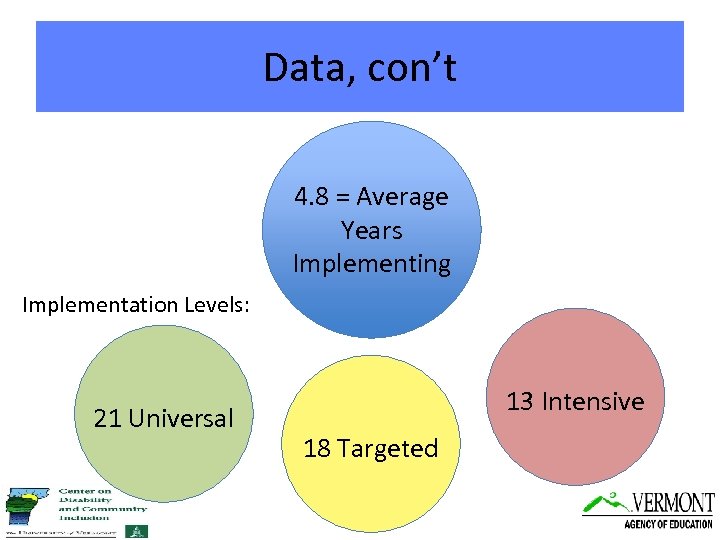
Data, con’t 4. 8 = Average Years Implementing Implementation Levels: 21 Universal 13 Intensive 18 Targeted
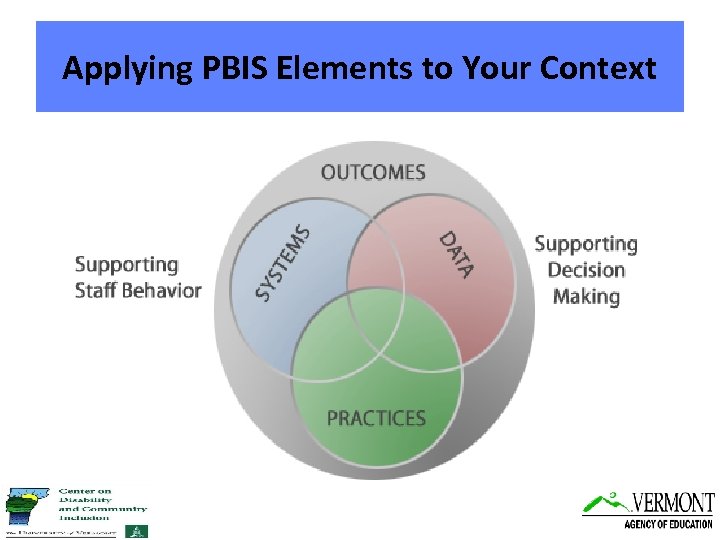
Applying PBIS Elements to Your Context
Need for Outcomes How will you know if PBIS is working if you are not sure where it should be taking you?
What are your Outcomes? Outcomes should be: Locally determined Contextually and culturally relevant Observable and measurable Summarized in goal statements Consider using a “SMART Goal Format”
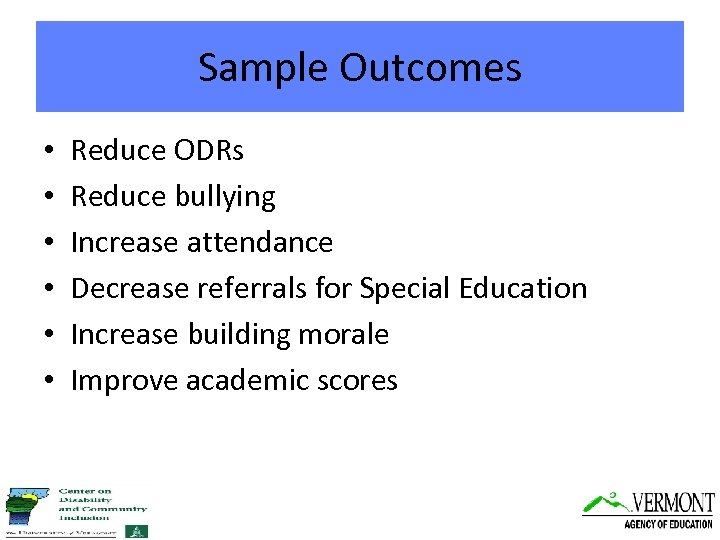
Sample Outcomes • • • Reduce ODRs Reduce bullying Increase attendance Decrease referrals for Special Education Increase building morale Improve academic scores
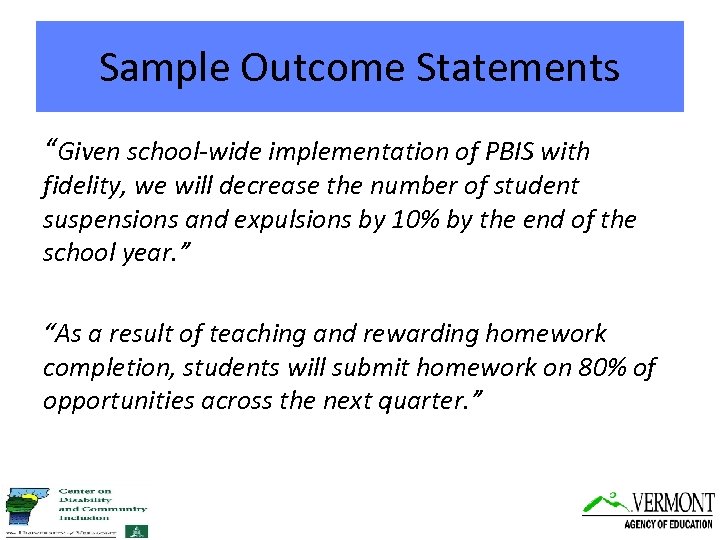
Sample Outcome Statements “Given school-wide implementation of PBIS with fidelity, we will decrease the number of student suspensions and expulsions by 10% by the end of the school year. ” “As a result of teaching and rewarding homework completion, students will submit homework on 80% of opportunities across the next quarter. ”
Outcomes Activity • Think about the main reason your school is implementing PBIS. • Draft an outcome statement that is specific, (observable and) measurable, achievable, realistic, and timely. • How will you ensure that all students will experience the same results? Use the PBIS Smart Goal Template to record your outcome statement. Talk to your neighbor. We’ll hear a sampling of responses.
The Tiered Fidelity Inventory (TFI) Will Help you Get to Outcomes
TFI • What? An efficient and effective validated measure to assess fidelity of core PBIS features at all 3 tiers – Teams, Implementation and Evaluation • Why? To guide and sustain effective implementation of PBIS Vermont PBIS TFI Training
When? • Expectation is once a year for all schools – Window open January 3 rd - March 31 st (for TFI and SAS) • Consider completing TFI more than once to monitor/assess progress – Contact Anne Dubie if you would like your window opened • Teams should anticipate 30 minutes to complete each tier’s assessment the first time Vermont PBIS TFI Training
How? Before Assessment • Identify which tiers you will assess • Gather supporting documentation that will help you to identify an implementation level for various items on the TFI Vermont PBIS TFI Training
How? During Assessment • As a team, review item components, main idea, and scoring criteria • Team votes to identify whether the item is not in place, partially in place, or fully in place • Record consensus vote • Shouldn’t be an extensive conversation • Save Action Planning for later Vermont PBIS TFI Training
How? After Assessment • Analyze data: – Total score report – Subscale report (broken down by tier) – Sub-sub scale report (broken down by components) – Individual items report • Celebrate your 2’s, examine your 0’s and 1’s Vermont PBIS TFI Training
How? After Assessment • Select a small number of items (1 -3) for implementation action planning • Ask: “What are the smallest changes we can make in the next three months to improve implementation? ” • After a few months, use the TFI again to monitor progress • Share results with stakeholders
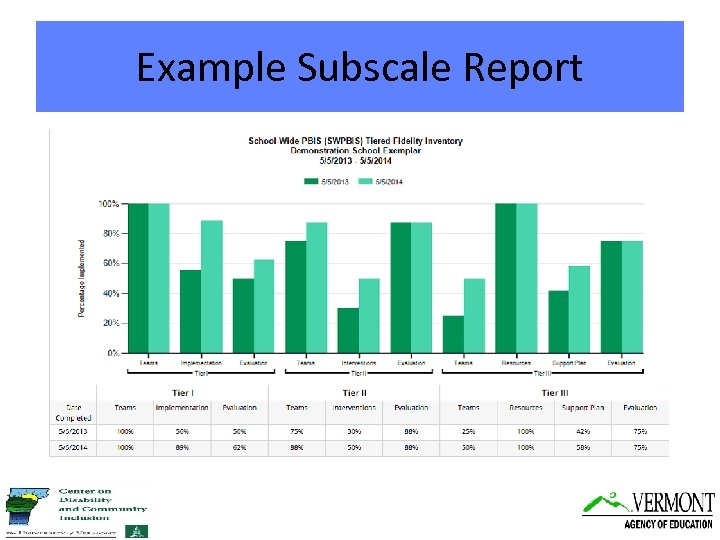
Example Subscale Report
TFI Activities • Generate great ideas as a group • Problem solve any challenges • Record the strategies you like on TFI Action Plan template
Tier 1: Team Big Ideas: • Teams need people with multiple skills and perspectives to implement PBIS well. • Specific features are necessary to ensure meetings are effective for action planning and tracking progress.
TFI Activity – Team Composition – could include: • Coordinator • Behavioral expertise • Administrative authority • Coaching expertise • Knowledge about academic/behavior outcomes • Knowledge about school operations • Family/Student perspective included Do you have these perspectives represented? What are some strategies for improvement?
Tier 1: Team Explicit team operating procedures: • Regular, monthly meetings • Meeting format • Minutes taken during and disseminated after each meeting • Participant roles are clearly defined • Action plan current to the school year What works for you? What are strategies for improvement?
Small Group Activity Implementation • Count off by 6 and go to your assigned table • Introduce yourselves and assign a facilitator, recorder(s), and timekeeper • As a group, discuss the following questions found on your table regarding Tier 1 Implementation. • Select 1 -2 people to record your answers on the Post-it notes at your table and place on designated chart paper on the wall.
TFI Activity Debrief • Walk around the room to see the recordings from each group. • We’ll hear a sampling of responses.
Tier 1 - Evaluation Big Ideas: • Teams need the right information at the right time to make effective decisions. • Measuring fidelity data is essential for maintaining effective implementation of PBIS. • Implementation of Tier 1 is likely more sustainable if the Team self-assesses at least annually AND reports this data to key stakeholders.
Tier 1 – Evaluation Data collection and problem-solving includes: • Access to both academic and behavior data that is reviewed monthly • Completion of Fidelity Assessments • Tying data findings into Tier 1 Action Planning • Reporting data to all stakeholders What works for you? What are strategies for improvement?
Guiding Principles for Sustainability • Never stop doing what is already working • Always look for the smallest change that will produce the largest effect • Do not add something new without also defining what you will stop doing • Collect and use data for decision-making
Integrating PBIS and Social/Emotional Learning A brief presentation And a little food for thought 33
Why is this topic important? • SEL and PBIS are 2 of the most widely adopted, evidence-based approaches that have been advocated to address student mental health. • Research findings indicate that an integrated approach (SEL and PBIS) produces better results than either one alone.
What is SEL? Developing skills that are the foundation for social competence and resilience, such as: • Self-regulation; • Emotion management; • Empathy; • Interpersonal problem-solving; and • Future orientation (Zins, Bloodworth, Weissberg, & Walberg, 2004)
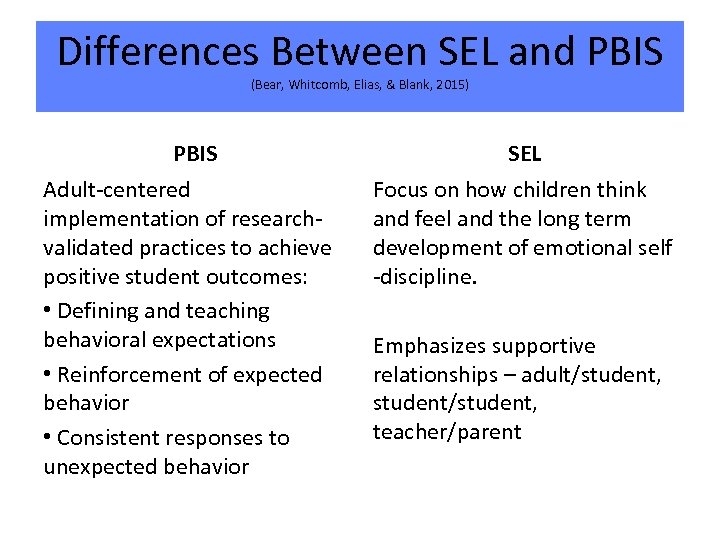
Differences Between SEL and PBIS (Bear, Whitcomb, Elias, & Blank, 2015) PBIS Adult-centered implementation of researchvalidated practices to achieve positive student outcomes: • Defining and teaching behavioral expectations • Reinforcement of expected behavior • Consistent responses to unexpected behavior SEL Focus on how children think and feel and the long term development of emotional self -discipline. Emphasizes supportive relationships – adult/student, student/student, teacher/parent
What do PBIS and SEL have in Common? (Bear, Whitcomb, Elias, & Blank, 2015) • Shared emphasis on preventing problem behaviors (unlike zero tolerance approach) • Use of positive techniques • Strong emphasis on systems change • Goal to improve social culture of the school • Provides students with critical life skills • Links problem behavior with teaching and reflection about how to try a different approach in the future
Strategies for Integrating PBIS and SEL (Bear, Whitcomb, Elias, & Blank, 2015) • Teach and reinforce the expectation, then provide instruction on why the rules are important and how that impacts relationship development and responsible decision making • Link expectations to things like conflict resolution and emotional regulation
Strategies for Integrating PBIS and SEL (cont’d. ) (Bear, Whitcomb, Elias, & Blank, 2015) • Link rewards with competencies, such as cooperation or teamwork • Fade rewards when students are able to reflect internally and can link PBIS behavioral expectations with social-emotional processes such as empathy, pride and self-identity • Promote positive school culture and climate by unifying PBIS and SEL themes
If you are already teaching SEL. . . • • What are you doing? Are you using an evidence-based curriculum? Who is doing it? How can the link be made to PBIS?
If you don’t already teach SEL. . . • Can your leadership team take this on? – Determine what social-emotional outcomes you are looking for – Determine which evidence-based curriculum will help you meet those outcomes – Problem solve around what it will take to implement: • Resources (staff, money, time) • Buy-in
VTPBi. S Coordinators Meeting Networking Logistics, Updates, Q & A 42
Networking Sessions
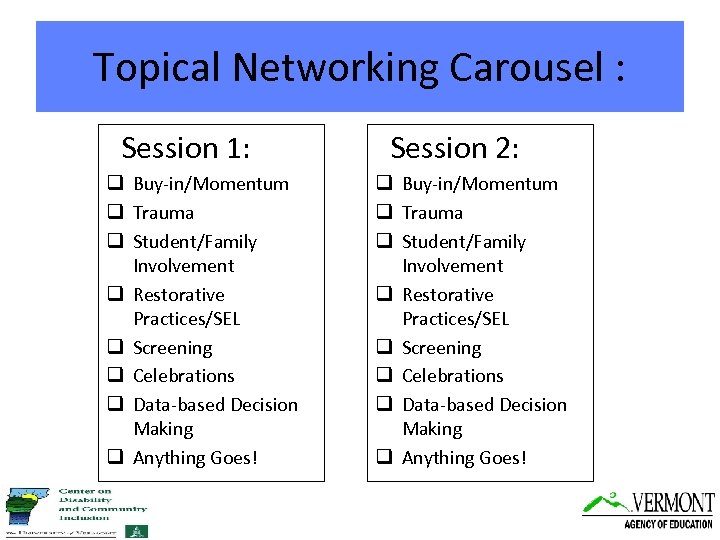
Topical Networking Carousel : Session 1: q Buy-in/Momentum q Trauma q Student/Family Involvement q Restorative Practices/SEL q Screening q Celebrations q Data-based Decision Making q Anything Goes! Session 2: q Buy-in/Momentum q Trauma q Student/Family Involvement q Restorative Practices/SEL q Screening q Celebrations q Data-based Decision Making q Anything Goes!
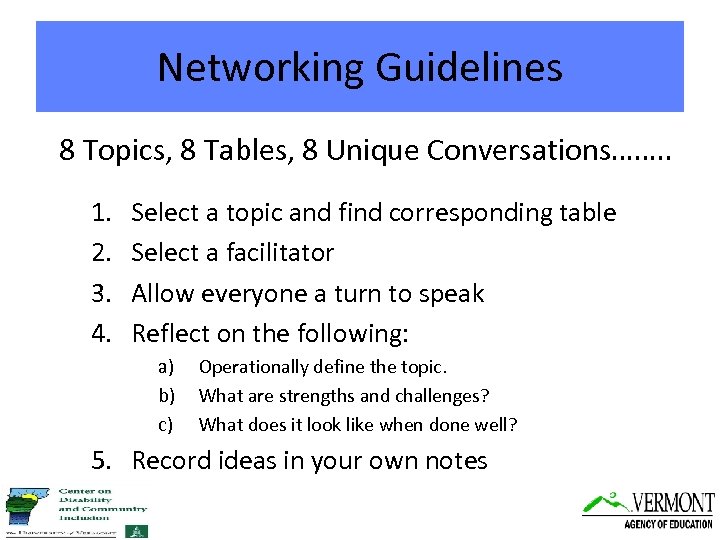
Networking Guidelines 8 Topics, 8 Tables, 8 Unique Conversations……. . 1. 2. 3. 4. Select a topic and find corresponding table Select a facilitator Allow everyone a turn to speak Reflect on the following: a) b) c) Operationally define the topic. What are strengths and challenges? What does it look like when done well? 5. Record ideas in your own notes
VTPBi. S Quarterly Report Review 46
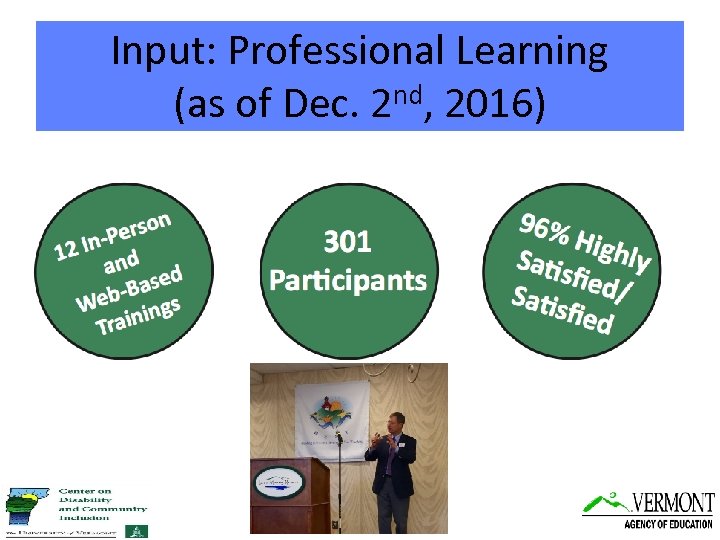
Input: Professional Learning (as of Dec. 2 nd, 2016)
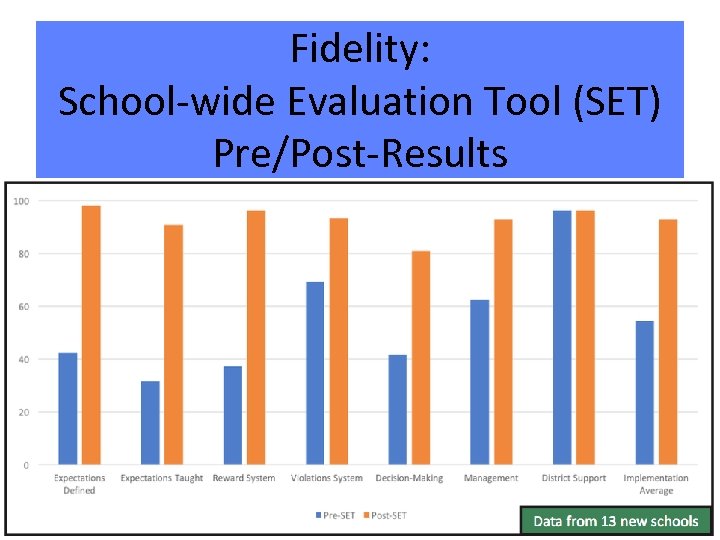
Fidelity: School-wide Evaluation Tool (SET) Pre/Post-Results
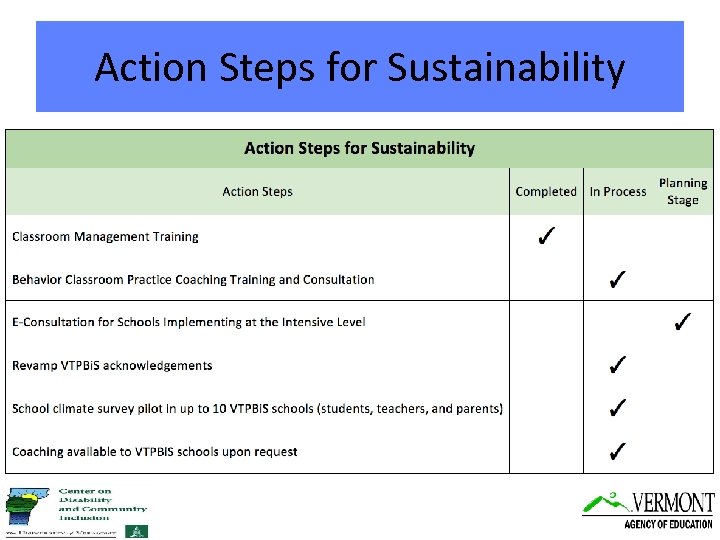
Action Steps for Sustainability
SAS and TFI Reminder! • The SAS Window is currently open! It closes on March 31 st! • The TFI Window is currently open! It closes on March 31 st! 50
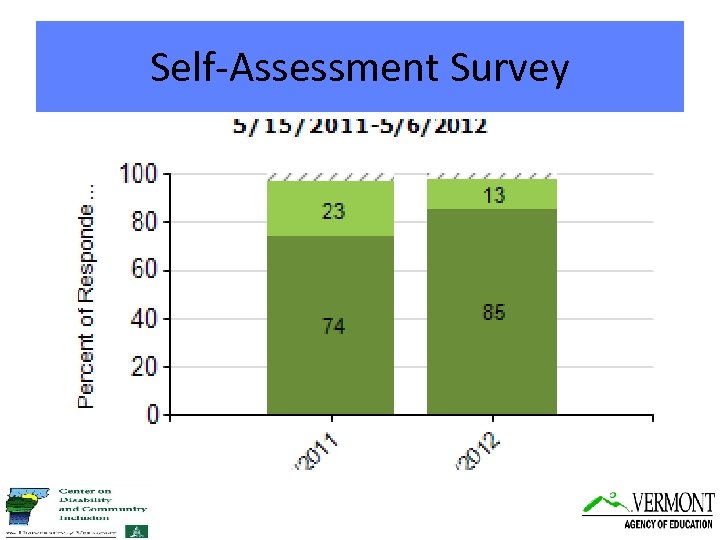
Self-Assessment Survey
TFI and SAS Instructions For TFI, go to: http: //www. pbisvermont. org/resources/evaluat ion-tools/tiered-fidelity-inventory-tfi For SAS, go to: http: //www. pbisvermont. org/resources/evaluat ion-tools/ebs-self-assessment-survey
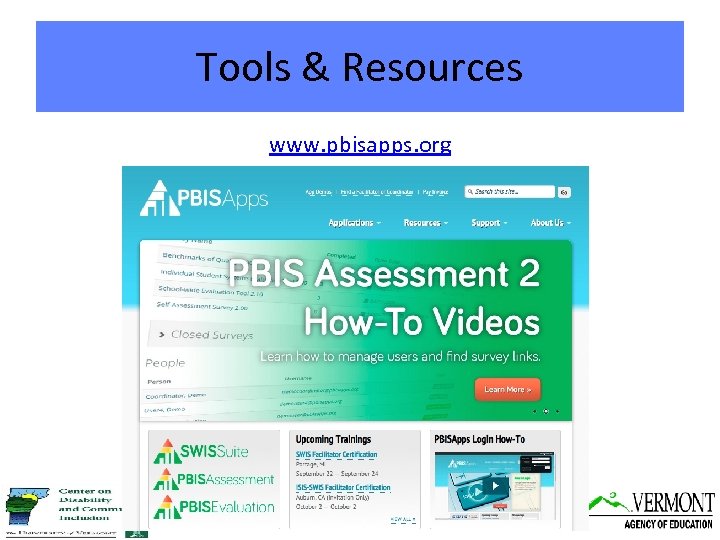
Tools & Resources www. pbisapps. org
VTPBi. S Upcoming Events • Upcoming Trainings: FBA/BSP – 2/3 and 2/10 in Killington Trauma Webinar – 3/15 March PBIS – 3/30 – 3/31 in Hampton Inn, Colchester CPI – 3/17 in South Burlington • Next Coordinators’ Meetings: NORTH: MAY 3 rd – Holiday Inn, S. Burlington SOUTH: MAY 4 th – Newsbank Conference Center, Chester • 2017 Summer Institute 54
VTPBi. S Updates • • • Classroom Behavior Practice Coaches Cohort Tier 3 E-Consultation Coordinators Handbook Access to VTPBi. S Coaching Survey Monkey Feedback Communication: Facebook, Twitter, Website DO YOU RECEIVE VTPBi. S Updates? ? ?
References • Durlak, J. A. (2015). Handbook of social and emotional learning: research and practice. New York: The Guilford Press. • Cook, C. R. , Frye, M. , Slemrod, T. , Lyon, A. R. , Renshaw, T. L. , & Zhang, Y. (2015). An integrated approach to universal prevention: Independent and combined effects of PBIS and SEL on youths’ mental health. School Psychology Quarterly, 30(2), 166 -183.
 Скачать презентацию VTPBi S Coordinators as Coaches Learning Networking
97136805d3297005869fb1c5077f24b2.ppt