

ВТОРАЯ НЕДЕЛЯ ФОРМИРОВАНИЕ ДВУХСЛОЙНОГО ЗАРОДЫША


 Скачать презентацию ВТОРАЯ НЕДЕЛЯ ФОРМИРОВАНИЕ ДВУХСЛОЙНОГО ЗАРОДЫША
Вторая неделя.ppt
- Количество слайдов: 18
ВТОРАЯ НЕДЕЛЯ ФОРМИРОВАНИЕ ДВУХСЛОЙНОГО ЗАРОДЫША
ОСНОВНАЯ ХАРАКТЕРИСТИКА Implantation of the blastocyst is completed during the second week. As this process occurs, morphologic changes in the embryoblast produce a bilaminar embryonic disc composed of epiblast and The embryonic disc gives rise to the germ layers that form all the tissues and organs of the embryo. Extraembryonic structures forming during the second week are the amniotic cavity, amnion, umbilical vesicle (yolk sac), connecting stalk, and chorionic sac.
ЗАВЕРШЕНИЕ ИМПЛАНТАЦИИ И ДАЛЬНЕЙШЕЕ РАЗВИТИЕ Implantation of the blastocyst is completed by the end of the second week. It occurs during a restricted time period 6 to 10 days after ovulation. As the blastocyst implants , more trophoblast contacts the endometrium and differentiates into the cytotrophoblast, a layer of cells that is mitotically active and forms new cells that migrate into the increasing mass of syncytiotrophoblast, where they fuse and lose their cell membranes The syncytiotrophoblast, a rapidly expanding, multinucleated mass in which no cell boundaries are discernible
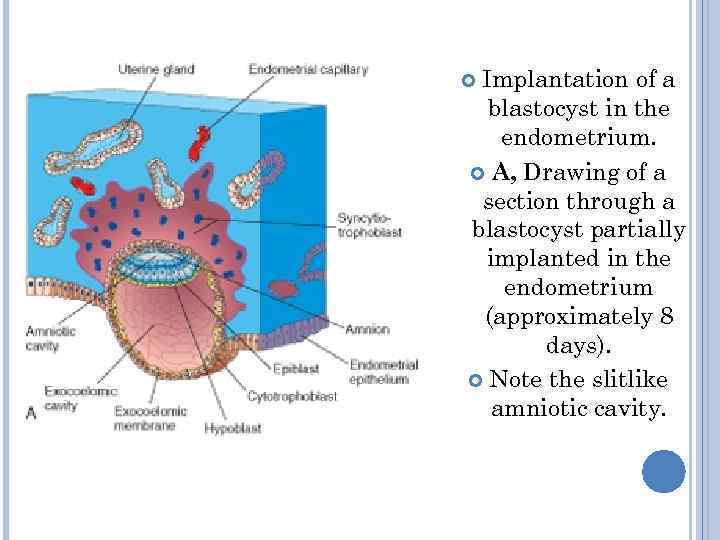
Implantation of a blastocyst in the endometrium. A, Drawing of a section through a blastocyst partially implanted in the endometrium (approximately 8 days). Note the slitlike amniotic cavity.
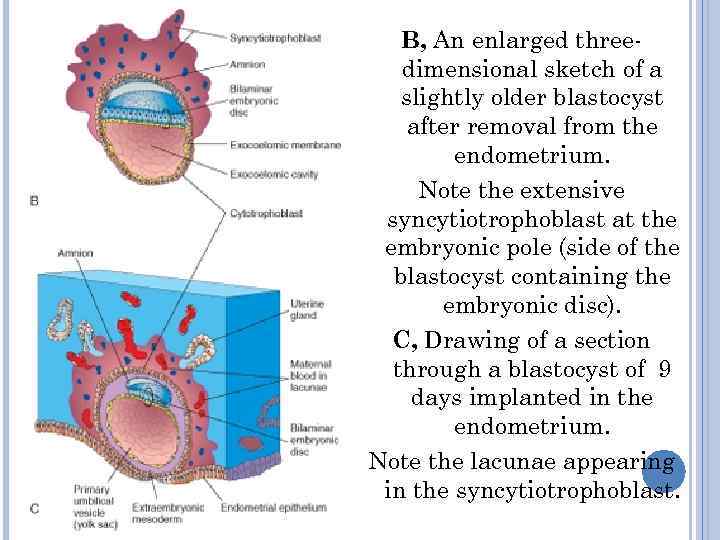
B, An enlarged three- dimensional sketch of a slightly older blastocyst after removal from the endometrium. Note the extensive syncytiotrophoblast at the embryonic pole (side of the blastocyst containing the embryonic disc). C, Drawing of a section through a blastocyst of 9 days implanted in the endometrium. Note the lacunae appearing in the syncytiotrophoblast.
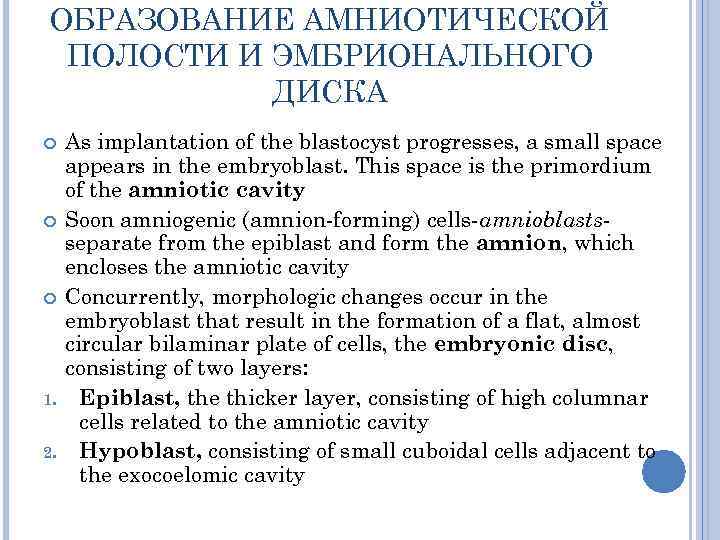
ОБРАЗОВАНИЕ АМНИОТИЧЕСКОЙ ПОЛОСТИ И ЭМБРИОНАЛЬНОГО ДИСКА As implantation of the blastocyst progresses, a small space appears in the embryoblast. This space is the primordium of the amniotic cavity Soon amniogenic (amnion-forming) cells-amnioblasts- separate from the epiblast and form the amnion, which encloses the amniotic cavity Concurrently, morphologic changes occur in the embryoblast that result in the formation of a flat, almost circular bilaminar plate of cells, the embryonic disc, consisting of two layers: 1. Epiblast, the thicker layer, consisting of high columnar cells related to the amniotic cavity 2. Hypoblast, consisting of small cuboidal cells adjacent to the exocoelomic cavity
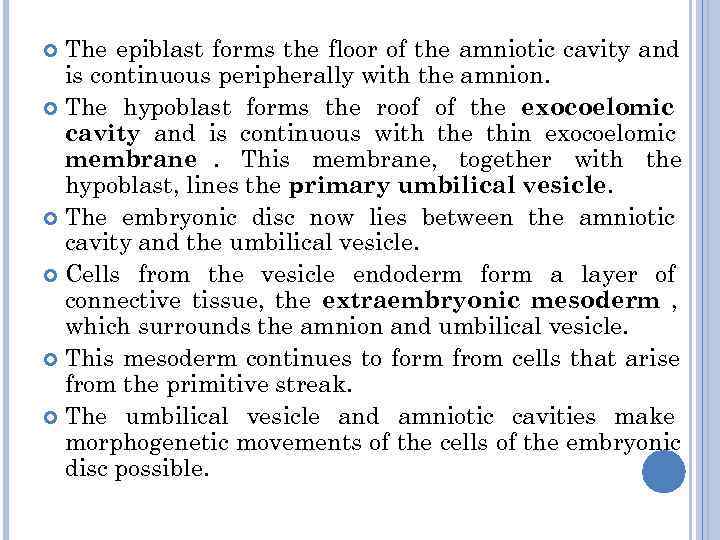
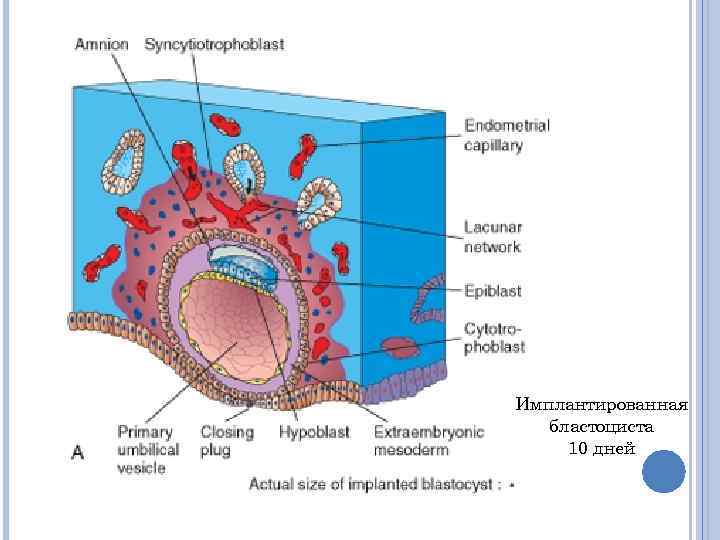
The epiblast forms the floor of the amniotic cavity and is continuous peripherally with the amnion. The hypoblast forms the roof of the exocoelomic cavity and is continuous with the thin exocoelomic membrane. This membrane, together with the hypoblast, lines the primary umbilical vesicle. The embryonic disc now lies between the amniotic cavity and the umbilical vesicle. Cells from the vesicle endoderm form a layer of connective tissue, the extraembryonic mesoderm , which surrounds the amnion and umbilical vesicle. This mesoderm continues to form from cells that arise from the primitive streak. The umbilical vesicle and amniotic cavities make morphogenetic movements of the cells of the embryonic disc possible.
Имплантированная бластоциста 10 дней
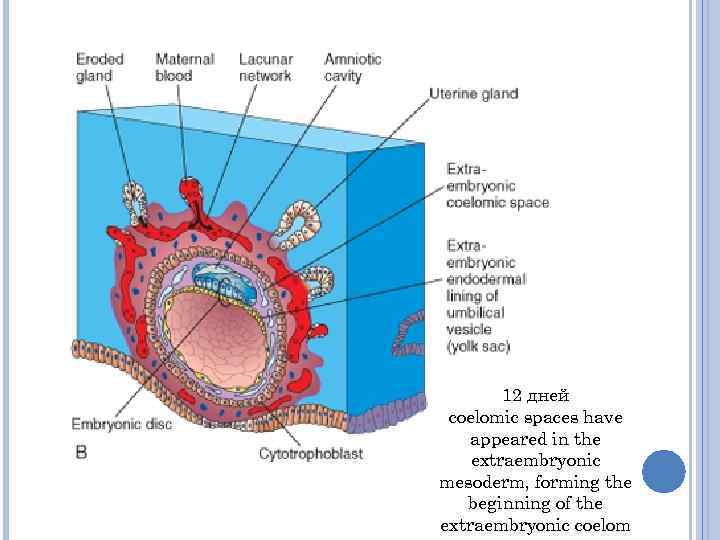
12 дней coelomic spaces have appeared in the extraembryonic mesoderm, forming the beginning of the extraembryonic coelom
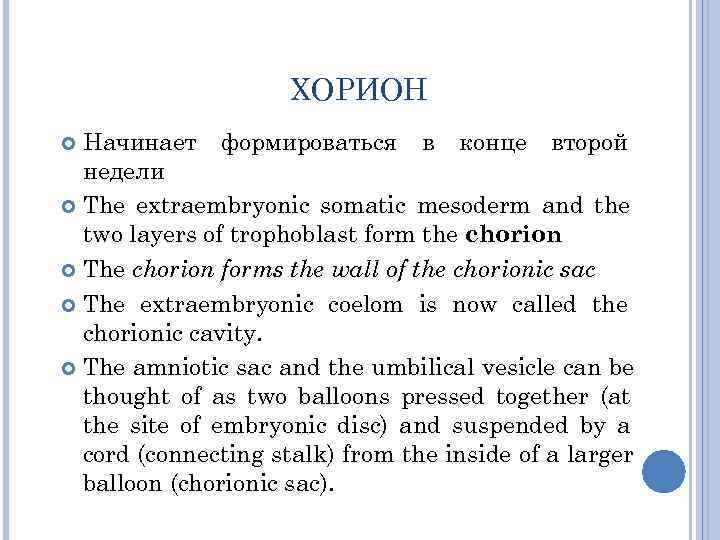
As changes occur in the trophoblast and endometrium, the extraembryonic mesoderm increases and isolated extraembryonic coelomic spaces appear within These spaces rapidly fuse to form a large isolated cavity, the extraembryonic coelom As the extraembryonic coelom forms, the primary umbilical vesicle decreases in size and a smaller secondary umbilical vesicle forms. This smaller vesicle is formed by extraembryonic endodermal cells that migrate from the hypoblast inside the primary umbilical vesicle During formation of the secondary umbilical vesicle, a large part of the primary umbilical vesicle is pinched off The umbilical vesicle contains no yolk ; however, it has important functions (e. g. , it is the site of origin of primordial germ cells). It may have a role in the selective transfer of nutrients to the embryo.
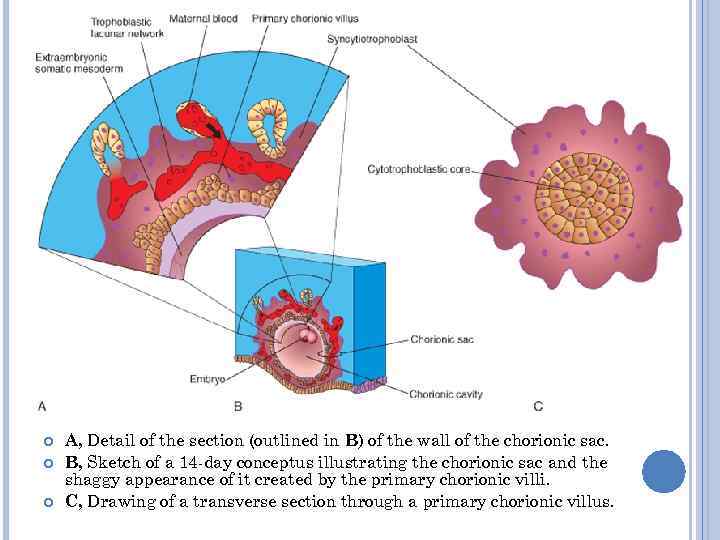
ХОРИОН Начинает формироваться в конце второй недели The extraembryonic somatic mesoderm and the two layers of trophoblast form the chorion The chorion forms the wall of the chorionic sac The extraembryonic coelom is now called the chorionic cavity. The amniotic sac and the umbilical vesicle can be thought of as two balloons pressed together (at the site of embryonic disc) and suspended by a cord (connecting stalk) from the inside of a larger balloon (chorionic sac).
A, Detail of the section (outlined in B) of the wall of the chorionic sac. B, Sketch of a 14 -day conceptus illustrating the chorionic sac and the shaggy appearance of it created by the primary chorionic villi. C, Drawing of a transverse section through a primary chorionic villus.
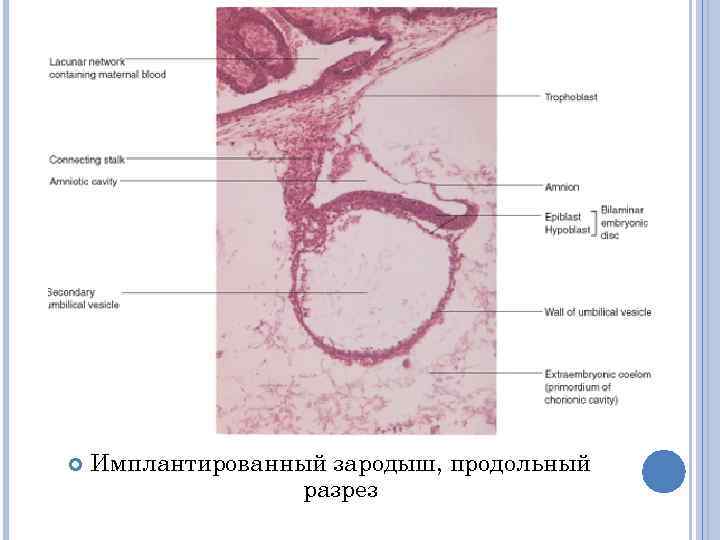
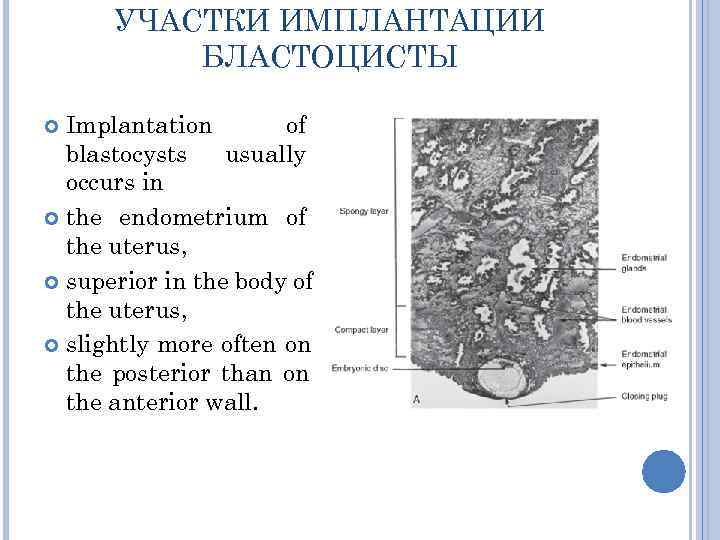
Имплантированный зародыш, продольный разрез
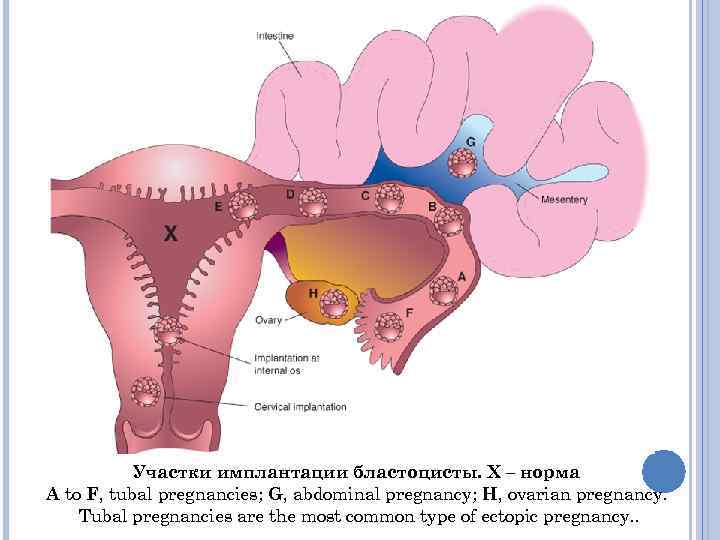
УЧАСТКИ ИМПЛАНТАЦИИ БЛАСТОЦИСТЫ Implantation of blastocysts usually occurs in the endometrium of the uterus, superior in the body of the uterus, slightly more often on the posterior than on the anterior wall.
Участки имплантации бластоцисты. Х – норма A to F, tubal pregnancies; G, abdominal pregnancy; H, ovarian pregnancy. Tubal pregnancies are the most common type of ectopic pregnancy. .
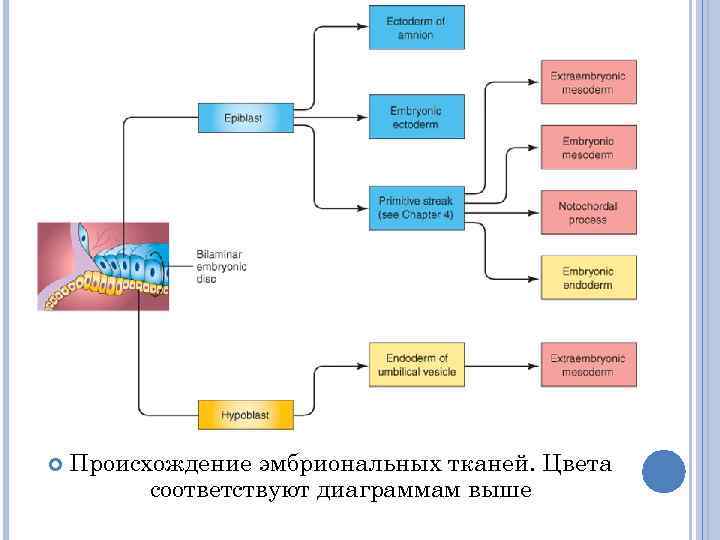
Происхождение эмбриональных тканей. Цвета соответствуют диаграммам выше
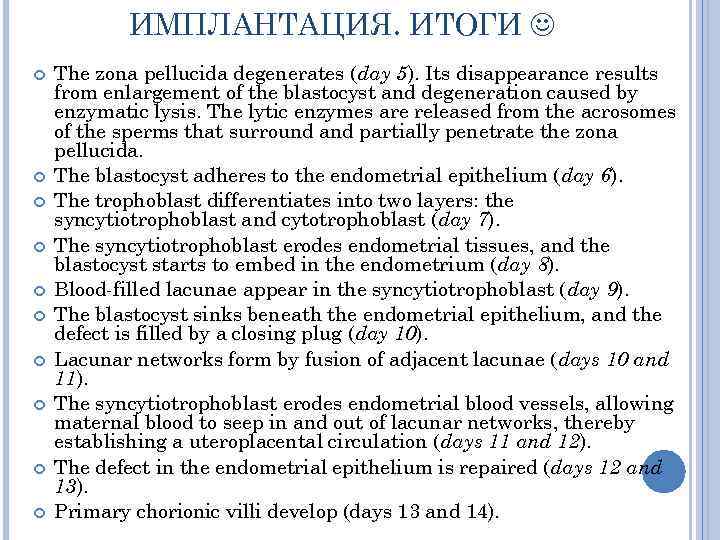
ИМПЛАНТАЦИЯ. ИТОГИ The zona pellucida degenerates (day 5). Its disappearance results from enlargement of the blastocyst and degeneration caused by enzymatic lysis. The lytic enzymes are released from the acrosomes of the sperms that surround and partially penetrate the zona pellucida. The blastocyst adheres to the endometrial epithelium (day 6). The trophoblast differentiates into two layers: the syncytiotrophoblast and cytotrophoblast (day 7). The syncytiotrophoblast erodes endometrial tissues, and the blastocyst starts to embed in the endometrium (day 8). Blood-filled lacunae appear in the syncytiotrophoblast (day 9). The blastocyst sinks beneath the endometrial epithelium, and the defect is filled by a closing plug (day 10). Lacunar networks form by fusion of adjacent lacunae (days 10 and 11). The syncytiotrophoblast erodes endometrial blood vessels, allowing maternal blood to seep in and out of lacunar networks, thereby establishing a uteroplacental circulation (days 11 and 12). The defect in the endometrial epithelium is repaired (days 12 and 13). Primary chorionic villi develop (days 13 and 14).
ВТОРАЯ НЕДЕЛЯ. ИТОГИ Rapid proliferation and differentiation of the trophoblast occurs as the blastocyst completes its implantation in the endometrium. The endometrial changes resulting from the adaptation of these tissues in preparation for implantation are known as the decidual reaction. Concurrently, the primary umbilical vesicle (yolk sac) forms and extraembryonic mesoderm develops. The extraembryonic coelom forms from spaces that develop in the extraembryonic mesoderm. The coelom later becomes the chorionic cavity. The primary umbilical vesicle becomes smaller and gradually disappears as the secondary umbilical vesicle develops. The amniotic cavity appears as a space between the cytotrophoblast and the embryoblast. The embryoblast differentiates into a bilaminar embryonic disc consisting of epiblast , related to the amniotic cavity, and hypoblast, adjacent to the blastocyst cavity. The prechordal plate develops as a localized thickening of the hypoblast, which indicates the future cranial region of the embryo and the future site of the mouth; the prechordal plate is also an important organizer of the head region.