Скачать презентацию VTA HR Conference 2008 Recruitment and Retention Strategies
ae5b5b7ead64f886b0387cd69e75bbbf.ppt
- Количество слайдов: 43
 VTA HR Conference 2008 Recruitment and Retention Strategies
 Today’s presentation • Background to the Institute • Investors In People Framework and our approach/Alignment • Workforce Planning and Mgt process and associated strategies • Next steps in the Institute for Retention and Recruitment strategies

 BACKGROUND • • • $40 MILL TURNOVER 750 STAFF (480 EFT) 14, 000 STUDENTS GEOGRAPHICALLY SPREAD EMERGING CULTURE FROM TWO DISTINCT INSTITUTES THAT AMALGAMATED IN 1996
 Shepparton Benalla Seymour Wangaratta
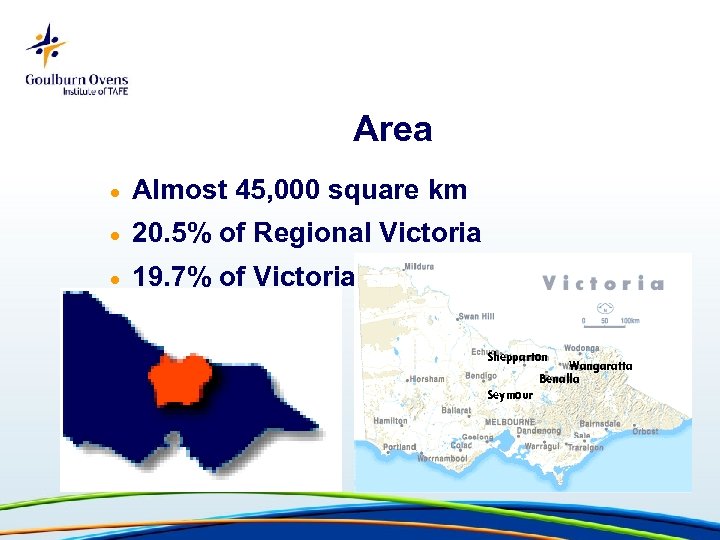 Area Almost 45, 000 square km 20. 5% of Regional Victoria 19. 7% of Victoria Shepparton Wangaratta Benalla Seymour
 Our Brands
 Vision Statement A world class Institute delivering quality education and training beyond expectations
 Our Brands
 Our Brands
 Issues Facing a Regional TAFE Institute • Competition (with private RTOs other TAFEs other industries for all staff/programs) • Commercialisation (govt funding still in place with a greater reliance on institute’s becoming financially viable. ) • Community Obligations (goals in each community built on partnerships with Local Govt, industry groups, community groups) • Industrial Relations (internally and externally) • Lifestyle versus Quality (can have a career and a life) • Workforce Issues (recruiting and retaining the best people possible/ identifying who needs to leave) • Positioning and Relevance (Positioning and Branding as an employer and the assoicated recognition)
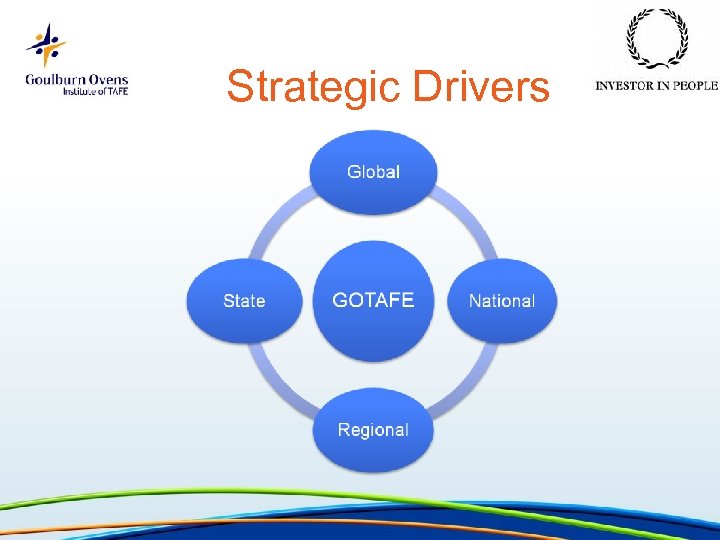 Strategic Drivers
 COAG 6 guiding principles • • • Demand driven Competition between providers Greater transparency Public and private investment Quality guarantees No barriers to entry
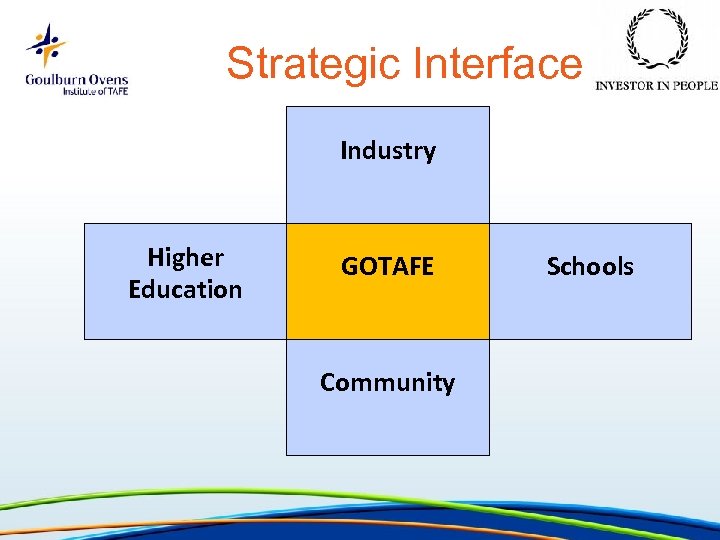 Strategic Interface Industry Higher Education GOTAFE Community Schools
 Strategic Principles The Strategic Directions of Goulburn Ovens Institute of TAFE are underpinned by the following strategic principles: • The State Government as the sole shareholder of the Institute ultimately determines the Institute’s vocational education and training policy • The Institute is a major tool of economic and social development for regional industries and businesses, local communities and individuals
 Strategic Principles • Institute programs focus on the skills development of the whole person by a competency approach to education and training that emphasises skills, knowledge and behaviours • The nurturing of creativity, entrepreneurship and innovation are embedded into Institute education and training programs • Sound business management processes are fundamental to the Institute’s continued financial sustainability
 Strategic Principles • The recruitment of quality staff and their continual professional growth determines the Institute’s ability to delivery quality outcomes • The fostering of long-term relationships, alliances and partnerships with key industries and communities are the cornerstones of the Institute’s future success • The regular monitoring of client satisfaction levels and the measuring of quality outcomes data are vital to the Institute’s continuous improvement and its ability to be competitive
 Strategic Goals • • Recognises as an Employer of Choice Learning Culture Health and wellbeing goals Re accreditation for Ii. P 100% Qualified Retention based on right fit Diversity and Flexibility Staff Satisfaction/ Succession Plans

 The Investors in People Standard – What is it? • An internationally-recognised standard • Developed in UK in 1990 by a partnership of leading businesses and national organisations, the Standard helps organisations to improve performance and realise objectives through the management and development of their people. • Reviewed every 3 years to ensure that it remains relevant, accessible and attractive to all. The most recent review was completed in November 2004.
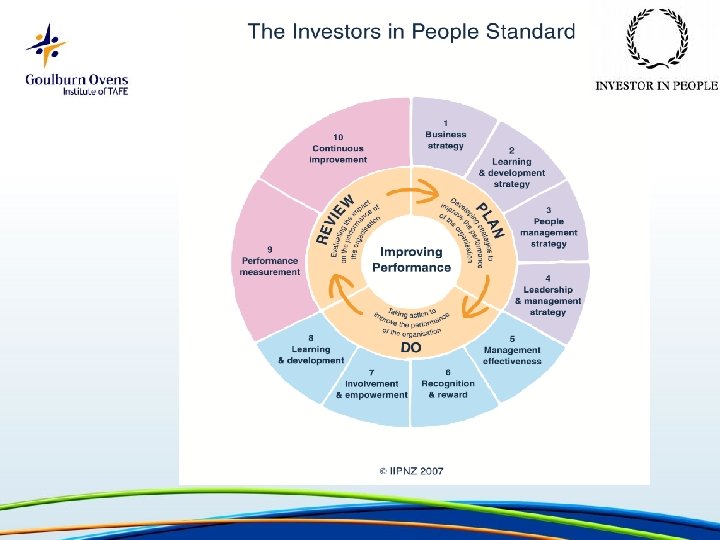
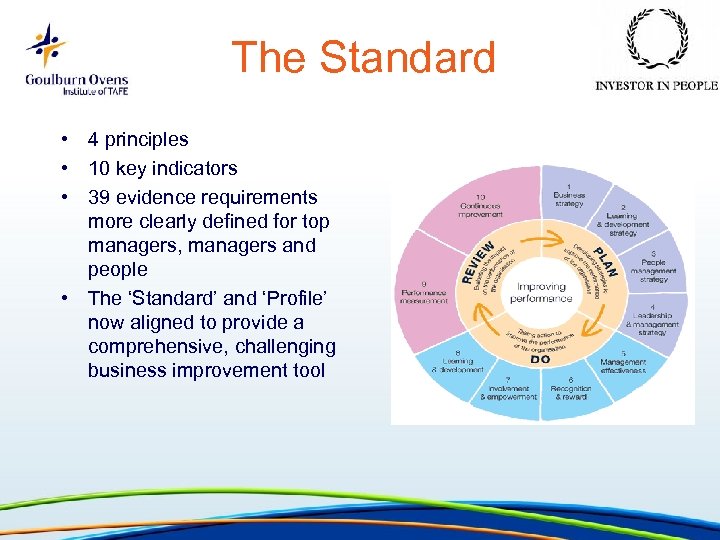 The Standard • 4 principles • 10 key indicators • 39 evidence requirements more clearly defined for top managers, managers and people • The ‘Standard’ and ‘Profile’ now aligned to provide a comprehensive, challenging business improvement tool
 The GOTAFE Journey 1. Decision to take the Ii. P journey in 2003 2. Adopted the framework in 2004 3. Diagnostic Assessment – April 2007 4. Assessment – December 2007
 • • • The Investors in People Standard – What are the benefits for the Institute? Improved earnings, productivity and profitability Customer satisfaction Increased staff motivation Reduced costs and wastage Enhanced quality Competitive advantage through improved performance • Public recognition
 The Investors in People Standard – What are the benefits for staff? • A good working environment • Recognition and development • Pride in being part of a successful organisation • Good quality training when required • Improved job satisfaction • Better communication • Skill and career development opportunities • Increased responsibility and involvement
 Investors in People Main message • Major strength – Ii. P standard focuses on engaging staff rather than documenting policies, procedures and practices • Major strength – Ii. P accreditation based on random cross-section of staff rather than just managers or handpicked staff representatives • Major focus – Ii. P strives to increase staff ownership of the Institute’s strategic goals and operational targets, processes and practices and improve their understanding of how they contribute to its success • Major focus – Ii. P aims to create a supportive “learning” environment where staff are valued and feel valued • Major outcomes – Ii. P leads to a culture of continuous improvement as it is expected the organisation continually improves against the Ii. P standard rather than just maintains the status quo
 Raising the Standard Early experience shows organisations find particular challenges around the following indicators: Indicator 4 The capabilities managers need to lead, manage and develop effectively are clearly defined and understood Indicator 5 Managers are effective in leading, managing and developing people ** Indicator 7 People are encouraged to take ownership and responsibility by being involved in decision-making Indicator 9 Investment in people improves the performance of the organisation ** Accreditation process highlighted gaps in this area/feedback +ve/-ve
 Recognition as an Investor in People What does this mean for employees? • Consistency and equality of support and development in all areas • Avenue for on-going feedback (via assessment) • Career development opportunities more likely • Targeted professional development • Managers ‘walking the talk’ • Poor performance of colleagues will addressed fairly
 Organisational Excellence • Obtained accreditation in Dec 2007. Formally recognised in Feb 2008. First TAFE Institute in Australia to be recognised under the new Standard. • No resting on your laurels! • Continuous Improvement not negotiable with Investors in People. • Organisational Excellence for IIP means: - Sound planning and cascading of goals with all levels of the Organisation - Effective professional development - Consistent Leadership and management practices - Recognition and empowerment

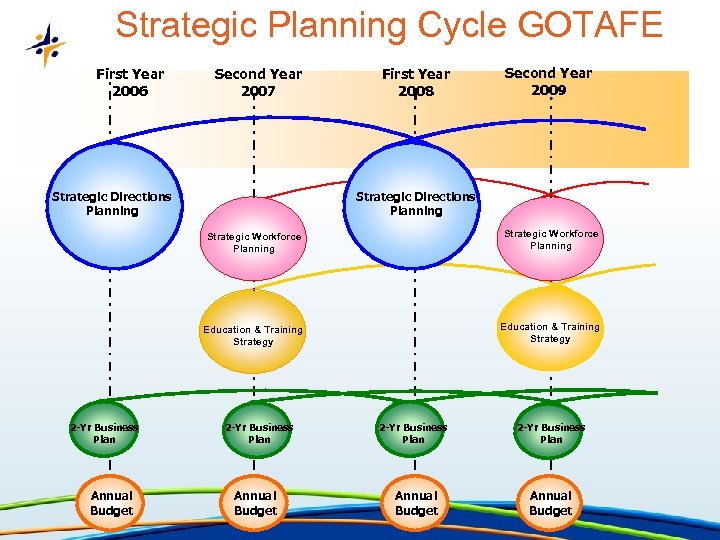 Strategic Planning Cycle GOTAFE First Year 2006 Second Year 2007 Strategic Directions Planning First Year 2008 Second Year 2009 Strategic Directions Planning Strategic Workforce Planning Education & Training Strategy 2 -Yr Business Plan Annual Budget
 Why carry out the process? Key issues affecting the TAFE Sector • • • Increased competition from private Sector Regional TAFE institutions continue to experience extreme skill shortages as a result of lower level of access to specialist teaching staff Complexity and commercial role of TAFE itself (in comparison to other education sectors) increases the demand on the managerial and entrepreneurial skills of managers. • Increasing legislative and regulatory intervention that determines the nature and extent of service delivery • Increase in technology to improve access and efficiency of service delivery • Increasing technical education needs of a population staying in the workforce longer and likely to require more education services to meet changing work demands. Need to understand your labour demand then address the supply side of your labour. •
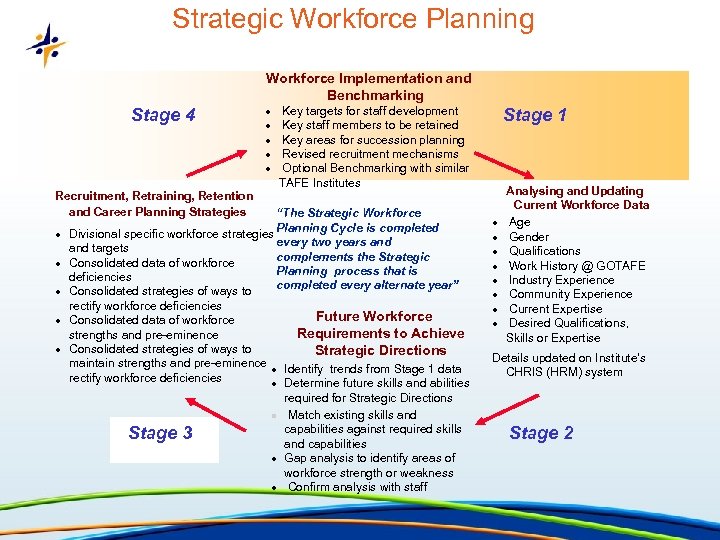 Strategic Workforce Planning Workforce Implementation and Benchmarking Stage 4 Key targets for staff development Key staff members to be retained Key areas for succession planning Revised recruitment mechanisms Optional Benchmarking with similar TAFE Institutes Recruitment, Retraining, Retention and Career Planning Strategies “The Strategic Workforce Planning Cycle is completed Divisional specific workforce strategies every two years and targets complements the Strategic Consolidated data of workforce Planning process that is deficiencies completed every alternate year” Consolidated strategies of ways to rectify workforce deficiencies Future Workforce Consolidated data of workforce Requirements to Achieve strengths and pre-eminence Consolidated strategies of ways to Strategic Directions maintain strengths and pre-eminence Identify trends from Stage 1 data rectify workforce deficiencies Determine future skills and abilities Stage 3 required for Strategic Directions Match existing skills and capabilities against required skills and capabilities Gap analysis to identify areas of workforce strength or weakness Confirm analysis with staff Stage 1 Analysing and Updating Current Workforce Data Age Gender Qualifications Work History @ GOTAFE Industry Experience Community Experience Current Expertise Desired Qualifications, Skills or Expertise Details updated on Institute’s CHRIS (HRM) system Stage 2
 Our Stats • • Approx 750 employees (450 ft, pt and approx 300 sessionals) Average Age of TAFE Employee Victoria 47 years. GOTAFE Average 49 in 2005, 46 yrs in 2007 (without sessionals is 51 yrs) 52% of Goulburn Ovens Institute of TAFE staff are 46 years or older. Staff satisfaction in 2006 71. 1% People Matter Survey : – 68% were proud to work for the Organisation – 66% view Goulburn Ovens as an Employer of Choice – 68% viewed working for the Organisation as a good Career Choice – However 45% said they were thinking about leaving the organisation – 36% said they were actively looking for a job outside the organisation Recruitment time to employ someone is approx 33 days in 2007 100% ongoing and contract staff have a had a work plan and career plan meeting in 2007
 Other Stats • Executive Team – Average Age 51 years. Pending retirements • Average Age of Managers – 47 years • Ave age of teachers – 45 years • Avg Age of PACCT staff 42 years with 50% over 50 years • Headcount has increased with the development of the NCDEA and NCEE brands and delivery
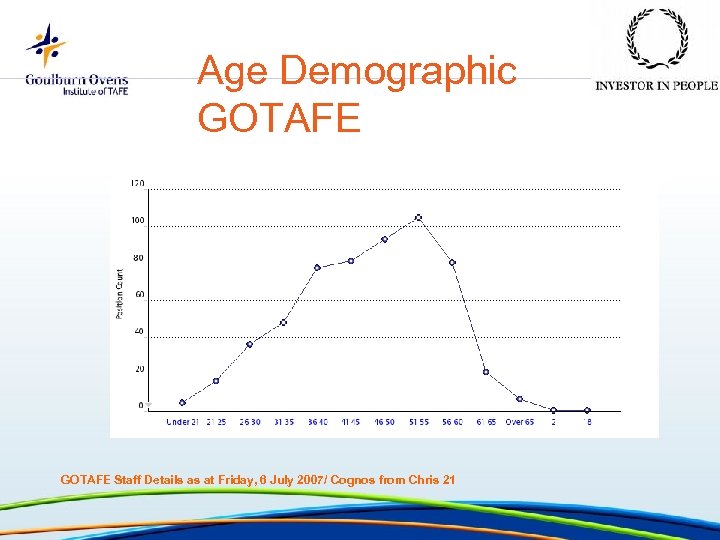 Age Demographic GOTAFE Staff Details as at Friday, 6 July 2007/ Cognos from Chris 21
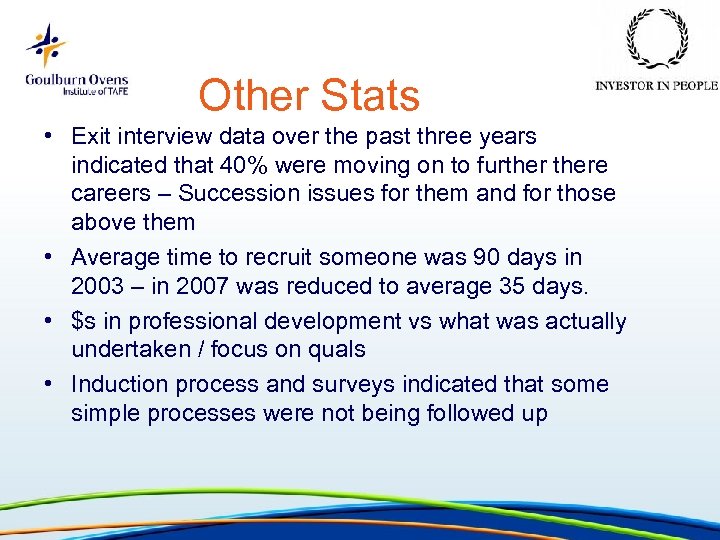 Other Stats • Exit interview data over the past three years indicated that 40% were moving on to furthere careers – Succession issues for them and for those above them • Average time to recruit someone was 90 days in 2003 – in 2007 was reduced to average 35 days. • $s in professional development vs what was actually undertaken / focus on quals • Induction process and surveys indicated that some simple processes were not being followed up
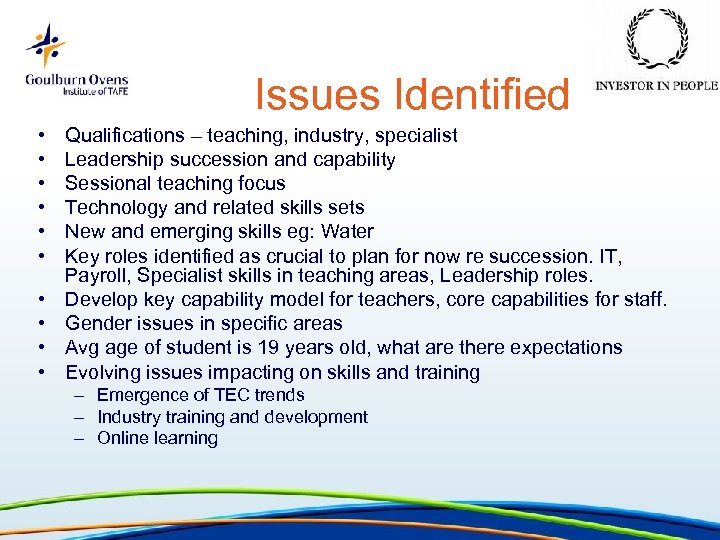 Issues Identified • • • Qualifications – teaching, industry, specialist Leadership succession and capability Sessional teaching focus Technology and related skills sets New and emerging skills eg: Water Key roles identified as crucial to plan for now re succession. IT, Payroll, Specialist skills in teaching areas, Leadership roles. Develop key capability model for teachers, core capabilities for staff. Gender issues in specific areas Avg age of student is 19 years old, what are there expectations Evolving issues impacting on skills and training – Emergence of TEC trends – Industry training and development – Online learning
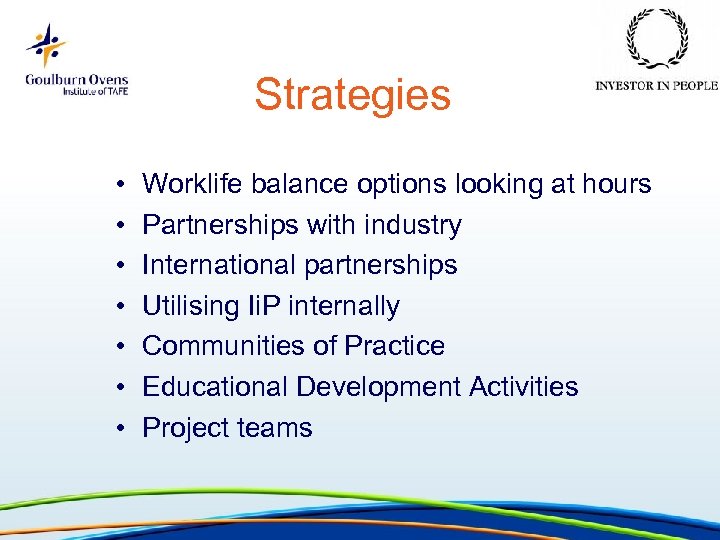 Strategies • • Worklife balance options looking at hours Partnerships with industry International partnerships Utilising Ii. P internally Communities of Practice Educational Development Activities Project teams
 • Strategies for retention budget to staff Increasing allocation of development by 2% of the total annual budget each year • Including usual release activities and overseas exchanges • Revise Education and Training Strategy in light of Teacher/Trainer Capability Report. • Implement all recommendations from Teacher/Trainer Capability Report.
 Strategies for attraction Radio spots • • Looking at change in working hours within the IR constraints aligning to industry demands • Sessional Development to become ft and pt • Career days • Industry exchanges
 Questions…