


 Скачать презентацию VT 1 IFOMIS Institute for Formal Ontology
1e0840450f763c0150baba371fba7ab5.ppt
- Количество слайдов: 108
 VT 1
VT 1
 IFOMIS Institute for Formal Ontology and Medical Information Science Faculty of Medicine University of Leipzig http: //ifomis. de 2
 Reference Ontology An ontology is a theory of a domain of entities in the world Ontology is outside the computer seeks maximal expressiveness and adequacy to reality and sacrifices computational tractability for the sake of representational adequacy 3
 Reference Ontology rejects Gruber’s doctrine of minimal ontological commitment -- this doctrine has been a disaster e. g. in medical informatics ontology (it will cause further disasters in Semantic Web ontologies) 4
 Reference Ontology a theory of reality designed as quality control for database/terminology systems 5
 Methodology Get ontology right first (realism; descriptive adequacy; rather powerful logic); solve tractability problems later 6
 The Reference Ontology Community IFOMIS (Leipzig) Laboratories for Applied Ontology (Trento/Rome, Turin) Foundational Ontology Project (Leeds) Ontology Works (Baltimore) Ontek Corporation (Buffalo/Leeds) Language and Computing (L&C) (Belgium/Philadelphia) 7
 Two basic BFO oppositions Granularity (of molecules, genes, cells, organisms. . . ) SNAP vs. SPAN getting time right of crucial importance for medical informatics 8
 Research projects UMLS – Universal Medical Language System “Leipzig is an idea or concept” “An Amino Acid Sequence is an idea or concept” “A human being is a physical entity” “A finger is an idea or concept” “A physician is a group” 9
 Research projects ISO Standardization 10
 User Ontologies for Adaptive Interactive Software Systems The problem: to extract information about users in a form that can be exploited by adaptive software. 11
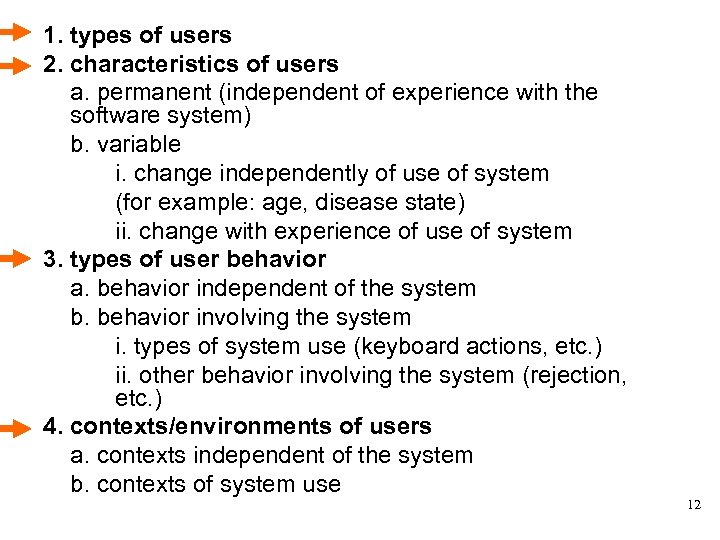 1. types of users 2. characteristics of users a. permanent (independent of experience with the software system) b. variable i. change independently of use of system (for example: age, disease state) ii. change with experience of use of system 3. types of user behavior a. behavior independent of the system b. behavior involving the system i. types of system use (keyboard actions, etc. ) ii. other behavior involving the system (rejection, etc. ) 4. contexts/environments of users a. contexts independent of the system b. contexts of system use 12
 The Theory of Granular Partitions Grids Theory of Grain-Size -- relevance to issue of disambiguation Mappings Knowledge-increase vs. Closed World Assumption Complete and incomplete partitions 13
 Mereotopological Theories for Medical Ontology Parts of anatomy of the human body Parts of physiology of the human body Formal Theories for Layered Structures 14
 The Ontology of the Gene Ontology Medical Ontology and Medical Anthropology Foundations of Spatiotemporal Ontology 15
 Testing the BFO/Med. O approach collaboration with Language and Computing nv (www. landcglobal. be) 16
 L&C Technology ‘Semantic Indexing for Smart Information Retrieval and Extraction’ 17
 L&C Technology Free. Pharma®, L&C’s natural language analyzer for converting free text (spoken or typed) prescription and pharmacology information into XML. Fast. Code®, L&C’s automated clinical coding product for translation of free text strings into ICD, SNOMED, Med. DRA, etc. Lin. KBase®, the largest formal medical knowledge base in the world, representing medicine in such a way that it is understandable for a computer. Lin. KFactory®, L&C’s product suite for developing and managing large formal multilingual ontologies. 18
 L&C’s long-term goal Transform the mass of unstructured free text patient records into a gigantic medical experiment 19
 The Project collaborate with L&C to show a realist ontology constructed on the basis of philosophical principles can help in overhauling and validating the large terminology-based medical ontology Link. Base® used by L&C for NLP 20
 IFOMIS’s long-term goal Build a robust high-level BFO-Med. O framework THE WORLD’S FIRST INDUSTRIALSTRENGTH PHILOSOPHY which can serve as the basis for an ontologically coherent unification of medical knowledge and terminology and for quality control in medical informatics software 21
 A language-independent ontology an ontology of reality as it is independently of thought and language realism about instances (objects, qualities, functions, & processes) realism about universals/properties mismatch between our concepts (expressed in any given language) and the universals existing in reality 22
 IFOMIS will provide the open source upper level framework for L&C’s large terminology based ontology QUESTION: what language to use for this purpose? 23
 Ontology: A Generalization of Davidsonian Semantics 24
 NOT ALL FORMALISMS ARE CREATED EQUAL bad (over-weak, over-strong) formalisms lead to bad ontology 25
 Armstrong’s spreadsheet ontology 26
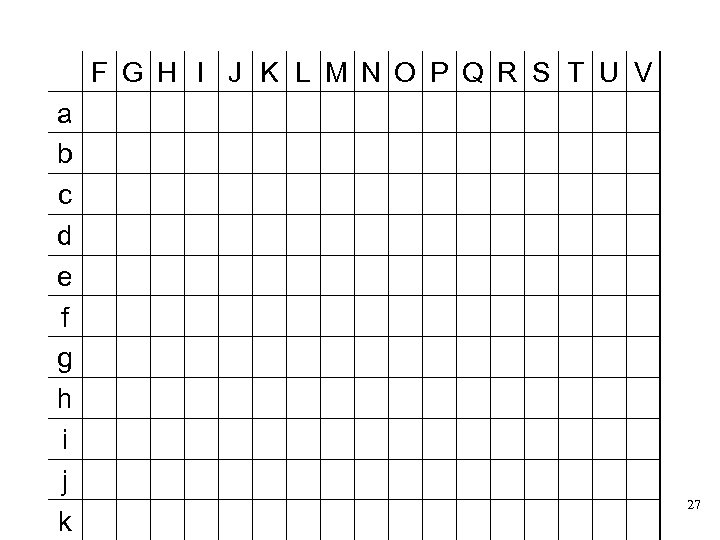 F G H I J K L M N O P Q R S T U V a b c d e f g h i j k 27
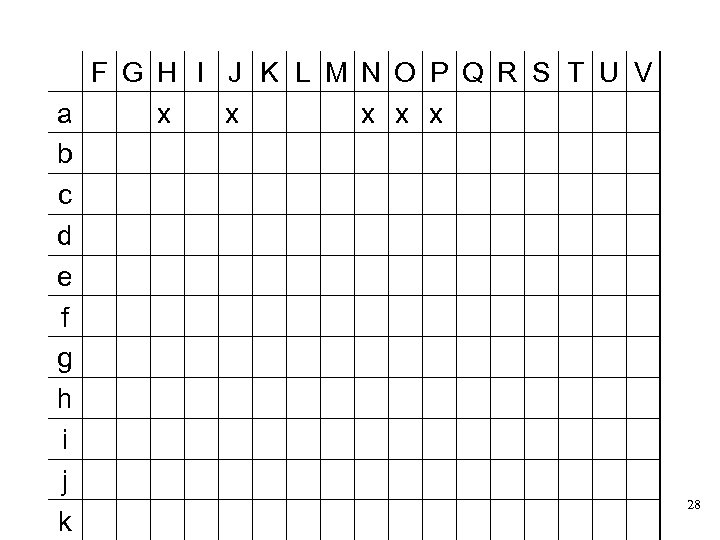 F G H I J K L M N O P Q R S T U V a x x x b c d e f g h i j k 28
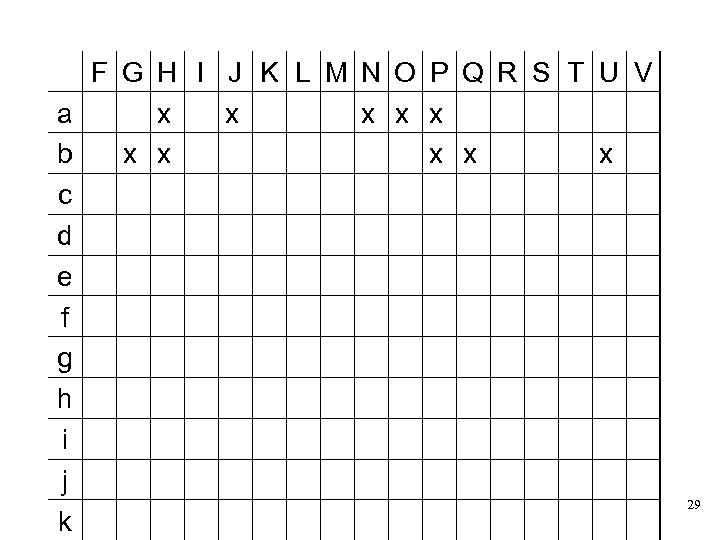 F G H I J K L M N O P Q R S T U V a x x x b x x x c d e f g h i j k 29
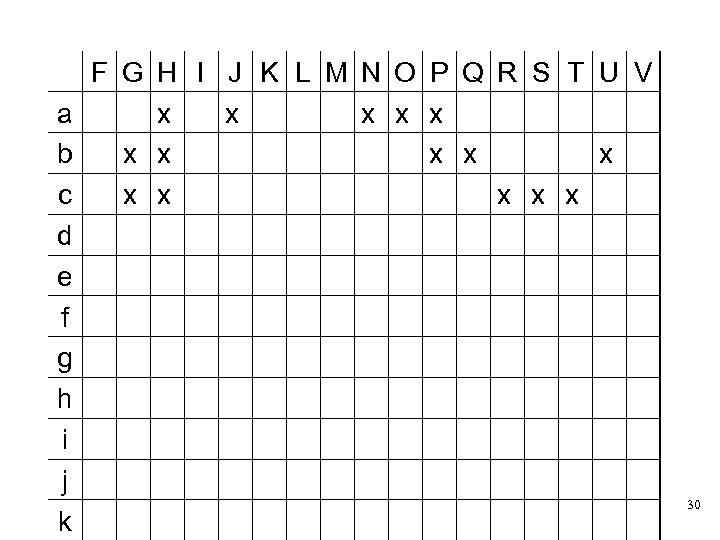 F G H I J K L M N O P Q R S T U V a x x x b x x x c x x x d e f g h i j k 30
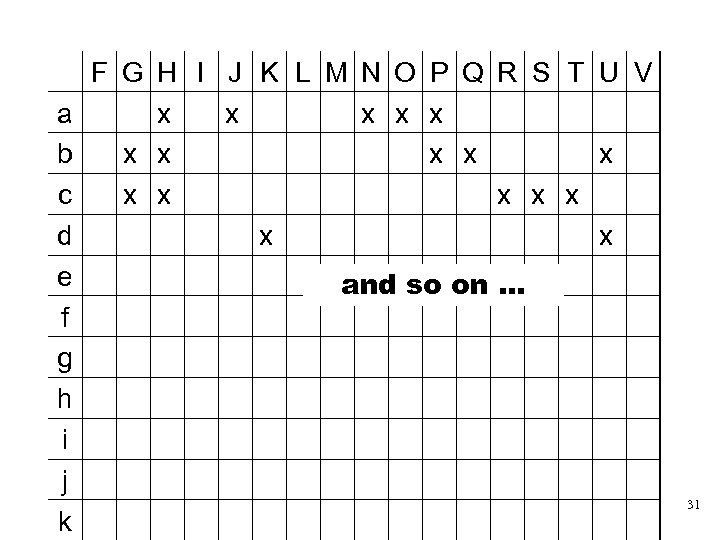 F G H I J K L M N O P Q R S T U V a x x x b x x x c x x x d x x e and so on … f g h i j k 31
 Fantology The doctrine, usually tacit, according to which ‘Fa’ (or ‘Rab’) is the key to ontological structure The syntax of first-order predicate logic is a mirror of reality (Fantology a special case of linguistic Kantianism: the structure of language is they key to the structure of [knowable] reality) 32
 Formal Ontology and Symbolic Logic Great advances of Frege, Russell, Wittgenstein, Peano (in logic, and in philosophy of mathematics) Leibnizian idea of a universal characteristic …symbols are a good thing 33
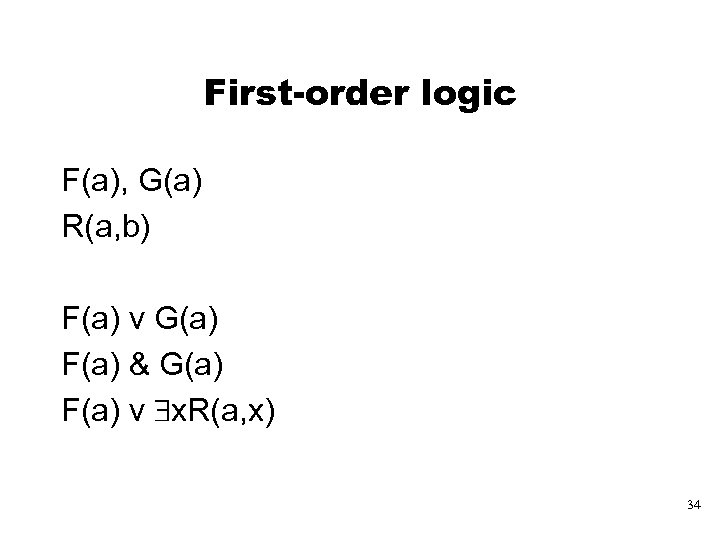 First-order logic F(a), G(a) R(a, b) F(a) v G(a) F(a) & G(a) F(a) v x. R(a, x) 34
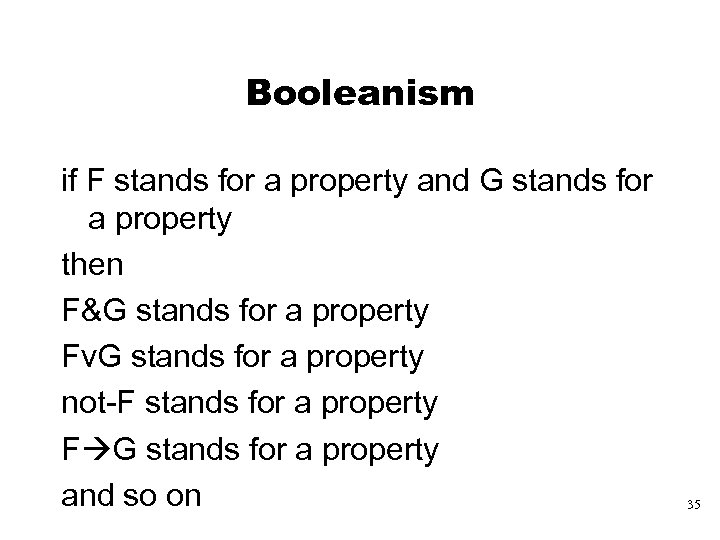 Booleanism if F stands for a property and G stands for a property then F&G stands for a property Fv. G stands for a property not-F stands for a property F G stands for a property and so on 35
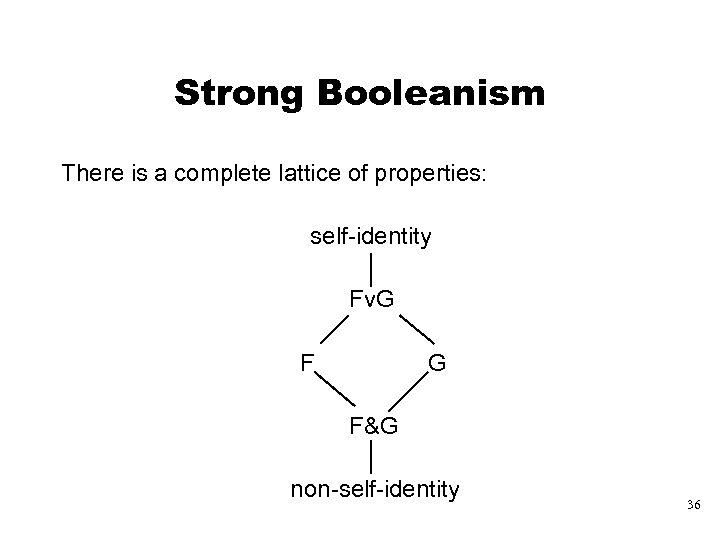 Strong Booleanism There is a complete lattice of properties: self-identity Fv. G F&G non-self-identity 36
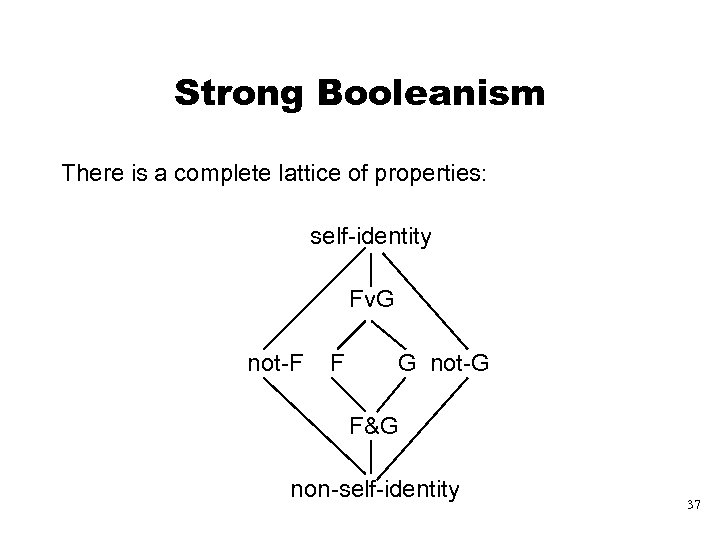 Strong Booleanism There is a complete lattice of properties: self-identity Fv. G not-F F G not-G F&G non-self-identity 37
 Booleanism responsible, among other things, for Russell’s paradox Armstrong, D. Lewis free from Booleanism With their sparse theory of properties 38
 20 th-Century Analytic Metaphysics embraced Booleanism as the default position 39
 that Lewis and Armstrong arrived at their sparse view of properties against the solid wall of fantological Booleanist orthodoxy is a miracle of modern intellectual history analogous to a 5 stone weakling climbing up to breathe free air at the top of Mount Everest with 1000 ton weights attached to his feet 40
 leading them back, on this point, to where Aristotelians were from the very beginning 41
 Standard semantics F stands for a property a stands for an individual properties belong to Platonic realm of forms or properties are sets of individuals for which F(a) is true (circularity) 42
 Fantology infects computer science, too here I will concentrate on the role of fantology within analytical metaphysics 43
 Fantology Works very well in mathematics Platonist theories of properties here are very attractive 44
 Fantology Fa All generality belongs to the predicate ‘a’ is a mere name Contrast this with the way scientists use names: The electron has a negative charge DNA-Binding Requirements of the Yeast Protein Rap 1 p as selected In Silico from Ribosomal Protein Gene Promoter Sequences 45
 For extreme fantologists ‘a’ leaves no room for ontological complexity Hence: reality is made of atoms Hence: all probability is combinatoric Fantology reduces all complexity to Boolean combination All true ontology is the ontology of ultimate universal furniture – the ontology of some future, perfected physics Thus fantology is conducive to reductionism in philosophy 46
 Fantology Tends to make you believe in some future state of ‚total science‘ when the values of ‚F‘ and ‚a‘, all of them, will be revealed to the elect (A science is a totality of propositions closed under logical consequence) 47
 Fantological Mysterianism Fa noumenal view of particulars Cf. Wittgenstein’s Tractatus (doctrine of simples) 48
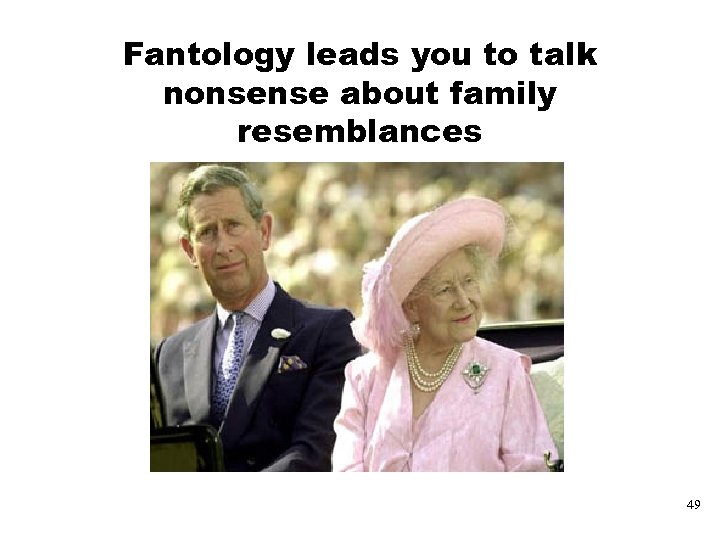 Fantology leads you to talk nonsense about family resemblances 49
 Fantology emphasizes the linguistic over the perceptual/physiognomic (the digitalized over the analogue) 50
 Fantology implies a poor treatment of relations R(a, b) in terms of adicity What is the adicity of your headache (A relation between your consciousness and various processes taking place in an around your brain) ? 51
 For the fantologist “(F(a)”, “R(a, b)” … is the language for ontology This language reflects the structure of reality The fantologist sees reality as being made up of atoms plus abstract (1 - and n-place) ‘properties’ or ‘attributes’ 52
 Fantology Fa To understand properties is to understand predication (effectively in terms of functional application à la Frege) 53
 The limitations of fantology lead one into the temptations of possible world metaphysics, and other similar fantasies 54
 Fantology leads one to talk nonsense about possible worlds Definition: A possible world W is a pair (L, D) consisting of a set of first-order propositions L and a set of ground-level assertions D. … Informally, the set L is called the laws of W, and the set D is called the database of W. Other informal terms might be used: L may be called the set of axioms or database constraints for W. (John Sowa) 55
 Fantology and time Fa No clear way to deal with time and tense (Set theory neglects the dimension of time) 56
 Fantology (given its roots in mathematics) has no satisfactory way of dealing with time hence leads to banishment of time from the ontology (as in Quine’s and Armstrong’s fourdimensionalism) 57
 The alternative to fantology ‘a’ in ‘F(a)’ refers to something that is complex Thus we must take the spatiality and materiality and modular complexity and temporality of substances seriously Mereology plus granularity plus theory of spatial extension plus dimension of TIME 58
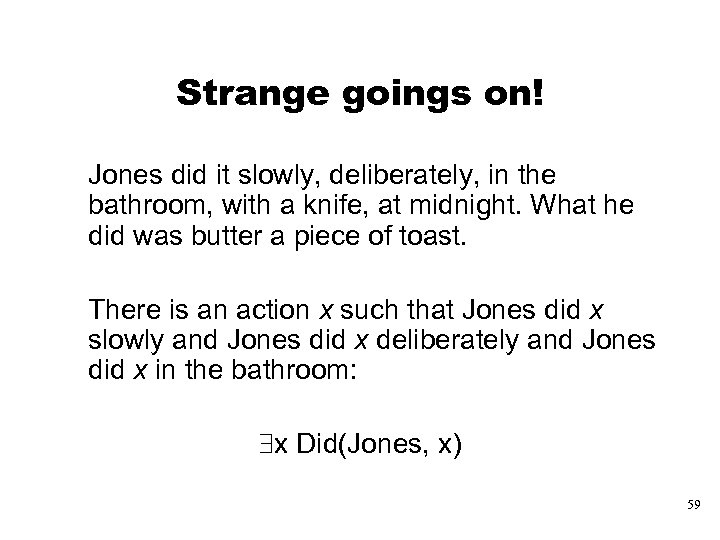 Strange goings on! Jones did it slowly, deliberately, in the bathroom, with a knife, at midnight. What he did was butter a piece of toast. There is an action x such that Jones did x slowly and Jones did x deliberately and Jones did x in the bathroom: x Did(Jones, x) 59
 Solution not FOPL but FOLWUT first-order logic with universal terms 60
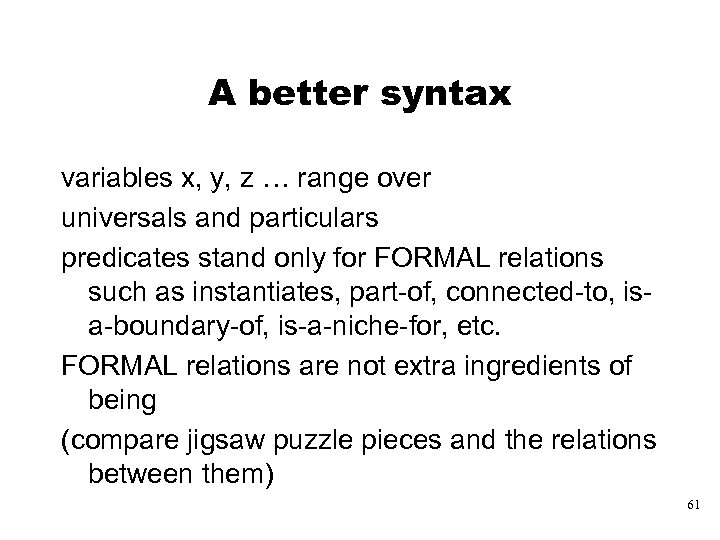 A better syntax variables x, y, z … range over universals and particulars predicates stand only for FORMAL relations such as instantiates, part-of, connected-to, isa-boundary-of, is-a-niche-for, etc. FORMAL relations are not extra ingredients of being (compare jigsaw puzzle pieces and the relations between them) 61
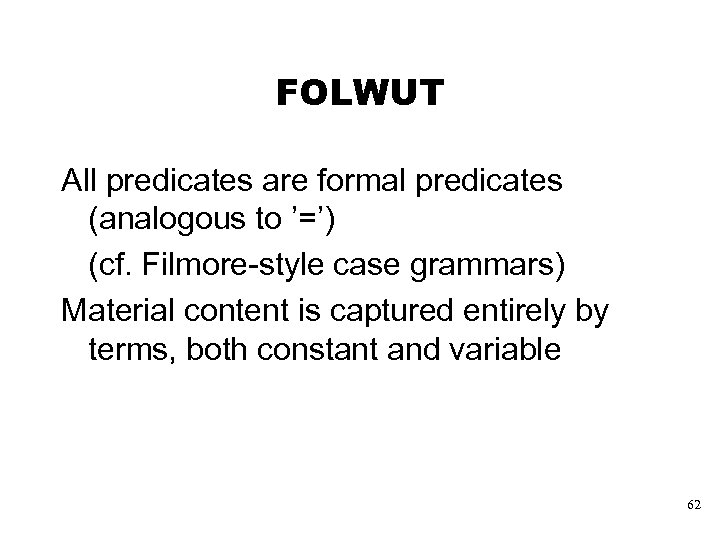 FOLWUT All predicates are formal predicates (analogous to ’=’) (cf. Filmore-style case grammars) Material content is captured entirely by terms, both constant and variable 62
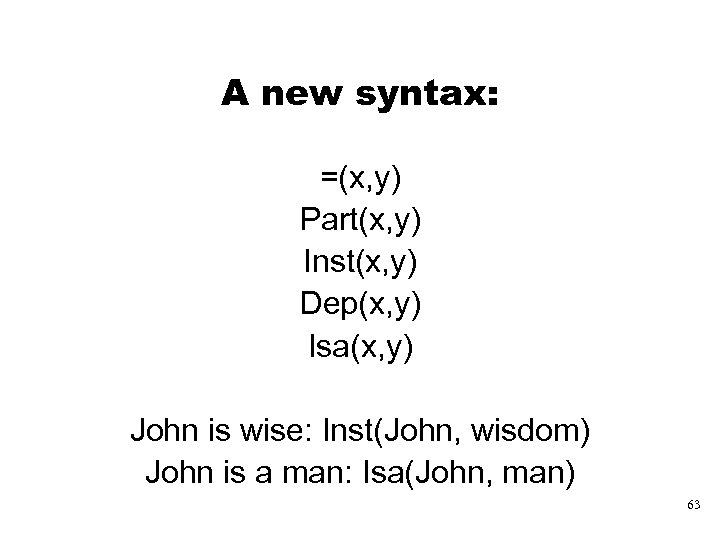 A new syntax: =(x, y) Part(x, y) Inst(x, y) Dep(x, y) Isa(x, y) John is wise: Inst(John, wisdom) John is a man: Isa(John, man) 63
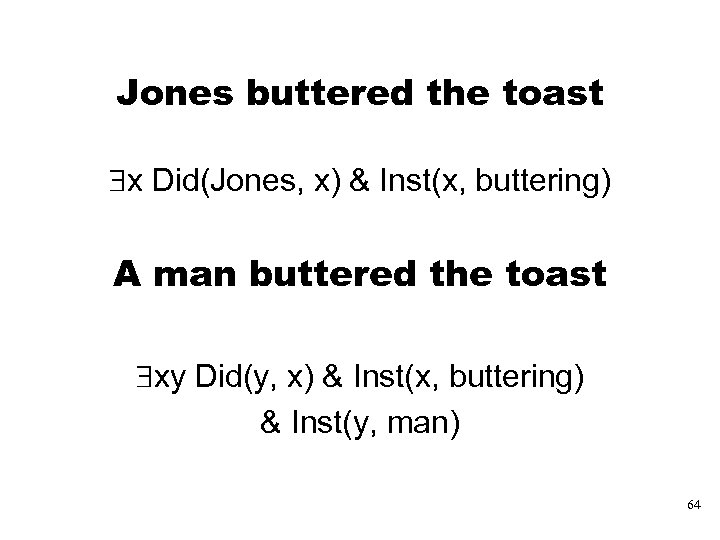 Jones buttered the toast x Did(Jones, x) & Inst(x, buttering) A man buttered the toast xy Did(y, x) & Inst(x, buttering) & Inst(y, man) 64
 Sparse repertoire of predicates insurance against Booleanism, and against paradoxes Combined with quantification over universals, gives us some of the power of 2 nd-order logic (2 nd-order logic is problematic only when Boolean combination is allowed in the space of predicates) 65
 Compare the syntax of set theory (x, y) one (formal) predicate + constant and variable terms for material entities called sets 66
 First-order logic with identity = interpretation of identity is fixed (does not vary with semantics) 67
 Syntax of FOLWUT A few dozen formal predicates + constant and variable terms for particulars and universals 68
 Which formal relations we need is not an a priori matter Logic gives us no clue as to what the few dozen formal relations are (they must include: location in space, location at a time …) 69
 Which universals exist is not an a priori matter Logic gives us no clue as to what universals exist in reality (they must include: universals corresponding to each of the elements in the periodic table) 70
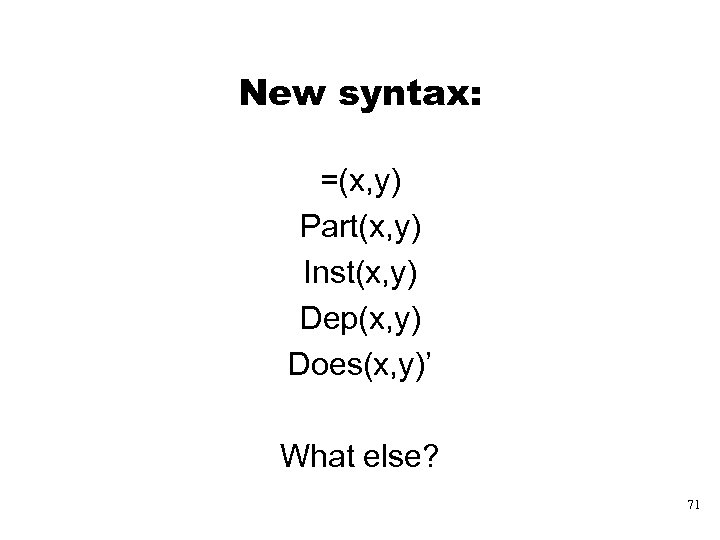 New syntax: =(x, y) Part(x, y) Inst(x, y) Dep(x, y) Does(x, y)’ What else? 71
 what ARE the formal relations? how separate form and content? 72
![Linguistic Ontologies SIMPLE Ala (wing) Sem. U: 3232 Type: [Part] Part of an airplane](https://present5.com/presentation/1e0840450f763c0150baba371fba7ab5/image-73.jpg "Linguistic Ontologies SIMPLE Ala (wing) Sem. U: 3232 Type: [Part] Part of an airplane") Linguistic Ontologies SIMPLE Ala (wing) Sem. U: 3232 Type: [Part] Part of an airplane
Linguistic Ontologies SIMPLE Ala (wing) Sem. U: 3232 Type: [Part] Part of an airplane
 Different ontological perspectives Universals vs. Particulars Different levels of granularity: molecular, cellular, organism. . . 74
 Nouns and verbs Substances and processes Continuants and occurrents Endurants and perdurants In preparing an inventory of reality we keep track of these two different categories of entities in two different ways 75
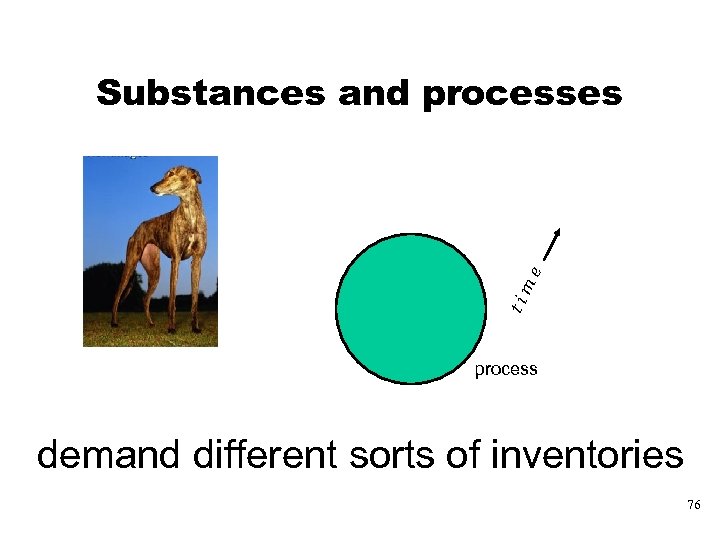 ti m e Substances and processes process demand different sorts of inventories 76
 Endurants/continuants Objects, things, substances + states, powers, qualities, roles, functions, dispositions, plans, shapes … Perdurants/Occurrents Processes = the expressions, realizations of functions, roles, powers in time 77
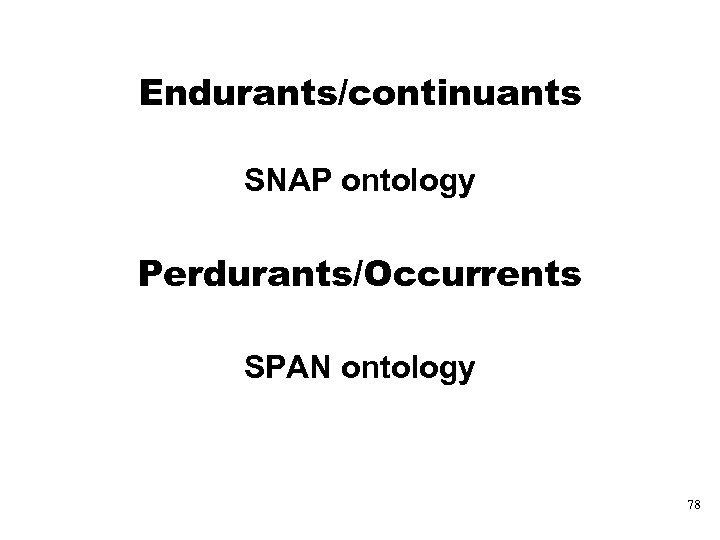 Endurants/continuants SNAP ontology Perdurants/Occurrents SPAN ontology 78
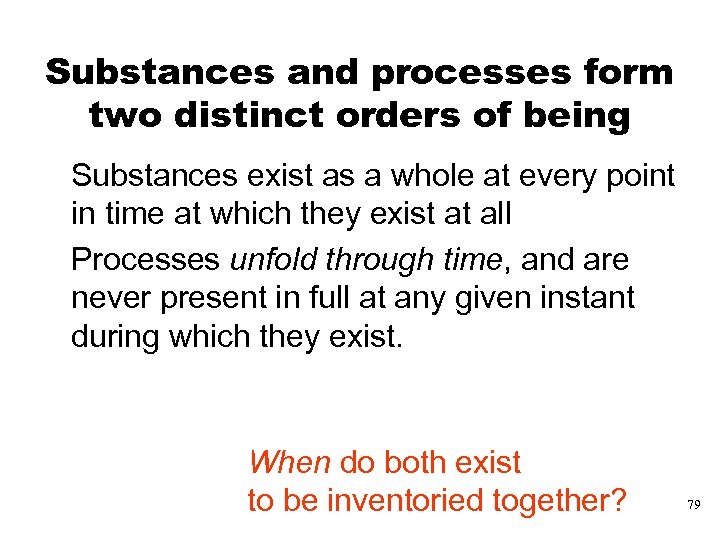 Substances and processes form two distinct orders of being Substances exist as a whole at every point in time at which they exist at all Processes unfold through time, and are never present in full at any given instant during which they exist. When do both exist to be inventoried together? 79
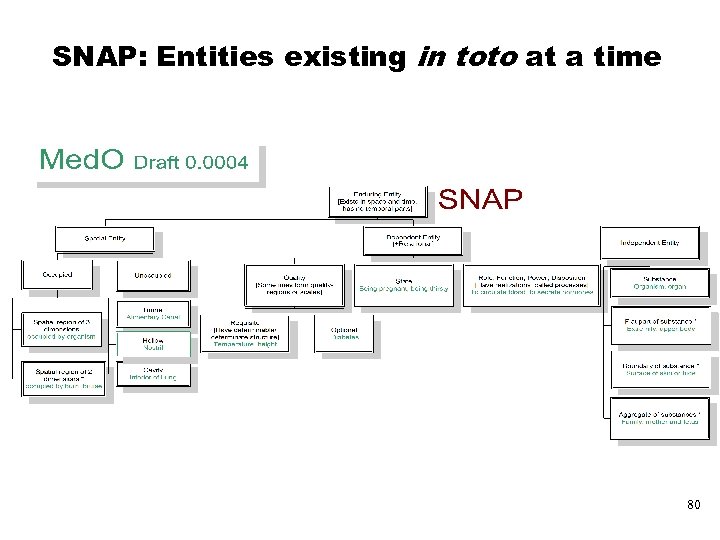 SNAP: Entities existing in toto at a time 80
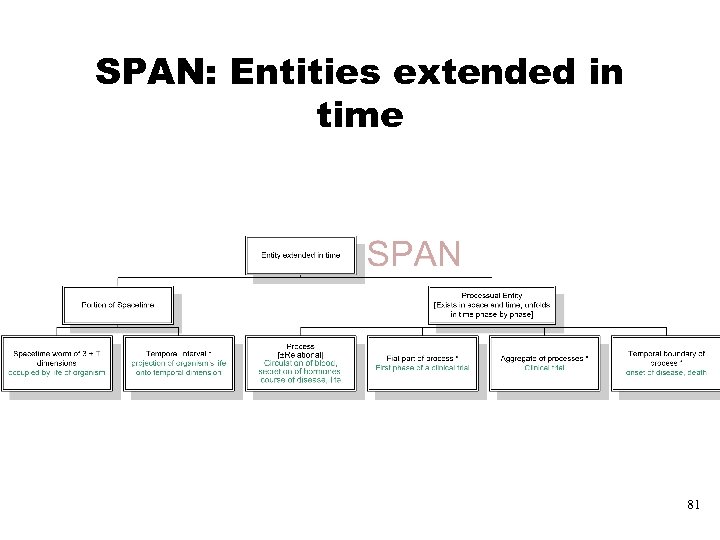 SPAN: Entities extended in time 81
 Relations between SNAP and SPAN SNAP-entities participate in processes they have lives, histories 82
 SPQR… entities and their SPAN realizations the expression of a function the exercise of a role the execution of a plan the realization of a disposition 83
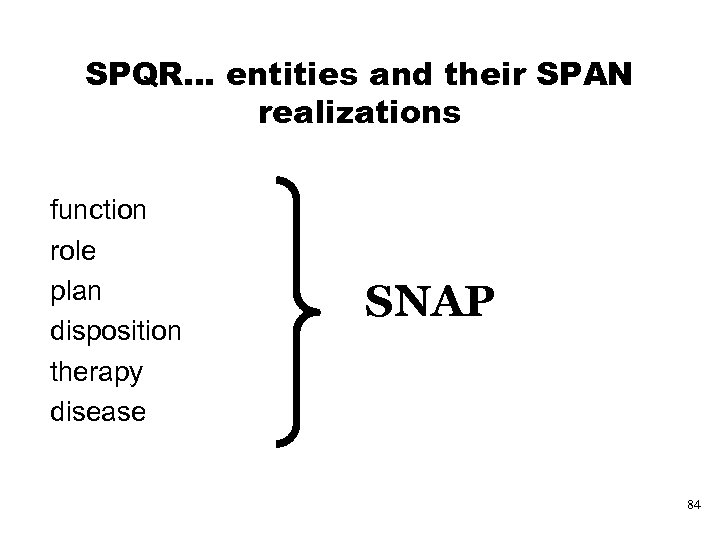 SPQR… entities and their SPAN realizations function role plan disposition therapy disease SNAP 84
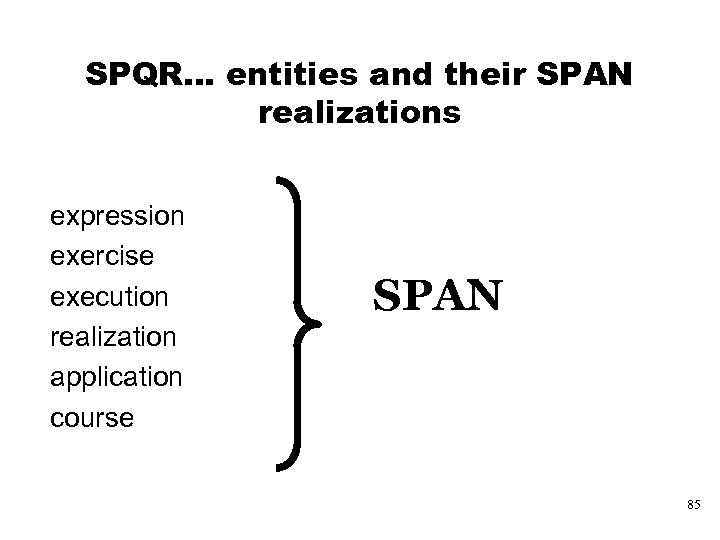 SPQR… entities and their SPAN realizations expression exercise execution realization application course SPAN 85
 How are entities in the SNAP and SPAN ontologies related together? via FORMAL RELATIONS such as instantiation, part-whole, identity 86
 A hypothesis (first rough version) Formal relations are those relations which are not captured by either SNAP or SPAN because they traverse the SNAP-SPAN divide they glue SNAP and SPAN entities together above all participation: Does(John, x) 87
 The idea (modified version) Formal relations are the relations that hold SNAP and SPAN entities/ontologies together + analogous relations that come for free, they do not add anything to being 88
 Generating a typology Two main types of formal relations: inter-ontological („transcendental“): obtain between entities of different ontologies intra-ontological: obtain between entities of the same ontology (intra-SNAP, intra. SPAN) 89
 Substance->Process PARTICIPATION (a species of dependence) 90
 Participation (SNAP-SPAN) A substance (SNAP) participates in a process (SPAN) A runner participates in a race 91
![Axes of variation activity/passivity ( agentive) direct/mediated benefactor/malefactor ( conducive to existence) [MEDICINE] 92](https://present5.com/presentation/1e0840450f763c0150baba371fba7ab5/image-92.jpg "Axes of variation activity/passivity ( agentive) direct/mediated benefactor/malefactor ( conducive to existence) [MEDICINE] 92") Axes of variation activity/passivity ( agentive) direct/mediated benefactor/malefactor ( conducive to existence) [MEDICINE] 92
Axes of variation activity/passivity ( agentive) direct/mediated benefactor/malefactor ( conducive to existence) [MEDICINE] 92
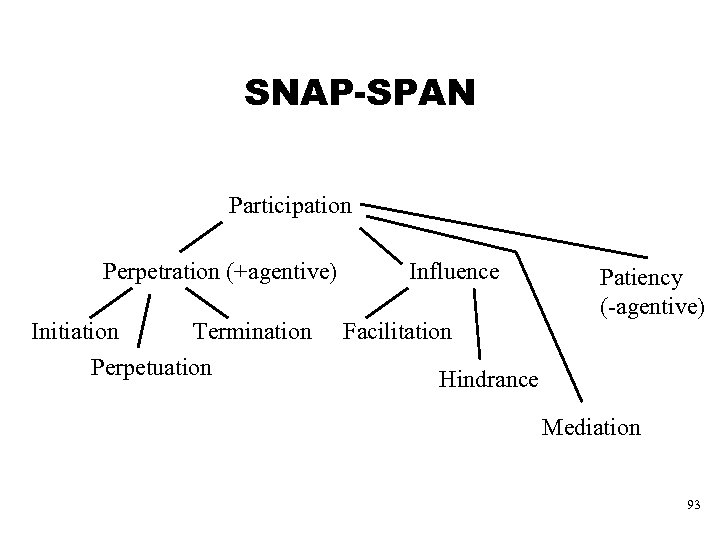 SNAP-SPAN Participation Perpetration (+agentive) Initiation Termination Perpetuation Influence Facilitation Patiency (-agentive) Hindrance Mediation 93
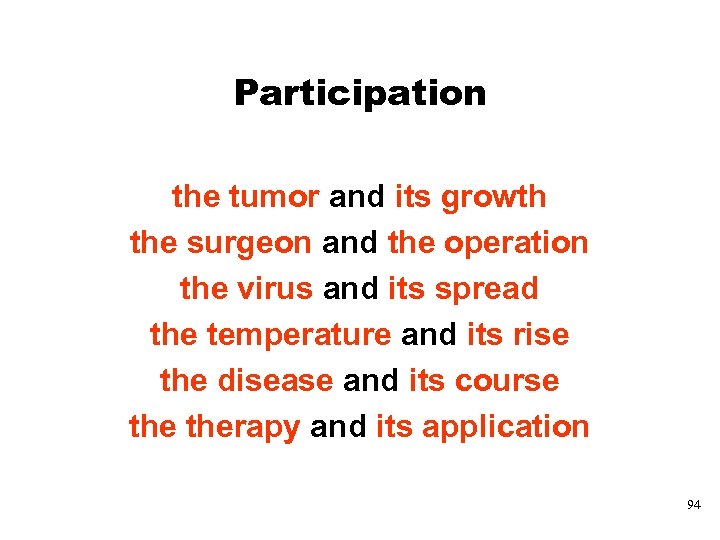 Participation the tumor and its growth the surgeon and the operation the virus and its spread the temperature and its rise the disease and its course therapy and its application 94
 Participation (genus) 95
 Perpetration (species) A substance perpetrates an action (direct and agentive participation in a process): The referee fires the starting-pistol The captain gives the order 96
 Initiation (species) A substance initiates a process: The referee starts the race 97
 Perpetuation (species) A substance sustains a process: The charged filament perpetuates the emission of light 98
 Termination (species) A substance terminates a process: The operator terminates the projection of the film 99
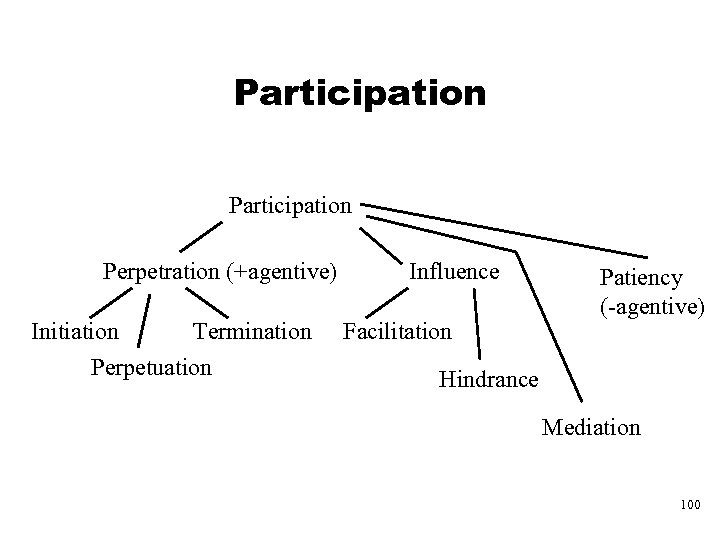 Participation Perpetration (+agentive) Initiation Termination Perpetuation Influence Facilitation Patiency (-agentive) Hindrance Mediation 100
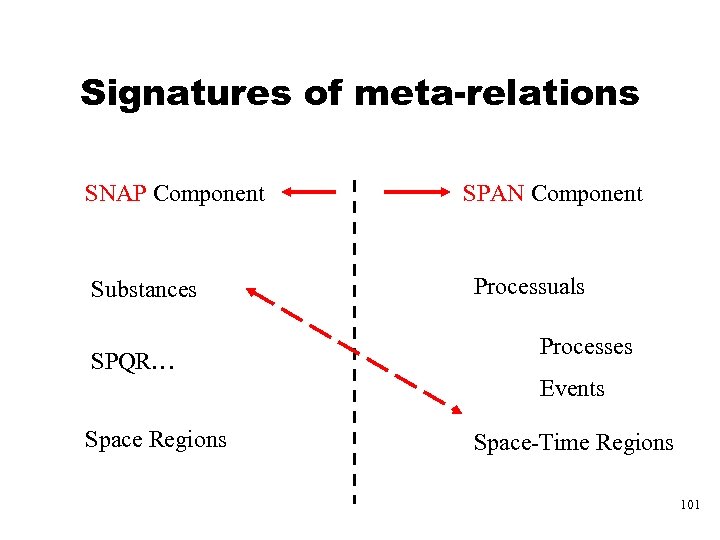 Signatures of meta-relations SNAP Component Substances SPQR… SPAN Component Processuals Processes Events Space Regions Space-Time Regions 101
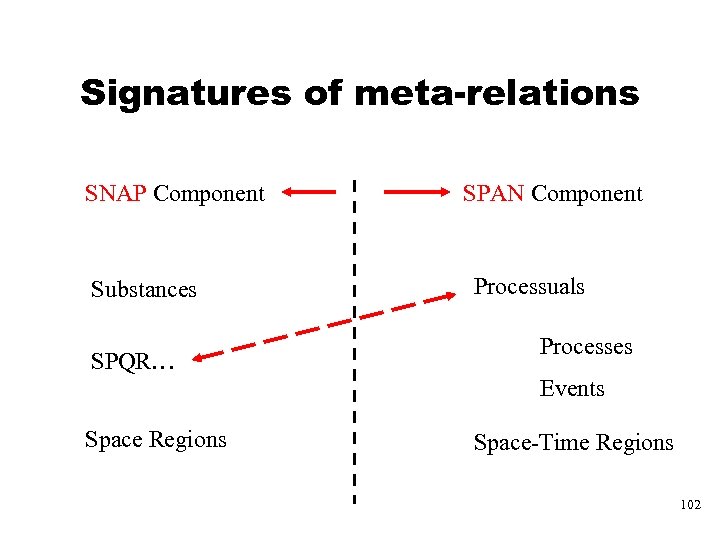 Signatures of meta-relations SNAP Component Substances SPQR… SPAN Component Processuals Processes Events Space Regions Space-Time Regions 102
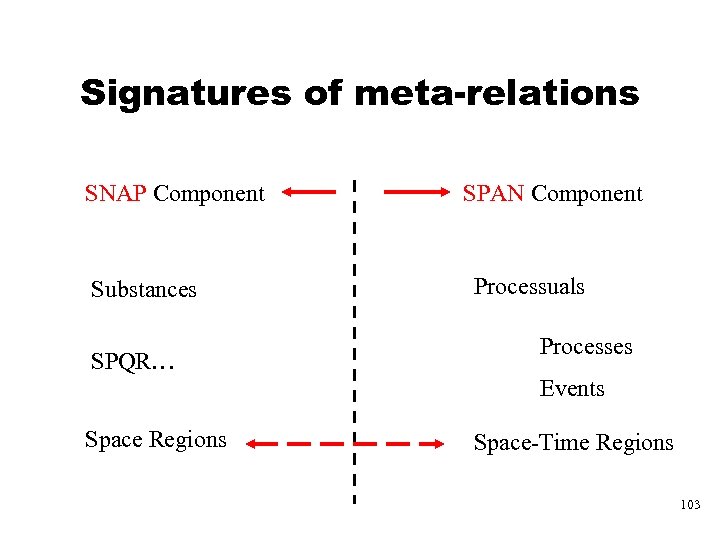 Signatures of meta-relations SNAP Component Substances SPQR… SPAN Component Processuals Processes Events Space Regions Space-Time Regions 103
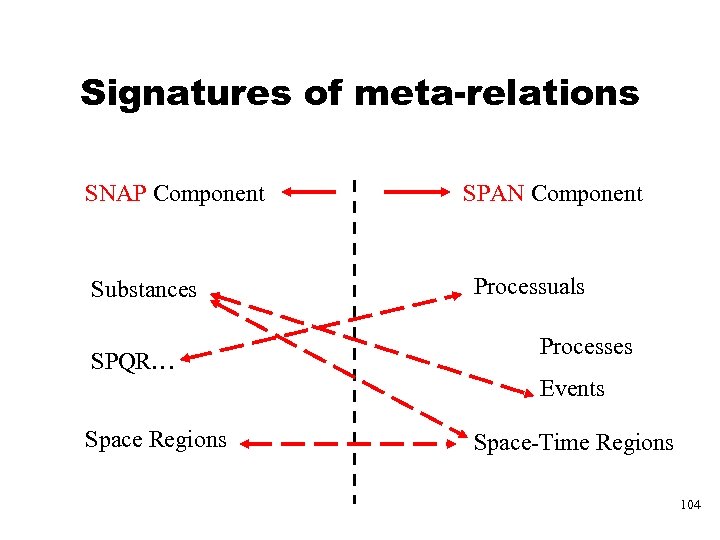 Signatures of meta-relations SNAP Component Substances SPQR… SPAN Component Processuals Processes Events Space Regions Space-Time Regions 104
 2 nd Family REALIZATION from qualities, functions, roles (SNAP) to processes 105
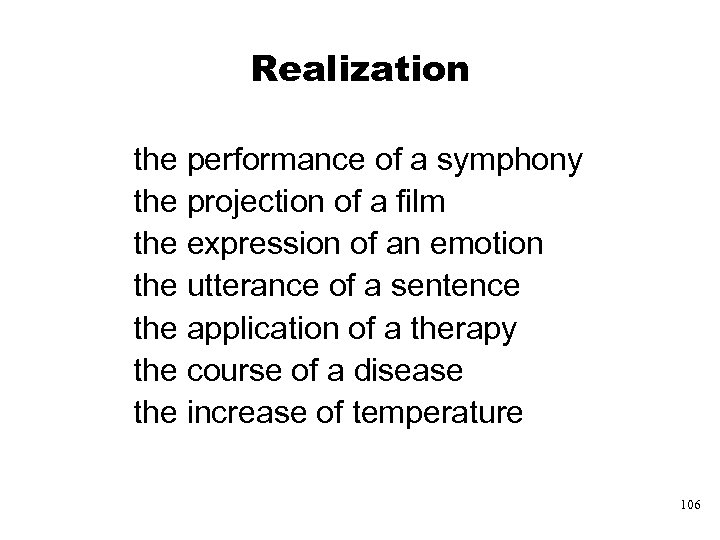 Realization the performance of a symphony the projection of a film the expression of an emotion the utterance of a sentence the application of a therapy the course of a disease the increase of temperature 106
 Types of Formal Relation Intracategorial Mereological (part) Topological (connected, temporally precedes) Dependency (e. g. functional ? ) Intercategorial Inherence (quality of) Location Participation (agent) Dependency (of process on substance) Transcendentals Identity 107
 END http: //ontologist. com http: //ifomis. de 108