


 Скачать презентацию VSR-NET Workshop — May 25 th-26 th 2006
5a431bdcafa6c54c74e6dda2bedfcf63.ppt
- Количество слайдов: 35
 VSR-NET Workshop - May 25 th-26 th, 2006 RAL Cosener’s House Abingdon, UK Alloy / Mondex Case Study : Refinement Checks with Model Finding Tahina Ramananandro École Normale Supérieure Paris, France Daniel Jackson MIT CSAIL Software Design Cambridge MA, USA
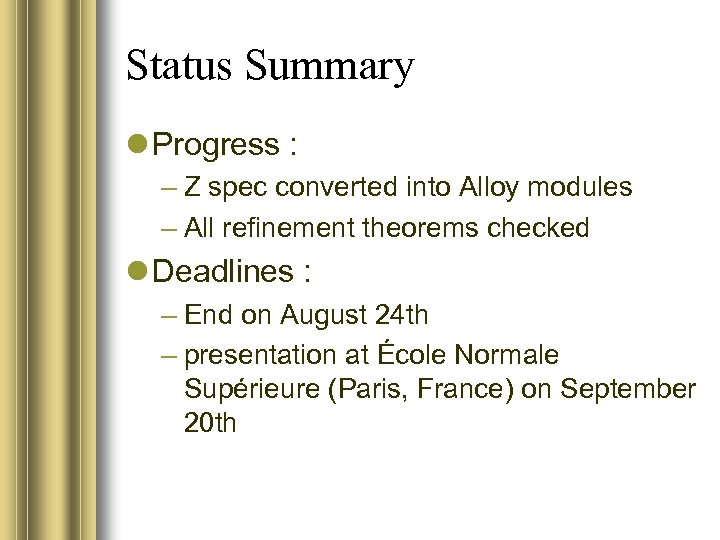 Status Summary Progress : – Z spec converted into Alloy modules – All refinement theorems checked Deadlines : – End on August 24 th – presentation at École Normale Supérieure (Paris, France) on September 20 th
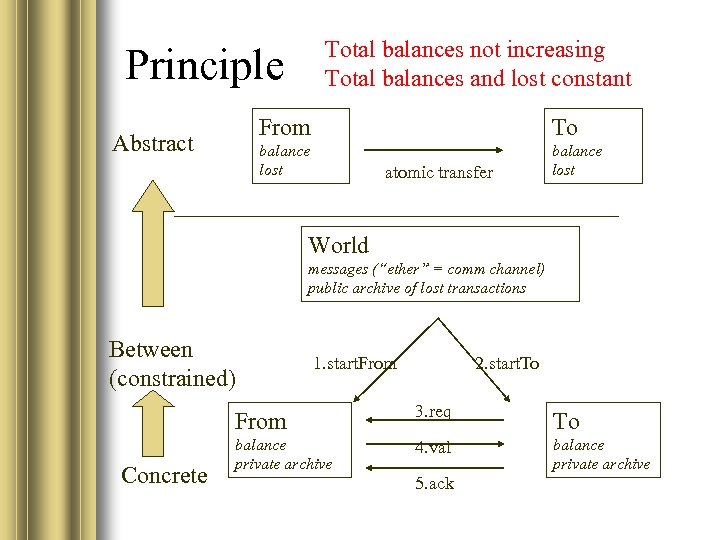 Total balances not increasing Total balances and lost constant Principle From balance lost Abstract To balance lost atomic transfer World messages (“ether” = comm channel) public archive of lost transactions Between (constrained) 1. start. From 2. start. To From Concrete 3. req To balance private archive 4. val balance private archive 5. ack
 Outline Alloy Principles Mondex in Alloy : General Method Technical issues Conclusions
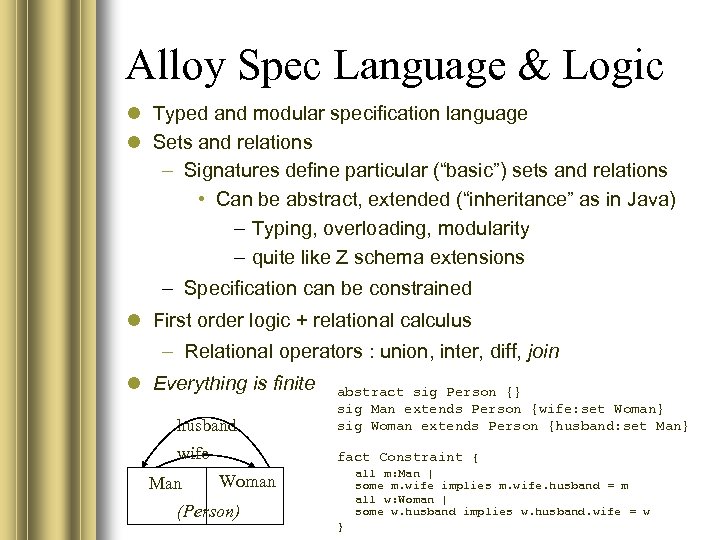 Alloy Spec Language & Logic Typed and modular specification language Sets and relations – Signatures define particular (“basic”) sets and relations • Can be abstract, extended (“inheritance” as in Java) – Typing, overloading, modularity – quite like Z schema extensions – Specification can be constrained First order logic + relational calculus – Relational operators : union, inter, diff, join Everything is finite husband abstract sig Person {} sig Man extends Person {wife: set Woman} sig Woman extends Person {husband: set Man} wife fact Constraint { Man all m: Man | some m. wife implies m. wife. husband = m all w: Woman | some w. husband implies w. husband. wife = w Woman (Person) }
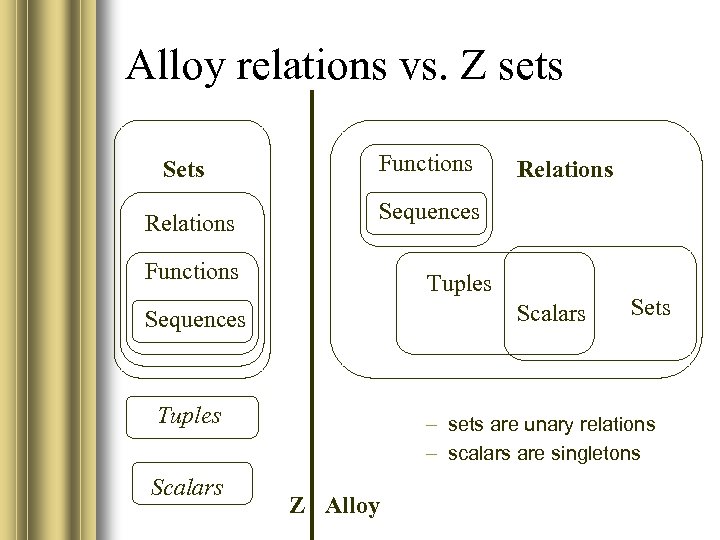 Alloy relations vs. Z sets Sets Functions Relations Sequences Functions Tuples Scalars Sequences Tuples Scalars Relations Sets – sets are unary relations – scalars are singletons Z Alloy
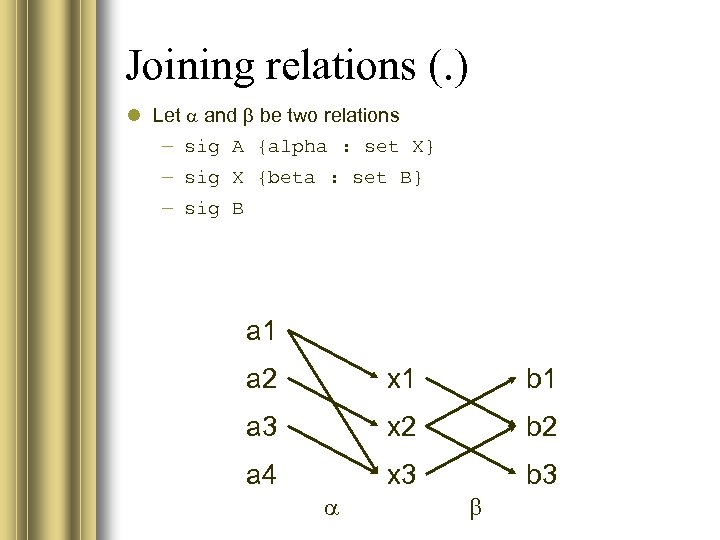 Joining relations (. ) Let and be two relations – sig A {alpha : set X} – sig X {beta : set B} – sig B a 1 a 2 x 1 b 1 a 3 x 2 b 2 a 4 x 3 b 3
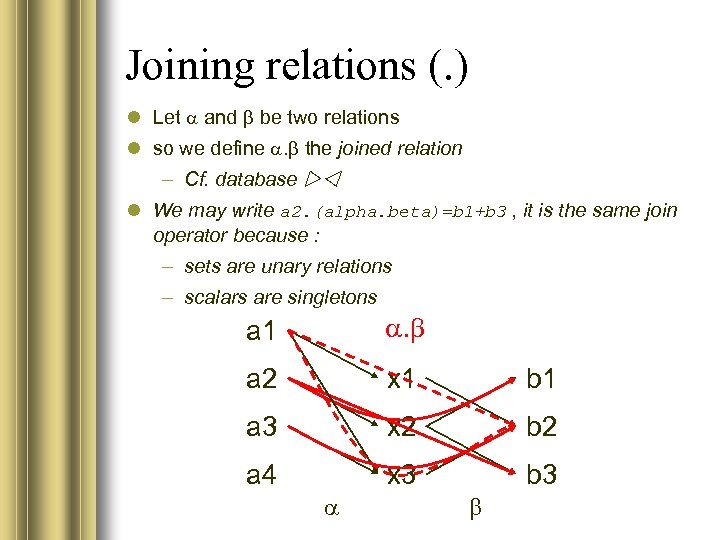 Joining relations (. ) Let and be two relations so we define the joined relation – Cf. database We may write a 2. (alpha. beta)=b 1+b 3 , it is the same join operator because : – sets are unary relations – scalars are singletons a 1 a 2 x 1 b 1 a 3 x 2 b 2 a 4 x 3 b 3
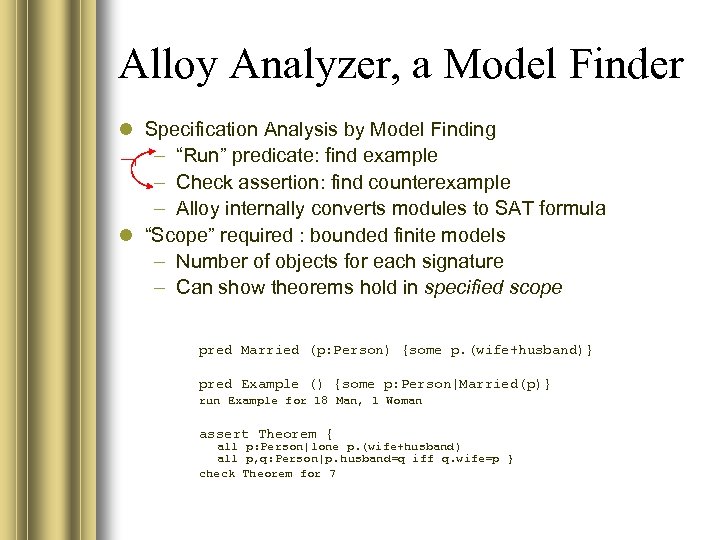 Alloy Analyzer, a Model Finder Specification Analysis by Model Finding – “Run” predicate: find example – Check assertion: find counterexample – Alloy internally converts modules to SAT formula “Scope” required : bounded finite models – Number of objects for each signature – Can show theorems hold in specified scope pred Married (p: Person) {some p. (wife+husband)} pred Example () {some p: Person|Married(p)} run Example for 18 Man, 1 Woman assert Theorem { all p: Person|lone p. (wife+husband) all p, q: Person|p. husband=q iff q. wife=p } check Theorem for 7
 Outline Alloy Principles Mondex in Alloy : General Method Technical Issues Conclusions
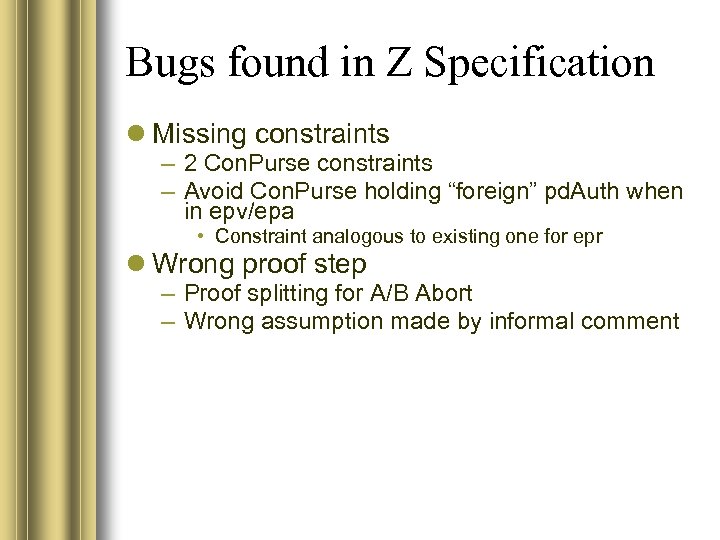 Bugs found in Z Specification Missing constraints – 2 Con. Purse constraints – Avoid Con. Purse holding “foreign” pd. Auth when in epv/epa • Constraint analogous to existing one for epr Wrong proof step – Proof splitting for A/B Abort – Wrong assumption made by informal comment
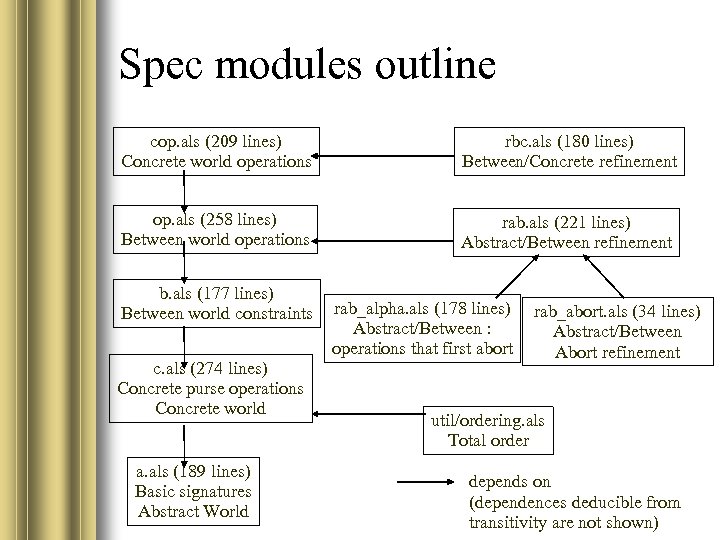 Spec modules outline cop. als (209 lines) Concrete world operations rbc. als (180 lines) Between/Concrete refinement op. als (258 lines) Between world operations rab. als (221 lines) Abstract/Between refinement b. als (177 lines) Between world constraints c. als (274 lines) Concrete purse operations Concrete world a. als (189 lines) Basic signatures Abstract World rab_alpha. als (178 lines) Abstract/Between : operations that first abort rab_abort. als (34 lines) Abstract/Between Abort refinement util/ordering. als Total order depends on (dependences deducible from transitivity are not shown)
 Almost everything represented Alloy modules very close to Z specification – Representation size is comparable – Alloy Proof size is negligible • Actually no proof details in Alloy modules – Quite quick to write (< 1 month) Only changes : – Integer representation – Unable to express infiniteness in Alloy • finiteness properties ignored – CLEAR code • quantify over CLEAR codes instead of their corresponding sets of Pay. Details Enforces 1 st order quantifications
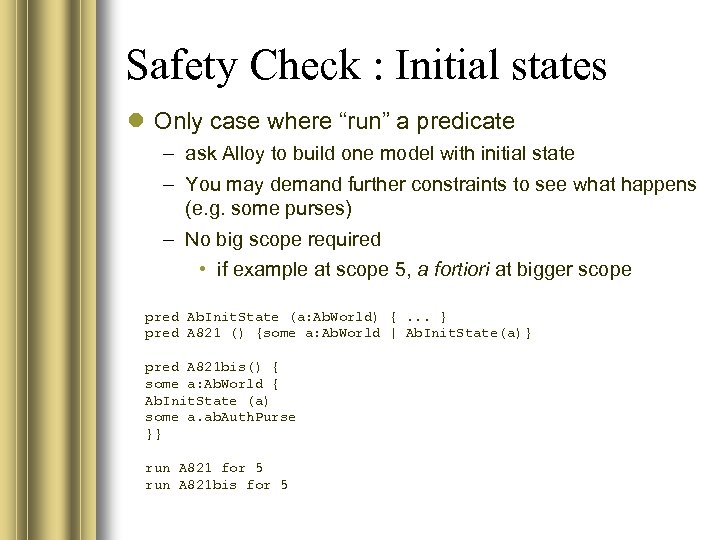 Safety Check : Initial states Only case where “run” a predicate – ask Alloy to build one model with initial state – You may demand further constraints to see what happens (e. g. some purses) – No big scope required • if example at scope 5, a fortiori at bigger scope pred Ab. Init. State (a: Ab. World) {. . . } pred A 821 () {some a: Ab. World | Ab. Init. State(a)} pred A 821 bis() { some a: Ab. World { Ab. Init. State (a) some a. ab. Auth. Purse }} run A 821 for 5 run A 821 bis for 5
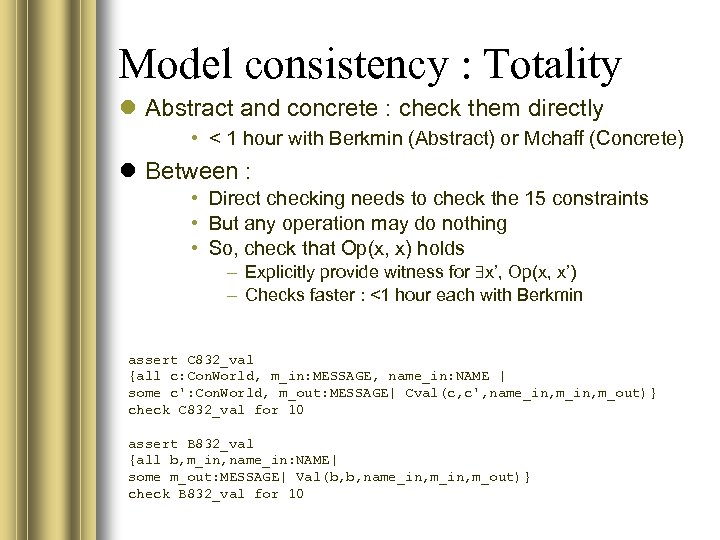 Model consistency : Totality Abstract and concrete : check them directly • < 1 hour with Berkmin (Abstract) or Mchaff (Concrete) Between : • Direct checking needs to check the 15 constraints • But any operation may do nothing • So, check that Op(x, x) holds – Explicitly provide witness for x’, Op(x, x’) – Checks faster : <1 hour each with Berkmin assert C 832_val {all c: Con. World, m_in: MESSAGE, name_in: NAME | some c': Con. World, m_out: MESSAGE| Cval(c, c', name_in, m_out)} check C 832_val for 10 assert B 832_val {all b, m_in, name_in: NAME| some m_out: MESSAGE| Val(b, b, name_in, m_out)} check B 832_val for 10
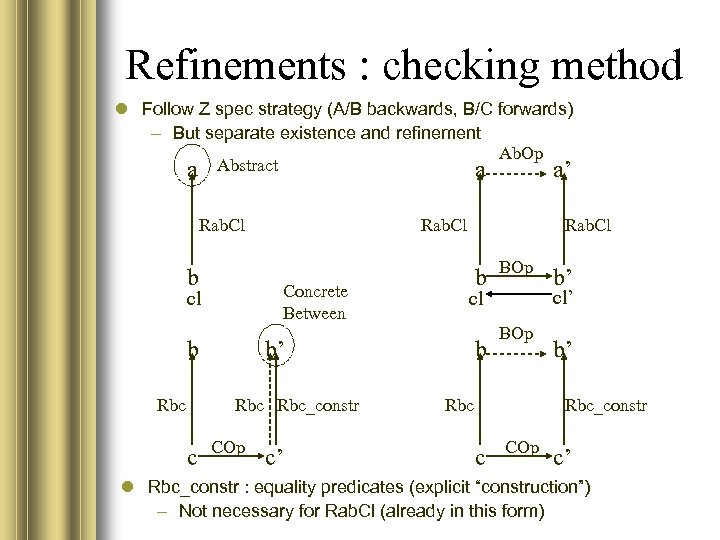 Refinements : checking method Follow Z spec strategy (A/B backwards, B/C forwards) – But separate existence and refinement Ab. Op Abstract a a a’ Rab. Cl b Concrete Between cl b Rbc Rab. Cl b COp c’ BOp b b’ cl b’ Rbc_constr c Rab. Cl BOp Rbc b’ Rbc_constr c COp c’ Rbc_constr : equality predicates (explicit “construction”) – Not necessary for Rab. Cl (already in this form)
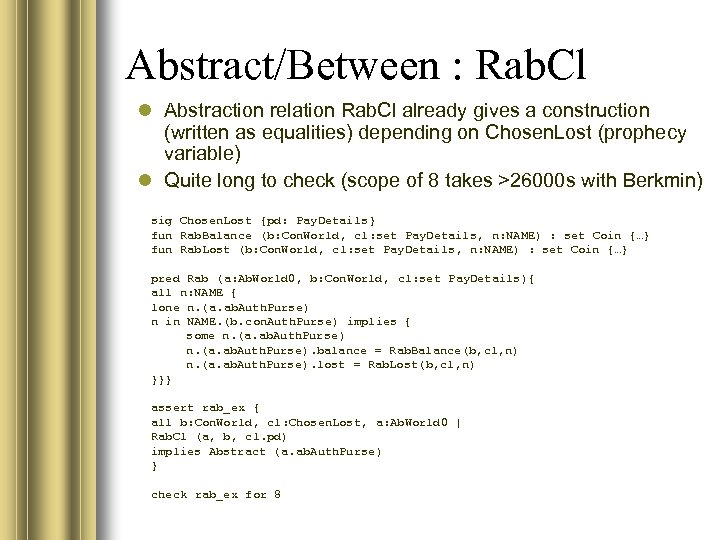 Abstract/Between : Rab. Cl Abstraction relation Rab. Cl already gives a construction (written as equalities) depending on Chosen. Lost (prophecy variable) Quite long to check (scope of 8 takes >26000 s with Berkmin) sig Chosen. Lost {pd: Pay. Details} fun Rab. Balance (b: Con. World, cl: set Pay. Details, n: NAME) : set Coin {…} fun Rab. Lost (b: Con. World, cl: set Pay. Details, n: NAME) : set Coin {…} pred Rab (a: Ab. World 0, b: Con. World, cl: set Pay. Details){ all n: NAME { lone n. (a. ab. Auth. Purse) n in NAME. (b. con. Auth. Purse) implies { some n. (a. ab. Auth. Purse). balance = Rab. Balance(b, cl, n) n. (a. ab. Auth. Purse). lost = Rab. Lost(b, cl, n) }}} assert rab_ex { all b: Con. World, cl: Chosen. Lost, a: Ab. World 0 | Rab. Cl (a, b, cl. pd) implies Abstract (a. ab. Auth. Purse) } check rab_ex for 8
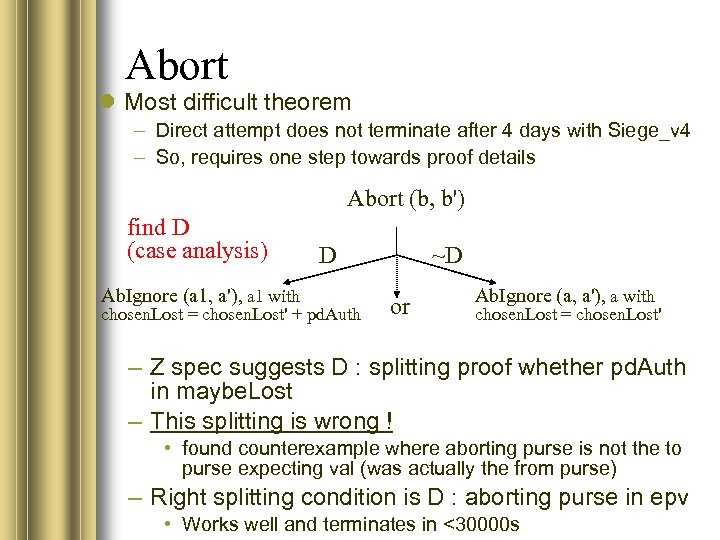 Abort Most difficult theorem – Direct attempt does not terminate after 4 days with Siege_v 4 – So, requires one step towards proof details Abort (b, b') find D (case analysis) Ab. Ignore (a 1, a'), a 1 with D chosen. Lost = chosen. Lost' + pd. Auth ~D or Ab. Ignore (a, a'), a with chosen. Lost = chosen. Lost' – Z spec suggests D : splitting proof whether pd. Auth in maybe. Lost – This splitting is wrong ! • found counterexample where aborting purse is not the to purse expecting val (was actually the from purse) – Right splitting condition is D : aborting purse in epv • Works well and terminates in <30000 s
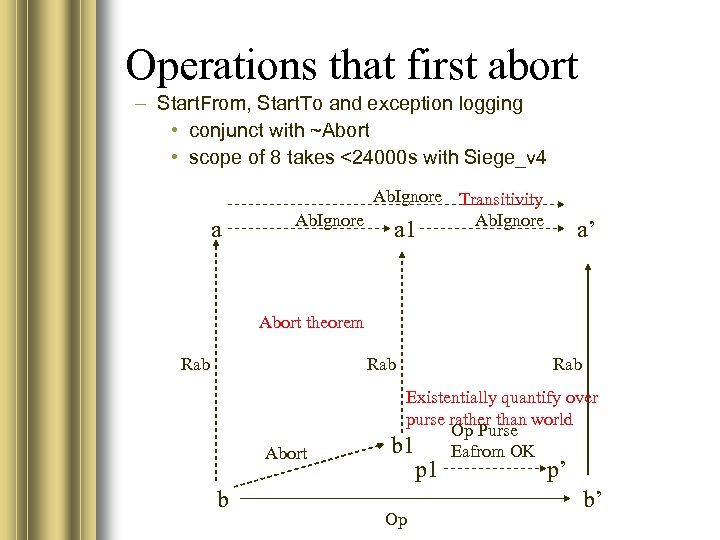 Operations that first abort – Start. From, Start. To and exception logging • conjunct with ~Abort • scope of 8 takes <24000 s with Siege_v 4 a Ab. Ignore Transitivity Ab. Ignore a 1 a’ Abort theorem Rab Abort b Rab Existentially quantify over purse rather than world Op Purse b 1 Eafrom OK p 1 Op p’ b’
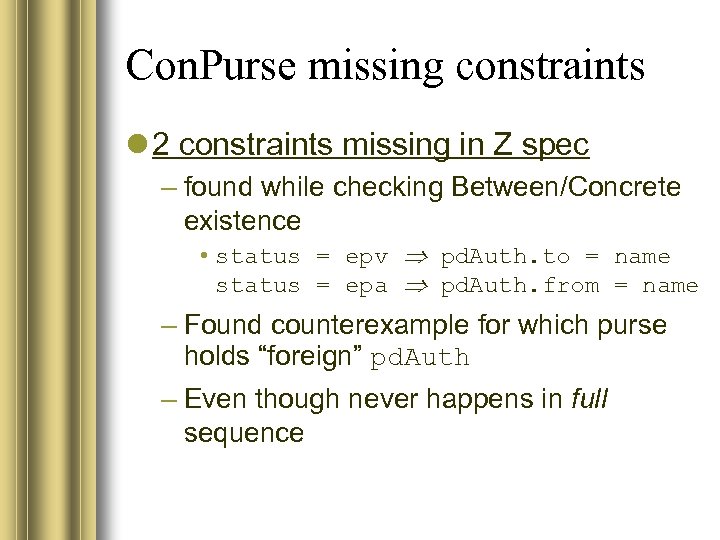 Con. Purse missing constraints 2 constraints missing in Z spec – found while checking Between/Concrete existence • status = epv pd. Auth. to = name status = epa pd. Auth. from = name – Found counterexample for which purse holds “foreign” pd. Auth – Even though never happens in full sequence
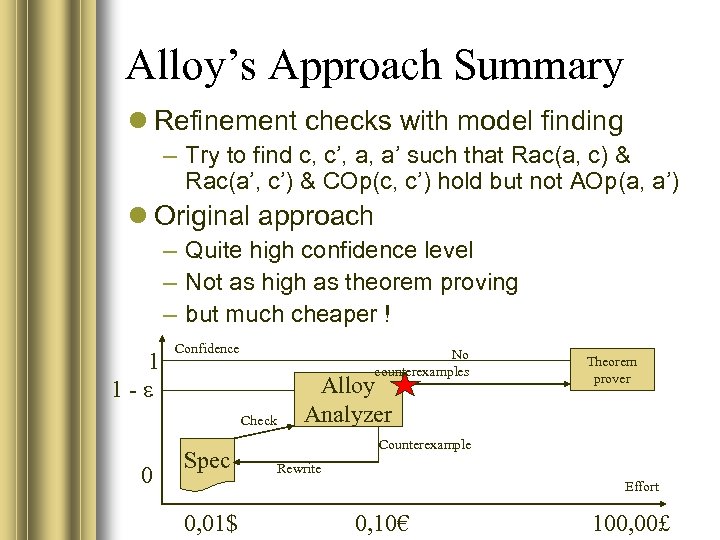 Alloy’s Approach Summary Refinement checks with model finding – Try to find c, c’, a, a’ such that Rac(a, c) & Rac(a’, c’) & COp(c, c’) hold but not AOp(a, a’) Original approach – Quite high confidence level – Not as high as theorem proving – but much cheaper ! 1 1 - Confidence No counterexamples Check 0 Spec Alloy Analyzer Theorem prover Counterexample Rewrite Effort 0, 01$ 0, 10€ 100, 00£
 Outline Alloy Principles Mondex in Alloy : General Method Technical Issues Conclusions
 Integers in Alloy are heavy – Builds boolean circuits for +, < – Expensive operations So, avoid them – Not all properties of N used – Determine which – Pick most lightweight repr that works
 Representing SEQNO Avoid integers in Alloy SEQNO just requires total order – No operations – Even no successor Simply use Alloy’s ordering module – Exploit built-in symmetry breaking too
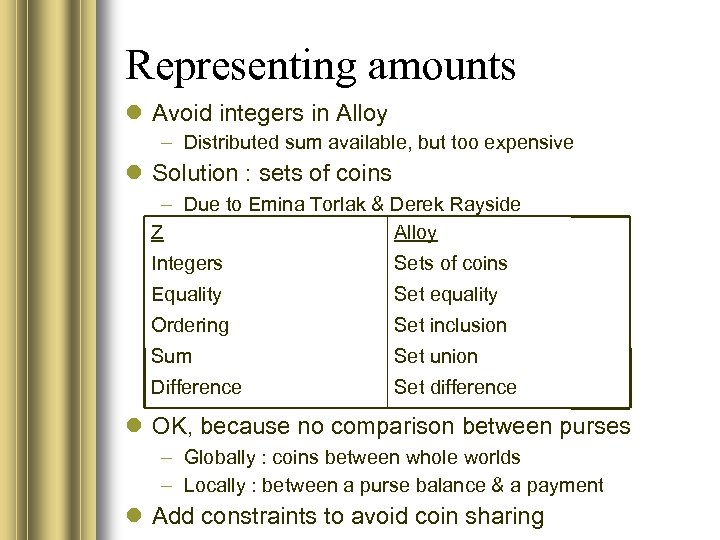 Representing amounts Avoid integers in Alloy – Distributed sum available, but too expensive Solution : sets of coins – Due to Emina Torlak & Derek Rayside Z Alloy Integers Sets of coins Equality Set equality Ordering Set inclusion Sum Set union Difference Set difference OK, because no comparison between purses – Globally : coins between whole worlds – Locally : between a purse balance & a payment Add constraints to avoid coin sharing
![Concrete purse : Z and Alloy [ NAME ] Con. Purse balance : N](https://present5.com/presentation/5a431bdcafa6c54c74e6dda2bedfcf63/image-26.jpg "Concrete purse : Z and Alloy [ NAME ] Con. Purse balance : N") Concrete purse : Z and Alloy [ NAME ] Con. Purse balance : N ex. Log : P Pay. Details name : NAME next. Seq. No : N pd. Auth : Pay. Details status : STATUS sig NAME {} sig Coin, SEQNO {} open util/ordering[SEQNO] as seqord sig Con. Purse { balance : set Coin, ex. Log : set Pay. Details, name : NAME, next. Seq. No : SEQNO, pd. Auth : set Pay. Details, status : STATUS } fact {all c: Con. Purse { all p: Pay. Details|p in c. ex. Log implies name in p. from+p. to pd : ex. Log name {pd. from, pd. to} status = epr name = pd. Auth. from pd. Auth. value balance pd. Auth. from. Seq. No < next. Seq. No status = epv pd. Auth. to. Seq. No < next. Seq. No status = epa pd. Auth. from. Seq. No < next. Seq. No c. status = epr implies { name=c. pd. Auth. from c. pd. Auth. value in c. balance seqord/lt (c. pd. Auth. from. Seq. No, c. next. Seq. No) } c. status = epv implies { name=c. pd. Auth. to seqord/lt (c. pd. Auth. to. Seq. No, c. next. Seq. No) } c. status = epa implies { name=c. pd. Auth. from seqord/lt (c. pd. Auth. from. Seq. No, c. next. Seq. No) } no c. balance & c. ex. Log. value }}
Concrete purse : Z and Alloy [ NAME ] Con. Purse balance : N ex. Log : P Pay. Details name : NAME next. Seq. No : N pd. Auth : Pay. Details status : STATUS sig NAME {} sig Coin, SEQNO {} open util/ordering[SEQNO] as seqord sig Con. Purse { balance : set Coin, ex. Log : set Pay. Details, name : NAME, next. Seq. No : SEQNO, pd. Auth : set Pay. Details, status : STATUS } fact {all c: Con. Purse { all p: Pay. Details|p in c. ex. Log implies name in p. from+p. to pd : ex. Log name {pd. from, pd. to} status = epr name = pd. Auth. from pd. Auth. value balance pd. Auth. from. Seq. No < next. Seq. No status = epv pd. Auth. to. Seq. No < next. Seq. No status = epa pd. Auth. from. Seq. No < next. Seq. No c. status = epr implies { name=c. pd. Auth. from c. pd. Auth. value in c. balance seqord/lt (c. pd. Auth. from. Seq. No, c. next. Seq. No) } c. status = epv implies { name=c. pd. Auth. to seqord/lt (c. pd. Auth. to. Seq. No, c. next. Seq. No) } c. status = epa implies { name=c. pd. Auth. from seqord/lt (c. pd. Auth. from. Seq. No, c. next. Seq. No) } no c. balance & c. ex. Log. value }}
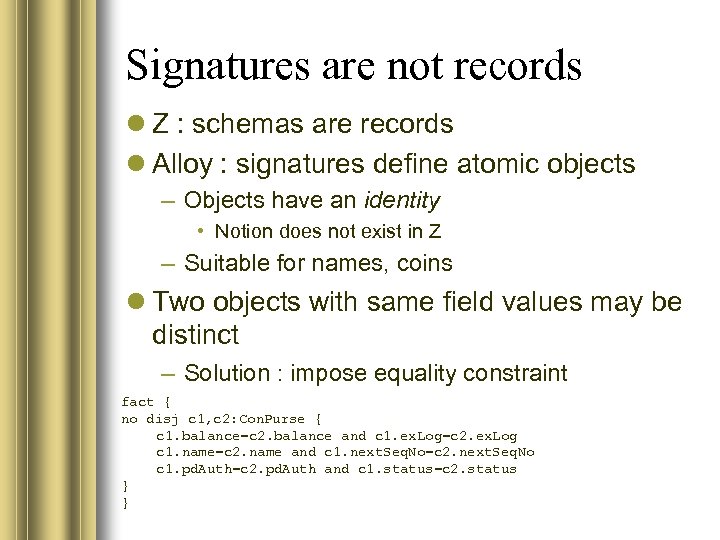 Signatures are not records Z : schemas are records Alloy : signatures define atomic objects – Objects have an identity • Notion does not exist in Z – Suitable for names, coins Two objects with same field values may be distinct – Solution : impose equality constraint fact { no disj c 1, c 2: Con. Purse { c 1. balance=c 2. balance and c 1. ex. Log=c 2. ex. Log c 1. name=c 2. name and c 1. next. Seq. No=c 2. next. Seq. No c 1. pd. Auth=c 2. pd. Auth and c 1. status=c 2. status } }
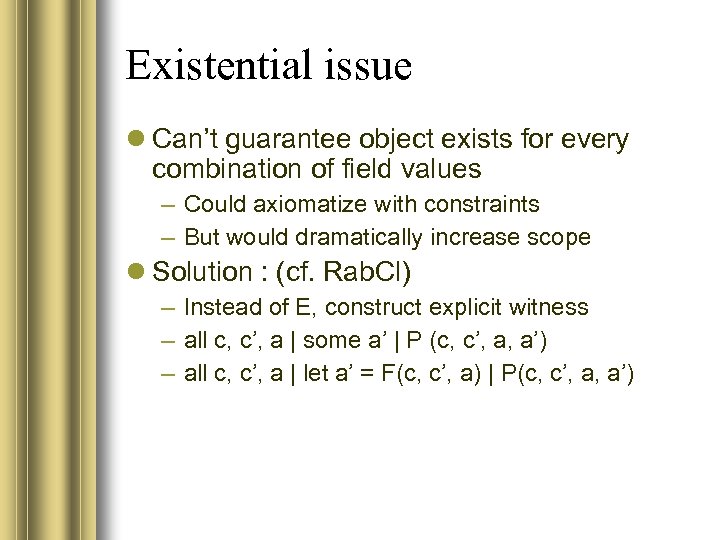 Existential issue Can’t guarantee object exists for every combination of field values – Could axiomatize with constraints – But would dramatically increase scope Solution : (cf. Rab. Cl) – Instead of E, construct explicit witness – all c, c’, a | some a’ | P (c, c’, a, a’) – all c, c’, a | let a’ = F(c, c’, a) | P(c, c’, a, a’)
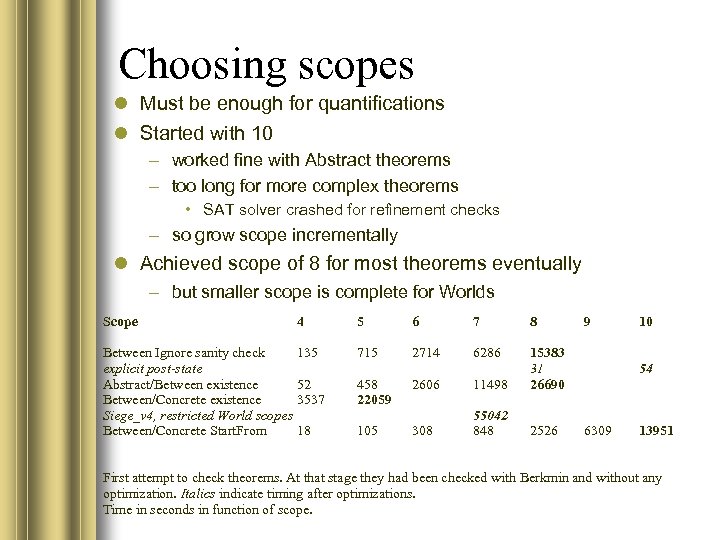 Choosing scopes Must be enough for quantifications Started with 10 – worked fine with Abstract theorems – too long for more complex theorems • SAT solver crashed for refinement checks – so grow scope incrementally Achieved scope of 8 for most theorems eventually – but smaller scope is complete for Worlds Scope 4 Between Ignore sanity check 135 explicit post-state Abstract/Between existence 52 Between/Concrete existence 3537 Siege_v 4, restricted World scopes Between/Concrete Start. From 18 5 6 7 8 715 2714 6286 458 22059 105 2606 11498 15383 31 26690 308 55042 848 2526 9 10 54 6309 13951 First attempt to check theorems. At that stage they had been checked with Berkmin and without any optimization. Italics indicate timing after optimizations. Time in seconds in function of scope.
 Outline Alloy Principles Mondex in Alloy : General Method Technical issues Conclusions
 General observations Modeling – Transcribed Z to Alloy very directly – May be better to try Alloy idiom? High level checking – Proof structure not needed: automated – Exception: abort splitting – Need to provide explicit witness for SAT-Solving duration varies – From seconds to hours (even days!) – Time correlated with theorem importance?
 Alloy Limitations Alloy is finite – Can express unbounded but not infinite models – But in practice, world of purses finite Alloy Analyzer’s analysis is bounded – Results valid only on given scope – Is scope of 8 enough? Reasonable tradeoff for industry? – Much less effort than theorem proving
 Personal Experience Learn Z and Alloy from scratch Nice : – Language easy to understand • no / /graphical issues – Though quite close to Z – Expressive & smooth relation logic Nasty : – Signatures are not records • Equality & Existential theorems – Resource- and time-consuming SAT-Solving • Very long time for obvious-looking theorems (easily provable by hand, e. g. Ignore refinements) • Perhaps syntactic pre-analysis would help?
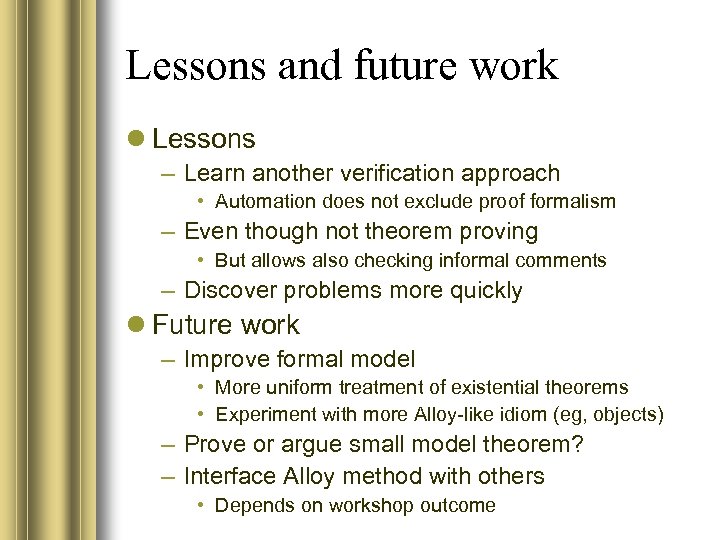 Lessons and future work Lessons – Learn another verification approach • Automation does not exclude proof formalism – Even though not theorem proving • But allows also checking informal comments – Discover problems more quickly Future work – Improve formal model • More uniform treatment of existential theorems • Experiment with more Alloy-like idiom (eg, objects) – Prove or argue small model theorem? – Interface Alloy method with others • Depends on workshop outcome
 Any questions ? E-mail addresses – ramanana@mit. edu Tahina Ramananandro – dnj@mit. edu Daniel Jackson Alloy modules available at : – http: //www. eleves. ens. fr/~ramanana/ work/mondex Alloy Website : – http: //alloy. mit. edu