


 Скачать презентацию ВОЗМОЖНОЕ ВЛИЯНИЕ КОСМИЧЕНСКОЙ ПОГОДЫ НА ЗЕРНОВЫЕ РЫНКИ ВЧЕРА
9d52601e016b573c643205ad239e2109.ppt
- Количество слайдов: 24
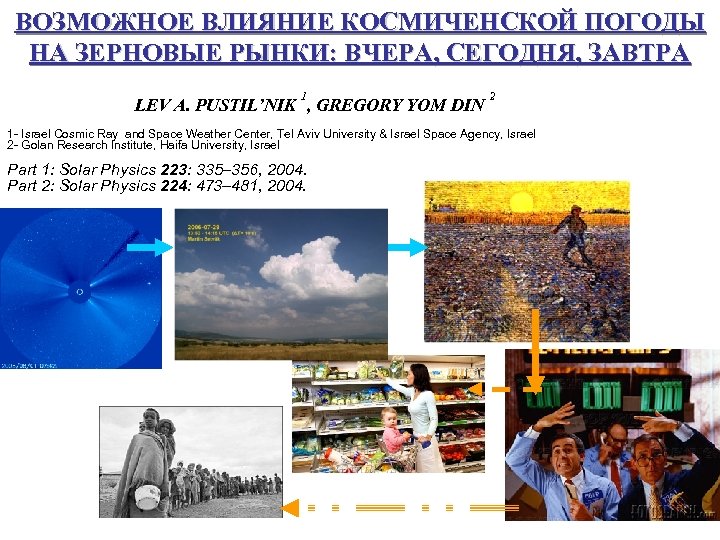 ВОЗМОЖНОЕ ВЛИЯНИЕ КОСМИЧЕНСКОЙ ПОГОДЫ НА ЗЕРНОВЫЕ РЫНКИ: ВЧЕРА, СЕГОДНЯ, ЗАВТРА 1 LEV A. PUSTIL’NIK , GREGORY YOM DIN 2 1 - Israel Cosmic Ray and Space Weather Center, Tel Aviv University & Israel Space Agency, Israel 2 - Golan Research Institute, Haifa University, Israel Part 1: Solar Physics 223: 335– 356, 2004. Part 2: Solar Physics 224: 473– 481, 2004.
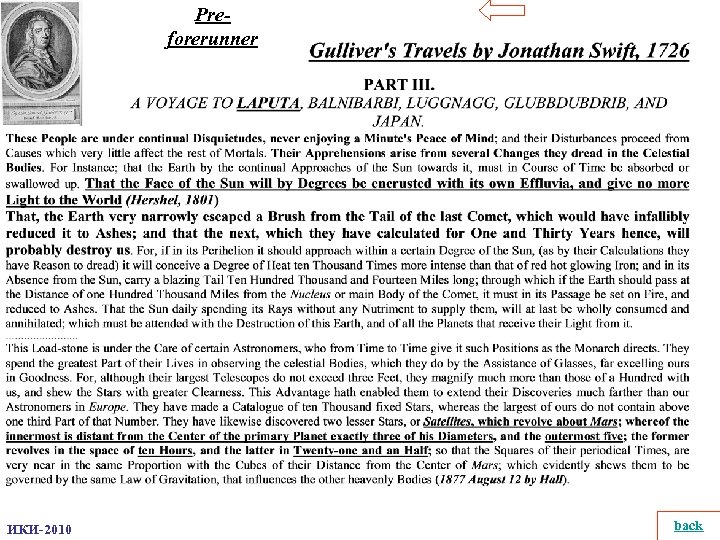
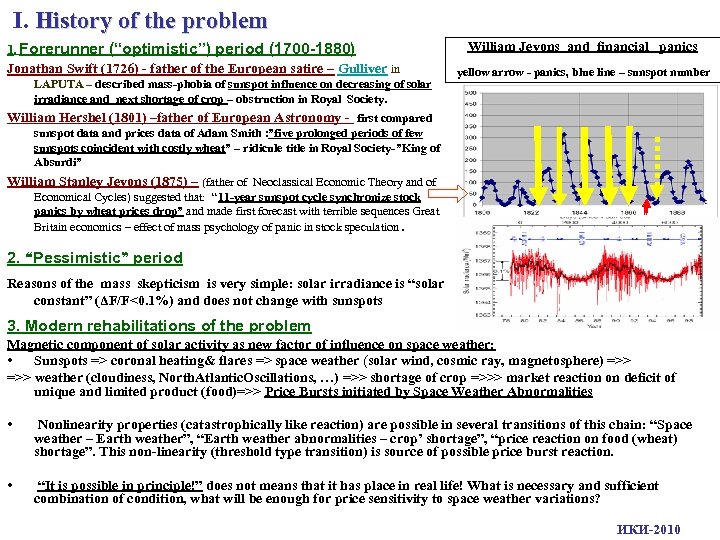 I. History of the problem 1. Forerunner (“optimistic”) period (1700 -1880) Jonathan Swift (1726) - father of the European satire – Gulliver in LAPUTA – described mass-phobia of sunspot influence on decreasing of solar irradiance and next shortage of crop – obstruction in Royal Society. William Jevons and financial panics yellow arrow - panics, blue line – sunspot number William Hershel (1801) –father of European Astronomy - first compared sunspot data and prices data of Adam Smith : ”five prolonged periods of few sunspots coincident with costly wheat” – ridicule title in Royal Society-”King of Absurdi” William Stanley Jevons (1875) – (father of Neoclassical Economic Theory and of Economical Cycles) suggested that: “ 11 -year sunspot cycle synchronize stock panics by wheat prices drop” and made first forecast with terrible sequences Great Britain economics – effect of mass psychology of panic in stock speculation. 2. “Pessimistic” period Reasons of the mass skepticism is very simple: solar irradiance is “solar constant” (ΔF/F<0. 1%) and does not change with sunspots 3. Modern rehabilitations of the problem Magnetic component of solar activity as new factor of influence on space weather: • Sunspots => coronal heating& flares => space weather (solar wind, cosmic ray, magnetosphere) =>> weather (cloudiness, North. Atlantic. Oscillations, …) =>> shortage of crop =>>> market reaction on deficit of unique and limited product (food)=>> Price Bursts initiated by Space Weather Abnormalities • Nonlinearity properties (catastrophically like reaction) are possible in several transitions of this chain: “Space weather – Earth weather”, “Earth weather abnormalities – crop’ shortage”, “price reaction on food (wheat) shortage”. This non-linearity (threshold type transition) is source of possible price burst reaction. • “It is possible in principle!” does not means that it has place in real life! What is necessary and sufficient combination of condition, what will be enough for price sensitivity to space weather variations? ИКИ-2010
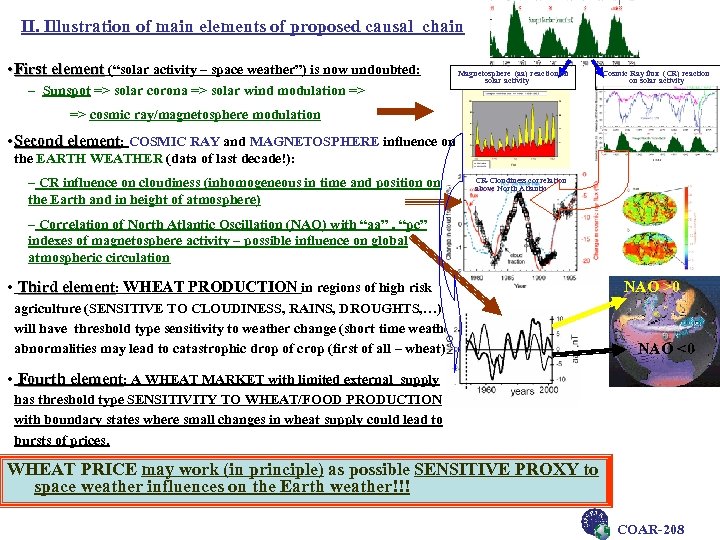 II. Illustration of main elements of proposed causal chain • First element (“solar activity – space weather”) is now undoubted: – Sunspot => solar corona => solar wind modulation => Magnetosphere (aa) reaction on solar activity Cosmic Ray flux (CR) reaction on solar activity => cosmic ray/magnetosphere modulation • Second element: COSMIC RAY and MAGNETOSPHERE influence on the EARTH WEATHER (data of last decade!): – CR influence on cloudiness (inhomogeneous in time and position on the Earth and in height of atmosphere) CR-Cloudiness correlation above North Atlantic – Correlation of North Atlantic Oscillation (NAO) with “aa” , “pc” indexes of magnetosphere activity – possible influence on global atmospheric circulation • Third element: WHEAT PRODUCTION in regions of high risk agriculture (SENSITIVE TO CLOUDINESS, RAINS, DROUGHTS, …) will have threshold type sensitivity to weather change (short time weather abnormalities may lead to catastrophic drop of crop (first of all – wheat). NAO >0 NAO <0 • Fourth element: A WHEAT MARKET with limited external supply has threshold type SENSITIVITY TO WHEAT/FOOD PRODUCTION with boundary states where small changes in wheat supply could lead to bursts of prices. WHEAT PRICE may work (in principle) as possible SENSITIVE PROXY to space weather influences on the Earth weather!!! COAR-208
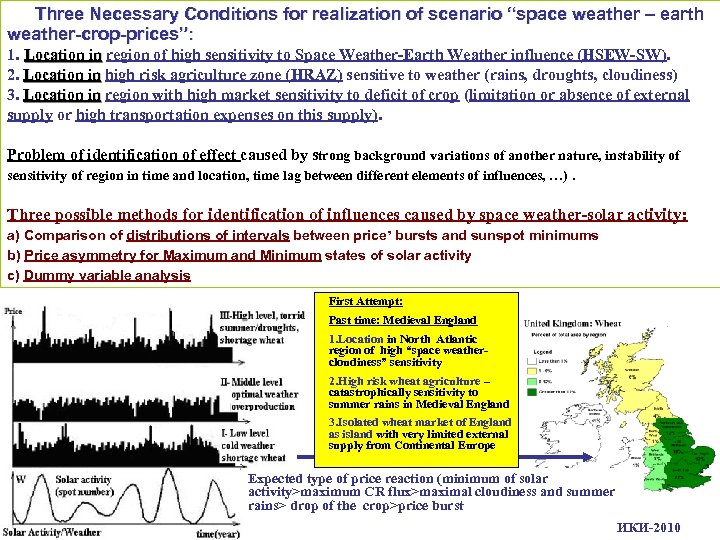 Three Necessary Conditions for realization of scenario “space weather – earth weather-crop-prices”: 1. Location in region of high sensitivity to Space Weather-Earth Weather influence (HSEW-SW). 2. Location in high risk agriculture zone (HRAZ) sensitive to weather (rains, droughts, cloudiness) 3. Location in region with high market sensitivity to deficit of crop (limitation or absence of external supply or high transportation expenses on this supply). Problem of identification of effect caused by strong background variations of another nature, instability of sensitivity of region in time and location, time lag between different elements of influences, …). Three possible methods for identification of influences caused by space weather-solar activity : a) Comparison of distributions of intervals between price’ bursts and sunspot minimums b) Price asymmetry for Maximum and Minimum states of solar activity c) Dummy variable analysis First Attempt: Past time: Medieval England 1. Location in North Atlantic region of high “space weathercloudiness” sensitivity 2. High risk wheat agriculture – catastrophically sensitivity to summer rains in Medieval England 3. Isolated wheat market of England as island with very limited external supply from Continental Europe Expected type of price reaction (minimum of solar activity>maximum CR flux>maximal cloudiness and summer rains> drop of the crop>price burst ИКИ-2010
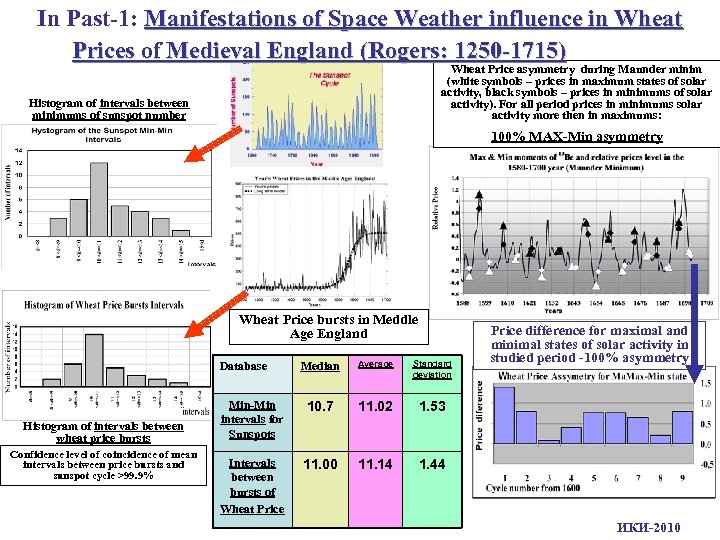 In Past-1: Manifestations of Space Weather influence in Wheat Prices of Medieval England (Rogers: 1250 -1715) Wheat Price asymmetry during Maunder minim (white symbols – prices in maximum states of solar activity, black symbols – prices in minimums of solar activity). For all period prices in minimums solar activity more then in maximums: Histogram of intervals between minimums of sunspot number 100% MAX-Min asymmetry Wheat Price bursts in Meddle Age England Median Average Standard deviation Min-Min intervals for Sunspots 10. 7 11. 02 1. 53 Intervals between bursts of Wheat Price 11. 00 11. 14 1. 44 Database Histogram of intervals between wheat price bursts Confidence level of coincidence of mean intervals between price bursts and sunspot cycle >99. 9% Price difference for maximal and minimal states of solar activity in studied period -100% asymmetry ИКИ-2010
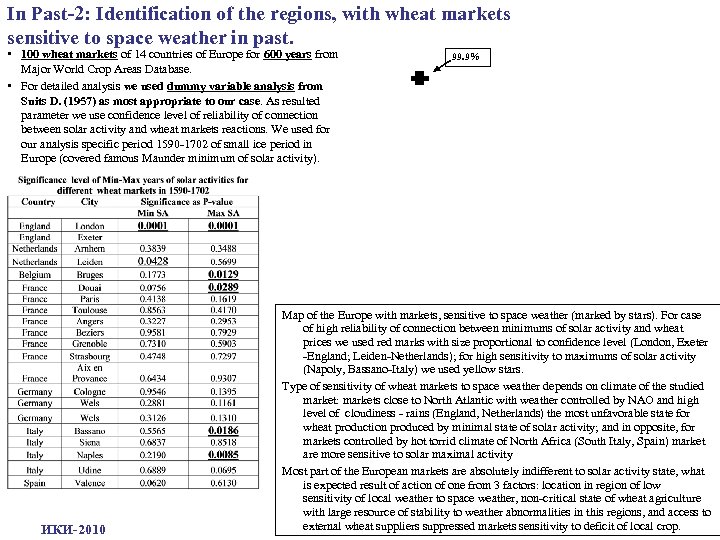 In Past-2: Identification of the regions, with wheat markets sensitive to space weather in past. • 100 wheat markets of 14 countries of Europe for 600 years from Major World Crop Areas Database. • For detailed analysis we used dummy variable analysis from Suits D. (1957) as most appropriate to our case. As resulted parameter we use confidence level of reliability of connection between solar activity and wheat markets reactions. We used for our analysis specific period 1590 -1702 of small ice period in Europe (covered famous Maunder minimum of solar activity). ИКИ-2010 99. 9% Map of the Europe with markets, sensitive to space weather (marked by stars). For case of high reliability of connection between minimums of solar activity and wheat prices we used red marks with size proportional to confidence level (London, Exeter -England; Leiden-Netherlands); for high sensitivity to maximums of solar activity (Napoly, Bassano-Italy) we used yellow stars. Type of sensitivity of wheat markets to space weather depends on climate of the studied market: markets close to North Atlantic with weather controlled by NAO and high level of cloudiness - rains (England, Netherlands) the most unfavorable state for wheat production produced by minimal state of solar activity; and in opposite, for markets controlled by hot torrid climate of North Africa (South Italy, Spain) market are more sensitive to solar maximal activity Most part of the European markets are absolutely indifferent to solar activity state, what is expected result of action of one from 3 factors: location in region of low sensitivity of local weather to space weather, non-critical state of wheat agriculture with large resource of stability to weather abnormalities in this regions, and access to external wheat suppliers suppressed markets sensitivity to deficit of local crop.
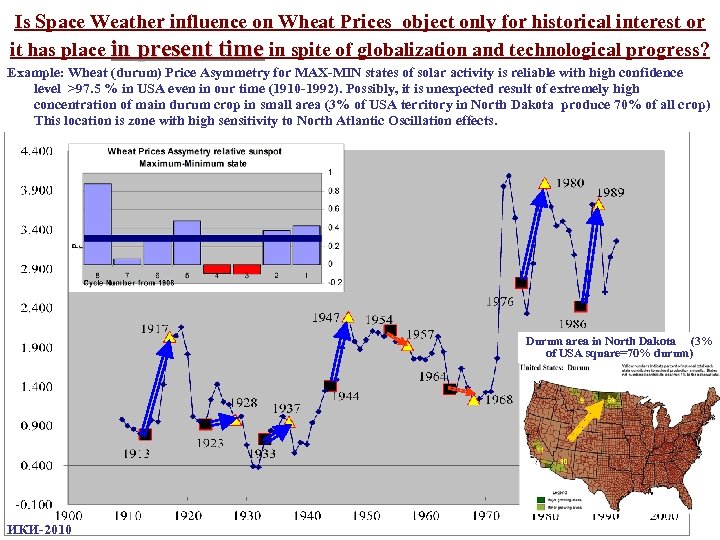 Is Space Weather influence on Wheat Prices object only for historical interest or it has place in present time in spite of globalization and technological progress? Example: Wheat (durum) Price Asymmetry for MAX-MIN states of solar activity is reliable with high confidence level >97. 5 % in USA even in our time (1910 -1992). Possibly, it is unexpected result of extremely high concentration of main durum crop in small area (3% of USA territory in North Dakota produce 70% of all crop) This location is zone with high sensitivity to North Atlantic Oscillation effects. Durum area in North Dakota (3% of USA square=70% durum) ИКИ-2010
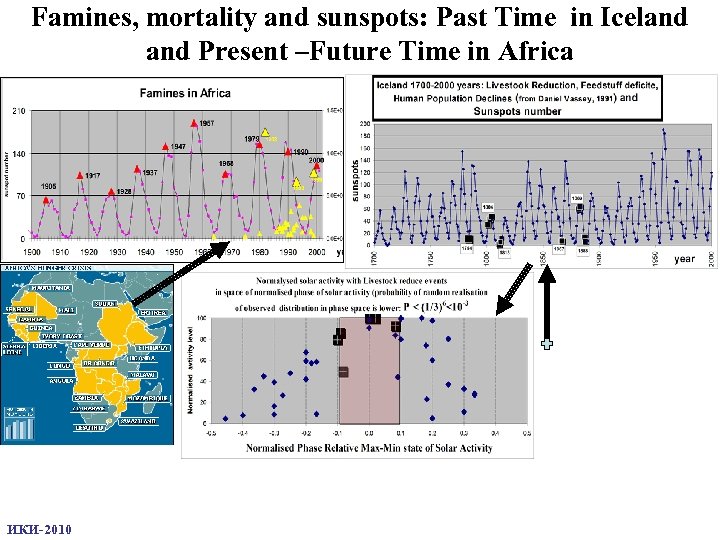 Famines, mortality and sunspots: Past Time in Iceland Present –Future Time in Africa ИКИ-2010
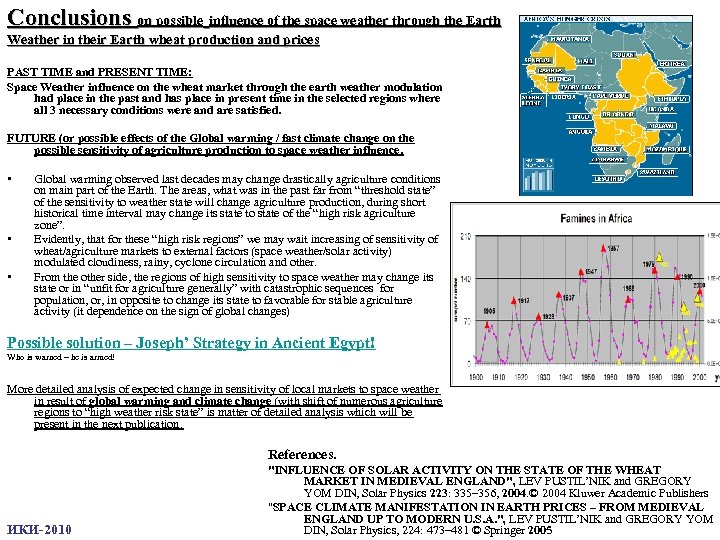 Conclusions on possible influence of the space weather through the Earth Weather in their Earth wheat production and prices PAST TIME and PRESENT TIME: Space Weather influence on the wheat market through the earth weather modulation had place in the past and has place in present time in the selected regions where all 3 necessary conditions were and are satisfied. FUTURE (or possible effects of the Global warming / fast climate change on the possible sensitivity of agriculture production to space weather influence. • Global warming observed last decades may change drastically agriculture conditions on main part of the Earth. The areas, what was in the past far from “threshold state” of the sensitivity to weather state will change agriculture production, during short historical time interval may change its state to state of the “high risk agriculture zone”. • Evidently, that for these “high risk regions” we may wait increasing of sensitivity of wheat/agriculture markets to external factors (space weather/solar activity) modulated cloudiness, rainy, cyclone circulation and other. • From the other side, the regions of high sensitivity to space weather may change its state or in “unfit for agriculture generally” with catastrophic sequences for population, or, in opposite to change its state to favorable for stable agriculture activity (it dependence on the sign of global changes) Possible solution – Joseph’ Strategy in Ancient Egypt! Who is warned – he is armed! More detailed analysis of expected change in sensitivity of local markets to space weather in result of global warming and climate change (with shift of numerous agriculture regions to “high weather risk state” is matter of detailed analysis which will be present in the next publication. References. ИКИ-2010 "INFLUENCE OF SOLAR ACTIVITY ON THE STATE OF THE WHEAT MARKET IN MEDIEVAL ENGLAND", LEV PUSTIL’NIK and GREGORY YOM DIN, Solar Physics 223: 335– 356, 2004. © 2004 Kluwer Academic Publishers "SPACE CLIMATE MANIFESTATION IN EARTH PRICES – FROM MEDIEVAL ENGLAND UP TO MODERN U. S. A. ", LEV PUSTIL’NIK and GREGORY YOM DIN, Solar Physics, 224: 473– 481 © Springer 2005

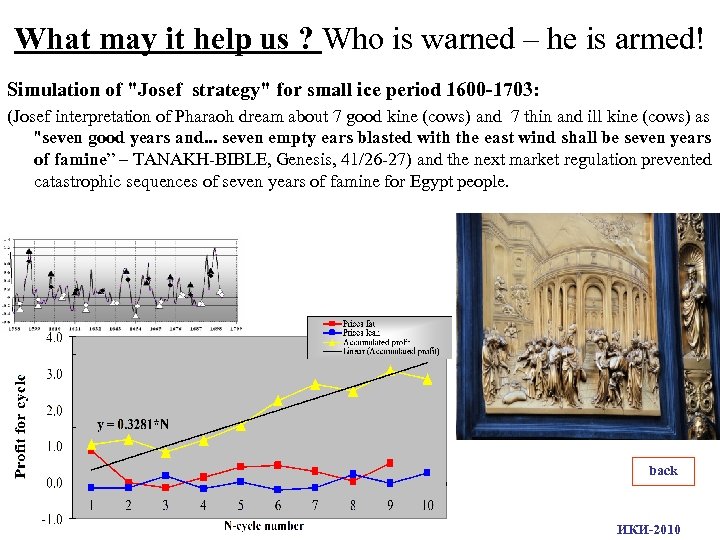 What may it help us ? Who is warned – he is armed! Simulation of "Josef strategy" for small ice period 1600 -1703: (Josef interpretation of Pharaoh dream about 7 good kine (cows) and 7 thin and ill kine (cows) as "seven good years and. . . seven empty ears blasted with the east wind shall be seven years of famine” – TANAKH-BIBLE, Genesis, 41/26 -27) and the next market regulation prevented catastrophic sequences of seven years of famine for Egypt people. back ИКИ-2010
 Preforerunner ИКИ-2010 back
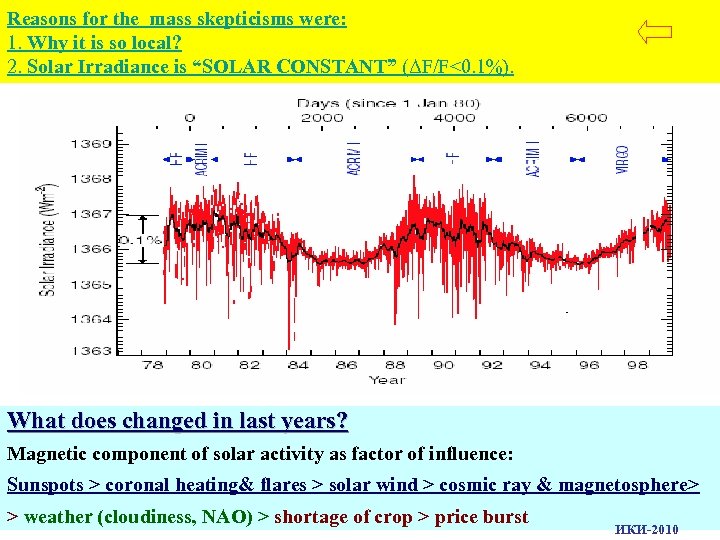 Reasons for the mass skepticisms were: 1. Why it is so local? 2. Solar Irradiance is “SOLAR CONSTANT” (ΔF/F<0. 1%). What does changed in last years? Magnetic component of solar activity as factor of influence: Sunspots > coronal heating& flares > solar wind > cosmic ray & magnetosphere> > weather (cloudiness, NAO) > shortage of crop > price burst ИКИ-2010
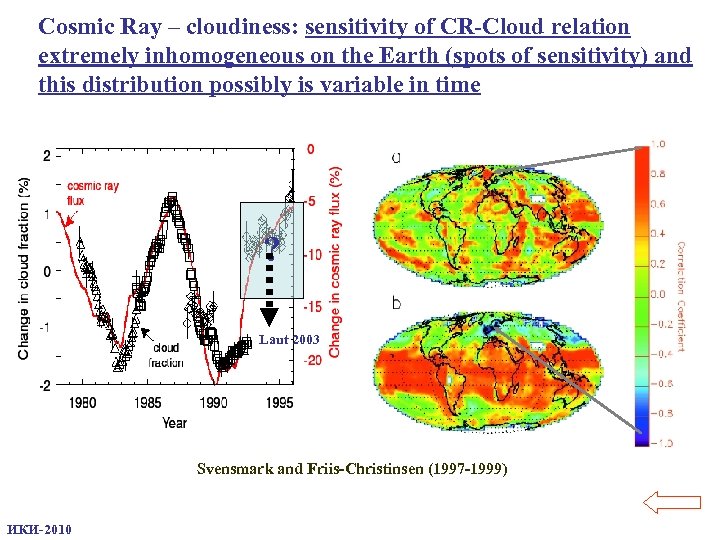 Cosmic Ray – cloudiness: sensitivity of CR-Cloud relation extremely inhomogeneous on the Earth (spots of sensitivity) and this distribution possibly is variable in time ? Laut 2003 Svensmark and Friis-Christinsen (1997 -1999) ИКИ-2010
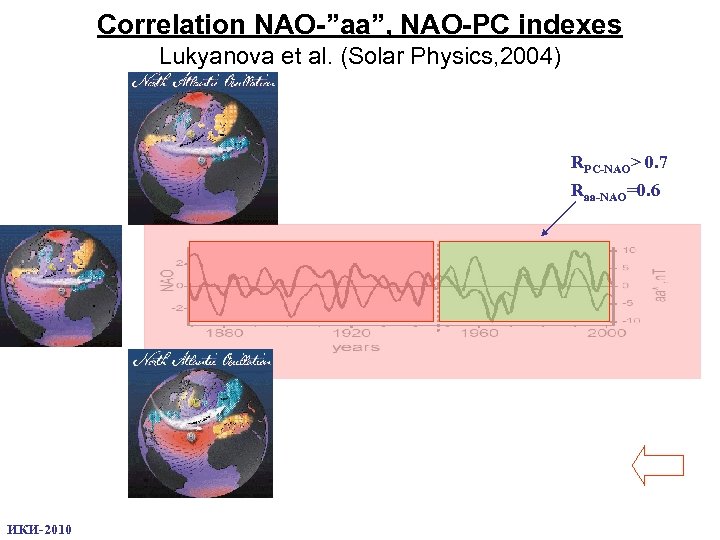 Correlation NAO-”aa”, NAO-PC indexes Lukyanova et al. (Solar Physics, 2004) RPC-NAO> 0. 7 Raa-NAO=0. 6 ИКИ-2010
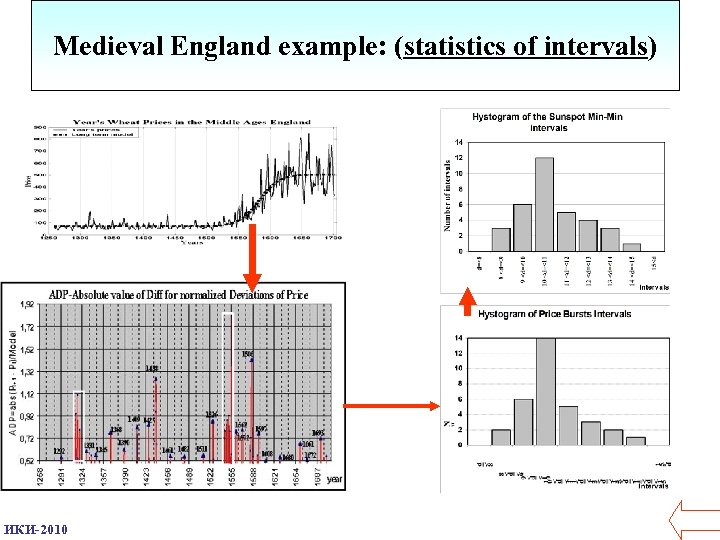 Medieval England example: (statistics of intervals) ИКИ-2010
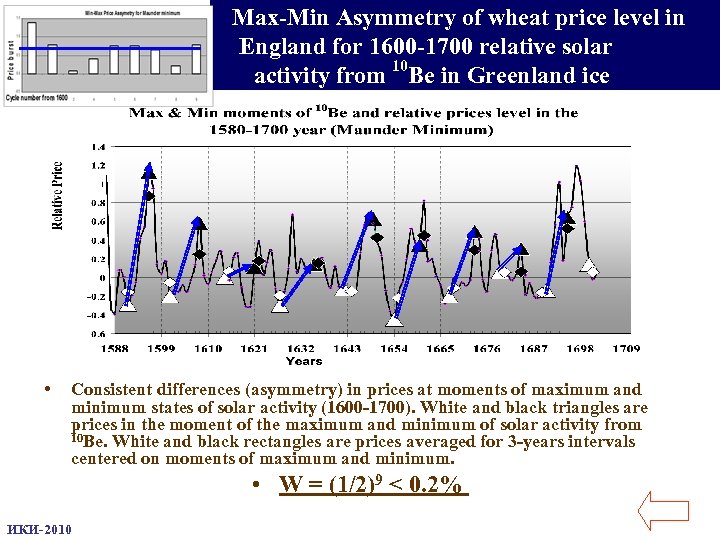 Max-Min Asymmetry of wheat price level in England for 1600 -1700 relative solar activity from 10 Be in Greenland ice • Consistent differences (asymmetry) in prices at moments of maximum and minimum states of solar activity (1600 -1700). White and black triangles are prices in the moment of the maximum and minimum of solar activity from 10 Be. White and black rectangles are prices averaged for 3 -years intervals centered on moments of maximum and minimum. • W = (1/2)9 < 0. 2% ИКИ-2010
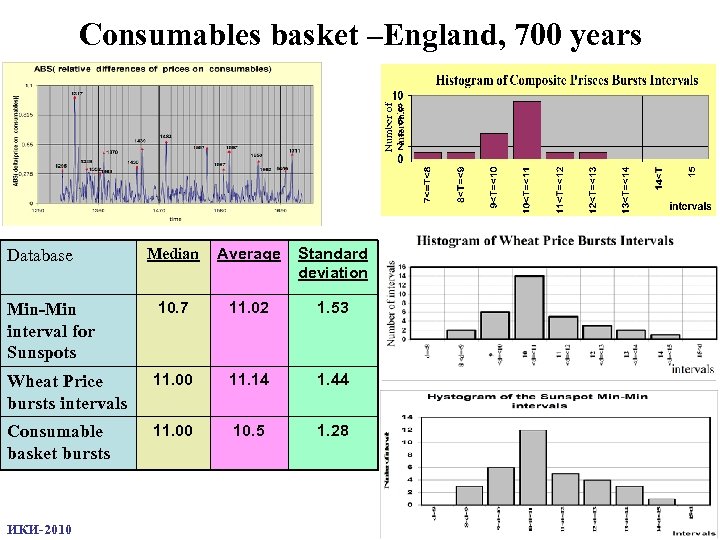 Consumables basket –England, 700 years Median Average Standard deviation Min-Min interval for Sunspots 10. 7 11. 02 1. 53 Wheat Price bursts intervals 11. 00 11. 14 1. 44 Consumable basket bursts 11. 00 10. 5 1. 28 Database ИКИ-2010
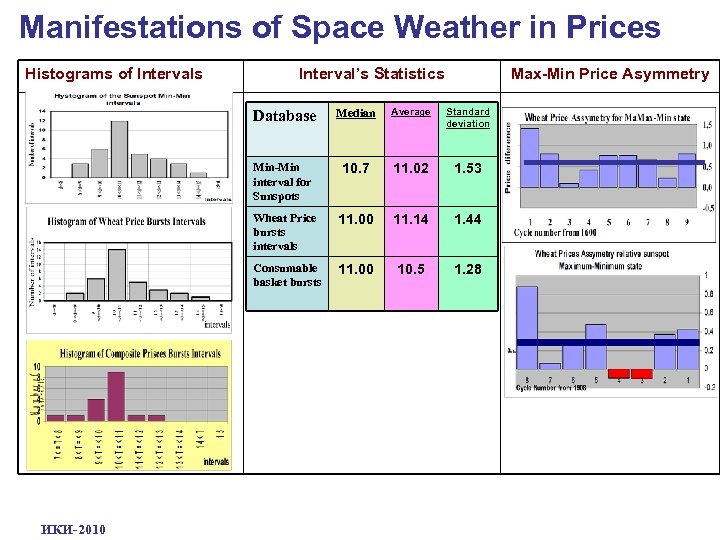 Manifestations of Space Weather in Prices Histograms of Intervals Interval’s Statistics Max-Min Price Asymmetry Database Average Standard deviation Min-Min interval for Sunspots 10. 7 11. 02 1. 53 Wheat Price bursts intervals 11. 00 11. 14 1. 44 Consumable basket bursts ИКИ-2010 Median 11. 00 10. 5 1. 28
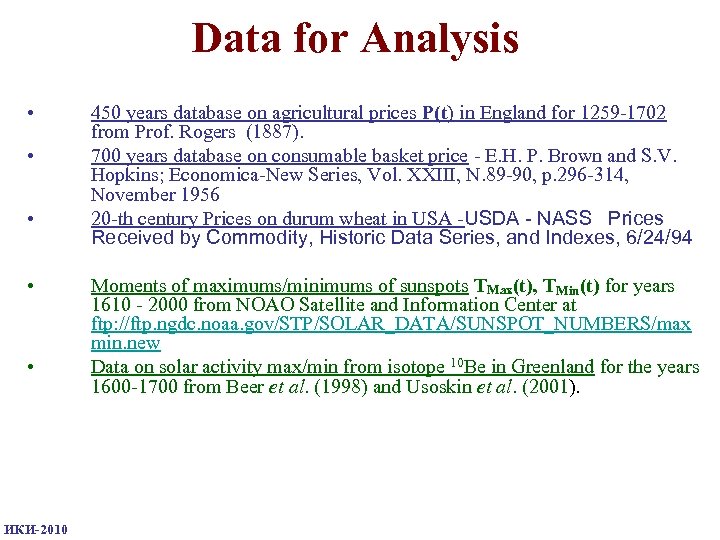 Data for Analysis • • • ИКИ-2010 450 years database on agricultural prices P(t) in England for 1259 -1702 from Prof. Rogers (1887). 700 years database on consumable basket price - E. H. P. Brown and S. V. Hopkins; Economica-New Series, Vol. XXIII, N. 89 -90, p. 296 -314, November 1956 20 -th century Prices on durum wheat in USA -USDA - NASS Prices Received by Commodity, Historic Data Series, and Indexes, 6/24/94 Moments of maximums/minimums of sunspots TMax(t), TMin(t) for years 1610 - 2000 from NOAO Satellite and Information Center at ftp: //ftp. ngdc. noaa. gov/STP/SOLAR_DATA/SUNSPOT_NUMBERS/max min. new Data on solar activity max/min from isotope 10 Be in Greenland for the years 1600 -1700 from Beer et al. (1998) and Usoskin et al. (2001).
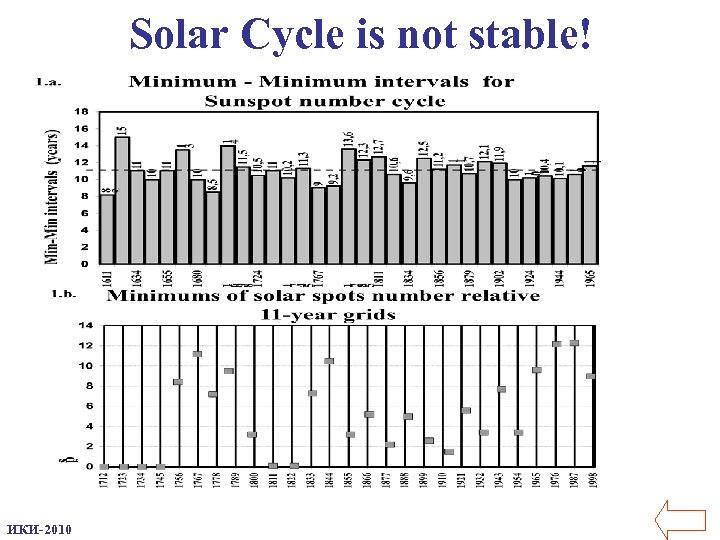 Solar Cycle is not stable! ИКИ-2010
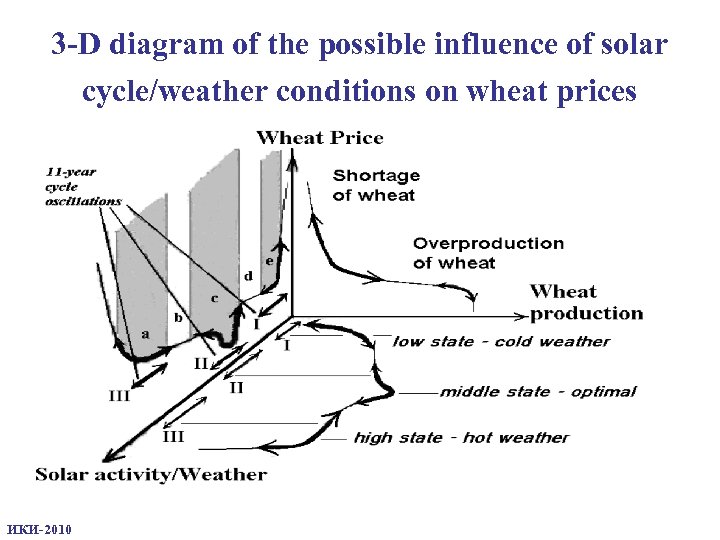 3 -D diagram of the possible influence of solar cycle/weather conditions on wheat prices ИКИ-2010
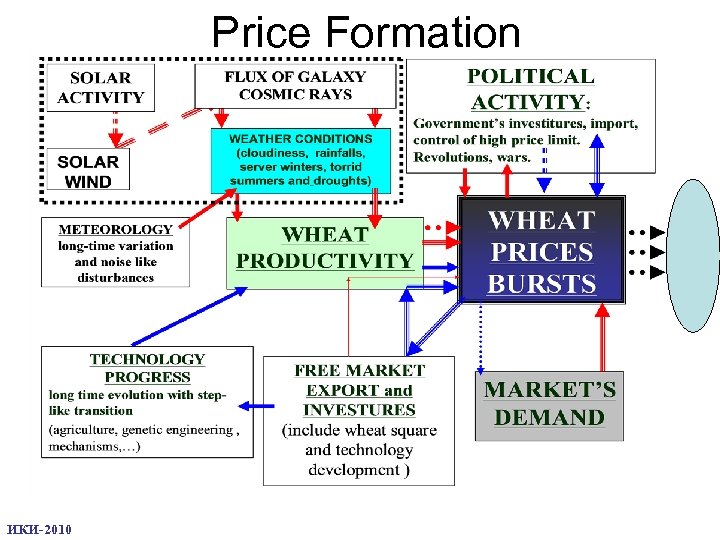 Price Formation ИКИ-2010
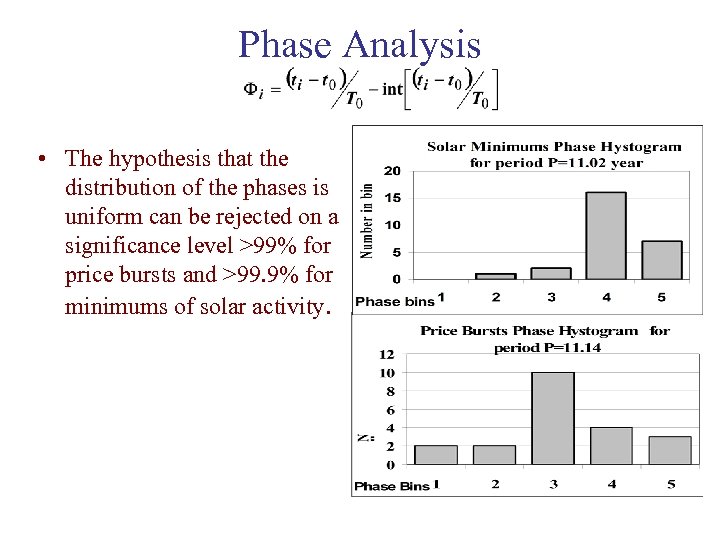 Phase Analysis • The hypothesis that the distribution of the phases is uniform can be rejected on a significance level >99% for price bursts and >99. 9% for minimums of solar activity.