


 Скачать презентацию Vowel articulation in English LING 110 Fall Quarter
4d53bd0155216fe1e9282924dc53c430.ppt
- Количество слайдов: 29
 Vowel articulation in English LING 110 Fall Quarter 2002
 Articulatory parameters for classifying vowels Height of tongue Backness of tongue Lip rounding Tense/Lax Nasality Rhotacization
 A word of caution In terms of phonetics and phonology, the dialects of English are primarily distinguished by differences in vowel quality number of vowels Here we will focus on what is often termed “General American” – the type of English used by American newscasters (which is based mostly on Mid-Western varieties; henceforth AE) Occasionally, we will be comparing AE to the British English equivalent (often referred to as RP for Received Pronunciation)
 Types of English vowels can be distinguished along two main parameters: A Monophthongs (vowels that have the same quality throughout their production, e. g. bid) Diphthongs (vowels that change quality during their production, e. g. boy) B Tense (e. g. bead) Lax (e. g. bid)
![Which vowel is in what category Tense vowels [i ] [e ] [ ]](https://present5.com/presentation/4d53bd0155216fe1e9282924dc53c430/image-5.jpg "Which vowel is in what category Tense vowels [i ] [e ] [ ]") Which vowel is in what category Tense vowels [i ] [e ] [ ] [o ] [a ] [ju] [u ] Lax vowels [ ] [E] [ ] [ ] Monophthongs [i ] [ ] [ ] [u ] [E] Diphthongs [e ] [ [o ] [a ] [ ]
Which vowel is in what category Tense vowels [i ] [e ] [ ] [o ] [a ] [ju] [u ] Lax vowels [ ] [E] [ ] [ ] Monophthongs [i ] [ ] [ ] [u ] [E] Diphthongs [e ] [ [o ] [a ] [ ]
 Word of caution For tense monophthongs we will be using the symbol for the vowel followed by the length diacritic [ ] This is to make the distinction between tense and lax vowels clearer But in fact the length difference is due to the difference in tenseness, i. e. tense vowels are longer than their lax counterparts because they are tense This does not mean that all lax vowels are short: the vowel with the longest intrinsic duration is [ ], which is lax
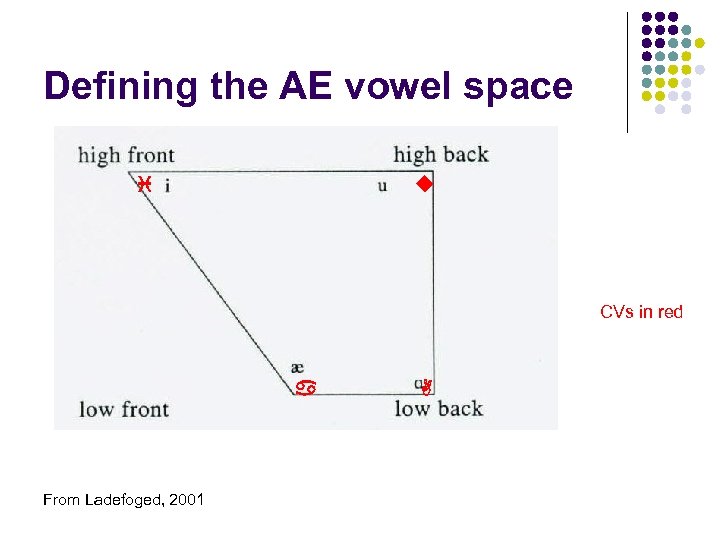 Defining the AE vowel space i u CVs in red a From Ladefoged, 2001
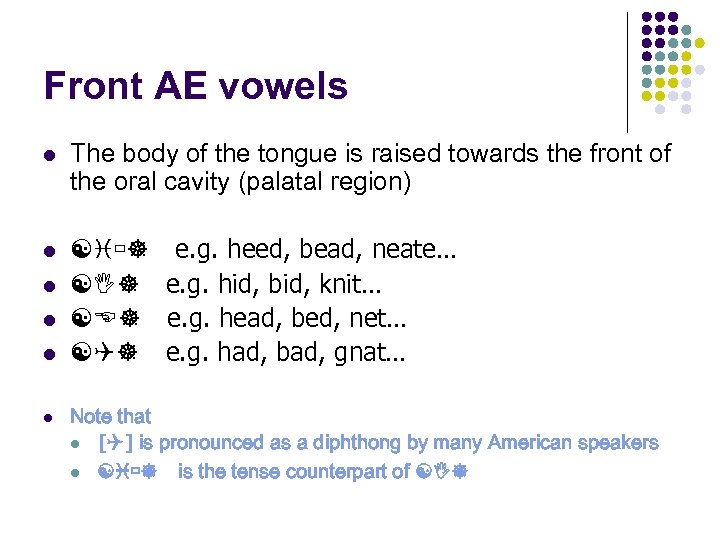 Front AE vowels The body of the tongue is raised towards the front of the oral cavity (palatal region) [ ] e. g. heed, bead, neate… [ ] e. g. hid, bid, knit… [E] e. g. head, bed, net… [ ] e. g. had, bad, gnat… Note that [ ] is pronounced as a diphthong by many American speakers [i ] is the tense counterpart of [ ]
![Tense and lax [i ] and [ ] From Ladefoged & Maddieson 1996](https://present5.com/presentation/4d53bd0155216fe1e9282924dc53c430/image-9.jpg "Tense and lax [i ] and [ ] From Ladefoged & Maddieson 1996") Tense and lax [i ] and [ ] From Ladefoged & Maddieson 1996
Tense and lax [i ] and [ ] From Ladefoged & Maddieson 1996
![Tongue position for AE front vowels heed [i ] hid [ ] head [E]](https://present5.com/presentation/4d53bd0155216fe1e9282924dc53c430/image-10.jpg "Tongue position for AE front vowels heed [i ] hid [ ] head [E]") Tongue position for AE front vowels heed [i ] hid [ ] head [E] had [ ] From Ladefoged, 2001
Tongue position for AE front vowels heed [i ] hid [ ] head [E] had [ ] From Ladefoged, 2001
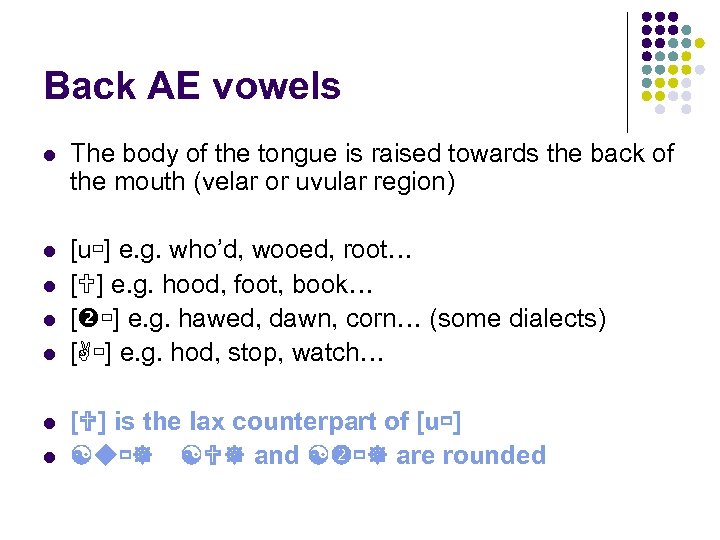 Back AE vowels The body of the tongue is raised towards the back of the mouth (velar or uvular region) [u ] e. g. who’d, wooed, root… [ ] e. g. hood, foot, book… [ ] e. g. hawed, dawn, corn… (some dialects) [ ] e. g. hod, stop, watch… [ ] is the lax counterpart of [u ] [ ] and [ ] are rounded
![Tense and lax [u ] and [ ] From Ladefoged & Maddieson 1996](https://present5.com/presentation/4d53bd0155216fe1e9282924dc53c430/image-12.jpg "Tense and lax [u ] and [ ] From Ladefoged & Maddieson 1996") Tense and lax [u ] and [ ] From Ladefoged & Maddieson 1996
Tense and lax [u ] and [ ] From Ladefoged & Maddieson 1996
![Tongue position for some AE back vowels who’d [u ] hood [ ] hod](https://present5.com/presentation/4d53bd0155216fe1e9282924dc53c430/image-13.jpg "Tongue position for some AE back vowels who’d [u ] hood [ ] hod") Tongue position for some AE back vowels who’d [u ] hood [ ] hod [ ] However, many speakers, for example in California, (a) use an unrounded vowel in the place of [ ] (b) use a central vowel in the place of [u ] From Ladefoged, 2001
Tongue position for some AE back vowels who’d [u ] hood [ ] hod [ ] However, many speakers, for example in California, (a) use an unrounded vowel in the place of [ ] (b) use a central vowel in the place of [u ] From Ladefoged, 2001
![On [ ] and [ ] Finding examples for [ ] and [ ]](https://present5.com/presentation/4d53bd0155216fe1e9282924dc53c430/image-14.jpg "On [ ] and [ ] Finding examples for [ ] and [ ]") On [ ] and [ ] Finding examples for [ ] and [ ] is tricky In some words, e. g. coffee, speakers of some AE dialects use [ ] while others use [ ] (and still others may use a diphthong) Midwestern and Californian dialects have no distinction between these two vowels, but instead have a vowel of intermediate (e. g. is don and dawn different for you? ) British English, on the other hand, uses both [ ] and [ ] (but in different contexts), and has an additional vowel, [ ]; e. g. calm ([ ]), caught ([ ]) and cot ([ ])
On [ ] and [ ] Finding examples for [ ] and [ ] is tricky In some words, e. g. coffee, speakers of some AE dialects use [ ] while others use [ ] (and still others may use a diphthong) Midwestern and Californian dialects have no distinction between these two vowels, but instead have a vowel of intermediate (e. g. is don and dawn different for you? ) British English, on the other hand, uses both [ ] and [ ] (but in different contexts), and has an additional vowel, [ ]; e. g. calm ([ ]), caught ([ ]) and cot ([ ])
![Central vowels [ ] e. g. mud, cup, gunk… [ ] e. g. bird,](https://present5.com/presentation/4d53bd0155216fe1e9282924dc53c430/image-15.jpg "Central vowels [ ] e. g. mud, cup, gunk… [ ] e. g. bird,") Central vowels [ ] e. g. mud, cup, gunk… [ ] e. g. bird, third, curd… In AE these two vowels have very similar mid central quality What distinguishes them is rhotacization, the r-coloring of [ ] Note: British English has no rhotacization (it is a non-rhotic variety); the quality of [ ] and [ ] is distinct, with [ ] being lower
Central vowels [ ] e. g. mud, cup, gunk… [ ] e. g. bird, third, curd… In AE these two vowels have very similar mid central quality What distinguishes them is rhotacization, the r-coloring of [ ] Note: British English has no rhotacization (it is a non-rhotic variety); the quality of [ ] and [ ] is distinct, with [ ] being lower
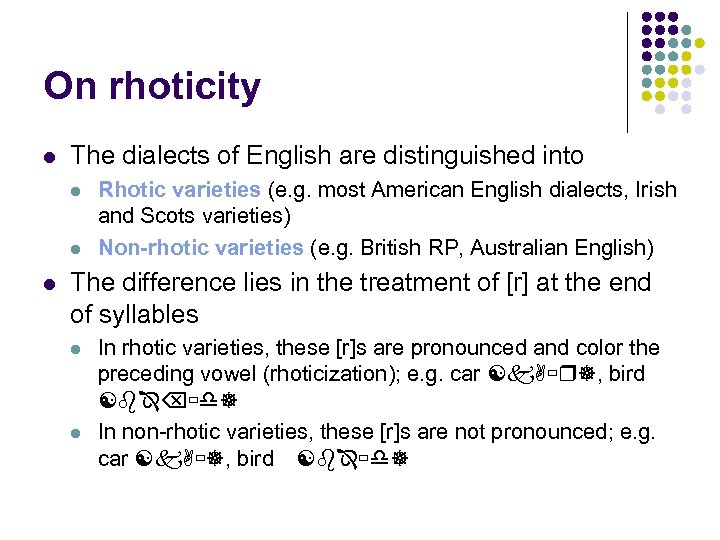 On rhoticity The dialects of English are distinguished into Rhotic varieties (e. g. most American English dialects, Irish and Scots varieties) Non-rhotic varieties (e. g. British RP, Australian English) The difference lies in the treatment of [r] at the end of syllables In rhotic varieties, these [r]s are pronounced and color the preceding vowel (rhoticization); e. g. car [ ], bird [ d] In non-rhotic varieties, these [r]s are not pronounced; e. g. car [ ], bird [ d]
![The diphthongs [ ] e. g. hay, may, rate… [ ] e. g. boy,](https://present5.com/presentation/4d53bd0155216fe1e9282924dc53c430/image-17.jpg "The diphthongs [ ] e. g. hay, may, rate… [ ] e. g. boy,") The diphthongs [ ] e. g. hay, may, rate… [ ] e. g. boy, toy, Lois… [o ] e. g. hoed, foam, boat… [a ] e. g. height, type, right… [a ] e. g. house, mouse, trout… [ju ] e. g. cute, mute, puke…
The diphthongs [ ] e. g. hay, may, rate… [ ] e. g. boy, toy, Lois… [o ] e. g. hoed, foam, boat… [a ] e. g. height, type, right… [a ] e. g. house, mouse, trout… [ju ] e. g. cute, mute, puke…
![[e ] [ ] may be pronounced in many different ways The first part](https://present5.com/presentation/4d53bd0155216fe1e9282924dc53c430/image-18.jpg "[e ] [ ] may be pronounced in many different ways The first part") [e ] [ ] may be pronounced in many different ways The first part is often very close to [E] But many RP speakers and many Midwestern Americans have a closer initial quality (hence the transcription [ ]) Other varieties (e. g. Cockney, Australian English) have a more open quality Still others (e. g. Scots) have a monophthong [e] Note: [e] is also used as a symbol for [ ] in many American textbooks
[e ] [ ] may be pronounced in many different ways The first part is often very close to [E] But many RP speakers and many Midwestern Americans have a closer initial quality (hence the transcription [ ]) Other varieties (e. g. Cockney, Australian English) have a more open quality Still others (e. g. Scots) have a monophthong [e] Note: [e] is also used as a symbol for [ ] in many American textbooks
![[a ] and [a ] Though we use the symbol [a] for these diphthongs,](https://present5.com/presentation/4d53bd0155216fe1e9282924dc53c430/image-19.jpg "[a ] and [a ] Though we use the symbol [a] for these diphthongs,") [a ] and [a ] Though we use the symbol [a] for these diphthongs, for most speakers the beginning quality is neither front nor back and closer to [ ] The ending quality is lower than that indicated by the symbols [ ] and [ ] Texan and other South and Southwest varieties have a monophthong [a ] instead of the diphthong [a ]
[a ] and [a ] Though we use the symbol [a] for these diphthongs, for most speakers the beginning quality is neither front nor back and closer to [ ] The ending quality is lower than that indicated by the symbols [ ] and [ ] Texan and other South and Southwest varieties have a monophthong [a ] instead of the diphthong [a ]
![[ ] and [o ] Despite the different symbol used, [ ] and [o](https://present5.com/presentation/4d53bd0155216fe1e9282924dc53c430/image-20.jpg "[ ] and [o ] Despite the different symbol used, [ ] and [o") [ ] and [o ] Despite the different symbol used, [ ] and [o ] do not have particularly different starting qualities in AE Both [ ] and [o ] end in qualities slightly lower than the symbols [ ] and [ ] suggest [o ] is transcribed as [o] in many American textbooks In British English [o ] has a central beginning quality (hence the transcription [ ]), though this is now changing
[ ] and [o ] Despite the different symbol used, [ ] and [o ] do not have particularly different starting qualities in AE Both [ ] and [o ] end in qualities slightly lower than the symbols [ ] and [ ] suggest [o ] is transcribed as [o] in many American textbooks In British English [o ] has a central beginning quality (hence the transcription [ ]), though this is now changing
![[ju ] This combination is most often considered as a sequence of [j] and](https://present5.com/presentation/4d53bd0155216fe1e9282924dc53c430/image-21.jpg "[ju ] This combination is most often considered as a sequence of [j] and") [ju ] This combination is most often considered as a sequence of [j] and [u ] However, sequences of (s)+consonant+[j] can only occur before [u ]; e. g. spew, few, cue, beauty This gap needs no explanation if we classify [ju ] as a diphthong
[ju ] This combination is most often considered as a sequence of [j] and [u ] However, sequences of (s)+consonant+[j] can only occur before [u ]; e. g. spew, few, cue, beauty This gap needs no explanation if we classify [ju ] as a diphthong
![For classification purposes High vowels: [i ] [u ] [ ] Low vowels: [](https://present5.com/presentation/4d53bd0155216fe1e9282924dc53c430/image-22.jpg "For classification purposes High vowels: [i ] [u ] [ ] Low vowels: [") For classification purposes High vowels: [i ] [u ] [ ] Low vowels: [ ] Mid vowels: [E] [ ] [ ] Front vowels: [i ] [E] [ ] Back vowels: [ ] [u ] [ ] Central vowels: [ ]
For classification purposes High vowels: [i ] [u ] [ ] Low vowels: [ ] Mid vowels: [E] [ ] [ ] Front vowels: [i ] [E] [ ] Back vowels: [ ] [u ] [ ] Central vowels: [ ]
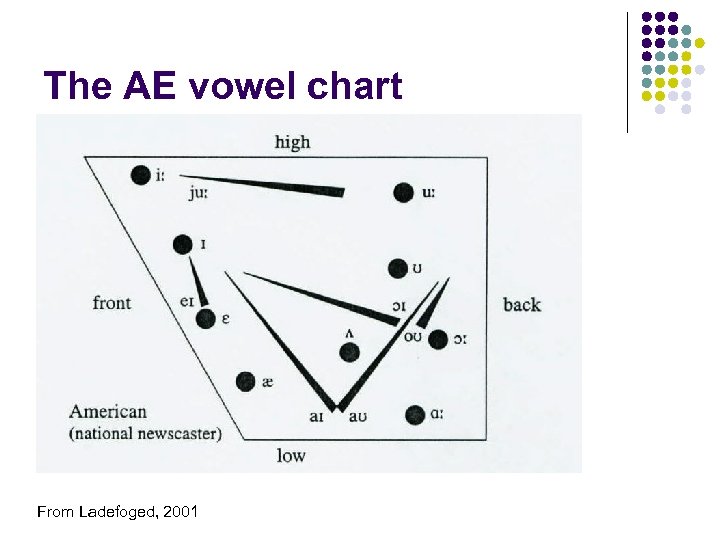 The AE vowel chart From Ladefoged, 2001
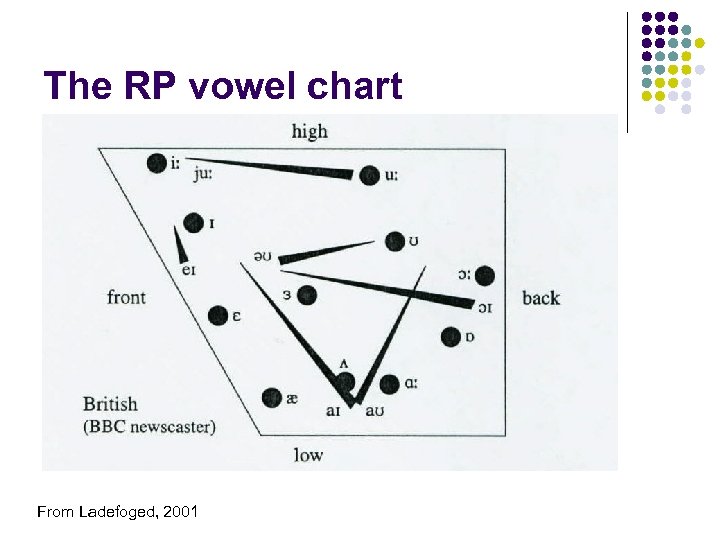 The RP vowel chart From Ladefoged, 2001
 Context-depended variation
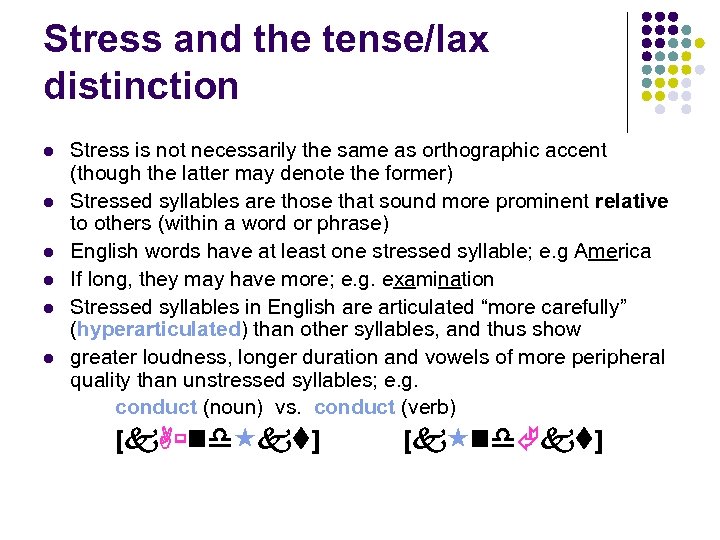 Stress and the tense/lax distinction Stress is not necessarily the same as orthographic accent (though the latter may denote the former) Stressed syllables are those that sound more prominent relative to others (within a word or phrase) English words have at least one stressed syllable; e. g America If long, they may have more; e. g. examination Stressed syllables in English are articulated “more carefully” (hyperarticulated) than other syllables, and thus show greater loudness, longer duration and vowels of more peripheral quality than unstressed syllables; e. g. conduct (noun) vs. conduct (verb) [k nd kt]
![Unstressed vowels • Unstressed vowels are often reduced to [ ] (schwa), [ ](/[](https://present5.com/presentation/4d53bd0155216fe1e9282924dc53c430/image-27.jpg "Unstressed vowels • Unstressed vowels are often reduced to [ ] (schwa), [ ](/[") Unstressed vowels • Unstressed vowels are often reduced to [ ] (schwa), [ ](/[ ]): atom [ ] atomic [ ] declare [d E ] declaration [ d. E ] • Whether you use one or two of these vowels depends on your accent
Unstressed vowels • Unstressed vowels are often reduced to [ ] (schwa), [ ](/[ ]): atom [ ] atomic [ ] declare [d E ] declaration [ d. E ] • Whether you use one or two of these vowels depends on your accent
![But be careful: not all unstressed vowels are reduced to [ ] or](https://present5.com/presentation/4d53bd0155216fe1e9282924dc53c430/image-28.jpg "But be careful: not all unstressed vowels are reduced to [ ] or") But be careful: not all unstressed vowels are reduced to [ ] or [ ]; e. g. unseasonably [ s z ]
But be careful: not all unstressed vowels are reduced to [ ] or [ ]; e. g. unseasonably [ s z ]
![Nasalization Vowels are nasalized in syllables closed by a nasal consonant ban [ ]](https://present5.com/presentation/4d53bd0155216fe1e9282924dc53c430/image-29.jpg "Nasalization Vowels are nasalized in syllables closed by a nasal consonant ban [ ]") Nasalization Vowels are nasalized in syllables closed by a nasal consonant ban [ ] hungry [ h Ng ] win [w ] compare. . . enemy [E ] The degree of nasalization depends on the accent
Nasalization Vowels are nasalized in syllables closed by a nasal consonant ban [ ] hungry [ h Ng ] win [w ] compare. . . enemy [E ] The degree of nasalization depends on the accent