


 Скачать презентацию Volzhsky Institute of Humanities Economic department World economy
Презентация на англ-м.pptx
- Количество слайдов: 19
 Volzhsky Institute of Humanities Economic department (World economy) research work “Russian modern logistics infrastructure” by Tatiana Pecheykina for presenting at workshop of Offenburg Institute of 20 -25, May 2012
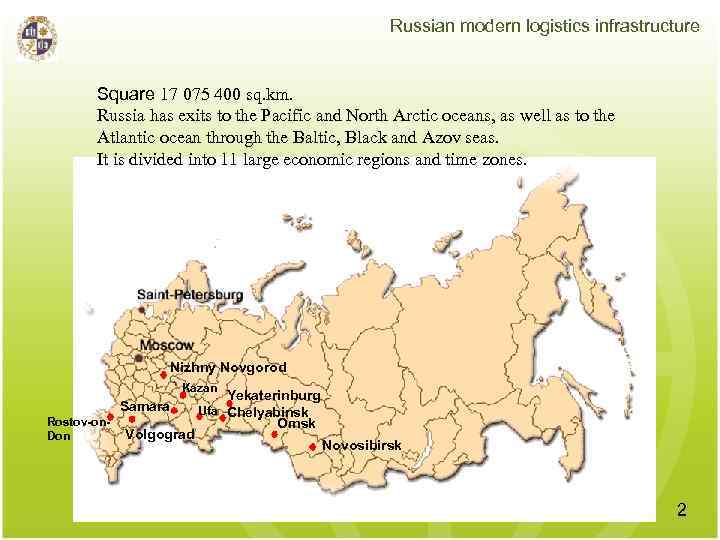 Russian modern logistics infrastructure Square 17 075 400 sq. km. Russia has exits to the Pacific and North Arctic oceans, as well as to the Atlantic ocean through the Baltic, Black and Azov seas. It is divided into 11 large economic regions and time zones. Nizhny Novgorod Kazan Samara Rostov-on. Don Volgograd Yekaterinburg Ufa Chelyabinsk Omsk Novosibirsk 2
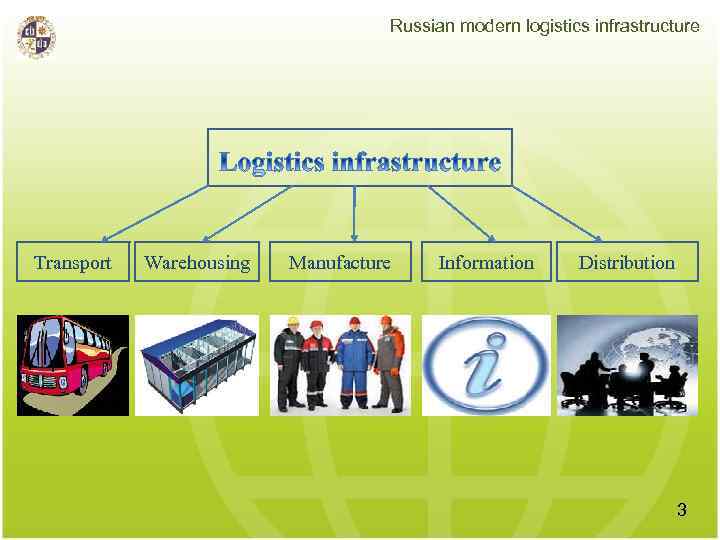 Russian modern logistics infrastructure Transport Warehousing Manufacture Information Distribution 3
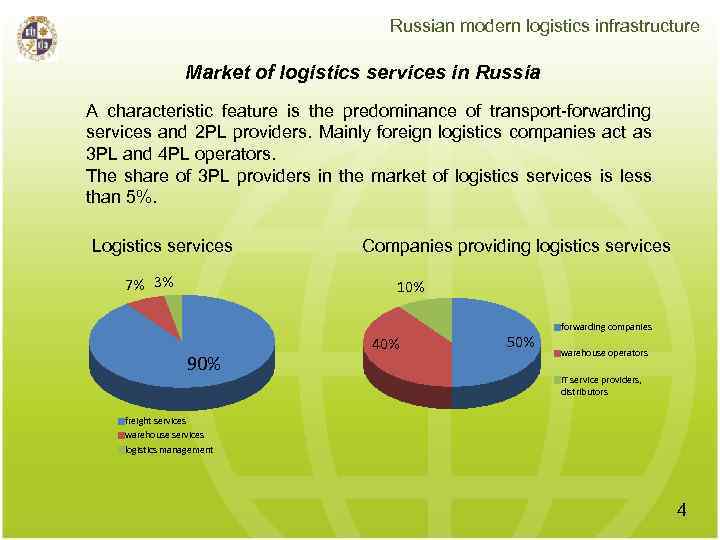 Russian modern logistics infrastructure Market of logistics services in Russia A characteristic feature is the predominance of transport-forwarding services and 2 PL providers. Mainly foreign logistics companies act as 3 PL and 4 PL operators. The share of 3 PL providers in the market of logistics services is less than 5%. Logistics services 7% 3% Companies providing logistics services 10% 90% 40% 50% forwarding companies warehouse operators IT service providers, distributors freight services warehouse services logistics management 4
 Russian modern logistics infrastructure Market of logistics services in Russia Leaders of the Russian logistics market: Ø Ø Ø FM Logistic, Deutsche Post DHL, DPD, Itella. NLC, Kuehne+Nagel, Maersk, Schenker, STS Logistics, TNT Express, UPS, N-Trans, Fed. EX. 5
 Russian modern logistics infrastructure Logistics infrastructure development: in Russia comes along with the population density features. Population density by regions 6
 Russian modern logistics infrastructure Transport infrastructure Automobile transport The length of motor roads of common use is 948 thousand km. About 20 thousand km of federal roads do not comply with the normative transport requirements. St. Petersburg Moscow RUSSIA Rostov-on-Don Krasnoyarsk Kazakhstan Nakhodka Corridor “East-West” Corridor “North-South” Existing transport corridors Projected transport corridors Northern sea route Transport corridors outside Russia 7
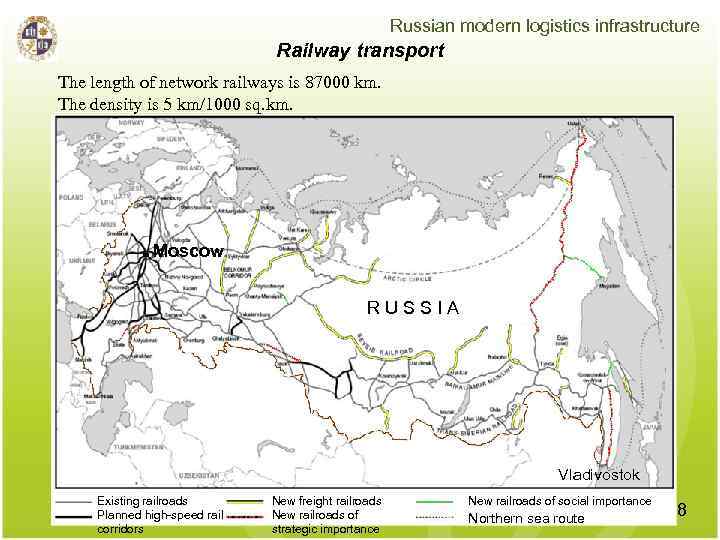 Russian modern logistics infrastructure Railway transport The length of network railways is 87000 km. The density is 5 km/1000 sq. km. Moscow RUSSIA Vladivostok Existing railroads Planned high-speed rail corridors New freight railroads New railroads of strategic importance New railroads of social importance Northern sea route 8
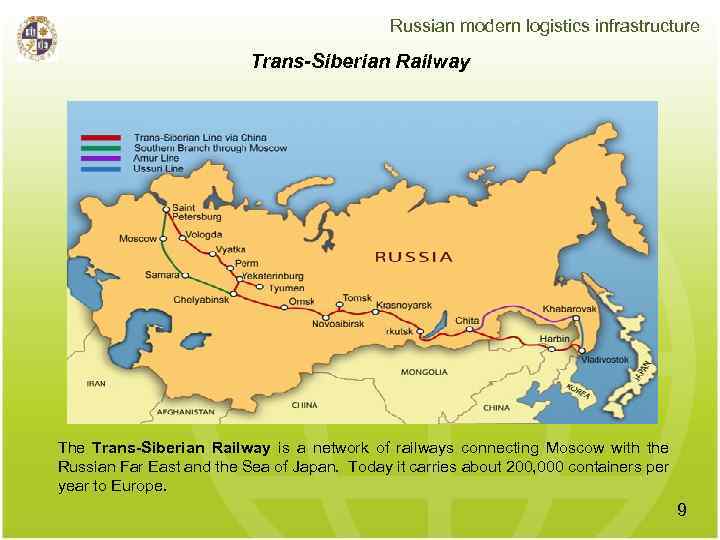 Russian modern logistics infrastructure Trans-Siberian Railway The Trans-Siberian Railway is a network of railways connecting Moscow with the Russian Far East and the Sea of Japan. Today it carries about 200, 000 containers per year to Europe. 9
 Inland water transport Volga-Baltic canal St. Petersburg ØThe length of inland waterways - 101, 6 thousand km. Vo lga Moscow Vo lg a ØIn the European part of the country length of deep-water shipping is 6. 5 thousand km. ØIts parts are included in the international transport corridor "North-South". Volga-Don canal Volgograd 10
 Russian modern logistics infrastructure Air transport There are 196 operating airports in Russia (the 7 th place among the countries of the world), including 69 international. 11
 Russian modern logistics infrastructure Key Russian airports Anadyr Murmansk St. Petersburg Magadan Smolensk Vologda Moscow Khanty-Mansiysk Yakutsk Petropavlovsk. Kamchatsky Rostov-on-Don Volgograd Yekaterinburg Omsk Krasnodar Astrakhan Krasnoyarsk Novosibirsk Vladivostok 12
 Russian modern logistics infrastructure Transport system Current state of the transport system is characterized by a low technical level and deterioration of the vast majority of vehicles, as well as the uneven development of infrastructure. The greatest share of transportation falls on the railway and pipeline transport. Share in cargo turnover Railway Automobile Sea transport Inland water Pipeline Air Share in passenger turnover 13
 Russian modern logistics infrastructure Logistics centers Warehouse network in Russia includes a set of terminals: • Federal distribution centers; • Regional warehouses; • Loading platforms and warehouses of delivery; • Warehouses at stores and in other points of sales. The warehouse real estate market is more developed in Moscow and Saint-Petersburg areas. 14
 Russian modern logistics infrastructure Moscow warehouse real estate market Aggregate supply of first-rate warehouse premises 6, 09 mln. sq. m space (end of 2011) First-rate warehouses increase in 2011 6, 5% The percentage of vacant space at the end of the year 7, 5% Trend of warehouse space supply, Moscow region, th. sq. m 15
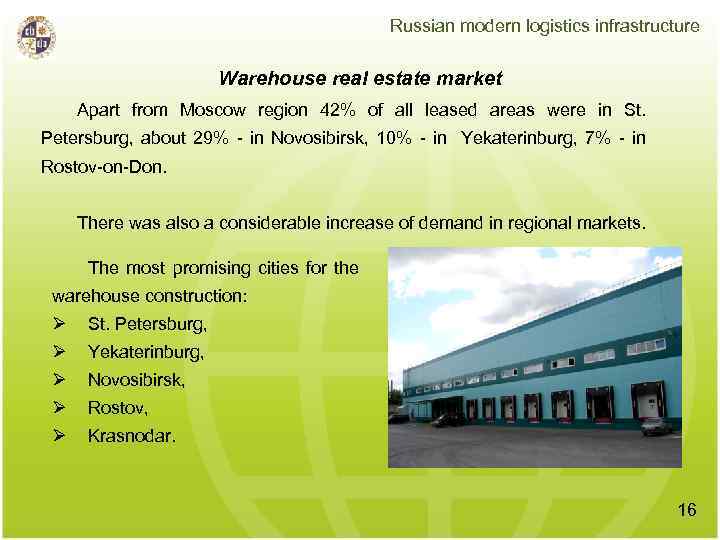 Russian modern logistics infrastructure Warehouse real estate market Apart from Moscow region 42% of all leased areas were in St. Petersburg, about 29% - in Novosibirsk, 10% - in Yekaterinburg, 7% - in Rostov-on-Don. There was also a considerable increase of demand in regional markets. The most promising cities for the warehouse construction: Ø St. Petersburg, Ø Yekaterinburg, Ø Novosibirsk, Ø Rostov, Ø Krasnodar. 16
 Russian modern logistics infrastructure Logistics infrastructure of the southern Federal district (SFD) Railway transport prevails in the Southern Federal District with the share of 60% of all cargo shipped. Major sea and river ports: Novorossiysk, Tuapse, Olya, Taganrog, Yeisk, the Caucasus, the Azov, Rostovon-don, Volgograd, Astrakhan Southern Federal district There are 10 airports, including 6 international ones. 17
 Russian modern logistics infrastructure Strategic areas of the Southern Federal District infrastructure development -formation of a regional transport and logistics base for the foreign trade relations, improvement of competitiveness and integration of the transport-logistics complex of the South of Russia in the world transport system; - development of the infrastructure of international transport corridors on the territory of the southern Federal district, realization of transit potential; - transport support for the resort complex of the South of Russia, preparation for the Winter Olympic Games 2014 in Sochi. 18
 Russian modern logistics infrastructure The national program of transport system development Ø modernization of air transport; Ø elimination of "bottlenecks" by 2015; Ø intensive construction of the railway and automobile infrastructure; Ø increase of roads length and capacity; Ø modernization and renewal of the vehicle fleet; Ø reduction of the transport costs in the products price to 30 per cent by 2030; Ø increase of the commercial speed of goods by motor transport up to 1400 km/day, and rail transport (containers) - up to 1, 000 - 1, 200 km/day; Ø improving the timely goods delivery to the level of developed countries; Ø increase of the transit flows from 28 million tonnes to 100 million tonnes by 2030. 19