


 Скачать презентацию Voluntary Return Counselors Forum Research DATA INCLUDED
cf6c23cc756e0a8ae8f0d998bd3b7e00.ppt
- Количество слайдов: 40
 Voluntary Return Counselors Forum Research
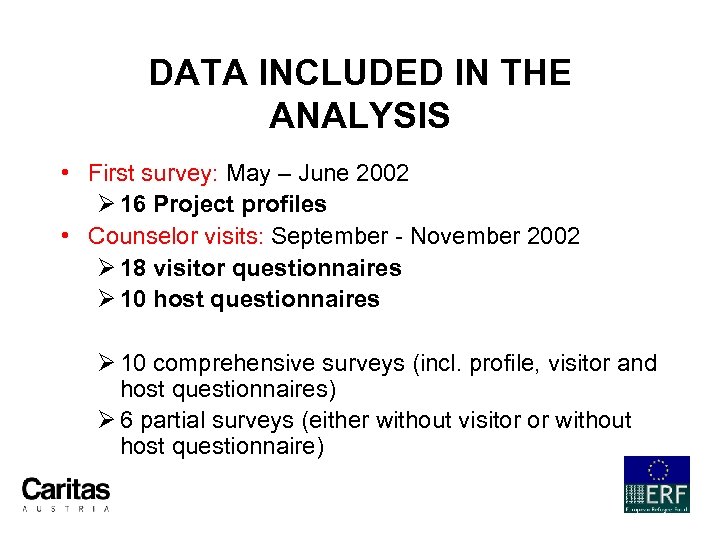 DATA INCLUDED IN THE ANALYSIS • First survey: May – June 2002 Ø 16 Project profiles • Counselor visits: September - November 2002 Ø 18 visitor questionnaires Ø 10 host questionnaires Ø 10 comprehensive surveys (incl. profile, visitor and host questionnaires) Ø 6 partial surveys (either without visitor or without host questionnaire)
 Structure of the presentation 1. Introduction of participant projects. 2. Impact of policy and legislative contexts. 3. Selected findings on assistance and services provided in the projects. 4. Transferables, evaluation, conclusion.
 Participant projects • • • 16 participant projects in the exchange 13 NGOs 1 governmental organisation (local) 1 non-profit company 1 organisation funded by churches Source: project profiles
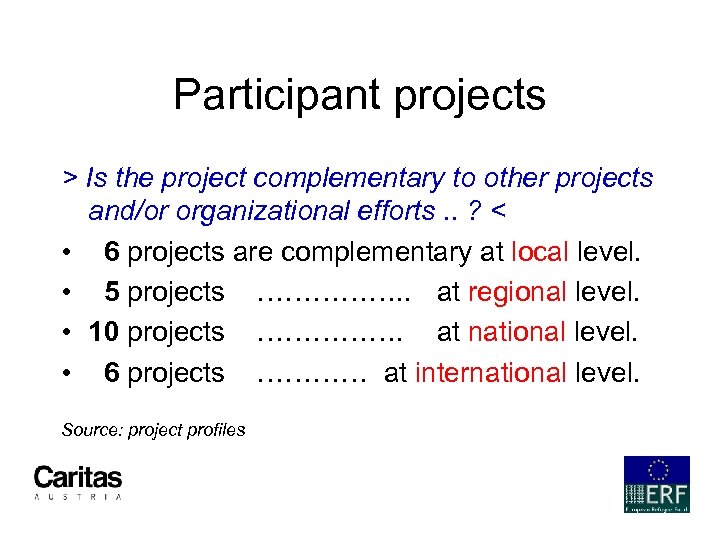 Participant projects > Is the project complementary to other projects and/or organizational efforts. . ? < • 6 projects are complementary at local level. • 5 projects ……………. . at regional level. • 10 projects ……………. at national level. • 6 projects ………… at international level. Source: project profiles
 Project resources. • Financial resources • Staff • Contacts – – contacts in host country contacts in COR
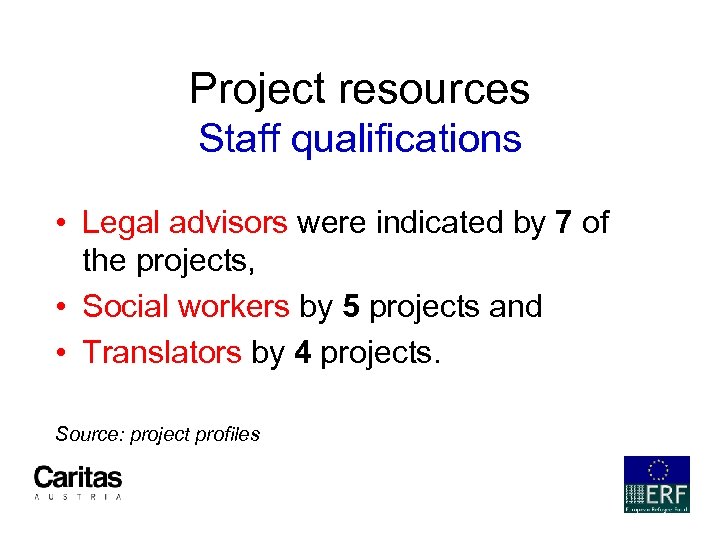 Project resources Staff qualifications • Legal advisors were indicated by 7 of the projects, • Social workers by 5 projects and • Translators by 4 projects. Source: project profiles
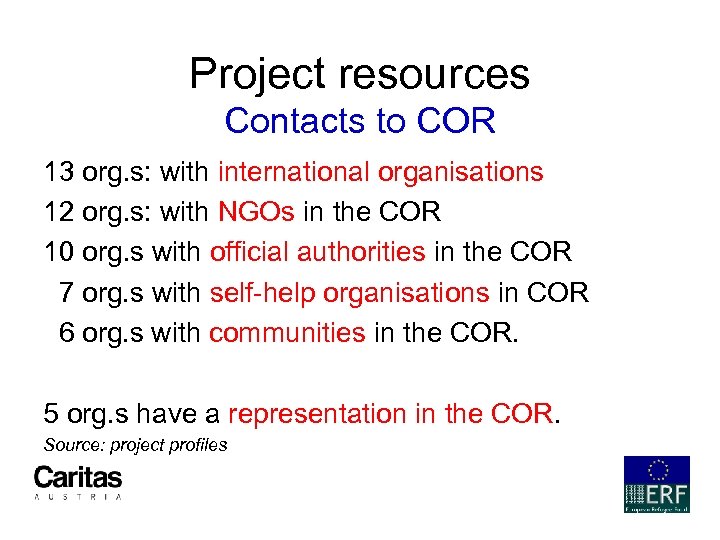 Project resources Contacts to COR 13 org. s: with international organisations 12 org. s: with NGOs in the COR 10 org. s with official authorities in the COR 7 org. s with self-help organisations in COR 6 org. s with communities in the COR. 5 org. s have a representation in the COR. Source: project profiles
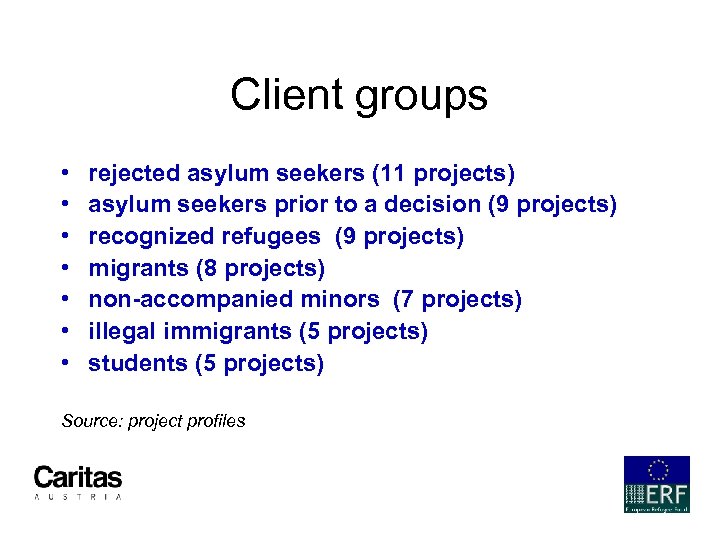 Client groups • • rejected asylum seekers (11 projects) asylum seekers prior to a decision (9 projects) recognized refugees (9 projects) migrants (8 projects) non-accompanied minors (7 projects) illegal immigrants (5 projects) students (5 projects) Source: project profiles
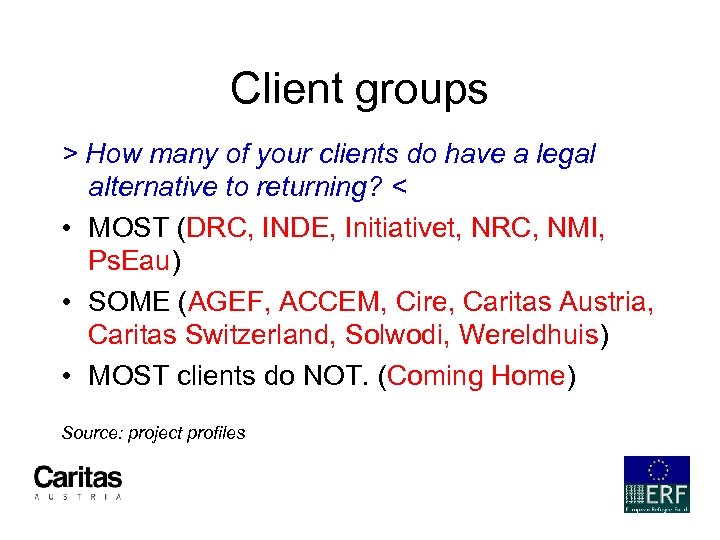 Client groups > How many of your clients do have a legal alternative to returning? < • MOST (DRC, INDE, Initiativet, NRC, NMI, Ps. Eau) • SOME (AGEF, ACCEM, Cire, Caritas Austria, Caritas Switzerland, Solwodi, Wereldhuis) • MOST clients do NOT. (Coming Home) Source: project profiles
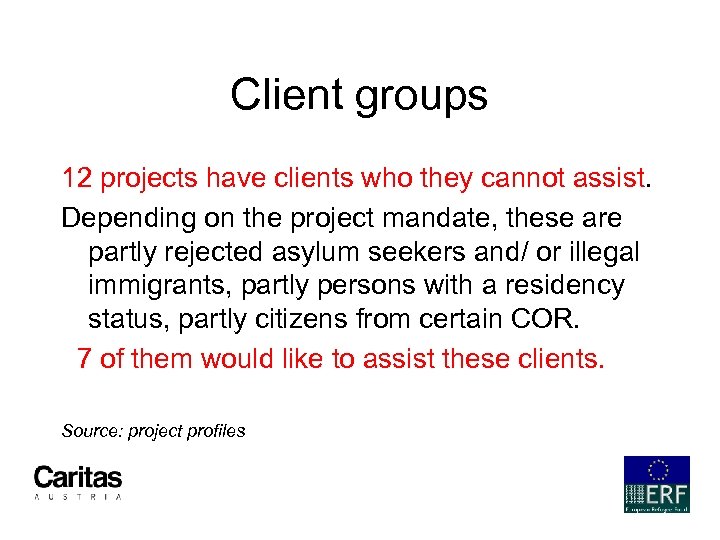 Client groups 12 projects have clients who they cannot assist. Depending on the project mandate, these are partly rejected asylum seekers and/ or illegal immigrants, partly persons with a residency status, partly citizens from certain COR. 7 of them would like to assist these clients. Source: project profiles
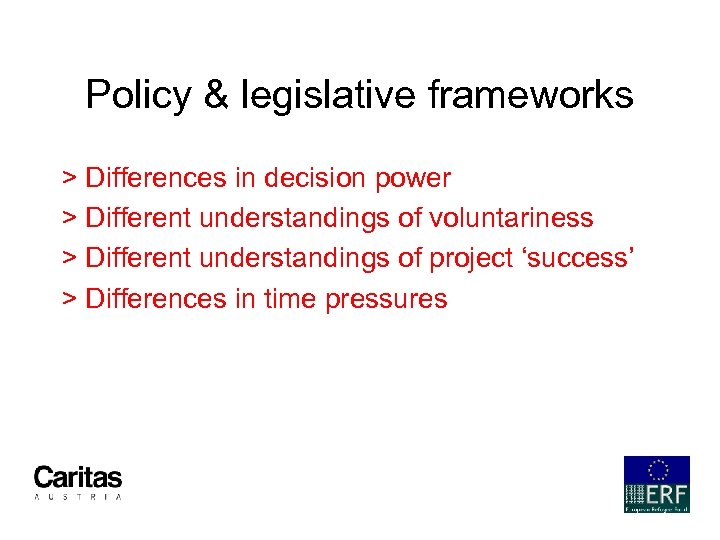 Policy & legislative frameworks > Differences in decision power > Different understandings of voluntariness > Different understandings of project ‘success’ > Differences in time pressures
 Policy & legislative frameworks • Different understandings of voluntariness ‘avoiding deportation’ versus ‘making wellinformed decisions’ • Different understandings of (project) ‘success’ ‘Counting departures’ versus ‘happy endings’
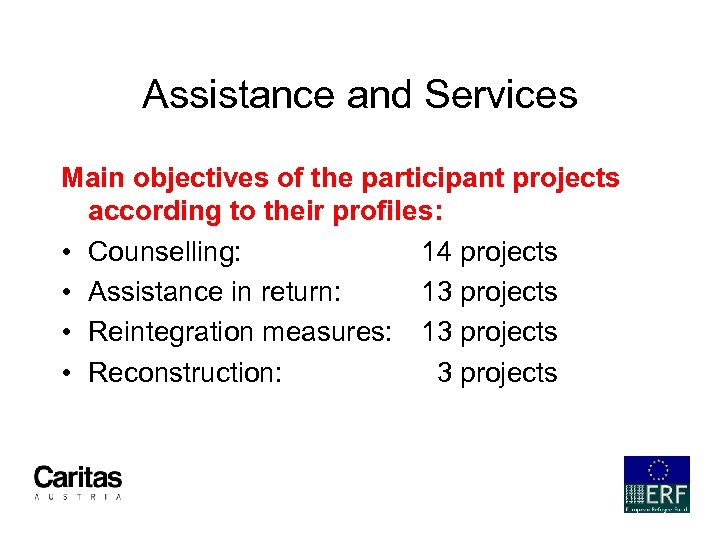 Assistance and Services Main objectives of the participant projects according to their profiles: • Counselling: 14 projects • Assistance in return: 13 projects • Reintegration measures: 13 projects • Reconstruction: 3 projects
 Counselling practices How and why do counselling practices differ? > External factors: - related to policy and regulatory contexts > Internal factors: - related to remit and politics of the project - related to organizational factors
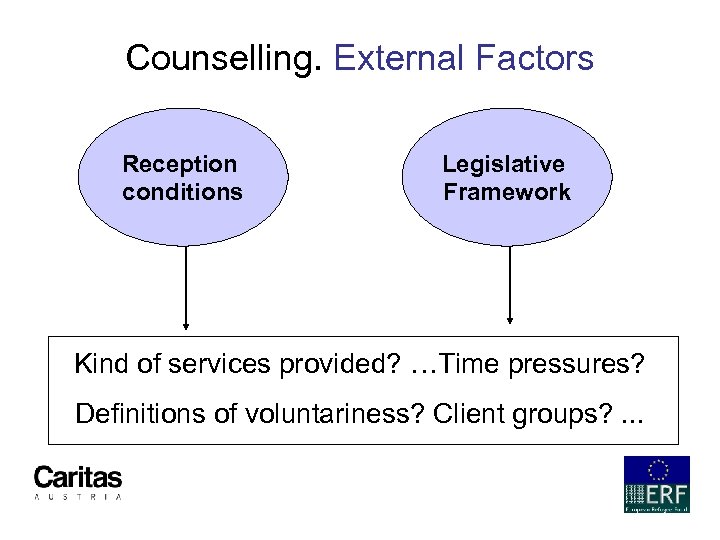 Counselling. External Factors Reception conditions Legislative Framework Kind of services provided? …Time pressures? Definitions of voluntariness? Client groups? . . .
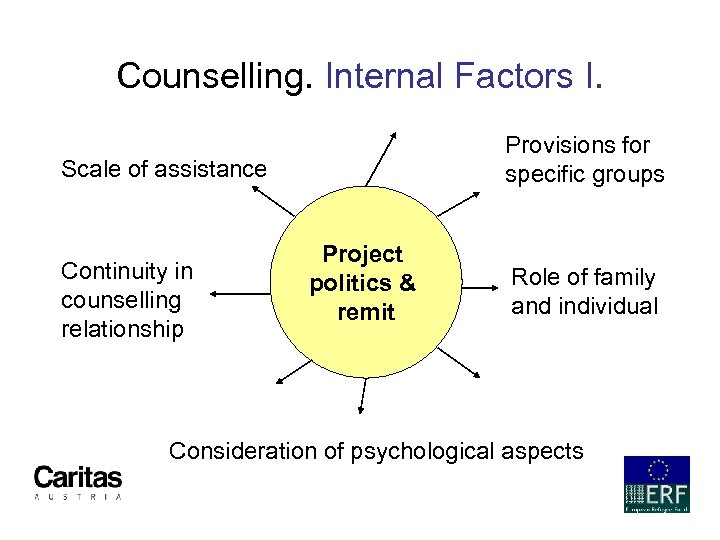 Counselling. Internal Factors I. Provisions for specific groups Scale of assistance Continuity in counselling relationship Project politics & remit Role of family and individual Consideration of psychological aspects
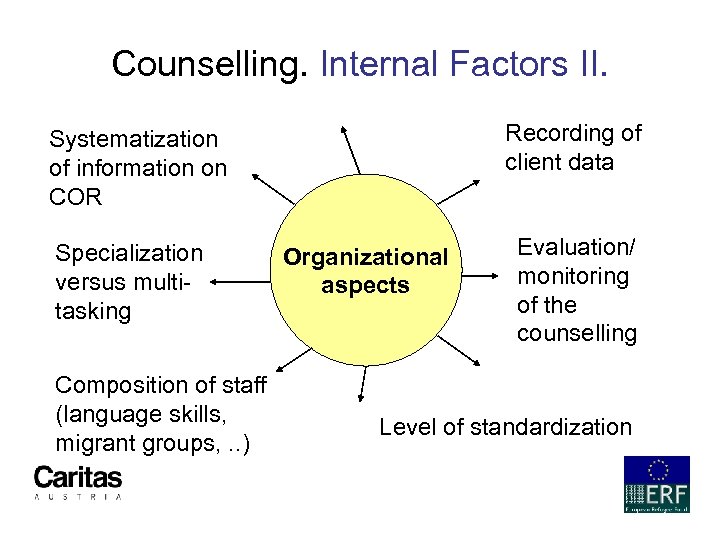 Counselling. Internal Factors II. Recording of client data Systematization of information on COR Specialization versus multitasking Composition of staff (language skills, migrant groups, . . ) Organizational aspects Evaluation/ monitoring of the counselling Level of standardization
 Assistance in return Differences between projects regard - how transport is organized (by IOM, through the project, by the client) - arrangements regarding physical company to the point of departure
 Assistance in return A financial contribution to travel and transport is offered by the following projects: Caritas Austria, Cire, DRC, Ps. Eau, Coming Home, Solwodi, INDE, ENTER, Caritas Switzerland, NMI and Choices. Source: project profiles
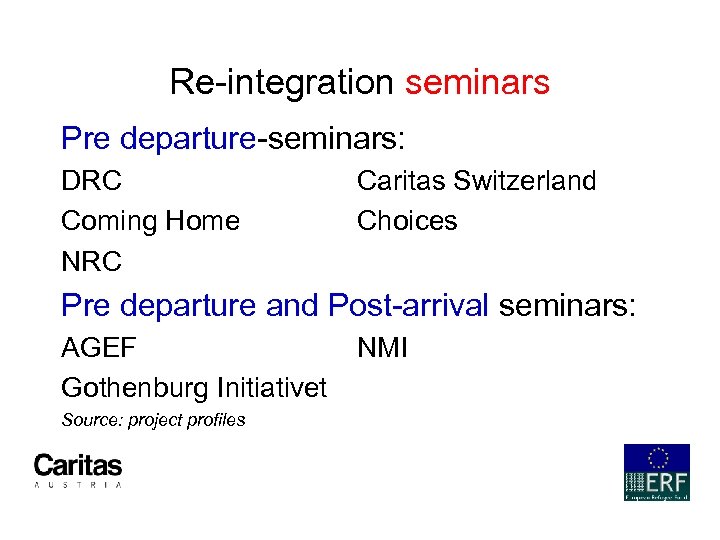 Re-integration seminars Pre departure-seminars: DRC Coming Home NRC Caritas Switzerland Choices Pre departure and Post-arrival seminars: AGEF NMI Gothenburg Initiativet Source: project profiles
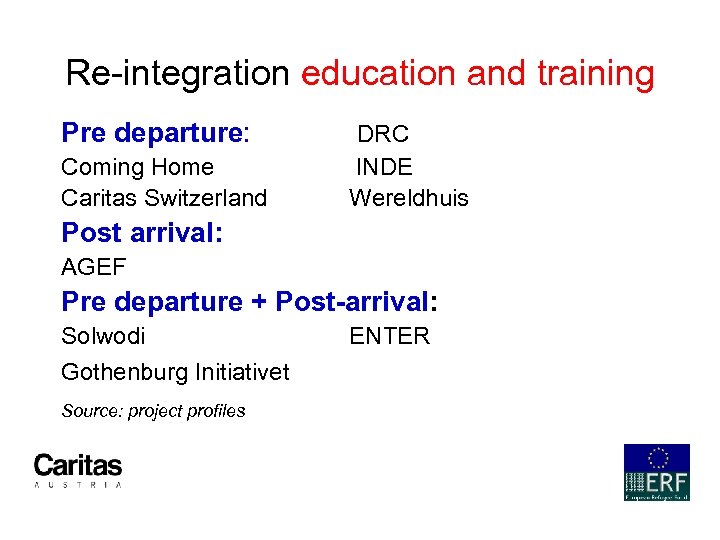 Re-integration education and training Pre departure: DRC Coming Home Caritas Switzerland INDE Wereldhuis Post arrival: AGEF Pre departure + Post-arrival: Solwodi Gothenburg Initiativet Source: project profiles ENTER
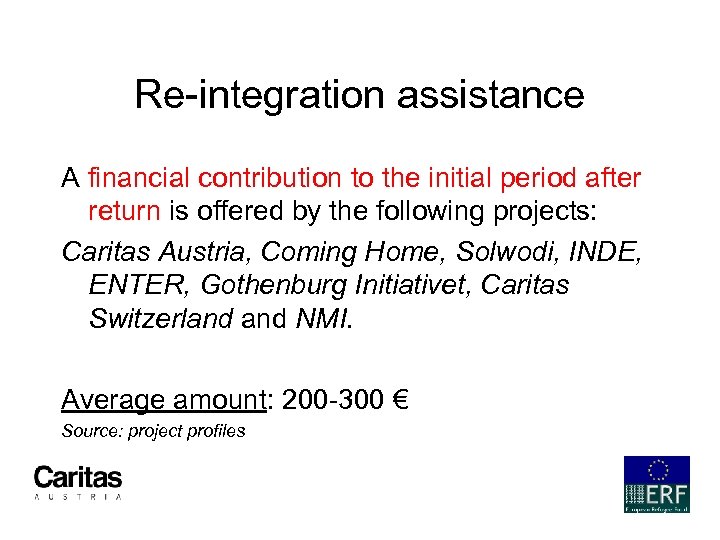 Re-integration assistance A financial contribution to the initial period after return is offered by the following projects: Caritas Austria, Coming Home, Solwodi, INDE, ENTER, Gothenburg Initiativet, Caritas Switzerland NMI. Average amount: 200 -300 € Source: project profiles
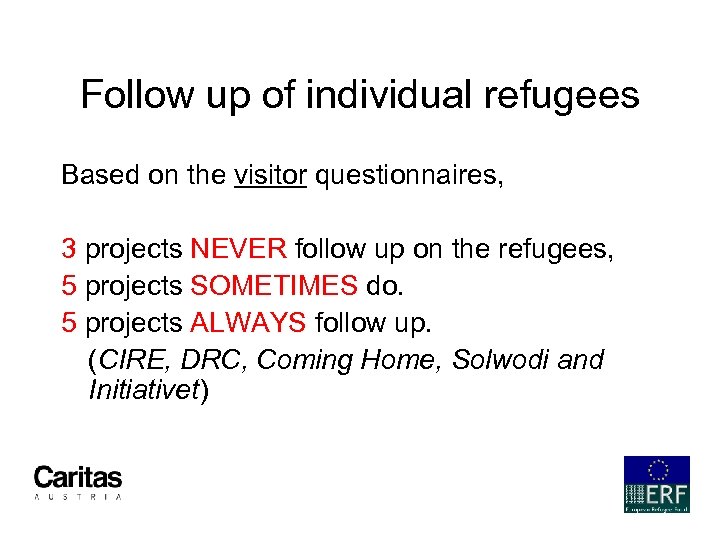 Follow up of individual refugees Based on the visitor questionnaires, 3 projects NEVER follow up on the refugees, 5 projects SOMETIMES do. 5 projects ALWAYS follow up. (CIRE, DRC, Coming Home, Solwodi and Initiativet)
 Reconstruction measures Were described by the visitors of DRC, Ps. Eau, Coming Home, INDE, Solwodi, INITIATIVET. Partly focusing on individual returnees, Partly working with the community.
 Activities during visit. > Which aspects of the host project did the counselors get to know during their visit? < • contacts with other organisations (13) • counselling (11) • contacts with authorities (8) • re-integration measures (7) • general administrative work (7)
 Feedback and evaluation of the visits > Do you think that you have gained some useful input / ideas for your work from the visit? < 12 visitors ticked YES, 1 NO, 1 not sure. > Has the visit met your overall expectations? < 8 visitors YES, 2 ‘it has exceeded my expectations’. 5 hosts YES, 2 NO.
 Transferables / 1 • Courses in the COR rather than in the host country as it is cheaper and more related to the country and situation. • More efficiency through bureaucratisation/ professionalisation of the administration. • Employment counselling service, a data base which provides easy access to information about available jobs in the return countries.
 Transferables / 2 • formalisation of counselling • More contact with local NGO’s which can help them in their reintegration process • network system with local NGO’s in the COR • stress on a multicultural and multilingual staff • …. Source: visitor questionnaires
 > Particularly interesting? < Existence of a legal framework for VR Pension schemes for elderly returnees (DK) …. . ‘The working atmosphere!’ (NRC) …. . ‘Combination of integration, re-integration and development projects. ’ (INDE) Source: visitor questionnaires
 Innovative project aspects according to project profiles • Return and employment in COR (AGEF) • Development of individual repatriation plans including counselling, educational & training measures, financial help for initial period, delivery of goods (COMING HOME) • Support for reintegration of single migrant women without means, mostly without education (Solwodi) • Free hotline with counselors speaking refugee languages (INDE)
 Innovative project aspects according to visitors • Services that extend beyond just repatriation related assistance (e. g. housing) (Choices) • Search for private funding (ENTER) • Possibility to return to another country than country of origin (Caritas Austria) • Follow up of refugees during a long period of time (Gothenburg Initiativet) • Voluntary engagement of so many people (Wereldhuis)
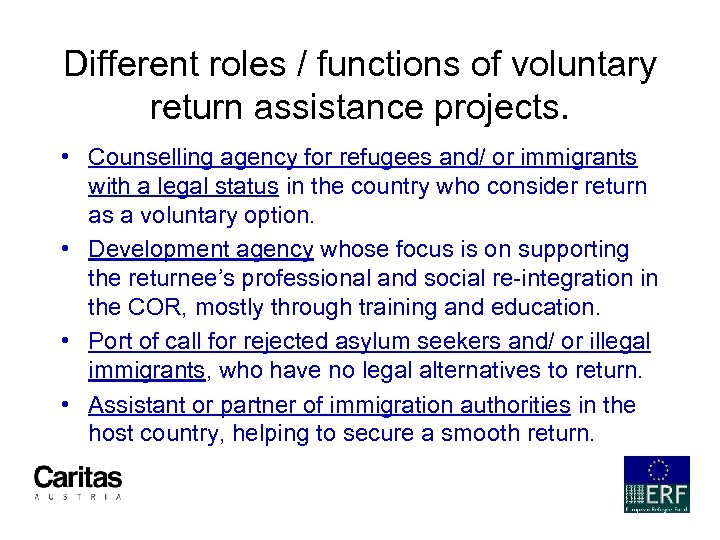 Different roles / functions of voluntary return assistance projects. • Counselling agency for refugees and/ or immigrants with a legal status in the country who consider return as a voluntary option. • Development agency whose focus is on supporting the returnee’s professional and social re-integration in the COR, mostly through training and education. • Port of call for rejected asylum seekers and/ or illegal immigrants, who have no legal alternatives to return. • Assistant or partner of immigration authorities in the host country, helping to secure a smooth return.
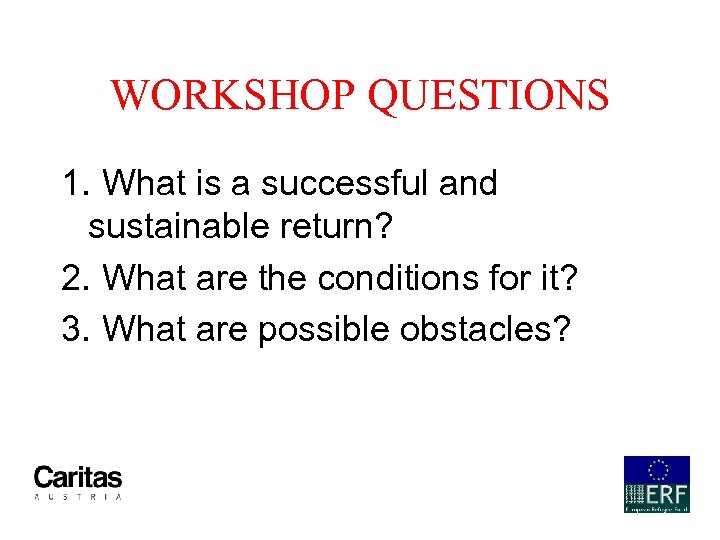 WORKSHOP QUESTIONS 1. What is a successful and sustainable return? 2. What are the conditions for it? 3. What are possible obstacles?
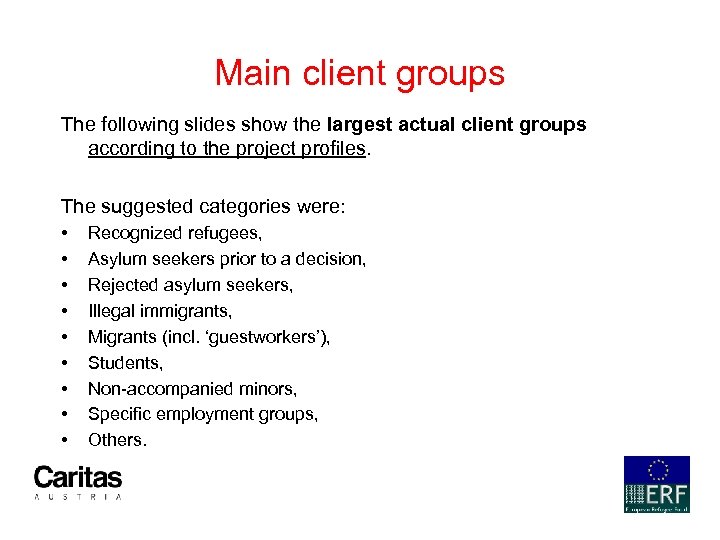 Main client groups The following slides show the largest actual client groups according to the project profiles. The suggested categories were: • • • Recognized refugees, Asylum seekers prior to a decision, Rejected asylum seekers, Illegal immigrants, Migrants (incl. ‘guestworkers’), Students, Non-accompanied minors, Specific employment groups, Others.
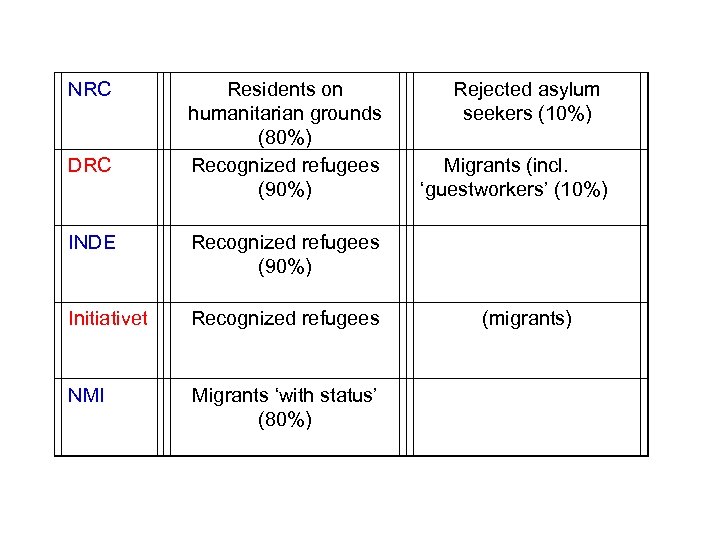 NRC DRC Residents on humanitarian grounds (80%) Recognized refugees (90%) Rejected asylum seekers (10%) Migrants (incl. ‘guestworkers’ (10%) INDE Recognized refugees (90%) Initiativet Recognized refugees (migrants) NMI Migrants ‘with status’ (80%)
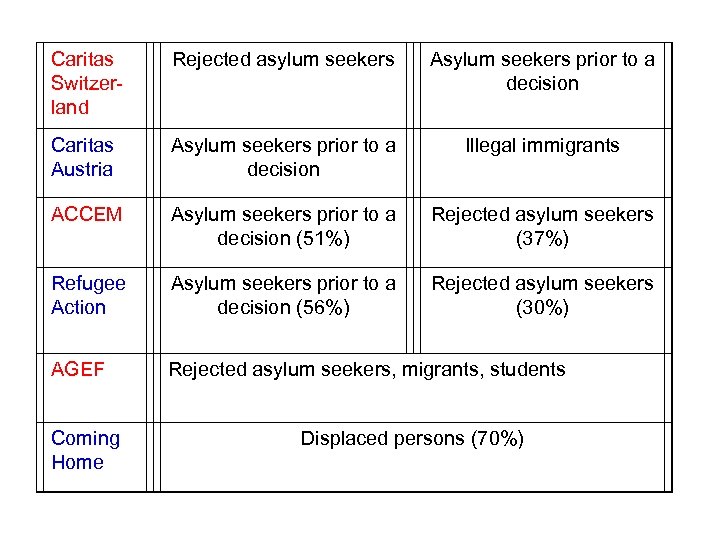 Caritas Switzerland Rejected asylum seekers Asylum seekers prior to a decision Caritas Austria Asylum seekers prior to a decision Illegal immigrants ACCEM Asylum seekers prior to a decision (51%) Rejected asylum seekers (37%) Refugee Action Asylum seekers prior to a decision (56%) Rejected asylum seekers (30%) AGEF Rejected asylum seekers, migrants, students Coming Home Displaced persons (70%)
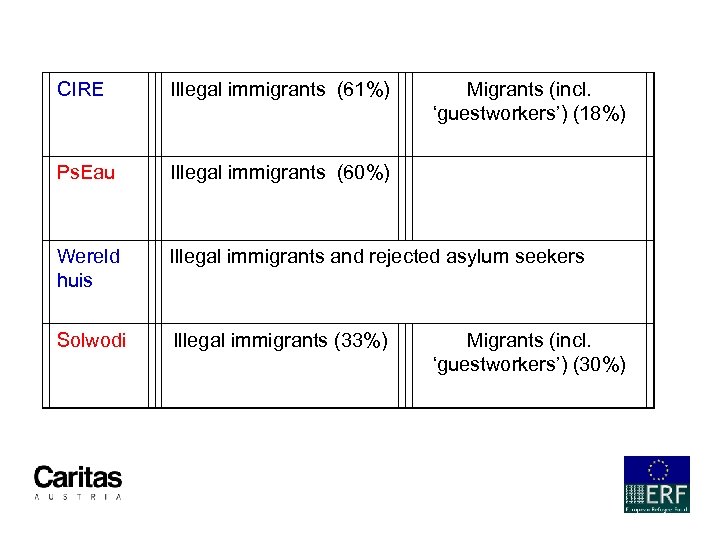 CIRE Illegal immigrants (61%) Migrants (incl. ‘guestworkers’) (18%) Ps. Eau Illegal immigrants (60%) Wereld huis Illegal immigrants and rejected asylum seekers Solwodi Illegal immigrants (33%) Migrants (incl. ‘guestworkers’) (30%)
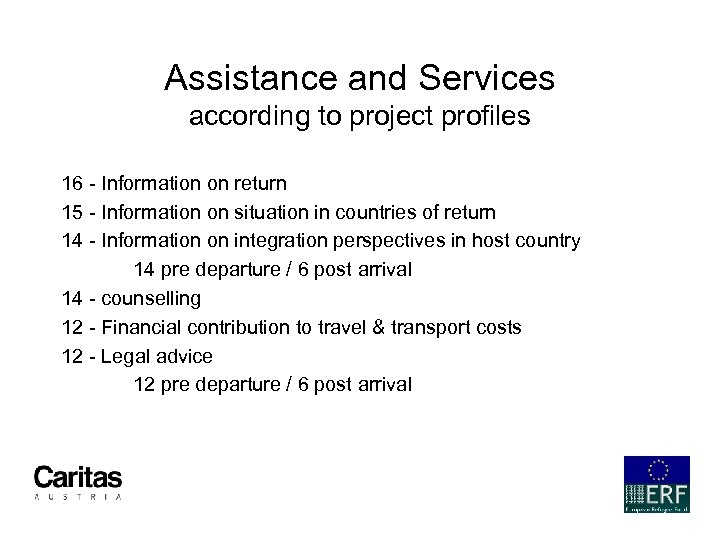 Assistance and Services according to project profiles 16 - Information on return 15 - Information on situation in countries of return 14 - Information on integration perspectives in host country 14 pre departure / 6 post arrival 14 - counselling 12 - Financial contribution to travel & transport costs 12 - Legal advice 12 pre departure / 6 post arrival
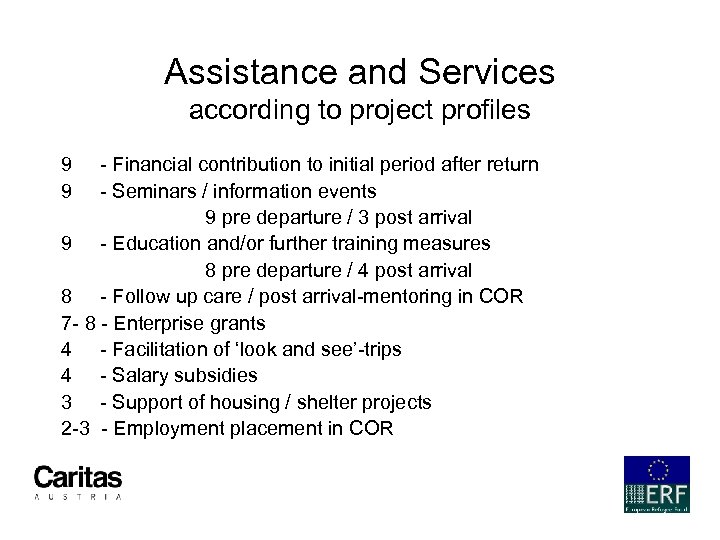 Assistance and Services according to project profiles 9 - Financial contribution to initial period after return 9 - Seminars / information events 9 pre departure / 3 post arrival 9 - Education and/or further training measures 8 pre departure / 4 post arrival 8 - Follow up care / post arrival-mentoring in COR 7 - 8 - Enterprise grants 4 - Facilitation of ‘look and see’-trips 4 - Salary subsidies 3 - Support of housing / shelter projects 2 -3 - Employment placement in COR