

Volumes of Revolution Consider the line y=3x Now

 Скачать презентацию Volumes of Revolution Consider the line y=3x Now
19734-10_volumes_of_revolution.ppt
- Количество слайдов: 13
Volumes of Revolution
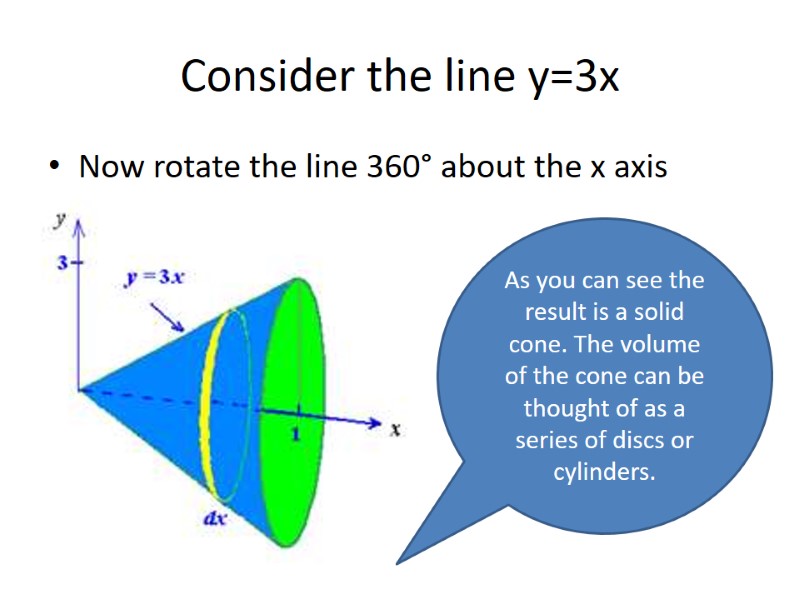
Consider the line y=3x Now rotate the line 360° about the x axis . As you can see the result is a solid cone. The volume of the cone can be thought of as a series of discs or cylinders.
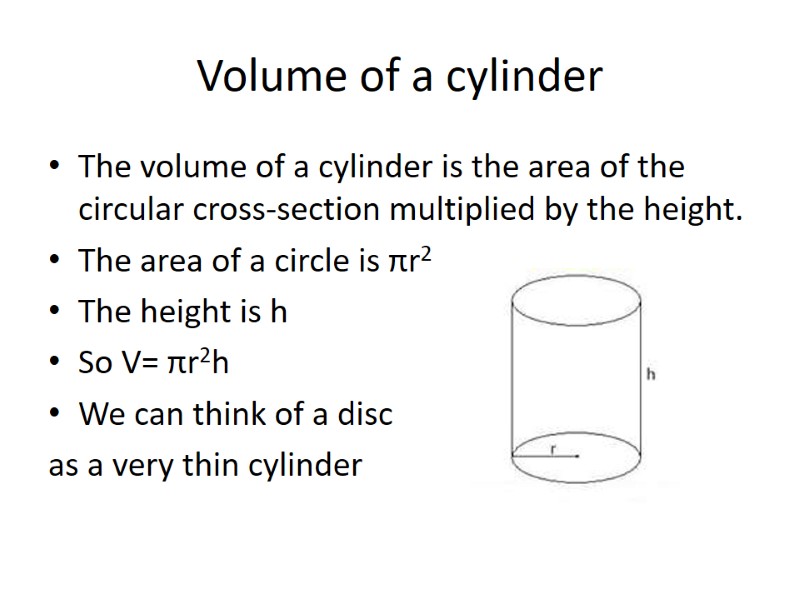
Volume of a cylinder The volume of a cylinder is the area of the circular cross-section multiplied by the height. The area of a circle is πr2 The height is h So V= πr2h We can think of a disc as a very thin cylinder
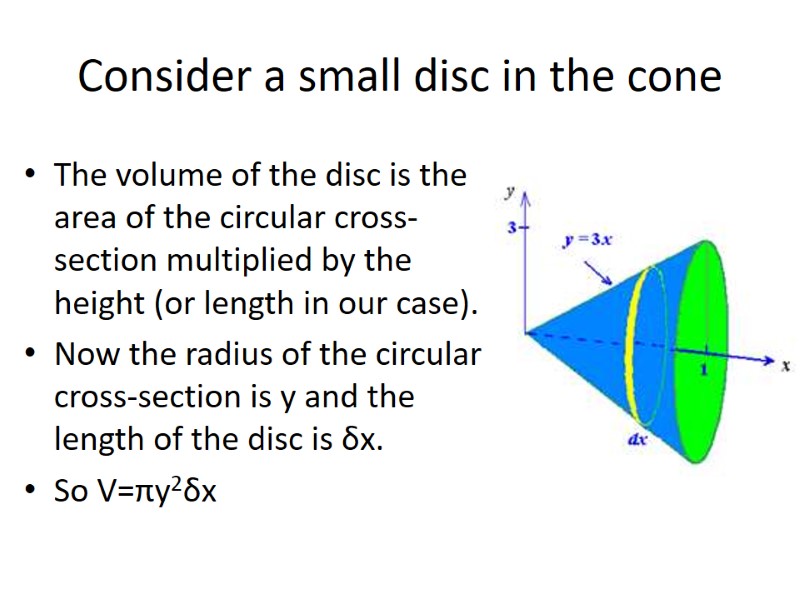
Consider a small disc in the cone The volume of the disc is the area of the circular cross-section multiplied by the height (or length in our case). Now the radius of the circular cross-section is y and the length of the disc is δx. So V=πy2δx
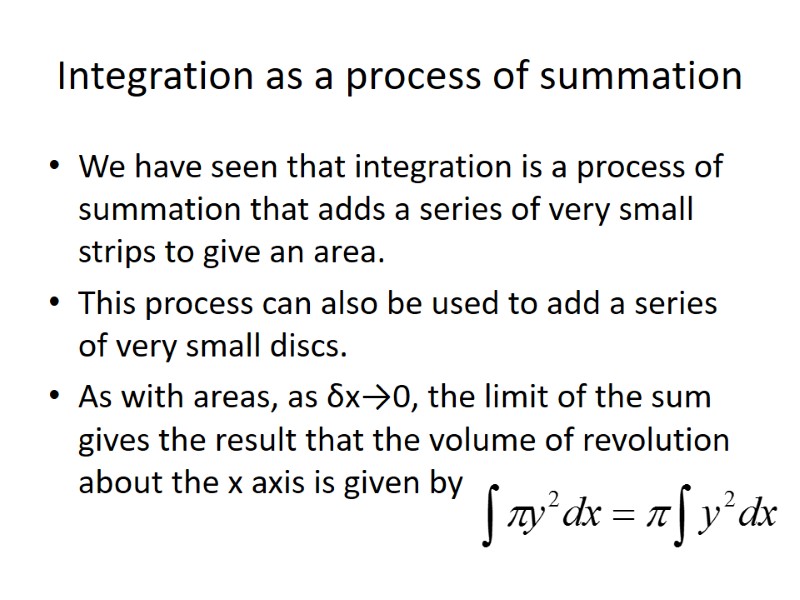
Integration as a process of summation We have seen that integration is a process of summation that adds a series of very small strips to give an area. This process can also be used to add a series of very small discs. As with areas, as δx→0, the limit of the sum gives the result that the volume of revolution about the x axis is given by
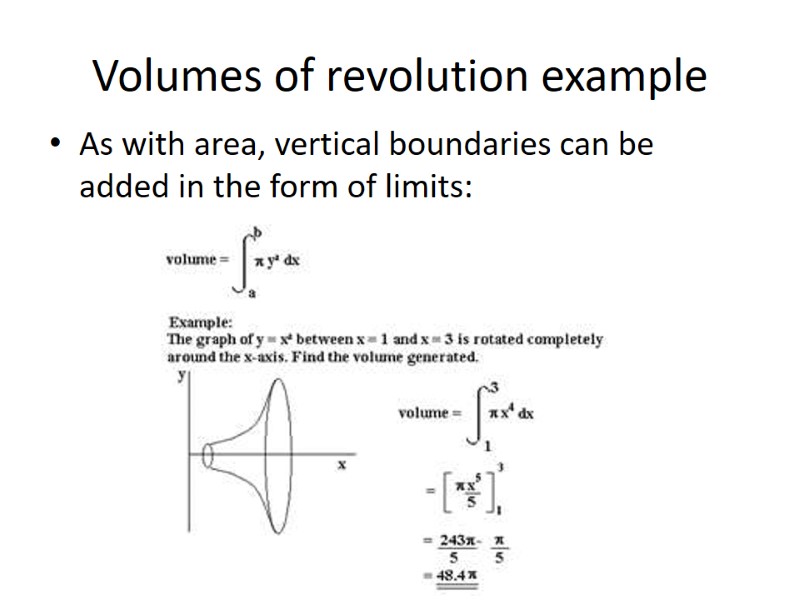
Volumes of revolution example As with area, vertical boundaries can be added in the form of limits:
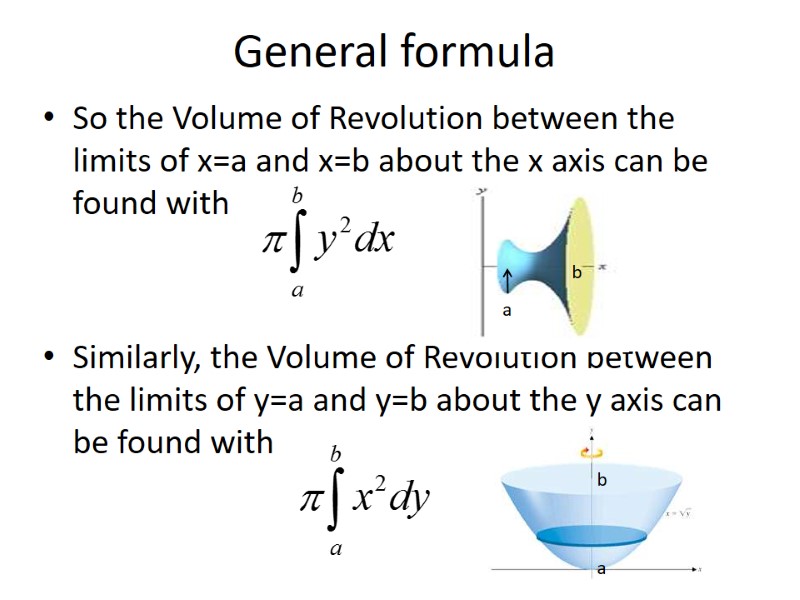
General formula So the Volume of Revolution between the limits of x=a and x=b about the x axis can be found with Similarly, the Volume of Revolution between the limits of y=a and y=b about the y axis can be found with
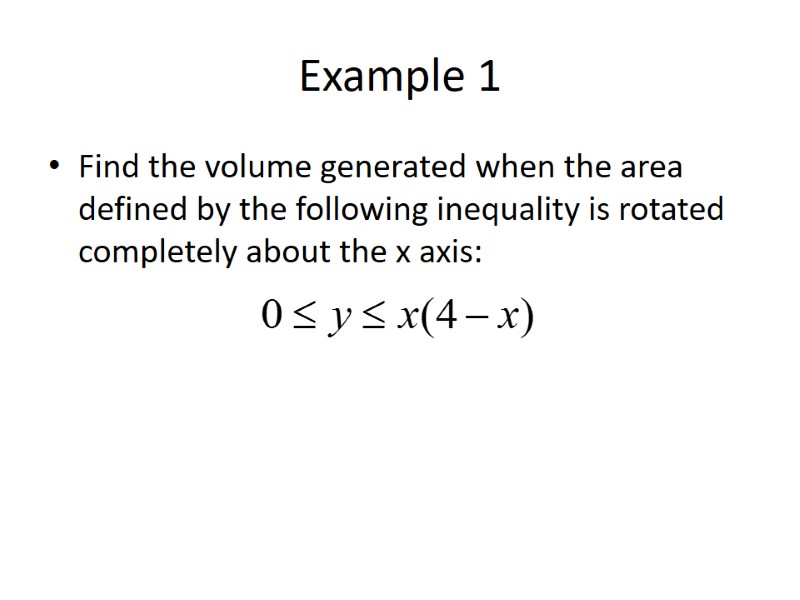
Example 1 Find the volume generated when the area defined by the following inequality is rotated completely about the x axis:
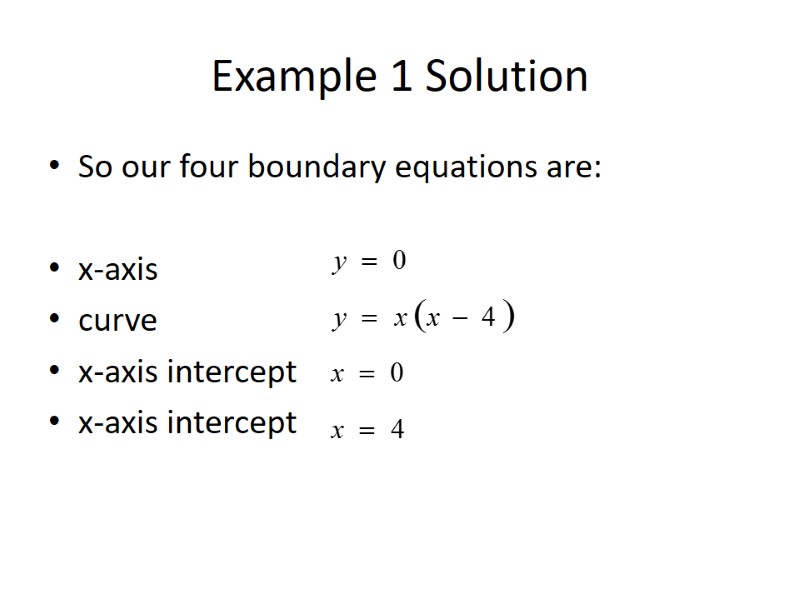
Example 1 Solution So our four boundary equations are: x-axis curve x-axis intercept x-axis intercept
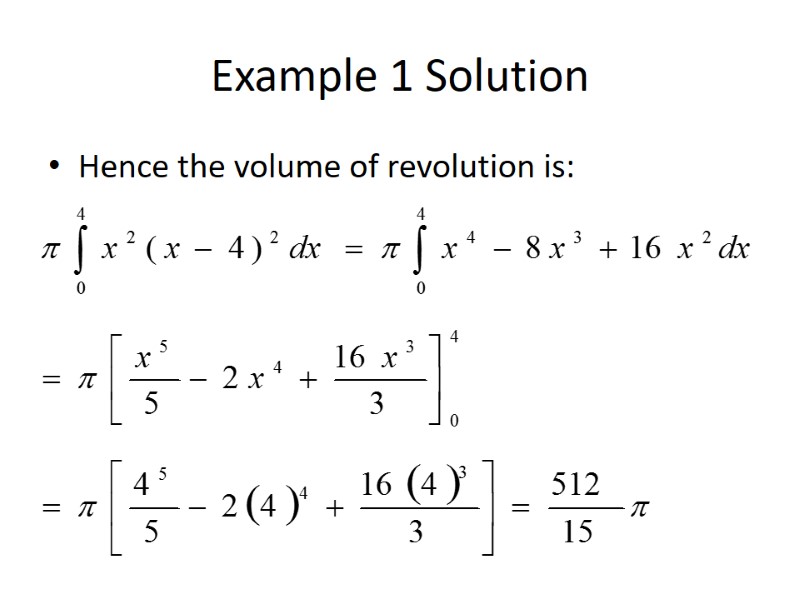
Example 1 Solution Hence the volume of revolution is:
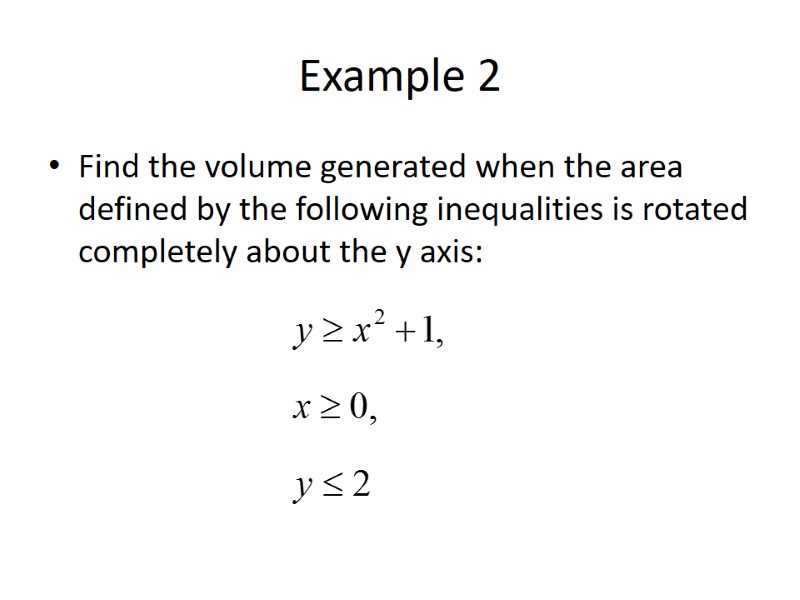
Example 2 Find the volume generated when the area defined by the following inequalities is rotated completely about the y axis:
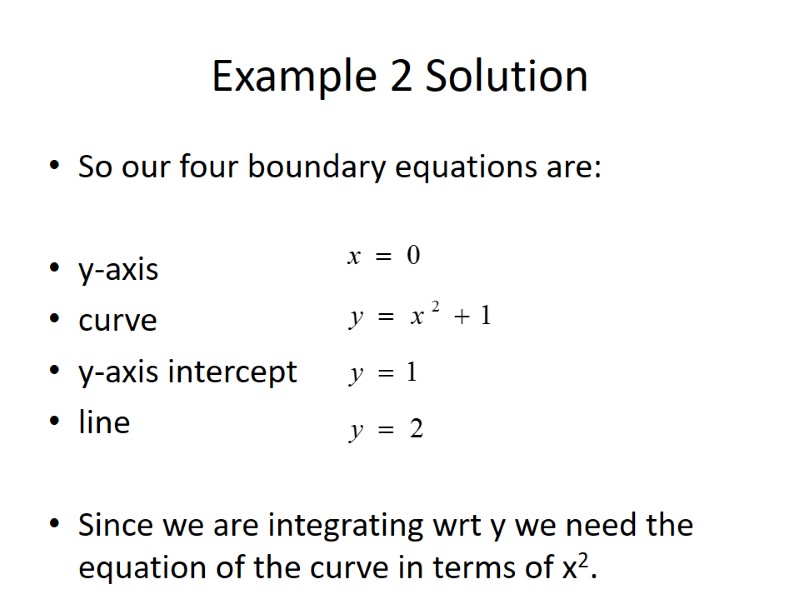
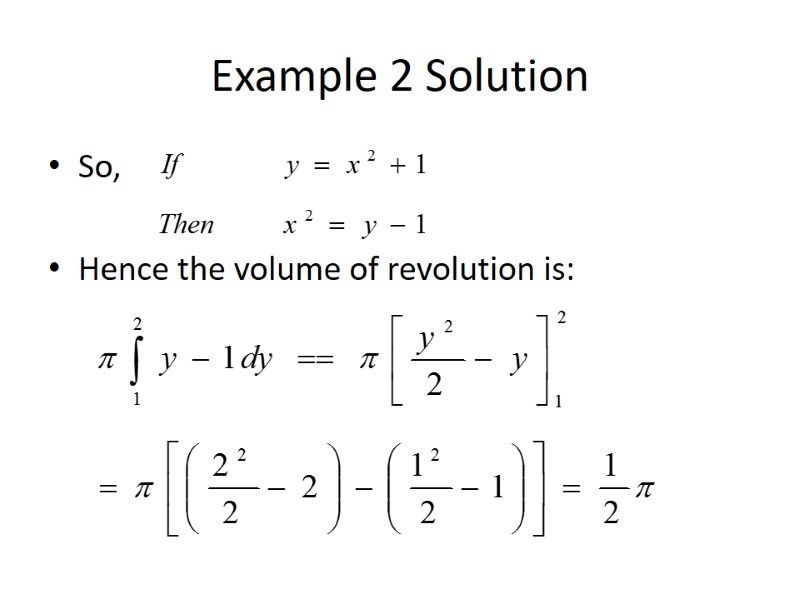
Example 2 Solution So our four boundary equations are: y-axis curve y-axis intercept line Since we are integrating wrt y we need the equation of the curve in terms of x2.
Example 2 Solution So, Hence the volume of revolution is: