 Скачать презентацию Voltage Spike Study in Superconducting Magnets at Fermilab
a9d391b6a4164970c74ad7a41a3b1e92.ppt
- Количество слайдов: 23



Voltage Spike Study in Superconducting Magnets at Fermilab The next generation of SC magnets Edgar Palacios Illinois Institute of Technology Fermilab SIST 2008
Outline n Superconductivity at Fermilab q q q n The phenomena of superconductivity Development of Nb 3 Sn Magnets at Fermilab Instabilities in Nb 3 Sn Conductors Study of Magnetic Flux Changes q Methods of Analysis n n q Test Data Analysis n n Voltage Spike Detection System Automated Voltage Spike Analysis Program TQC 02 A and TQC 02 E LARP Technology quadruples Conclusions 2
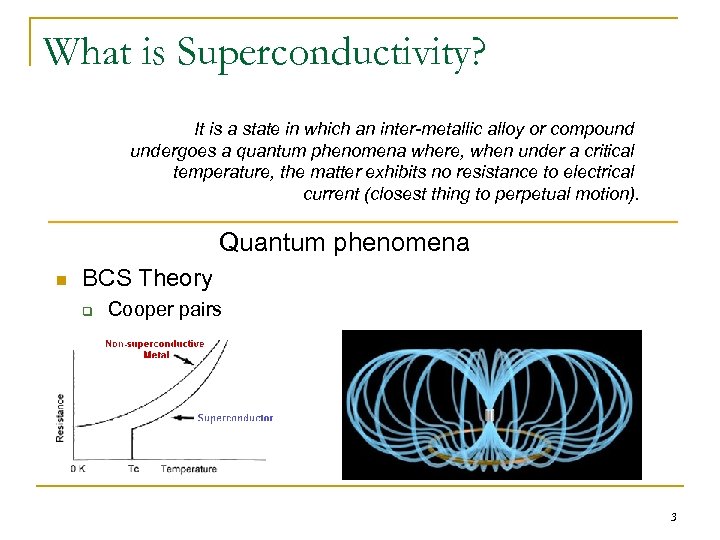
What is Superconductivity? It is a state in which an inter-metallic alloy or compound undergoes a quantum phenomena where, when under a critical temperature, the matter exhibits no resistance to electrical current (closest thing to perpetual motion). Quantum phenomena n BCS Theory q Cooper pairs 3
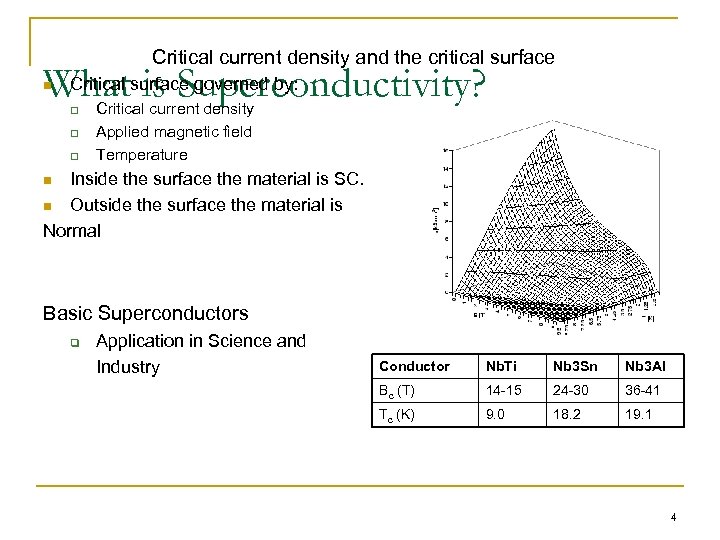
Critical current density and the critical surface Critical is Superconductivity? Whatsurface governed by: n q q q Critical current density Applied magnetic field Temperature Inside the surface the material is SC. n Outside the surface the material is Normal n Basic Superconductors q Application in Science and Industry Conductor Nb. Ti Nb 3 Sn Nb 3 Al Bc (T) 14 -15 24 -30 36 -41 Tc (K) 9. 0 18. 2 19. 1 4
Development of SC magnets at Fermilab Successful experience of Nb. Ti magnet production for the Tevatron at Fermilab n n n ~ 1000 superconducting magnets (dipole and quadrupole) Operating magnetic flux density of 4 T Operating Temperature ~4. 2 K Interaction Region quadrupoles at Large Hadron Collider (CERN) n Operating gradient 205 T/m for 70 mm aperture Development of new generation accelerator magnets n Advanced Nb 3 Sn Conductors q q n Offers higher Jc and B than Nb. Ti Best candidate for luminosity upgrade LARP Technology Quadrupoles for the LHC upgrade 5
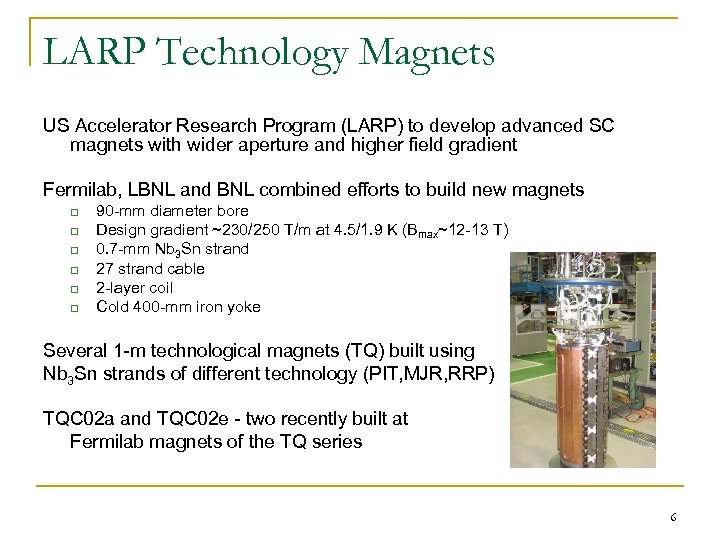
LARP Technology Magnets US Accelerator Research Program (LARP) to develop advanced SC magnets with wider aperture and higher field gradient Fermilab, LBNL and BNL combined efforts to build new magnets q q q 90 -mm diameter bore Design gradient ~230/250 T/m at 4. 5/1. 9 K (Bmax~12 -13 T) 0. 7 -mm Nb 3 Sn strand 27 strand cable 2 -layer coil Cold 400 -mm iron yoke Several 1 -m technological magnets (TQ) built using Nb 3 Sn strands of different technology (PIT, MJR, RRP) TQC 02 a and TQC 02 e - two recently built at Fermilab magnets of the TQ series 6
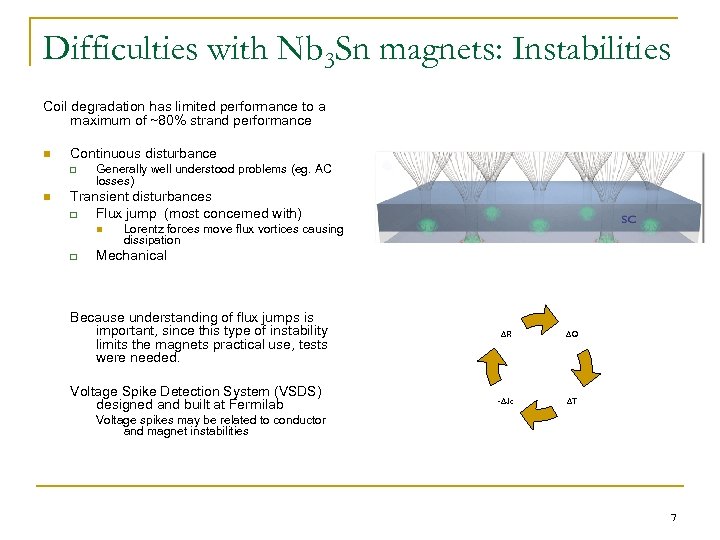
Difficulties with Nb 3 Sn magnets: Instabilities Coil degradation has limited performance to a maximum of ~80% strand performance n Continuous disturbance q n Generally well understood problems (eg. AC losses) Transient disturbances q Flux jump (most concerned with) n q Lorentz forces move flux vortices causing dissipation Mechanical Because understanding of flux jumps is important, since this type of instability limits the magnets practical use, tests were needed. ΔR ΔQ Voltage Spike Detection System (VSDS) designed and built at Fermilab -ΔJc ΔT Voltage spikes may be related to conductor and magnet instabilities 7
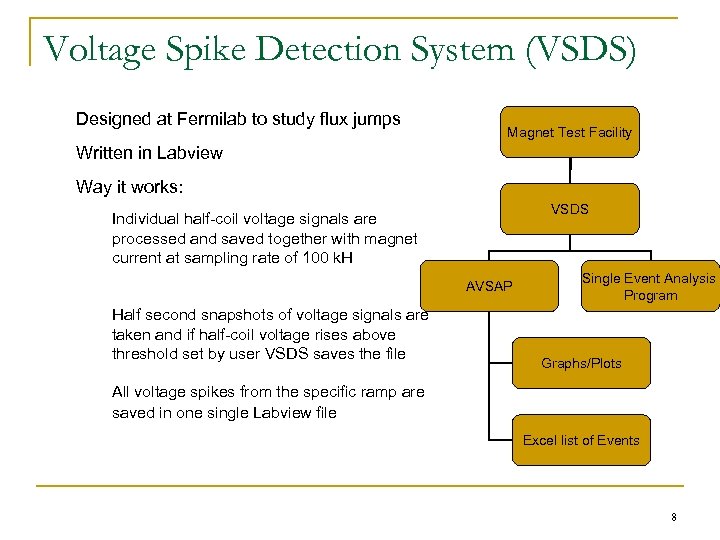
Voltage Spike Detection System (VSDS) Designed at Fermilab to study flux jumps Magnet Test Facility Written in Labview Way it works: VSDS Individual half-coil voltage signals are processed and saved together with magnet current at sampling rate of 100 k. H AVSAP Half second snapshots of voltage signals are taken and if half-coil voltage rises above threshold set by user VSDS saves the file Single Event Analysis Program Graphs/Plots All voltage spikes from the specific ramp are saved in one single Labview file Excel list of Events 8
Analysis software: AVSAP n AVSAP (Autonomous Voltage Spike Analysis Program) q q q Created by SIST 2007 students at Fermilab Written in Matlab, reads VSDS data exported from Labview to Matlab Way it works n Reads in voltages from half coils and takes the difference q q n Canceling common noises Applies 15 k. Hz low pass filter for noise reduction A difference would indicate location of voltage spike in one of the two coils Can create a multitude of graphs and able to export data to excel for further analysis AVSAP modified and improved in 2008 9
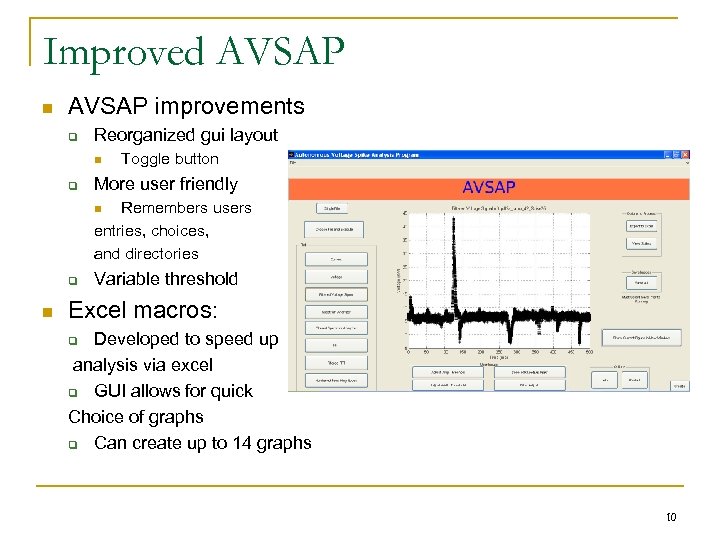
Improved AVSAP n AVSAP improvements q Reorganized gui layout n q Toggle button More user friendly Remembers users entries, choices, and directories n q n Variable threshold Excel macros: Developed to speed up analysis via excel q GUI allows for quick Choice of graphs q Can create up to 14 graphs q 10
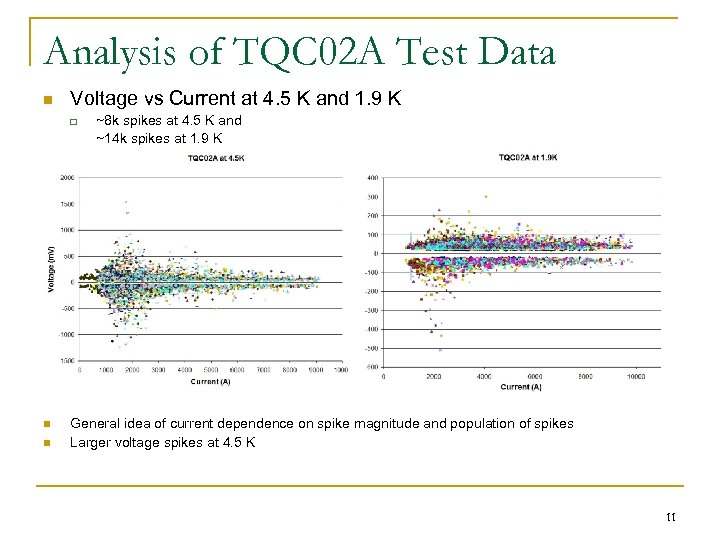
Analysis of TQC 02 A Test Data n Voltage vs Current at 4. 5 K and 1. 9 K q ~8 k spikes at 4. 5 K and ~14 k spikes at 1. 9 K n n General idea of current dependence on spike magnitude and population of spikes Larger voltage spikes at 4. 5 K 11
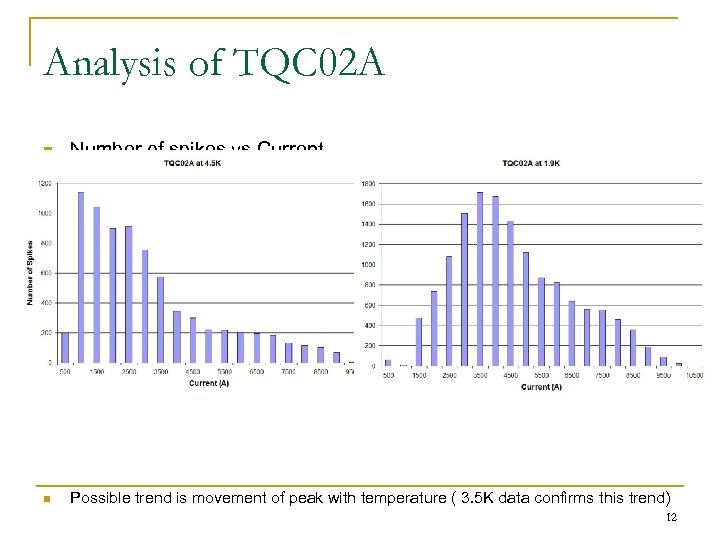
Analysis of TQC 02 A n Number of spikes vs Current q n More specific area of spike population according to current Possible trend is movement of peak with temperature ( 3. 5 K data confirms this trend) 12
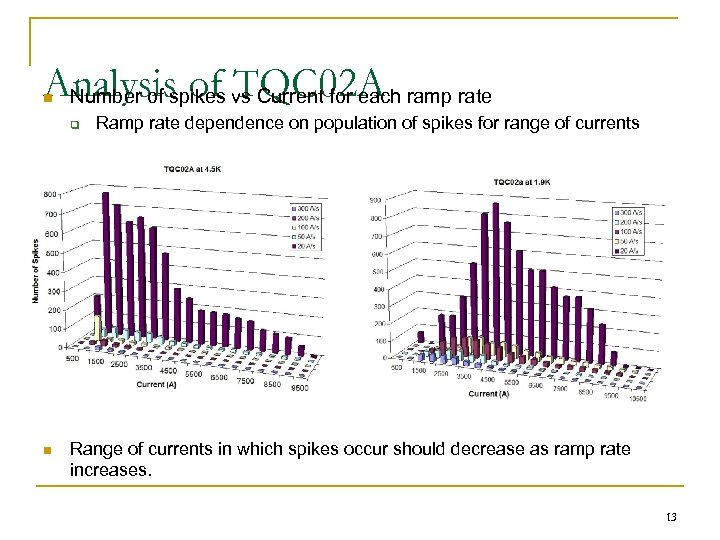
Analysisspikes vs Current for each ramp rate Number of of TQC 02 A n q n Ramp rate dependence on population of spikes for range of currents Range of currents in which spikes occur should decrease as ramp rate increases. 13
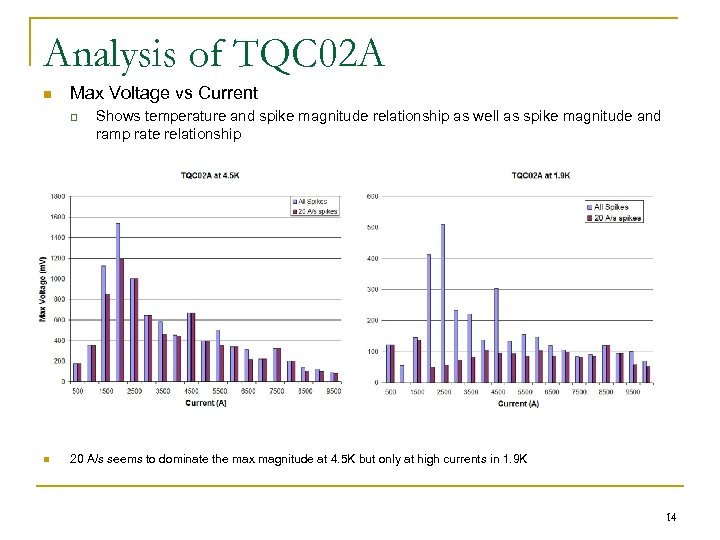
Analysis of TQC 02 A n Max Voltage vs Current q n Shows temperature and spike magnitude relationship as well as spike magnitude and ramp rate relationship 20 A/s seems to dominate the max magnitude at 4. 5 K but only at high currents in 1. 9 K 14
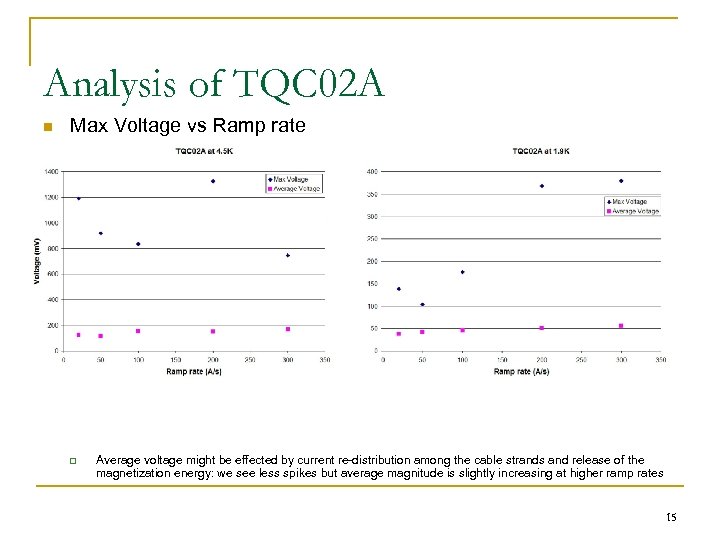
Analysis of TQC 02 A n Max Voltage vs Ramp rate q Average voltage might be effected by current re-distribution among the cable strands and release of the magnetization energy: we see less spikes but average magnitude is slightly increasing at higher ramp rates 15
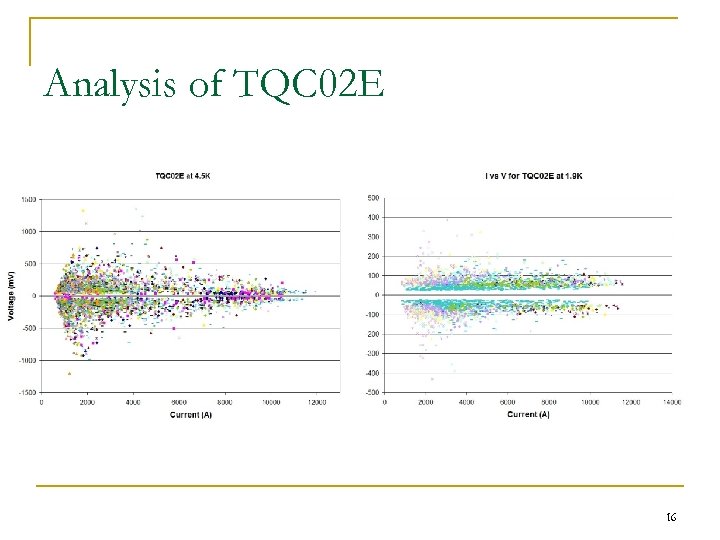
Analysis of TQC 02 E n Voltage vs Current 16
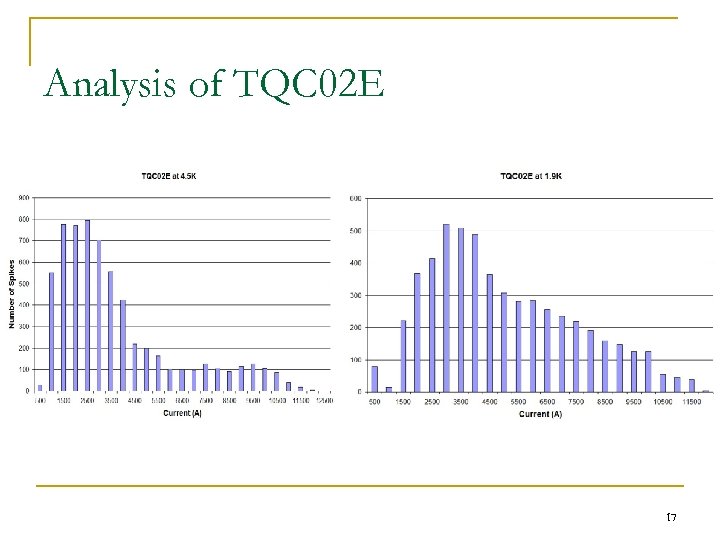
Analysis of TQC 02 E n Num Spikes vs Current 17
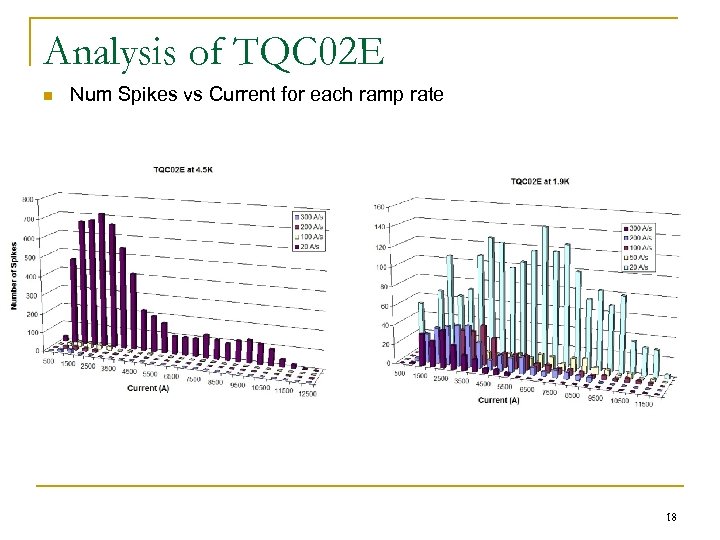
Analysis of TQC 02 E n Num Spikes vs Current for each ramp rate 18
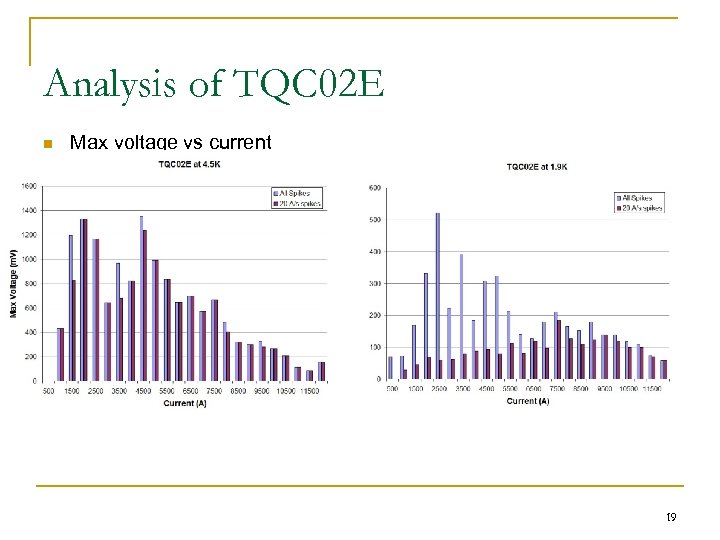
Analysis of TQC 02 E n Max voltage vs current 19
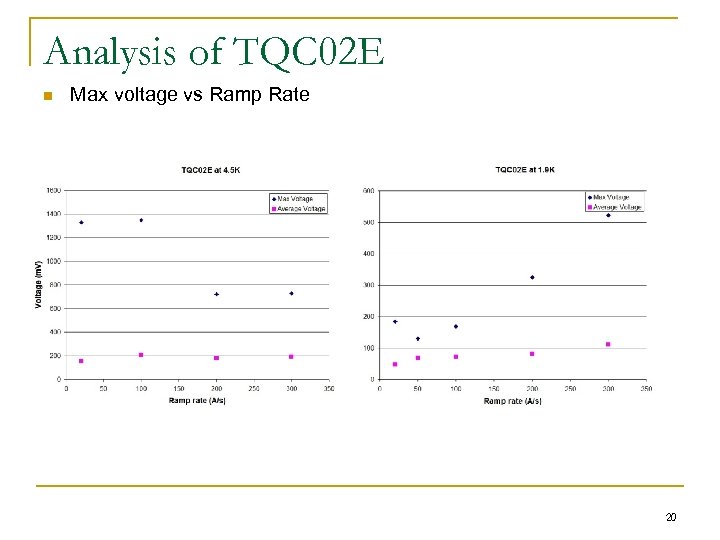
Analysis of TQC 02 E n Max voltage vs Ramp Rate 20
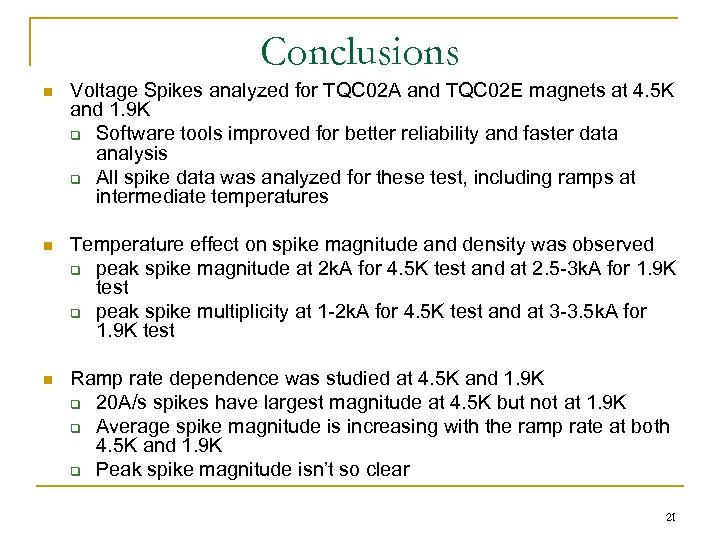
Conclusions n Voltage Spikes analyzed for TQC 02 A and TQC 02 E magnets at 4. 5 K and 1. 9 K q Software tools improved for better reliability and faster data analysis q All spike data was analyzed for these test, including ramps at intermediate temperatures n Temperature effect on spike magnitude and density was observed q peak spike magnitude at 2 k. A for 4. 5 K test and at 2. 5 -3 k. A for 1. 9 K test q peak spike multiplicity at 1 -2 k. A for 4. 5 K test and at 3 -3. 5 k. A for 1. 9 K test n Ramp rate dependence was studied at 4. 5 K and 1. 9 K q 20 A/s spikes have largest magnitude at 4. 5 K but not at 1. 9 K q Average spike magnitude is increasing with the ramp rate at both 4. 5 K and 1. 9 K q Peak spike magnitude isn’t so clear 21
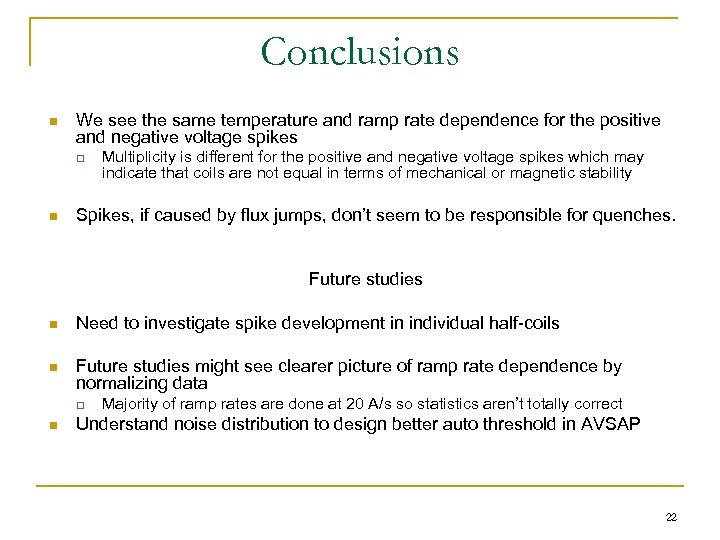
Conclusions n We see the same temperature and ramp rate dependence for the positive and negative voltage spikes q n Multiplicity is different for the positive and negative voltage spikes which may indicate that coils are not equal in terms of mechanical or magnetic stability Spikes, if caused by flux jumps, don’t seem to be responsible for quenches. Future studies n Need to investigate spike development in individual half-coils n Future studies might see clearer picture of ramp rate dependence by normalizing data q n Majority of ramp rates are done at 20 A/s so statistics aren’t totally correct Understand noise distribution to design better auto threshold in AVSAP 22
Acknowledgements n n n Special thanks to Guram Mike Tartaglia Giorgio Ambrosio Professor Hanlet Professor Segre SIST committee 23
Скачать презентацию Voltage Spike Study in Superconducting Magnets at Fermilab
a9d391b6a4164970c74ad7a41a3b1e92.ppt