


 Скачать презентацию Volcano Heights Sector Development Plan TCC Ad Hoc
84ca15349c6450f2f30584adadb3ada1.ppt
- Количество слайдов: 39
 Volcano Heights Sector Development Plan TCC Ad Hoc Committee Meeting #2 June 3, 2013
 Agenda n 1: Intersection Spacing Constraints n 2: Spacing Schemes & Analysis Vehicular Traffic Analysis n Pedestrian Analysis n 3: Conclusions: Justification for Access Request n June 3, 2013 VHSDP - TCC Ad Hoc Committee #2
 Changes to Access Modification Request: Intersection Spacing Constraints n Prior planning efforts n Checkerboard ownership n Irregular parcels n Limited access roads at 45 degree angles to property lines n Aligning access with existing access easements at property edges n City-owned Unser vs. State-owned Paseo June 3, 2013 VHSDP - TCC Ad Hoc Committee #2
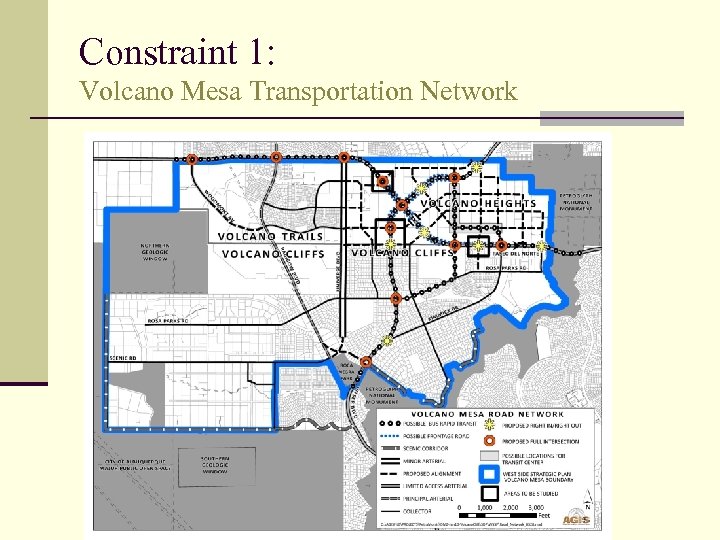 Constraint 1: Volcano Mesa Transportation Network
 Changes to Access Modification Request: Intersection Spacing Constraints n Prior planning efforts n Checkerboard ownership n Irregular parcels n Limited access roads at 45 degree angles to property lines n Aligning access with existing access easements at property edges n City-owned Unser vs. State-owned Paseo June 3, 2013 VHSDP - TCC Ad Hoc Committee #2
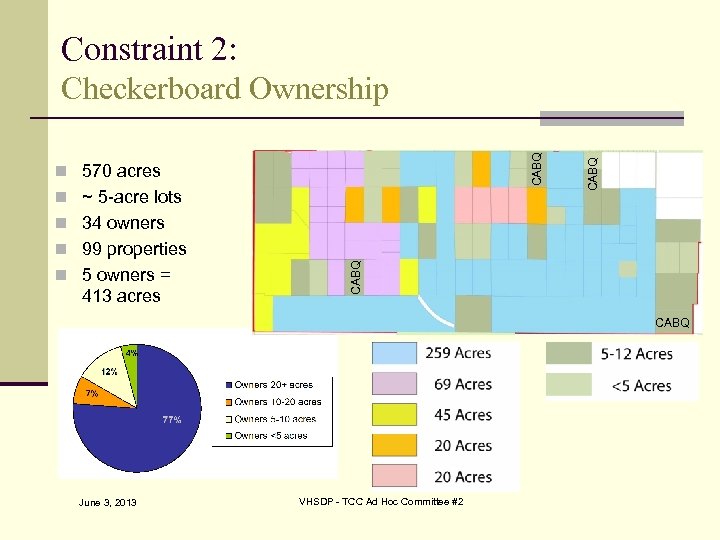 Constraint 2: n 570 acres n ~ 5 -acre lots CABQ Checkerboard Ownership n 34 owners n 5 owners = 413 acres CABQ n 99 properties CABQ June 3, 2013 VHSDP - TCC Ad Hoc Committee #2
 Changes to Access Modification Request: Intersection Spacing Constraints n Prior planning efforts n Checkerboard ownership n Irregular parcels n Limited access roads at 45 degree angles to property lines n Aligning access with existing access easements at property edges n City-owned Unser vs. State-owned Paseo June 3, 2013 VHSDP - TCC Ad Hoc Committee #2
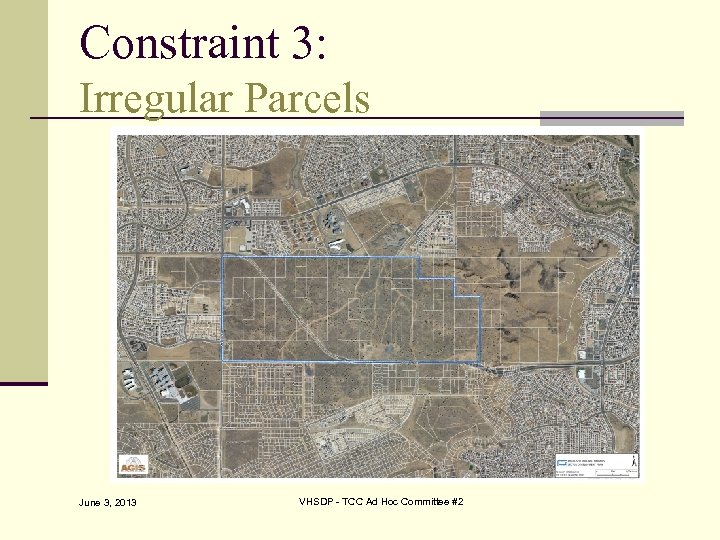 Constraint 3: Irregular Parcels June 3, 2013 VHSDP - TCC Ad Hoc Committee #2
 Changes to Access Modification Request: Intersection Spacing Constraints n Prior planning efforts n Checkerboard ownership n Irregular parcels n Limited access roads at 45 degree angles to property lines n Aligning access with existing access easements at property edges n City-owned Unser vs. State-owned Paseo June 3, 2013 VHSDP - TCC Ad Hoc Committee #2
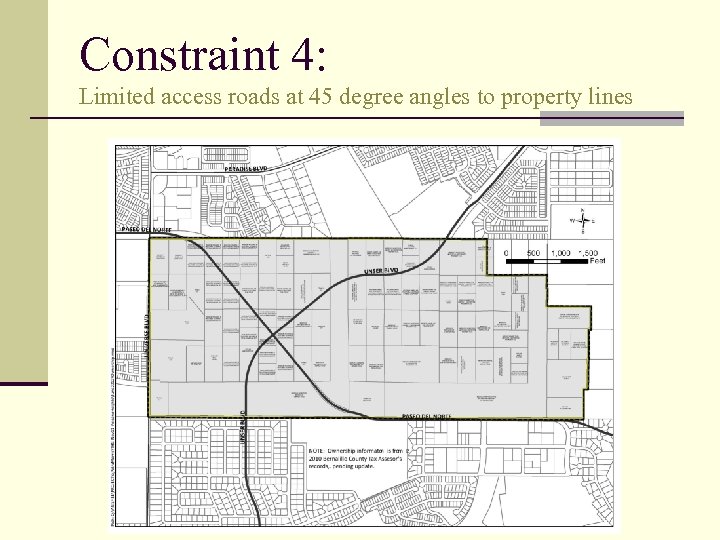 Constraint 4: Limited access roads at 45 degree angles to property lines
 Changes to Access Modification Request: Intersection Spacing Constraints n Prior planning efforts n Checkerboard ownership n Irregular parcels n Limited access roads at 45 degree angles to property lines n Aligning access with existing access easements at property edges n City-owned Unser vs. State-owned Paseo June 3, 2013 VHSDP - TCC Ad Hoc Committee #2
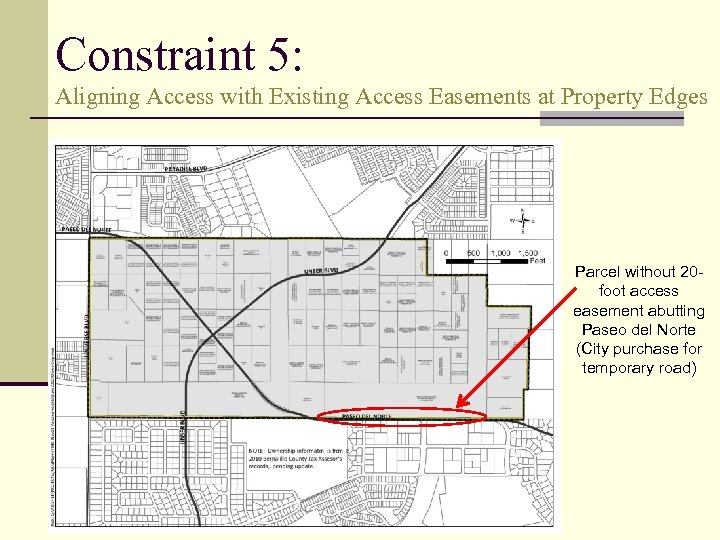 Constraint 5: Aligning Access with Existing Access Easements at Property Edges Parcel without 20 foot access easement abutting Paseo del Norte (City purchase for temporary road)
 Changes to Access Modification Request: Intersection Spacing Constraints n Prior planning efforts n Checkerboard ownership n Irregular parcels n Limited access roads at 45 degree angles to property lines n Aligning access with existing access easements at property edges n City-owned Unser vs. State-owned Paseo June 3, 2013 VHSDP - TCC Ad Hoc Committee #2
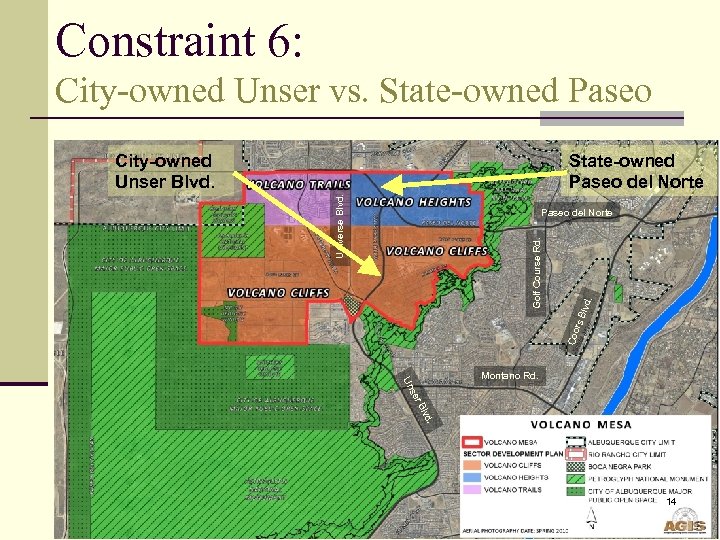 Constraint 6: City-owned Unser vs. State-owned Paseo del Norte Universe Blvd. City-owned Unser Blvd. Coo r s B Golf Course Rd. Paseo del Norte . lvd r B se Un Montano Rd. March 27, 2012 June 3, 2013 Volcano Heights SDP-Open Space & Recreation VHSDP - TCC Ad Hoc Committee #2 14
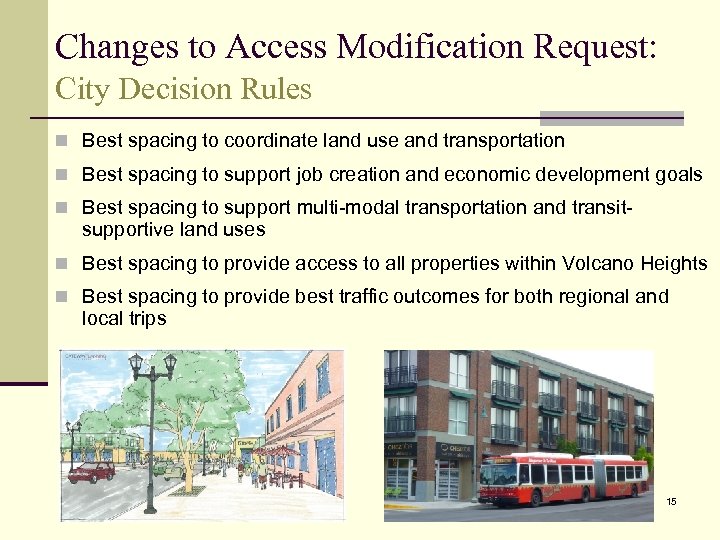 Changes to Access Modification Request: City Decision Rules n Best spacing to coordinate land use and transportation n Best spacing to support job creation and economic development goals n Best spacing to support multi-modal transportation and transit- supportive land uses n Best spacing to provide access to all properties within Volcano Heights n Best spacing to provide best traffic outcomes for both regional and local trips 15
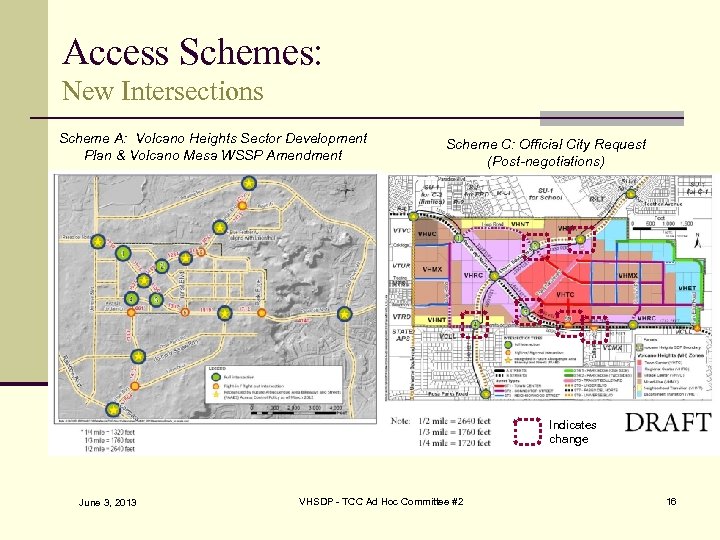 Access Schemes: New Intersections Scheme A: Volcano Heights Sector Development Plan & Volcano Mesa WSSP Amendment Scheme C: Official City Request (Post-negotiations) Indicates change June 3, 2013 VHSDP - TCC Ad Hoc Committee #2 16
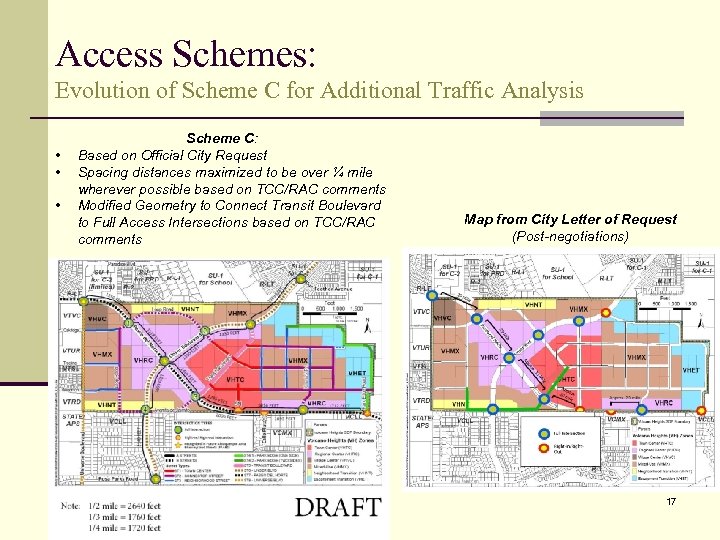 Access Schemes: Evolution of Scheme C for Additional Traffic Analysis • • • Scheme C: Based on Official City Request Spacing distances maximized to be over ¼ mile wherever possible based on TCC/RAC comments Modified Geometry to Connect Transit Boulevard to Full Access Intersections based on TCC/RAC comments June 3, 2013 Map from City Letter of Request (Post-negotiations) 17
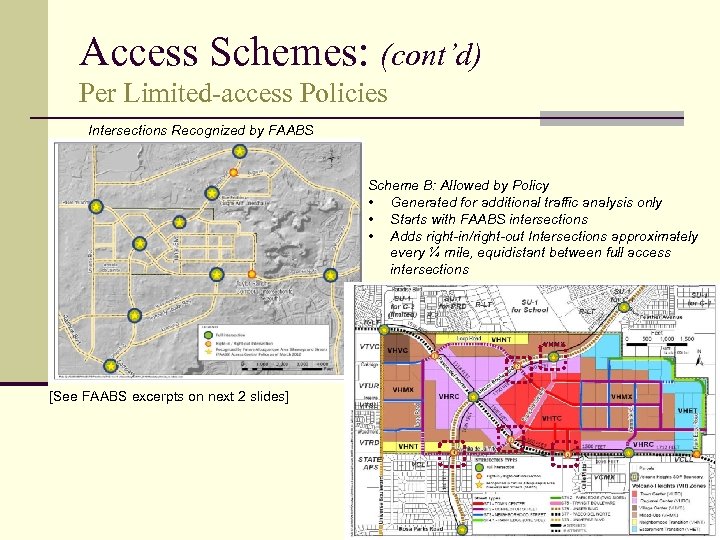 Access Schemes: (cont’d) Per Limited-access Policies Intersections Recognized by FAABS Scheme B: Allowed by Policy • Generated for additional traffic analysis only • Starts with FAABS intersections • Adds right-in/right-out Intersections approximately every ¼ mile, equidistant between full access intersections [See FAABS excerpts on next 2 slides]
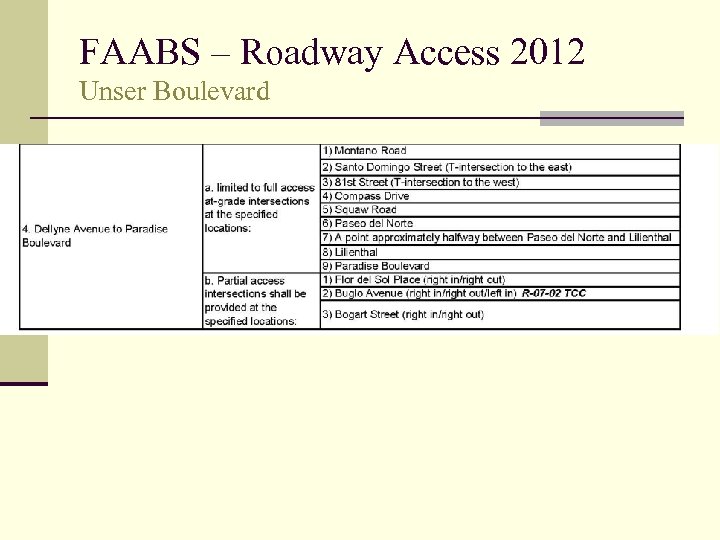 FAABS – Roadway Access 2012 Unser Boulevard
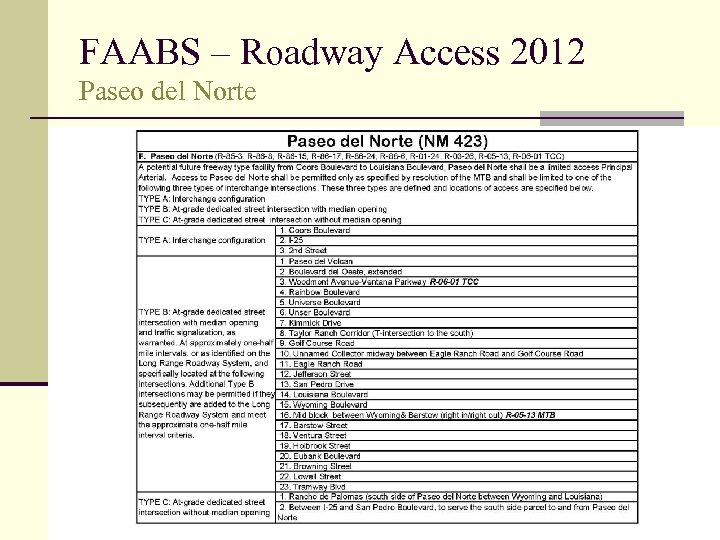 FAABS – Roadway Access 2012 Paseo del Norte
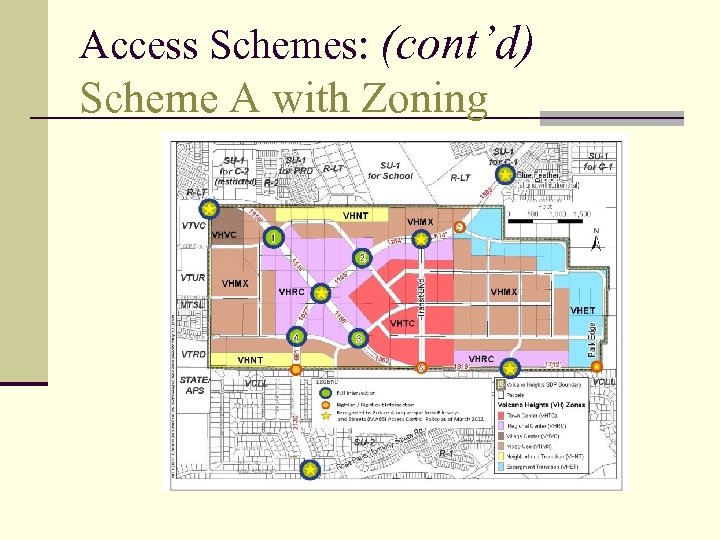 Access Schemes: (cont’d) Scheme A with Zoning
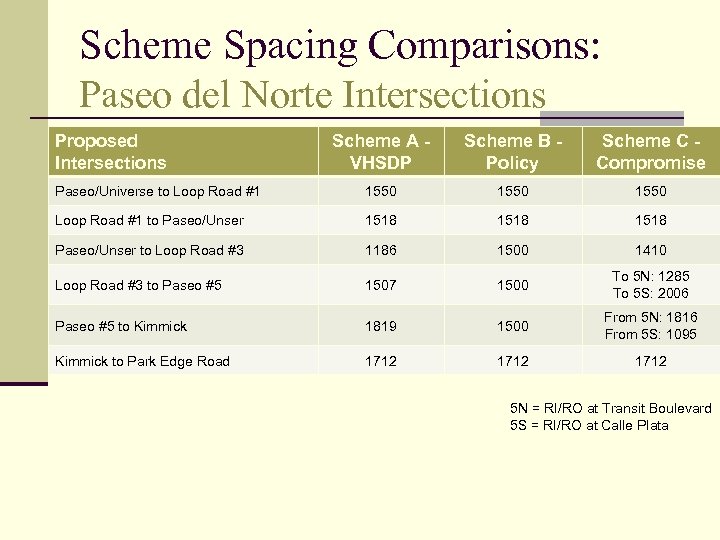 Scheme Spacing Comparisons: Paseo del Norte Intersections Proposed Intersections Scheme A - VHSDP Scheme B - Policy Scheme C - Compromise Paseo/Universe to Loop Road #1 1550 Loop Road #1 to Paseo/Unser 1518 Paseo/Unser to Loop Road #3 1186 1500 1410 Loop Road #3 to Paseo #5 1507 1500 To 5 N: 1285 To 5 S: 2006 Paseo #5 to Kimmick 1819 1500 From 5 N: 1816 From 5 S: 1095 Kimmick to Park Edge Road 1712 5 N = RI/RO at Transit Boulevard 5 S = RI/RO at Calle Plata
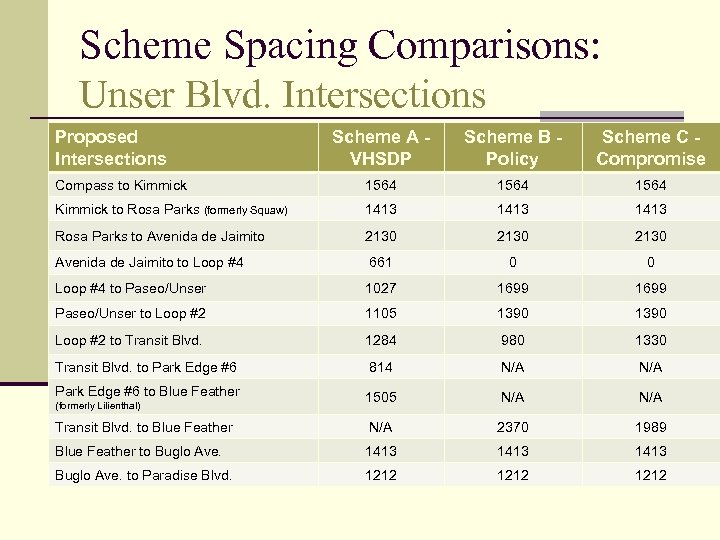 Scheme Spacing Comparisons: Unser Blvd. Intersections Proposed Intersections Scheme A - VHSDP Scheme B - Policy Scheme C - Compromise Compass to Kimmick 1564 Kimmick to Rosa Parks (formerly Squaw) 1413 Rosa Parks to Avenida de Jaimito 2130 Avenida de Jaimito to Loop #4 661 0 0 Loop #4 to Paseo/Unser 1027 1699 Paseo/Unser to Loop #2 1105 1390 Loop #2 to Transit Blvd. 1284 980 1330 Transit Blvd. to Park Edge #6 814 N/A Park Edge #6 to Blue Feather 1505 N/A Transit Blvd. to Blue Feather N/A 2370 1989 Blue Feather to Buglo Ave. 1413 Buglo Ave. to Paradise Blvd. 1212 (formerly Lilienthal)
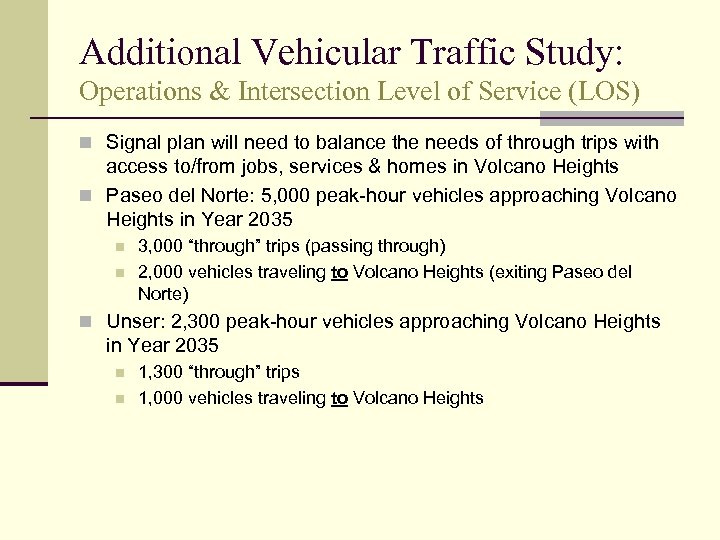 Additional Vehicular Traffic Study: Operations & Intersection Level of Service (LOS) n Signal plan will need to balance the needs of through trips with access to/from jobs, services & homes in Volcano Heights n Paseo del Norte: 5, 000 peak-hour vehicles approaching Volcano Heights in Year 2035 n n 3, 000 “through” trips (passing through) 2, 000 vehicles traveling to Volcano Heights (exiting Paseo del Norte) n Unser: 2, 300 peak-hour vehicles approaching Volcano Heights in Year 2035 n n 1, 300 “through” trips 1, 000 vehicles traveling to Volcano Heights
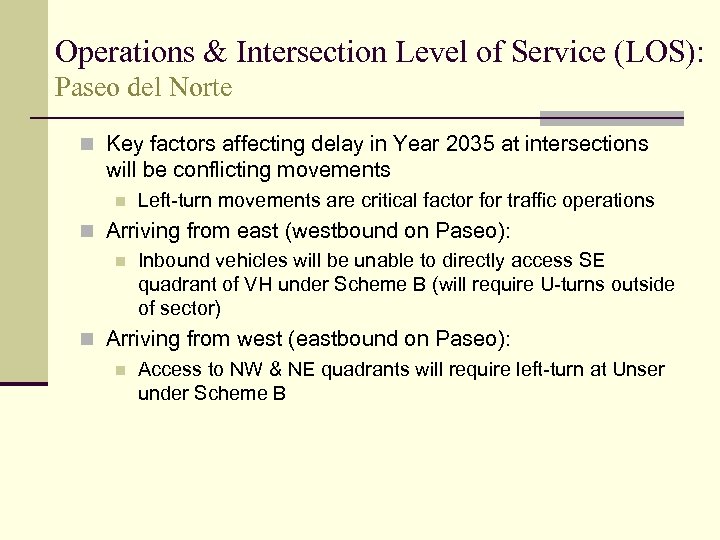 Operations & Intersection Level of Service (LOS): Paseo del Norte n Key factors affecting delay in Year 2035 at intersections will be conflicting movements n Left-turn movements are critical factor for traffic operations n Arriving from east (westbound on Paseo): n Inbound vehicles will be unable to directly access SE quadrant of VH under Scheme B (will require U-turns outside of sector) n Arriving from west (eastbound on Paseo): n Access to NW & NE quadrants will require left-turn at Unser under Scheme B
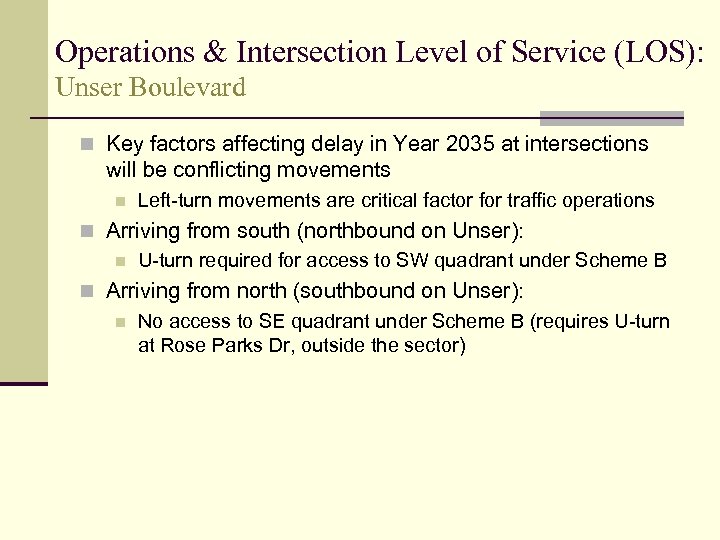 Operations & Intersection Level of Service (LOS): Unser Boulevard n Key factors affecting delay in Year 2035 at intersections will be conflicting movements n Left-turn movements are critical factor for traffic operations n Arriving from south (northbound on Unser): n U-turn required for access to SW quadrant under Scheme B n Arriving from north (southbound on Unser): n No access to SE quadrant under Scheme B (requires U-turn at Rose Parks Dr, outside the sector)
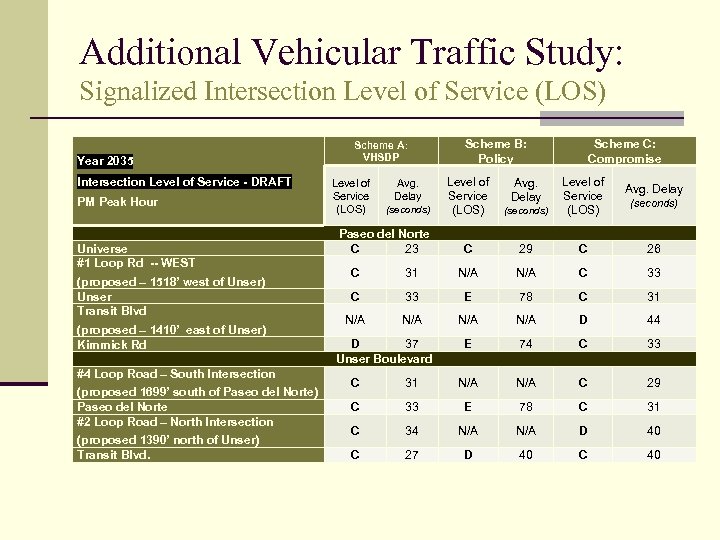 Additional Vehicular Traffic Study: Signalized Intersection Level of Service (LOS) Year 2035 Intersection Level of Service - DRAFT PM Peak Hour Universe #1 Loop Rd -- WEST (proposed – 1518’ west of Unser) Unser Transit Blvd (proposed – 1410’ east of Unser) Kimmick Rd #4 Loop Road – South Intersection (proposed 1699’ south of Paseo del Norte) Paseo del Norte #2 Loop Road – North Intersection (proposed 1390’ north of Unser) Transit Blvd. Scheme A: VHSDP Level of Service (LOS) Avg. Delay (seconds) Paseo del Norte C 23 Scheme B: Policy Level of Avg. Service Delay (seconds) (LOS) Scheme C: Compromise Level of Service (LOS) Avg. Delay (seconds) C 29 C 26 C 31 N/A C 33 E 78 C 31 N/A N/A D 44 E 74 C 33 D 37 Unser Boulevard C 31 N/A C 29 C 33 E 78 C 31 C 34 N/A D 40 C 27 D 40 C 40
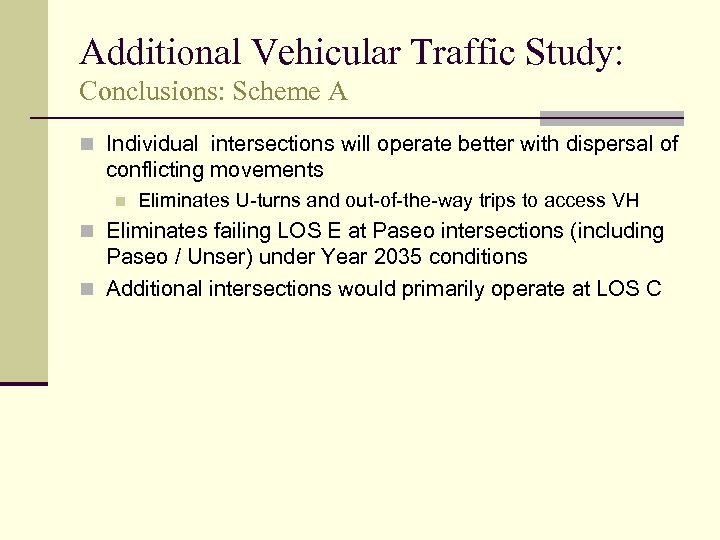 Additional Vehicular Traffic Study: Conclusions: Scheme A n Individual intersections will operate better with dispersal of conflicting movements n Eliminates U-turns and out-of-the-way trips to access VH n Eliminates failing LOS E at Paseo intersections (including Paseo / Unser) under Year 2035 conditions n Additional intersections would primarily operate at LOS C
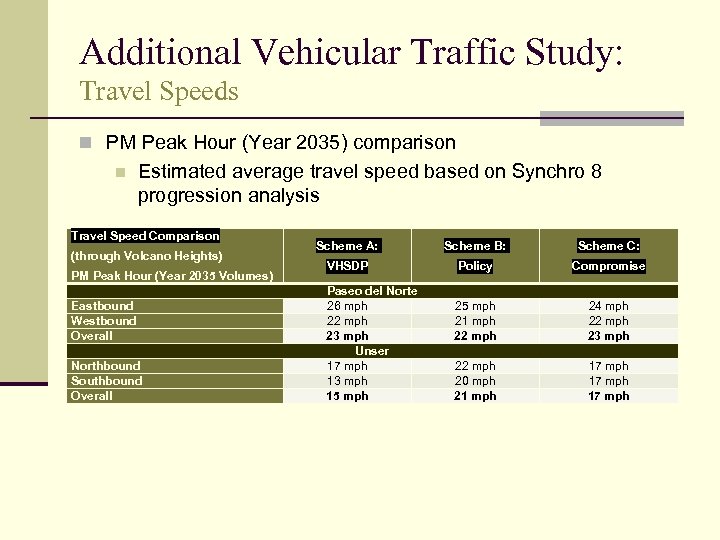 Additional Vehicular Traffic Study: Travel Speeds n PM Peak Hour (Year 2035) comparison n Estimated average travel speed based on Synchro 8 progression analysis Travel Speed Comparison (through Volcano Heights) PM Peak Hour (Year 2035 Volumes) Eastbound Westbound Overall Northbound Southbound Overall Scheme A: Scheme B: Scheme C: VHSDP Policy Compromise 25 mph 21 mph 22 mph 24 mph 22 mph 23 mph 22 mph 20 mph 21 mph 17 mph Paseo del Norte 26 mph 22 mph 23 mph Unser 17 mph 13 mph 15 mph
 Additional Vehicular Traffic Study: Year 2035 Peak Hour Travel Speeds n Year 2035 travel speed on Paseo increases by 1 mph under both Scheme A and C, due to dispersal of turning movements to multiple locations n Baseline travel speed on Paseo del Norte with forecasted Year 2035 volumes will be 23 mph during PM Peak Hour n Unser travel time potentially degrades by 3 to 5 mph (on segment through Volcano Heights sector) n n Baseline travel speed on Unser with forecasted Year 2035 volumes will be 21 mph during PM Peak Hour Reduced travel speed primarily results from assumed signal progression favoring east/west movement on Paseo del Norte
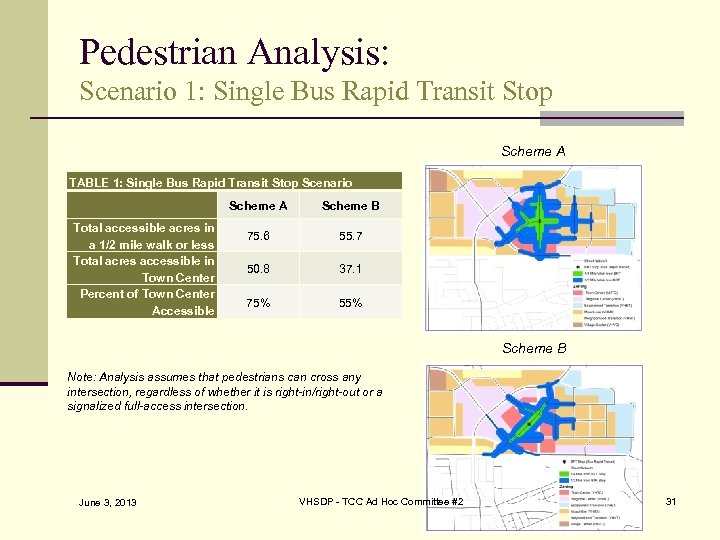 Pedestrian Analysis: Scenario 1: Single Bus Rapid Transit Stop Scheme A TABLE 1: Single Bus Rapid Transit Stop Scenario Scheme A Total accessible acres in a 1/2 mile walk or less Total acres accessible in Town Center Percent of Town Center Accessible Scheme B 75. 6 55. 7 50. 8 37. 1 75% 55% Scheme B Note: Analysis assumes that pedestrians can cross any intersection, regardless of whether it is right-in/right-out or a signalized full-access intersection. June 3, 2013 VHSDP - TCC Ad Hoc Committee #2 31
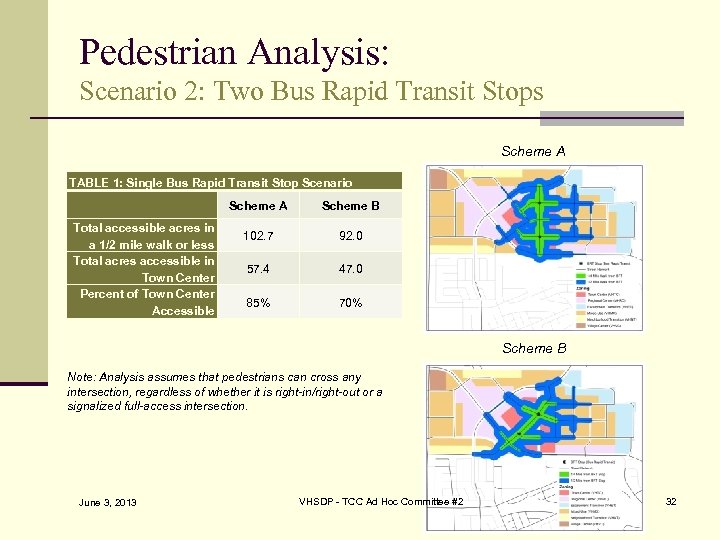 Pedestrian Analysis: Scenario 2: Two Bus Rapid Transit Stops Scheme A TABLE 1: Single Bus Rapid Transit Stop Scenario Scheme A Total accessible acres in a 1/2 mile walk or less Total acres accessible in Town Center Percent of Town Center Accessible Scheme B 102. 7 92. 0 57. 4 47. 0 85% 70% Scheme B Note: Analysis assumes that pedestrians can cross any intersection, regardless of whether it is right-in/right-out or a signalized full-access intersection. June 3, 2013 VHSDP - TCC Ad Hoc Committee #2 32
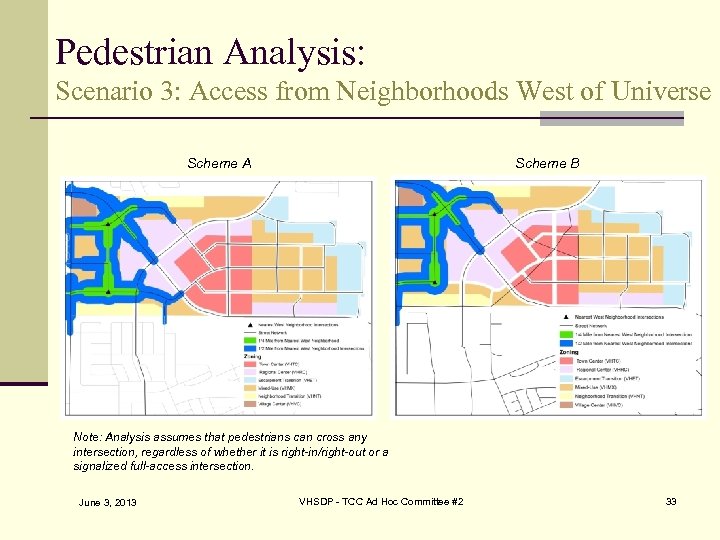 Pedestrian Analysis: Scenario 3: Access from Neighborhoods West of Universe Scheme A Scheme B Note: Analysis assumes that pedestrians can cross any intersection, regardless of whether it is right-in/right-out or a signalized full-access intersection. June 3, 2013 VHSDP - TCC Ad Hoc Committee #2 33
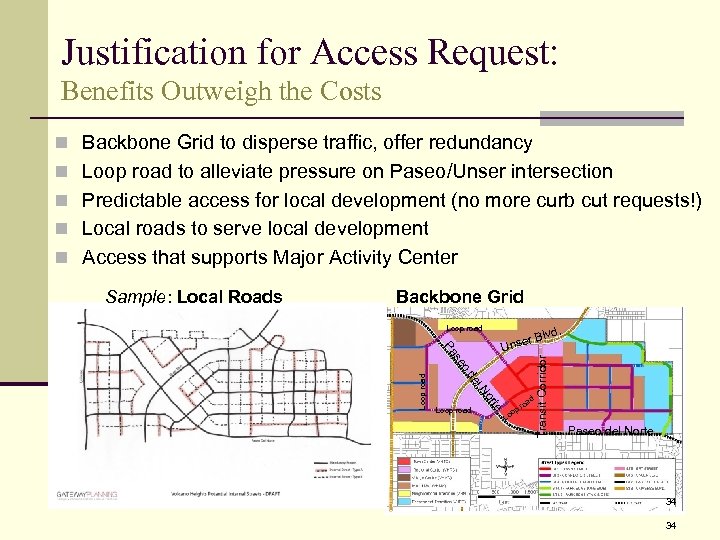 Justification for Access Request: Benefits Outweigh the Costs n Backbone Grid to disperse traffic, offer redundancy n Loop road to alleviate pressure on Paseo/Unser intersection n Predictable access for local development (no more curb cut requests!) n Local roads to serve local development n Access that supports Major Activity Center Backbone Grid Loop road VHSDP - TCC Ad Hoc Committee #2 te or Loop road l N de o se Pa June 3, 2013 d. lv er B Uns ad ro L p oo Transit Corridor Sample: Local Roads Paseo del Norte 34 34
 Justification for Access Request: Access Management Guidelines for Activity Centers n n Chapter 4 E. ACCESS CATEGORY: Urban Principal Arterial (UPA) (1) Functional Description: The urban principal arterial system serves the major centers of activity of urbanized areas, the highest traffic volume corridors, the longest trip desires, and carries a high proportion of the total urban area travel on a minimum of mileage. The system is integrated both internally and between major rural connections. The principal arterial system carries most of the trips entering and leaving an urban area, as well as most of the through movements bypassing central city areas. In addition, significant intra-area travel, such as between central business districts and outlying residential areas, between major inner city communities, and between major suburban centers, is served by this class of highway. In urbanized areas, this system provides continuity for all rural arterials that intercept the urban boundary. (2) General Access Characteristics: The primary functional responsibility of urban principal arterials is through traffic movement. Many urban principal arterials are fully or partially access controlled. Direct access service to abutting properties is subordinate to providing service to through traffic movements. Access location and spacing standards are strictly enforced. (3) Performance: The operational performance of UPA facilities should meet LOS D standards at a minimum. See Sub-Section 15. C, Table 15. C-1. June 3, 2013 VHSDP - TCC Ad Hoc Committee #2 35
 Justification for Access Request: NMDOT Access Management Manual n Specifically exempts "business districts" from spacing requirements. n 18. 31. 6. 7 Business District-- A business district occurs along a highway when within 300 feet along such highway there are buildings in use for business or industrial purposes (including but not limited to hotels, banks or office buildings, railroad stations and public buildings) which occupy at least fifty percent of the frontage on one side or fifty percent of the frontage collectively on both sides of the highway (page 2). n 18. 31. 6. 18 C (3) Business Districts. The spacing of access points within business districts on urban or rural highways may be adjusted based on site-specific conditions consistent with the requirements for the access category of the highway (page 23). Refers to Access Management Guidelines for Activity Centers, NCHRP 348, 1992. n http: //www. accessmanagement. info/pdf/348 NCHRP. pdf June 3, 2013 VHSDP - TCC Ad Hoc Committee #2 36
 Justification for Access Request: Access Management Guidelines for Activity Centers (1992) n Signalized spacing (pg. 4): n n n Unsignalized spacing (pg. 5): n June 3, 2013 The spacing guidelines should minimize the need for variances or exceptions, while simultaneously protecting arterial traffic flow. They should view driveways to major activity centers as intersecting arterial roads rather than as curb cuts. To assure efficient traffic flow, new signals should be limited to locations where the progressive movement of traffic will not be impeded significantly. The “optimum” distance between signals - where there is no loss in the through band width-depends on the cycle length and the prevailing speed. When signals are placed at other locations, there is a loss in band width and delay increases Strict application of traffic engineering criteria may push spacing requirements to 500 ft or more. However, such spacings may be unacceptable for land use and perceived economic reasons in many suburban and urban environments where development pressures opt for 100 - to 200 -ft spacing. Spacing guidelines should achieve a reasonable balance between these conflicting requirements. VHSDP - TCC Ad Hoc Committee #2 37
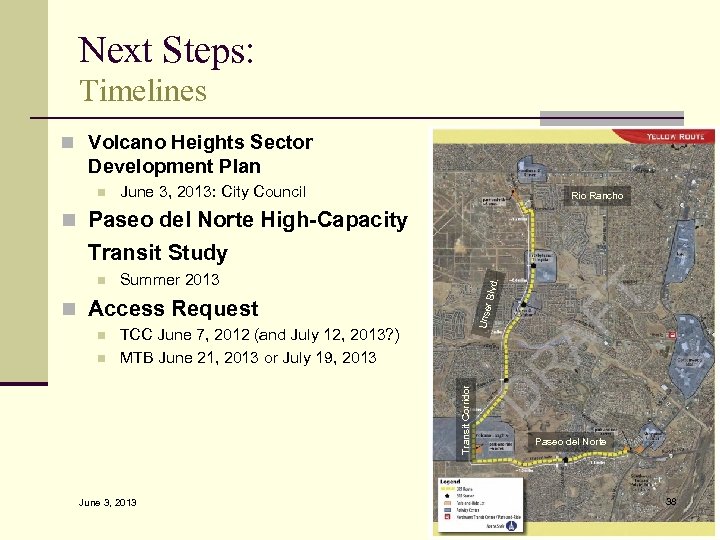 Next Steps: Timelines n Volcano Heights Sector Development Plan n June 3, 2013: City Council Rio Rancho n Paseo del Norte High-Capacity Transit Study . Summer 2013 r Blvd n n TCC June 7, 2012 (and July 12, 2013? ) MTB June 21, 2013 or July 19, 2013 Transit Corridor n Unse n Access Request June 3, 2013 Paseo del Norte 38
 Volcano Heights Sector Development Plan City Project Team Mikaela Renz-Whitmore Long-range Planner – Planning Dept. mrenz@cabq. gov 505 -924 -3932 Andrew Webb Policy Analyst – Council Services awebb@cabq. gov 505 -768 -3161 City’s Project Webpage: http: //www. cabq. gov/planning/residents/sectordevelopment-plans/volcano-mesa-area-sectordevelopment-plans/volcano-heights-sector/ June 3, 2013 VHSDP - TCC Ad Hoc Committee #2 39