 Скачать презентацию Volcanic Ash Crisis 2010 — Seminar Belgrade September
0b0cf38294d4a84eaa455eb3fd33f97b.ppt
- Количество слайдов: 14



Volcanic Ash Crisis 2010 - Seminar Belgrade, September 7 th, 2010 Use of Unmanned Aerial Systems (UAS) to support the predictability of future environmental crisis Dipl. -Ing. Ružica Vujasinović (DLR, Institute of Flight Guidance) Dipl. -Phys. Mirsad Delić (DLR, Institute of Flight Guidance) Slide 1 Use of Unmanned Aerial Systems (UAS) to support the predictability of future environmental crisis > 07/09/2010
Contents Who is DLR? • About DLR Institute of Flight Guidance What is COST? • COST ES 0802: UAS in Atmospheric Research Why are UAS a suitable means? Slide 2 Use of Unmanned Aerial Systems (UAS) to support the predictability of future environmental crisis > 07/09/2010
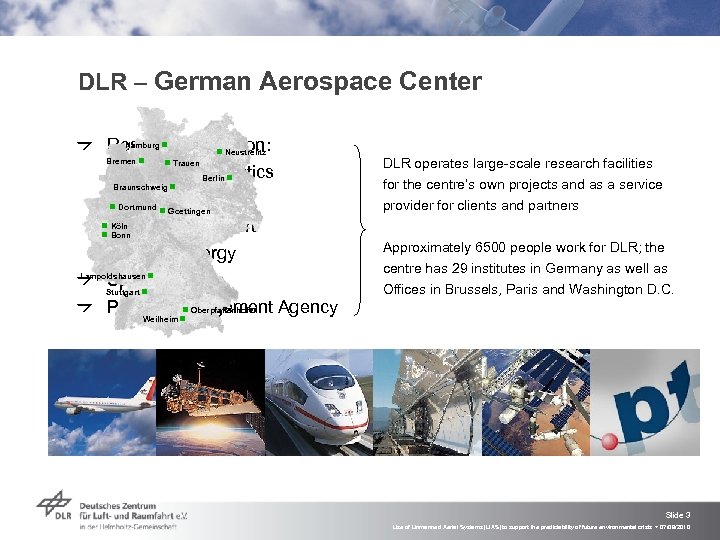
DLR – German Aerospace Center Hamburg n Research Institution: n Neustrelitz Bremen n n Trauen Aeronautics Berlin n Braunschweig n Space n Dortmund n Goettingen n Köln n Bonn DLR operates large-scale research facilities for the centre’s own projects and as a service provider for clients and partners Transport Energy Lampoldshausen n Space Agency Stuttgart n n Oberpfaffenhofen Project Management Agency Weilheim n Approximately 6500 people work for DLR; the centre has 29 institutes in Germany as well as Offices in Brussels, Paris and Washington D. C. Slide 3 Use of Unmanned Aerial Systems (UAS) to support the predictability of future environmental crisis > 07/09/2010
Goals and Strategies of the Aeronautics Research Area Primary goals Further development of civilian transport systems from the perspectives of efficiency/economy, safety and environmental compatibility Technological contributions towards assuring the capability profile of the German armed forces Focal areas of research at DLR Braunschweig Improvement of the dynamic aircraft behaviour and the operational safety of aircraft and helicopters Increase in the performance, safety and reliability of air, road and railway traffic Intelligent assistance systems for human operators of airborne and ground transportation systems Development of design principles and tools for low-drag and quiet air vehicles Development and realisation of adaptable, damage-tolerant and cost-efficient high -performance structures for aerospace and ground transportation application Slide 4 Use of Unmanned Aerial Systems (UAS) to support the predictability of future environmental crisis > 07/09/2010
COST is an intergovernmental framework for European Cooperation in Science and Technology; COST contributes to reducing the fragmentation in European research investments and opening the European Research Area to cooperation worldwide In total, there are 36 COST Countries: 35 member states: Austria, Belgium, Bosnia and Herzegovina, Bulgaria, Croatia, Cyprus, Czech Republic, Denmark, Estonia, Finland, France, Germany, Greece, Hungary, Iceland, Ireland, Italy, Latvia, Lithuania, Luxembourg, Macedonia, Malta, The Netherlands, Norway, Poland, Portugal, Romania, Serbia, Slovakia, Slovenia, Spain, Sweden, Switzerland, Turkey, United Kingdom One cooperating state: Israel Unmanned systems offer cost-efficient data acquisition options in regions that are hard to reach or too dangerous for manned operation (e. g. polar regions, Offshore wind parks, active volcanoes, dangerous pollution events) Slide 5 Use of Unmanned Aerial Systems (UAS) to support the predictability of future environmental crisis > 07/09/2010
COST ES 0802 Coordination of ongoing and conception of future research on development and application of UAS to provide cost-efficient, trans-boundary method for the monitoring of the atmospheric boundary layer and the underlying surface of Earth Creation of a knowledge base of existing UAS and suitable sensors and onboard logging systems to avoid unnecessary multiple inquiry and development DLR participates in WG 4 (UAS Operations) represented by the Slide 6 Use of Unmanned Aerial Systems (UAS) to support the predictability of future environmental crisis > 07/09/2010
How does the Institute of Flight Guidance fit in? The Institute of Flight Guidance does not conduct atmospheric research But, the Institute of Flight Guidance Conducts applied research in the Air Traffic Management area Designs concepts, processes, procedures and tools Develops adequate prototypes and evaluates internal and external products Airborne: UA-Simulation, Pilot Assistance, Sensor Evaluation Ground: System Control, UA Guidance, Image Processing, Sensor Simulation Conception, development, validation and verification of systems needed for operating UAS in non-segregated airspace Slide 7 Use of Unmanned Aerial Systems (UAS) to support the predictability of future environmental crisis > 07/09/2010
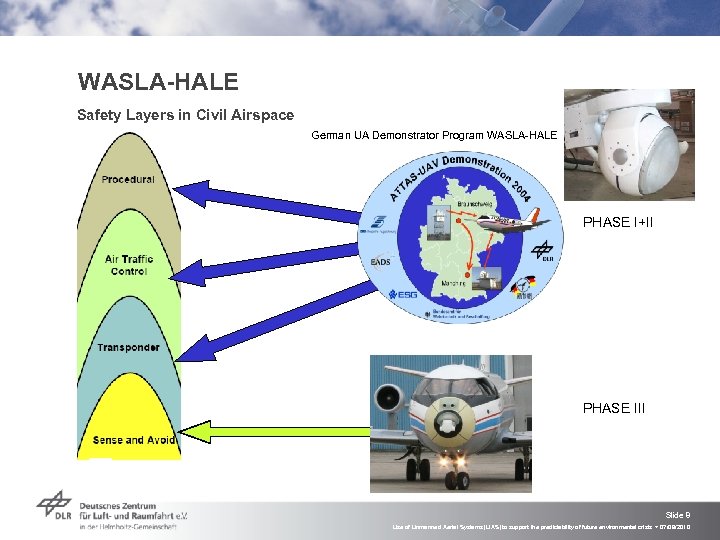
WASLA-HALE Safety Layers in Civil Airspace German UA Demonstrator Program WASLA-HALE PHASE I+II PHASE III Slide 8 Use of Unmanned Aerial Systems (UAS) to support the predictability of future environmental crisis > 07/09/2010
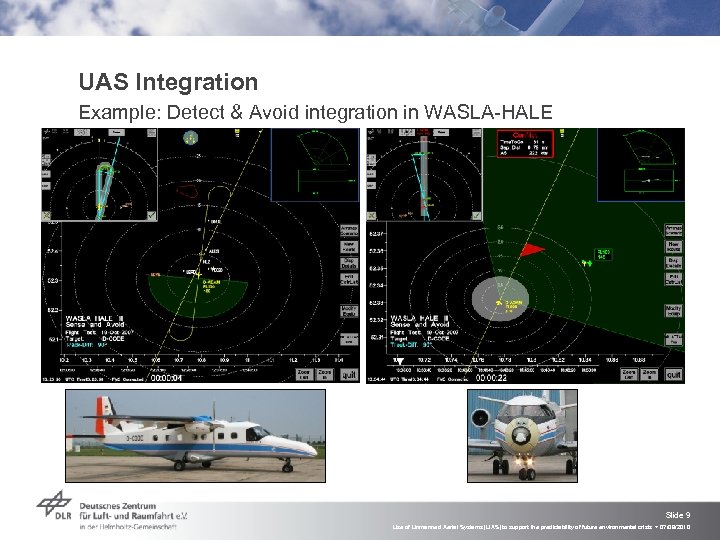
UAS Integration Example: Detect & Avoid integration in WASLA-HALE Slide 9 Use of Unmanned Aerial Systems (UAS) to support the predictability of future environmental crisis > 07/09/2010
Detect & Avoid Programs WASLA-HALE, German UA Demonstrator Program Mid-air Collision Avoidance System (Mid. CAS) - European successor program Five member states (France, Germany, Italy, Spain and Sweden) Objective: Demonstrate the technology for a detect and avoid system for UAS to fulfil requirements for traffic separation and collision avoidance in non-segregated airspace Slide 10 Use of Unmanned Aerial Systems (UAS) to support the predictability of future environmental crisis > 07/09/2010
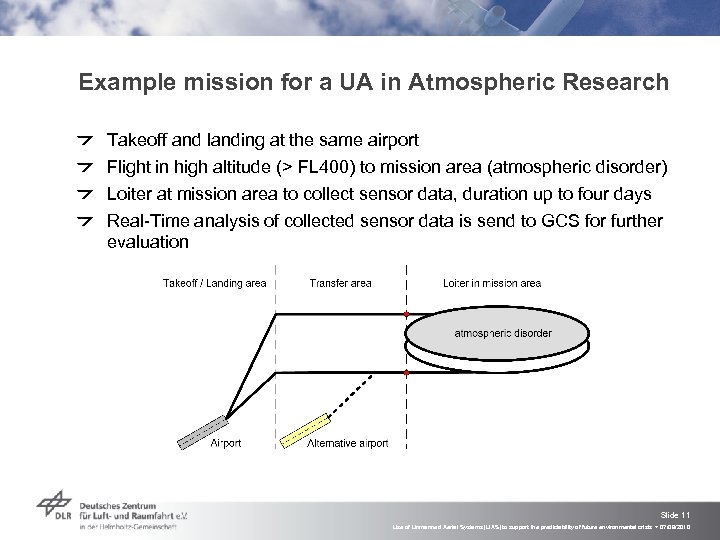
Example mission for a UA in Atmospheric Research Takeoff and landing at the same airport Flight in high altitude (> FL 400) to mission area (atmospheric disorder) Loiter at mission area to collect sensor data, duration up to four days Real-Time analysis of collected sensor data is send to GCS for further evaluation Slide 11 Use of Unmanned Aerial Systems (UAS) to support the predictability of future environmental crisis > 07/09/2010
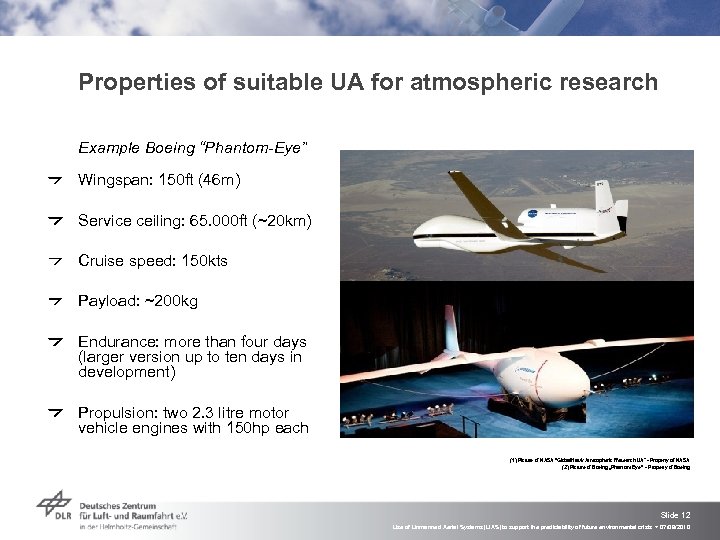
Properties of suitable UA for atmospheric research Example Boeing “Phantom-Eye” Wingspan: 150 ft (46 m) Service ceiling: 65. 000 ft (~20 km) Cruise speed: 150 kts Payload: ~200 kg Endurance: more than four days (larger version up to ten days in development) Propulsion: two 2. 3 litre motor vehicle engines with 150 hp each (1) Picture of NASA “Global. Hawk Atmospheric Research UA” - Property of NASA (2) Picture of Boeing „Phantom Eye“ - Property of Boeing Slide 12 Use of Unmanned Aerial Systems (UAS) to support the predictability of future environmental crisis > 07/09/2010
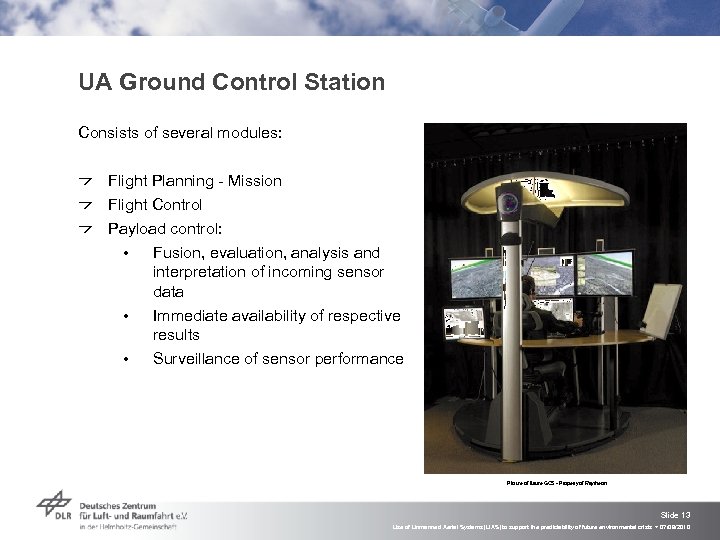
UA Ground Control Station Consists of several modules: Flight Planning - Mission Flight Control Payload control: • • • Fusion, evaluation, analysis and interpretation of incoming sensor data Immediate availability of respective results Surveillance of sensor performance Picture of future GCS - Property of Raytheon Slide 13 Use of Unmanned Aerial Systems (UAS) to support the predictability of future environmental crisis > 07/09/2010
Thank you. Any questions? Slide 14 Use of Unmanned Aerial Systems (UAS) to support the predictability of future environmental crisis > 07/09/2010
Скачать презентацию Volcanic Ash Crisis 2010 — Seminar Belgrade September
0b0cf38294d4a84eaa455eb3fd33f97b.ppt