


 Скачать презентацию VOIP and the Last Mile 1 Voice
09e2ba1712dbc271543dbf29966bde99.ppt
- Количество слайдов: 30
 VOIP and the “Last Mile” 1
 Voice over IP (Vo. IP) 2
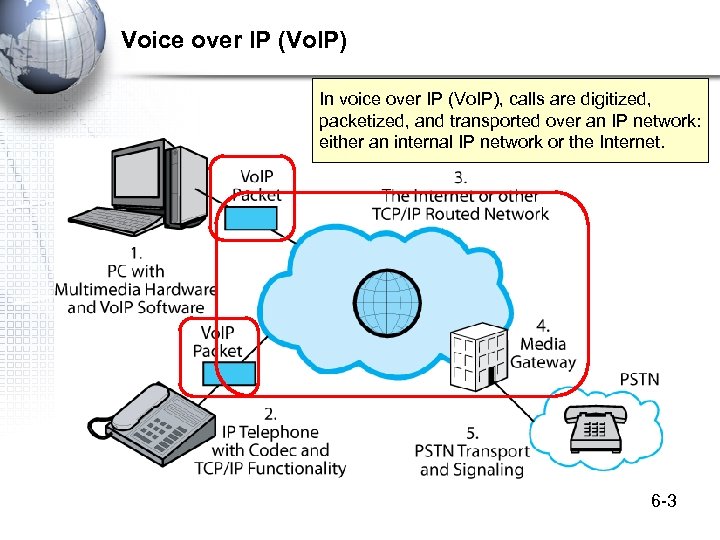 Voice over IP (Vo. IP) In voice over IP (Vo. IP), calls are digitized, packetized, and transported over an IP network: either an internal IP network or the Internet. 6 -3
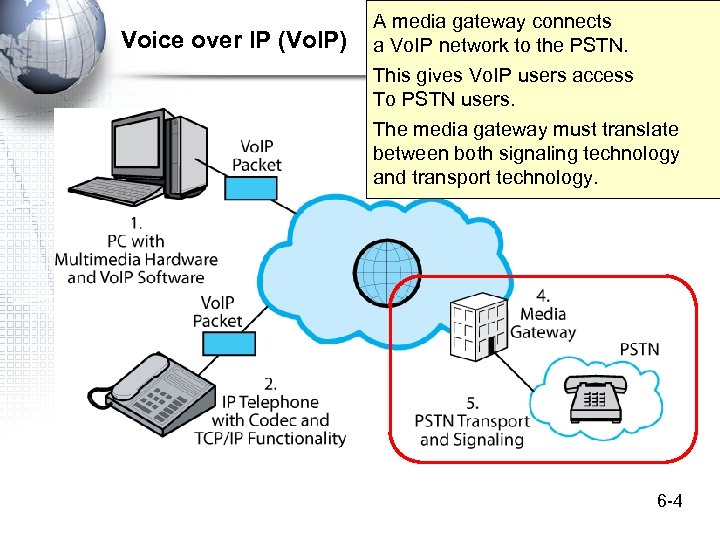 Voice over IP (Vo. IP) A media gateway connects a Vo. IP network to the PSTN. This gives Vo. IP users access To PSTN users. The media gateway must translate between both signaling technology and transport technology. 6 -4
 Vo. IP • Vo. IP means that a firm does not have to maintain two networks—an IP network for data and a circuitswitched voice network. – This should reduce costs considerably by only requiring the maintenance of a single network. • In addition, Vo. IP’s packet switching should be more efficient than the PSTN’s circuit switching. • But companies have concerns about sound quality and the high availability expected of telephone service. 6 -5
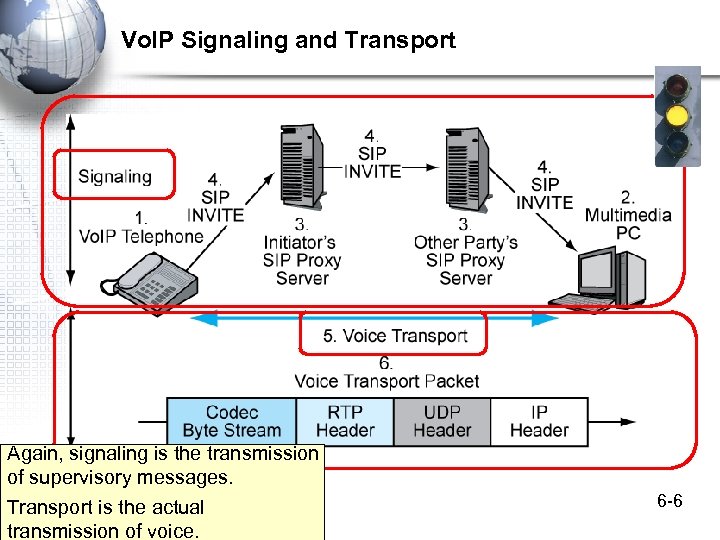 Vo. IP Signaling and Transport Again, signaling is the transmission of supervisory messages. Transport is the actual transmission of voice. 6 -6
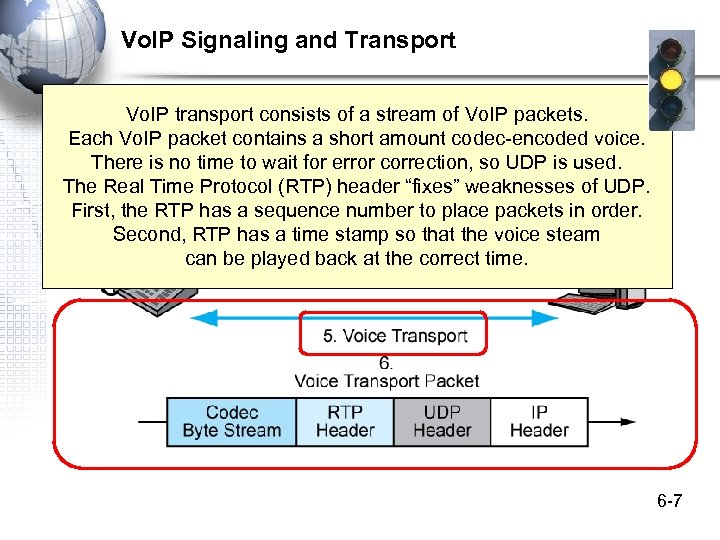 Vo. IP Signaling and Transport Vo. IP transport consists of a stream of Vo. IP packets. Each Vo. IP packet contains a short amount codec-encoded voice. There is no time to wait for error correction, so UDP is used. The Real Time Protocol (RTP) header “fixes” weaknesses of UDP. First, the RTP has a sequence number to place packets in order. Second, RTP has a time stamp so that the voice steam can be played back at the correct time. 6 -7
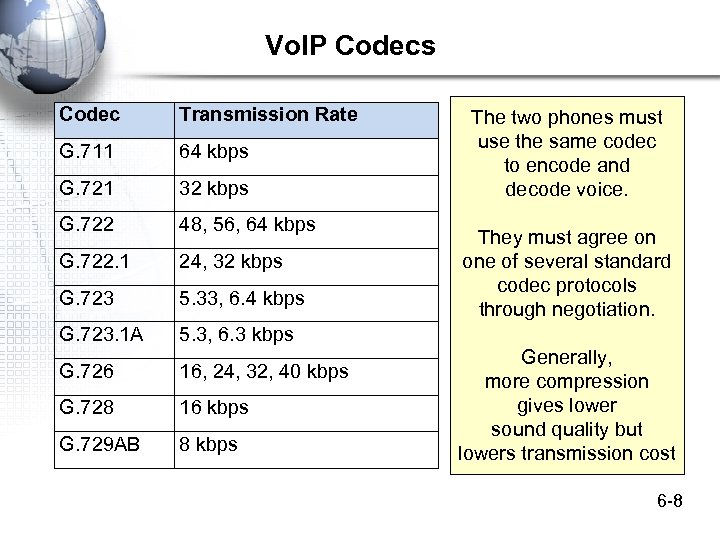 Vo. IP Codecs Codec Transmission Rate G. 711 64 kbps G. 721 32 kbps G. 722 48, 56, 64 kbps G. 722. 1 24, 32 kbps G. 723 5. 33, 6. 4 kbps G. 723. 1 A 5. 3, 6. 3 kbps G. 726 16, 24, 32, 40 kbps G. 728 16 kbps G. 729 AB 8 kbps The two phones must use the same codec to encode and decode voice. They must agree on one of several standard codec protocols through negotiation. Generally, more compression gives lower sound quality but lowers transmission cost 6 -8
 Wired “Last Mile” Services Telephone Modems ADSL Modem Service Cable Modem Service Fiber to the Home 9
 “Traditional” Technologies for the Last Mile • The Last Mile – The access line to your home – Traditionally, a 1 -pair VG UTP line from the telephone company – In the 1960 s, a few businesses started getting 2 -pair data -grade UTP and optical fiber – Given the cost of upgrading the 1 -pair VG UTP plant, 1 pair VG UTP seemed eternal 6 -10
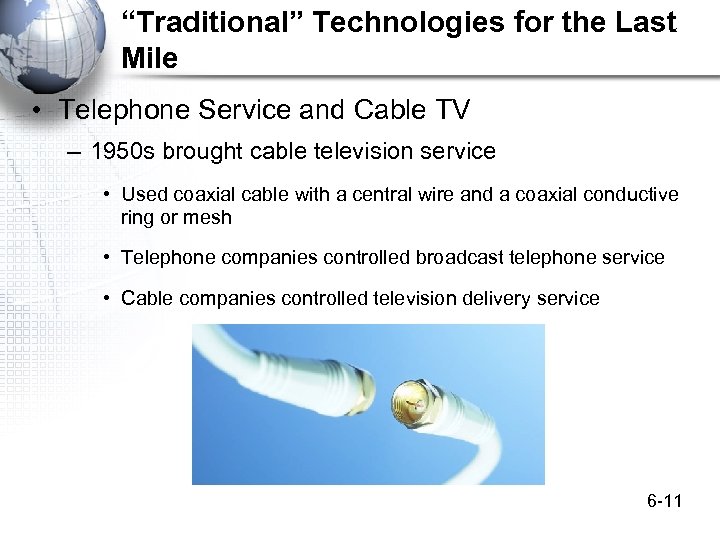 “Traditional” Technologies for the Last Mile • Telephone Service and Cable TV – 1950 s brought cable television service • Used coaxial cable with a central wire and a coaxial conductive ring or mesh • Telephone companies controlled broadcast telephone service • Cable companies controlled television delivery service 6 -11
 “Traditional” Technologies for the Last Mile • Telephone modems obsolete(I hope nobody uses it anymore) – Limited to 33. 6 kbps sending / 56 kbps receiving – Cannot use your telephone for calls while using the telephone modem 6 -12
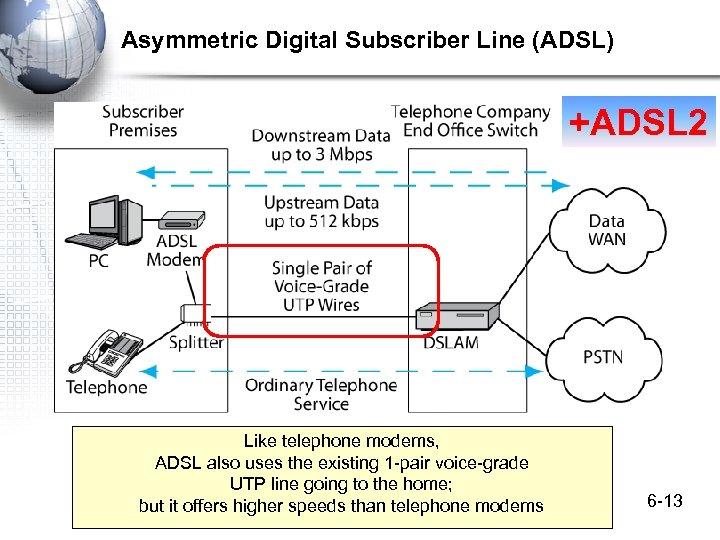 Asymmetric Digital Subscriber Line (ADSL) +ADSL 2 Like telephone modems, ADSL also uses the existing 1 -pair voice-grade UTP line going to the home; but it offers higher speeds than telephone modems 6 -13
 Telephone Modems and ADSL • Both use the 1 -pair VG UTP line running to the subscriber’s home – Already installed, so no extra cost of running a new line • Telephone modems send analog signals – This is what the traditional telephone system expects • ADSL – Send digital signals for data (digital subscriber line) – Requires special equipment at the end office switch (DSLAM) 6 -14
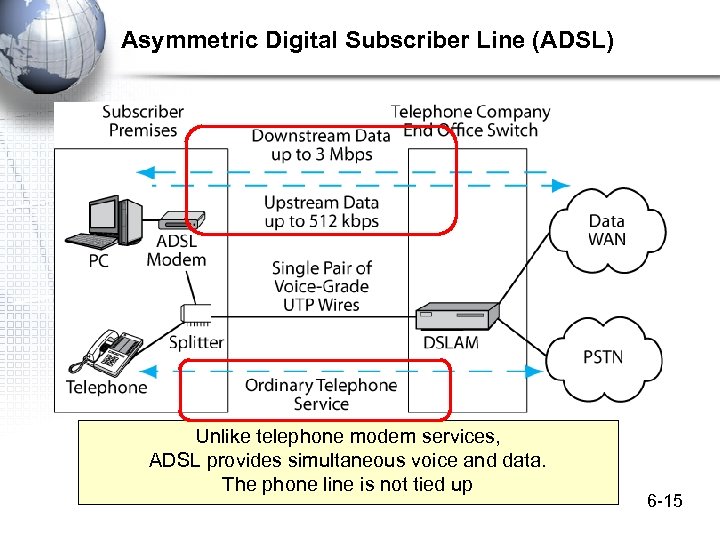 Asymmetric Digital Subscriber Line (ADSL) Unlike telephone modem services, ADSL provides simultaneous voice and data. The phone line is not tied up 6 -15
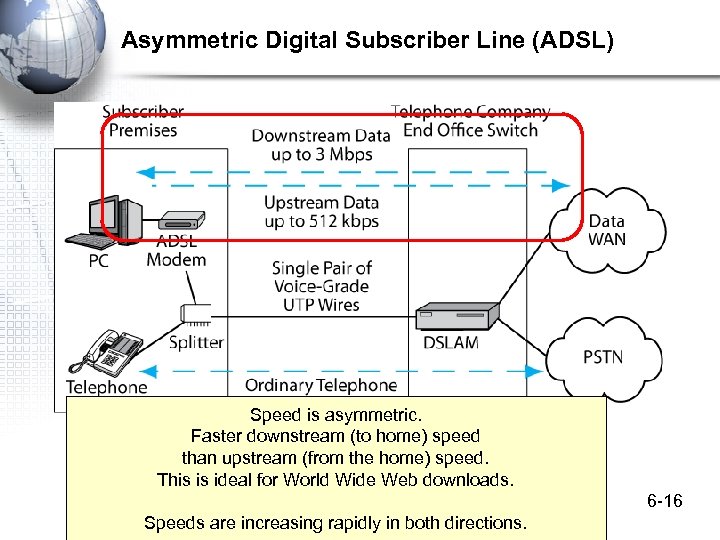 Asymmetric Digital Subscriber Line (ADSL) Speed is asymmetric. Faster downstream (to home) speed than upstream (from the home) speed. This is ideal for World Wide Web downloads. 6 -16 Speeds are increasing rapidly in both directions.
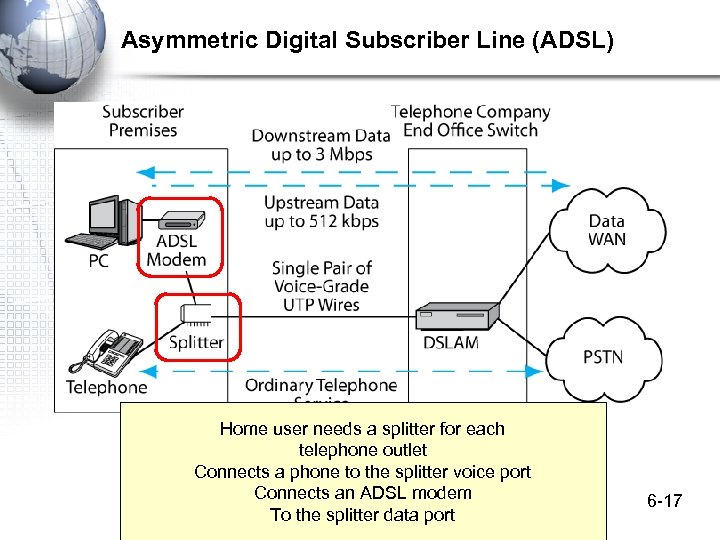 Asymmetric Digital Subscriber Line (ADSL) Home user needs a splitter for each telephone outlet Connects a phone to the splitter voice port Connects an ADSL modem To the splitter data port 6 -17
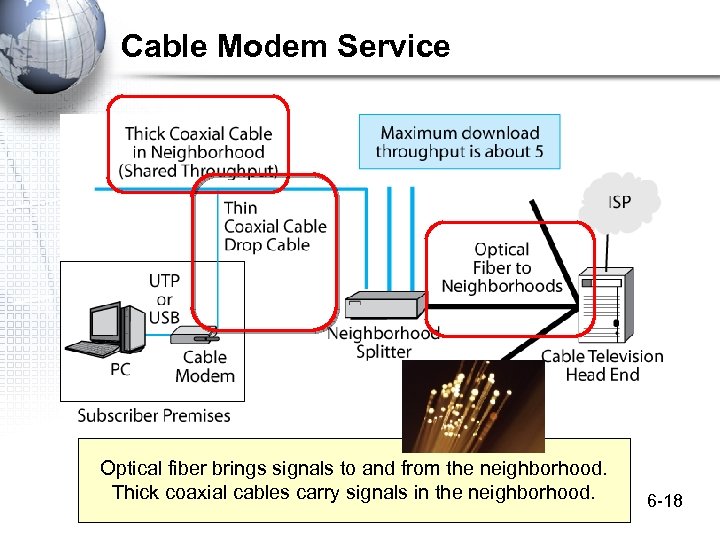 Cable Modem Service Optical fiber brings signals to and from the neighborhood. Thick coaxial cables carry signals in the neighborhood. 6 -18
 ADSL Versus Cable Modem Service • Generally, cable modem service is somewhat faster and not more expensive than ADSL service – However, price and performance ranges overlap – And performance is increasing rapidly • In cable modem service, all subscribers in a neighborhood must share the speed – However, cable modem speed to the neighborhood is very high, so cable modem subscribers usually still get higher-than-ADSL speeds – And other subscribers cannot read a subscriber’s transmissions, which are encrypted 6 -19
 Fiber to the Home • Some carriers are beginning to replace their 1 -pair voice grade UTP residential wiring with optical fiber • This is called fiber to the home or fiber to the premises • Download speeds vary. See Verizon FIOS. • Not more expensive than DSL service. • See FIOS and COMCAST comparison. 6 -20
 Wireless Access Service Wireless Technologies for the Last Mile 21
 Wireless for the Last Mile • 3 G Cellular Data Transmission – 3 G cellular was created to send data faster • current services offer DSL speeds at higher prices • 2 Mbps to 3 Mbps speeds are even more expensive • Consumer usage is dominating with downloading music, videos, and games 6 -22
 Wireless for the Last Mile • Cellular companies are still using many 3 G technologies • Cellular companies are introducing faster 4 G service – 100 Mbps or more – Using Long-Term Evolution (LTE) – Which is IP-based 6 -23
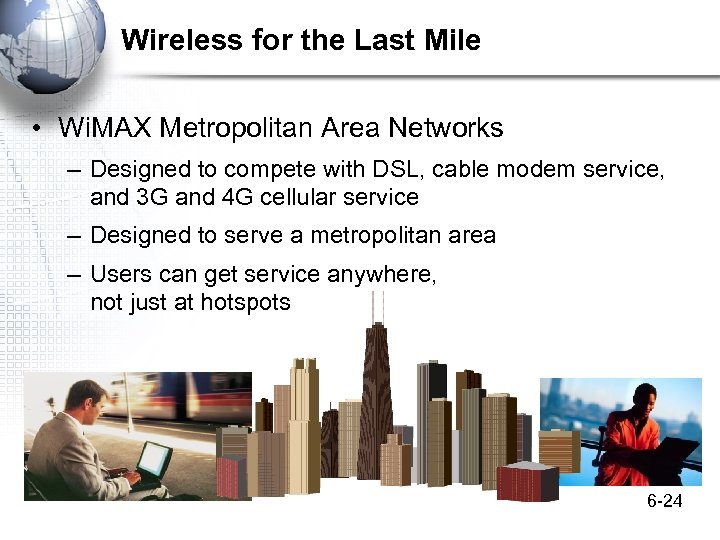 Wireless for the Last Mile • Wi. MAX Metropolitan Area Networks – Designed to compete with DSL, cable modem service, and 3 G and 4 G cellular service – Designed to serve a metropolitan area – Users can get service anywhere, not just at hotspots 6 -24
 Wireless for the Last Mile • Wi. MAX Metropolitan Area Networks – Promised to be faster than 3 G service at lower cost • Mobile subscribers with omnidirectional antennas could receive speeds at the lower end • Fixed subscribers in homes with directional antennas could receive at the higher end • The largest Wi. MAX network was created by Clearwire in the US. • Sprint acquired Clearwire and converted their users for LTE and will shutdown Wi. MAX in 2015. 6 -25
 4 G LTE Services • Standards are the same as for cellular 4 G LTE • Evolving market offerings – Verizon 4 G LTE Internet (Installed) • a variety of Internet and routers providing wireless connection to home and office. • see link at bottom of the page. – AT&T Wireless Home Phone & Internet • prices vary based on data usage. • see link at bottom of the page. – Mobile hotspots • an alternative to have Internet connection for devices without a 4 G LTE antenna (e. g. Laptops, tablets, etc). • Cost of the device, plus provider monthly fee. 6 -26
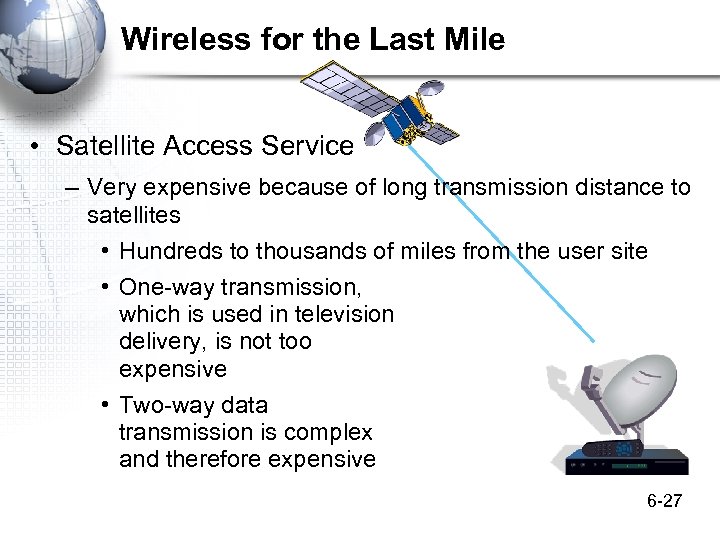 Wireless for the Last Mile • Satellite Access Service – Very expensive because of long transmission distance to satellites • Hundreds to thousands of miles from the user site • One-way transmission, which is used in television delivery, is not too expensive • Two-way data transmission is complex and therefore expensive 6 -27
 The Market Situation 286 -28
 The Market Situation • The Triple Play – The goal of access carriers • Telephony companies • Cable television companies • Wireless access companies – Provide telephony, data, and video in a package – Video is the hardest • People want multiple incoming TV signals • They also want HDTV 6 -29
 The Market Situation • The International Situation – United States ranks 9 th internationally in broadband speed and availability – Korea and Japan provide 500 Mbps speeds or faster at prices comparable to U. S. prices (for lower speeds) – Leadership in speed brings leadership in applications – See link at the bottom of the page for a recent report. 6 -30