


 Скачать презентацию VOICES FROM THE VANGUARD Scenarios from Africa Kate
288604ba2b5301f89602fc61314b59a7.ppt
- Количество слайдов: 33
 VOICES FROM THE VANGUARD: Scenarios from Africa Kate Winskell, Ph. D, Center for Health, Culture and Society, and Hubert Department of Global Health, Emory University, and Daniel Enger, Global Dialogues
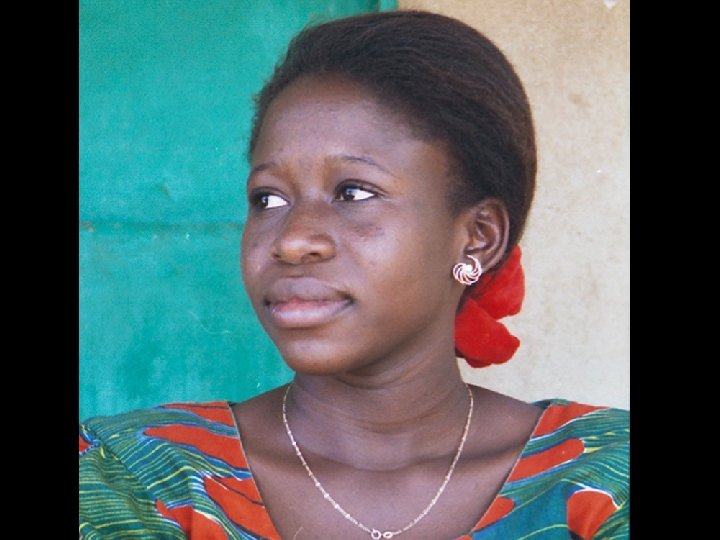
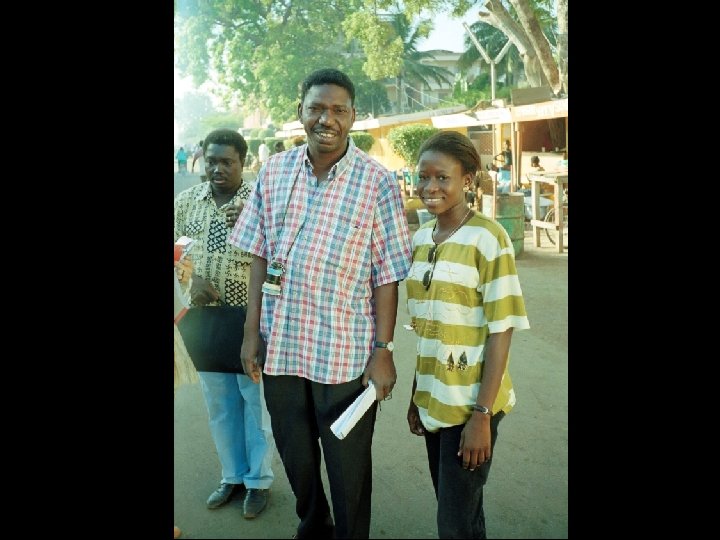
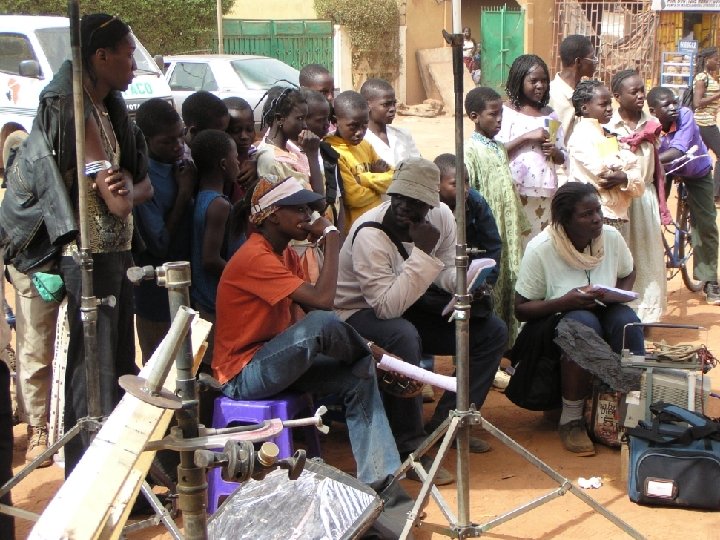
 Scenarios from Africa • A community mobilization, education and media process, involving hundreds of partners • Carried out with and for young people, originally in Senegal, Mali and Burkina Faso • Running since 1997 with funding from a range of sources. Principal funding partner since 1997 : • Drew inspiration from French project (CRIPS & partners) • Involves the production of short fiction films on HIV/AIDS by leading African directors
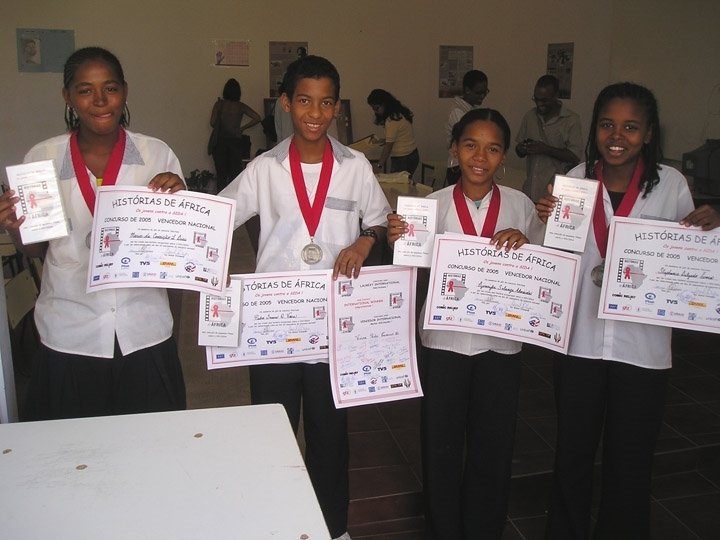
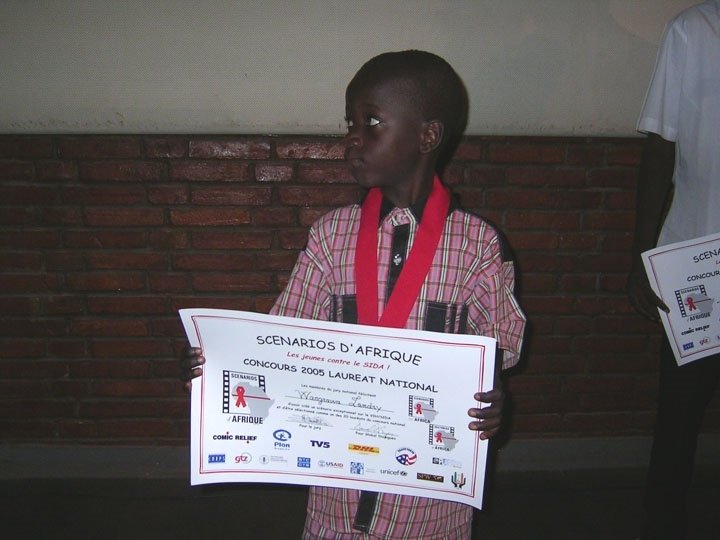
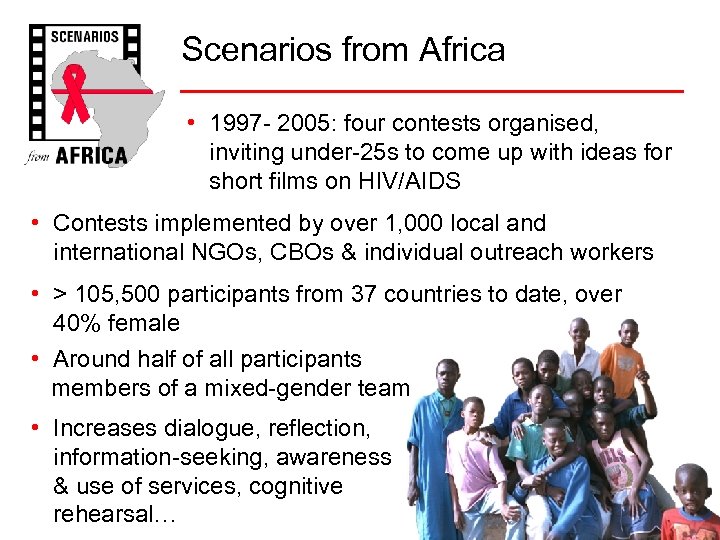 Scenarios from Africa • 1997 - 2005: four contests organised, inviting under-25 s to come up with ideas for short films on HIV/AIDS • Contests implemented by over 1, 000 local and international NGOs, CBOs & individual outreach workers • > 105, 500 participants from 37 countries to date, over 40% female • Around half of all participants members of a mixed-gender team • Increases dialogue, reflection, information-seeking, awareness & use of services, cognitive rehearsal…
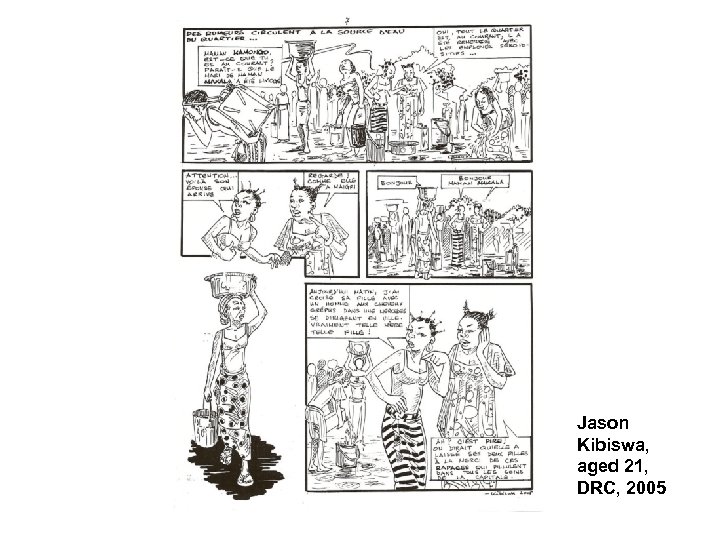 Jason Kibiswa, aged 21, DRC, 2005
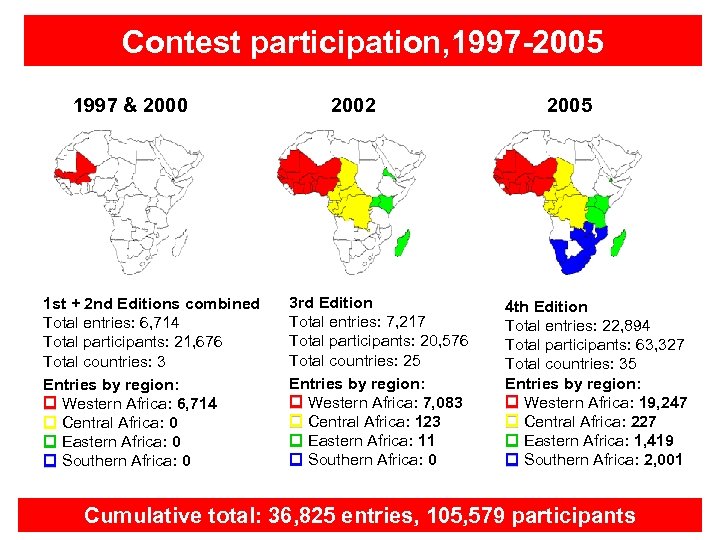 Contest participation, 1997 -2005 1997 & 2000 1 st + 2 nd Editions combined Total entries: 6, 714 Total participants: 21, 676 Total countries: 3 Entries by region: Western Africa: 6, 714 Central Africa: 0 Eastern Africa: 0 Southern Africa: 0 2002 3 rd Edition Total entries: 7, 217 Total participants: 20, 576 Total countries: 25 Entries by region: Western Africa: 7, 083 Central Africa: 123 Eastern Africa: 11 Southern Africa: 0 2005 4 th Edition Total entries: 22, 894 Total participants: 63, 327 Total countries: 35 Entries by region: Western Africa: 19, 247 Central Africa: 227 Eastern Africa: 1, 419 Southern Africa: 2, 001 Cumulative total: 36, 825 entries, 105, 579 participants
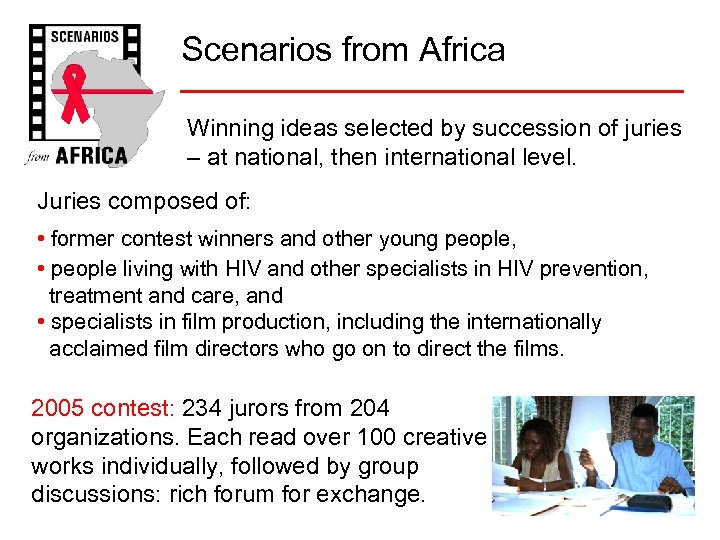 Scenarios from Africa Winning ideas selected by succession of juries – at national, then international level. Juries composed of: • former contest winners and other young people, • people living with HIV and other specialists in HIV prevention, treatment and care, and • specialists in film production, including the internationally acclaimed film directors who go on to direct the films. 2005 contest: 234 jurors from 204 organizations. Each read over 100 creative works individually, followed by group discussions: rich forum for exchange.
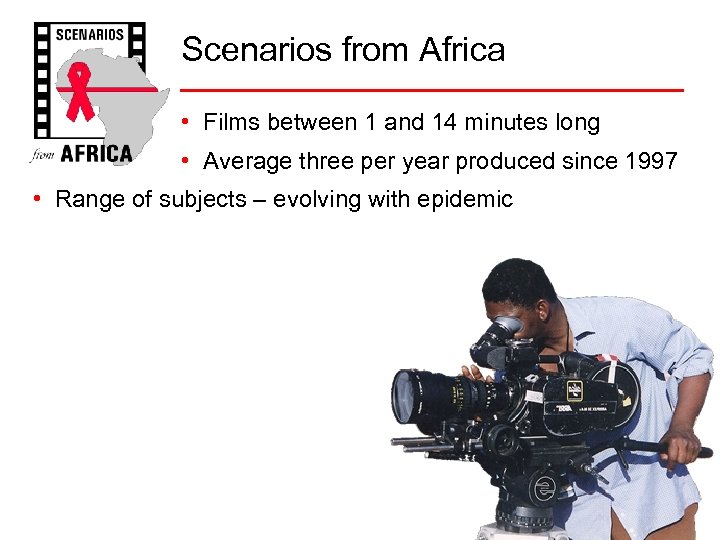 Scenarios from Africa • Films between 1 and 14 minutes long • Average three per year produced since 1997 • Range of subjects – evolving with epidemic
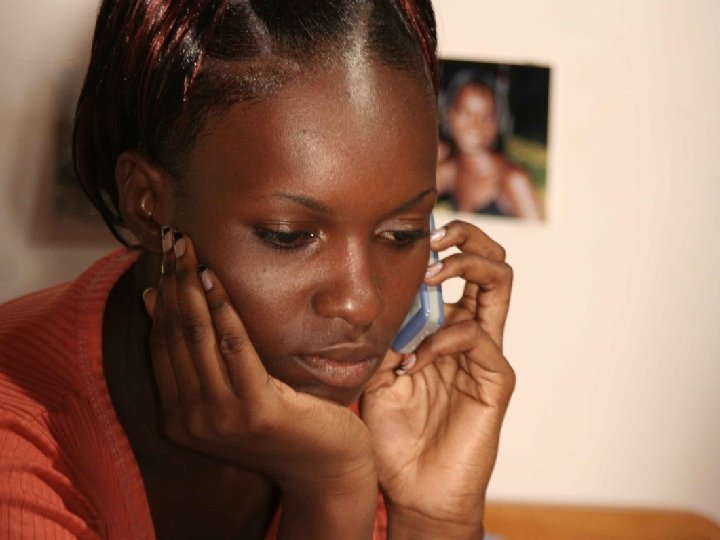
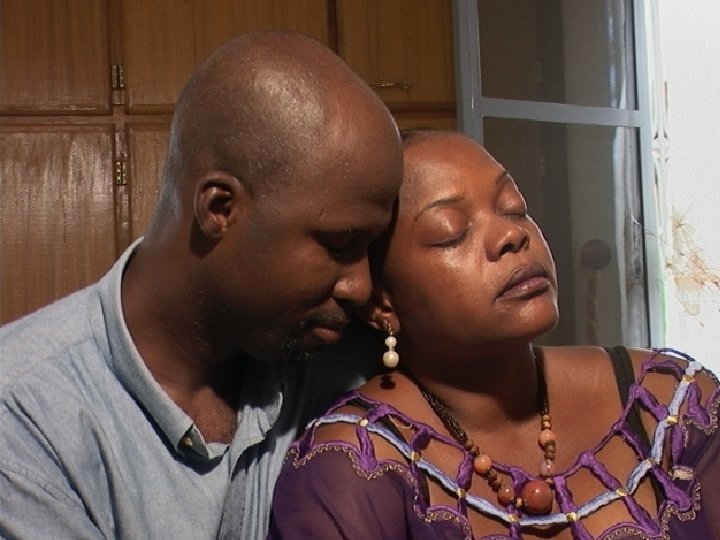
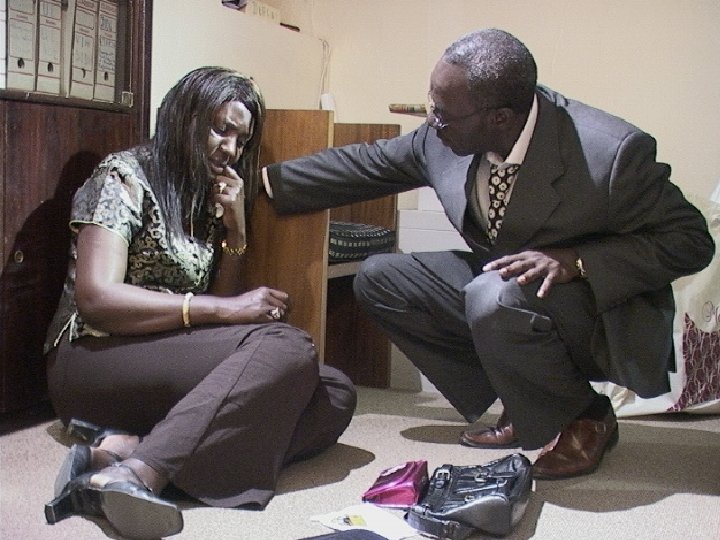
 Scenarios from Africa • Films between 1 and 14 minutes long • Average three per year produced since 1997 • Range of subjects – evolving with epidemic • Donated to broadcasters; broadcast in almost every country in s. SA, often at prime time • Available in range of European and African languages and sign language • 70, 000+ copies on video, DVD, CD & audio cassette distributed in Africa
 Evaluation ● Range of evaluation activities, both internal and external, including: - pre- and post-contest surveys of young people; - data on service provision especially VCT; - focus group discussions and individual interviews with - participants, mentors, partners; - ethnographic studies; - formative evaluation and pre-testing; - extensive reporting by partner organizations; - empowering exchange evaluation visits between national - coordinators; - analysis of contest scripts…. • Priority: to operate within a culture of learning
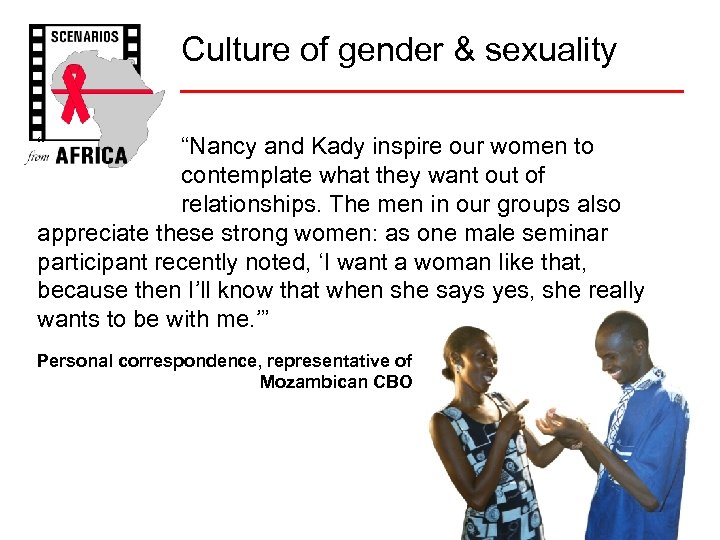 Culture of gender & sexuality “ “Nancy and Kady inspire our women to contemplate what they want out of relationships. The men in our groups also appreciate these strong women: as one male seminar participant recently noted, ‘I want a woman like that, because then I’ll know that when she says yes, she really wants to be with me. ’” Personal correspondence, representative of Mozambican CBO
 Empowerment of vulnerable groups “Far too often, we’re considered to be ‘risk groups’ by practically everybody involved in HIV/AIDS. For us, taking part in this contest is a way to tell all of them that we are every bit as aware of AIDS as they are, and just as committed to doing something about it, and we owe it to ourselves to protect ourselves. ” Young commercial sex worker, Burkina Faso "Scenarios from Africa is reaching every corner of the continent, changing attitudes towards those of us who live with the virus – and WE are at the heart of it all! You can't imagine what that means to us. It makes us feel so useful, so strong. " Person living with HIV, Burkina Faso
 Capacity as social & symbolic capital • forges links between diverse groups and links small groups into broader networks of influence • lends new and lesser-known organizations visibility and credibility • allows young people to identify, value, and use local resources and services • empowers young people and organizations by providing them with the symbolic capital of having their voices heard • identifies them as vectors of social change, thereby reinforcing their civic engagement and building collective efficacy
 Capacity as political participation “A girl who watched Scenarios films during the contest was very moved by the situation of AIDS orphans. So, she wrote a letter to the President of the Republic, asking that more be done on behalf of orphans and vulnerable children. ” (Contest report, Senegal, 2005)
 Story starters for 2007 -8 Contest 1. Write a story for a very short, fast-moving film involving HIV/AIDS and football - a film that you would like to see on TV during halftime of matches in the 2010 World Cup in South Africa. 2. Imagine that you had magical powers for a day, and just by lifting a finger you could change things in your community, in your culture, that make people vulnerable to HIV infection. Tell a story that describes what you would change and what your new world would be like. 3. Your best friend is living with HIV but refuses to get any help or treatment because he is afraid of how people might react if they knew. Stigma, rejection and discrimination - or at least your friend's fear of those things - could kill him. What do you do?
 • The contest invited participants to put themselves in the shoes of a person living with HIV as he or she looks in the mirror and to contemplate what reasons for hope or “reasons for a smile” that person might have. The winning ideas were collated and people living with HIV/AIDS judged these imaginings in light of their own personal experience and then suggested adaptations to the script. The ultimate arbiters of the shape and content of the script were the four individuals featured in the film. They live with HIV and dedicate their lives to helping others avoid or live with infection. • It is crucial that social representations of HIV/AIDS evolve to incorporate the perspectives of PLWHA. The Scenarios process strives to provide a forum for people living with HIV to give public voice to their own reclaimed narratives and through the medium of film to disseminate those new cultural narratives of what it means to live with HIV to broader audiences. PLWHA members of the Scenarios team serve as key mentors to young contest participants. We contend that through the co-construction of new social representations in narrative, their negotiation through dialogue at community level and their dissemination through the media, the cycle of reproduction of negative cultural discourses can be undermined.
 Personal and community empowerment “…The characters embody our own—often hidden—struggles and emotions, and give an example of how we too may respond. They portray a very real world—an African world, where HIV is raging and heroes are learning to fight back. ” Personal correspondence, representative of Mozambican CBO www. globaldialogues. org
 Thank you! www. globaldialogues. org

 Scenarios from Africa Evaluation Challenges • Multiple components • Contest participants self-select; impact extends beyond participants • Broadcasts full coverage: no control • Airtime donated: no way of knowing in advance when or how often films will be aired • Dynamic environment: impossible to isolate impact from that of other program or partners • Limited local evaluation capacity; need for ownership • Budgetary constraints (small NGO)
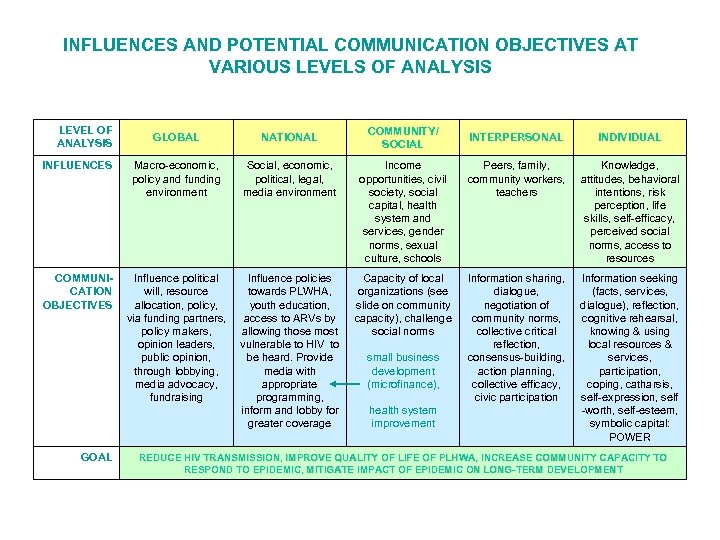 INFLUENCES AND POTENTIAL COMMUNICATION OBJECTIVES AT VARIOUS LEVELS OF ANALYSIS LEVEL OF ANALYSIS GLOBAL NATIONAL INFLUENCES Macro-economic, policy and funding environment Social, economic, political, legal, media environment COMMUNICATION OBJECTIVES Influence political will, resource allocation, policy, via funding partners, policy makers, opinion leaders, public opinion, through lobbying, media advocacy, fundraising Influence policies towards PLWHA, youth education, access to ARVs by allowing those most vulnerable to HIV to be heard. Provide media with appropriate programming, inform and lobby for greater coverage GOAL COMMUNITY/ SOCIAL INTERPERSONAL INDIVIDUAL Income opportunities, civil society, social capital, health system and services, gender norms, sexual culture, schools Peers, family, community workers, teachers Knowledge, attitudes, behavioral intentions, risk perception, life skills, self-efficacy, perceived social norms, access to resources Capacity of local organizations (see slide on community capacity), challenge social norms Information sharing, dialogue, negotiation of community norms, collective critical reflection, consensus-building, action planning, collective efficacy, civic participation Information seeking (facts, services, dialogue), reflection, cognitive rehearsal, knowing & using local resources & services, participation, coping, catharsis, self-expression, self -worth, self-esteem, symbolic capital: POWER small business development (microfinance), health system improvement REDUCE HIV TRANSMISSION, IMPROVE QUALITY OF LIFE OF PLHWA, INCREASE COMMUNITY CAPACITY TO RESPOND TO EPIDEMIC, MITIGATE IMPACT OF EPIDEMIC ON LONG-TERM DEVELOPMENT
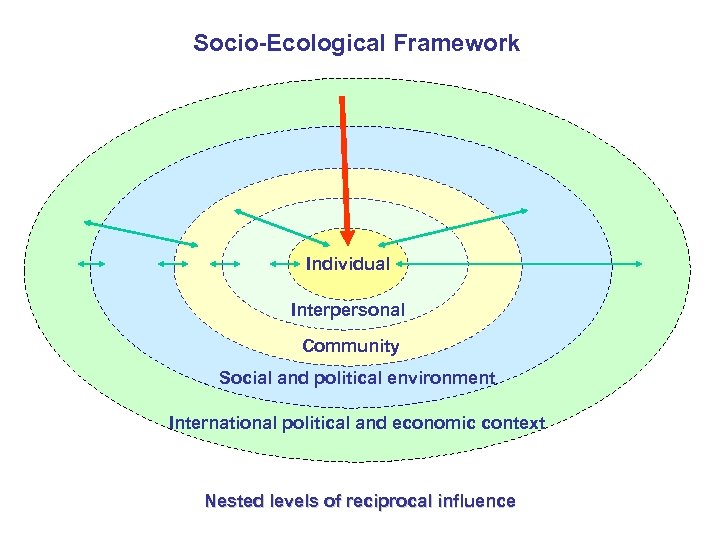 Socio-Ecological Framework Individual Interpersonal Community Social and political environment International political and economic context Nested levels of reciprocal influence