


 Скачать презентацию Voice over IP Andreas Mettis University of Cyprus
41f2e181c966b360c26bdcfe21703d9e.ppt
- Количество слайдов: 41
 Voice over IP Andreas Mettis University of Cyprus November 23, 2004
 Overview What is Vo. IP and how it works. l Reduction of voice quality. l Quality of Service for Vo. IP l
 Vo. IP (voice over IP - that is, voice delivered using the Internet Protocol) is a term used in IP telephony for a set of facilities for managing the delivery of voice information using the Internet Protocol (IP). In general, this means sending voice information in digital form in discrete packets rather than in the traditional circuit-committed protocols of the public switched telephone network (PSTN).
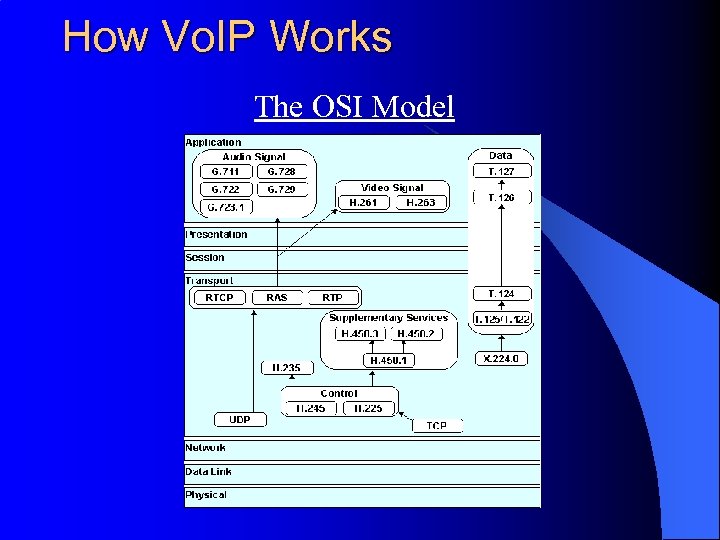 How Vo. IP Works The OSI Model
 Analog to Digital Voice is nothing but air vibration. l The microphone converts this vibration into an equivalent variation of an electrical current. l The amplitude of this current is measured 8000 times every second. l Each reading is coded in binary (ones and zeros). l Each code is made up of 8 bits. l
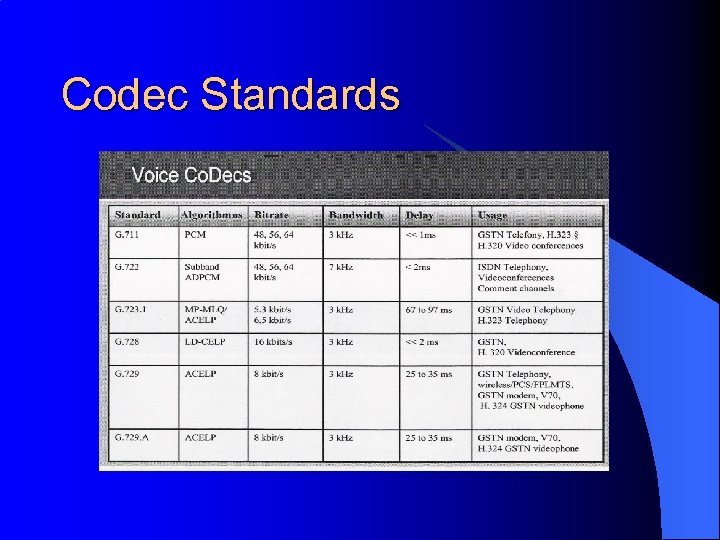 Codec Standards
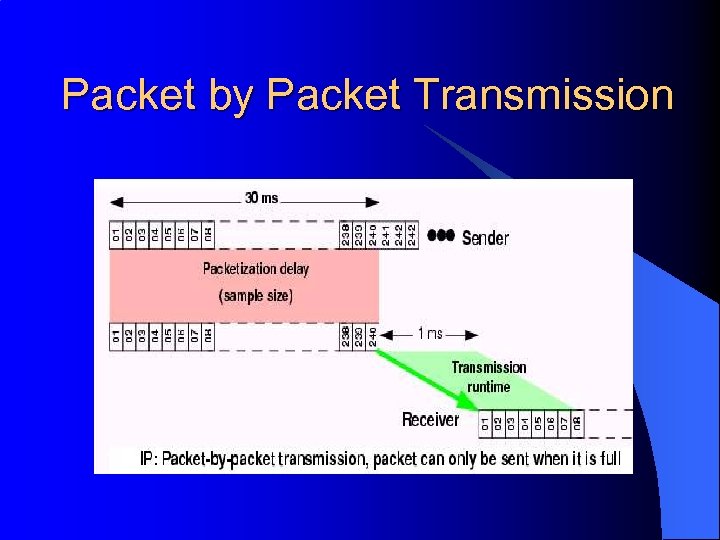 Packet by Packet Transmission
 Transport Layer The Real-time Transport (RTP) Protocol provides end-to-end network transport functions suitable for applications transmitting real-time data such as audio, video or simulation data, over multicast or unicast network services. l RTP does not address resource reservation and does not guarantee quality-of-service for real-time services. l
 Transport Layer The User Datagram Protocol (UDP), provides a simple, but unreliable message service for transaction-oriented services. l Each UDP header carries both a source port identifier and destination port identifier, allowing high-level protocols to target specific applications and services among hosts. l
 Network Layer The Internet Protocol (IP), is the routing layer datagram service of the TCP/IP suite. The IP is used to route packets from host to host. l The IP packet header contains routing information and control information associated with datagram delivery. l
 Data Link/ Physical Layer The Ethernet header is attached to the Vo. IP frame. l At the Physical Layer the data are sent from the sender to the receiver. l
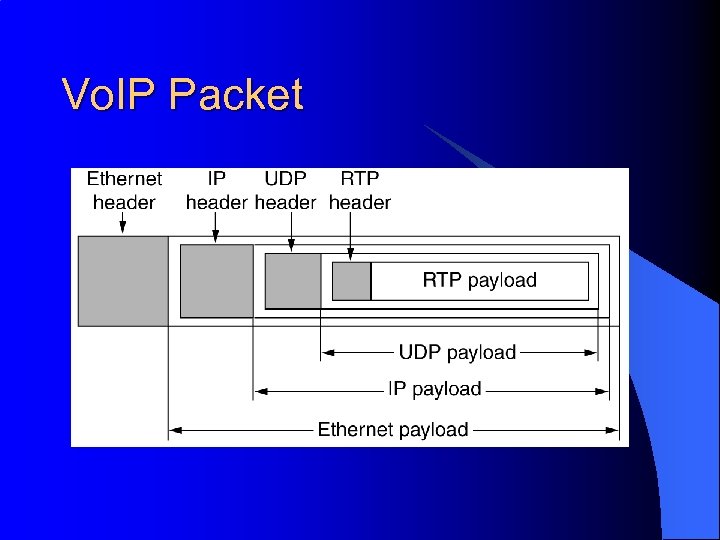 Vo. IP Packet
 Reduction of voice quality
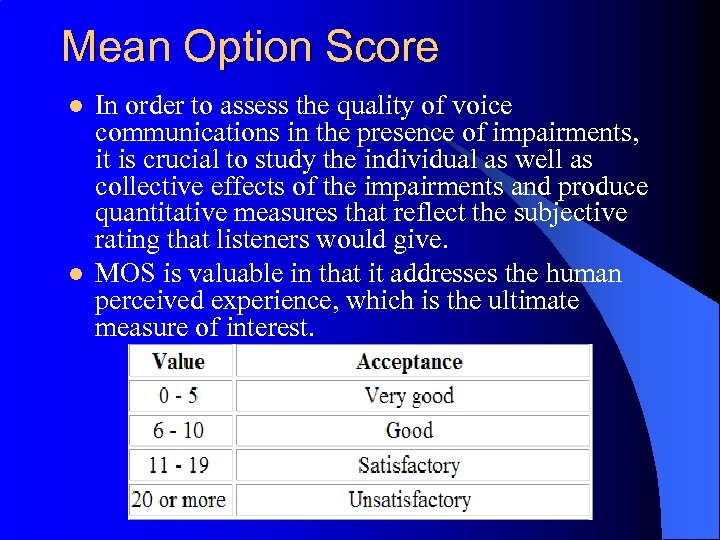 Mean Option Score l l In order to assess the quality of voice communications in the presence of impairments, it is crucial to study the individual as well as collective effects of the impairments and produce quantitative measures that reflect the subjective rating that listeners would give. MOS is valuable in that it addresses the human perceived experience, which is the ultimate measure of interest.
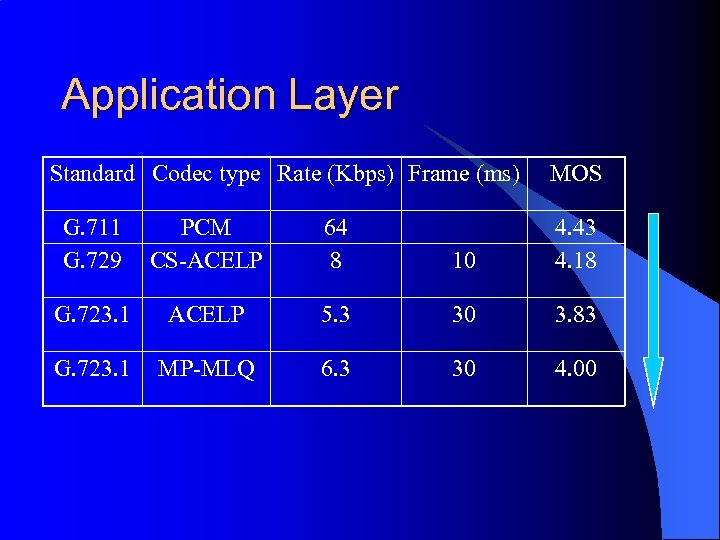 Application Layer Standard Codec type Rate (Kbps) Frame (ms) MOS G. 711 G. 729 PCM CS-ACELP 64 8 10 4. 43 4. 18 G. 723. 1 ACELP 5. 3 30 3. 83 G. 723. 1 MP-MLQ 6. 3 30 4. 00
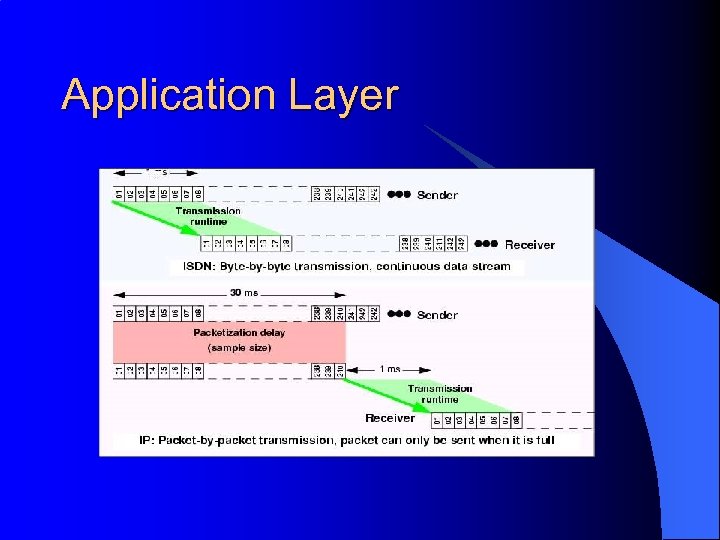 Application Layer
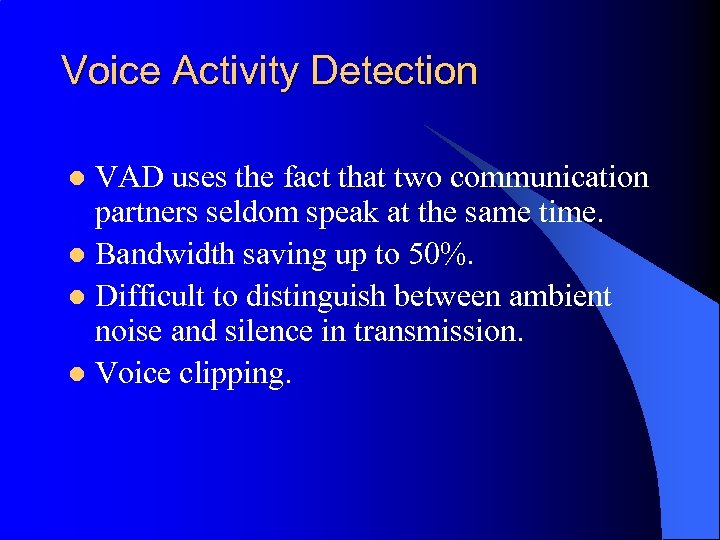 Voice Activity Detection VAD uses the fact that two communication partners seldom speak at the same time. l Bandwidth saving up to 50%. l Difficult to distinguish between ambient noise and silence in transmission. l Voice clipping. l
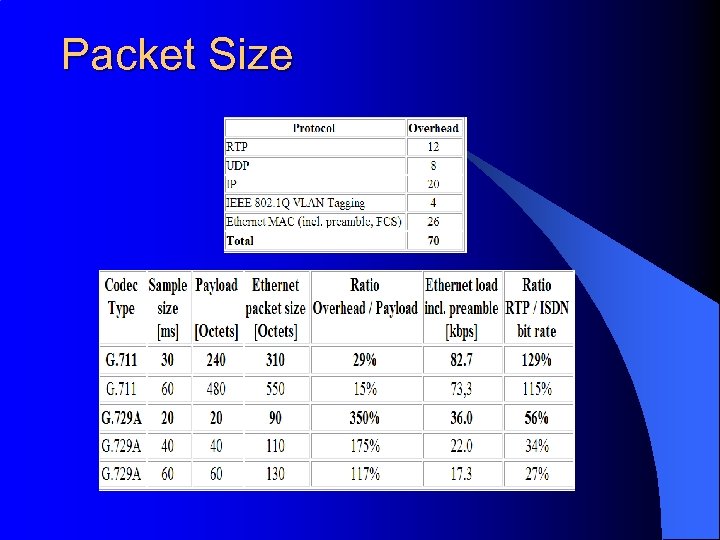 Packet Size
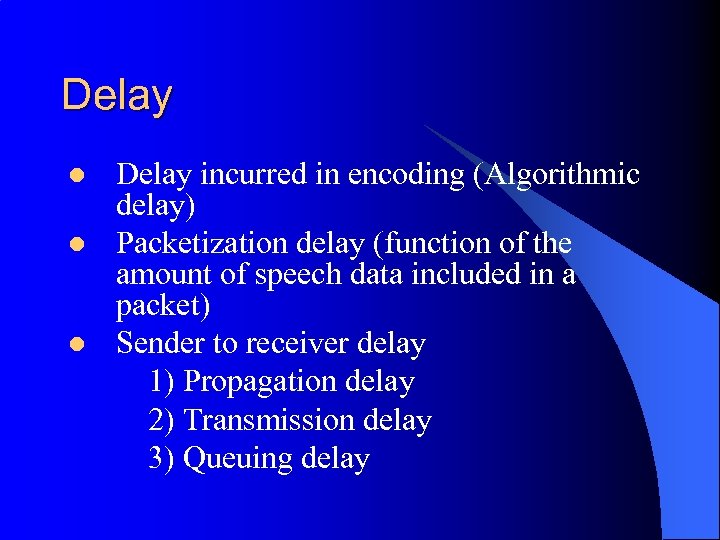 Delay l l l Delay incurred in encoding (Algorithmic delay) Packetization delay (function of the amount of speech data included in a packet) Sender to receiver delay 1) Propagation delay 2) Transmission delay 3) Queuing delay
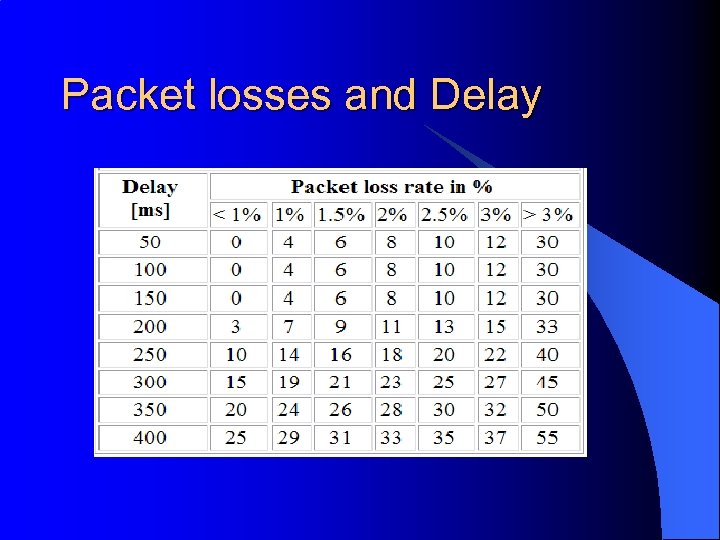 Packet losses and Delay
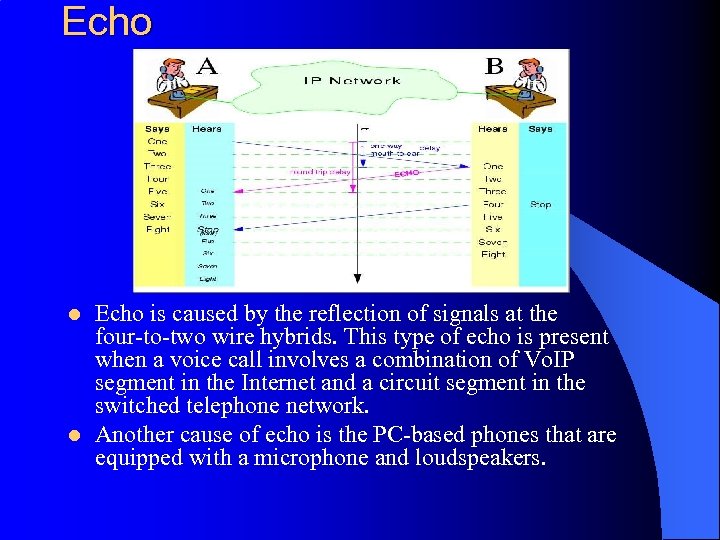 Echo l l Echo is caused by the reflection of signals at the four-to-two wire hybrids. This type of echo is present when a voice call involves a combination of Vo. IP segment in the Internet and a circuit segment in the switched telephone network. Another cause of echo is the PC-based phones that are equipped with a microphone and loudspeakers.
 Why bother about Vo. IP? l MONEY, MO NEY, MONEY, MONEY!!!!!
 Quality of Service
 Algorithms used Echo Cancellation l Loss Recovery: Forward error correction adds redundancy information into voice streams for aiding the loss correction. l Error Concealment: A replacement for a lost packet is produced which is similar to the original lost packet. This is possible because voice signals exhibit large amounts of short-term self similarity. l
 Worst Case Design Advantages l Qo. S is guarantee. Disadvantages l Too expensive. l The utilization is very small.
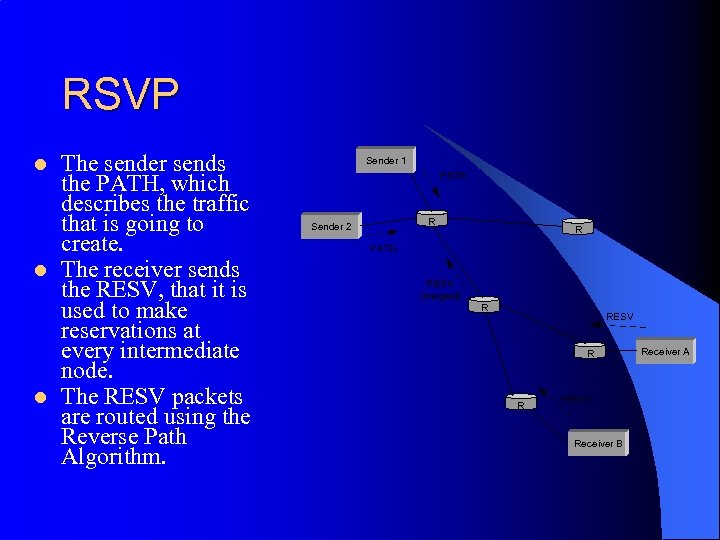 RSVP l l l The sender sends the PATH, which describes the traffic that is going to create. The receiver sends the RESV, that it is used to make reservations at every intermediate node. The RESV packets are routed using the Reverse Path Algorithm. Sender 1 PATH R Sender 2 R PATH RESV (merged) R RESV Receiver B Receiver A
 RSVP Advantages l It is possible to assign bandwidth reliably for each. Vo. IP session. Disadvantages l Some resources remain not used when Vo. IP data has burst character. l The load of routers becomes high and application to a very large scale network becomes difficult.
 Virtual Private Networks Advantages l Qo. S can be high. Disadvantages l Utilization of the network might be low. l Might cause starvation for other Vo. IP traffic.
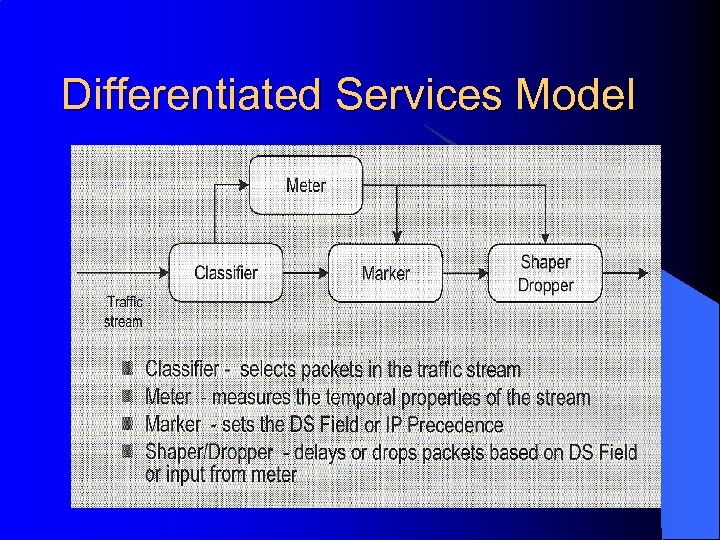 Differentiated Services Model
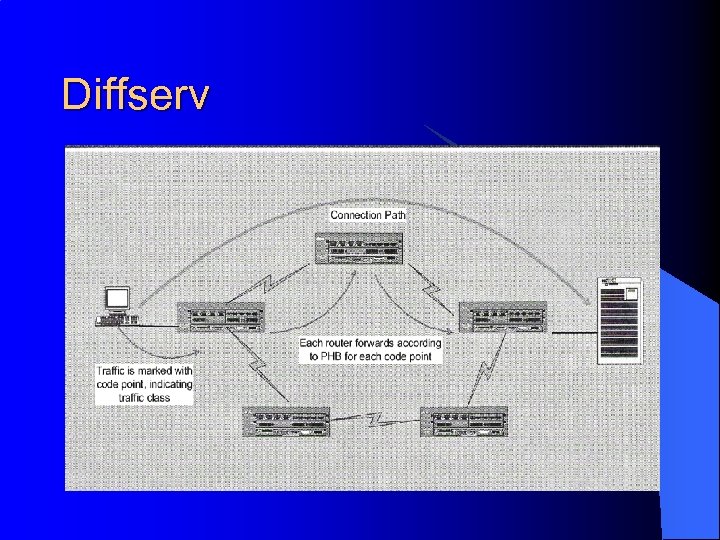 Diffserv
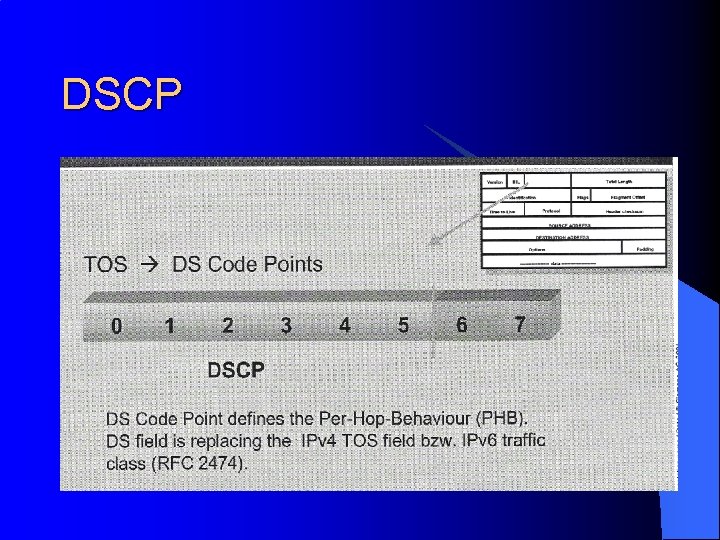 DSCP
DSCP
 DSCP – Expedited Forwarding l EF – PHB ensures a minimum departure rate, independently of any other traffic attempting to transit across the node. l EF – PHB provides a low loss, low jitter assured bandwidth, end to end service through DS domains.
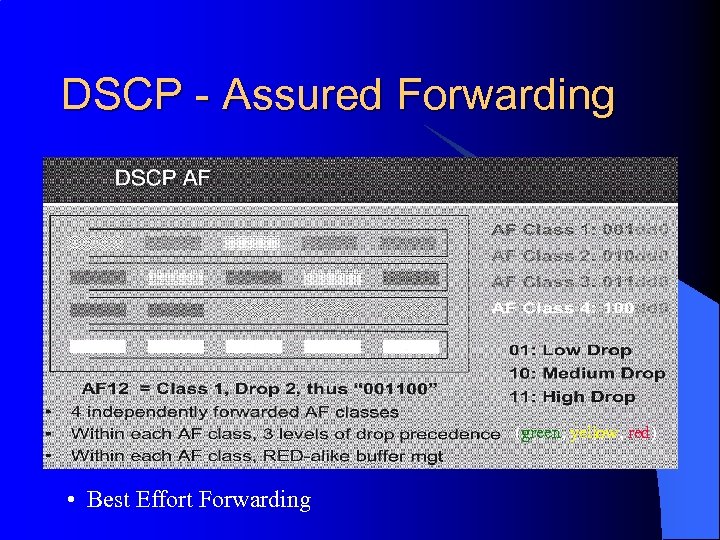 DSCP - Assured Forwarding (green, yellow, red) • Best Effort Forwarding
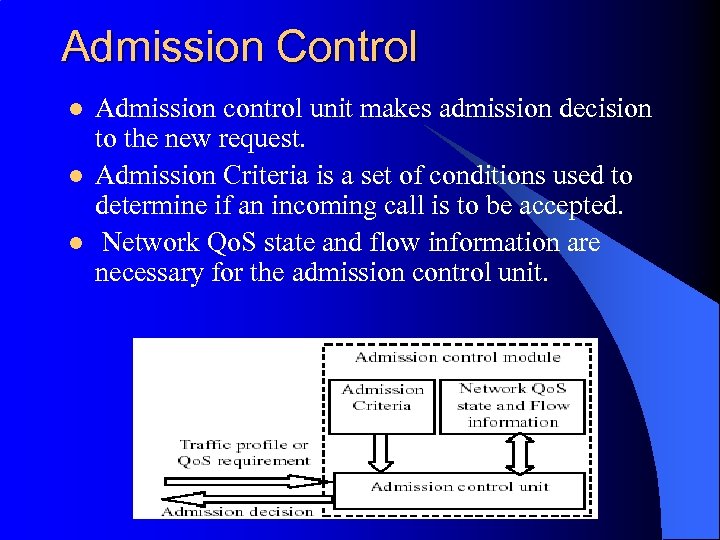 Admission Control l Admission control unit makes admission decision to the new request. Admission Criteria is a set of conditions used to determine if an incoming call is to be accepted. Network Qo. S state and flow information are necessary for the admission control unit.
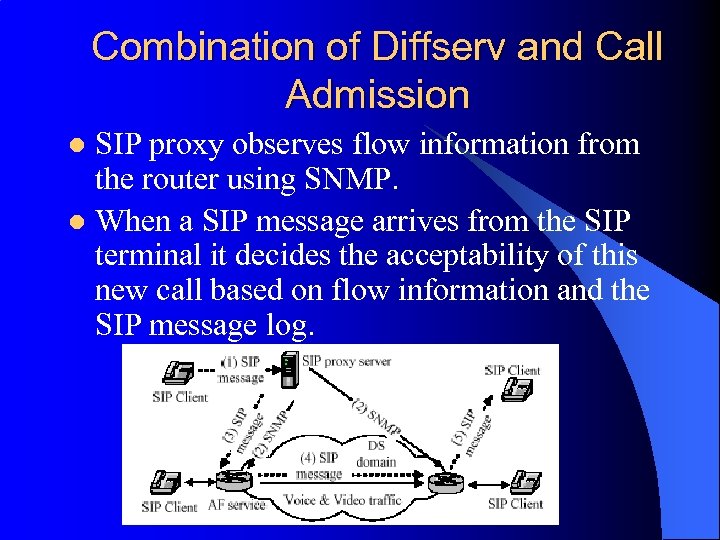 Combination of Diffserv and Call Admission SIP proxy observes flow information from the router using SNMP. l When a SIP message arrives from the SIP terminal it decides the acceptability of this new call based on flow information and the SIP message log. l
 Diffserv Packet Marking Rule Green: Basic data of all communication sessions. l Yellow: Additional data of important sessions. l Red: Additional data of normal sessions. l
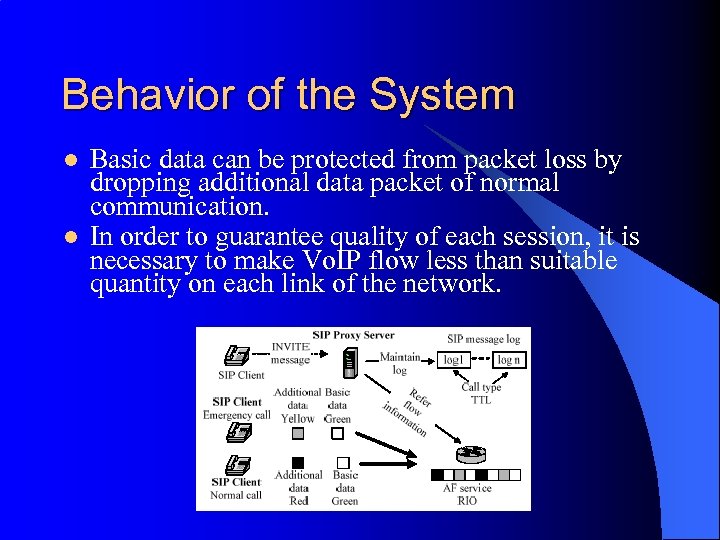 Behavior of the System l l Basic data can be protected from packet loss by dropping additional data packet of normal communication. In order to guarantee quality of each session, it is necessary to make Vo. IP flow less than suitable quantity on each link of the network.
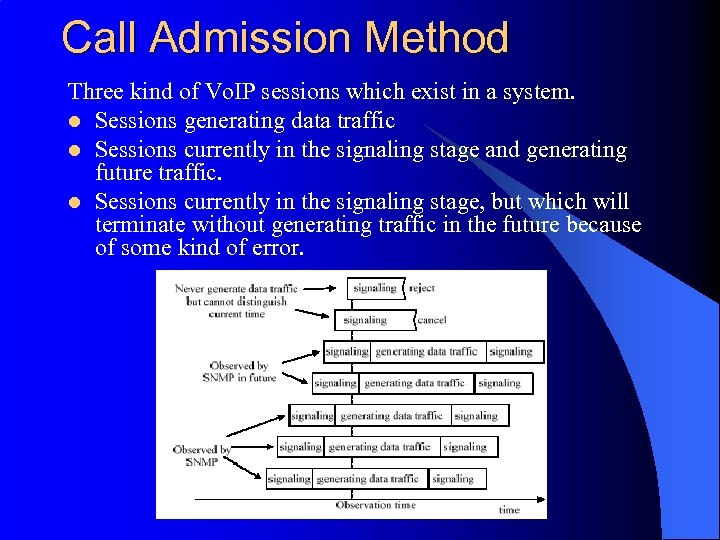 Call Admission Method Three kind of Vo. IP sessions which exist in a system. l Sessions generating data traffic l Sessions currently in the signaling stage and generating future traffic. l Sessions currently in the signaling stage, but which will terminate without generating traffic in the future because of some kind of error.
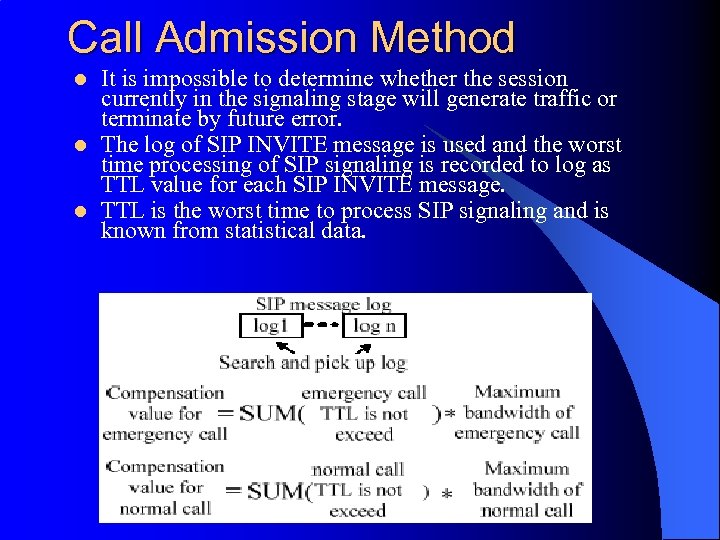 Call Admission Method l l l It is impossible to determine whether the session currently in the signaling stage will generate traffic or terminate by future error. The log of SIP INVITE message is used and the worst time processing of SIP signaling is recorded to log as TTL value for each SIP INVITE message. TTL is the worst time to process SIP signaling and is known from statistical data.
 Conclusions l l Vo. IP is rather easy to implement but difficult to guarantee Qo. S. The combination of Diffserv and Call Admission provide a good mechanism for Qo. S for Vo. IP offers a lower Qo. S compared with the PSTN, and can also offers lower costs to the organizations and people that use it. Still need to find better solutions for providing Qo. S for Vo. IP.
![References l l l l [1] Athina P. Markopoulou, Fouad A. Tobagi and Mansour](https://present5.com/presentation/41f2e181c966b360c26bdcfe21703d9e/image-41.jpg "References l l l l [1] Athina P. Markopoulou, Fouad A. Tobagi and Mansour") References l l l l [1] Athina P. Markopoulou, Fouad A. Tobagi and Mansour J. Karam, “Assessing the Quality of Voice Communications over Internet Backbones”, pp 747 -760, 2003. [2] Xiuzhong Chen, Chunfeng Wang, Dong Xuan, Zhongcheng Li, Yinghua Min and Wei Zhao, “Survey on Qo. S Management of Vo. IP”, Proceedings of the 2003 International Conference on Computer networks and Mobile Computing (ICCNMC’ 03). [3] Masaaki Noro 1, Takahiro KIKUCHI 1, Ken-ichi BABA 2, Hideki SUNAHARA 1, 3, Shinji SHIMOJO, “Qo. S Support for Vo. IP Traffic to Prepare Emergency”, Proceedings of the 2004 International Symposium on Applications and the Internet Workshops (SAINTW’ 04) [4] http: //www. protocols. com/ [5] Dr. Christos Panayiotou lecture notes. [6] Siemens. Information and Communications networks. [7] Hi. Path 4000 V 1. 0, IP Distributed Architecture, Service Manual.
References l l l l [1] Athina P. Markopoulou, Fouad A. Tobagi and Mansour J. Karam, “Assessing the Quality of Voice Communications over Internet Backbones”, pp 747 -760, 2003. [2] Xiuzhong Chen, Chunfeng Wang, Dong Xuan, Zhongcheng Li, Yinghua Min and Wei Zhao, “Survey on Qo. S Management of Vo. IP”, Proceedings of the 2003 International Conference on Computer networks and Mobile Computing (ICCNMC’ 03). [3] Masaaki Noro 1, Takahiro KIKUCHI 1, Ken-ichi BABA 2, Hideki SUNAHARA 1, 3, Shinji SHIMOJO, “Qo. S Support for Vo. IP Traffic to Prepare Emergency”, Proceedings of the 2004 International Symposium on Applications and the Internet Workshops (SAINTW’ 04) [4] http: //www. protocols. com/ [5] Dr. Christos Panayiotou lecture notes. [6] Siemens. Information and Communications networks. [7] Hi. Path 4000 V 1. 0, IP Distributed Architecture, Service Manual.