


 Скачать презентацию Voice in English and Spanish in a typological
19e402d3244a7ff5dfd52e025a19ef90.ppt
- Количество слайдов: 128
 Voice in English and Spanish in a typological perspective Anna Siewierska & Dik Bakker (Lancaster University) Voice English & Spanish 1
 Voice • Voice is primarily concerned with the way event participants are involved in actions, and with the communicative value, or discourse relevance pertaining to the event participants from the nature of this involvement (Shibatani 2006: 219) Voice English & Spanish 2
 Major manifestations • Major manifestations of voice • • • Active vs. Passive Reflexive Middle Antipassive Inverse Events involving two participants which reflect some atypical distribution of properties Voice English & Spanish 3
 The passive • A widely discussed construction • • in linguistic theory cross-linguistically Interesting from a comparative English vs. Spanish perspective Interacts with many other aspects of grammar Voice English & Spanish 4
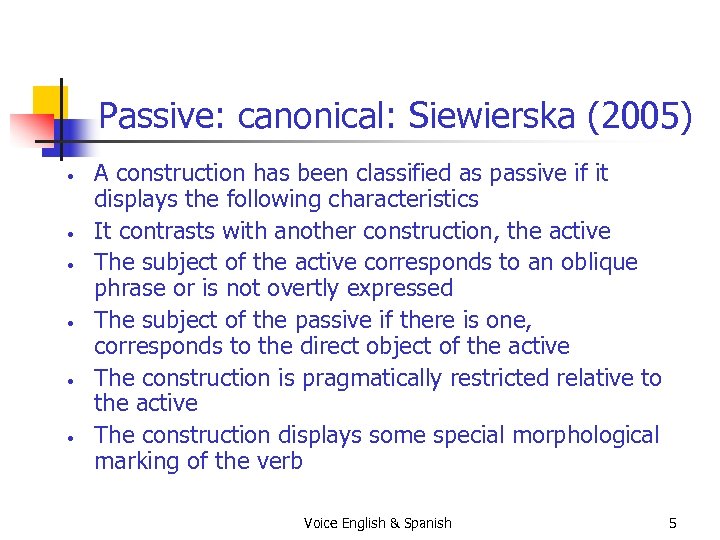 Passive: canonical: Siewierska (2005) • • • A construction has been classified as passive if it displays the following characteristics It contrasts with another construction, the active The subject of the active corresponds to an oblique phrase or is not overtly expressed The subject of the passive if there is one, corresponds to the direct object of the active The construction is pragmatically restricted relative to the active The construction displays some special morphological marking of the verb Voice English & Spanish 5
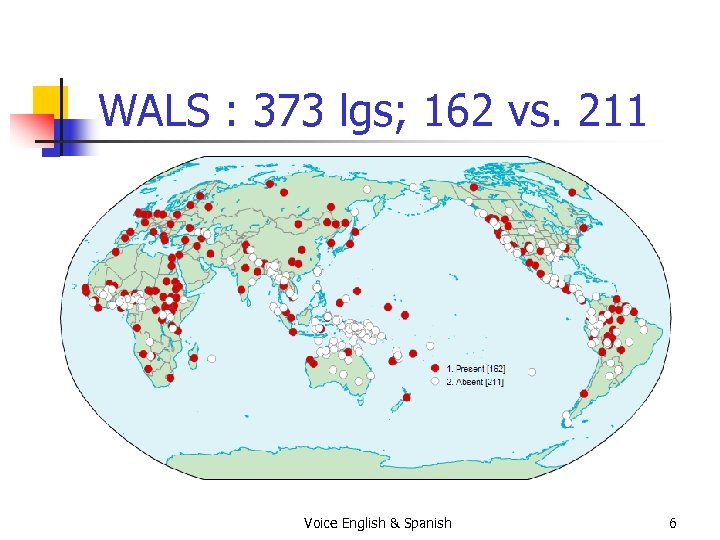 WALS : 373 lgs; 162 vs. 211 Voice English & Spanish 6
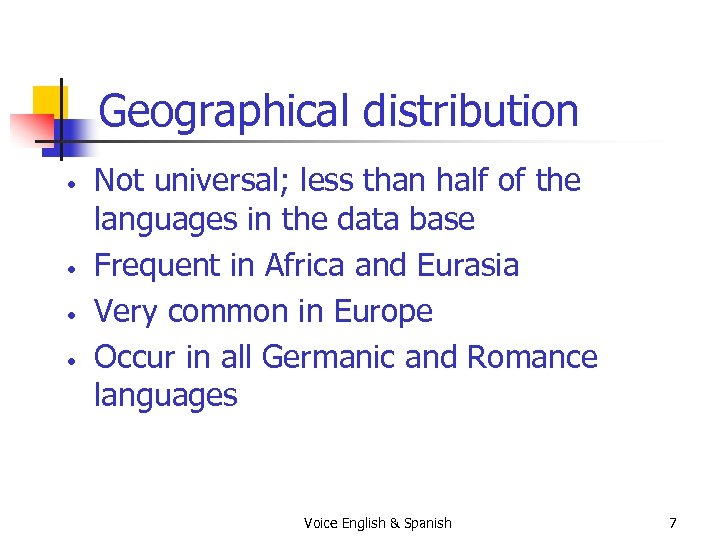 Geographical distribution • • Not universal; less than half of the languages in the data base Frequent in Africa and Eurasia Very common in Europe Occur in all Germanic and Romance languages Voice English & Spanish 7
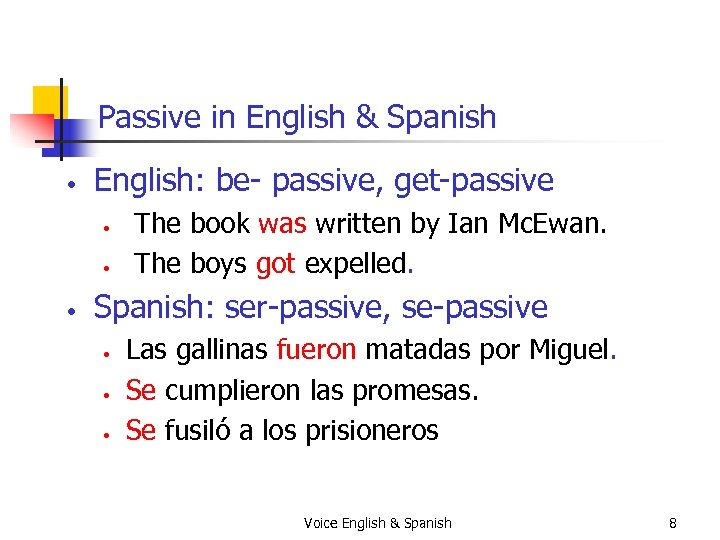 Passive in English & Spanish • English: be- passive, get-passive • • • The book was written by Ian Mc. Ewan. The boys got expelled. Spanish: ser-passive, se-passive • • • Las gallinas fueron matadas por Miguel. Se cumplieron las promesas. Se fusiló a los prisioneros Voice English & Spanish 8
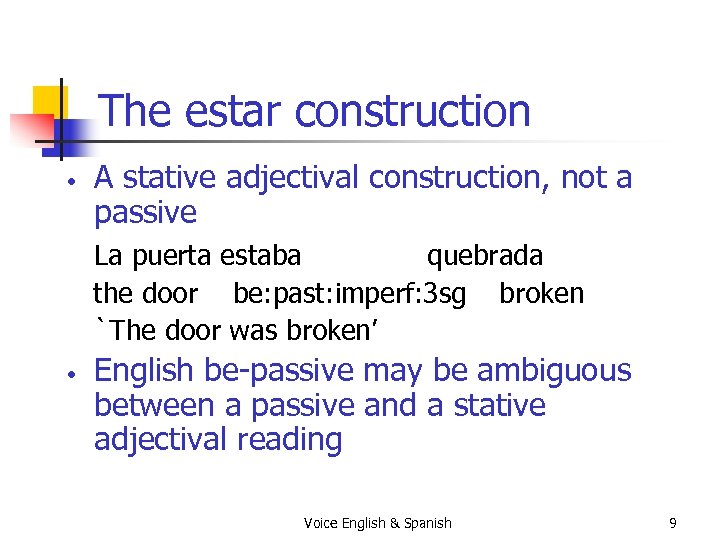 The estar construction • A stative adjectival construction, not a passive La puerta estaba quebrada the door be: past: imperf: 3 sg broken `The door was broken’ • English be-passive may be ambiguous between a passive and a stative adjectival reading Voice English & Spanish 9
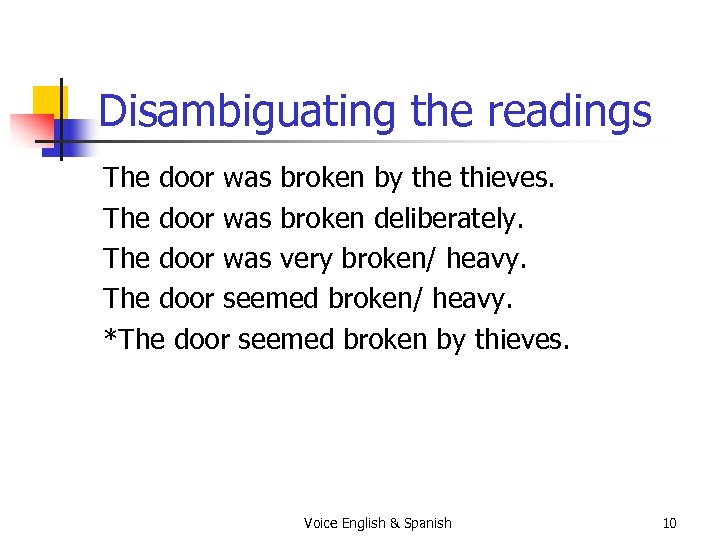 Disambiguating the readings The door was broken by the thieves. The door was broken deliberately. The door was very broken/ heavy. The door seemed broken/ heavy. *The door seemed broken by thieves. Voice English & Spanish 10
 Use of passive: English • • English be- passive: frequency of use depends on text type English get-passive: essentially confined to the spoken language: tied to sociolinguistic factors, class, dialect, age Voice English & Spanish 11
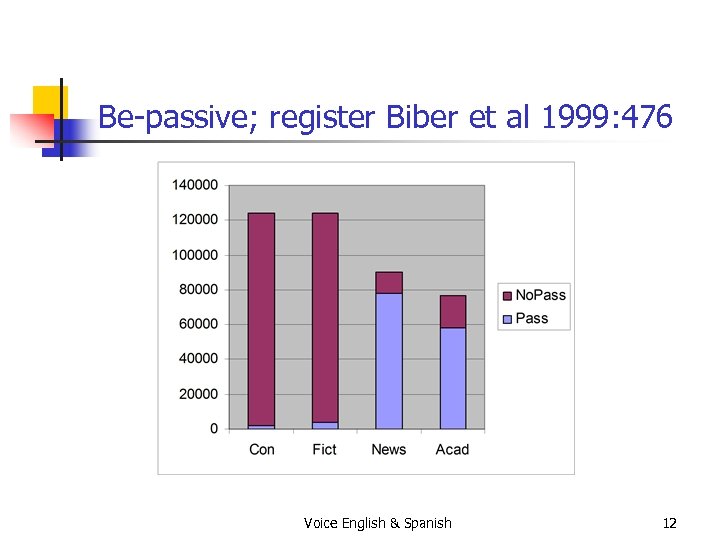 Be-passive; register Biber et al 1999: 476 Voice English & Spanish 12
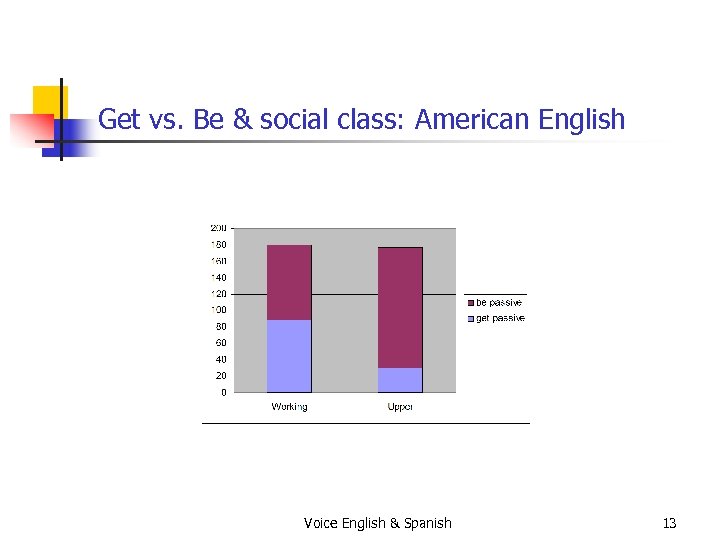 Get vs. Be & social class: American English Voice English & Spanish 13
 Get in earlier stages of English • • • Negative attitude to get not expressed till 1788 (Waterval 1984: 7) 1870 I am by no means certain… that the whole of this amendatory program will get itself performed to equal satisfaction. 1877 One of the most costly, splendid, and elaborate structures in the world got itself built. Voice English & Spanish 14
 Use of passive: Spanish • Ser-passives • • used less frequently than the English be-passive; frequency of use is on the increase Butt & Benjamin (2004: 402) characteristic of the written language but does occur in speech Se-passive • Frequent in speech and writing and in all text types Voice English & Spanish 15
 Classifying passives • • • Nature of verbal marking Presence and type of subject Type of verb Expression of agent Type of agent Voice English & Spanish 16
 Type of verbal marking • • • Synthetic vs. Periphrastic Synthetic: cross-linguistically dominant Periphrastic: mainly Indo-European, also Dravidian, Hamito-Semitic, Sinno-Tibetan, Amerindian (South) English: periphrastic passive be and get Spanish: periphrastic passive ser and atypical synthetic passive se; clitic or particle not Voice English & Spanish 17
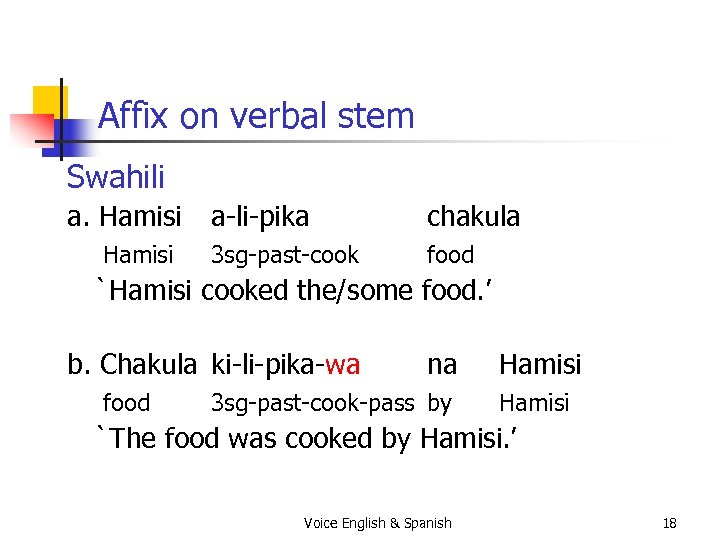 Affix on verbal stem Swahili a. Hamisi a-li-pika chakula 3 sg-past-cook food `Hamisi cooked the/some food. ’ b. Chakula ki-li-pika-wa food na 3 sg-past-cook-pass by Hamisi `The food was cooked by Hamisi. ’ Voice English & Spanish 18
 Type of periphrastic passives • • • Type of Auxiliaries cross-linguistically: be (Urdu, Quechua), become (German, Hindi, Latvian) go (Italian, Gaelic, Bengali) receive/get (Welsh, Tzeltal, German) suffer/undergo (Thai, Cambodian, Burmese, Tamil Kannada), come (Italian, Kurdish, Kashmiri English and Spanish: be English: get Voice English & Spanish 19
 Origin of passive marking • • • Auxiliary verbs Personal pronoun Reflexive marker • • Se-passive Get-passive (indirectly) Voice English & Spanish 20
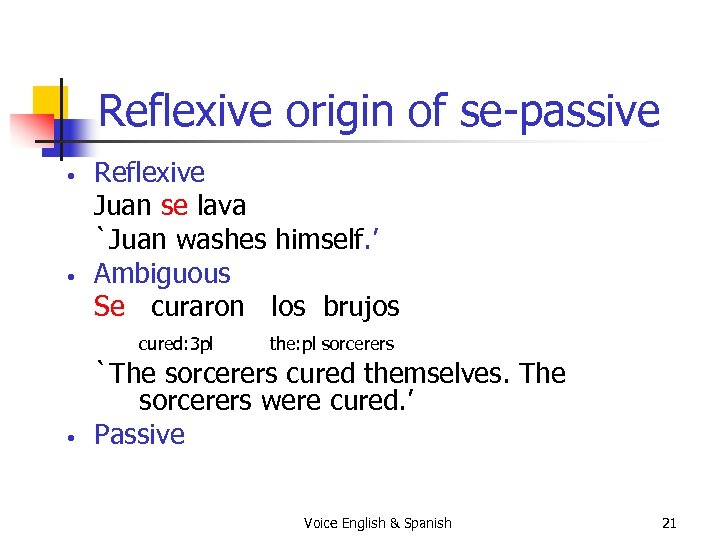 Reflexive origin of se-passive • • Reflexive Juan se lava `Juan washes himself. ’ Ambiguous Se curaron los brujos cured: 3 pl • the: pl sorcerers `The sorcerers cured themselves. The sorcerers were cured. ’ Passive Voice English & Spanish 21
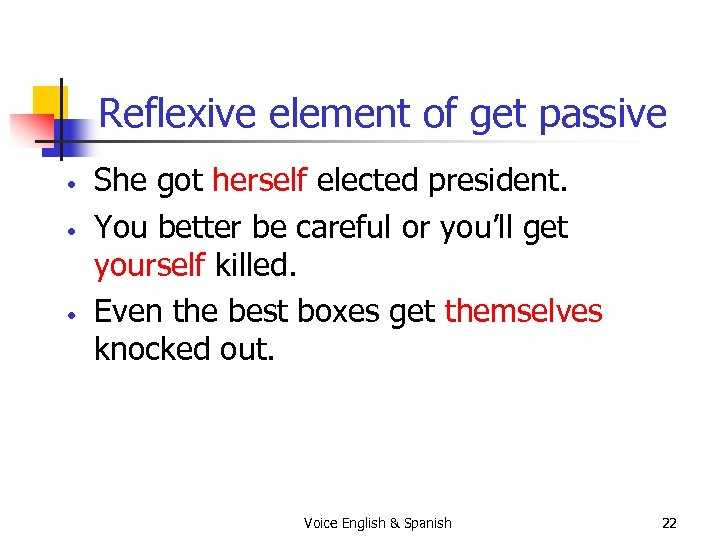 Reflexive element of get passive • • • She got herself elected president. You better be careful or you’ll get yourself killed. Even the best boxes get themselves knocked out. Voice English & Spanish 22
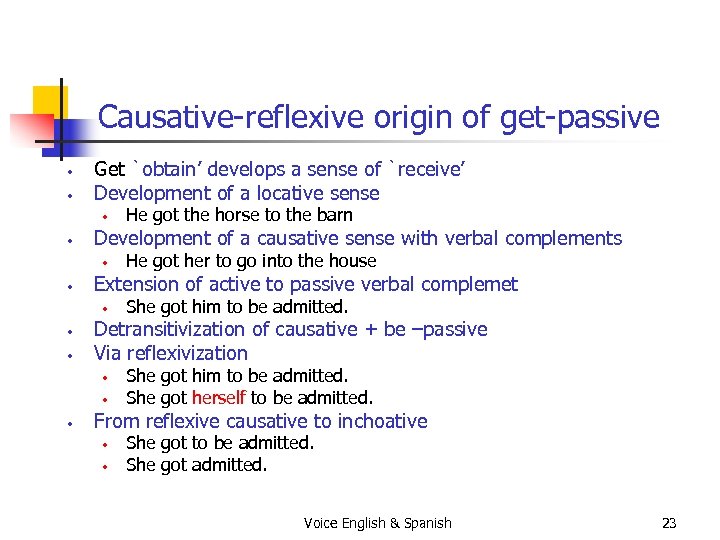 Causative-reflexive origin of get-passive • • Get `obtain’ develops a sense of `receive’ Development of a locative sense • • Development of a causative sense with verbal complements • • • She got him to be admitted. Detransitivization of causative + be –passive Via reflexivization • • • He got her to go into the house Extension of active to passive verbal complemet • • He got the horse to the barn She got him to be admitted. She got herself to be admitted. From reflexive causative to inchoative • • She got to be admitted. She got admitted. Voice English & Spanish 23
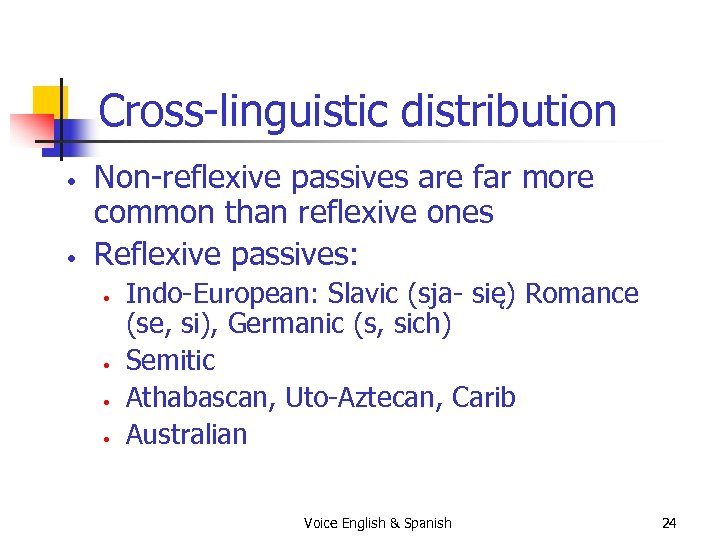 Cross-linguistic distribution • • Non-reflexive passives are far more common than reflexive ones Reflexive passives: • • Indo-European: Slavic (sja- się) Romance (se, si), Germanic (s, sich) Semitic Athabascan, Uto-Aztecan, Carib Australian Voice English & Spanish 24
 Presence & type of subject • • • Presence of overt subject Semantic role of subject Semantic properties of subject Voice English & Spanish 25
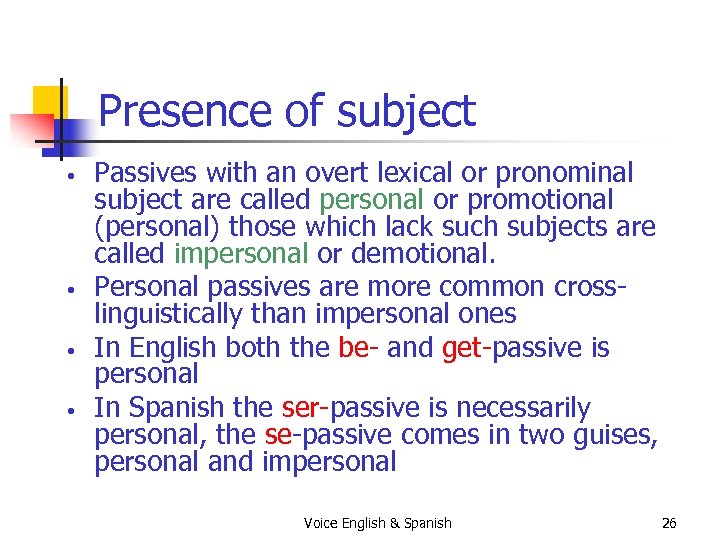 Presence of subject • • Passives with an overt lexical or pronominal subject are called personal or promotional (personal) those which lack such subjects are called impersonal or demotional. Personal passives are more common crosslinguistically than impersonal ones In English both the be- and get-passive is personal In Spanish the ser-passive is necessarily personal, the se-passive comes in two guises, personal and impersonal Voice English & Spanish 26
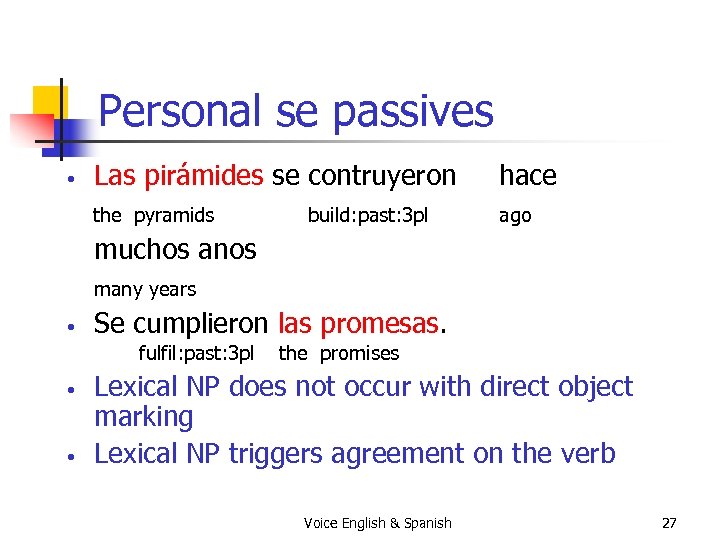 Personal se passives Las pirámides se contruyeron hace the pyramids • ago build: past: 3 pl muchos anos many years • Se cumplieron las promesas. fulfil: past: 3 pl • • the promises Lexical NP does not occur with direct object marking Lexical NP triggers agreement on the verb Voice English & Spanish 27
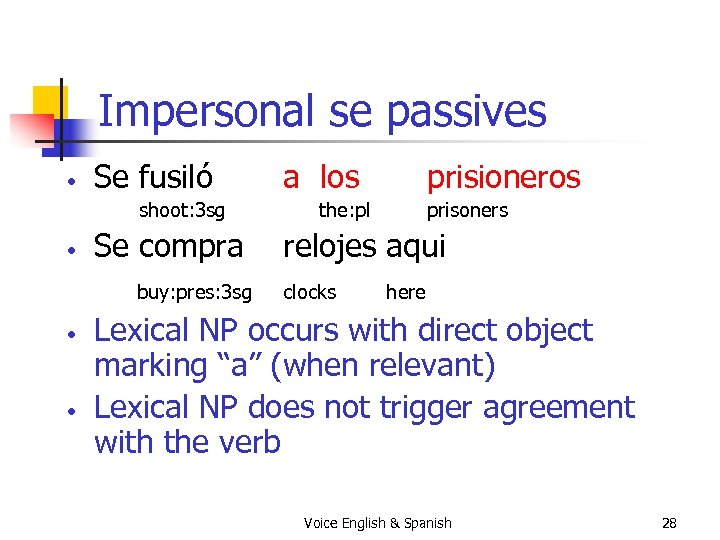 Impersonal se passives • Se fusiló shoot: 3 sg • Se compra buy: pres: 3 sg • • a los prisioneros the: pl prisoners relojes aqui clocks here Lexical NP occurs with direct object marking “a” (when relevant) Lexical NP does not trigger agreement with the verb Voice English & Spanish 28
 Se-passive in varieties of Spanish • Personal se- passives are more common in Iberian Spanish than in Latin. American Spanish Voice English & Spanish 29
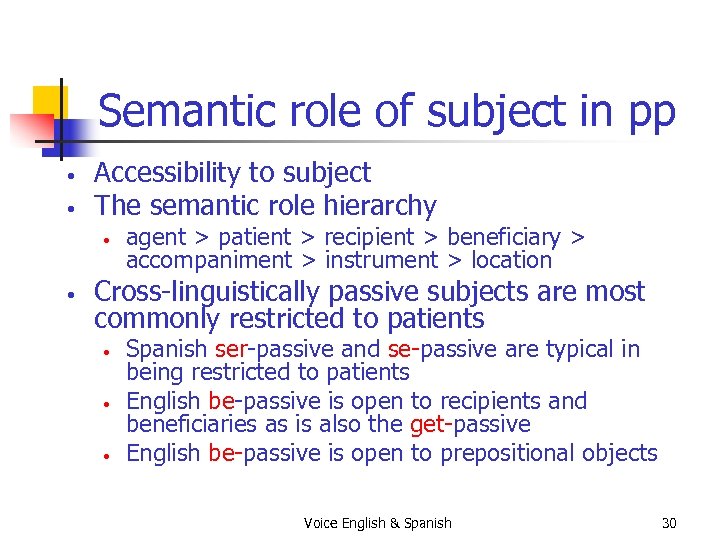 Semantic role of subject in pp • • Accessibility to subject The semantic role hierarchy • • agent > patient > recipient > beneficiary > accompaniment > instrument > location Cross-linguistically passive subjects are most commonly restricted to patients • • • Spanish ser-passive and se-passive are typical in being restricted to patients English be-passive is open to recipients and beneficiaries as is also the get-passive English be-passive is open to prepositional objects Voice English & Spanish 30
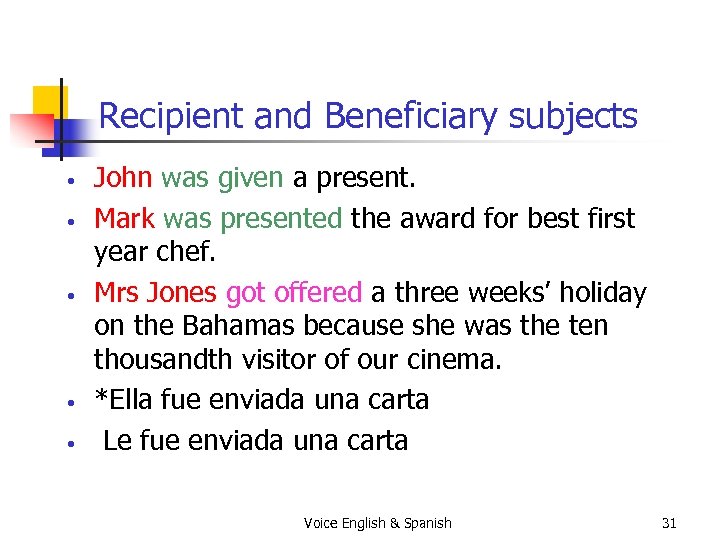 Recipient and Beneficiary subjects • • • John was given a present. Mark was presented the award for best first year chef. Mrs Jones got offered a three weeks’ holiday on the Bahamas because she was the ten thousandth visitor of our cinema. *Ella fue enviada una carta Le fue enviada una carta Voice English & Spanish 31
 How strange is English? • • No other Indo-European language can passivize recipients or benefactives Passivization of recipients and benefactives is possible in • • many Bantu languages a few Western and Central Malayo-Polynesian sporadically in Amerindian languages Japanese Voice English & Spanish 32
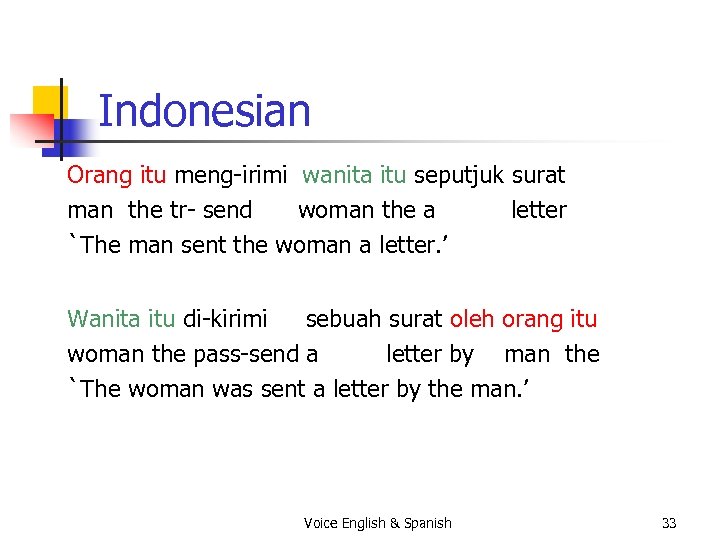 Indonesian Orang itu meng-irimi wanita itu seputjuk surat man the tr- send woman the a letter `The man sent the woman a letter. ’ Wanita itu di-kirimi sebuah surat oleh orang itu woman the pass-send a letter by man the `The woman was sent a letter by the man. ’ Voice English & Spanish 33
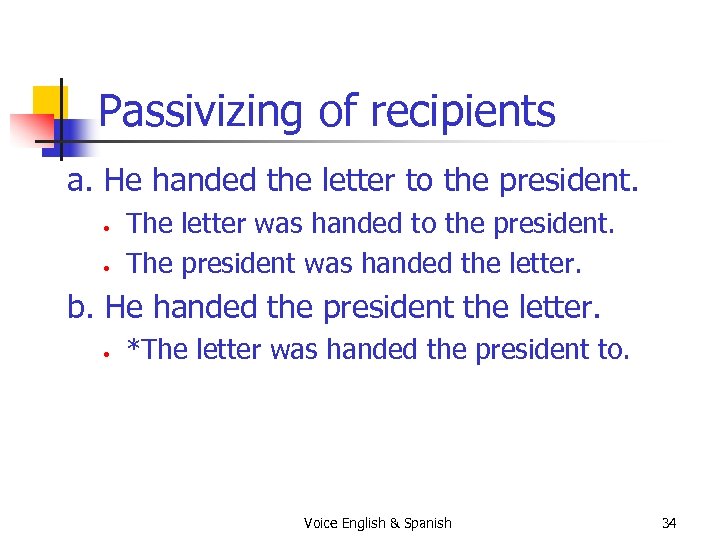 Passivizing of recipients a. He handed the letter to the president. • • The letter was handed to the president. The president was handed the letter. b. He handed the president the letter. • *The letter was handed the president to. Voice English & Spanish 34
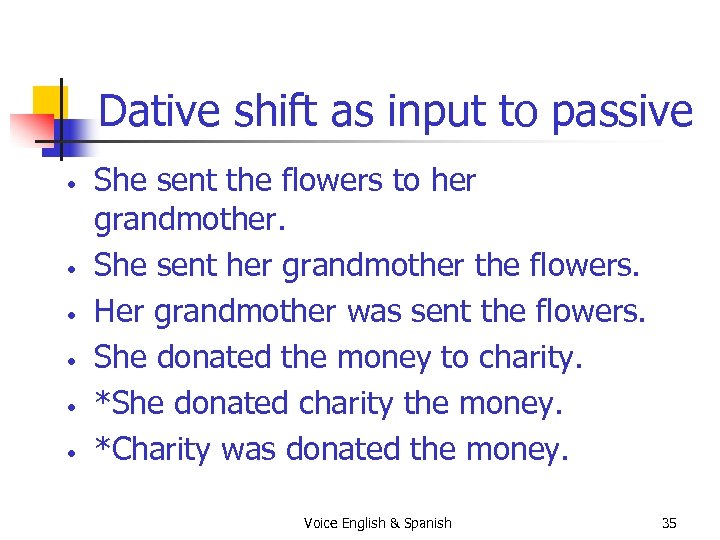 Dative shift as input to passive • • • She sent the flowers to her grandmother. She sent her grandmother the flowers. Her grandmother was sent the flowers. She donated the money to charity. *She donated charity the money. *Charity was donated the money. Voice English & Spanish 35
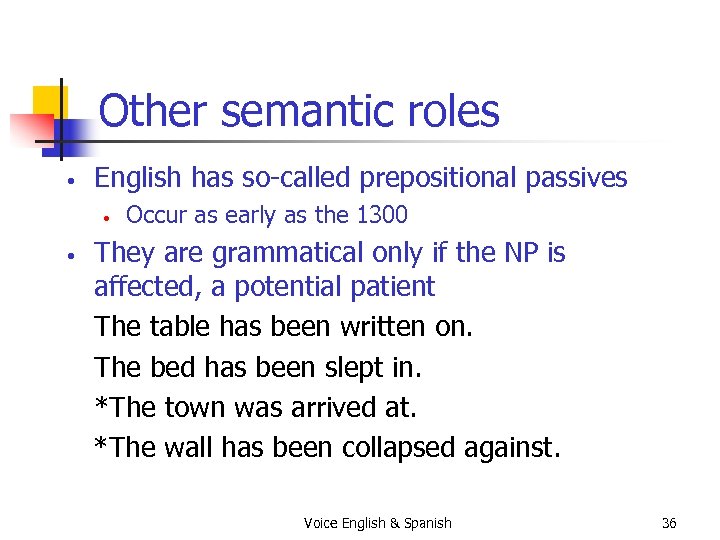 Other semantic roles • English has so-called prepositional passives • • Occur as early as the 1300 They are grammatical only if the NP is affected, a potential patient The table has been written on. The bed has been slept in. *The town was arrived at. *The wall has been collapsed against. Voice English & Spanish 36
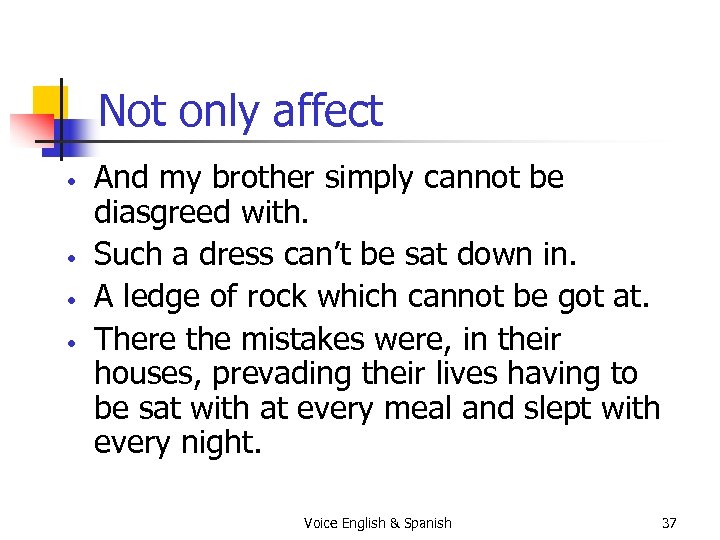 Not only affect • • And my brother simply cannot be diasgreed with. Such a dress can’t be sat down in. A ledge of rock which cannot be got at. There the mistakes were, in their houses, prevading their lives having to be sat with at every meal and slept with every night. Voice English & Spanish 37
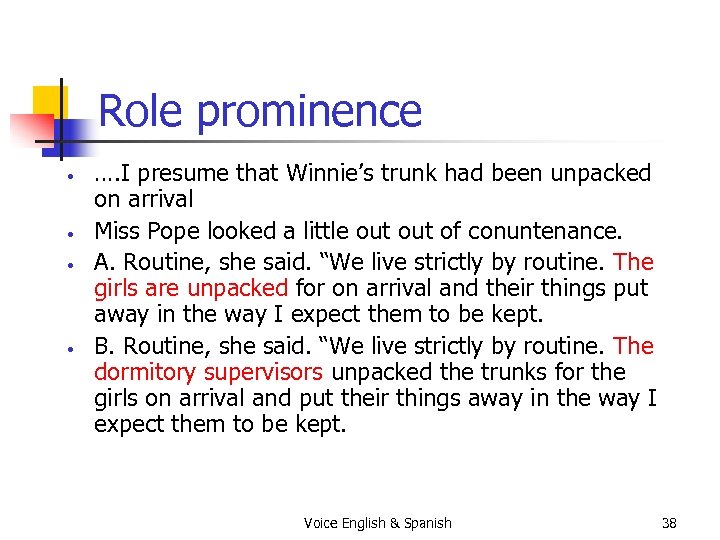 Role prominence • • …. I presume that Winnie’s trunk had been unpacked on arrival Miss Pope looked a little out of conuntenance. A. Routine, she said. “We live strictly by routine. The girls are unpacked for on arrival and their things put away in the way I expect them to be kept. B. Routine, she said. “We live strictly by routine. The dormitory supervisors unpacked the trunks for the girls on arrival and put their things away in the way I expect them to be kept. Voice English & Spanish 38
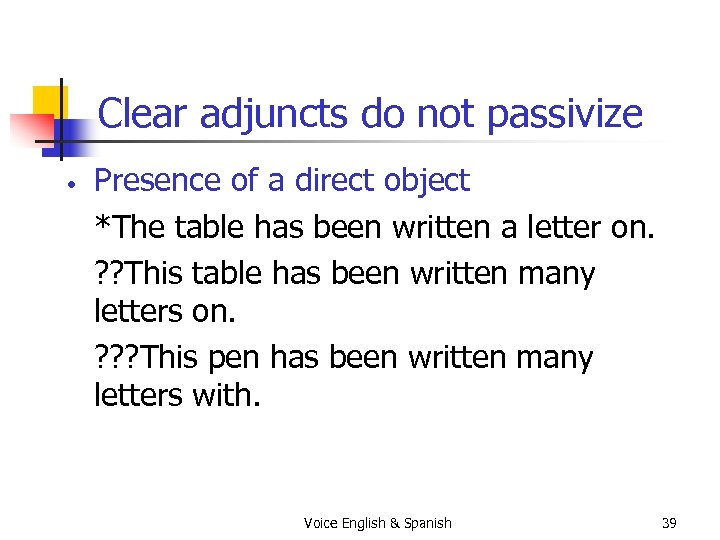 Clear adjuncts do not passivize • Presence of a direct object *The table has been written a letter on. ? ? This table has been written many letters on. ? ? ? This pen has been written many letters with. Voice English & Spanish 39
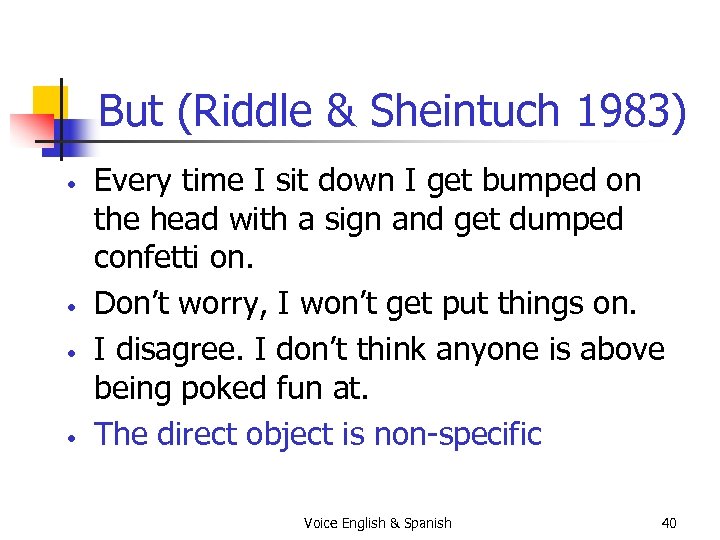 But (Riddle & Sheintuch 1983) • • Every time I sit down I get bumped on the head with a sign and get dumped confetti on. Don’t worry, I won’t get put things on. I disagree. I don’t think anyone is above being poked fun at. The direct object is non-specific Voice English & Spanish 40
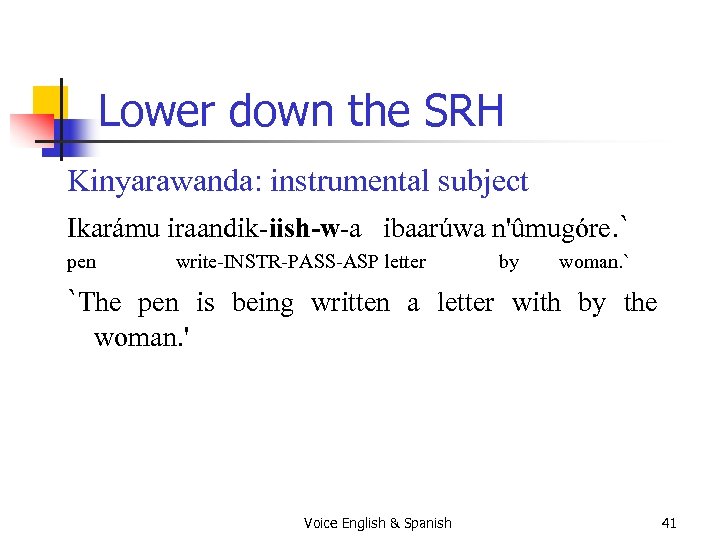 Lower down the SRH Kinyarawanda: instrumental subject Ikarámu iraandik-iish-w-a ibaarúwa n'ûmugóre. ` pen write-INSTR-PASS-ASP letter by woman. ` `The pen is being written a letter with by the woman. ' Voice English & Spanish 41
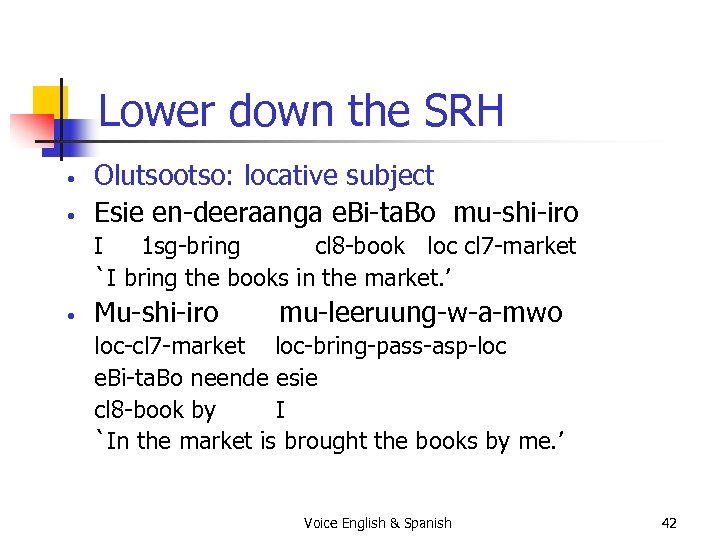 Lower down the SRH • • Olutsootso: locative subject Esie en-deeraanga e. Bi-ta. Bo mu-shi-iro I 1 sg-bring cl 8 -book loc cl 7 -market `I bring the books in the market. ’ • Mu-shi-iro mu-leeruung-w-a-mwo loc-cl 7 -market loc-bring-pass-asp-loc e. Bi-ta. Bo neende esie cl 8 -book by I `In the market is brought the books by me. ’ Voice English & Spanish 42
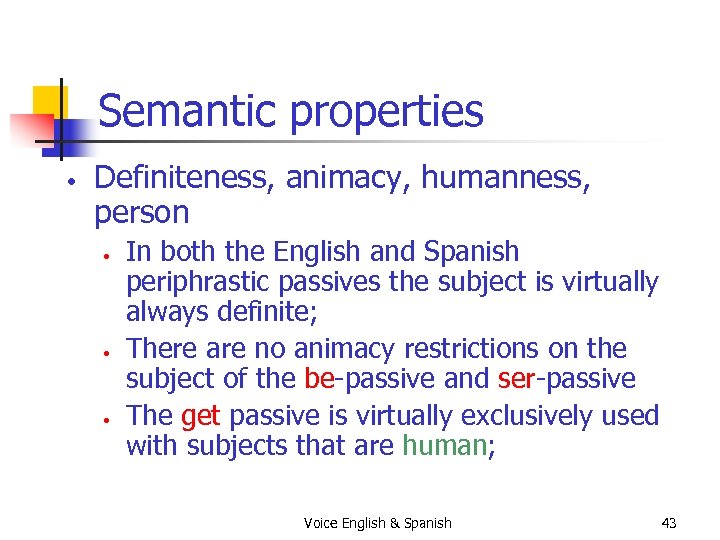 Semantic properties • Definiteness, animacy, humanness, person • • • In both the English and Spanish periphrastic passives the subject is virtually always definite; There are no animacy restrictions on the subject of the be-passive and ser-passive The get passive is virtually exclusively used with subjects that are human; Voice English & Spanish 43
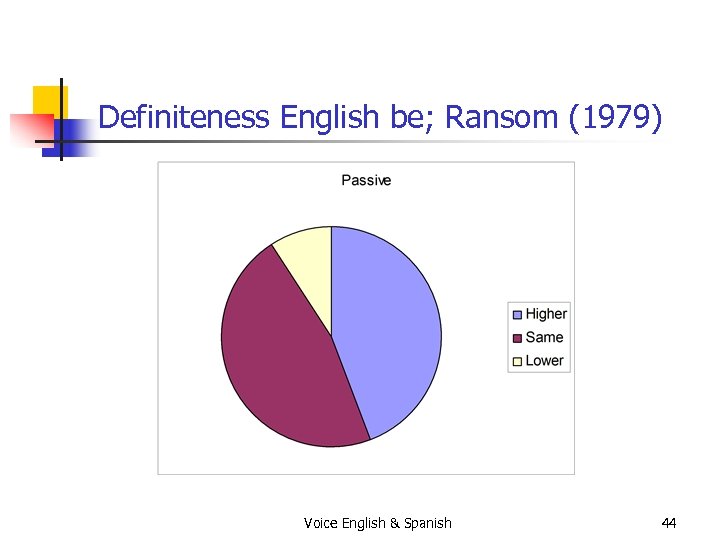 Definiteness English be; Ransom (1979) Voice English & Spanish 44
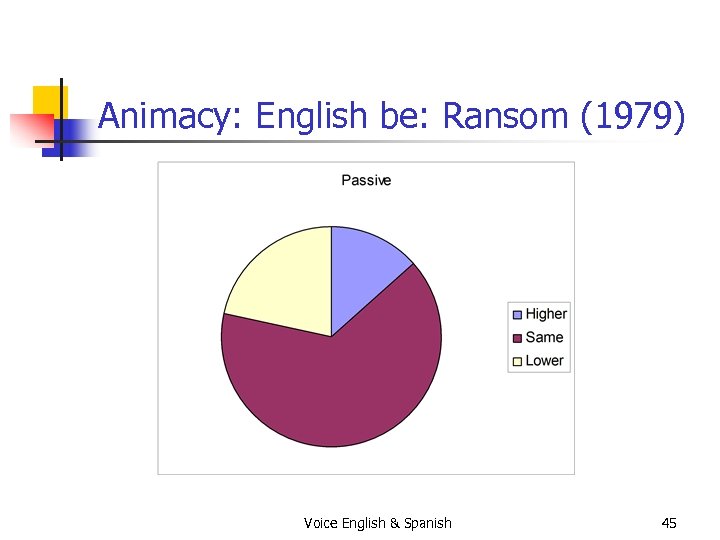 Animacy: English be: Ransom (1979) Voice English & Spanish 45
 Human subjects of get passive • • • There was a bit of shooting and Tim got hit. Though he knew no more about military science and tactics than any other desk officer, he managed to get transferred to the combat forces. Having lost the chairmanship of the Technical Education Board, Sidney failed to get reelected. Voice English & Spanish 46
 Non-human subjects with get • • If non-human subjects occur they are possessed items, typically inalienably From Brown, LOB and Nijmegen corpora We came to live their after our house got burned. The carpet is loose there and my heel got caught. His hand got bitten off. Did they know how wealth from over-large estates gets misused? Voice English & Spanish 47
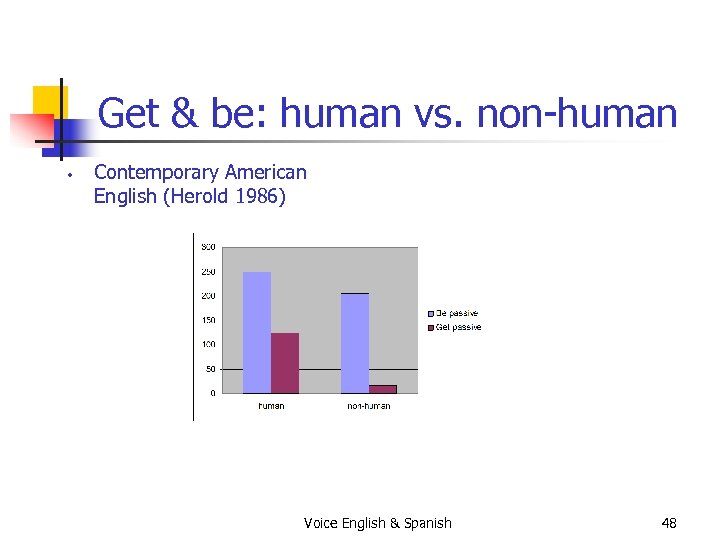 Get & be: human vs. non-human • Contemporary American English (Herold 1986) Voice English & Spanish 48
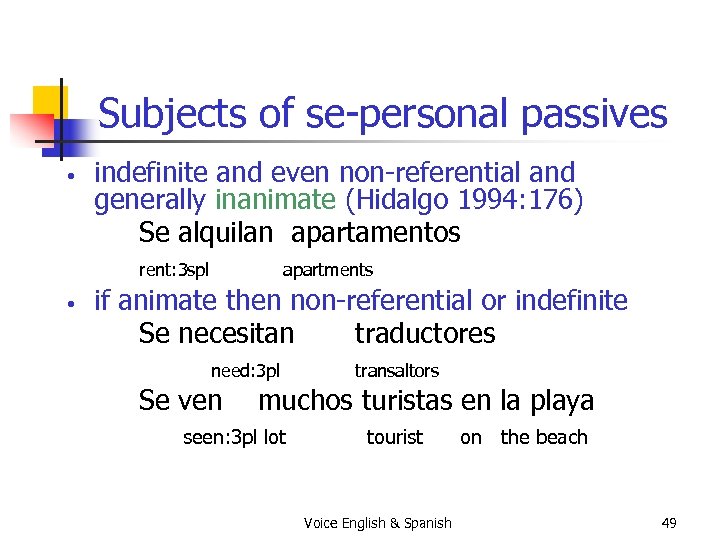 Subjects of se-personal passives • indefinite and even non-referential and generally inanimate (Hidalgo 1994: 176) Se alquilan apartamentos rent: 3 spl • apartments if animate then non-referential or indefinite Se necesitan traductores need: 3 pl Se ven transaltors muchos turistas en la playa seen: 3 pl lot tourist Voice English & Spanish on the beach 49
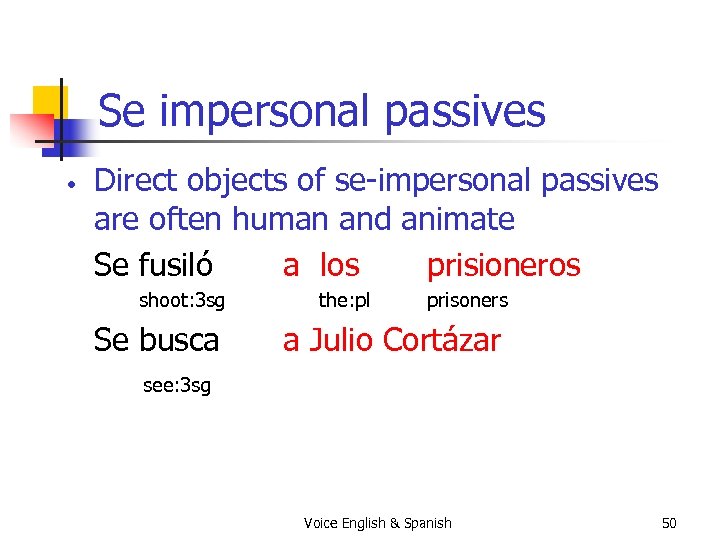 Se impersonal passives • Direct objects of se-impersonal passives are often human and animate Se fusiló a los prisioneros shoot: 3 sg Se busca the: pl prisoners a Julio Cortázar see: 3 sg Voice English & Spanish 50
 Animacy in personal vs. impersonal se • Non-human nature of subjects in se personal passive • Avoidance of ambiguity between a passive and a reflexive reading Voice English & Spanish 51
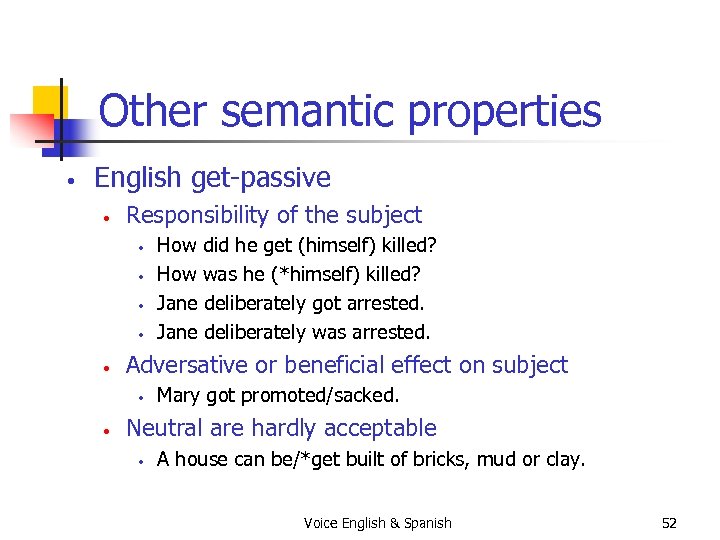 Other semantic properties • English get-passive • Responsibility of the subject • • • Adversative or beneficial effect on subject • • How did he get (himself) killed? How was he (*himself) killed? Jane deliberately got arrested. Jane deliberately was arrested. Mary got promoted/sacked. Neutral are hardly acceptable • A house can be/*get built of bricks, mud or clay. Voice English & Spanish 52
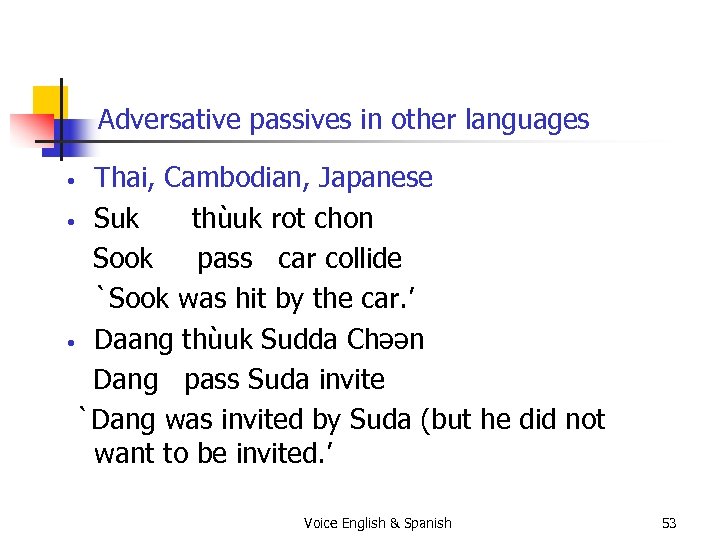 Adversative passives in other languages Thai, Cambodian, Japanese • Suk thùuk rot chon Sook pass car collide `Sook was hit by the car. ’ • Daang thùuk Sudda Chəən Dang pass Suda invite `Dang was invited by Suda (but he did not want to be invited. ’ • Voice English & Spanish 53
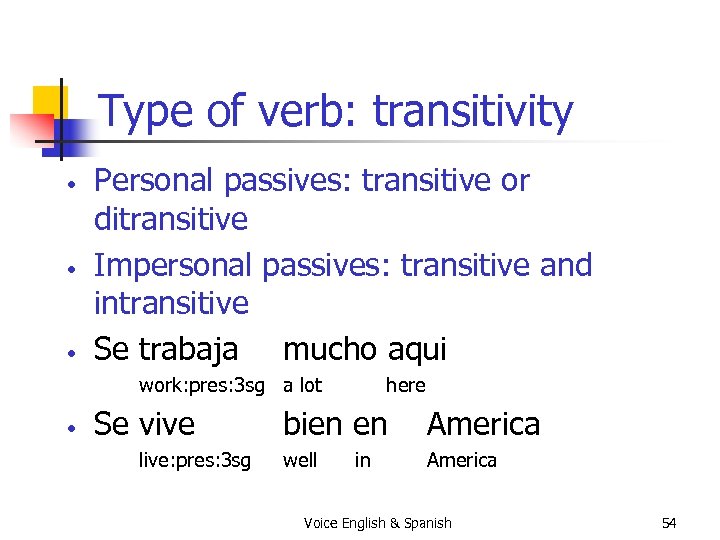 Type of verb: transitivity • • • Personal passives: transitive or ditransitive Impersonal passives: transitive and intransitive Se trabaja mucho aqui work: pres: 3 sg a lot • Se vive live: pres: 3 sg here bien en America well America in Voice English & Spanish 54
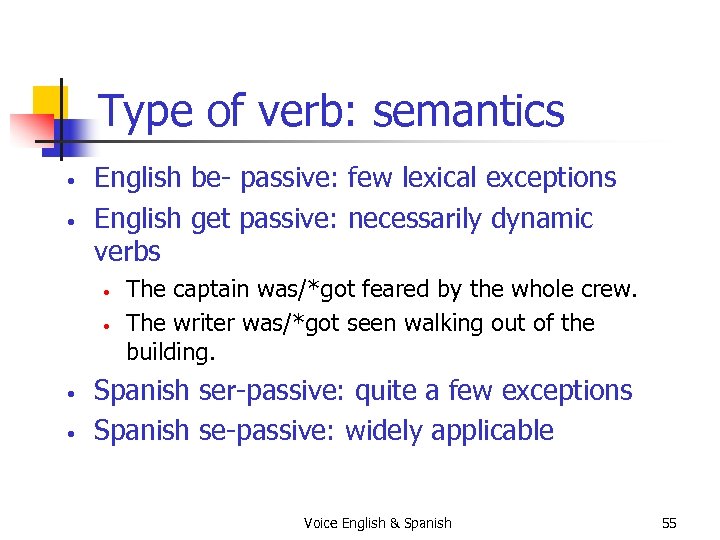 Type of verb: semantics • • English be- passive: few lexical exceptions English get passive: necessarily dynamic verbs • • The captain was/*got feared by the whole crew. The writer was/*got seen walking out of the building. Spanish ser-passive: quite a few exceptions Spanish se-passive: widely applicable Voice English & Spanish 55
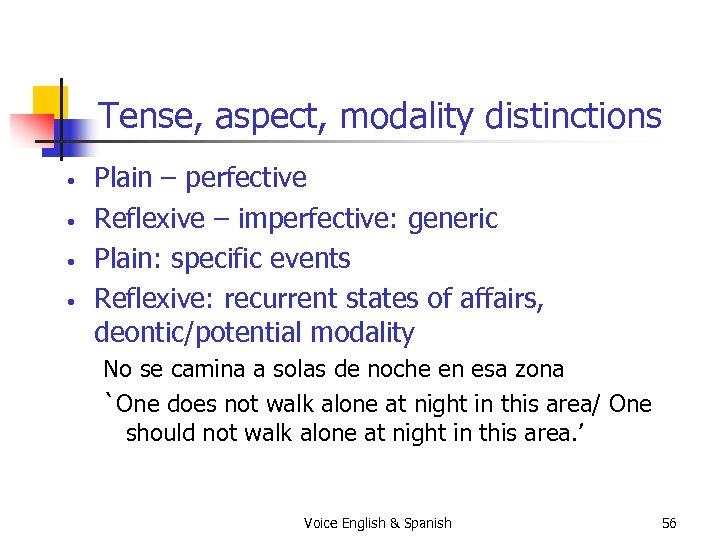 Tense, aspect, modality distinctions • • Plain – perfective Reflexive – imperfective: generic Plain: specific events Reflexive: recurrent states of affairs, deontic/potential modality No se camina a solas de noche en esa zona `One does not walk alone at night in this area/ One should not walk alone at night in this area. ’ Voice English & Spanish 56
 Expression of agent • • Can the agent be overtly expressed? Are there any semantic restrictions on the agent, e. g. in terms of semantic role or animacy or person? Voice English & Spanish 57
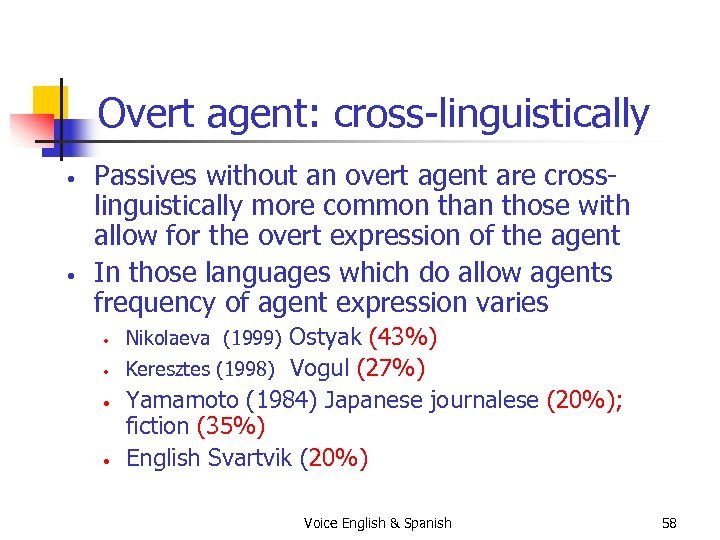 Overt agent: cross-linguistically • • Passives without an overt agent are crosslinguistically more common than those with allow for the overt expression of the agent In those languages which do allow agents frequency of agent expression varies • • Ostyak (43%) Keresztes (1998) Vogul (27%) Yamamoto (1984) Japanese journalese (20%); fiction (35%) English Svartvik (20%) Nikolaeva (1999) Voice English & Spanish 58
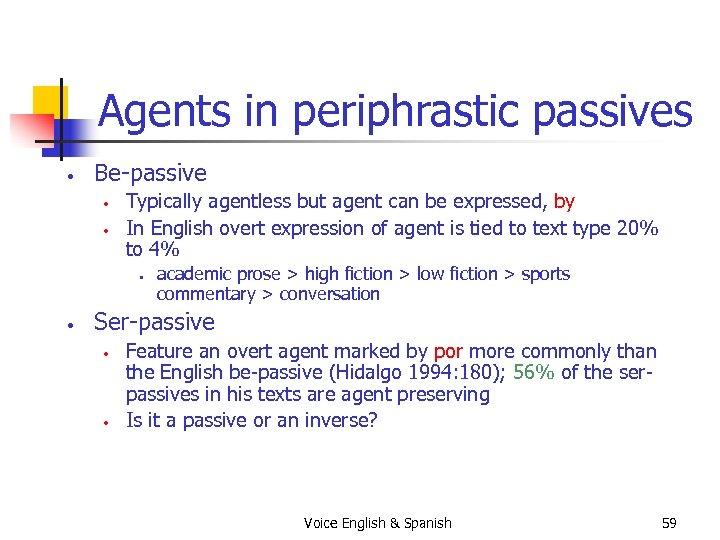 Agents in periphrastic passives • Be-passive • • Typically agentless but agent can be expressed, by In English overt expression of agent is tied to text type 20% to 4% • • academic prose > high fiction > low fiction > sports commentary > conversation Ser-passive • • Feature an overt agent marked by por more commonly than the English be-passive (Hidalgo 1994: 180); 56% of the serpassives in his texts are agent preserving Is it a passive or an inverse? Voice English & Spanish 59
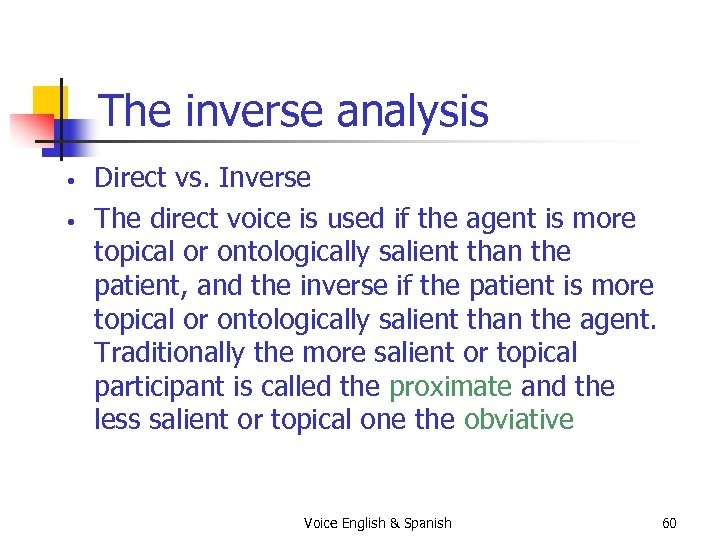 The inverse analysis • • Direct vs. Inverse The direct voice is used if the agent is more topical or ontologically salient than the patient, and the inverse if the patient is more topical or ontologically salient than the agent. Traditionally the more salient or topical participant is called the proximate and the less salient or topical one the obviative Voice English & Spanish 60
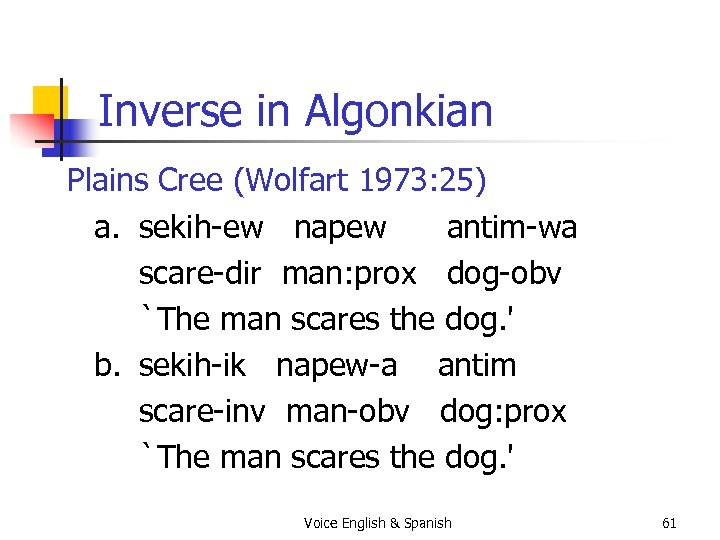 Inverse in Algonkian Plains Cree (Wolfart 1973: 25) a. sekih-ew napew antim-wa scare-dir man: prox dog-obv `The man scares the dog. ' b. sekih-ik napew-a antim scare-inv man-obv dog: prox `The man scares the dog. ' Voice English & Spanish 61
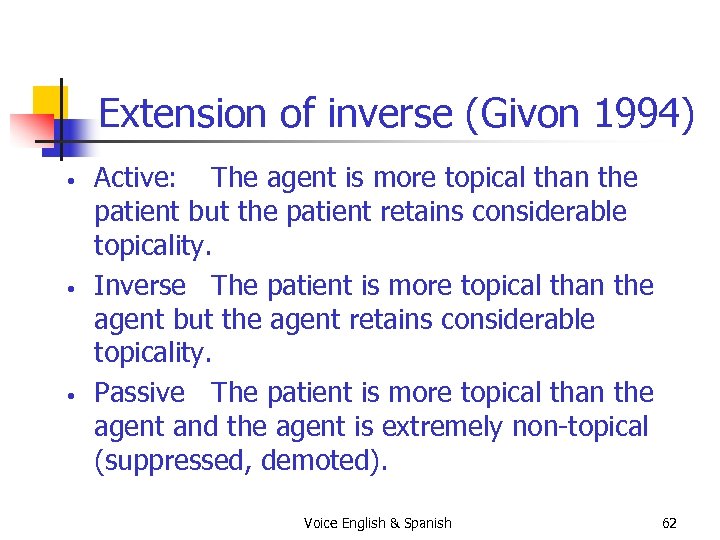 Extension of inverse (Givon 1994) • • • Active: The agent is more topical than the patient but the patient retains considerable topicality. Inverse The patient is more topical than the agent but the agent retains considerable topicality. Passive The patient is more topical than the agent and the agent is extremely non-topical (suppressed, demoted). Voice English & Spanish 62
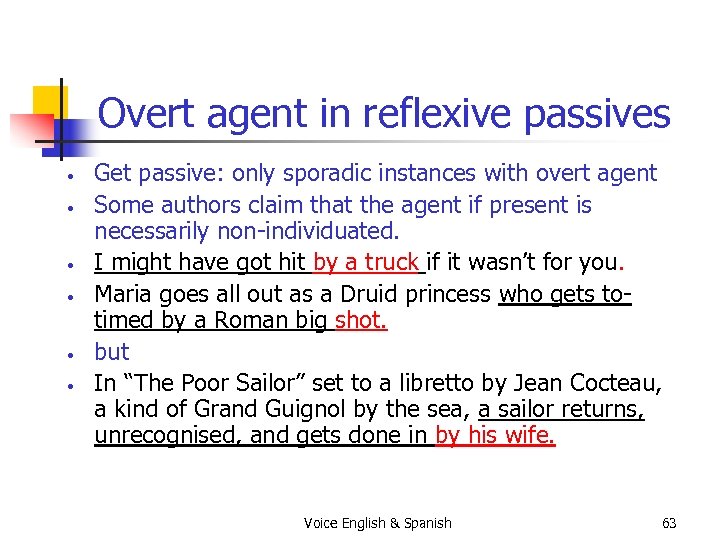 Overt agent in reflexive passives • • • Get passive: only sporadic instances with overt agent Some authors claim that the agent if present is necessarily non-individuated. I might have got hit by a truck if it wasn’t for you. Maria goes all out as a Druid princess who gets totimed by a Roman big shot. but In “The Poor Sailor” set to a libretto by Jean Cocteau, a kind of Grand Guignol by the sea, a sailor returns, unrecognised, and gets done in by his wife. Voice English & Spanish 63
 Overt agent in reflexive passive • Se passive • • No overt agent Cross-linguistically reflexive passives may have an agent Voice English & Spanish 64
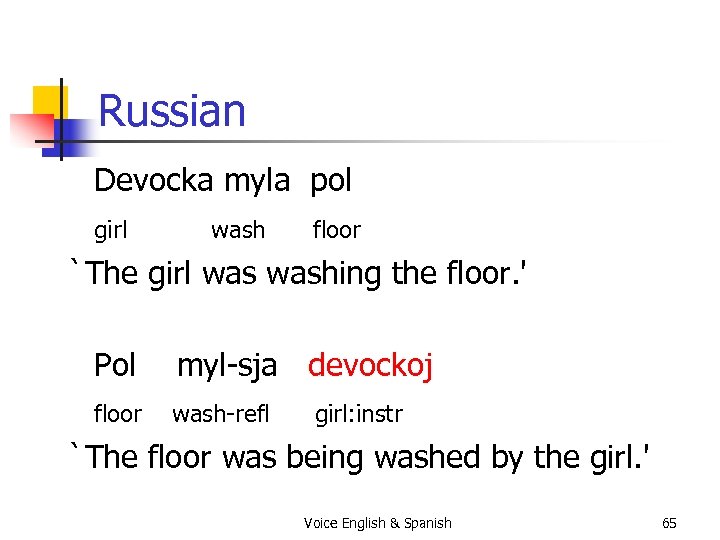 Russian Devocka myla pol girl wash floor `The girl washing the floor. ' Pol myl-sja devockoj floor wash-refl girl: instr `The floor was being washed by the girl. ' Voice English & Spanish 65
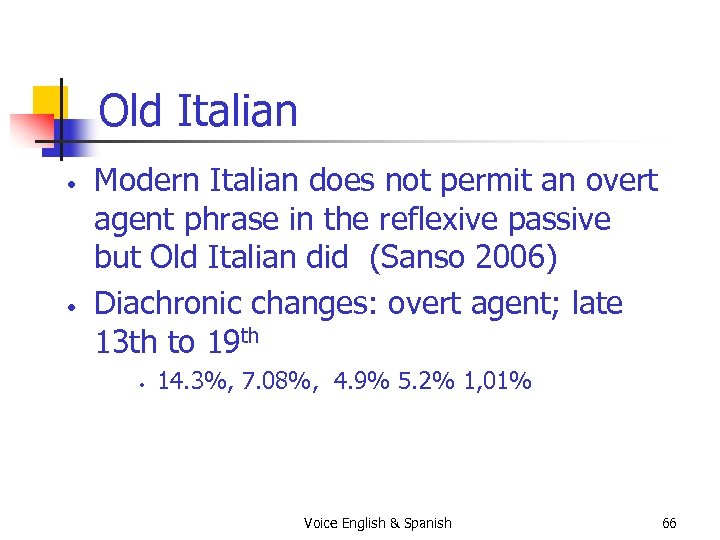 Old Italian • • Modern Italian does not permit an overt agent phrase in the reflexive passive but Old Italian did (Sanso 2006) Diachronic changes: overt agent; late 13 th to 19 th • 14. 3%, 7. 08%, 4. 9% 5. 2% 1, 01% Voice English & Spanish 66
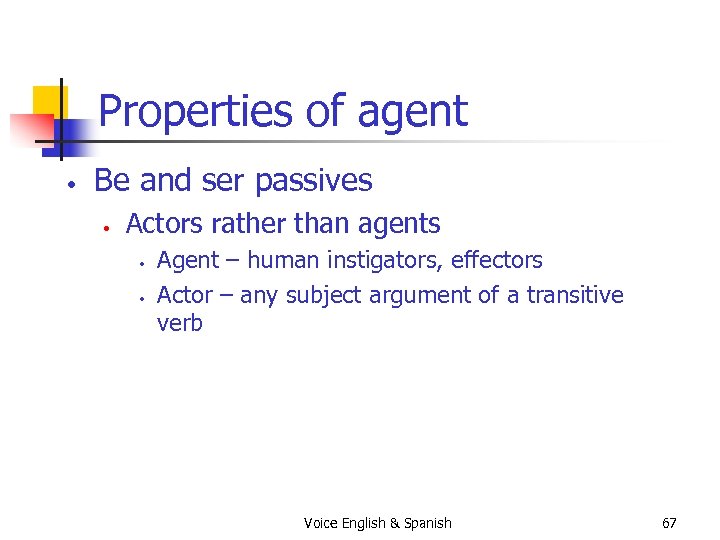 Properties of agent • Be and ser passives • Actors rather than agents • • Agent – human instigators, effectors Actor – any subject argument of a transitive verb Voice English & Spanish 67
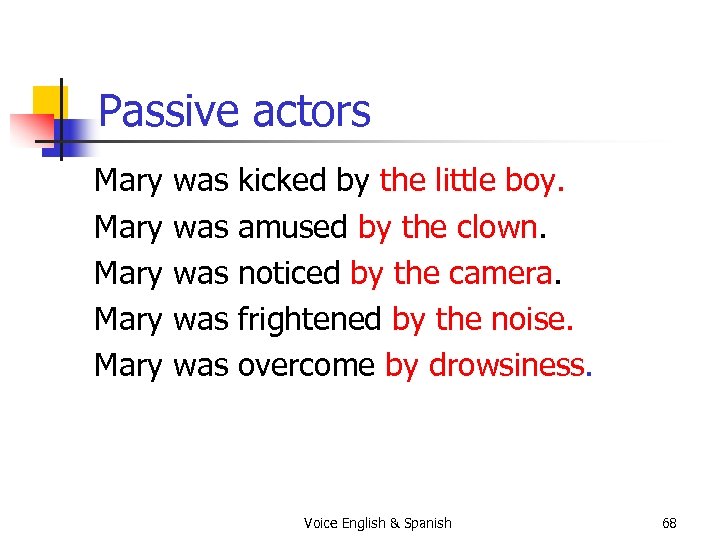 Passive actors Mary Mary was was was kicked by the little boy. amused by the clown. noticed by the camera. frightened by the noise. overcome by drowsiness. Voice English & Spanish 68
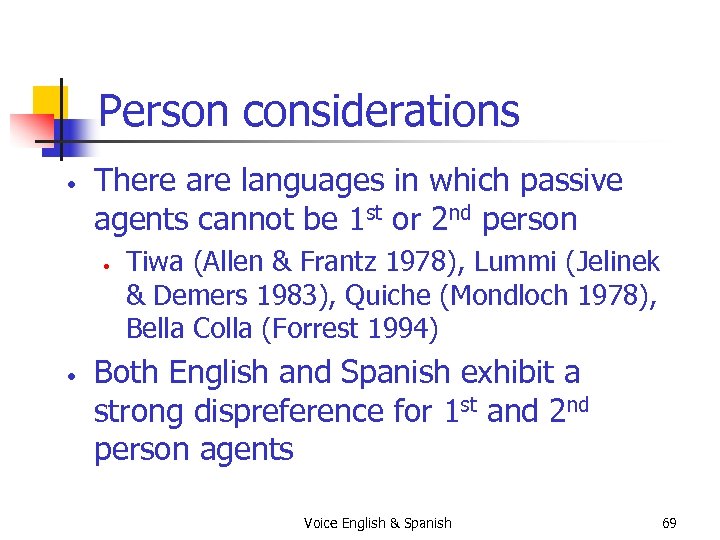 Person considerations • There are languages in which passive agents cannot be 1 st or 2 nd person • • Tiwa (Allen & Frantz 1978), Lummi (Jelinek & Demers 1983), Quiche (Mondloch 1978), Bella Colla (Forrest 1994) Both English and Spanish exhibit a strong dispreference for 1 st and 2 nd person agents Voice English & Spanish 69
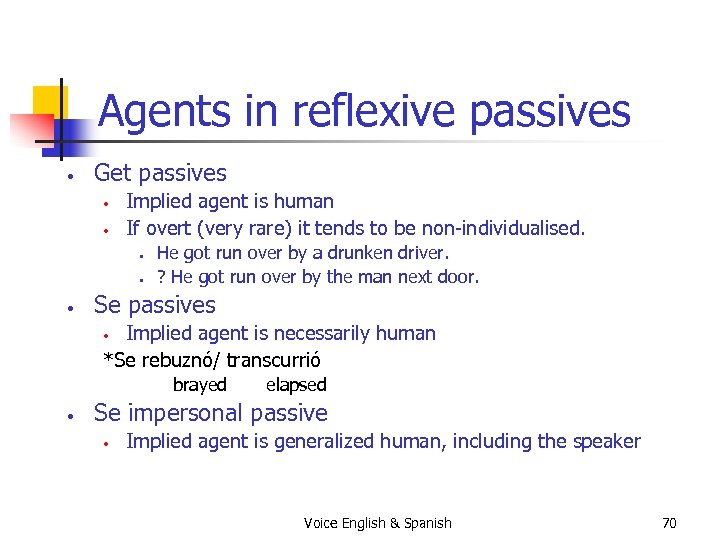 Agents in reflexive passives • Get passives • • Implied agent is human If overt (very rare) it tends to be non-individualised. • • • He got run over by a drunken driver. ? He got run over by the man next door. Se passives Implied agent is necessarily human *Se rebuznó/ transcurrió • brayed • elapsed Se impersonal passive • Implied agent is generalized human, including the speaker Voice English & Spanish 70
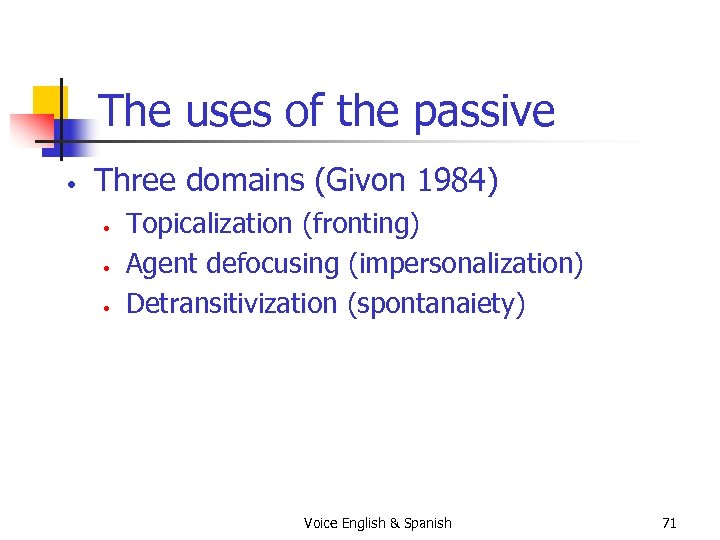 The uses of the passive • Three domains (Givon 1984) • • • Topicalization (fronting) Agent defocusing (impersonalization) Detransitivization (spontanaiety) Voice English & Spanish 71
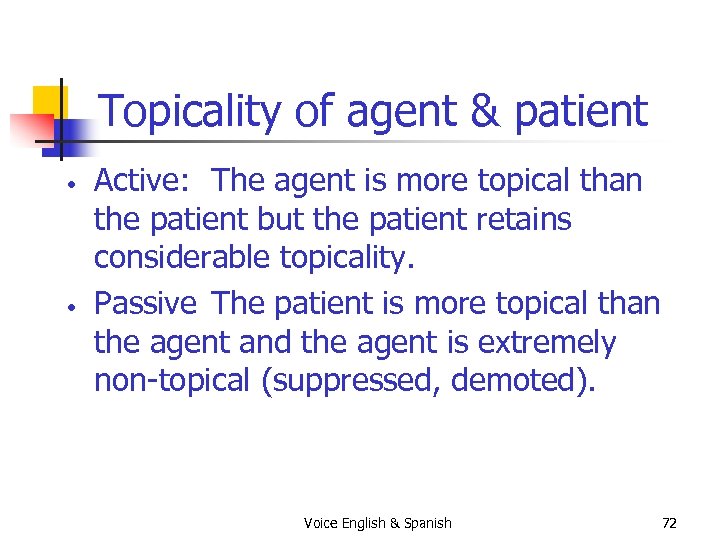 Topicality of agent & patient • • Active: The agent is more topical than the patient but the patient retains considerable topicality. Passive The patient is more topical than the agent and the agent is extremely non-topical (suppressed, demoted). Voice English & Spanish 72
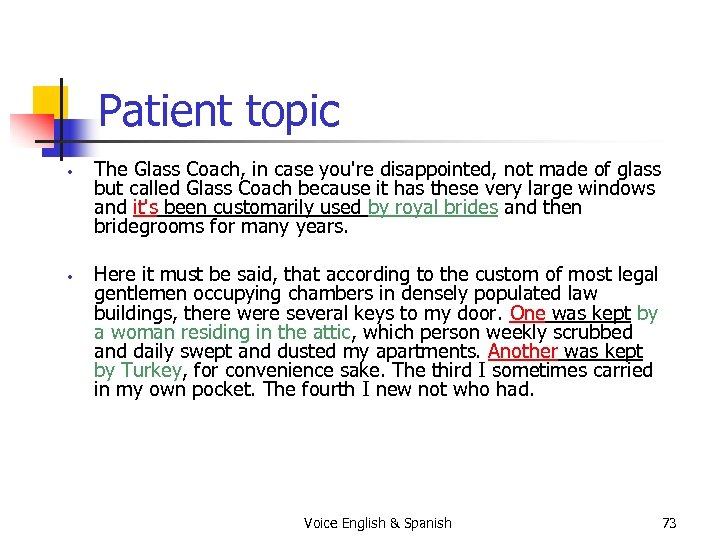 Patient topic • • The Glass Coach, in case you're disappointed, not made of glass but called Glass Coach because it has these very large windows and it's been customarily used by royal brides and then bridegrooms for many years. Here it must be said, that according to the custom of most legal gentlemen occupying chambers in densely populated law buildings, there were several keys to my door. One was kept by a woman residing in the attic, which person weekly scrubbed and daily swept and dusted my apartments. Another was kept by Turkey, for convenience sake. The third I sometimes carried in my own pocket. The fourth I new not who had. Voice English & Spanish 73
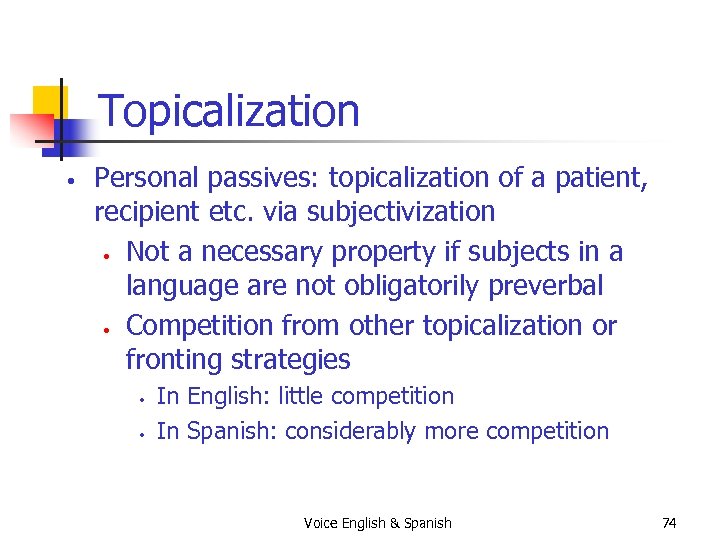 Topicalization • Personal passives: topicalization of a patient, recipient etc. via subjectivization • Not a necessary property if subjects in a language are not obligatorily preverbal • Competition from other topicalization or fronting strategies • • In English: little competition In Spanish: considerably more competition Voice English & Spanish 74
 Fronting in English • • Topicalization Left-dislocation Voice English & Spanish 75
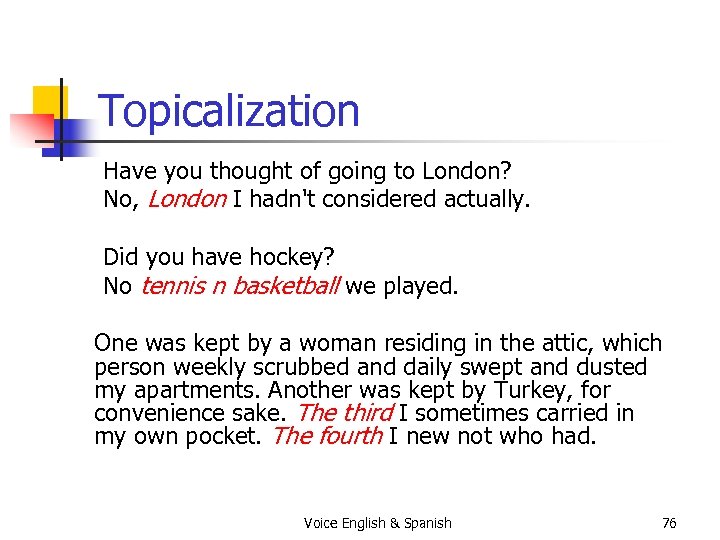 Topicalization Have you thought of going to London? No, London I hadn't considered actually. Did you have hockey? No tennis n basketball we played. One was kept by a woman residing in the attic, which person weekly scrubbed and daily swept and dusted my apartments. Another was kept by Turkey, for convenience sake. The third I sometimes carried in my own pocket. The fourth I new not who had. Voice English & Spanish 76
 Left-dislocation (1) • • Gelukens (1992); used to introduce usually irrecoverable, discourse new (but possibly inferrable) referents and a proposition concerning it. Used in interaction to highlight a referent. Prince (1997) • • • Simplifying LDs Posit LDs Amnestying LDs Voice English & Spanish 77
 Simplifying LDs • • • Simplifying LDs, serve to simply the discourse processing of Discourse-new entities by removing them from a syntactic position disfavoured for discourse new entities and creating a separate processing unit for them. LD’s of subjects Conversation Voice English & Spanish 78
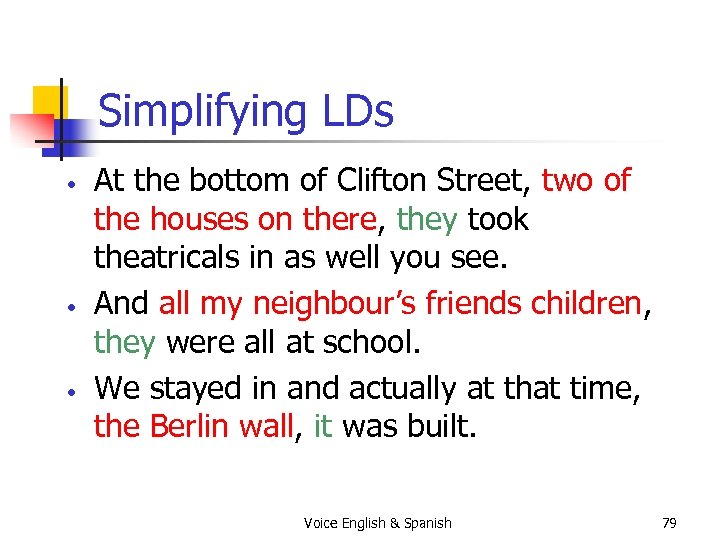 Simplifying LDs • • • At the bottom of Clifton Street, two of the houses on there, they took theatricals in as well you see. And all my neighbour’s friends children, they were all at school. We stayed in and actually at that time, the Berlin wall, it was built. Voice English & Spanish 79
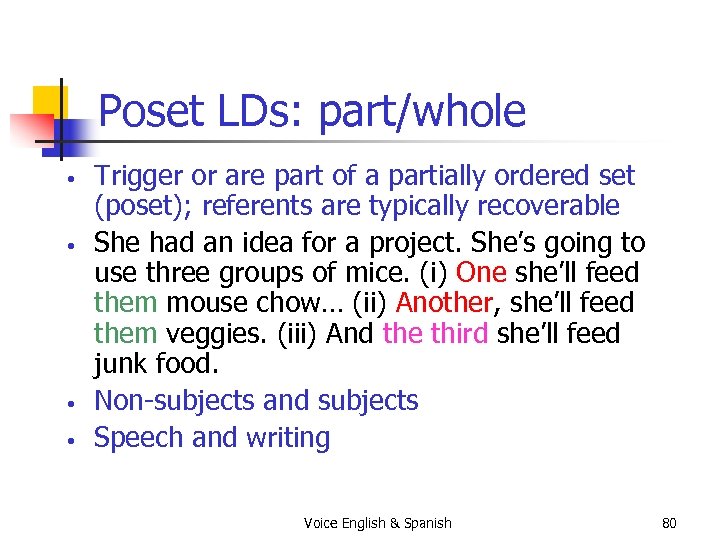 Poset LDs: part/whole • • Trigger or are part of a partially ordered set (poset); referents are typically recoverable She had an idea for a project. She’s going to use three groups of mice. (i) One she’ll feed them mouse chow… (ii) Another, she’ll feed them veggies. (iii) And the third she’ll feed junk food. Non-subjects and subjects Speech and writing Voice English & Spanish 80
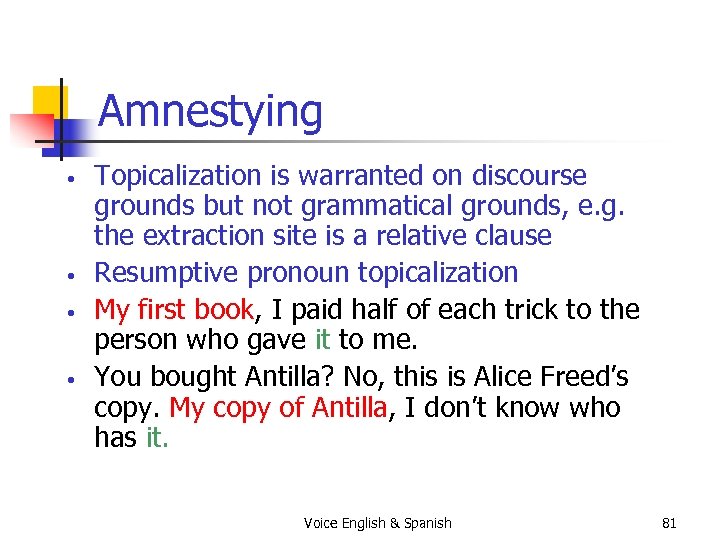 Amnestying • • Topicalization is warranted on discourse grounds but not grammatical grounds, e. g. the extraction site is a relative clause Resumptive pronoun topicalization My first book, I paid half of each trick to the person who gave it to me. You bought Antilla? No, this is Alice Freed’s copy. My copy of Antilla, I don’t know who has it. Voice English & Spanish 81
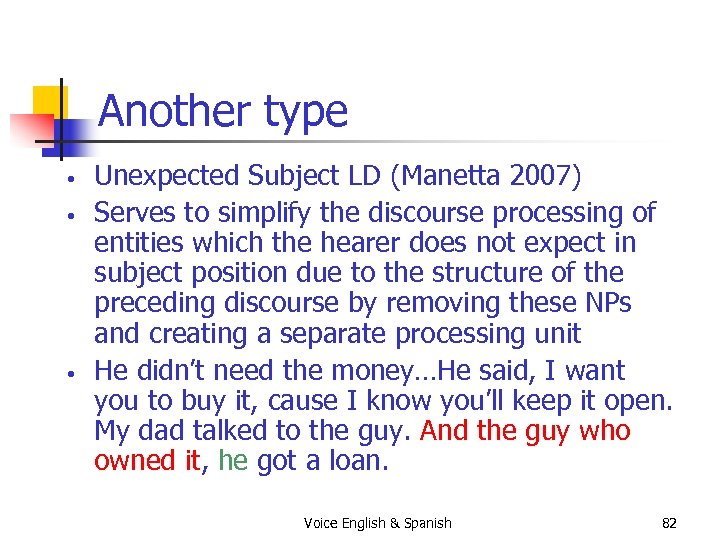 Another type • • • Unexpected Subject LD (Manetta 2007) Serves to simplify the discourse processing of entities which the hearer does not expect in subject position due to the structure of the preceding discourse by removing these NPs and creating a separate processing unit He didn’t need the money…He said, I want you to buy it, cause I know you’ll keep it open. My dad talked to the guy. And the guy who owned it, he got a loan. Voice English & Spanish 82
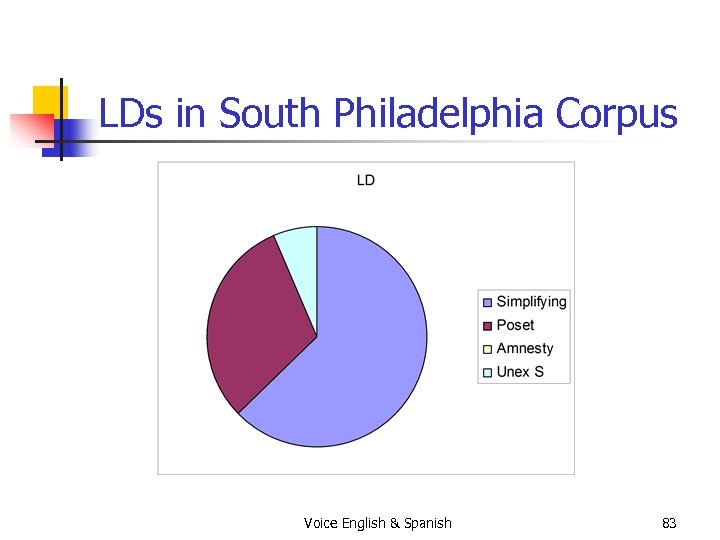 LDs in South Philadelphia Corpus Voice English & Spanish 83
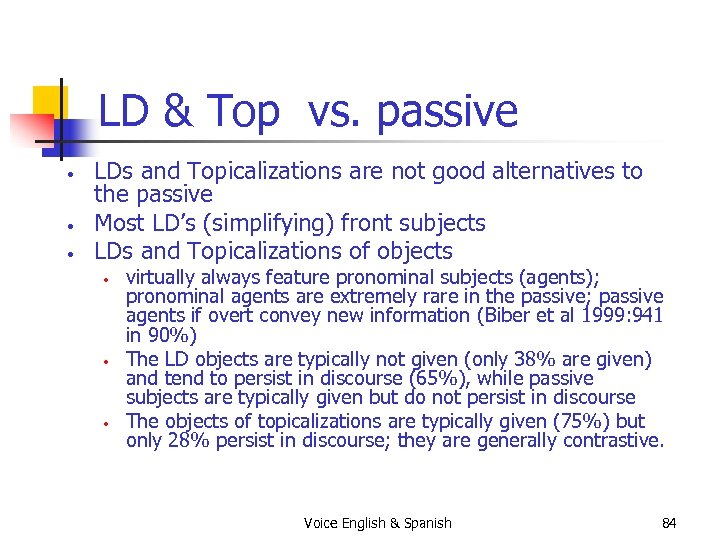 LD & Top vs. passive • • • LDs and Topicalizations are not good alternatives to the passive Most LD’s (simplifying) front subjects LDs and Topicalizations of objects • • • virtually always feature pronominal subjects (agents); pronominal agents are extremely rare in the passive; passive agents if overt convey new information (Biber et al 1999: 941 in 90%) The LD objects are typically not given (only 38% are given) and tend to persist in discourse (65%), while passive subjects are typically given but do not persist in discourse The objects of topicalizations are typically given (75%) but only 28% persist in discourse; they are generally contrastive. Voice English & Spanish 84
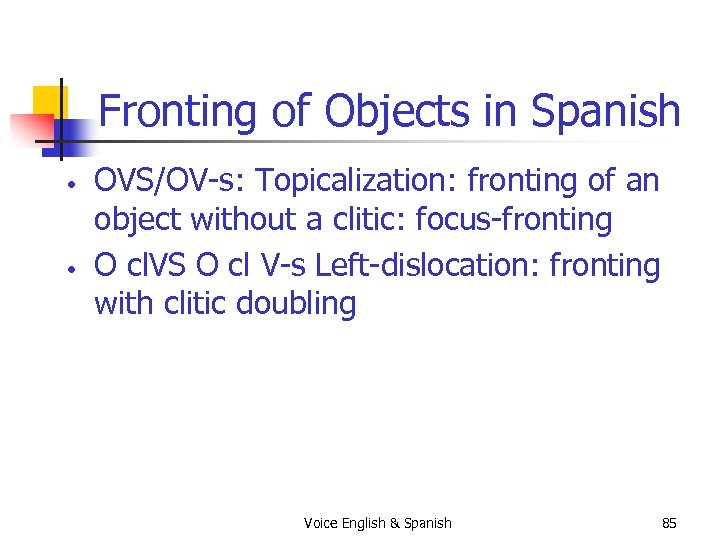 Fronting of Objects in Spanish • • OVS/OV-s: Topicalization: fronting of an object without a clitic: focus-fronting O cl. VS O cl V-s Left-dislocation: fronting with clitic doubling Voice English & Spanish 85
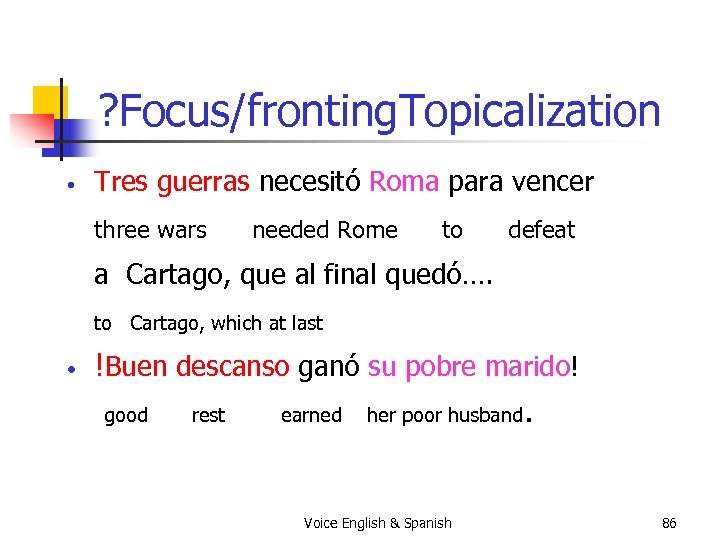 ? Focus/fronting. Topicalization • Tres guerras necesitó Roma para vencer three wars needed Rome to defeat a Cartago, que al final quedó…. to Cartago, which at last • !Buen descanso ganó su pobre marido! good rest earned her poor husband. Voice English & Spanish 86
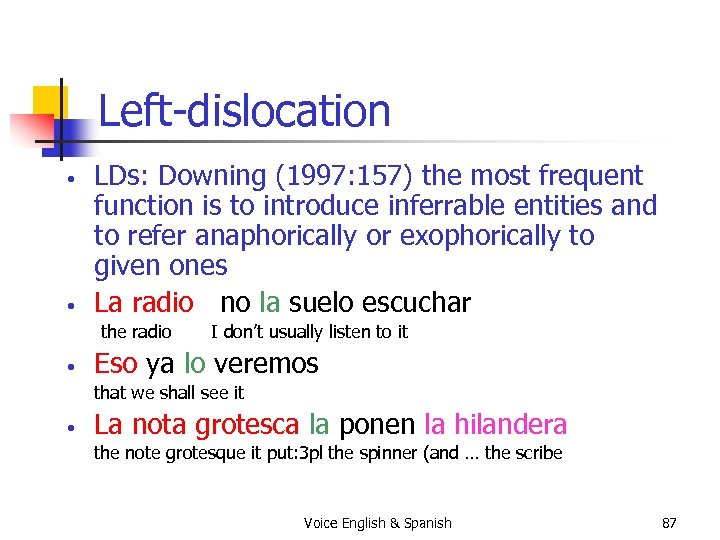 Left-dislocation • • LDs: Downing (1997: 157) the most frequent function is to introduce inferrable entities and to refer anaphorically or exophorically to given ones La radio no la suelo escuchar the radio • I don’t usually listen to it Eso ya lo veremos that we shall see it • La nota grotesca la ponen la hilandera the note grotesque it put: 3 pl the spinner (and … the scribe Voice English & Spanish 87
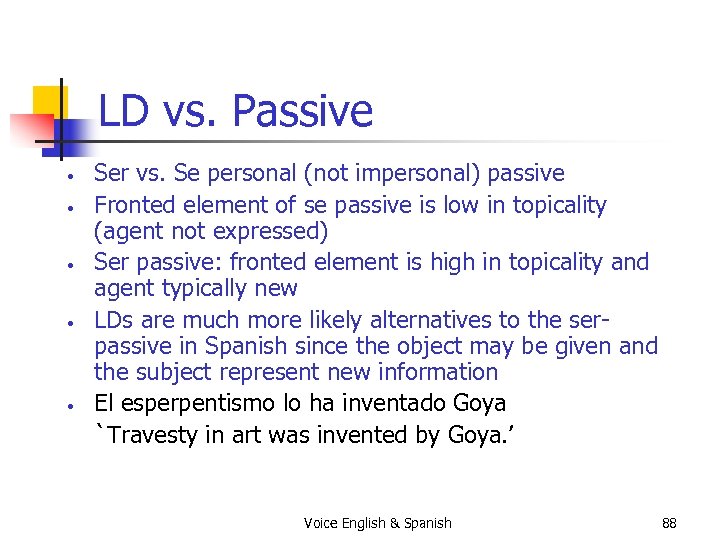 LD vs. Passive • • • Ser vs. Se personal (not impersonal) passive Fronted element of se passive is low in topicality (agent not expressed) Ser passive: fronted element is high in topicality and agent typically new LDs are much more likely alternatives to the serpassive in Spanish since the object may be given and the subject represent new information El esperpentismo lo ha inventado Goya `Travesty in art was invented by Goya. ’ Voice English & Spanish 88
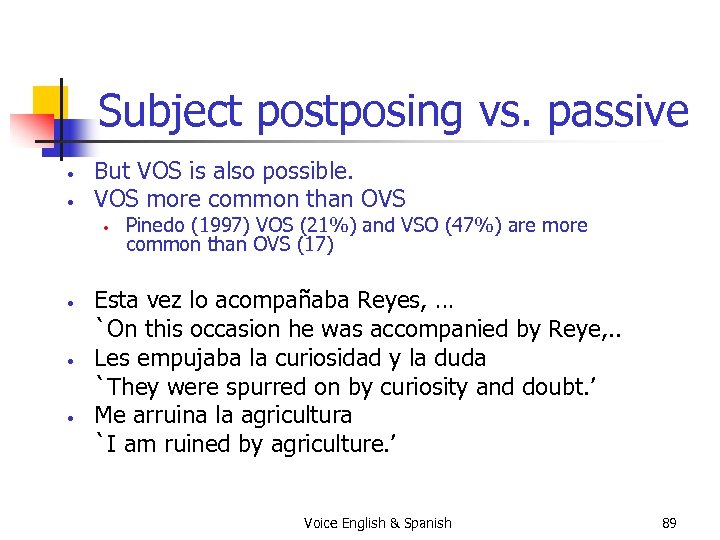 Subject postposing vs. passive • • But VOS is also possible. VOS more common than OVS • • Pinedo (1997) VOS (21%) and VSO (47%) are more common than OVS (17) Esta vez lo acompañaba Reyes, … `On this occasion he was accompanied by Reye, . . Les empujaba la curiosidad y la duda `They were spurred on by curiosity and doubt. ’ Me arruina la agricultura `I am ruined by agriculture. ’ Voice English & Spanish 89
 Impersonalization • • • No overt subject No agent; no specific agent: a generalized human agent; a loosely specified human agent Major function of the passive Individualism is prized, egotism is not. Under Cromwell, lace was dismissed as ungodly - at least for the lower and middle classes. Voice English & Spanish 90
 Other impersonalizing strategies • • • Generalised nouns: people, humans, French on, German man, Italian uno Nonspecific uses of person forms (free or bound): 1 pl, 2 sg, 3 pl Special verbal forms, impersonal, reflexives, infinitival Voice English & Spanish 91
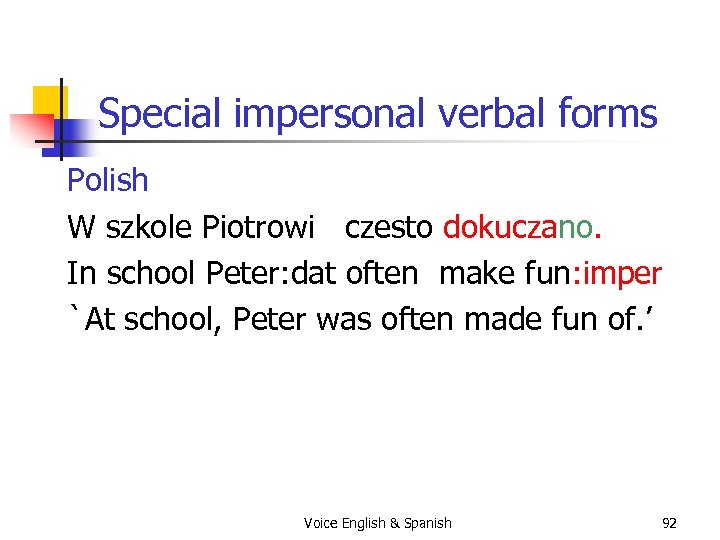 Special impersonal verbal forms Polish W szkole Piotrowi czesto dokuczano. In school Peter: dat often make fun: imper `At school, Peter was often made fun of. ’ Voice English & Spanish 92
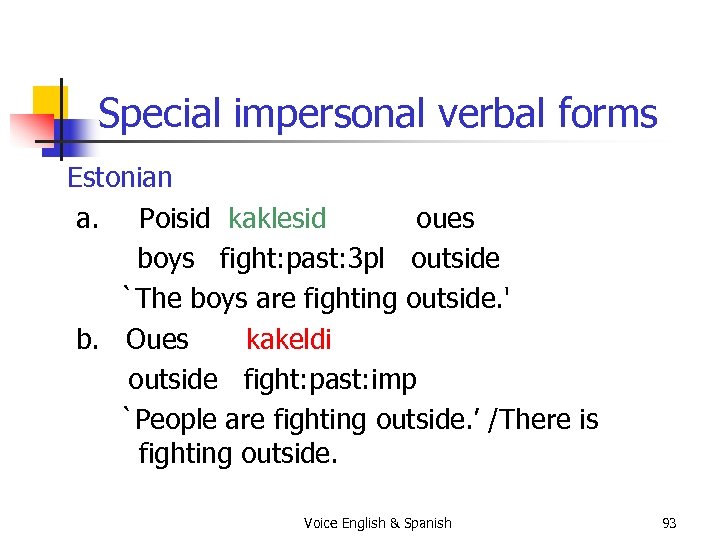 Special impersonal verbal forms Estonian a. Poisid kaklesid oues boys fight: past: 3 pl outside `The boys are fighting outside. ' b. Oues kakeldi outside fight: past: imp `People are fighting outside. ’ /There is fighting outside. Voice English & Spanish 93
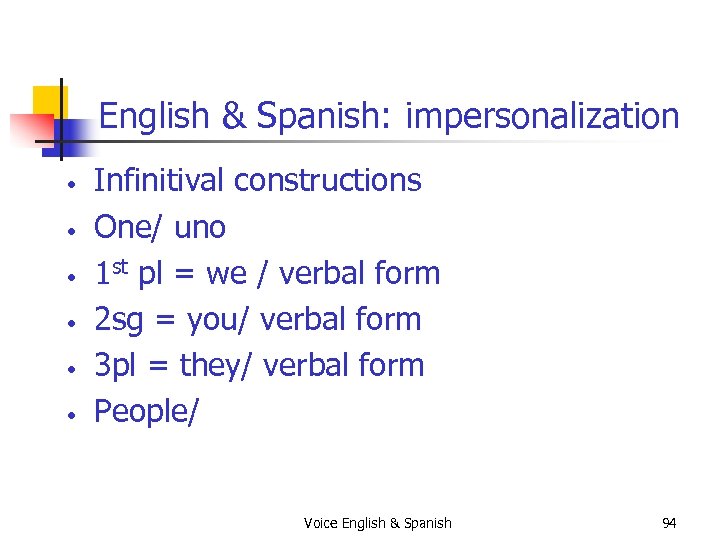 English & Spanish: impersonalization • • • Infinitival constructions One/ uno 1 st pl = we / verbal form 2 sg = you/ verbal form 3 pl = they/ verbal form People/ Voice English & Spanish 94
![Infinitival impersonals Es difícil [ solucionar este problema] is difficult to-solve this problem `It](https://present5.com/presentation/19e402d3244a7ff5dfd52e025a19ef90/image-95.jpg "Infinitival impersonals Es difícil [ solucionar este problema] is difficult to-solve this problem `It") Infinitival impersonals Es difícil [ solucionar este problema] is difficult to-solve this problem `It is diffiult to solve this problem’. Voice English & Spanish 95
Infinitival impersonals Es difícil [ solucionar este problema] is difficult to-solve this problem `It is diffiult to solve this problem’. Voice English & Spanish 95
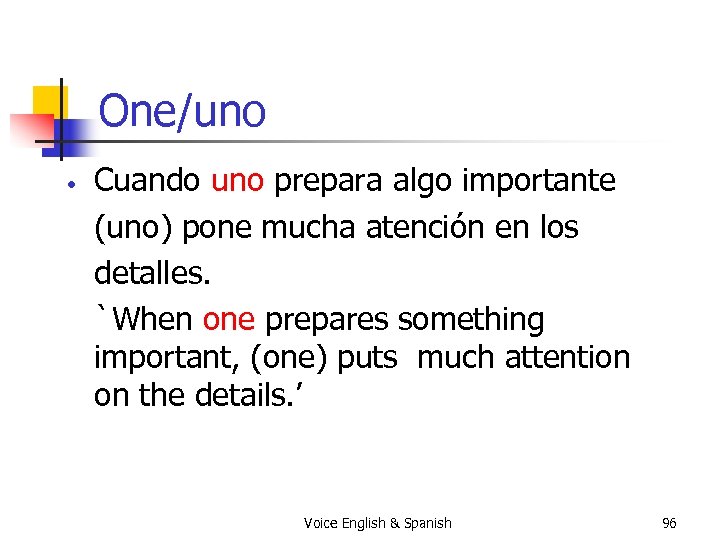 One/uno • Cuando uno prepara algo importante (uno) pone mucha atención en los detalles. `When one prepares something important, (one) puts much attention on the details. ’ Voice English & Spanish 96
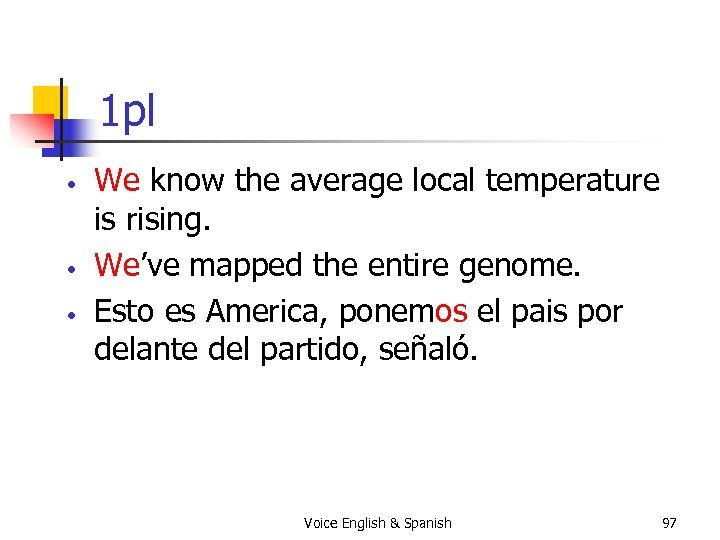 1 pl • • • We know the average local temperature is rising. We’ve mapped the entire genome. Esto es America, ponemos el pais por delante del partido, señaló. Voice English & Spanish 97
 2 sg • En este pais todos sabemos … cuál es el peaje que tienes que pagar para que te dejen en paz `In this country we all know… what price you have to pay in order for them to leave you in peace. ’ You can get there by train. You have to take the train at Lancaster and get off at Windermere. Voice English & Spanish 98
 2 sg : Puerto Rico: overt tu • Si, pero hubo gente que regresaron a los Estados Unidos, con diez mil, quince mil, y veinte mil dólares. Porque tú no gastas nada O sea, si tú te quedas en la barraca Tú no tienes que pagar desayuno, ni almuerzo, ni comida Tú no tienes que pagar ropa, ni laundry, nada, o sea `Because you spend nothing. In other words if you stay in the barracks, you don’t have to pay for breakfast, lunch, food, you don’t have to pay for clothing, laundry nothing. ’ Voice English & Spanish 99
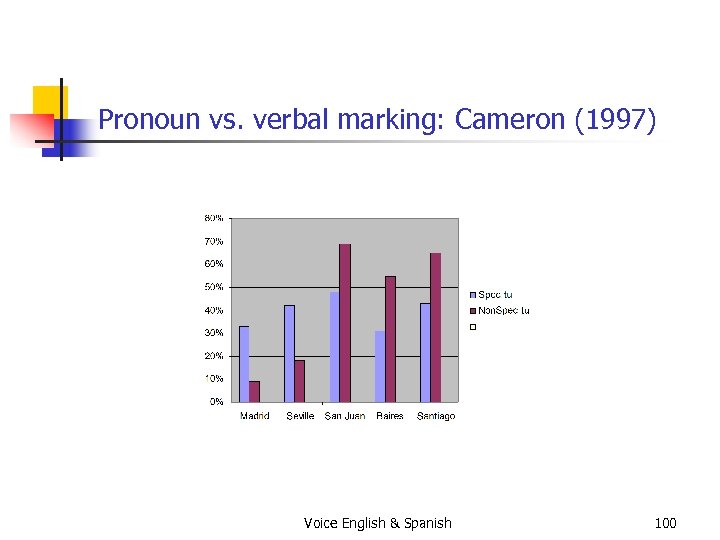 Pronoun vs. verbal marking: Cameron (1997) Voice English & Spanish 100
 3 pl Dijeron en la radio que iba a llover. `They said on the radio that it was going to rain. ’ • En Paris conducen como los mil demonios. ’ `In Paris they drive like a thousand devils. ’ • Voice English & Spanish 101
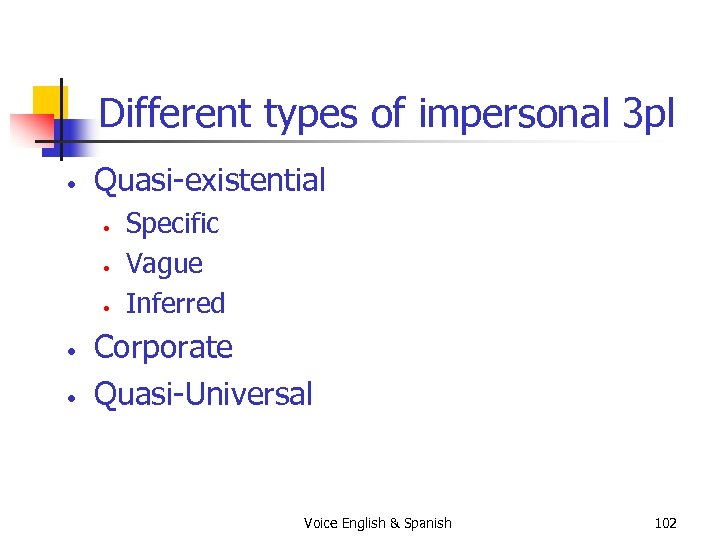 Different types of impersonal 3 pl • Quasi-existential • • • Specific Vague Inferred Corporate Quasi-Universal Voice English & Spanish 102
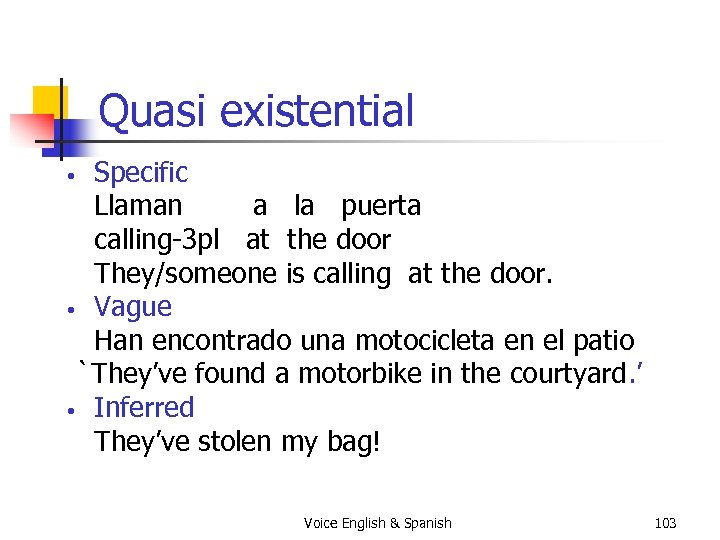 Quasi existential Specific Llaman a la puerta calling-3 pl at the door They/someone is calling at the door. • Vague Han encontrado una motocicleta en el patio `They’ve found a motorbike in the courtyard. ’ • Inferred They’ve stolen my bag! • Voice English & Spanish 103
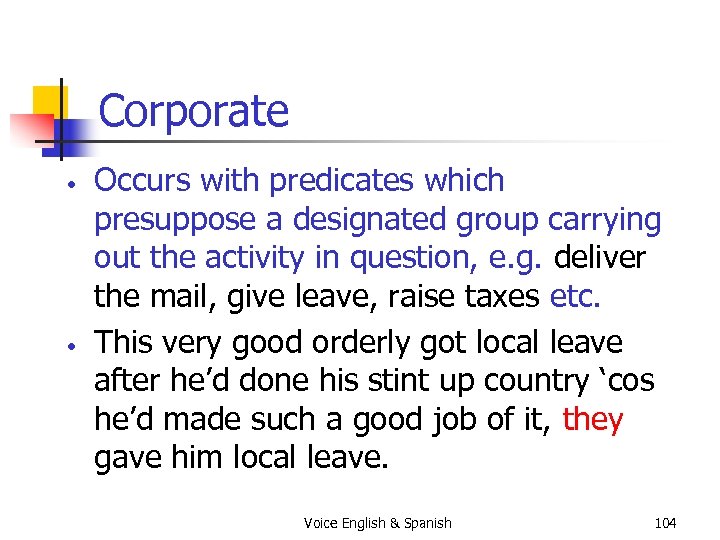 Corporate • • Occurs with predicates which presuppose a designated group carrying out the activity in question, e. g. deliver the mail, give leave, raise taxes etc. This very good orderly got local leave after he’d done his stint up country ‘cos he’d made such a good job of it, they gave him local leave. Voice English & Spanish 104
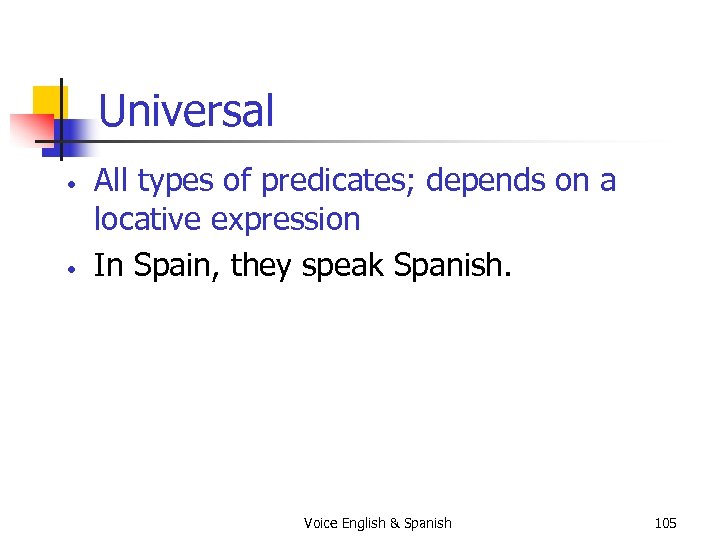 Universal • • All types of predicates; depends on a locative expression In Spain, they speak Spanish. Voice English & Spanish 105
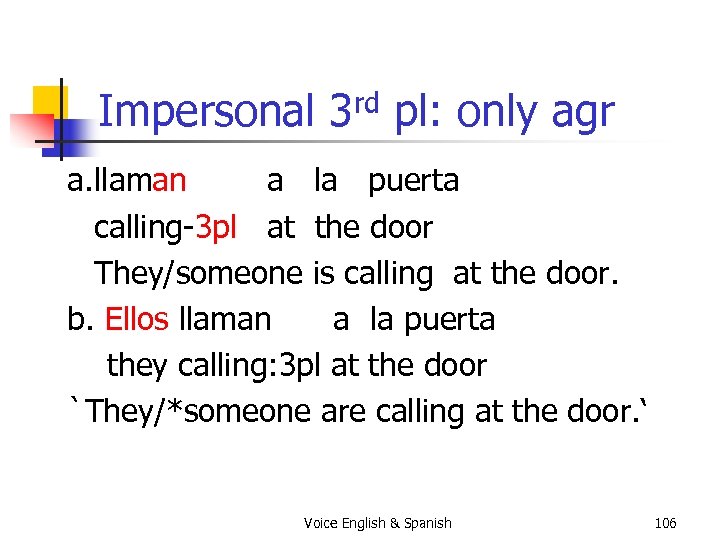 Impersonal 3 rd pl: only agr a. llaman a la puerta calling-3 pl at the door They/someone is calling at the door. b. Ellos llaman a la puerta they calling: 3 pl at the door `They/*someone are calling at the door. ‘ Voice English & Spanish 106
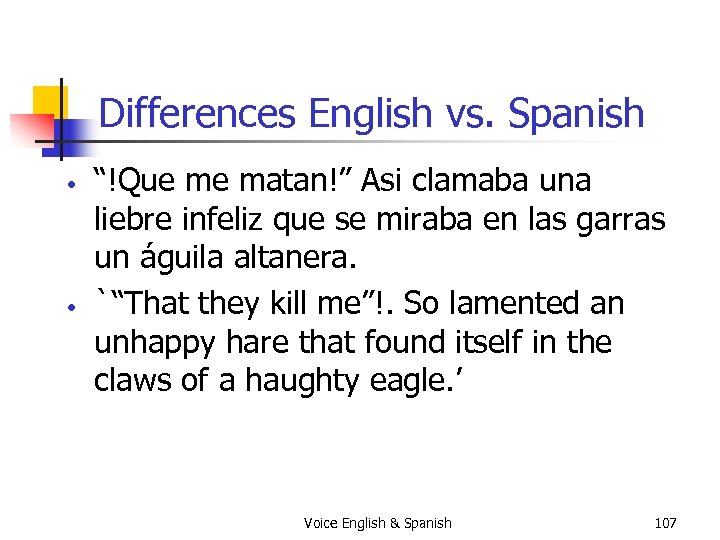 Differences English vs. Spanish • • “!Que me matan!” Asi clamaba una liebre infeliz que se miraba en las garras un águila altanera. `“That they kill me”!. So lamented an unhappy hare that found itself in the claws of a haughty eagle. ’ Voice English & Spanish 107
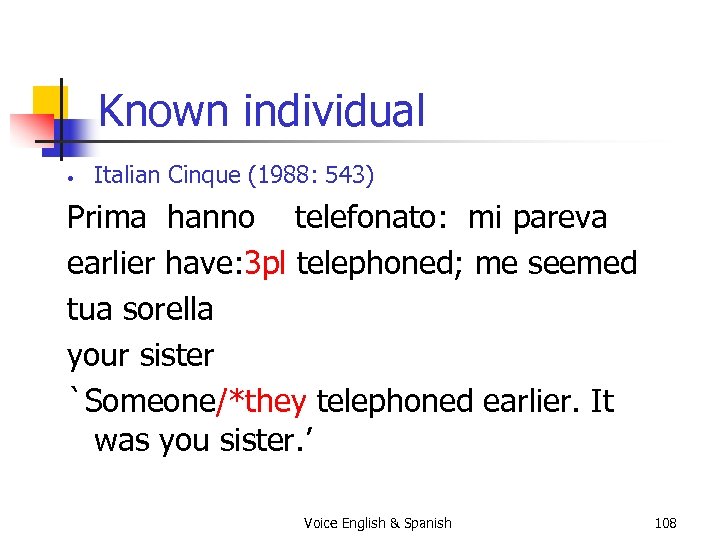 Known individual • Italian Cinque (1988: 543) Prima hanno telefonato: mi pareva earlier have: 3 pl telephoned; me seemed tua sorella your sister `Someone/*they telephoned earlier. It was you sister. ’ Voice English & Spanish 108
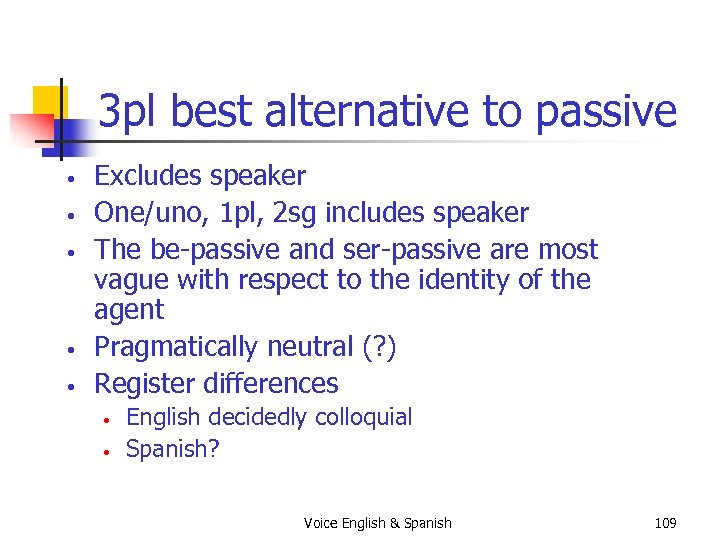 3 pl best alternative to passive • • • Excludes speaker One/uno, 1 pl, 2 sg includes speaker The be-passive and ser-passive are most vague with respect to the identity of the agent Pragmatically neutral (? ) Register differences • • English decidedly colloquial Spanish? Voice English & Spanish 109
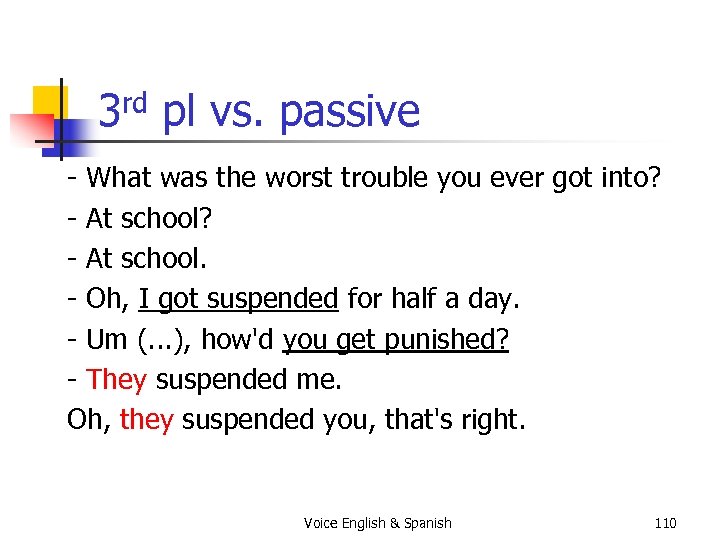 3 rd pl vs. passive - What was the worst trouble you ever got into? - At school. - Oh, I got suspended for half a day. - Um (. . . ), how'd you get punished? - They suspended me. Oh, they suspended you, that's right. Voice English & Spanish 110
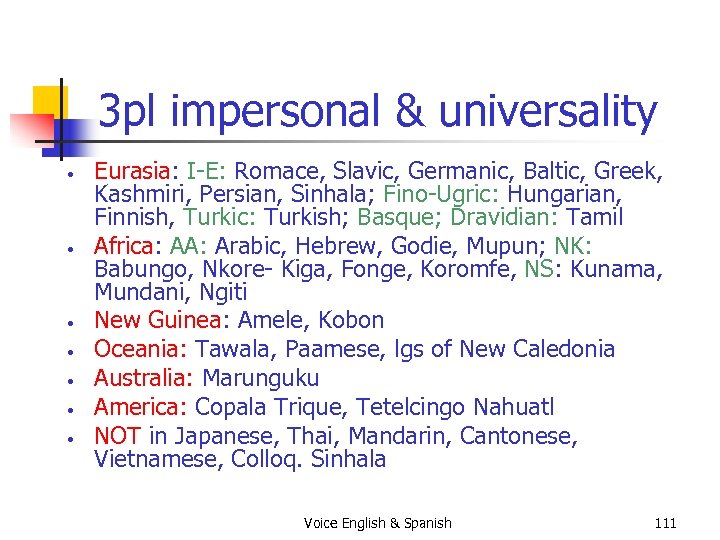 3 pl impersonal & universality • • Eurasia: I-E: Romace, Slavic, Germanic, Baltic, Greek, Kashmiri, Persian, Sinhala; Fino-Ugric: Hungarian, Finnish, Turkic: Turkish; Basque; Dravidian: Tamil Africa: AA: Arabic, Hebrew, Godie, Mupun; NK: Babungo, Nkore- Kiga, Fonge, Koromfe, NS: Kunama, Mundani, Ngiti New Guinea: Amele, Kobon Oceania: Tawala, Paamese, lgs of New Caledonia Australia: Marunguku America: Copala Trique, Tetelcingo Nahuatl NOT in Japanese, Thai, Mandarin, Cantonese, Vietnamese, Colloq. Sinhala Voice English & Spanish 111
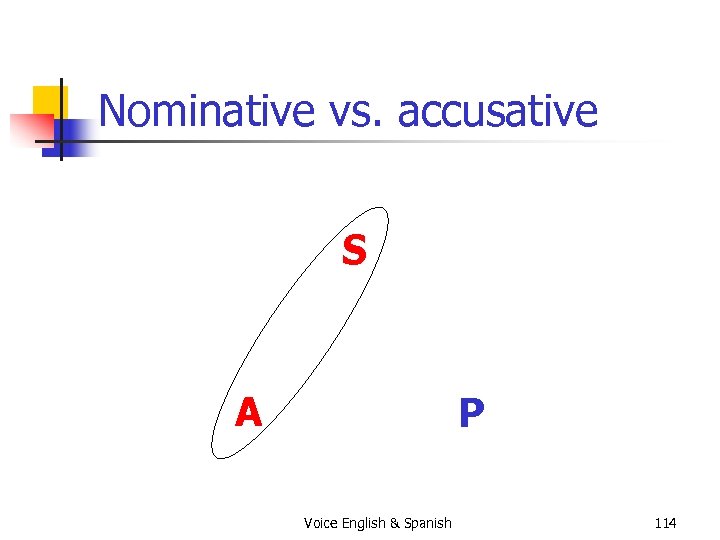
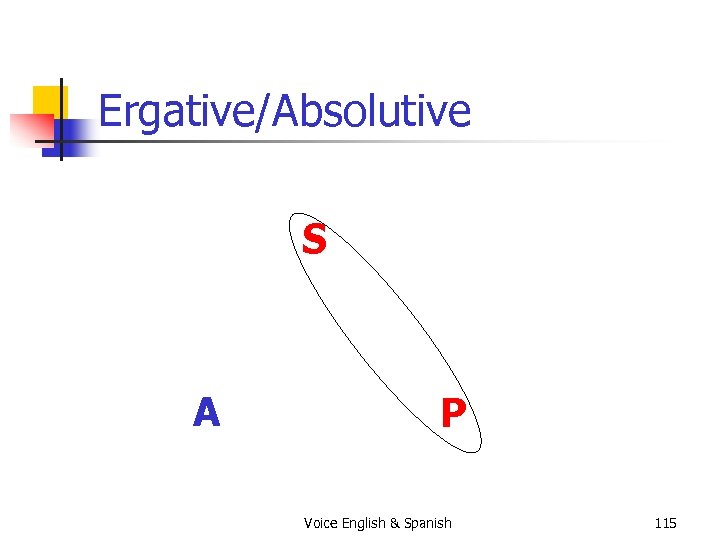
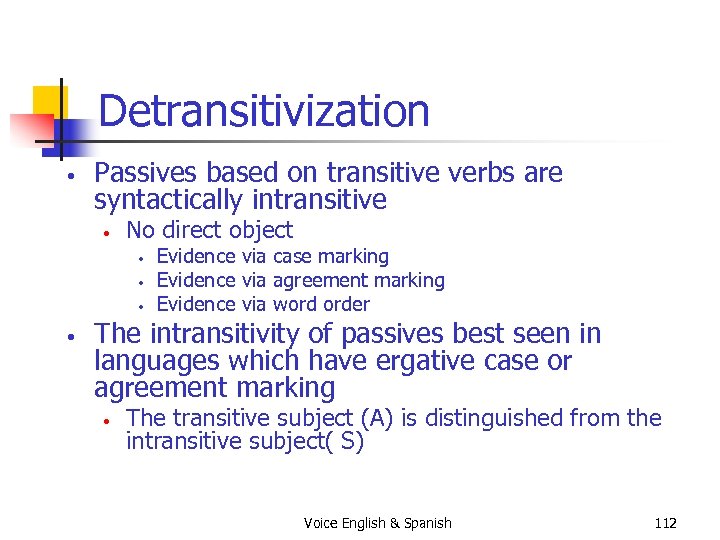 Detransitivization • Passives based on transitive verbs are syntactically intransitive • No direct object • • Evidence via case marking Evidence via agreement marking Evidence via word order The intransitivity of passives best seen in languages which have ergative case or agreement marking • The transitive subject (A) is distinguished from the intransitive subject( S) Voice English & Spanish 112
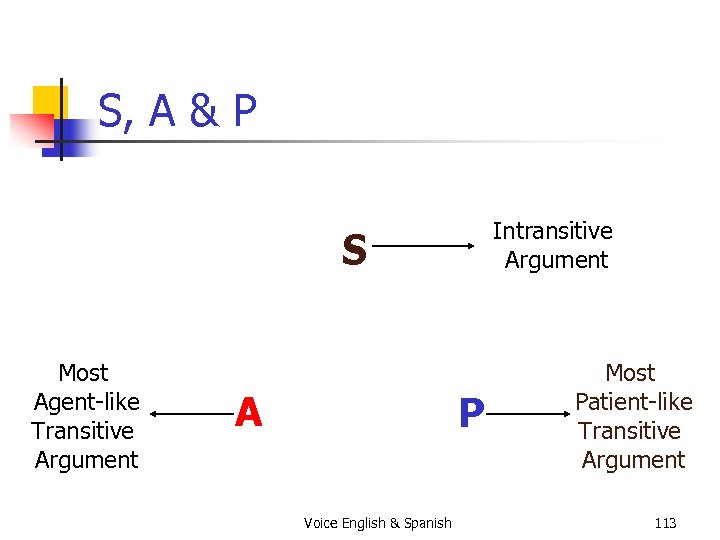 S, A & P Intransitive Argument S Most Agent-like Transitive Argument A P Voice English & Spanish Most Patient-like Transitive Argument 113
 Nominative vs. accusative S A P Voice English & Spanish 114
 Ergative/Absolutive S A P Voice English & Spanish 115
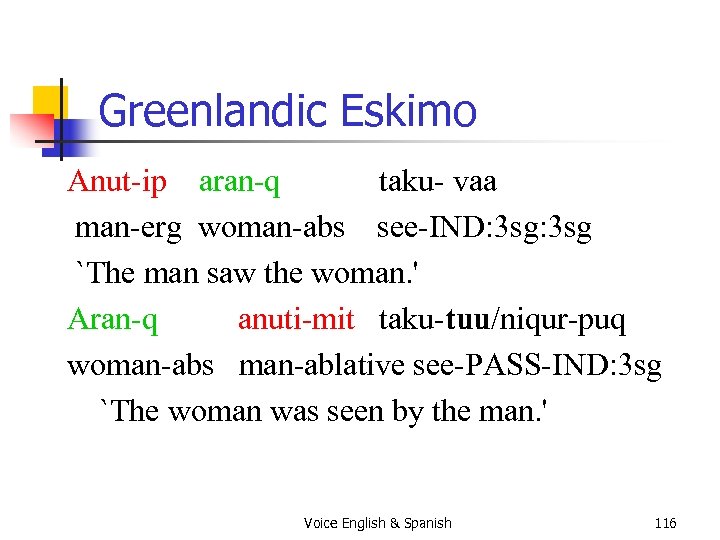 Greenlandic Eskimo Anut-ip aran-q taku- vaa man-erg woman-abs see-IND: 3 sg `The man saw the woman. ' Aran-q anuti-mit taku-tuu/niqur-puq woman-abs man-ablative see-PASS-IND: 3 sg `The woman was seen by the man. ' Voice English & Spanish 116
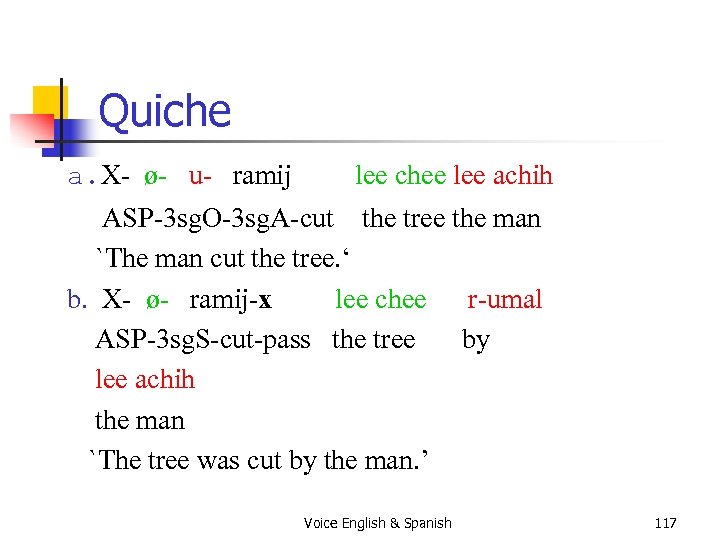 Quiche a. X- ø- u- ramij lee chee lee achih ASP-3 sg. O-3 sg. A-cut the tree the man `The man cut the tree. ‘ b. X- ø- ramij-x lee chee r-umal ASP-3 sg. S-cut-pass the tree by lee achih the man `The tree was cut by the man. ’ Voice English & Spanish 117
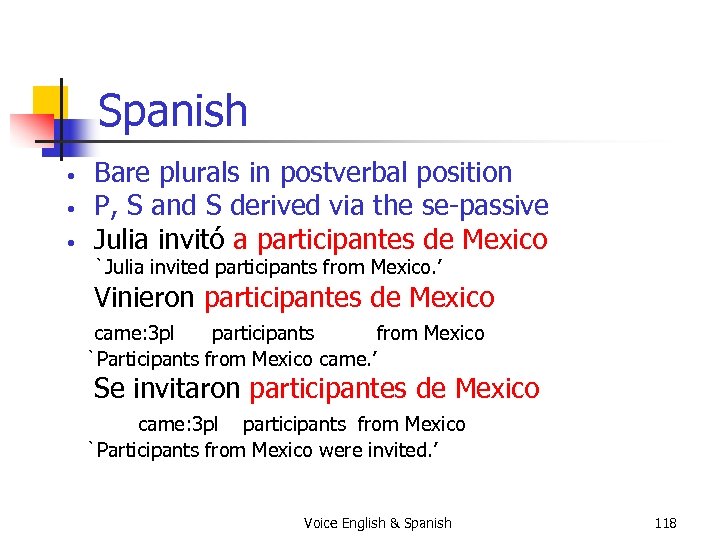 Spanish • • • Bare plurals in postverbal position P, S and S derived via the se-passive Julia invitó a participantes de Mexico `Julia invited participants from Mexico. ’ Vinieron participantes de Mexico came: 3 pl participants from Mexico `Participants from Mexico came. ’ Se invitaron participantes de Mexico came: 3 pl participants from Mexico `Participants from Mexico were invited. ’ Voice English & Spanish 118
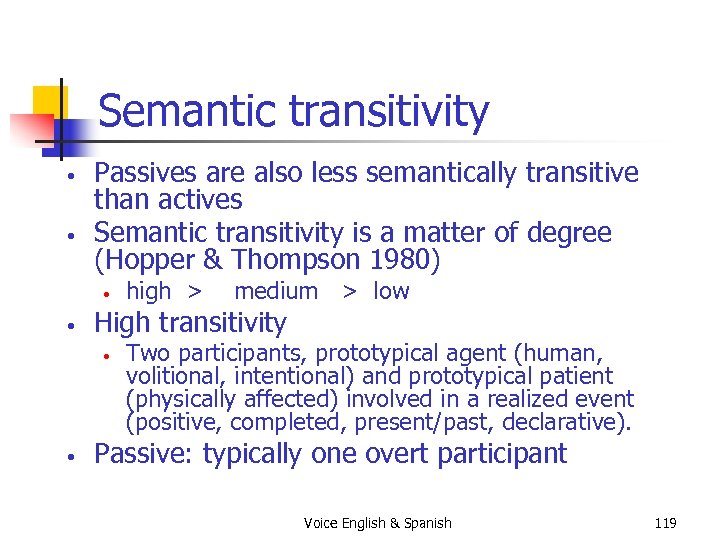 Semantic transitivity • • Passives are also less semantically transitive than actives Semantic transitivity is a matter of degree (Hopper & Thompson 1980) • • medium > low High transitivity • • high > Two participants, prototypical agent (human, volitional, intentional) and prototypical patient (physically affected) involved in a realized event (positive, completed, present/past, declarative). Passive: typically one overt participant Voice English & Spanish 119
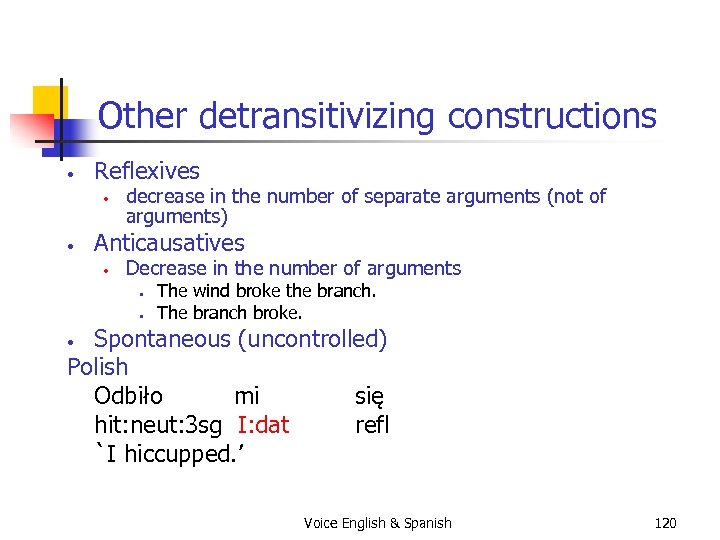 Other detransitivizing constructions • Reflexives • • decrease in the number of separate arguments (not of arguments) Anticausatives • Decrease in the number of arguments • • The wind broke the branch. The branch broke. Spontaneous (uncontrolled) Polish Odbiło mi się hit: neut: 3 sg I: dat refl `I hiccupped. ’ • Voice English & Spanish 120
 The most important function • • Topicalization Impersonalization Detransitivization Shibatani (1985): impersonalization (agent defocusing) Voice English & Spanish 121
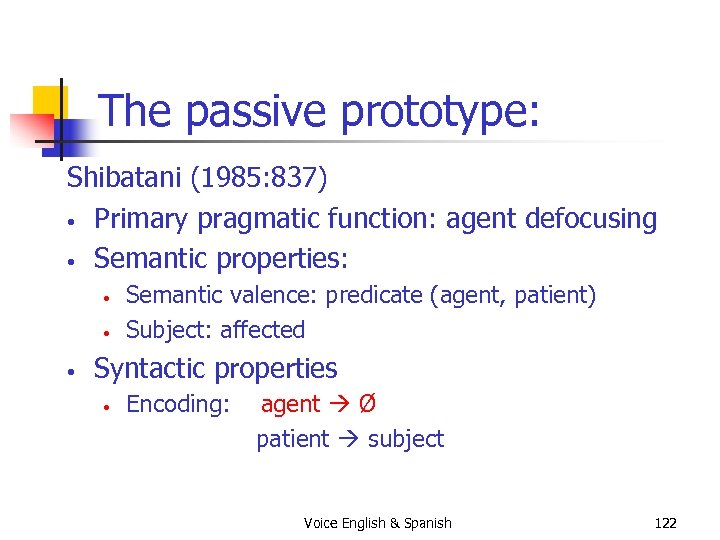 The passive prototype: Shibatani (1985: 837) • Primary pragmatic function: agent defocusing • Semantic properties: • • • Semantic valence: predicate (agent, patient) Subject: affected Syntactic properties • Encoding: agent Ø patient subject Voice English & Spanish 122
 The passive & grammaticalization • How grammaticalized are the respective passive constructions in Spanish and English? Voice English & Spanish 123
 Grammaticalization • • The emergence of grammatical material from lexical material or more grammatical from less grammatical Typically morpheme or element based; the development of individual morphemes or grams (Lehmann 1985, 1995; Bybee et al. 1994) along the following phonological, morpho-syntactic and functional dimensions Voice English & Spanish 124
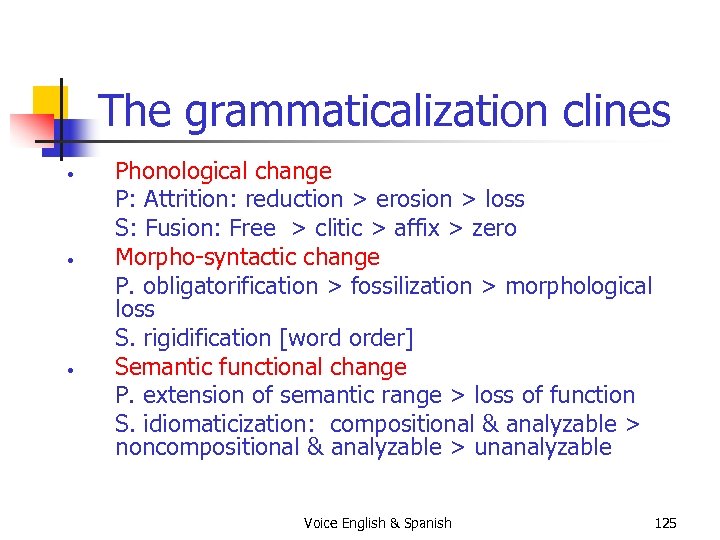 The grammaticalization clines • • • Phonological change P: Attrition: reduction > erosion > loss S: Fusion: Free > clitic > affix > zero Morpho-syntactic change P. obligatorification > fossilization > morphological loss S. rigidification [word order] Semantic functional change P. extension of semantic range > loss of function S. idiomaticization: compositional & analyzable > noncompositional & analyzable > unanalyzable Voice English & Spanish 125
 What do we look at? • The morphology of the predicate • Periphrastic marking • • Synthetic marking • • • Degree of synthesis clitic > agglutinative affix > fused affix The nature and marking of the passive agent • • • Degree of semantic bleeching of the auxiliary, e. g. Polish zostać vs. być the presence or properties of the agent phrase as a whole the properties of agent marker itself The nature of the passive subject Voice English & Spanish 126
 References • • Cameron, Richard (1997). Accessibility theory in a variable syntax of Spanish. Journal of Pragmatics 28: 29 -67. Downing, Angela (1994). The discoursepragamtic functions of left-dislocations in Spanish. Paper presented at the 6 th International Conference of Functional Grammar. York 25 th August 1994. Voice English & Spanish 127
 References • • • Geluykens, Ronald (1992). From discourse process to grammatical construction. On left-dislocations in English. Amsterdam: John Benjamins. Gregory, Michelle L. & Laura A. Michaelis (2001). Topicalization and left-dislocation: a functional opposition revisited. Journal of Pragmatics 33: 16651706. Prince, Ellen (1997). On the functions of Leftdislocations in English Discourse. In: Akio Kamio (ed. ), Directions in Functional Linguistics. Amsterdam: John Benjamins, 117 -143. Voice English & Spanish 128