 Скачать презентацию Vocabulary The sometimes forgotten Big Idea Mary Dosch
b66a3a183115876c5954da8ec74e4e48.ppt
- Количество слайдов: 73



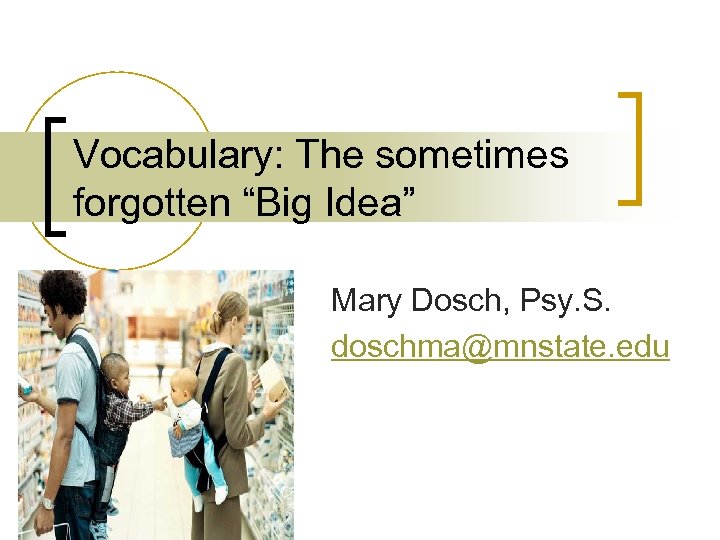
Vocabulary: The sometimes forgotten “Big Idea” Mary Dosch, Psy. S. doschma@mnstate. edu
What is “Vocabulary” n n n Mental dictionary (lexicon) Recognition vocab is greater than productive vocab for most Vocabulary is not defined by the # of words a child can decode in print
1. 2. 3. 4. 5. Phonemic Awareness Alphabetic Principle-Phonics and Decoding Fluency Vocabulary Comprehension
Vocabulary Development n n Focus on vocabulary should start at the preschool level Word rich environments Lots of books: dialogic reading and interactive read-alouds Lots of conversation
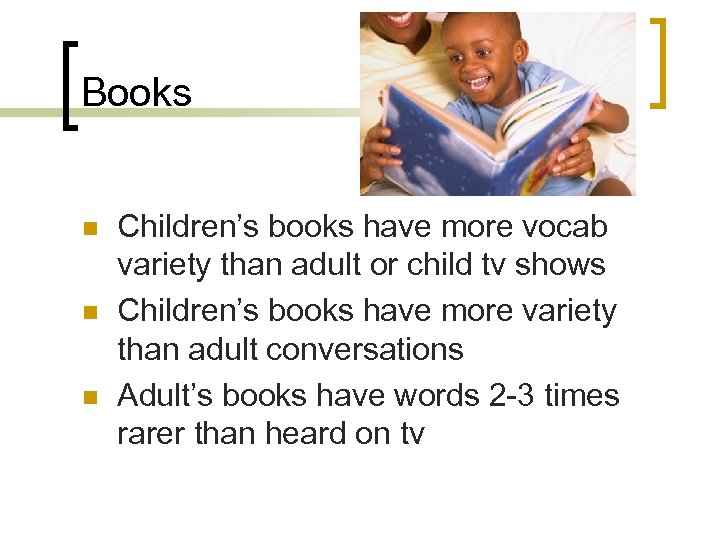
Books n n n Children’s books have more vocab variety than adult or child tv shows Children’s books have more variety than adult conversations Adult’s books have words 2 -3 times rarer than heard on tv
Vocabulary development n Vocabulary development begins through the use of daily oral language Opportunities ¡ Types of words used ¡ Elaboration **e. g. Grocery store Low verbal Average High Verbal ¡
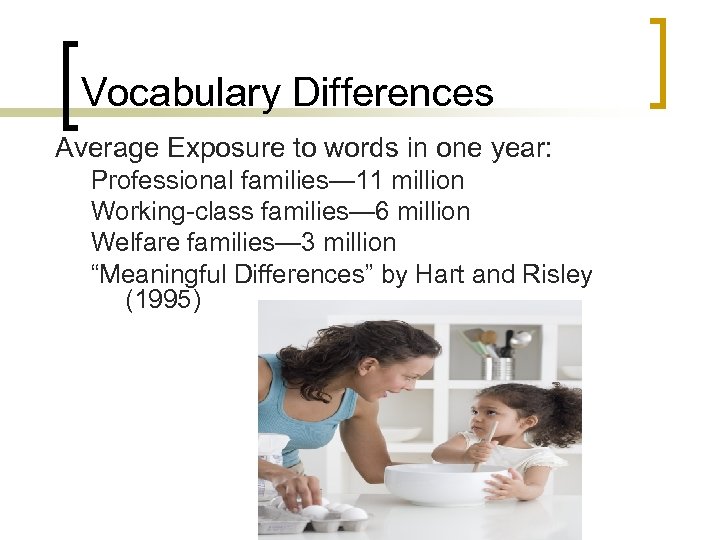
Vocabulary Differences Average Exposure to words in one year: Professional families— 11 million Working-class families— 6 million Welfare families— 3 million “Meaningful Differences” by Hart and Risley (1995)
Intelligence Testing n n Vocabulary is the best single measure of intelligence on cognitive ability tests Teaching vocab improves verbal IQ and reading comprehension
Comprehension depends on knowing word Meanings n n n Vocab is strongly related to reading comp Can decode and pronounce, but if meaning is not recognized, comprehension will be impaired Knowledge of meanings facilitates word recognition
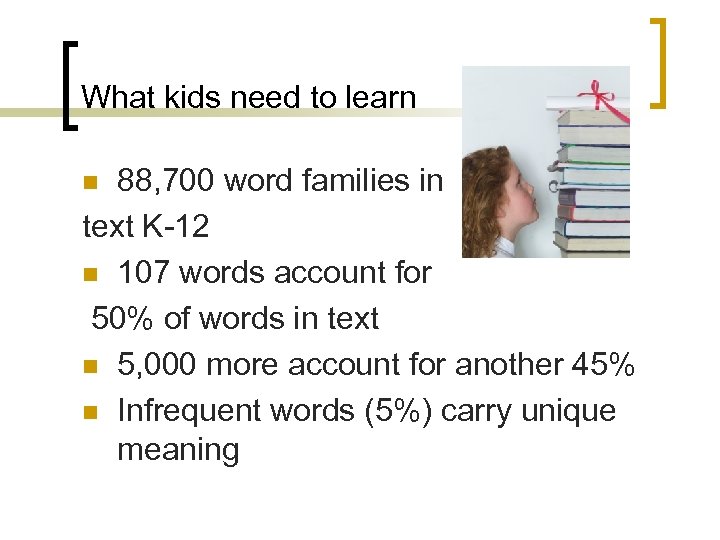
What kids need to learn 88, 700 word families in text K-12 n 107 words account for 50% of words in text n 5, 000 more account for another 45% n Infrequent words (5%) carry unique meaning n
# of words children know In 1 st & 2 nd grades, children need 800+ words per year, about 2 per day. n Children need to learn 2, 000 - 3, 000 new words each year from 3 rd grade on, about 6 -8 per day. ***Matthew Effect **Need about 4000 meanings for words by end of 1 st grade =Average n
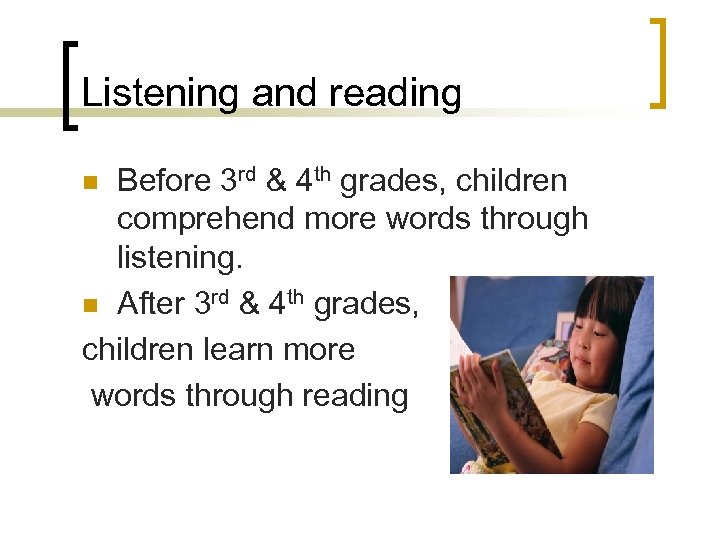
Listening and reading Before 3 rd & 4 th grades, children comprehend more words through listening. n After 3 rd & 4 th grades, children learn more words through reading n
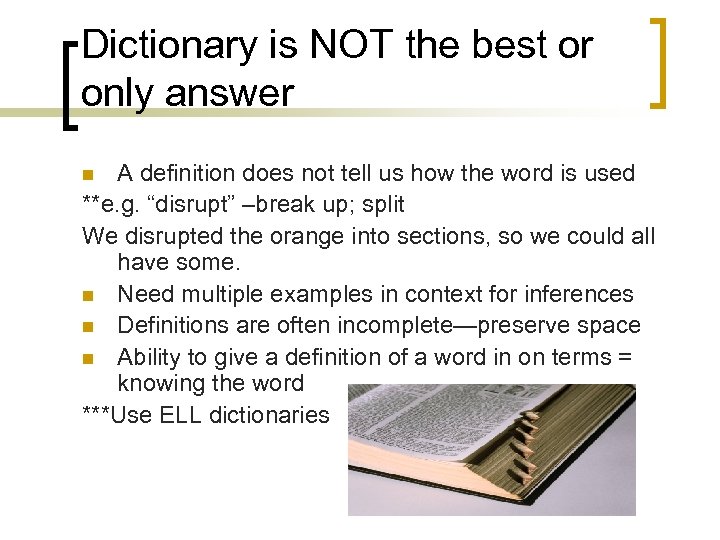
Dictionary is NOT the best or only answer A definition does not tell us how the word is used **e. g. “disrupt” –break up; split We disrupted the orange into sections, so we could all have some. n Need multiple examples in context for inferences n Definitions are often incomplete—preserve space n Ability to give a definition of a word in on terms = knowing the word ***Use ELL dictionaries n
How we know words (1)By reading a lot: n n n Appropriate level of difficulty Sufficient amounts Motivation to pursue understanding
How we know words (2) Exposure to multiple examples in context, spoken & written (3) Through explicit instruction: n Constructing definitions n Dictionary use n Analyze word structure n Exploring word relationships
How we learn words (4) Become conscious: n Words, sounds, and morphemes n Words origins n Word’s usage and multiple meanings ***Exercise “jargon” word—Make up 1 -2 sentences for a partner.
Construction of meaning is personal n Gain meaning through experience ¡ Republican Metacognition- sense of knowing our own understanding and misunderstanding
Hierarchical networks Words & concepts are best learned in relation to one another **Exercise Sort the words into categories & subcategories n
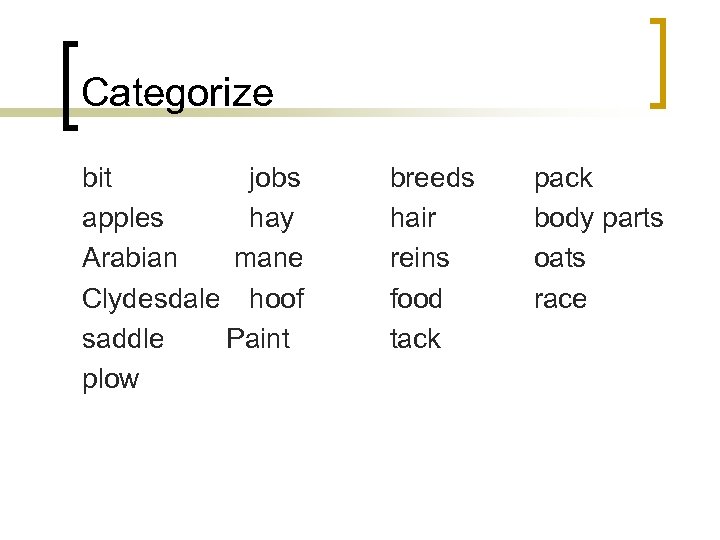
Categorize bit jobs apples hay Arabian mane Clydesdale hoof saddle Paint plow breeds hair reins food tack pack body parts oats race
After Categorizing ? What did you need to know to accomplish this task? ? Can you represent this in a “mindmap” or graphic organizer?
Dictionary Format 1) 2) 3) denote category synonym concepts on features or properties ***kids often only give part of a definition
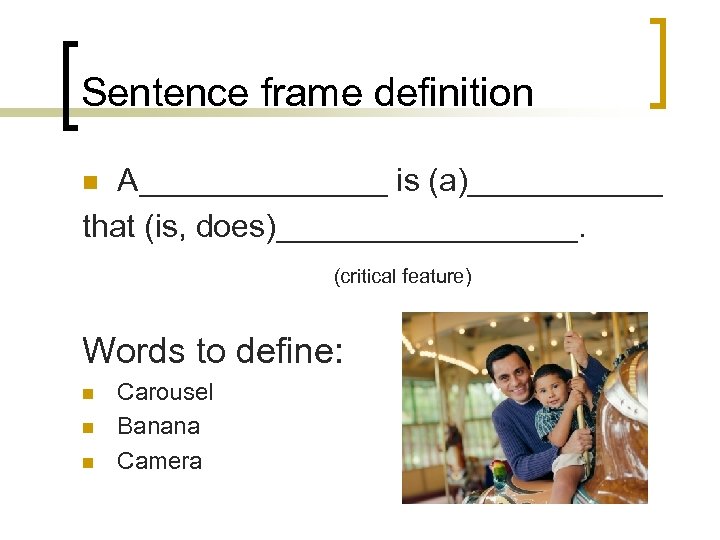
Sentence frame definition A_______ is (a)______ that (is, does)_________. n (critical feature) Words to define: n n n Carousel Banana Camera
Framed Sentences 1. 2. 3. 4. 5. A ______ is a kind of _______that… X and Y are similar in that they both…, but x , while y … _____begins with…, continues with…, and ends with… ______ wanted…, but…, so… _______ happens because…
“Hey! Whatever Works!!”
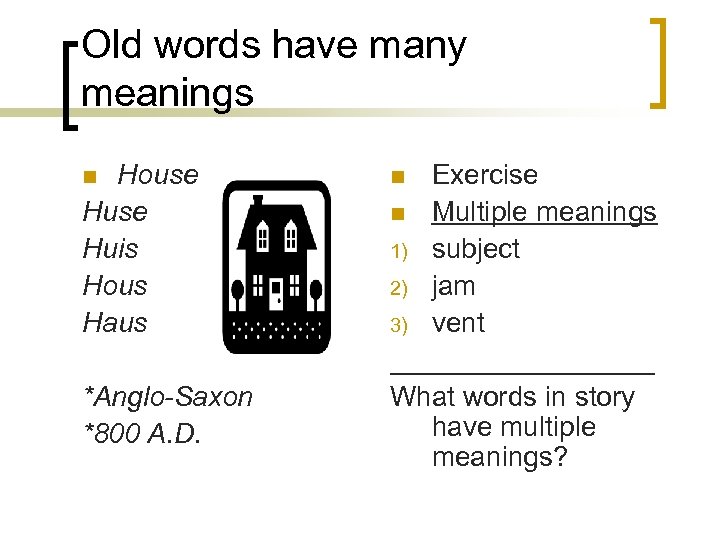
Old words have many meanings House Huis Hous Haus n *Anglo-Saxon *800 A. D. Exercise n Multiple meanings 1) subject 2) jam 3) vent _________ What words in story have multiple meanings? n
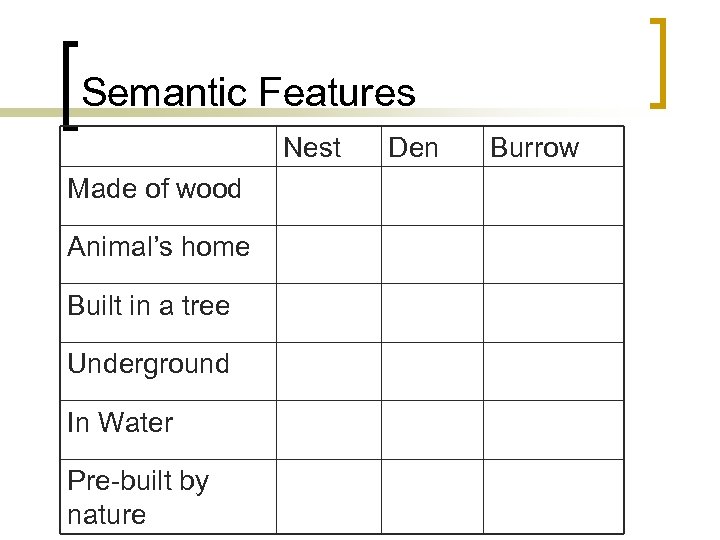
Semantic Features Nest Made of wood Animal’s home Built in a tree Underground In Water Pre-built by nature Den Burrow
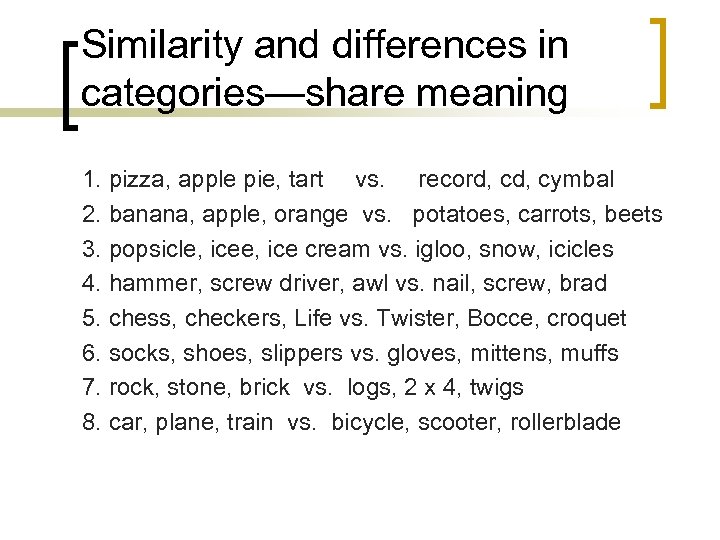
Similarity and differences in categories—share meaning 1. pizza, apple pie, tart vs. record, cymbal 2. banana, apple, orange vs. potatoes, carrots, beets 3. popsicle, ice cream vs. igloo, snow, icicles 4. hammer, screw driver, awl vs. nail, screw, brad 5. chess, checkers, Life vs. Twister, Bocce, croquet 6. socks, shoes, slippers vs. gloves, mittens, muffs 7. rock, stone, brick vs. logs, 2 x 4, twigs 8. car, plane, train vs. bicycle, scooter, rollerblade
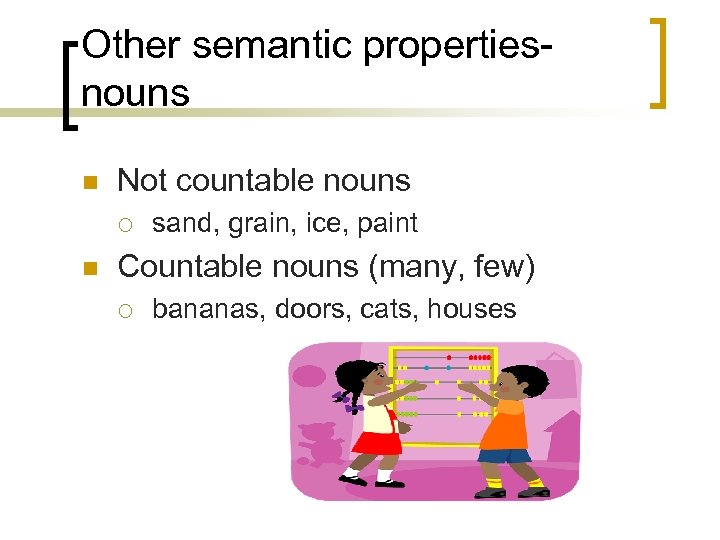
Other semantic propertiesnouns n Not countable nouns ¡ n sand, grain, ice, paint Countable nouns (many, few) ¡ bananas, doors, cats, houses
Semantic properties--verbs n Takes a direct object (transitive) ¡ n brought, put, rescued Do not take a direct object (intransitive) ¡ slept, dreamed, stumbled ***parts of speech and grammar are important
Antonyms-gradable & complementary n Gradable—show degrees on a continuum ¡ n depressed----ecstatic Complementary—either/or—not at same time pregnant----not pregnant ¡ malignant----benign ***Exercise ¡
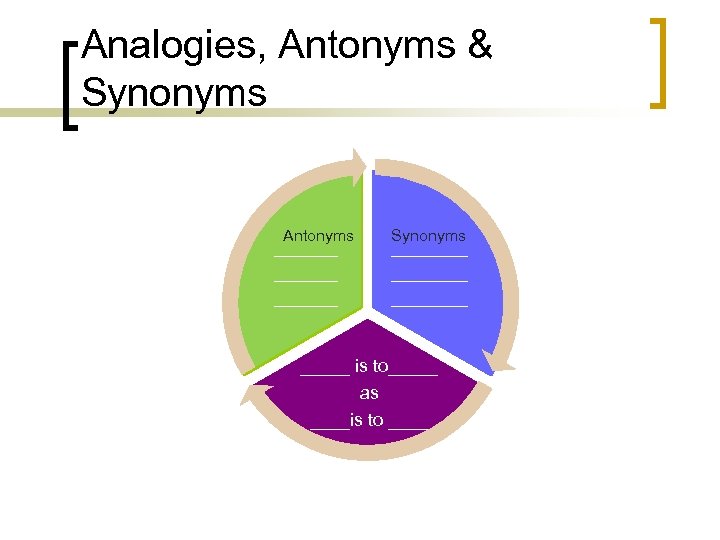
Analogies, Antonyms & Synonyms Antonyms _____ Synonyms ______ is to_____ as ____is to ____
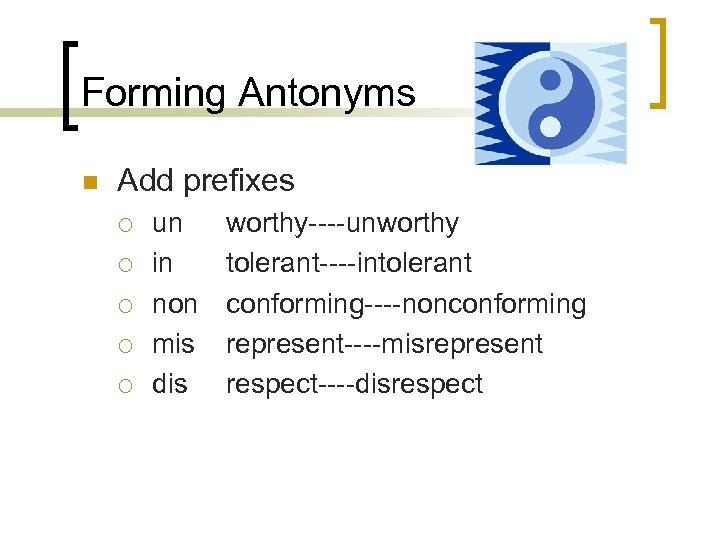
Forming Antonyms n Add prefixes ¡ ¡ ¡ un in non mis dis worthy----unworthy tolerant----intolerant conforming----nonconforming represent----misrepresent respect----disrespect
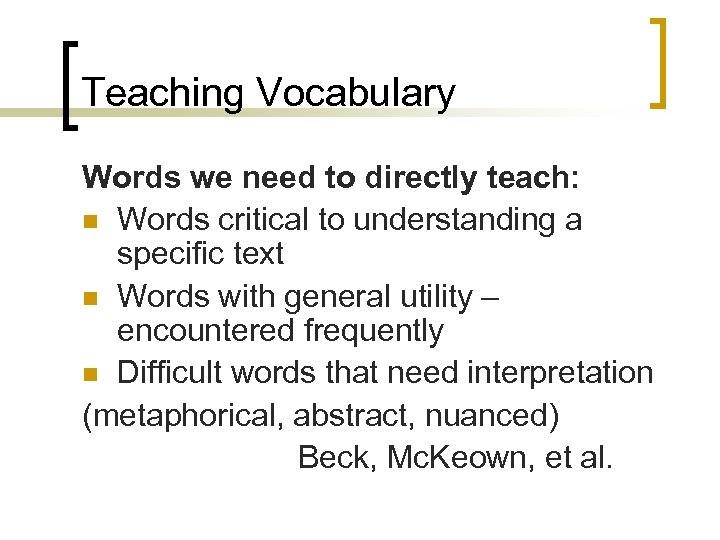
Teaching Vocabulary Words we need to directly teach: n Words critical to understanding a specific text n Words with general utility – encountered frequently n Difficult words that need interpretation (metaphorical, abstract, nuanced) Beck, Mc. Keown, et al.
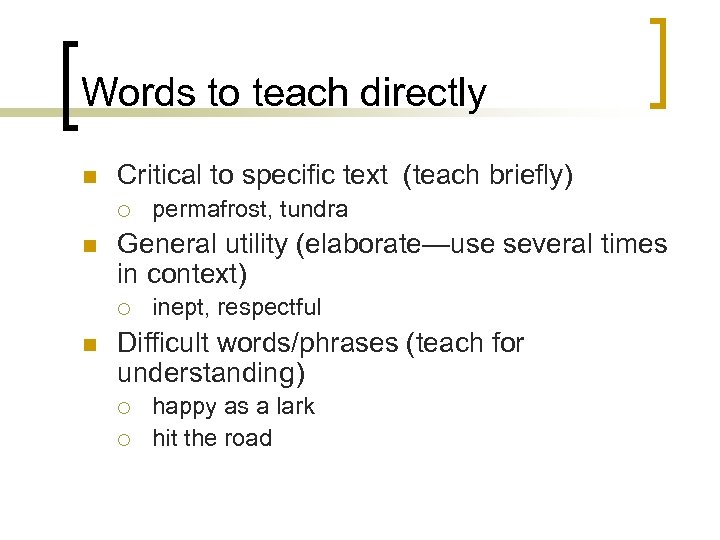
Words to teach directly n Critical to specific text (teach briefly) ¡ n General utility (elaborate—use several times in context) ¡ n permafrost, tundra inept, respectful Difficult words/phrases (teach for understanding) ¡ ¡ happy as a lark hit the road
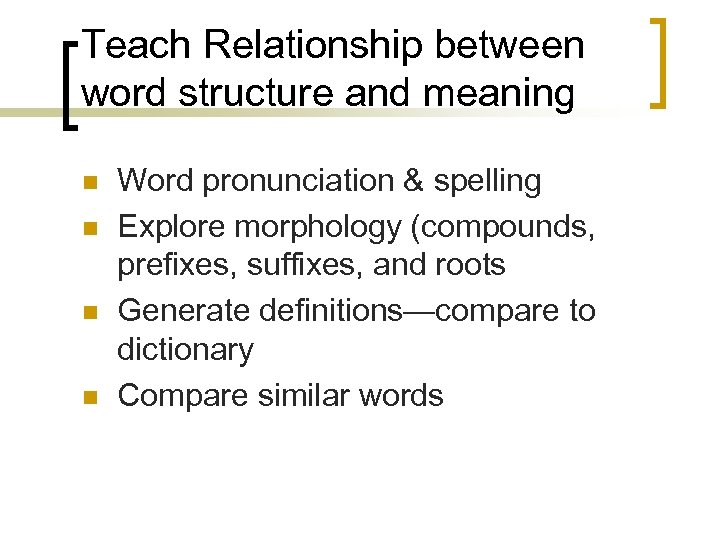
Teach Relationship between word structure and meaning n n Word pronunciation & spelling Explore morphology (compounds, prefixes, suffixes, and roots Generate definitions—compare to dictionary Compare similar words
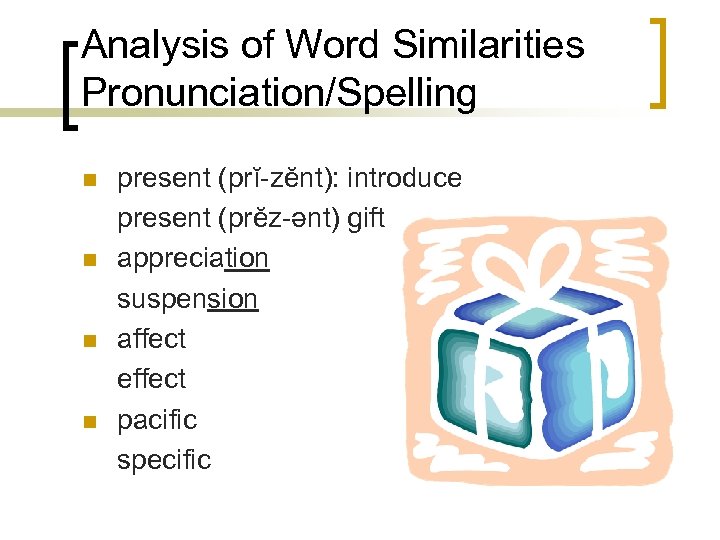
Analysis of Word Similarities Pronunciation/Spelling n n present (prĭ-zĕnt): introduce present (prĕz-ənt) gift appreciation suspension affect effect pacific specific
Excuses…. Excuses!!! n n n My son is under a doctor’s care and should not take any PE today. Please execute him. Dear School: Please excuse John being absent on Jan. 28, 29, 30, 31, 32, and 33. Please excuse Jimmy for being. It was his father’s fault.
Excuses…Excuses!!! n n Please excuse Roland from P. E. for a few days. Yesterday he fell out of a tree and misplaced his hip. Please excuse Mary for being absent yesterday. She was in bed with gramps.
Word derivations n Complexity of English language vowels— 18 vowel sounds ¡ word origin—melting of languages Latin & Greek = 70% of our language Anglo Saxon & French = most of remainder ¡ ***Makes our novels so fascinating
Morphology n word parts that have meaning ¡ ¡ affixes (prefixes or suffixes) roots pre able ic post hyper hypo ity tract ology phono dis inner
Origins n Anglo-Saxon ¡ ¡ n short, one syllable or compound eg--sky, moon, father, love, been French ¡ ¡ ¡ food & fashion words, relationships soft c & g, endings such as –ine, -ette, elle eg—triage, baguette, novice, cuisine
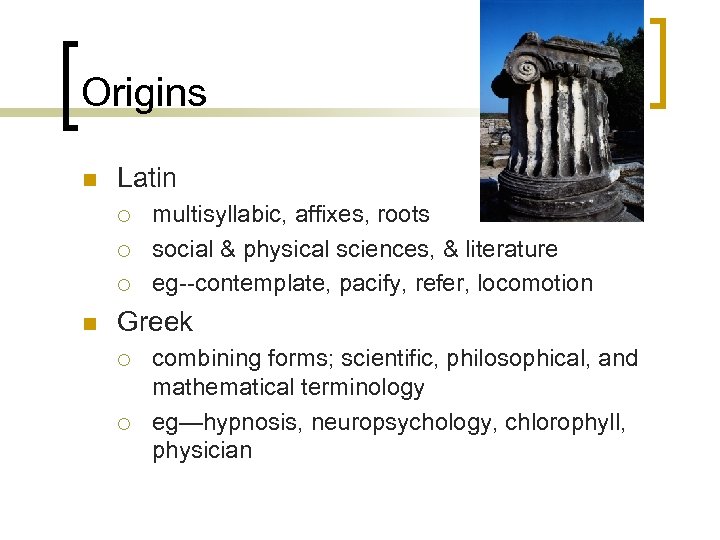
Origins n Latin ¡ ¡ ¡ n multisyllabic, affixes, roots social & physical sciences, & literature eg--contemplate, pacify, refer, locomotion Greek ¡ ¡ combining forms; scientific, philosophical, and mathematical terminology eg—hypnosis, neuropsychology, chlorophyll, physician
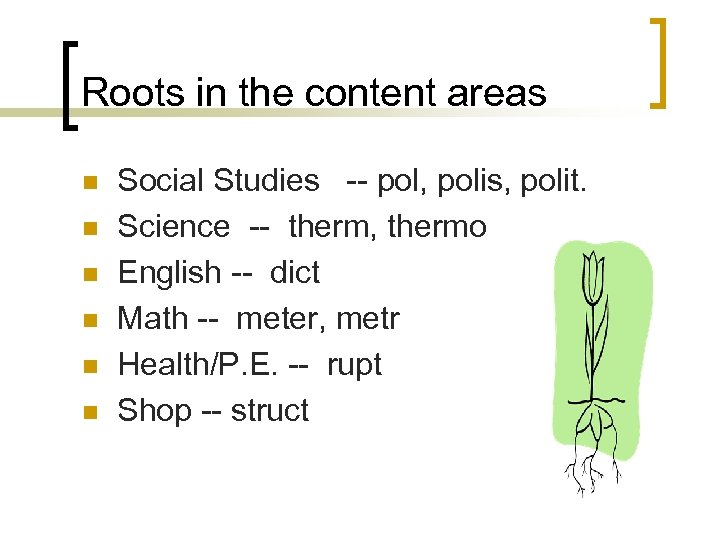
Roots in the content areas n n n Social Studies -- pol, polis, polit. Science -- therm, thermo English -- dict Math -- meter, metr Health/P. E. -- rupt Shop -- struct
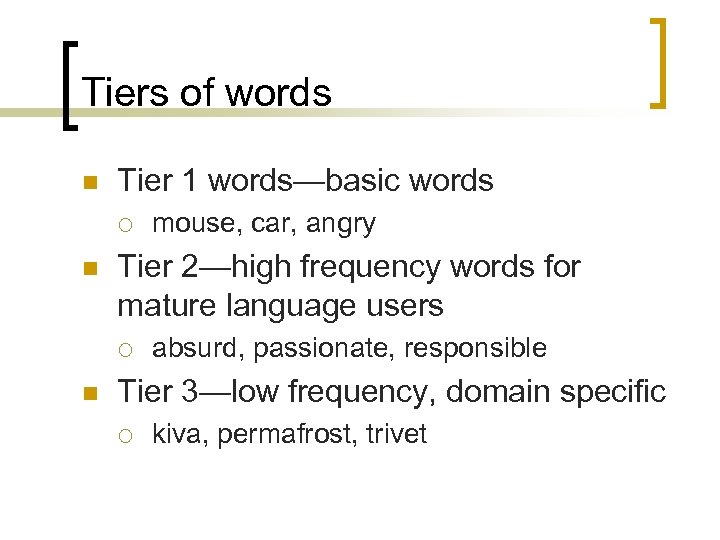
Tiers of words n Tier 1 words—basic words ¡ n Tier 2—high frequency words for mature language users ¡ n mouse, car, angry absurd, passionate, responsible Tier 3—low frequency, domain specific ¡ kiva, permafrost, trivet
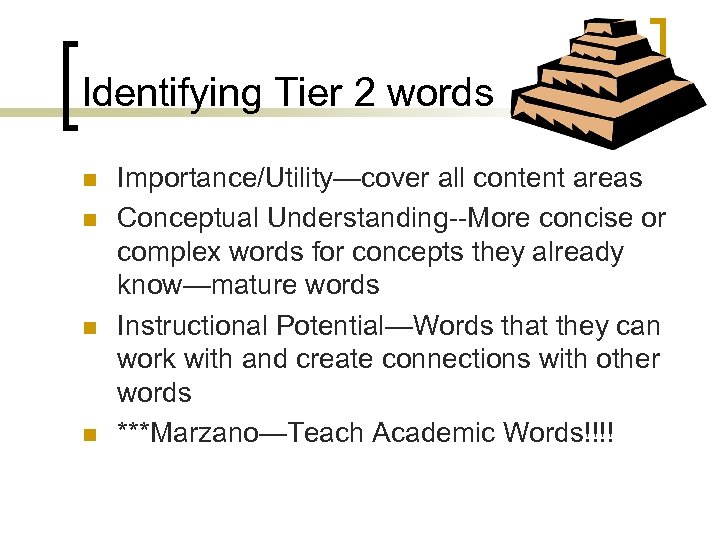
Identifying Tier 2 words n n Importance/Utility—cover all content areas Conceptual Understanding--More concise or complex words for concepts they already know—mature words Instructional Potential—Words that they can work with and create connections with other words ***Marzano—Teach Academic Words!!!!
Definition Generation n n Use context to create definition and then check it Study multiple definitions of words and their uses ***learning new uses and meanings = more flexibility and curiosity
Plan Instruction n Decide on 5 -10 words that are most important to teach directly & thoroughly. List words to be taught more briefly. Outline a few activities that would be useful for building vocabulary before, during, or after the reading selection.
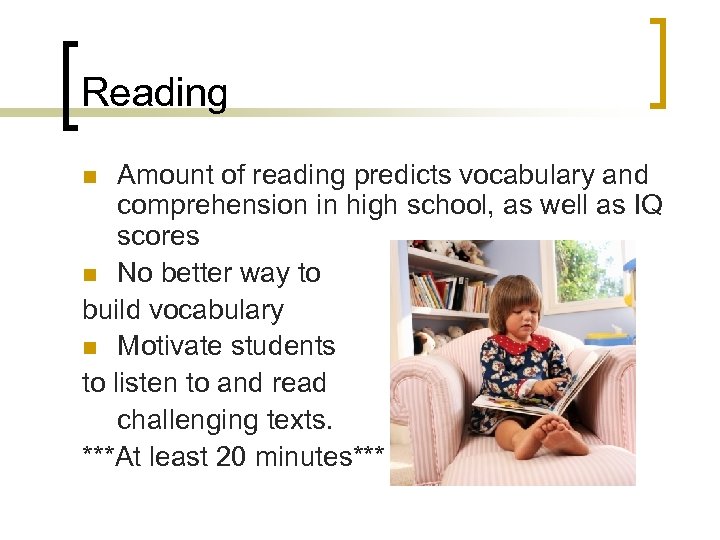
Reading Amount of reading predicts vocabulary and comprehension in high school, as well as IQ scores n No better way to build vocabulary n Motivate students to listen to and read challenging texts. ***At least 20 minutes*** n
Talk a Mile a Minute n Similar to Taboo, but try to guess all words on card, then the main topic. Things Associated with Outerspace Sun Orbits Mars Venus Saturn Galaxy Meteors
“I Need some caffeine!!!”
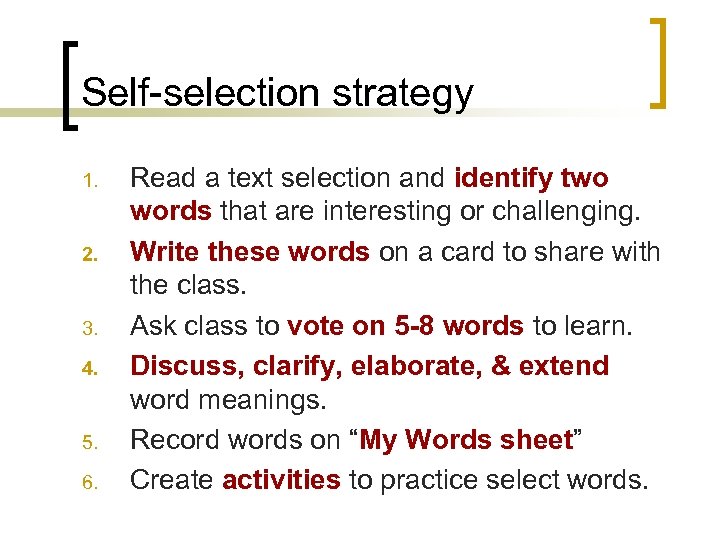
Self-selection strategy 1. 2. 3. 4. 5. 6. Read a text selection and identify two words that are interesting or challenging. Write these words on a card to share with the class. Ask class to vote on 5 -8 words to learn. Discuss, clarify, elaborate, & extend word meanings. Record words on “My Words sheet” Create activities to practice select words.
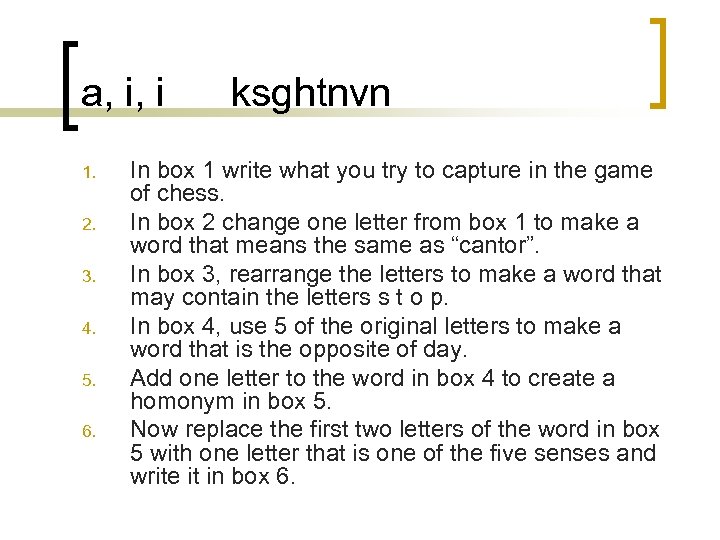
a, i, i 1. 2. 3. 4. 5. 6. ksghtnvn In box 1 write what you try to capture in the game of chess. In box 2 change one letter from box 1 to make a word that means the same as “cantor”. In box 3, rearrange the letters to make a word that may contain the letters s t o p. In box 4, use 5 of the original letters to make a word that is the opposite of day. Add one letter to the word in box 4 to create a homonym in box 5. Now replace the first two letters of the word in box 5 with one letter that is one of the five senses and write it in box 6.
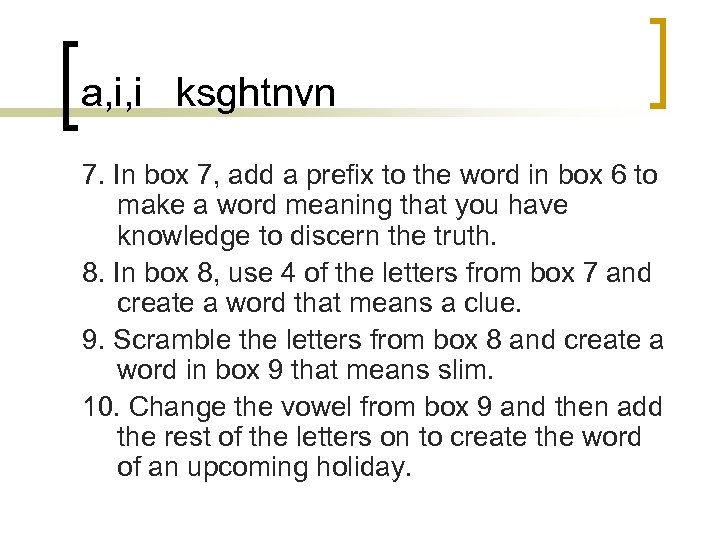
a, i, i ksghtnvn 7. In box 7, add a prefix to the word in box 6 to make a word meaning that you have knowledge to discern the truth. 8. In box 8, use 4 of the letters from box 7 and create a word that means a clue. 9. Scramble the letters from box 8 and create a word in box 9 that means slim. 10. Change the vowel from box 9 and then add the rest of the letters on to create the word of an upcoming holiday.
Homophones n n Words that sound the same, but are spelled different and have different meaning. Homophone Win, Lose, or Draw
Idiom n n Phrase that has a meaning different from the literal meaning of its word. Instruction of idioms 1. 2. 3. Awareness that idioms are common in English Familiarize students with intended meaning Reinforce looking for clues to unlock meaning
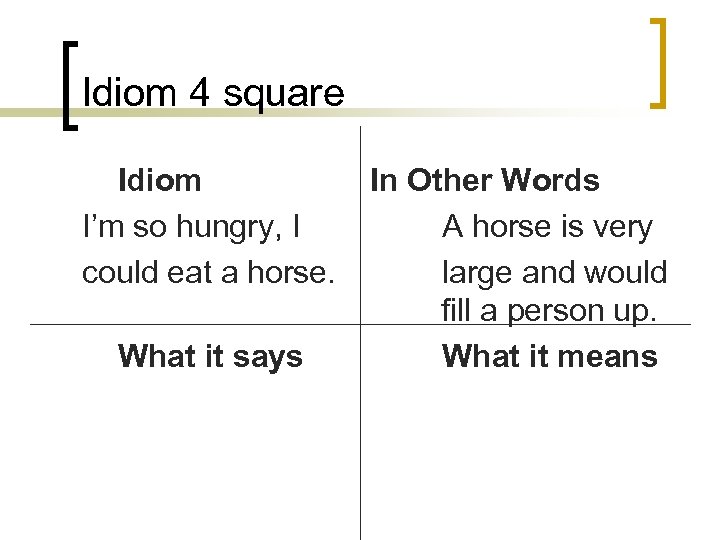
Idiom 4 square Idiom I’m so hungry, I could eat a horse. What it says In Other Words A horse is very large and would fill a person up. What it means
Figurative language n n n Teach metaphors and similes Select a reading passage Make connections through questioning ¡ ¡ ¡ n Text-to-self Text-to-text Text-to-world Draw it out
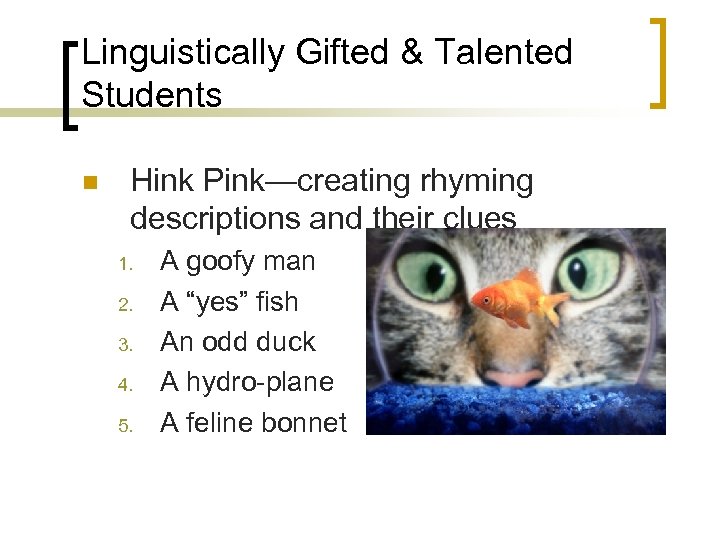
Linguistically Gifted & Talented Students n Hink Pink—creating rhyming descriptions and their clues 1. 2. 3. 4. 5. A goofy man A “yes” fish An odd duck A hydro-plane A feline bonnet
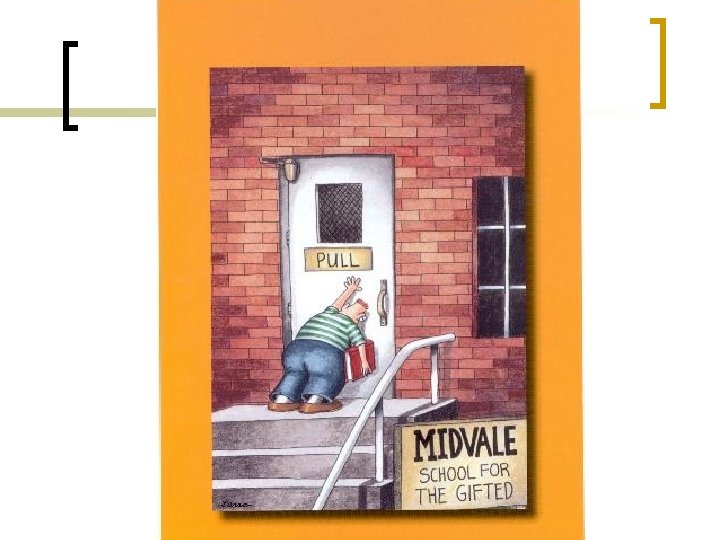
G & T continued Trilingual dictionaries n Word Etymologies n Creating new words with word parts n Create a poem using 3 definitions of the same word n Create crossword puzzles n Publish children’s work ***Book has many great ways to differentiate in various areas of intelligence n Block & Mangieri 2006
Assessment is VERY important! Where is the leak coming from?
Vocabulary Assessments n n n Assess informally in class—test roots & affixes Have students self evaluate Cloze/Maze Analogies Oddity/Categorization

Vocab Fun n n Sticky notes for vocabulary extenders —grab some sticky words Vocabulary penny stackers Plastic shower curtain Vocabulary trees
More fun… n n n Use plastic cups w/ Expo markers to create heirarchy (food chain) Use keyrings for vocabulary words; math facts TP the room—TP & felt tip marker ¡ Brainstorming –decorate the room with TP
Final thoughts on vocabulary n n n Intentionally use/model a strong vocabulary Query-use powerful questions Encourage dialogue and discussion Use opportune moments Help students to understand metacognition
Dive In!!!
References Block, C. C. & Mangieri, J. N. (Eds. ). (2006). The Vocabulary-Enriched Classroom: Practices for Improving the Reading Performance of All Students in Grades 3 and Up. New York, NY: Scholastic Marzano, R. J. (2004). Building Background Knowledge for Academic Achievement: Research on What Works in Schools. Alexandria, VA: ASCD Marzano, R. J. & Pickering, D. J. (2005). Building Academic Vocabulary. Alexandria, VA: ASCD
References n Beck, I. , Mc. Keown, & Kucan, L. (2002). Bringing Words to Life. Guilford Press: n Hart, B. , & Risley, T. R. Meaningful Differences in the Everyday Experience of Young American Children. n Moats, L. (2004). Language Essentials for Teachers of Reading and Spelling. Longmont, CO: Sopris West. CRISS strategies www. projectcriss. org n
Скачать презентацию Vocabulary The sometimes forgotten Big Idea Mary Dosch
b66a3a183115876c5954da8ec74e4e48.ppt