 Скачать презентацию VLDB 2005 Semantic Overlay Networks Karl Aberer and
66a815391936589a5fa35af66512681a.ppt
- Количество слайдов: 92



VLDB 2005 Semantic Overlay Networks Karl Aberer and Philippe Cudré-Mauroux School of Computer and Communication Sciences EPFL -- Switzerland
Overview of the Tutorial • I. P 2 P Systems Overview • II. Query Evaluation in SONs – RDFPeers – PIER – Edutella • III. Semantic Mediation in SONs (PDMSs) – – Peer. DB Hyperion Piazza Grid. Vine • IV. Current Research Directions © 2005, Karl Aberer and Philippe Cudré-Mauroux
What this tutorial is about • Describing a (pertinent) selection of systems managing data in large scale, decentralized overlays networks – Focus on architectures and approaches to evaluate / reformulate queries • It is not about – A comprehensive list of research projects in the area • But we’ll give pointers for that – Complete description of each project • We focus on a few aspects – Performance evaluation of each approach • No meaningful comparison metrics at this stage © 2005, Karl Aberer and Philippe Cudré-Mauroux
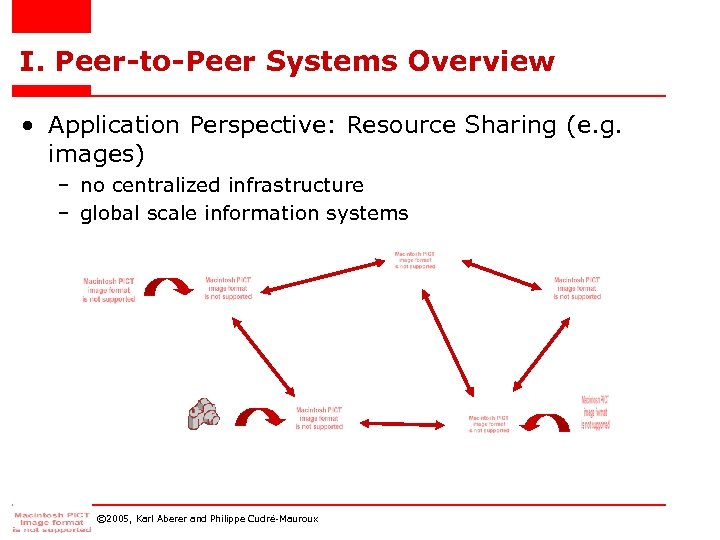
I. Peer-to-Peer Systems Overview • Application Perspective: Resource Sharing (e. g. images) – no centralized infrastructure – global scale information systems © 2005, Karl Aberer and Philippe Cudré-Mauroux
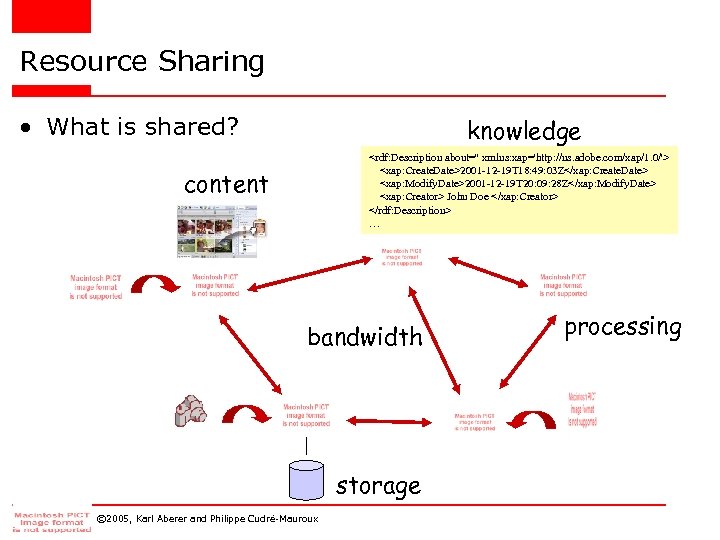
Resource Sharing • What is shared? knowledge <rdf: Description about='' xmlns: xap='http: //ns. adobe. com/xap/1. 0/'> <xap: Create. Date>2001 -12 -19 T 18: 49: 03 Z</xap: Create. Date> <xap: Modify. Date>2001 -12 -19 T 20: 09: 28 Z</xap: Modify. Date> <xap: Creator> John Doe </xap: Creator> </rdf: Description> … content bandwidth storage © 2005, Karl Aberer and Philippe Cudré-Mauroux processing
Enabling Resource Sharing • Searching for Resources – Overlay Networks, Routing, Mapping • Resource Storage – Archival storage, replication and coding • Access to Resources – Streaming, Dissemination • Publishing of Resources – Notification, Subscription • Load Balancing – Bandwidth, Storage, Computation • Trusting into Resources – Security and Reputation • etc. © 2005, Karl Aberer and Philippe Cudré-Mauroux
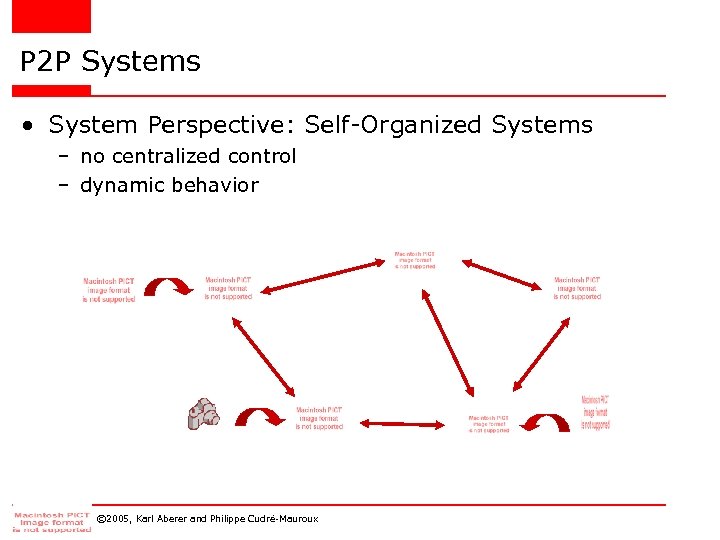
P 2 P Systems • System Perspective: Self-Organized Systems – no centralized control – dynamic behavior © 2005, Karl Aberer and Philippe Cudré-Mauroux
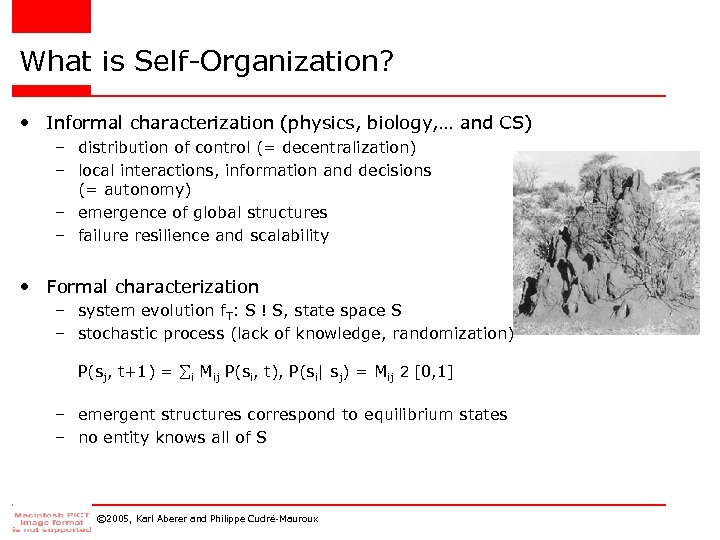
What is Self-Organization? • Informal characterization (physics, biology, … and CS) – distribution of control (= decentralization) – local interactions, information and decisions (= autonomy) – emergence of global structures – failure resilience and scalability • Formal characterization – system evolution f. T: S ! S, state space S – stochastic process (lack of knowledge, randomization) P(sj, t+1) = i Mij P(si, t), P(si| sj) = Mij 2 [0, 1] – emergent structures correspond to equilibrium states – no entity knows all of S © 2005, Karl Aberer and Philippe Cudré-Mauroux
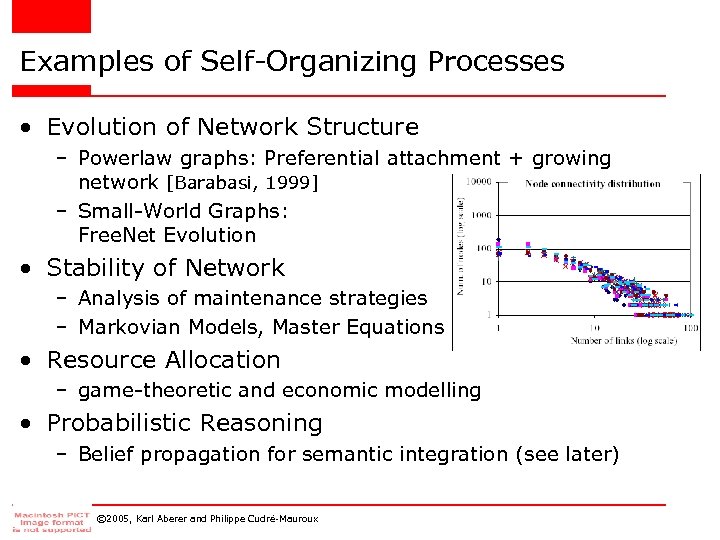
Examples of Self-Organizing Processes • Evolution of Network Structure – Powerlaw graphs: Preferential attachment + growing network [Barabasi, 1999] – Small-World Graphs: Free. Net Evolution • Stability of Network – Analysis of maintenance strategies – Markovian Models, Master Equations • Resource Allocation – game-theoretic and economic modelling • Probabilistic Reasoning – Belief propagation for semantic integration (see later) © 2005, Karl Aberer and Philippe Cudré-Mauroux
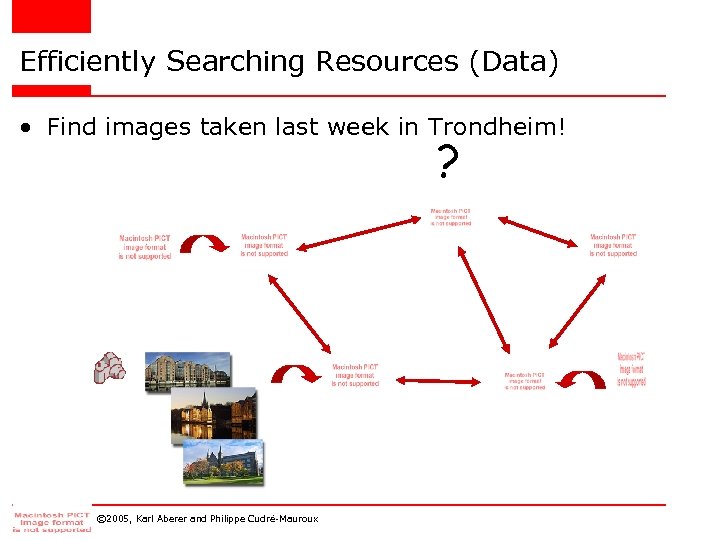
Efficiently Searching Resources (Data) • Find images taken last week in Trondheim! ? © 2005, Karl Aberer and Philippe Cudré-Mauroux
Overlay Networks • Form a logical network in top of the physical network (e. g. TCP/IP) – originally designed for resource location (search) – today other applications (e. g. dissemination) • Each peer connects to a few other peers – locality, scalability • Different organizational principles and routing strategies – unstructured overlay networks – hierarchical overlay networks © 2005, Karl Aberer and Philippe Cudré-Mauroux
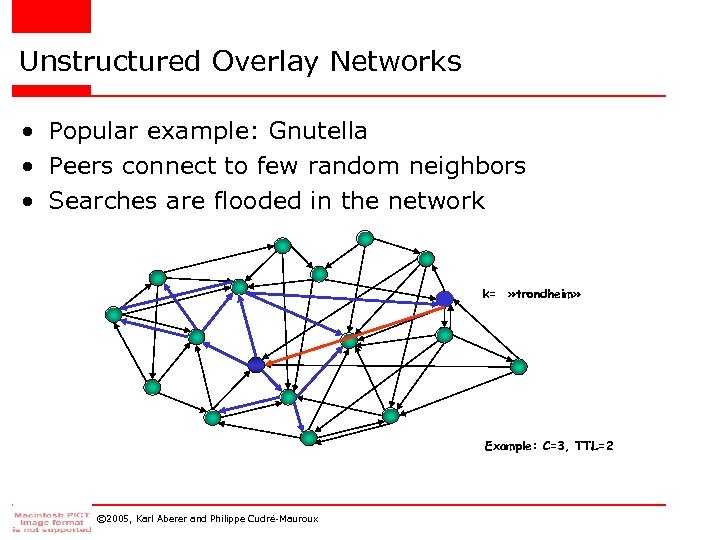
Unstructured Overlay Networks • Popular example: Gnutella • Peers connect to few random neighbors • Searches are flooded in the network k= » trondheim» Example: C=3, TTL=2 © 2005, Karl Aberer and Philippe Cudré-Mauroux
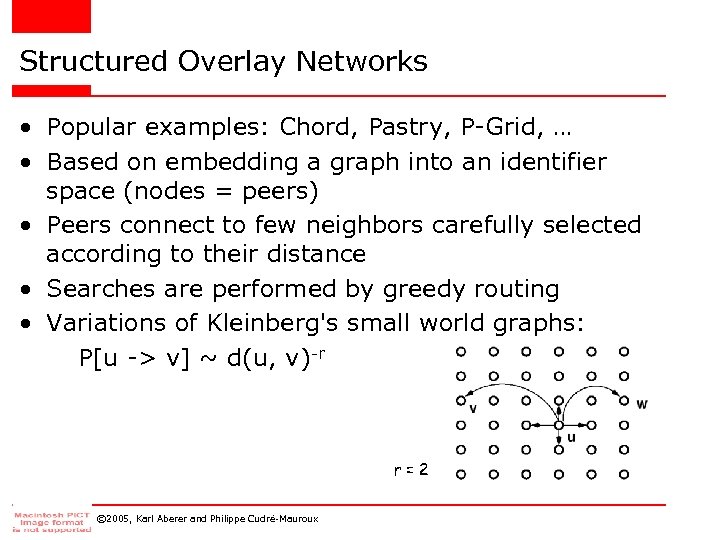
Structured Overlay Networks • Popular examples: Chord, Pastry, P-Grid, … • Based on embedding a graph into an identifier space (nodes = peers) • Peers connect to few neighbors carefully selected according to their distance • Searches are performed by greedy routing • Variations of Kleinberg's small world graphs: P[u -> v] ~ d(u, v)-r r=2 © 2005, Karl Aberer and Philippe Cudré-Mauroux
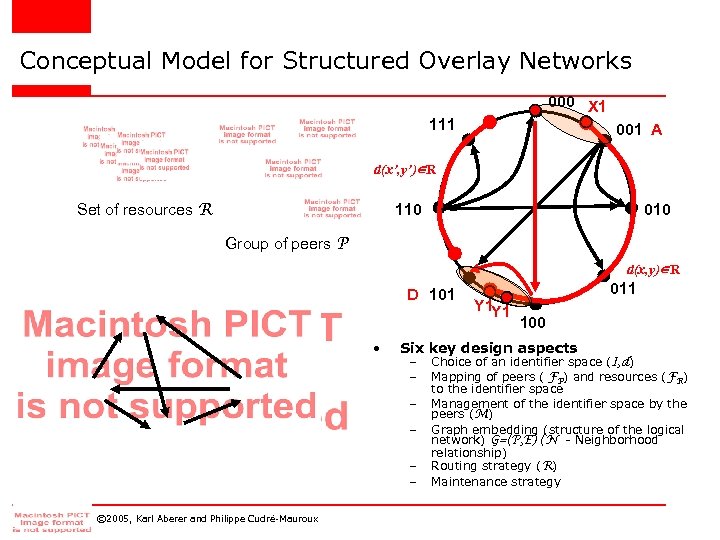
Conceptual Model for Structured Overlay Networks 000 X 1 111 001 A d(x’, y’) R 110 Set of resources R 010 Group of peers P d(x, y) R D 101 Identifier Space • 100 Six key design aspects – – – © 2005, Karl Aberer and Philippe Cudré-Mauroux Y 1 Y 1 011 Choice of an identifier space (I, d) Mapping of peers ( FP) and resources (FR) to the identifier space Management of the identifier space by the peers (M) Graph embedding (structure of the logical network) G=(P, E) (N - Neighborhood relationship) Routing strategy (R) Maintenance strategy
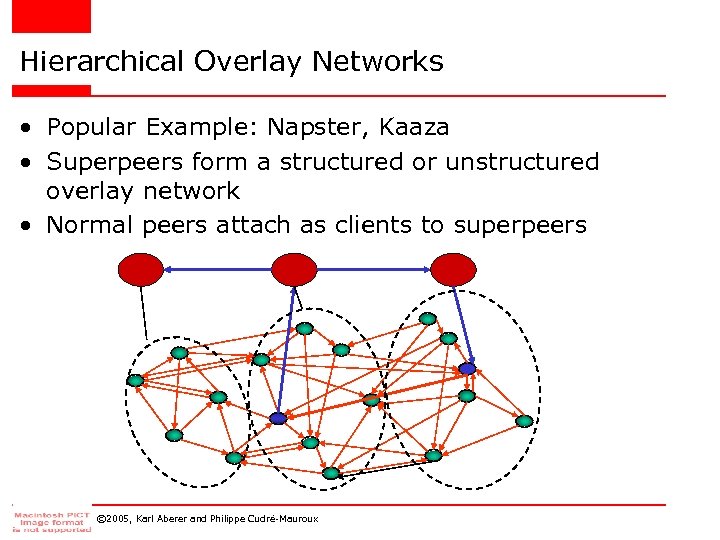
Hierarchical Overlay Networks • Popular Example: Napster, Kaaza • Superpeers form a structured or unstructured overlay network • Normal peers attach as clients to superpeers © 2005, Karl Aberer and Philippe Cudré-Mauroux
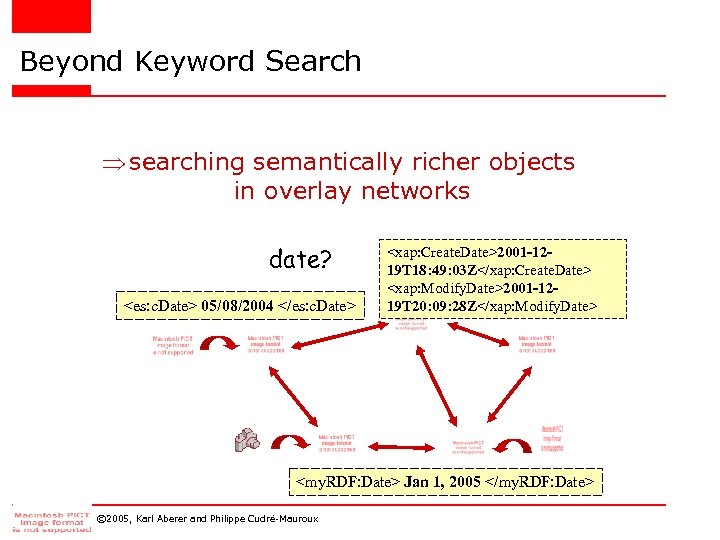
Beyond Keyword Search searching semantically richer objects in overlay networks date? <es: c. Date> 05/08/2004 </es: c. Date> <xap: Create. Date>2001 -1219 T 18: 49: 03 Z</xap: Create. Date> <xap: Modify. Date>2001 -1219 T 20: 09: 28 Z</xap: Modify. Date> <my. RDF: Date> Jan 1, 2005 </my. RDF: Date> © 2005, Karl Aberer and Philippe Cudré-Mauroux
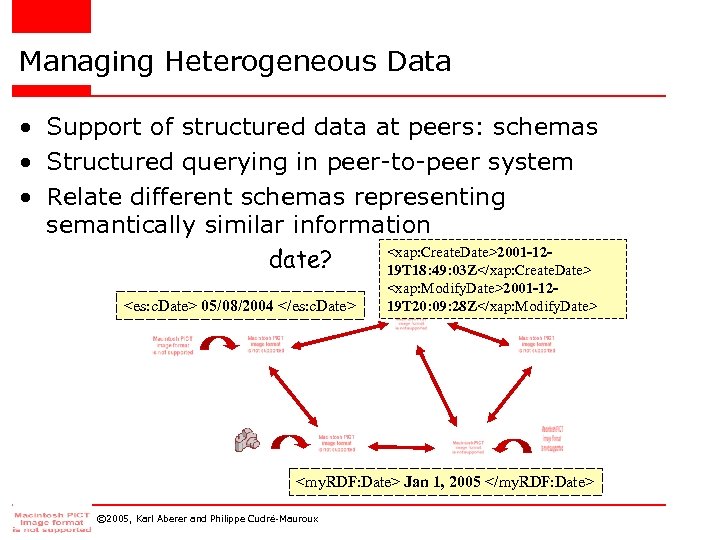
Managing Heterogeneous Data • Support of structured data at peers: schemas • Structured querying in peer-to-peer system • Relate different schemas representing semantically similar information <xap: Create. Date>2001 -12 date? 19 T 18: 49: 03 Z</xap: Create. Date> <es: c. Date> 05/08/2004 </es: c. Date> <xap: Modify. Date>2001 -1219 T 20: 09: 28 Z</xap: Modify. Date> <my. RDF: Date> Jan 1, 2005 </my. RDF: Date> © 2005, Karl Aberer and Philippe Cudré-Mauroux
II. Query Evaluation in SONs Beyond keyword searching complex structured data in overlay networks © 2005, Karl Aberer and Philippe Cudré-Mauroux
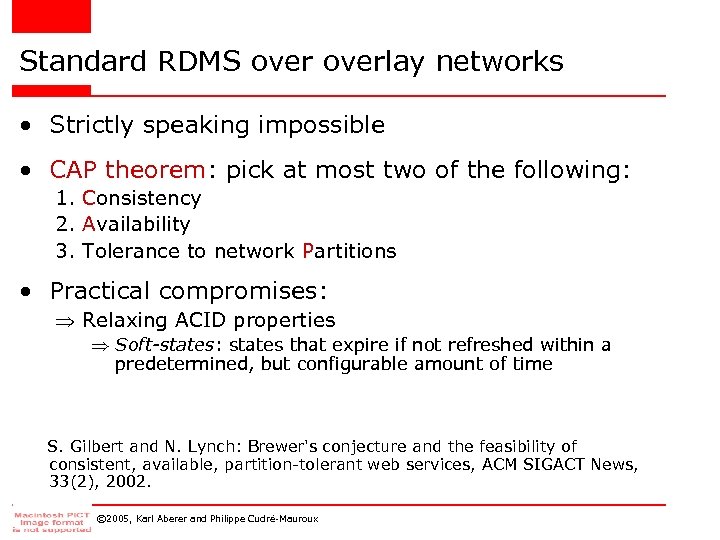
Standard RDMS overlay networks • Strictly speaking impossible • CAP theorem: pick at most two of the following: 1. Consistency 2. Availability 3. Tolerance to network Partitions • Practical compromises: Relaxing ACID properties Soft-states: states that expire if not refreshed within a predetermined, but configurable amount of time S. Gilbert and N. Lynch: Brewer's conjecture and the feasibility of consistent, available, partition-tolerant web services, ACM SIGACT News, 33(2), 2002. © 2005, Karl Aberer and Philippe Cudré-Mauroux
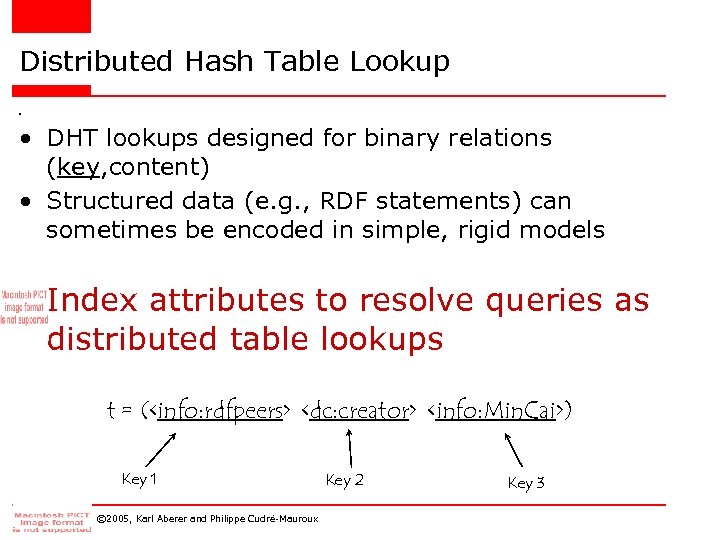
Distributed Hash Table Lookup • • DHT lookups designed for binary relations (key, content) • Structured data (e. g. , RDF statements) can sometimes be encoded in simple, rigid models • Index attributes to resolve queries as distributed table lookups t = (<info: rdfpeers> <dc: creator> <info: Min. Cai>) Key 1 © 2005, Karl Aberer and Philippe Cudré-Mauroux Key 2 Key 3
RDFPeers: A distributed RDF repository Who? – U. S. C. (Information Sciences Institute) Overlay structure – DHT (MAAN [Chord] ) Data model – RDF Queries – RDQL Query evaluation – Distributed (iterative lookup) © 2005, Karl Aberer and Philippe Cudré-Mauroux
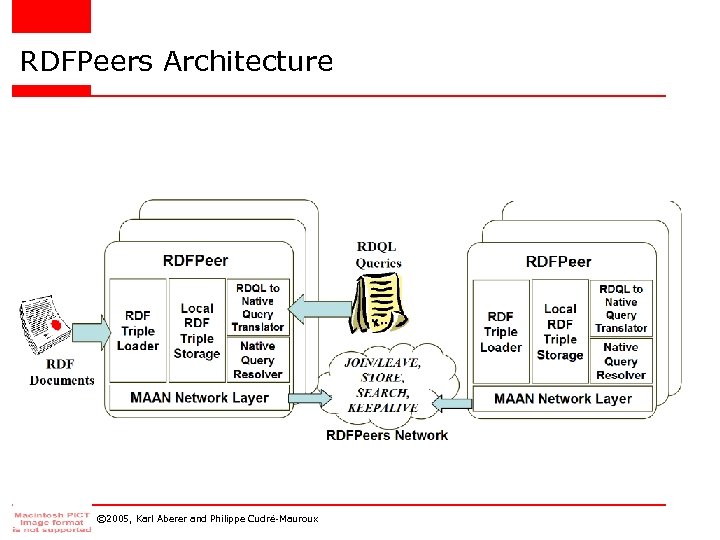
RDFPeers Architecture © 2005, Karl Aberer and Philippe Cudré-Mauroux
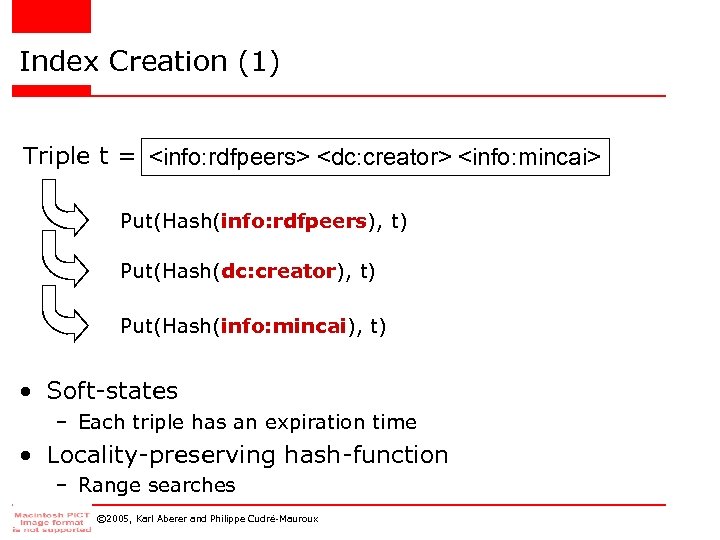
Index Creation (1) Triple t = <info: rdfpeers> <dc: creator> <info: mincai> Put(Hash(info: rdfpeers), t) Put(Hash(dc: creator), t) Put(Hash(info: mincai), t) • Soft-states – Each triple has an expiration time • Locality-preserving hash-function – Range searches © 2005, Karl Aberer and Philippe Cudré-Mauroux
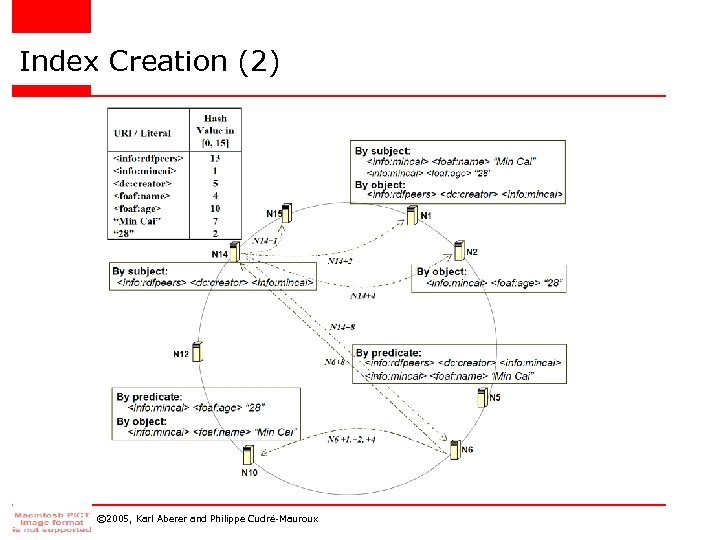
Index Creation (2) © 2005, Karl Aberer and Philippe Cudré-Mauroux
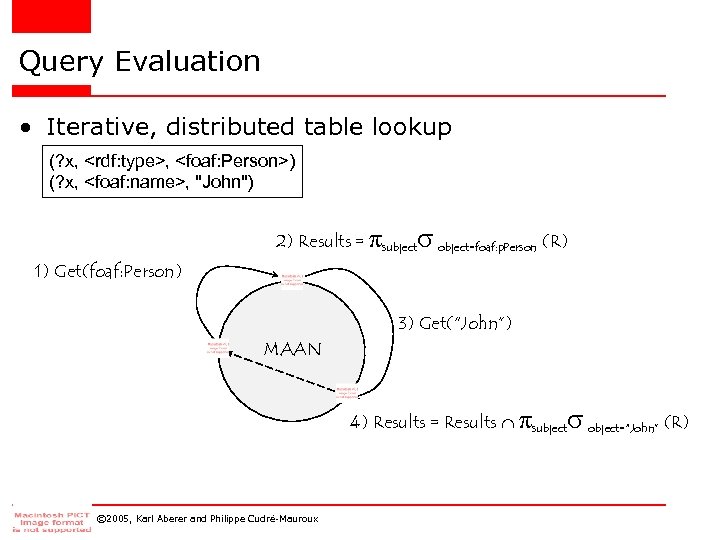
Query Evaluation • Iterative, distributed table lookup (? x, <rdf: type>, <foaf: Person>) (? x, <foaf: name>, "John") 2) Results = πsubject object=foaf: p. Person (R) 1) Get(foaf: Person) 3) Get(“John”) MAAN 4) Results = Results πsubject object=“John” (R) © 2005, Karl Aberer and Philippe Cudré-Mauroux
Want more? Distributed RDF Notifications • Pub/Sub system on top of RDFPeers • Subscription = triple pattern with at least one constant term – Routed to the peer P responsible of the term – P keeps a local list of subscriptions – Fires notifications as soon as a triple matching the pattern gets indexed • Extensions for disjunctive and range subscriptions © 2005, Karl Aberer and Philippe Cudré-Mauroux
References • M. Cai, M. Frank, J. Chen, and P. Szekely. Maan: A mulitattribute addressable network for grid information services. Journal of Grid Computing, 2(1), 2004. • M. Cai and M. Frank. Rdfpeers: A scalable distributed rdf repository based on a structured peer-to-peer network. In International World Wide Web Conference(WWW), 2004. • M. Cai, M. Frank, B. Pan, and R. Mac. Gregor. A subscribable peer-to-peer rdf repository for distributed metadata management. Journal of Web Semantics, 2(2), 2005. © 2005, Karl Aberer and Philippe Cudré-Mauroux
DHT-Based RDMS • • Traditional DHTs only support keyword lookups • Traditional RDMS do no scale gracefully with the number of nodes • Scaling-up RDMS over a DHT – Distributing storage load – Distributing query load Relaxing ACID properties © 2005, Karl Aberer and Philippe Cudré-Mauroux
The PIER Project Who? – U. C. Berkeley Overlay structure – DHT (currently Bamboo and Chord) Data model – Relational Queries – Relational, with joins and aggregation Query evaluation – Distributed (based on query plans) © 2005, Karl Aberer and Philippe Cudré-Mauroux
PIER Architecture • Peer-to-peer Information Exchange and Retrieval • Relational query processing system built on top of a DHT • Query processing and storage are decoupled Sacrificing strong consistency semantics • Best-Effort © 2005, Karl Aberer and Philippe Cudré-Mauroux
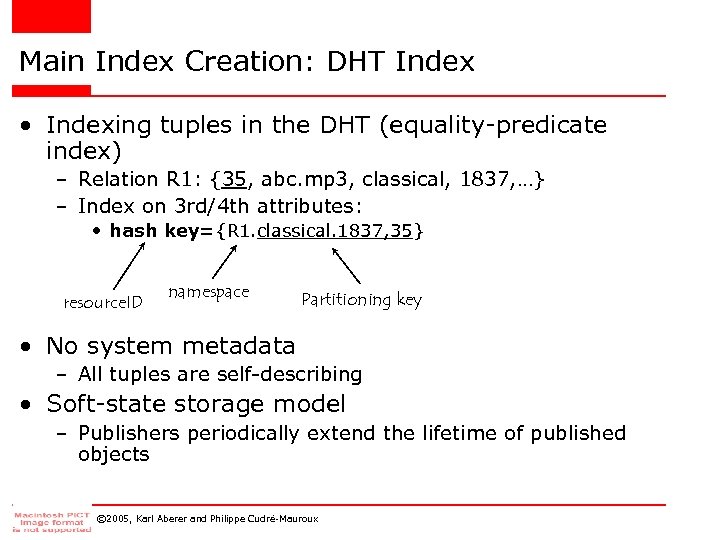
Main Index Creation: DHT Index • Indexing tuples in the DHT (equality-predicate index) – Relation R 1: {35, abc. mp 3, classical, 1837, …} – Index on 3 rd/4 th attributes: • hash key={R 1. classical. 1837, 35} resource. ID namespace Partitioning key • No system metadata – All tuples are self-describing • Soft-state storage model – Publishers periodically extend the lifetime of published objects © 2005, Karl Aberer and Philippe Cudré-Mauroux
Two Other Indexes • Multicast index – Multicast tree created over the DHT • Range index – Prefix hash tree created over the DHT © 2005, Karl Aberer and Philippe Cudré-Mauroux
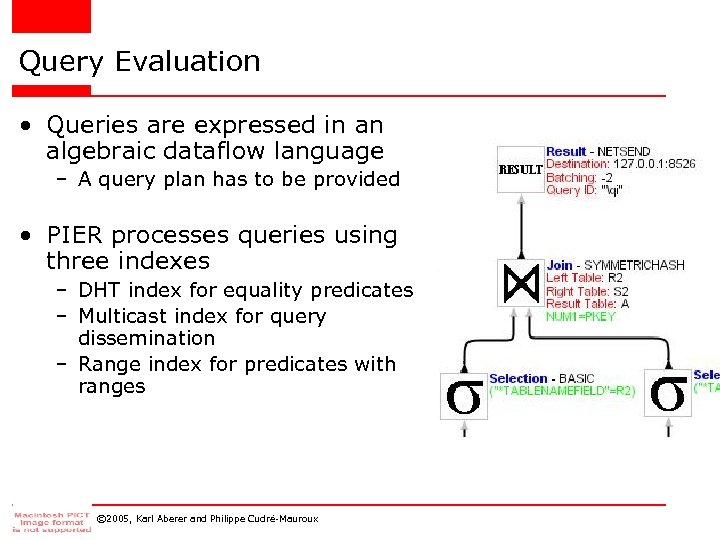
Query Evaluation • Queries are expressed in an algebraic dataflow language – A query plan has to be provided • PIER processes queries using three indexes – DHT index for equality predicates – Multicast index for query dissemination – Range index for predicates with ranges © 2005, Karl Aberer and Philippe Cudré-Mauroux
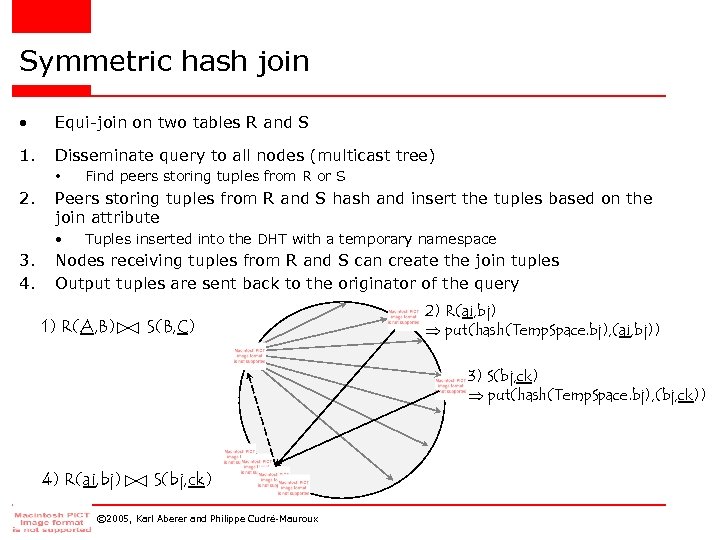
Symmetric hash join • Equi-join on two tables R and S 1. Disseminate query to all nodes (multicast tree) • 2. Peers storing tuples from R and S hash and insert the tuples based on the join attribute • 3. 4. Find peers storing tuples from R or S Tuples inserted into the DHT with a temporary namespace Nodes receiving tuples from R and S can create the join tuples Output tuples are sent back to the originator of the query 1) R(A, B) S(B, C) 2) R(ai, bj) put(hash(Temp. Space. bj), (ai, bj)) 3) S(bj, ck) put(hash(Temp. Space. bj), (bj, ck)) 4) R(ai, bj) S(bj, ck) © 2005, Karl Aberer and Philippe Cudré-Mauroux
Want more? Join variants in PIER • Skip rehashing – When one of the tables is already hashed on the join attribute in the equality-predicate index • Symmetric semi-join rewrite – Tuples are projected on the join attribute before being rehashed • Bloom filter rewrite – Each node creates a local Bloom filter and sends it to a temporary namespace – Local Bloom filters are OR-ed and multicast to nodes storing the other relations – Followed by a symmetric hash join, but only the tuples matching the filter are rehashed © 2005, Karl Aberer and Philippe Cudré-Mauroux
References • J. M. Hellerstein: Toward network data independence. SIGMOD Record 32(3), 2003 • R. Huebsch, J. M. Hellerstein, N. Lanham, B. Thau Loo, S. Shenker, and I. Stoica. Querying the internet with pier. In International Conference on Very Large Databases (VLDB), 2003. • B. Thau Loo, J. M. Hellerstein, R. Huebsch, S. Shenker, and I. Stoica. Enhancing p 2 p file-sharing with an internet-scale query processor. In International Conference on Very Large Databases (VLDB), 2004. • S. Ramabhadran, S. Ratnasamy, J. M. Hellerstein, and S. Shenker. Brief announcement: Prefix hash tree. In ACM PODC, 2004. • R. Huebsch, B. Chun, J. M. Hellerstein, B. Thau Loo, P. Maniatis, T. Roscoe, S. Shenker, I. Stoica, and A. R. Yumerefendi. The architecture of pier: an internetscale query processor. In Biennial Conference on Innovative Data Systems Research (CIDR), 2005. © 2005, Karl Aberer and Philippe Cudré-Mauroux
Routing Indices • • Flooding an overlay network with a query can be inefficient • Disseminating a query often boils down to computing a multicast tree for a portion of the peers • Storing semantic routing information at various granularities directly at the peers – Schema level – Attribute level – Value level © 2005, Karl Aberer and Philippe Cudré-Mauroux
The Edutella Project Who? – U. of Hannover (mainly) Overlay structure – Super-Peer (Hyper. Cup) Data model – RDF/S Queries – Triple patterns (or TRIPLE) Query evaluation – Distributed (based on routing indices) © 2005, Karl Aberer and Philippe Cudré-Mauroux
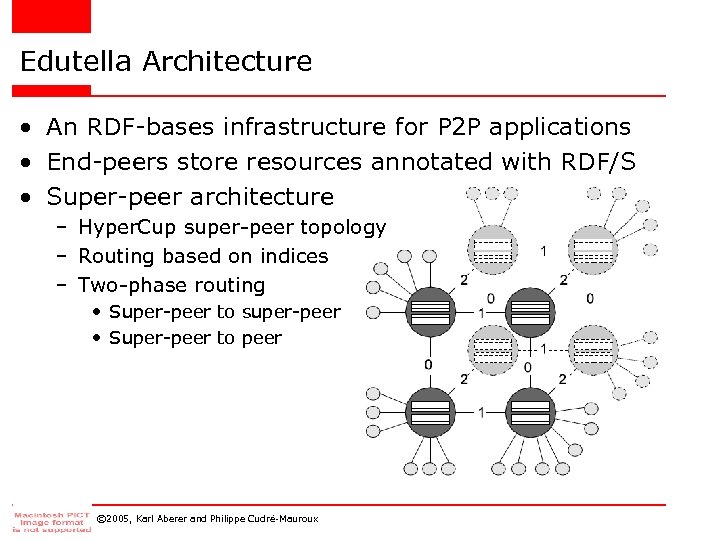
Edutella Architecture • An RDF-bases infrastructure for P 2 P applications • End-peers store resources annotated with RDF/S • Super-peer architecture – Hyper. Cup super-peer topology – Routing based on indices – Two-phase routing • Super-peer to super-peer • Super-peer to peer © 2005, Karl Aberer and Philippe Cudré-Mauroux
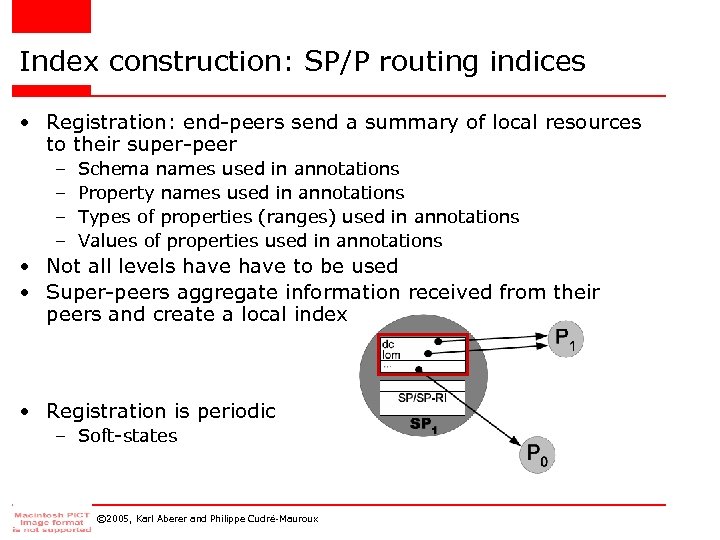
Index construction: SP/P routing indices • Registration: end-peers send a summary of local resources to their super-peer – – Schema names used in annotations Property names used in annotations Types of properties (ranges) used in annotations Values of properties used in annotations • Not all levels have to be used • Super-peers aggregate information received from their peers and create a local index • Registration is periodic – Soft-states © 2005, Karl Aberer and Philippe Cudré-Mauroux
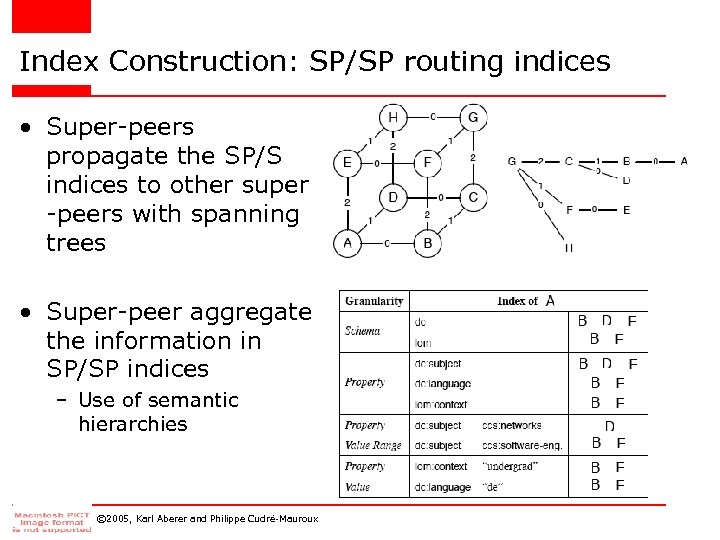
Index Construction: SP/SP routing indices • Super-peers propagate the SP/S indices to other super -peers with spanning trees • Super-peer aggregate the information in SP/SP indices – Use of semantic hierarchies © 2005, Karl Aberer and Philippe Cudré-Mauroux
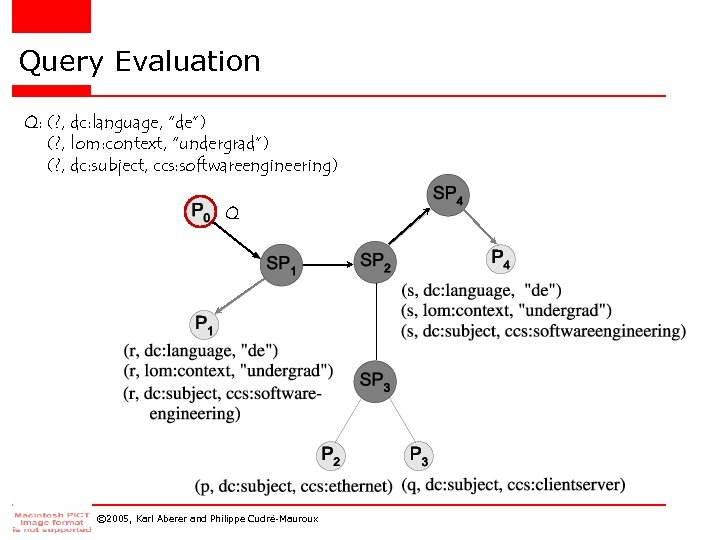
Query Evaluation Q: (? , dc: language, “de”) (? , lom: context, “undergrad”) (? , dc: subject, ccs: softwareengineering) Q © 2005, Karl Aberer and Philippe Cudré-Mauroux
Want More? Decentralized Ranking • Number of results returned grow with the size of the network • Decentralized top-k ranking – New weight operator to specify which predicate is important – Aggregation of top-k in three stages • End-peer • Super-peer • Query originator © 2005, Karl Aberer and Philippe Cudré-Mauroux
References • W. Nejdl, B. Wolf, C. Qu, S. Decker, M. Sintek, A. Naeve, M. Nilsson, M. Palmer, and T. Risch. Edutella: a p 2 p networking infrastructure based on rdf. In International World Wide Web Conference (WWW), 2002. • W. Nejdl, W. Siberski, and M. Sintek. Design issues and challenges for rdf- and schema-based peer-to-peer systems. SIGMOD Record, 32(3), 2003. • W. Nejdl, M. Wolpers, W. Siberski, C. Schmitz, M. T. Schlosser, I. Brunkhorst, and A. Loser. Super-peer-based routing and clustering strategies for rdf-based peer-to-peer networks. In International World Wide Web Conference (WWW), 2003. • W. Nejdl, M. Wolpers, W. Siberski, C. Schmitz, M. T. Schlosser, I. Brunkhorst, and A. Loser. Super-peer-based routing strategies for rdf-based peer-to-peer networks. Journal of Web Semantics, 2(2004), 1. • W. Nejdl, W. Siberski, W. Thaden, and W. T. Balke. Top-k query evaluation for schema -based peer-to-peer networks. In International Semantic Web Conference (ISWC), 2004. • H. Dhraief, A. Kemper, W. Nejdl, and C. Wiesner. Processing and optimization of complex queries in schema-based p 2 p-networks. In Workshop On Databases, Information Systems and Peer-to-Peer Computing (DBISP 2 P), 2004. • M. T. Schlosser, M. Sintek, S. Decker, and W. Nejdl. Hypercup - hypercubes, ontologies, and efficient search on peer-to-peer networks. In International Workshop on Agent and P 2 P Computing (AP 2 PC), 2002. © 2005, Karl Aberer and Philippe Cudré-Mauroux
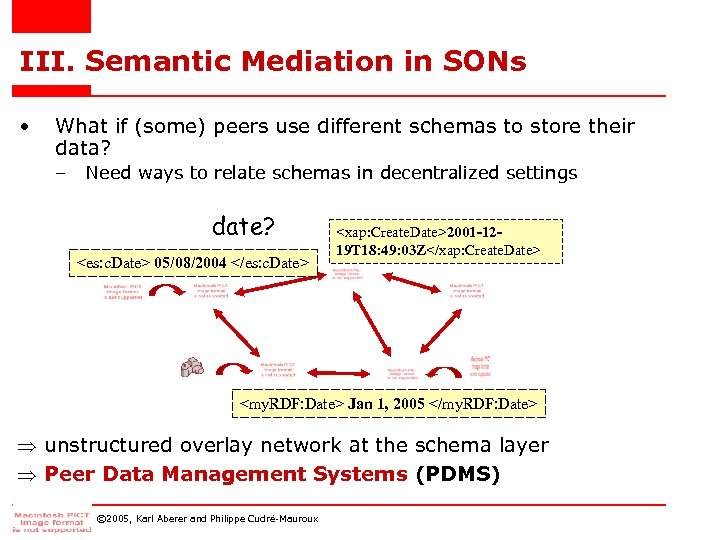
III. Semantic Mediation in SONs • What if (some) peers use different schemas to store their data? – Need ways to relate schemas in decentralized settings date? <es: c. Date> 05/08/2004 </es: c. Date> <xap: Create. Date>2001 -1219 T 18: 49: 03 Z</xap: Create. Date> <my. RDF: Date> Jan 1, 2005 </my. RDF: Date> unstructured overlay network at the schema layer Peer Data Management Systems (PDMS) © 2005, Karl Aberer and Philippe Cudré-Mauroux
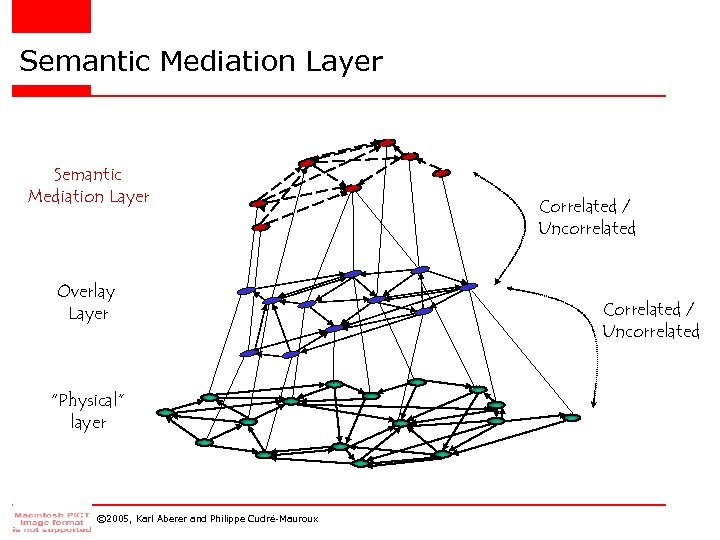
Semantic Mediation Layer Overlay Layer “Physical” layer © 2005, Karl Aberer and Philippe Cudré-Mauroux Correlated / Uncorrelated
Source Descriptions • Heterogeneous schemas can share semantically equivalent attributes • On the web, users are willing to annotate resources or filter results manually • Let users annotate their schemas – Search & Match similar annotations – Use IR methods to rank matches – Let users filter out results © 2005, Karl Aberer and Philippe Cudré-Mauroux
Peer. DB Who? – National U. of Singapore Overlay structure – Unstructured (Best. Peer) Data model – Relational Mappings – Keywords Query reformulation – Distributed Query evaluation – Distributed © 2005, Karl Aberer and Philippe Cudré-Mauroux
Peer. DB • A distributed data sharing system extending Best. Peer – Unstructured P 2 P network – Reconfigurable • Peers may choose their direct neighbors according to various strategies, dependent on the application – Uses mobile agents through local links • Dispatch queries • Dispatch code • Sharing heterogeneous relational data without explicit sharing of schemas © 2005, Karl Aberer and Philippe Cudré-Mauroux
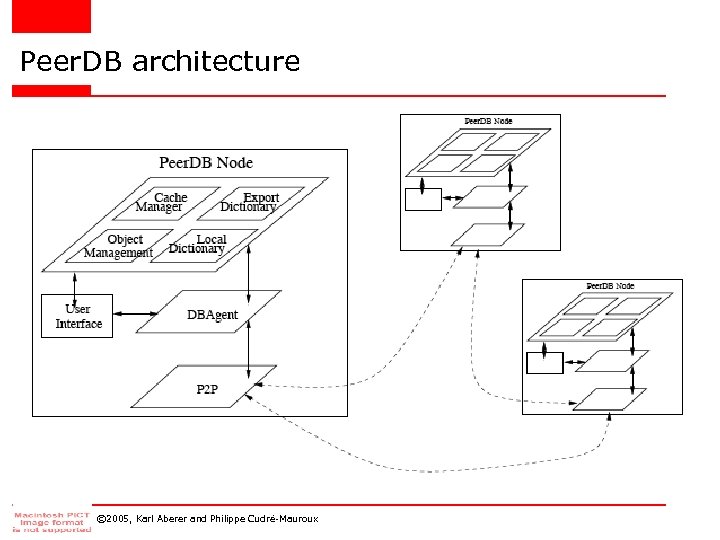
Peer. DB architecture © 2005, Karl Aberer and Philippe Cudré-Mauroux
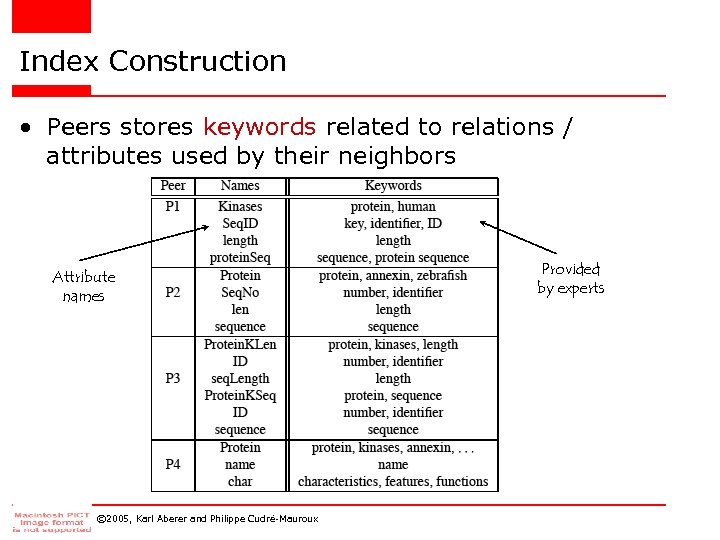
Index Construction • Peers stores keywords related to relations / attributes used by their neighbors Attribute names © 2005, Karl Aberer and Philippe Cudré-Mauroux Provided by experts
Query Reformulation (1) • Local query Q(R, A) – R: set of local relations – A: set of local attributes • Relations D from neighboring peers are ranked w. r. t. a matching function Match(Q, D) – Higher matching values if R’s keywords can be matched to relation names / keywords of the neighbor – Higher matching values if A’s keywords can be matched to attributes names / keywords of the neighbor © 2005, Karl Aberer and Philippe Cudré-Mauroux
Query Reformulation (2) • An agent is dispatched to a neighbor if it stores a relation D with Match(Q, D) > threshold • At the neighbor, the agent reformulates the query with local synonyms for R, A – Attributes might be dropped if no synonym is found • Results, matching relations and their keywords are all returned to the user – User filters out false positives manually at the relation level • Query is forwarded iteratively in this manner with a certain TTL © 2005, Karl Aberer and Philippe Cudré-Mauroux
Want More? Network Reconfiguration • Result performance depends on the semantic clustering of the network • Peer. DB network is reconfigurable according to three strategies: – Max. Count • Choose as direct neighbors the peers which have returned the most answers (tuples / bytes) – Min. Hops • Choose as direct neighbors those peers which returned answers from the furthest locations – Temp. Loc • Choose as direct neighbors those peers that have recently provided answers. © 2005, Karl Aberer and Philippe Cudré-Mauroux
References • W. Siong Ng, B. Chin Ooi, K. L. Tan, and A. Ying Zhou. Bestpeer: A selfconfigurable peer-to-peer system. In International Conference on Data Engineering (ICDE), 2002. • B. Chin Ooi, Y. Shu, and K. L. Tan. Db-enabled peers for managing distributed data. In Asian-Pacific Web Conference (APWeb), 2003 • B. Chin Ooi, Y. Shu, and K. L. Tan. Relational data sharing in peer-based data management systems. SIGMOD Record, 32(3), 2003. • W. Siong Ng, B. Chin Ooi, K. L. Tan, and A. Ying Zhou. Peerdb: A p 2 p-based system for distributed data sharing. In International Conference on Data Engineering (ICDE), 2003. © 2005, Karl Aberer and Philippe Cudré-Mauroux
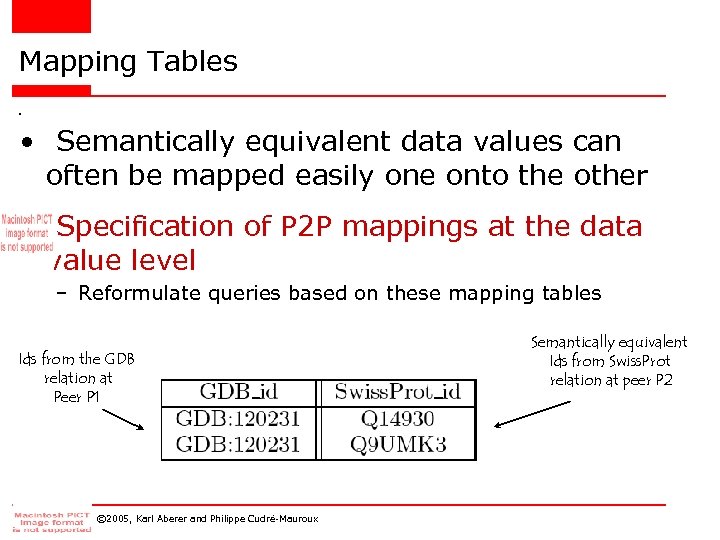
Mapping Tables • • Semantically equivalent data values can often be mapped easily one onto the other • Specification of P 2 P mappings at the data value level – Reformulate queries based on these mapping tables Ids from the GDB relation at Peer P 1 © 2005, Karl Aberer and Philippe Cudré-Mauroux Semantically equivalent Ids from Swiss. Prot relation at peer P 2
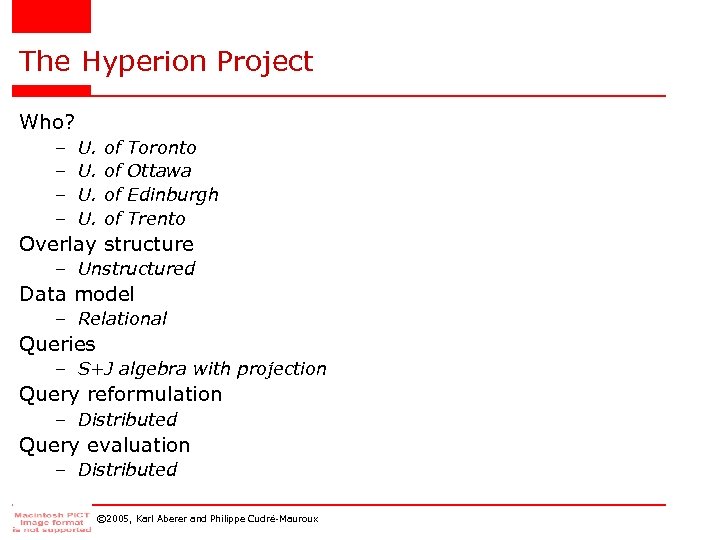
The Hyperion Project Who? – – U. U. of of Toronto Ottawa Edinburgh Trento Overlay structure – Unstructured Data model – Relational Queries – S+J algebra with projection Query reformulation – Distributed Query evaluation – Distributed © 2005, Karl Aberer and Philippe Cudré-Mauroux
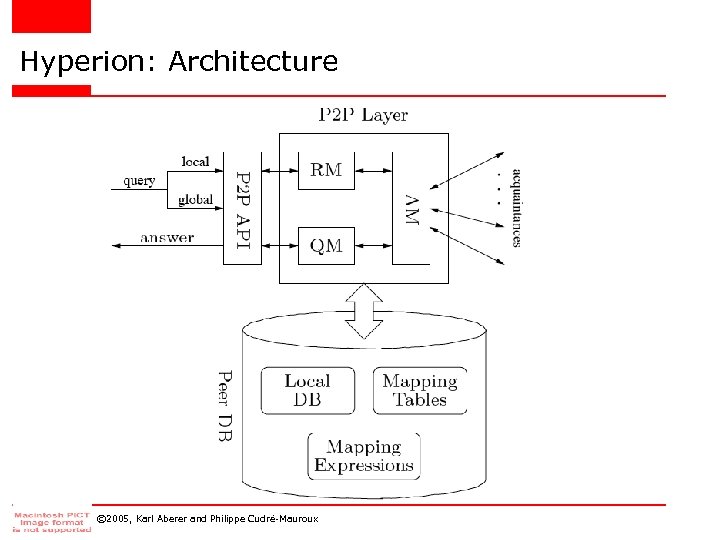
Hyperion: Architecture © 2005, Karl Aberer and Philippe Cudré-Mauroux
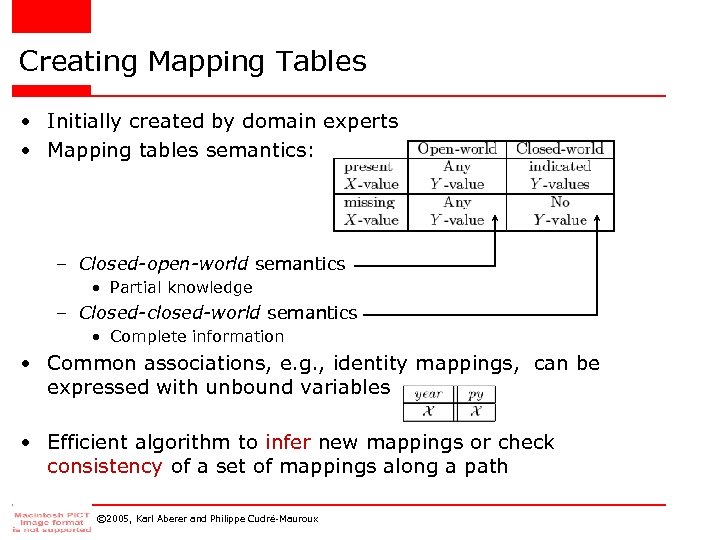
Creating Mapping Tables • Initially created by domain experts • Mapping tables semantics: – Closed-open-world semantics • Partial knowledge – Closed-closed-world semantics • Complete information • Common associations, e. g. , identity mappings, can be expressed with unbound variables • Efficient algorithm to infer new mappings or check consistency of a set of mappings along a path © 2005, Karl Aberer and Philippe Cudré-Mauroux
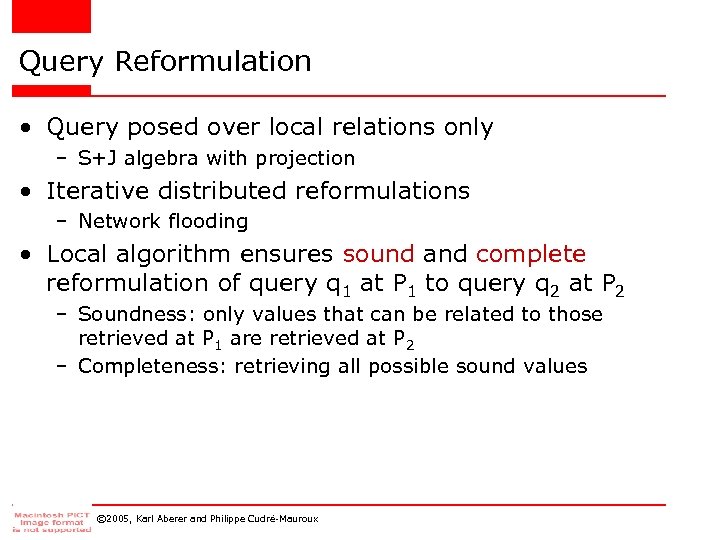
Query Reformulation • Query posed over local relations only – S+J algebra with projection • Iterative distributed reformulations – Network flooding • Local algorithm ensures sound and complete reformulation of query q 1 at P 1 to query q 2 at P 2 – Soundness: only values that can be related to those retrieved at P 1 are retrieved at P 2 – Completeness: retrieving all possible sound values © 2005, Karl Aberer and Philippe Cudré-Mauroux
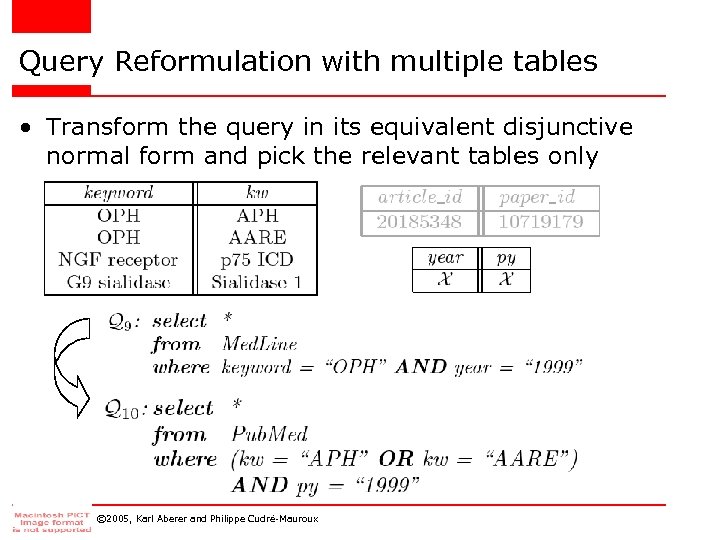
Query Reformulation with multiple tables • Transform the query in its equivalent disjunctive normal form and pick the relevant tables only © 2005, Karl Aberer and Philippe Cudré-Mauroux
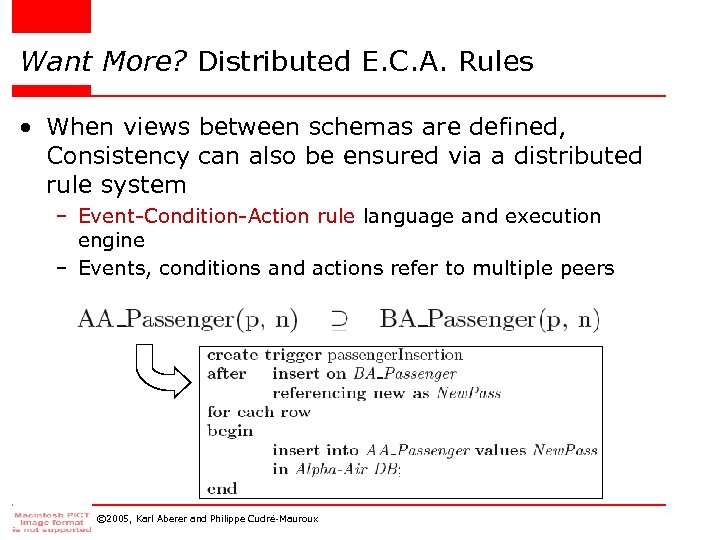
Want More? Distributed E. C. A. Rules • When views between schemas are defined, Consistency can also be ensured via a distributed rule system – Event-Condition-Action rule language and execution engine – Events, conditions and actions refer to multiple peers © 2005, Karl Aberer and Philippe Cudré-Mauroux
References • P. A. Bernstein, F. Giunchiglia, A. s Kementsietsidis, J. Mylopoulos, L. Serafini and l. Zaihrayeu. Data Management for Peer-to-Peer Computing: A Vision. In Web. DB 2002. • A. Kementsietsidis, M. Arenas, and R. J. Miller. Managing data mappings in the hyperion project. In International Conference on Data Engineering (ICDE), 2003. • A. Kementsietsidis, M. Arenas, and R. J. Miller. Mapping data in peer-topeer systems: Semantics and algorithmic issues. In ACM SIGMOD, 2003. • M. Arenas, V. Kantere, A. Kementsietsidis, I. Kiringa, R. J. Miller, and J. Mylopoulos. The hyperion project: From data integration to data coordination. SIGMOD Record, 32(3), 2003. • V. Kantere, I. Kiringa, J. Mylopoulos, A. Kementsietsidis, and M. Arenas. Coordinating peer databases using eca rules. In International Workshop on Databases, Information Systems and Peer-to-Peer Computing (DBISP 2 P), 2003. • A. Kementsietsidis and M. Arenas. Data sharing through query translation in autonomous sources. In International Conference on Very Large Data Bases (VLDB), 2004. © 2005, Karl Aberer and Philippe Cudré-Mauroux
Extending Data Integration Techniques • • Centralized data integration techniques take advantage of views to reformulate queries in efficient ways • Extending query reformulation using views to semantically decentralized settings © 2005, Karl Aberer and Philippe Cudré-Mauroux
The Piazza Project Who? – U. of Washington Overlay structure – Unstructured Data model – Relational (+XML) Queries – Relational Query reformulation – Centralized Query evaluation – Distributed © 2005, Karl Aberer and Philippe Cudré-Mauroux
Piazza • A Peer Data Management System • Semantically related data stored using different schemas • Pairwise mappings between the schemas – Peer descriptions (P 2 P schema mappings) – Storage descriptions (local db to peer mapping) Arbitrary graph of interconnected schemas © 2005, Karl Aberer and Philippe Cudré-Mauroux
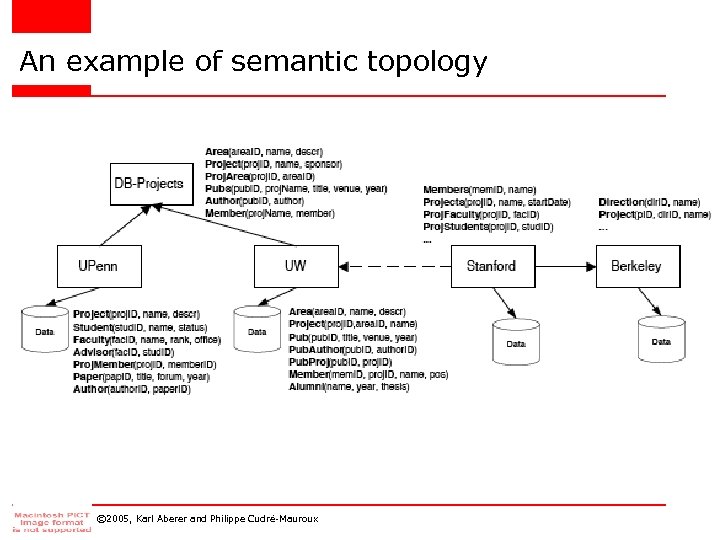
An example of semantic topology © 2005, Karl Aberer and Philippe Cudré-Mauroux
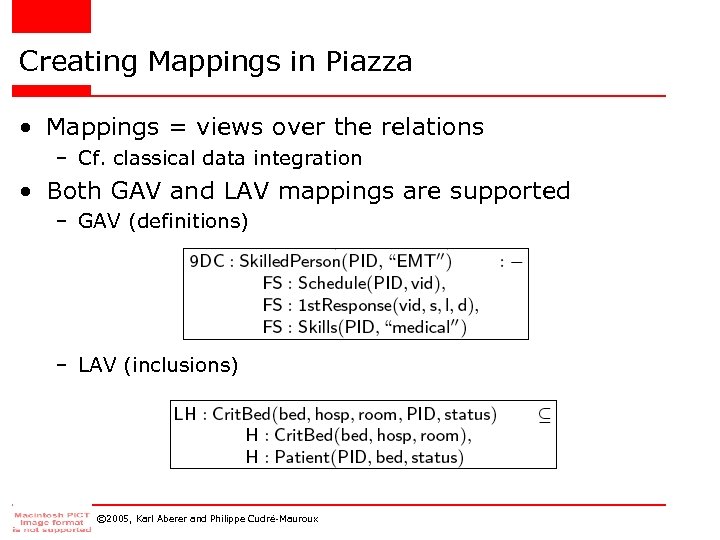
Creating Mappings in Piazza • Mappings = views over the relations – Cf. classical data integration • Both GAV and LAV mappings are supported – GAV (definitions) – LAV (inclusions) © 2005, Karl Aberer and Philippe Cudré-Mauroux
Posing queries in Piazza • Local query iteratively reformulated using the mappings • Reformulation algorithm – Input: a set of mappings and a conjunctive query expression Q (evt. with comparison predicates) – Output: a query expression Q’ that only refers to stored relations at the peer • Query reformulation is centralized © 2005, Karl Aberer and Philippe Cudré-Mauroux
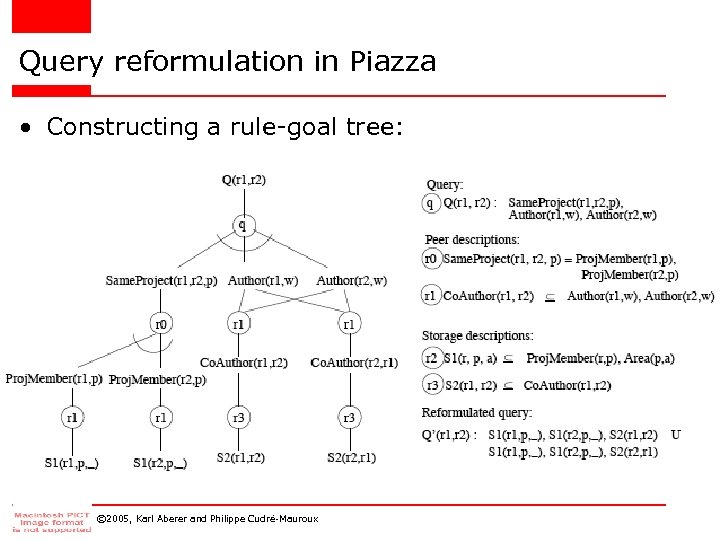
Query reformulation in Piazza • Constructing a rule-goal tree: © 2005, Karl Aberer and Philippe Cudré-Mauroux
More? Piazza & XML • Piazza also considers query reformulation for semi -structured XML documents • Mappings expressed with a subset of XQuery – Composition of XML mappings • Containment of XML queries © 2005, Karl Aberer and Philippe Cudré-Mauroux
References • A. Y. Halevy, Z. G. Ives, P. Mork, and I. Tatarinov. Schema mediation in peer data management systems. In International Conference on Data Engineering (ICDE), 2003. • A. Y. Halevy, Z. G. Ives, P. Mork, and I. Tatarinov. Peer data management systems: Infrastructure for the semantic web. In International World Wide Web Conference (WWW), 2003. • I. Tatarinov, Z. Ives, J. Madhavan, A. Halevy, D. Suciu, N. Dalvi, X. Dong, Y. Kadiyska, G. Miklau, and P. Mork. The piazza peer data management project. SIGMOD Record, 32(3), 2003. • I. Tatarinov and A. Halevy. Efficient query reformulation in peer data management systems. In ACM SIGMOD, 2004. • X. Dong, A. Y. Halevy, and I. Tatarinov. Containment of nested xml queries. In International Conference on Very Large Databases (VLDB), 2004. © 2005, Karl Aberer and Philippe Cudré-Mauroux
Semantic Gossiping (Chatty Web) • • Schemas might only partially overlap • Mappings can be faulty – Heterogeneity of conceptualizations – Inexpressive mapping language – (Semi-) automatic mapping creation • Self-organization principles at the semantic mediation layer – Per-hop semantic forwarding • Syntactic criteria • Semantic criteria © 2005, Karl Aberer and Philippe Cudré-Mauroux
Grid. Vine Who? – EPFL Overlay structure – DHT (P-Grid) Data model – RDF (annotations) RDFS (schemas) OWL (mappings) Queries – RDQL Query reformulation – Distributed Query evaluation – Distributed © 2005, Karl Aberer and Philippe Cudré-Mauroux
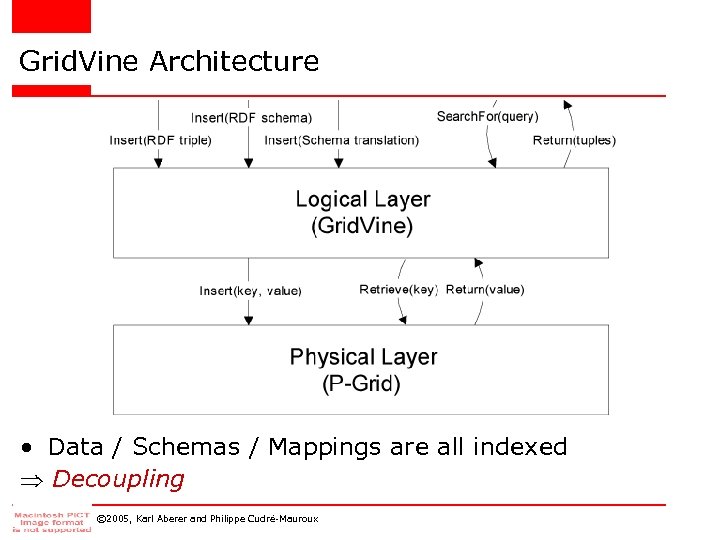
Grid. Vine Architecture • Data / Schemas / Mappings are all indexed Decoupling © 2005, Karl Aberer and Philippe Cudré-Mauroux
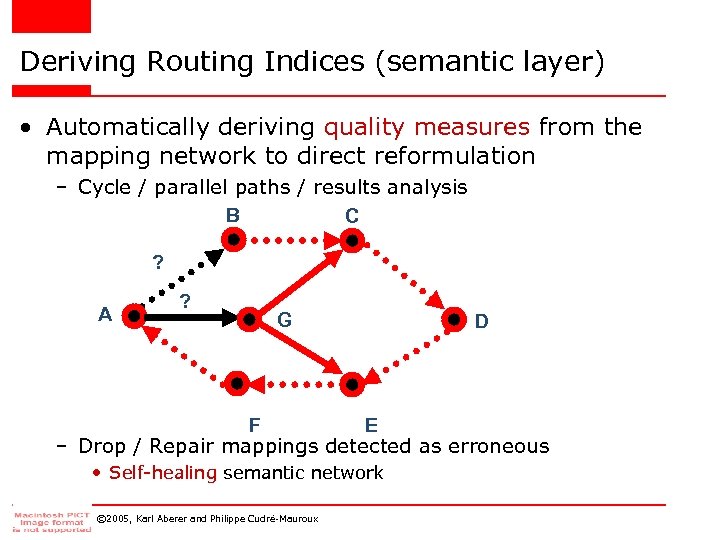
Deriving Routing Indices (semantic layer) • Automatically deriving quality measures from the mapping network to direct reformulation – Cycle / parallel paths / results analysis B C ? A ? G D F E – Drop / Repair mappings detected as erroneous • Self-healing semantic network © 2005, Karl Aberer and Philippe Cudré-Mauroux
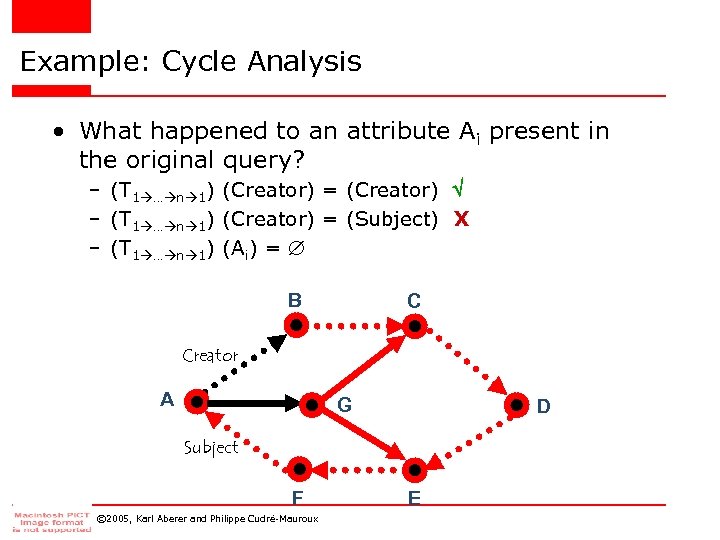
Example: Cycle Analysis • What happened to an attribute Ai present in the original query? – (T 1 … n 1) (Creator) = (Creator) – (T 1 … n 1) (Creator) = (Subject) X – (T 1 … n 1) (Ai) = B C Creator A G D Subject F © 2005, Karl Aberer and Philippe Cudré-Mauroux E
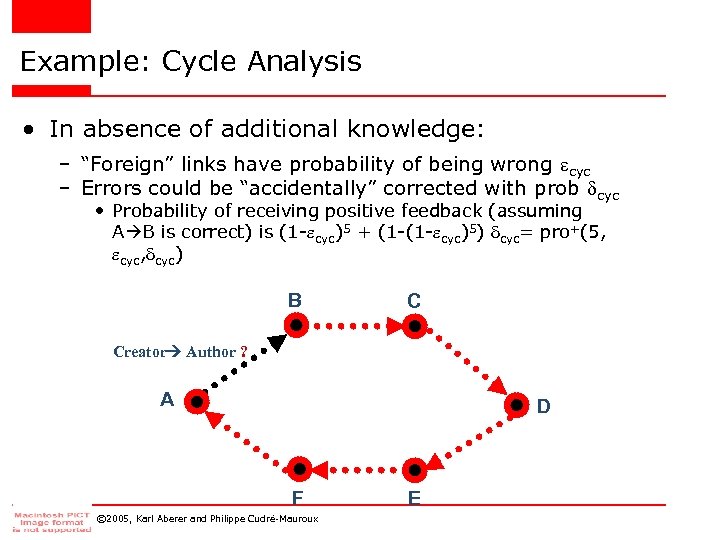
Example: Cycle Analysis • In absence of additional knowledge: – “Foreign” links have probability of being wrong cyc – Errors could be “accidentally” corrected with prob cyc • Probability of receiving positive feedback (assuming A B is correct) is (1 - cyc)5 + (1 -(1 - cyc)5) cyc= pro+(5, cyc, cyc) B C Creator Author ? A D F © 2005, Karl Aberer and Philippe Cudré-Mauroux E
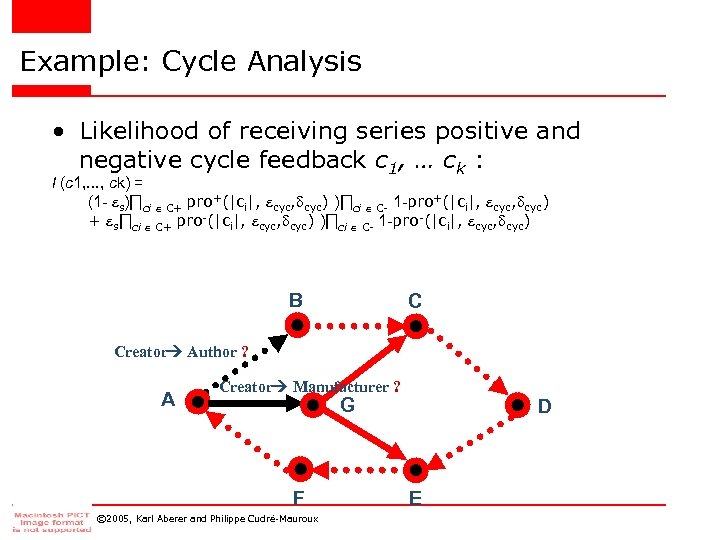
Example: Cycle Analysis • Likelihood of receiving series positive and negative cycle feedback c 1, … ck : l (c 1, . . . , ck) = (1 - s)∏ci C+ pro+(|ci|, cyc, cyc) )∏ci C- 1 -pro+(|ci|, cyc, cyc) + s∏ci C+ pro-(|ci|, cyc, cyc) )∏ci C- 1 -pro-(|ci|, cyc, cyc) B C Creator Author ? A Creator Manufacturer ? G F © 2005, Karl Aberer and Philippe Cudré-Mauroux D E
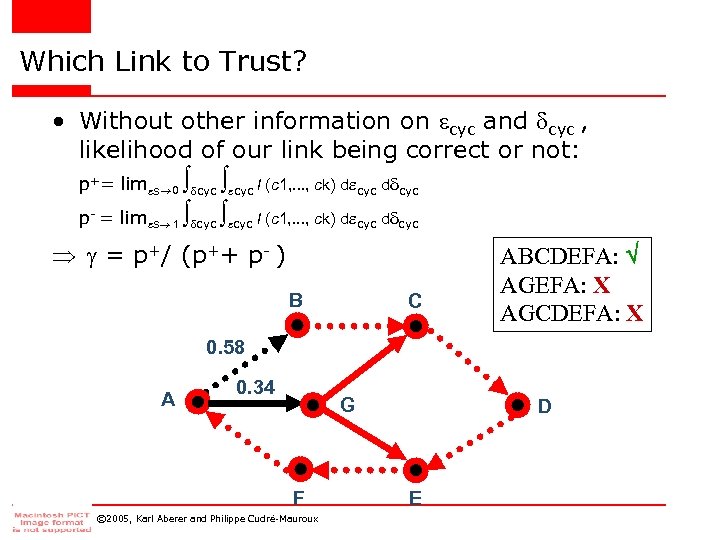
Which Link to Trust? • Without other information on cyc and cyc , likelihood of our link being correct or not: p+= lim s 0 cyc l (c 1, . . . , ck) d cyc p- = lim s 1 cyc l (c 1, . . . , ck) d cyc = p+/ (p++ p- ) B C ABCDEFA: AGEFA: X AGCDEFA: X 0. 58 A 0. 34 G F © 2005, Karl Aberer and Philippe Cudré-Mauroux D E
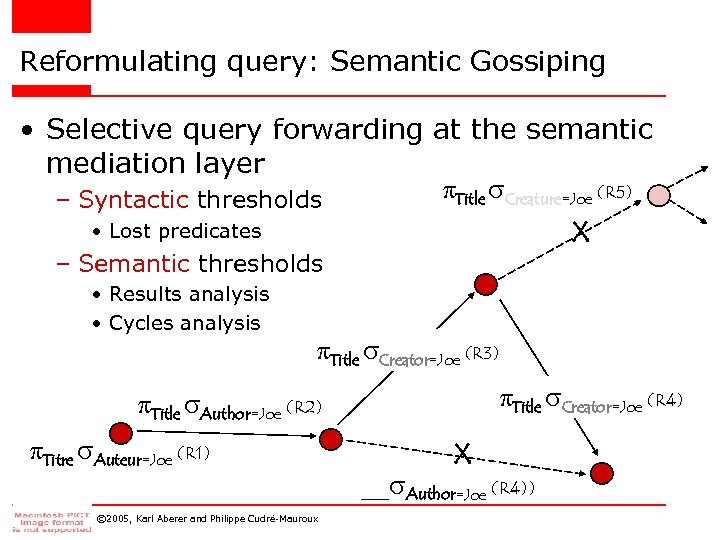
Reformulating query: Semantic Gossiping • Selective query forwarding at the semantic mediation layer πTitle Creature=Joe (R 5) – Syntactic thresholds X • Lost predicates – Semantic thresholds • Results analysis • Cycles analysis πTitle Creator=Joe (R 3) πTitle Creator=Joe (R 4) πTitle Author=Joe (R 2) πTitre Auteur=Joe (R 1) © 2005, Karl Aberer and Philippe Cudré-Mauroux X Author=Joe (R 4))
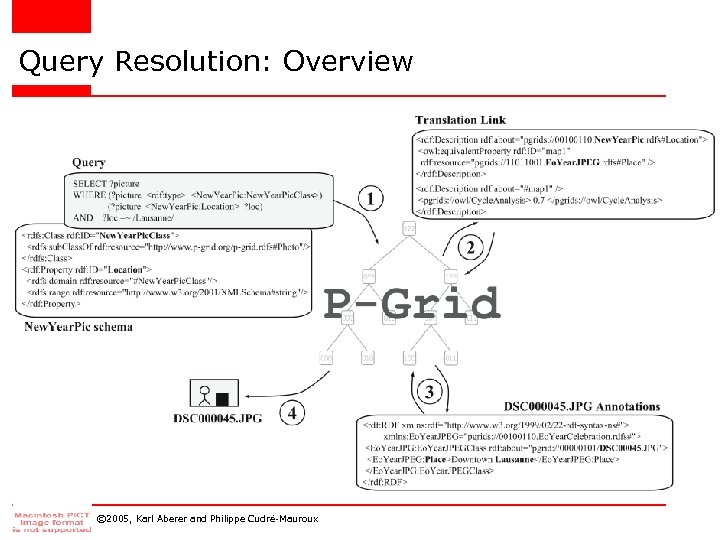
Query Resolution: Overview © 2005, Karl Aberer and Philippe Cudré-Mauroux
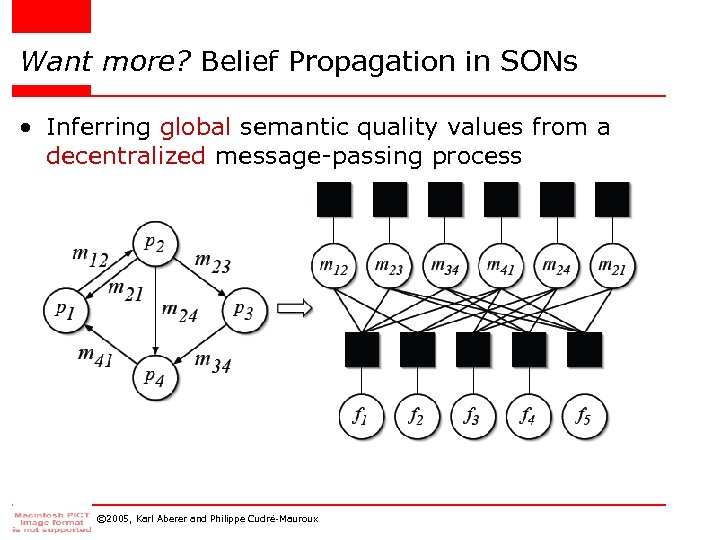
Want more? Belief Propagation in SONs • Inferring global semantic quality values from a decentralized message-passing process © 2005, Karl Aberer and Philippe Cudré-Mauroux
References • K. Aberer, P. Cudre-Mauroux, and M. Hauswirth. A Framework for Semantic Gossiping. SIGOMD RECORD, 31(4), 2002. • K. Aberer, P. Cudre-Mauroux, A. Datta, Z. Despotovic, M. Hauswirth, M. Punceva, and R. Schmidt. P-grid: A self-organizing structured p 2 p system. SIGMOD Record, 32(3), 2003. • K. Aberer, P. Cudre-Mauroux, and M. Hauswirth. The Chatty Web: Emergent Semantics Through Gossiping. In International World Wide Web Conference (WWW), 2003. • K. Aberer, P. Cudre-Mauroux, and M. Hauswirth. Start making sense: The Chatty Web approach for global semantic agreements. Journal of Web Semantics, 1(1), 2003. • K. Aberer, P. Cudre-Mauroux, M. Hauswirth, and T. van Pelt. Grid. Vine: Building Internet-Scale Semantic Overlay Networks. In International Semantic Web Conference (ISWC), 2004. © 2005, Karl Aberer and Philippe Cudré-Mauroux
IV. Current Research Directions © 2005, Karl Aberer and Philippe Cudré-Mauroux
Emergent Semantics • Semantic Overlay Networks can be viewed as highly dynamic systems (churn, autonomy) • Semantic agreements can be understood as emergent phenomena in complex systems Principles – mutual agreements for meaningful exchanges – agreements are dynamic, approximate and self-referential – global interoperability results from the aggregation of local agreements by self-organization K. Aberer, T. Catarci, P. Cudré-Mauroux, T. Dillon, S. Grimm, M. Hacid, A. Illarramendi, M. Jarrar, V. Kashyap, M. Mecella, E. Mena, E. J. Neuhold, A. M. Ouksel, T. Risse, M. Scannapieco, F. Saltor, L. de Santis, S. Spaccapietra, S. Staab, R. Studer and O. De Troyer: Emergent Semantics Systems. International Conference on Semantics of a Networked World (ICSNW 04). © 2005, Karl Aberer and Philippe Cudré-Mauroux
SON Graph Analysis • Networks resulting from self-organization processes – powerlaw graphs, small world graphs • Structure important for algorithm design – distribution, connectivity, redundancy Analysis and Modeling of SON from a graphtheoretic perspective P. Cudré-Mauroux, K. Aberer: "A Necessary Condition for Semantic Interoperability in the Large", Coop. IS/DOA/ODBASE (2) 2004: 859 -872. © 2005, Karl Aberer and Philippe Cudré-Mauroux
Information Retrieval and SONs • Combination of structural, link-based and content-based search • Precision of query answers drops with semantic mediation IR techniques to optimize precision/recall in SONs – Distributed ranking algorithms – Content-based search with DHTs – Peer selection using content synopsis M. Bender, S. Michel, P. Triantafillou, G. Weikum and C. Zimmer: Improving Collection Selection with Overlap Awareness in P 2 P Search Engines. SIGIR 2005. J. Wu, K. Aberer: "Using a Layered Markov Model for Distributed Web Ranking Computation", ICDCS 2005. © 2005, Karl Aberer and Philippe Cudré-Mauroux
Corpus-Based Information Management • Very large scale, dynamic environments require on-the-fly data integration • Automated schema alignment techniques may perform poorly – Lack of evidence Using a preexisting corpus of schema and mapping to guide the process – Mapping reuse – Statistics offer clues about semantics of structures J. Madhavan, P. A. Bernstein, A. i Doan and A. Y. Halevy: Corpusbased Schema Matching. ICDE 2005 © 2005, Karl Aberer and Philippe Cudré-Mauroux
Declarative Overlay Networks • Overlay networks are very hard to design, build, deploy and update Using declarative language not only to query, but also to express overlays – Logical description of overlay networks – Executed on a dataflow architecture to construct routing data structures and perform resource discovery B. Thau Loo, T. Condie, J. M. Hellerstein, P. Maniatis, T. Roscoe, I. Stoica: Implementing Declarative Overlays. ACM Symposium on Operating Systems Principles (SOSP), 2005 © 2005, Karl Aberer and Philippe Cudré-Mauroux
Internet-Scale Services • Many infrastructures tackle today data management at Internet scale – – Semantic Web Services Grid Computing Dissemination Services SONs as a generic infrastructure for very largescale data processing © 2005, Karl Aberer and Philippe Cudré-Mauroux
Further References • Length limits constrained the number of approaches we could discuss… http: //lsirwww. epfl. ch/SON For a more complete list of research projects in the area of Semantic Overlay Networks © 2005, Karl Aberer and Philippe Cudré-Mauroux
Скачать презентацию VLDB 2005 Semantic Overlay Networks Karl Aberer and
66a815391936589a5fa35af66512681a.ppt