 Скачать презентацию Vladimir Lenin Presentation by Maksim De Villiers
Ленин, Де Вильерс Максим.pptx
- Количество слайдов: 14



Vladimir Lenin Presentation by Maksim De Villiers
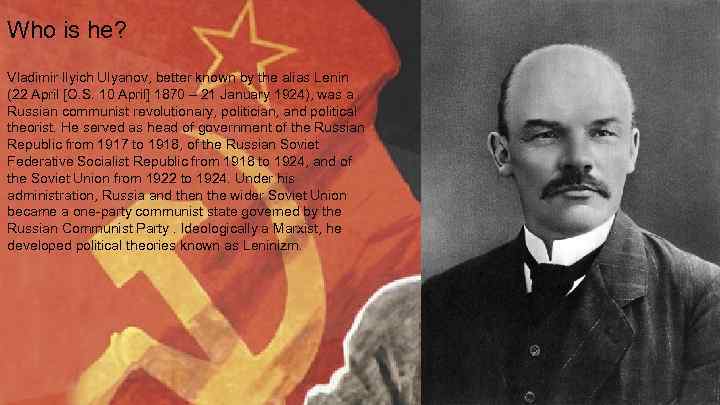
Who is he? Vladimir Ilyich Ulyanov, better known by the alias Lenin (22 April [O. S. 10 April] 1870 – 21 January 1924), was a Russian communist revolutionary, politician, and political theorist. He served as head of government of the Russian Republic from 1917 to 1918, of the Russian Soviet Federative Socialist Republic from 1918 to 1924, and of the Soviet Union from 1922 to 1924. Under his administration, Russia and then the wider Soviet Union became a one-party communist state governed by the Russian Communist Party. Ideologically a Marxist, he developed political theories known as Leninizm.
How he became the leader? Born to a wealthy middle-class family in Simbirsk, Lenin embraced revolutionary socialist politics following his brother's execution in 1887. Expelled from Kazan Imperial University for participating in protests against the Russian Empire's Tsarist regime, he devoted the following years to a law degree. He moved to Saint Petersburg in 1893 and became a senior figure in the Marxist Russian Social Democratic Labour Party (RSDLP). In 1897, he was arrested for sedition and exiled to Shushenskoye for three years, where he married Nadezhda Krupskaya. After his exile, he moved to Western Europe, where he became a prominent party theorist through his publications. In 1903, he took a key role in a RSDLP ideological split, leading the Bolshevik faction against Julius Martov's Mensheviks. Encouraging insurrection during Russia's failed Revolution of 1905, he later campaigned for the First World War to be transformed into a Europe-wide proletarian revolution, which as a Marxist he believed would cause the overthrow of capitalism and its replacement with socialism. After the 1917 February Revolution ousted the Tsar and established a Provisional Government, he returned to Russia to play a leading role in the October Revolution, in which the Bolsheviks overthrew the new regime.
His Life
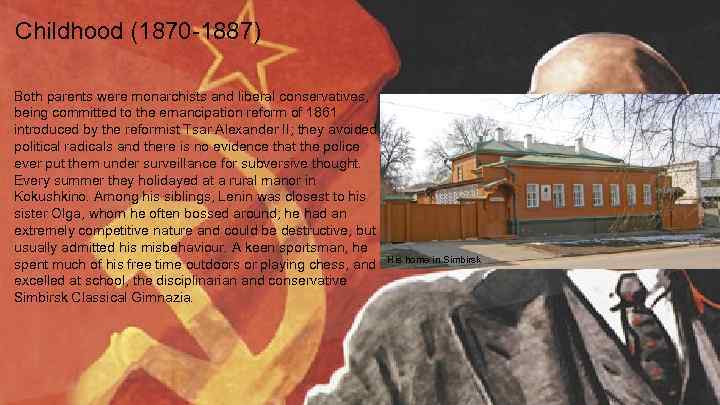
Childhood (1870 -1887) Both parents were monarchists and liberal conservatives, being committed to the emancipation reform of 1861 introduced by the reformist Tsar Alexander II; they avoided political radicals and there is no evidence that the police ever put them under surveillance for subversive thought. Every summer they holidayed at a rural manor in Kokushkino. Among his siblings, Lenin was closest to his sister Olga, whom he often bossed around; he had an extremely competitive nature and could be destructive, but usually admitted his misbehaviour. A keen sportsman, he spent much of his free time outdoors or playing chess, and excelled at school, the disciplinarian and conservative Simbirsk Classical Gimnazia. His home in Simbirsk
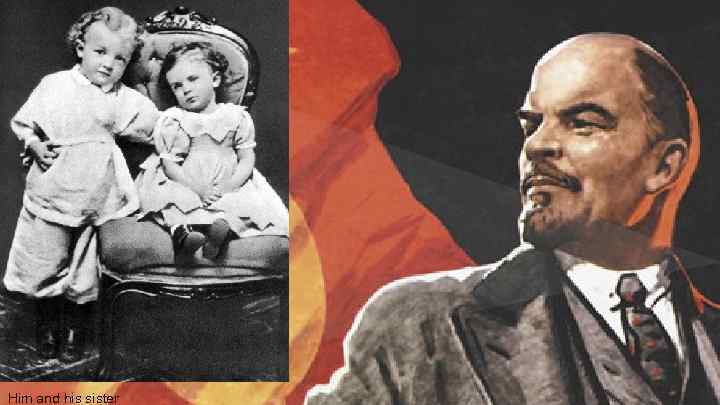
Him and his sister
His father died in January 1886, when Lenin was 16. Subsequently, Lenin's behaviour became erratic and confrontational, and he soon renounced his belief in God. At the time, Lenin's elder brother Alexander was studying at Saint Petersburg University. Involved in political agitation against the absolute monarchy of the reactionary Tsar Alexander III, he studied the writings of banned leftists and organised anti-government protests. He joined a revolutionary cell bent on assassinating the Tsar and was selected to construct a bomb. Before the attack could take place the conspirators were arrested and tried, and in May, his brother Alexander was executed by hanging. Despite the emotional trauma of his father's and brother's deaths, Lenin continued studying, graduated with a gold medal for exceptional performance, and decided to study law at Kazan University.
Revolutionary activity
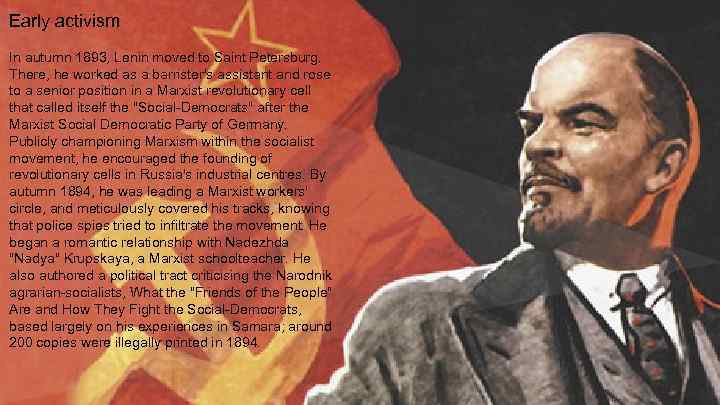
Early activism In autumn 1893, Lenin moved to Saint Petersburg. There, he worked as a barrister's assistant and rose to a senior position in a Marxist revolutionary cell that called itself the "Social-Democrats" after the Marxist Social Democratic Party of Germany. Publicly championing Marxism within the socialist movement, he encouraged the founding of revolutionary cells in Russia's industrial centres. By autumn 1894, he was leading a Marxist workers' circle, and meticulously covered his tracks, knowing that police spies tried to infiltrate the movement. He began a romantic relationship with Nadezhda "Nadya" Krupskaya, a Marxist schoolteacher. He also authored a political tract criticising the Narodnik agrarian-socialists, What the "Friends of the People" Are and How They Fight the Social-Democrats, based largely on his experiences in Samara; around 200 copies were illegally printed in 1894.
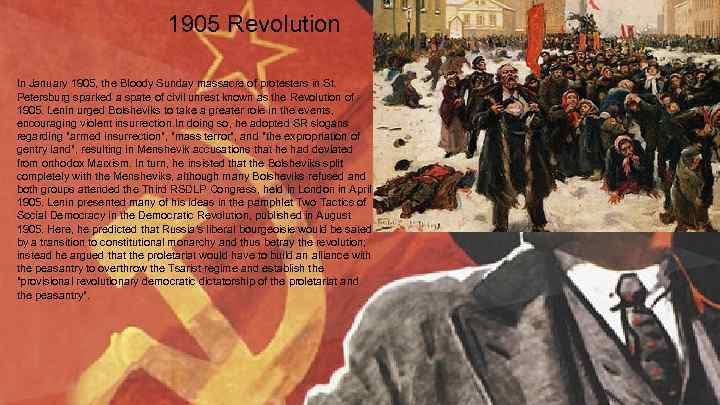
1905 Revolution In January 1905, the Bloody Sunday massacre of protesters in St. Petersburg sparked a spate of civil unrest known as the Revolution of 1905. Lenin urged Bolsheviks to take a greater role in the events, encouraging violent insurrection. In doing so, he adopted SR slogans regarding "armed insurrection", "mass terror", and "the expropriation of gentry land", resulting in Menshevik accusations that he had deviated from orthodox Marxism. In turn, he insisted that the Bolsheviks split completely with the Mensheviks, although many Bolsheviks refused and both groups attended the Third RSDLP Congress, held in London in April 1905. Lenin presented many of his ideas in the pamphlet Two Tactics of Social Democracy in the Democratic Revolution, published in August 1905. Here, he predicted that Russia's liberal bourgeoisie would be sated by a transition to constitutional monarchy and thus betray the revolution; instead he argued that the proletariat would have to build an alliance with the peasantry to overthrow the Tsarist regime and establish the "provisional revolutionary democratic dictatorship of the proletariat and the peasantry".
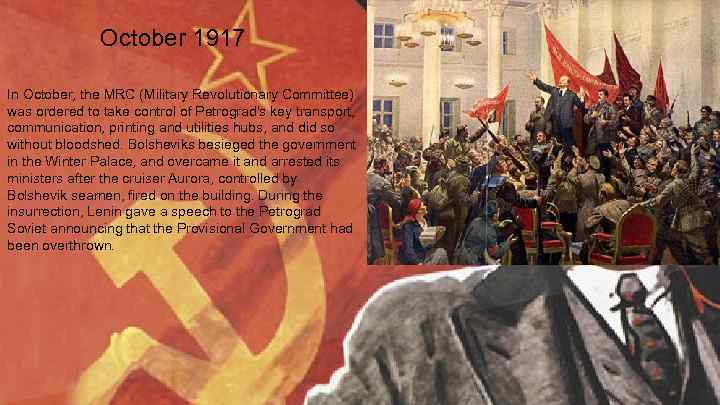
October 1917 In October, the MRC (Military Revolutionary Committee) was ordered to take control of Petrograd's key transport, communication, printing and utilities hubs, and did so without bloodshed. Bolsheviks besieged the government in the Winter Palace, and overcame it and arrested its ministers after the cruiser Aurora, controlled by Bolshevik seamen, fired on the building. During the insurrection, Lenin gave a speech to the Petrograd Soviet announcing that the Provisional Government had been overthrown.
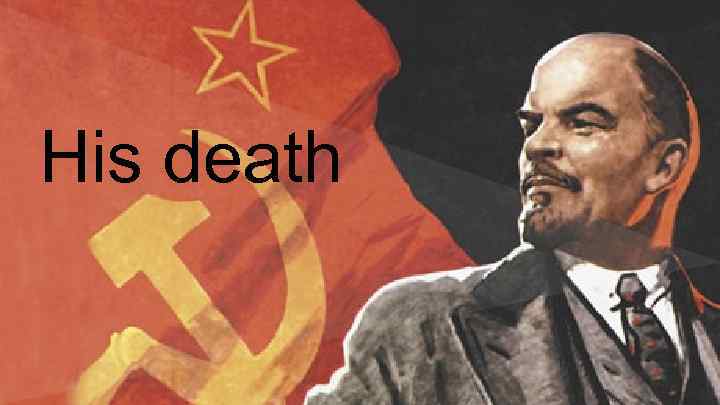
His death
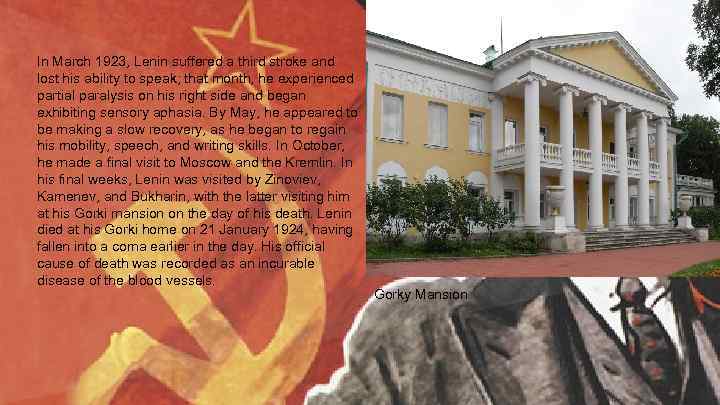
In March 1923, Lenin suffered a third stroke and lost his ability to speak; that month, he experienced partial paralysis on his right side and began exhibiting sensory aphasia. By May, he appeared to be making a slow recovery, as he began to regain his mobility, speech, and writing skills. In October, he made a final visit to Moscow and the Kremlin. In his final weeks, Lenin was visited by Zinoviev, Kamenev, and Bukharin, with the latter visiting him at his Gorki mansion on the day of his death. Lenin died at his Gorki home on 21 January 1924, having fallen into a coma earlier in the day. His official cause of death was recorded as an incurable disease of the blood vessels. Gorky Mansion
Thanks for watching!
Скачать презентацию Vladimir Lenin Presentation by Maksim De Villiers
Ленин, Де Вильерс Максим.pptx