


 Скачать презентацию Visualizing the Value of IT People Technology Services
5959d2b38cfd281e9e143802ccec654b.ppt
- Количество слайдов: 40
 Visualizing the Value of IT …People, Technology, Services, and Processes Donna Liss Associate Vice Provost Beth Forrest Warner Assistant Vice Provost October 24, 2007
 Copyright Beth Forrest Warner and Donna Liss, 2007. This work is the intellectual property of the authors. Permission is granted for this material to be shared for non-commercial, educational purposes, provided that this copyright statement appears on the reproduced materials and notice is given that the copying is by permission of the authors. To disseminate otherwise or to republish requires written permission from the authors. October 24, 2007 EDUCAUSE Annual Conference 2007 2
 The Spellings Commission “What we have learned over the last year makes clear that American higher education has become what, in the business world, would be called a mature enterprise: increasingly risk-averse, at times selfsatisfied, and unduly expensive. ” A Test of Leadership: Charting the future of US Higher Education October 24, 2007 EDUCAUSE Annual Conference 2007 3
 Perceptions of IT… q Is information technology… q. A solution to the challenges that higher education faces; q A contributor to the needed answers; or q Just another cost and yet another cost center? EDUCAUSE “Grand Challenges” Initiative Brian L. Hawkins, Annual Conference, 2006 October 24, 2007 EDUCAUSE Annual Conference 2007 4
 KU Provost’s Challenge q Questions posed to all KU departments: q Who are you? q What do you do? q Why is it important to KU? Finding the Answers for IT… October 24, 2007 EDUCAUSE Annual Conference 2007 5
 Where to Begin? Finding Models q Need a systematic approach to answering questions about who, what, why, how, and where? q Many models are available, but how can they work together to give a more complete picture? “You can’t redesign your system by dividing it into parts; everyone must look at the whole together. ” Peter Senge (1994), The Fifth Discipline Fieldbook October 24, 2007 EDUCAUSE Annual Conference 2007 6
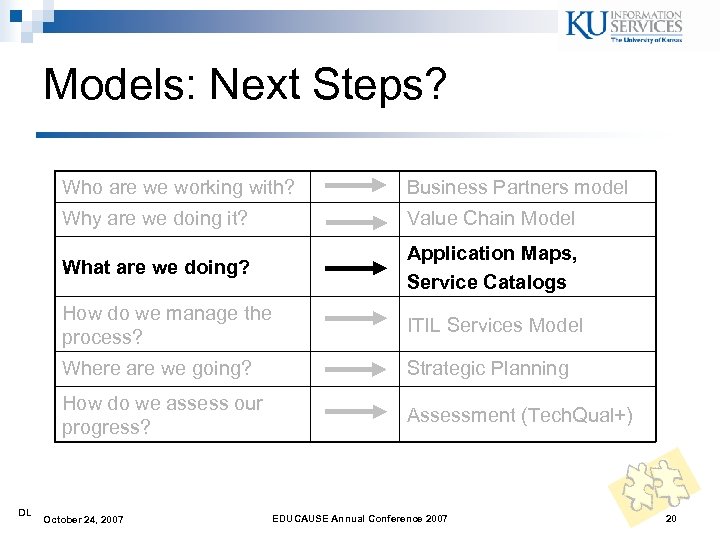
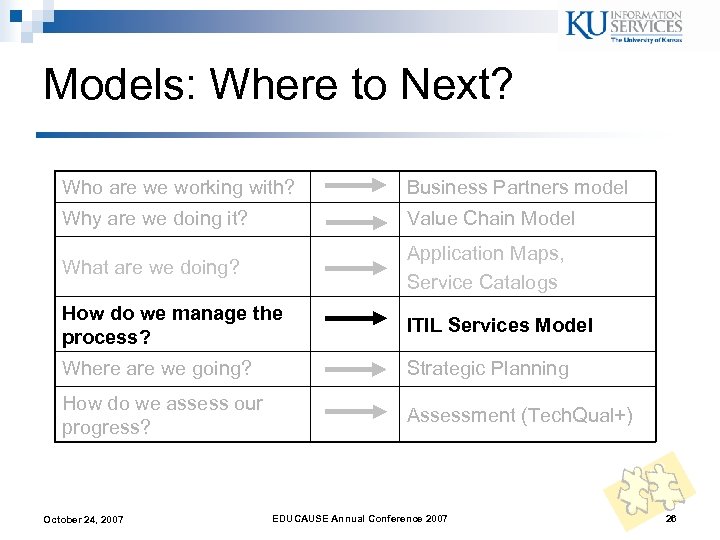
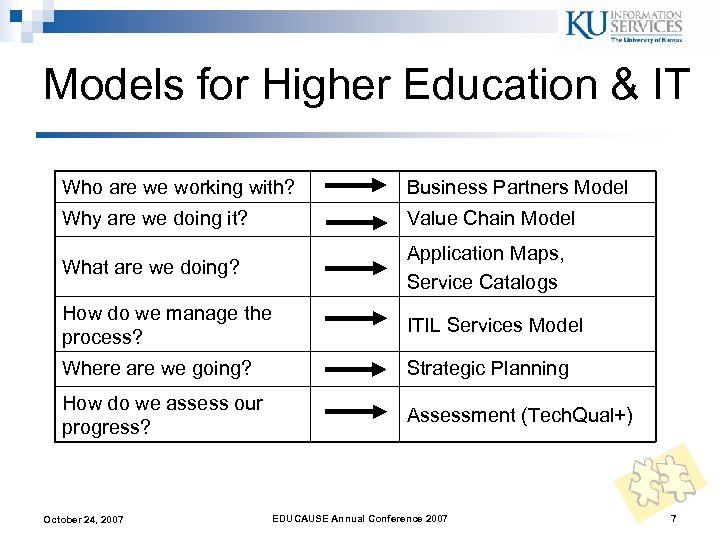 Models for Higher Education & IT Who are we working with? Business Partners Model Why are we doing it? Value Chain Model What are we doing? Application Maps, Service Catalogs How do we manage the process? ITIL Services Model Where are we going? Strategic Planning How do we assess our progress? Assessment (Tech. Qual+) October 24, 2007 EDUCAUSE Annual Conference 2007 7
 Who Are We Working With? Enterprise Business Partners Model q Business Partners Model identifies the different organizations, groups, and individuals that the organization interfaces with during normal business operations. q It articulates the different inputs that each organization receives from each business partner, and … q …the outputs that each business partner receives from the organization. Who are we working with? October 24, 2007 EDUCAUSE Annual Conference 2007 8
 Why Use a Business Partners Model q Simple, q Shows usable model communication streams q Looks at communication in relation to the business who are the contacts during normal business operations q what information is important to each group q Who are we working with? October 24, 2007 EDUCAUSE Annual Conference 2007 9
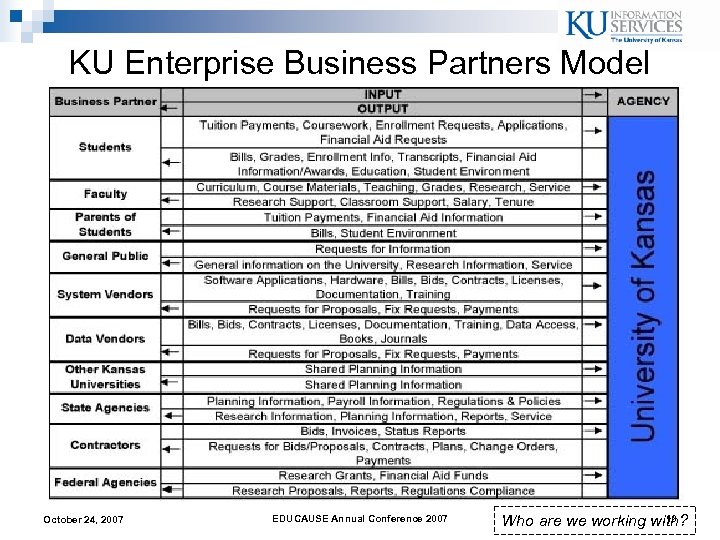 KU Enterprise Business Partners Model October 24, 2007 EDUCAUSE Annual Conference 2007 10 Who are we working with?
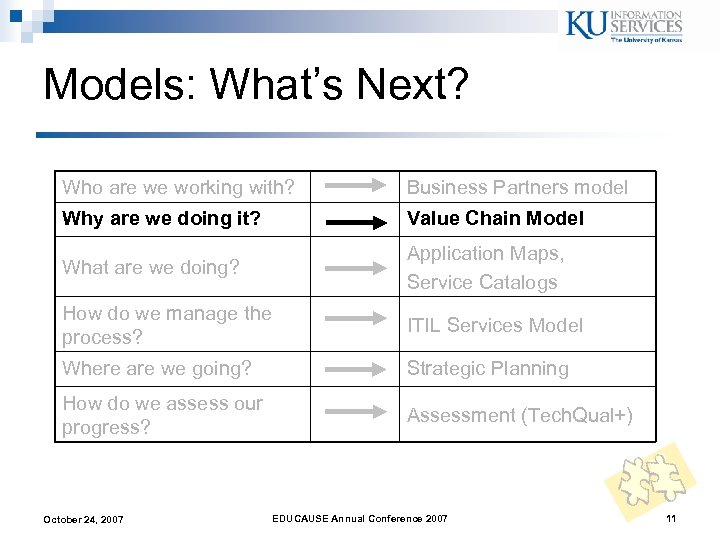 Models: What’s Next? Who are we working with? Business Partners model Why are we doing it? Value Chain Model What are we doing? Application Maps, Service Catalogs How do we manage the process? ITIL Services Model Where are we going? Strategic Planning How do we assess our progress? Assessment (Tech. Qual+) October 24, 2007 EDUCAUSE Annual Conference 2007 11
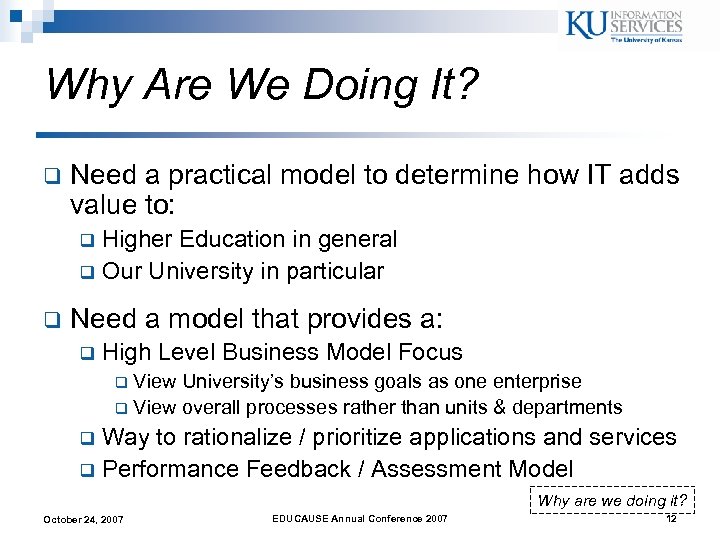 Why Are We Doing It? q Need a practical model to determine how IT adds value to: Higher Education in general q Our University in particular q q Need a model that provides a: q High Level Business Model Focus q View University’s business goals as one enterprise q View overall processes rather than units & departments Way to rationalize / prioritize applications and services q Performance Feedback / Assessment Model q Why are we doing it? October 24, 2007 EDUCAUSE Annual Conference 2007 12
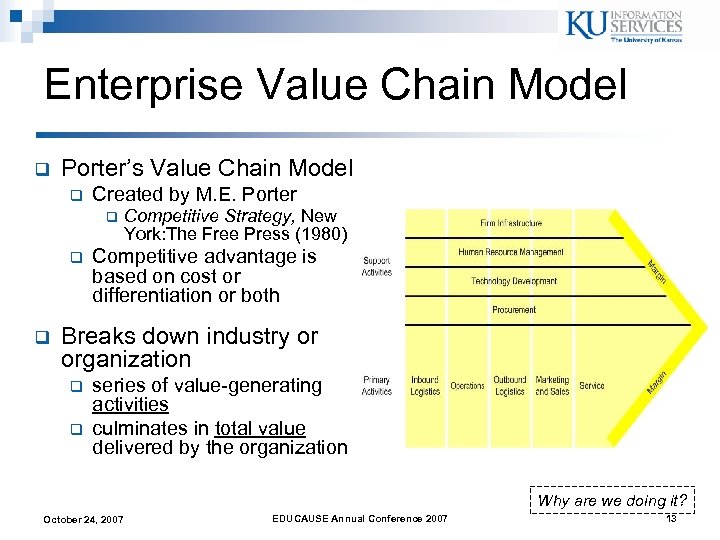 Enterprise Value Chain Model q Porter’s Value Chain Model q Created by M. E. Porter q q q Competitive Strategy, New York: The Free Press (1980) Competitive advantage is based on cost or differentiation or both Breaks down industry or organization q q series of value-generating activities culminates in total value delivered by the organization Why are we doing it? October 24, 2007 EDUCAUSE Annual Conference 2007 13
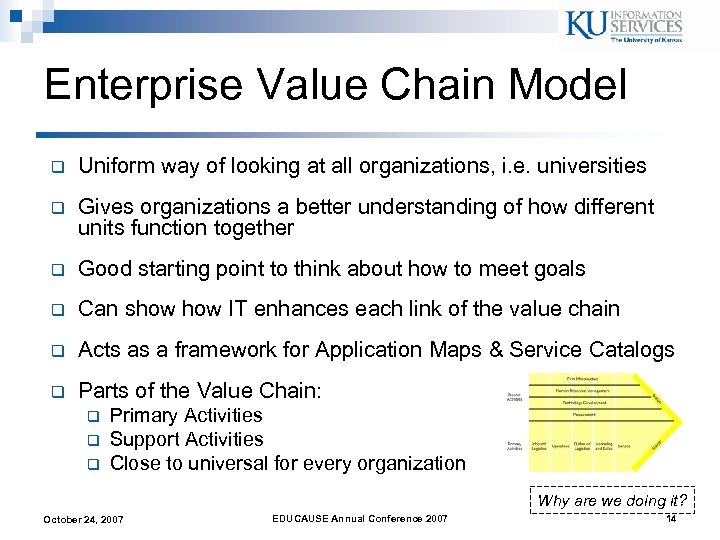 Enterprise Value Chain Model q Uniform way of looking at all organizations, i. e. universities q Gives organizations a better understanding of how different units function together q Good starting point to think about how to meet goals q Can show IT enhances each link of the value chain q Acts as a framework for Application Maps & Service Catalogs q Parts of the Value Chain: q q q Primary Activities Support Activities Close to universal for every organization Why are we doing it? October 24, 2007 EDUCAUSE Annual Conference 2007 14
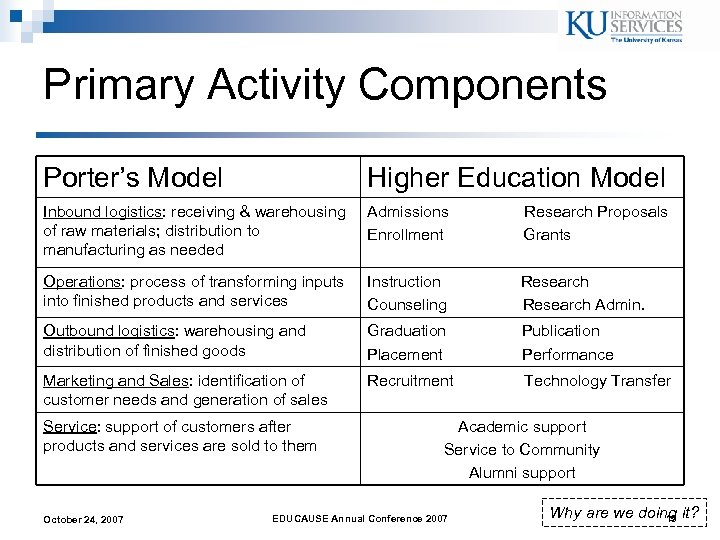 Primary Activity Components Porter’s Model Higher Education Model Inbound logistics: receiving & warehousing of raw materials; distribution to manufacturing as needed Admissions Enrollment Research Proposals Grants Operations: process of transforming inputs into finished products and services Instruction Counseling Research Admin. Outbound logistics: warehousing and distribution of finished goods Graduation Placement Publication Performance Marketing and Sales: identification of customer needs and generation of sales Recruitment Technology Transfer Service: support of customers after products and services are sold to them October 24, 2007 Academic support Service to Community Alumni support EDUCAUSE Annual Conference 2007 Why are we doing it? 15
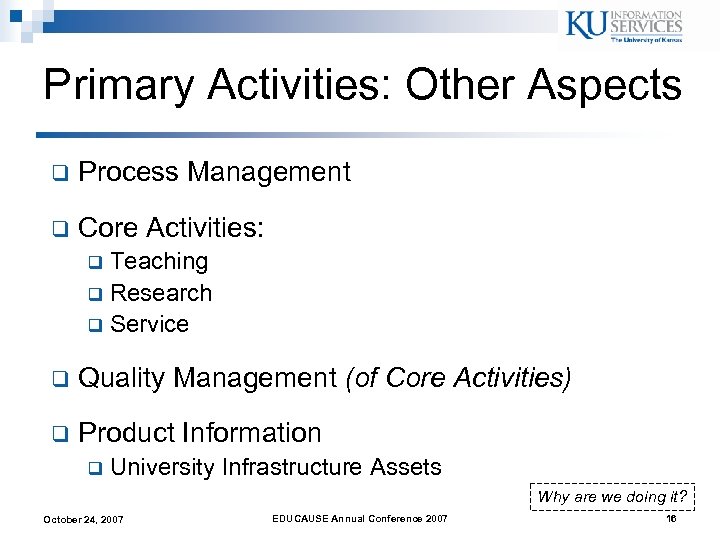 Primary Activities: Other Aspects q Process Management q Core Activities: Teaching q Research q Service q q Quality Management (of Core Activities) q Product Information q University Infrastructure Assets Why are we doing it? October 24, 2007 EDUCAUSE Annual Conference 2007 16
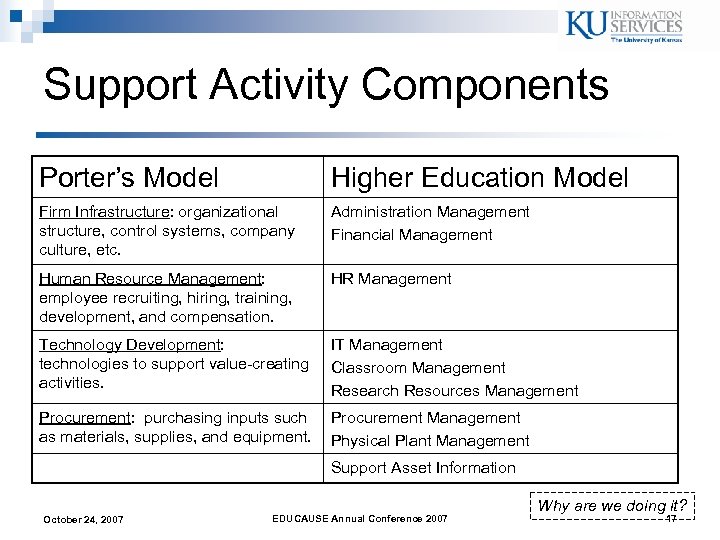 Support Activity Components Porter’s Model Higher Education Model Firm Infrastructure: organizational structure, control systems, company culture, etc. Administration Management Financial Management Human Resource Management: employee recruiting, hiring, training, development, and compensation. HR Management Technology Development: technologies to support value-creating activities. IT Management Classroom Management Research Resources Management Procurement: purchasing inputs such as materials, supplies, and equipment. Procurement Management Physical Plant Management Support Asset Information October 24, 2007 EDUCAUSE Annual Conference 2007 Why are we doing it? 17
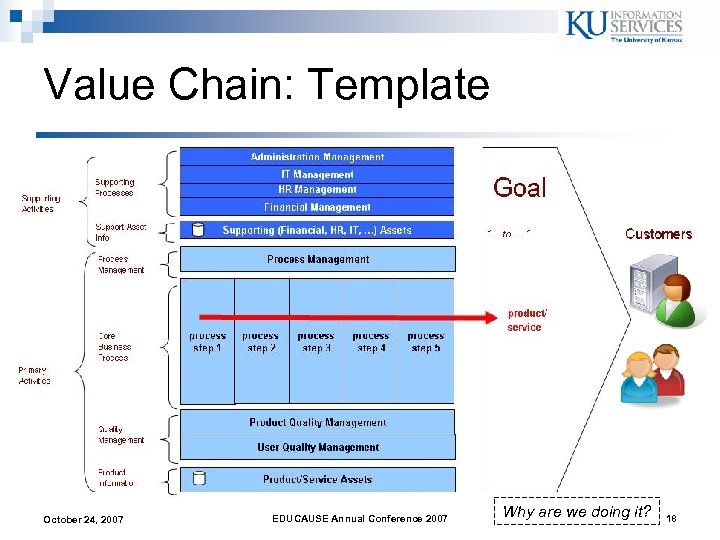 Value Chain: Template October 24, 2007 EDUCAUSE Annual Conference 2007 Why are we doing it? 18
 Higher Education Value Chain (ex. KU) Administration Management Goals IT Management Research Resources Management Supporting Activities HR Management Supporting Processes Financial Management Procurement Management Physical Plant Management Support Asset Info Supporting (Financial, HR, IT, Research, …) Assets Process Management Recruitment Admissions, Enrollment Instruction Academic Support Placement, Counseling Research Primary Activities Research Proposals Research Admin Research Facilities, Libraries Publishing, Performance Service Community Service Professional Service University Service Training, Development Alumni Support Students Faculty Parents Alumni Process Management Teaching Core Business Process The mission of the University of Kansas encompasses teaching, research and service as well as an international dimension and humanitarian values. Customers The transmission of information and knowledge to others The creation of information and knowledge The application of information and knowledge to benefit society General Public Federal Government State Government Industry Professional Societies Research Communities Teaching: Assessment, Degrees, Credentialing, Transcripts Quality Management Research: Peer Review, Research Awards, Tenure Service: Evaluation, Tenure Product Information October 24, 2007 University Infrastructure Assets EDUCAUSE Annual Conference 2007 Why are we doing it? 19
 Models: Next Steps? Who are we working with? Why are we doing it? Value Chain Model What are we doing? Application Maps, Service Catalogs How do we manage the process? ITIL Services Model Where are we going? Strategic Planning How do we assess our progress? DL Business Partners model Assessment (Tech. Qual+) October 24, 2007 EDUCAUSE Annual Conference 2007 20
 What Are We Doing? Technology and the Value Chain q Overall, technology is playing an ever greater role in business strategy q Technology is embedded at every link of the value chain – but not always apparent q How do we show technology’s importance to the value-generating activities of our organization? ? How do we concretely show the value? An Enterprise Application Map October 24, 2007 EDUCAUSE Annual Conference 2007 21
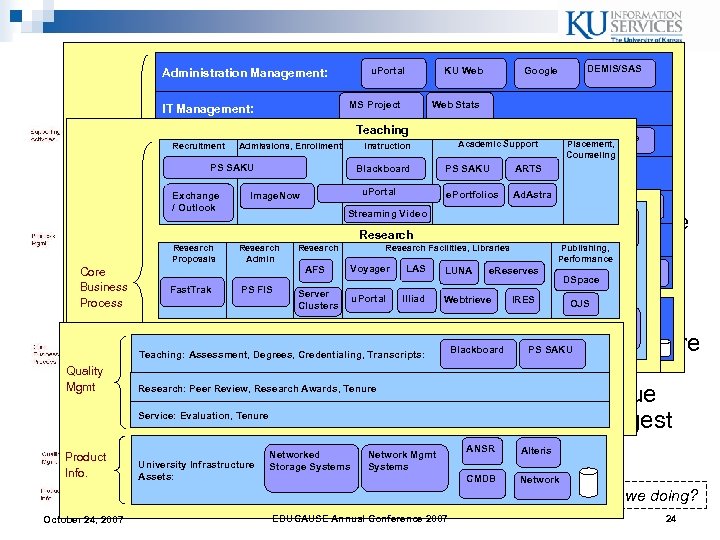
 Enterprise Application Map q Enterprise Application Map - an extension of the value chain q The Application Map seeks to categorize the applications and systems in an organization with links on the value chain. q It is: A business and technology hybrid model q High-level q What are we doing? October 24, 2007 EDUCAUSE Annual Conference 2007 22
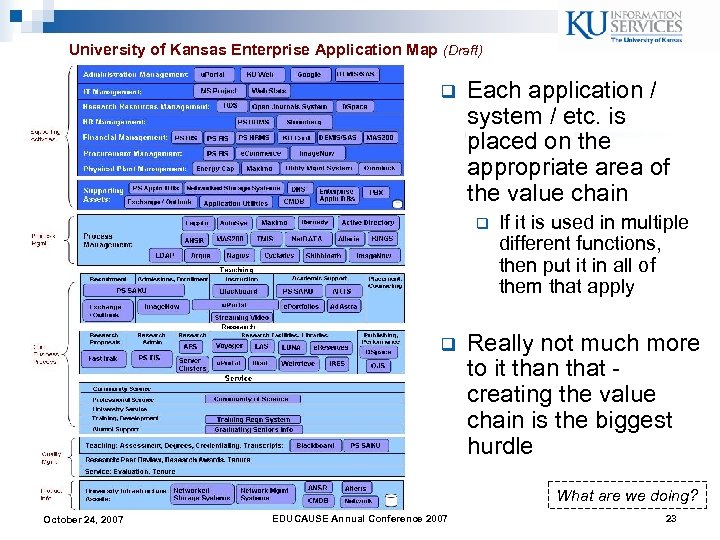 University of Kansas Enterprise Application Map (Draft) q Each application / system / etc. is placed on the appropriate area of the value chain q q If it is used in multiple different functions, then put it in all of them that apply Really not much more to it than that creating the value chain is the biggest hurdle What are we doing? October 24, 2007 EDUCAUSE Annual Conference 2007 23
 u. Portal Administration Management: Recruitment Process Core Mgmt Business Process Google DEMIS/SAS Each application / IT Management: system / etc. is Teaching. RDS DSpace Open Journals System Research Resources Management: placed on the PS SAKU Blackboard HRMS SAKU PS appropriate area of ARTS PS Stromberg HR Management: u. Portal e. Portfolios value chain Ad. Astra Image. Now Exchange the. Card DEMIS/SAS MAS 200 PS HRMS PS BIS KU PS FIS / Outlook Financial Management: MS Project Supporting Activities KU Web Admissions, Enrollment q Web Stats Academic Support Instruction Streaming Video Maximo Legato Auto. Sys Placement, Counseling Remedy Active Directory If it is used in multiple Researche. Commerce Image. Now PS FIS Procurement Management: different functions, Research Facilities, Libraries Publishing, Proposals Admin Performance MAS 200 Maximo Utility Mgmt put it in Omnilock then Alteris RINGS of all AFS LUNA Net. DATA ANSR Voyager e. Reserves System Physical Plant Management: Energy Cap LASTMIS Process DSpace Management: PS FIS Fast. Trak them that apply Server u. Portal Illiad IRES Webtrieve q OJS DNS Enterprise Shibbloeth Image. Now PBX Supporting Service Appln DBs Assets: CMDB Exchange / Outlook Application Utilities Community Service Blackboard PS SAKU Teaching: Assessment, Degrees, Credentialing, Transcripts: Community of Science Professional Service Clusters Networked Storage Systems PS Appln DBs Nagios LDAP Cyclades Argus Really not much more to it than that Research: Peer Review, Research Awards, Tenure Training Regn System creating the value Graduating Seniors Info Service: Evaluation, Tenure chain is the biggest ANSR Alteris hurdle Networked Network Mgmt q Quality Mgmt University Service Training, Development Alumni Support Product Info. University Infrastructure Assets: Storage Systems CMDB Network What are we doing? October 24, 2007 EDUCAUSE Annual Conference 2007 24
 Why an Application Map? q Allows units to see where each specific application fits in relation to the high-level business areas in the organization q Helps find gaps where IT does not have any / adequate applications in a particular business area q Helps show pervasive technology is in the organization q Can be used to illustrate justification for IT spending q Starts the process to visually see IT / Business alignment What are we doing? October 24, 2007 EDUCAUSE Annual Conference 2007 25
 Models: Where to Next? Who are we working with? Business Partners model Why are we doing it? Value Chain Model What are we doing? Application Maps, Service Catalogs How do we manage the process? ITIL Services Model Where are we going? Strategic Planning How do we assess our progress? Assessment (Tech. Qual+) October 24, 2007 EDUCAUSE Annual Conference 2007 26
 Application Lists and Service Catalogs q Historical approach to meeting individual / unit needs separate applications (Application lists) q ITIL Process Models q q Recognizing interconnections between applications across the organization ITIL Service Catalog concept Moving from Applications lists Services lists q Merges value to campus with application groups through operational and service level contracts q How do we manage it? October 24, 2007 EDUCAUSE Annual Conference 2007 27
 How Do We Manage It? q ITIL q IT service management concepts Portfolio management concepts How do we manage it? October 24, 2007 EDUCAUSE Annual Conference 2007 28
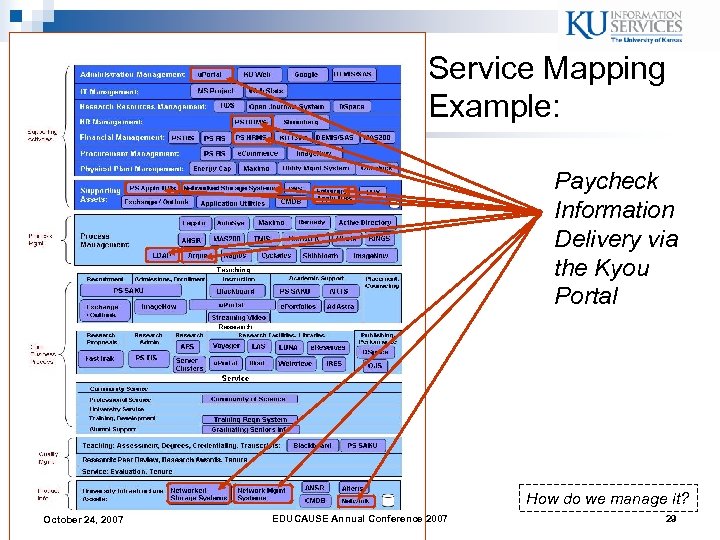 Service Mapping Example: Paycheck Information Delivery via the Kyou Portal How do we manage it? October 24, 2007 EDUCAUSE Annual Conference 2007 29
 Enterprise Portfolio Management q Portfolio strategy defines benefits delivered and when they can be expected q Enables organization to mature at a rate it can absorb change q Targets opportunities for early return on investment with minimal cultural impact q Aligns capabilities with solid, measurable implementation objectives www. planview. com How do we manage it? October 24, 2007 EDUCAUSE Annual Conference 2007 30
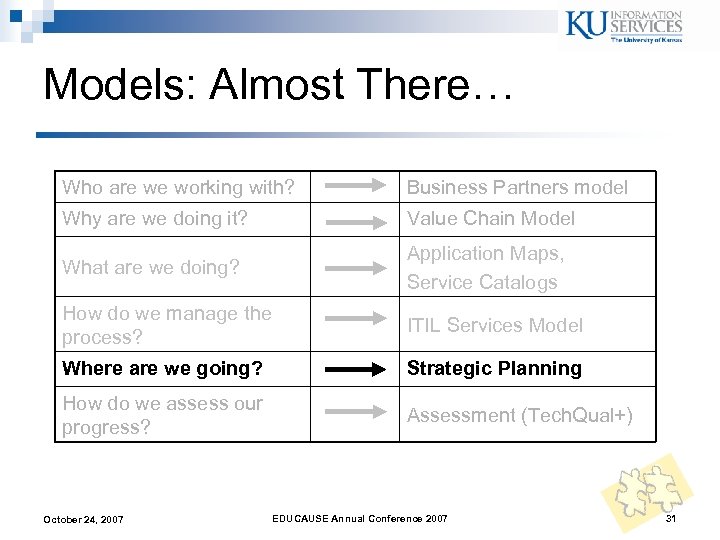 Models: Almost There… Who are we working with? Business Partners model Why are we doing it? Value Chain Model What are we doing? Application Maps, Service Catalogs How do we manage the process? ITIL Services Model Where are we going? Strategic Planning How do we assess our progress? Assessment (Tech. Qual+) October 24, 2007 EDUCAUSE Annual Conference 2007 31
 Where Are We Going? Strategic Planning Process q Using these models, it becomes easier to focus on core institutional services and how IT can contribute q Highlights gaps in services q Provides foundation for strategic directions q Provides basis for new service proposals q Governance models q Enterprise Application Resource Priority Group Where are we going? October 24, 2007 EDUCAUSE Annual Conference 2007 32
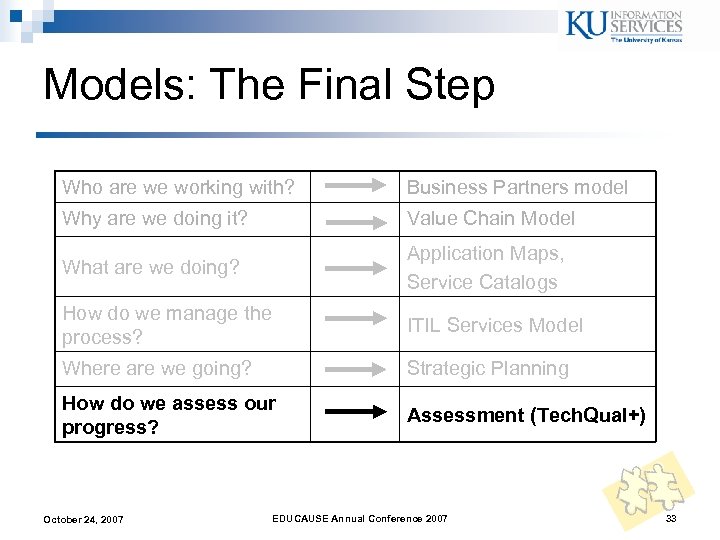 Models: The Final Step Who are we working with? Business Partners model Why are we doing it? Value Chain Model What are we doing? Application Maps, Service Catalogs How do we manage the process? ITIL Services Model Where are we going? Strategic Planning How do we assess our progress? Assessment (Tech. Qual+) October 24, 2007 EDUCAUSE Annual Conference 2007 33
 How Do We Assess Progress? q When planning any assessment activity, start by considering these four guiding questions: What do we need to know? q Who can tell us? q How can we get the information? q What will it enable us to do? q q The models discussed position IT well to answer these questions How do we assess it? October 24, 2007 EDUCAUSE Annual Conference 2007 34
 Why Do Assessment? q Benchmark current services and use data to improve efficiency and effectiveness. q Measure users’ perceptions and satisfactions with services. q Establish what services and resources are needed and desired. q Increase dialogue with users. How do we assess it? October 24, 2007 EDUCAUSE Annual Conference 2007 35
 Assessment Tools? q EDUCAUSE Core Data Service (http: //www. educause. edu/apps/coredata) q q Provides comparison data about campus information technology environments and practices to help benchmark, plan for, and make decisions about campus IT services Tech. Qual+ (http: //www. techqual. org) q q Project to develop a scientifically reliable and valid instrument that can be adopted by all institutions of higher education to conduct assessments of technology services on their own campuses. Modeled on the existing SERVQUAL, IS SERVQUAL, and Lib. Qual+ approaches How do we assess it? October 24, 2007 EDUCAUSE Annual Conference 2007 36
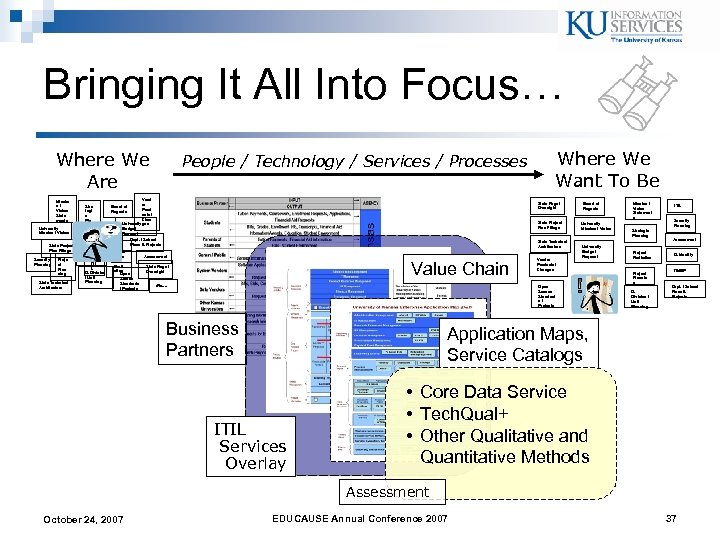 Bringing It All Into Focus… Where We Are Missio n/ Vision State ments University Mission / Vision Stra tegi c Pla nni ng People / Technology / Services / Processes Vend or Prod ucts / Chan University ges Budget Request State Regs / Oversight Board of Regents State Project Plan Filings Dept. / School State Project Plan Filings Security Planning Proje ct Plan ning State Technical Architecture IS Identity ITI L IS Division / Unit Planning Where We Want To Be State Technical Architecture Plans & Projects IT MB P Proje Assessment ct Portf State Regs / olios Oversight Open Source Standards Etc. … / Projects Value Chain Vendor Products / Changes Board of Regents University Mission / Vision ITIL Security Planning Strategic Planning Assessment University Budget Request Open Source Standard s/ Projects Business Partners Mission / Vision Statement s Project Portfolios Project Plannin g IS Division / Unit Planning IS Identity ITMBP Dept. / School Plans & Projects Application Maps, Service Catalogs ITIL Services Overlay • Core Data Service • Tech. Qual+ • Other Qualitative and Quantitative Methods Assessment October 24, 2007 EDUCAUSE Annual Conference 2007 37
 For More Information… q q q q Elloumi, Fathi, 2004. Value Chain Analysis: a strategic approach to online learning, in Theory and Practice of Online Learning, Chapter 3, Athabasca University. http: //cde. athabascau. ca/online_book/ch 3. html Hawkins, Brian, 2006. The EDUCAUSE “Grand Challenges” Initiative, EDUCAUSE Annual Conference, http: //www. educause. edu/Library. Detail. Page/666? ID=EDU 06059 ITIL Infrastructure Library, Office of Government Commerce, UK, http: //www. itil. co. uk/ Martin, J. and J. Leben, 1989. Strategic information planning methodologies, NJ: Prentice-Hall Porter, M. E. , 1980. Competitive Strategy, New York: The Free Press Sison, Raymund, et. al. , 2000. Value chain framework and support system for higher education. Proceedings of the Philippine Computing Science Congress. http: //citeseer. ist. psu. edu/correct/462203 van der Merwe, A. and Cronje, J. 2004. The educational value chain as a modelling tool in reengineering efforts. In Proceedings of the 2004 international Symposium on information and Communication Technologies (Las Vegas, Nevada, June 16 - 18, 2004). ACM International Conference Proceeding Series, vol. 90. Trinity College Dublin, 122 -127. http: //portal. acm. org/citation. cfm? id=1071509. 1071534&coll=&dl=acm&type=series&idx=1071509& part=Proceedings&Want. Type=Proceedings&title=ACM%20 International%20 Conference%20 Proce eding%20 Series&CFID=1515&CFTOKEN=6184618# Zielinski, Wojciech, 2005. ICT and competive advantage in higher education: applying value chain model and Balanced Scorecard for university, Proceedings of the 11 th International Conference of European University Information Systems, University of Manchester, http: //www. mc. manchester. ac. uk/eunis 2005/medialibrary/papers/paper_176. pdf October 24, 2007 EDUCAUSE Annual Conference 2007 38
 Thoughts? Donna Liss Questions? Beth Forrest Warner Associate Vice Provost dliss@ku. edu October 24, 2007 Assistant Vice Provost bwarner@ku. edu EDUCAUSE Annual Conference 2007 39
 October 24, 2007 EDUCAUSE Annual Conference 2007 40