 Скачать презентацию Visual Communication Development Kits for Business Application Integration
2d69d935f832302fdbf299b972c8c1a8.ppt
- Количество слайдов: 19



Visual Communication Development Kits for Business Application Integration Esa Vitikainen Master’s thesis presentation 5. 9. 2006 Thesis supervisor: Prof. Östergård Communications Laboratory Helsinki University of Technology
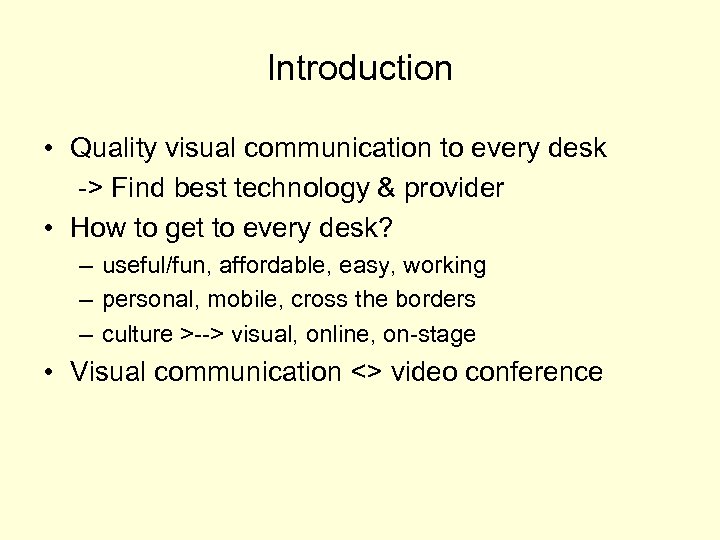
Introduction • Quality visual communication to every desk -> Find best technology & provider • How to get to every desk? – useful/fun, affordable, easy, working – personal, mobile, cross the borders – culture >--> visual, online, on-stage • Visual communication <> video conference
Contents • • • Introduction Multimedia communication architectures Multimedia connectivity in IP networks Requirements for the development kit Development kits available Conclusions
Real-time multimedia communication architectures • H. 323 • SIP • Megaco / H. 248 • Comparison
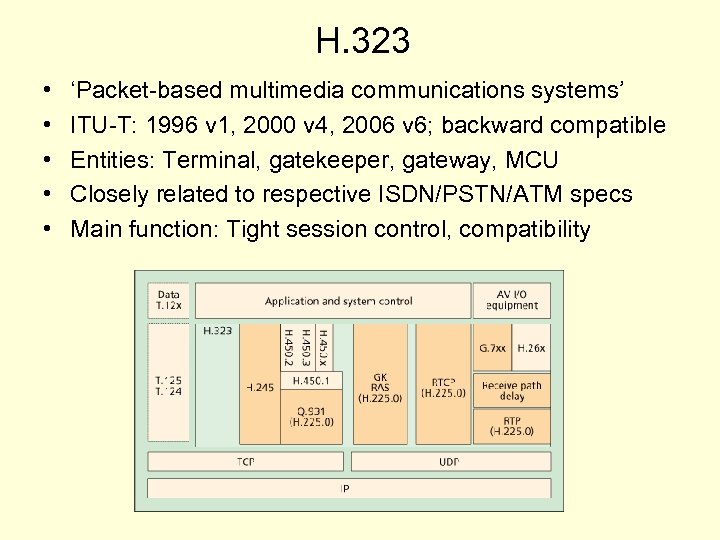
H. 323 • • • ‘Packet-based multimedia communications systems’ ITU-T: 1996 v 1, 2000 v 4, 2006 v 6; backward compatible Entities: Terminal, gatekeeper, gateway, MCU Closely related to respective ISDN/PSTN/ATM specs Main function: Tight session control, compatibility
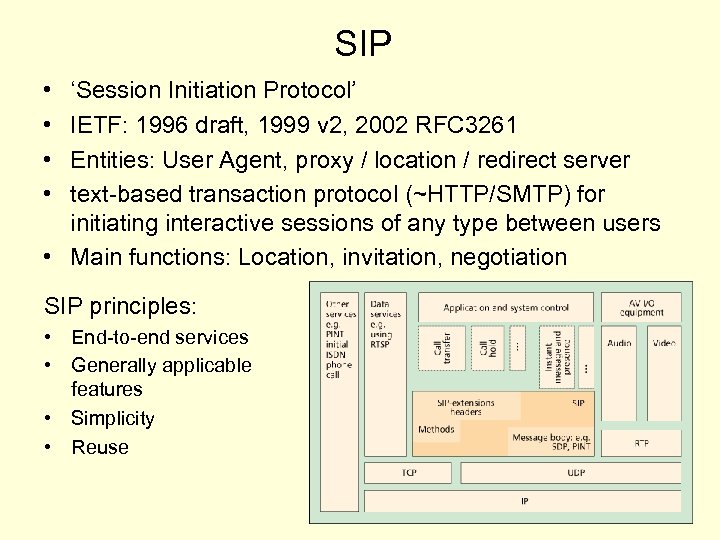
SIP • • ‘Session Initiation Protocol’ IETF: 1996 draft, 1999 v 2, 2002 RFC 3261 Entities: User Agent, proxy / location / redirect server text-based transaction protocol (~HTTP/SMTP) for initiating interactive sessions of any type between users • Main functions: Location, invitation, negotiation SIP principles: • End-to-end services • Generally applicable features • Simplicity • Reuse
Megaco / H. 248 • • Media gateway / Device control protocols IETF & al: 1998 -99 -> MGCP; IETF & ITU: 2000 H. 248 Entities: dumb Media Gateways, smart MG Controller Main function: Gateway decomposition
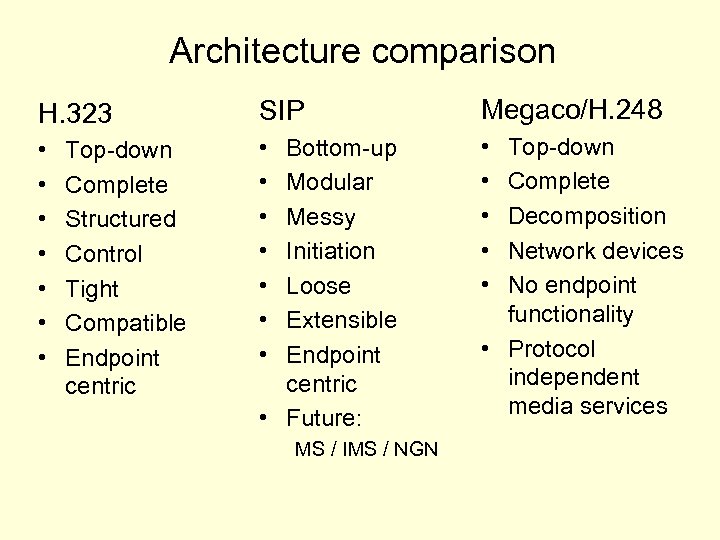
Architecture comparison H. 323 SIP Megaco/H. 248 • • • • • Top-down Complete Structured Control Tight Compatible Endpoint centric Bottom-up Modular Messy Initiation Loose Extensible Endpoint centric • Future: MS / IMS / NGN Top-down Complete Decomposition Network devices No endpoint functionality • Protocol independent media services
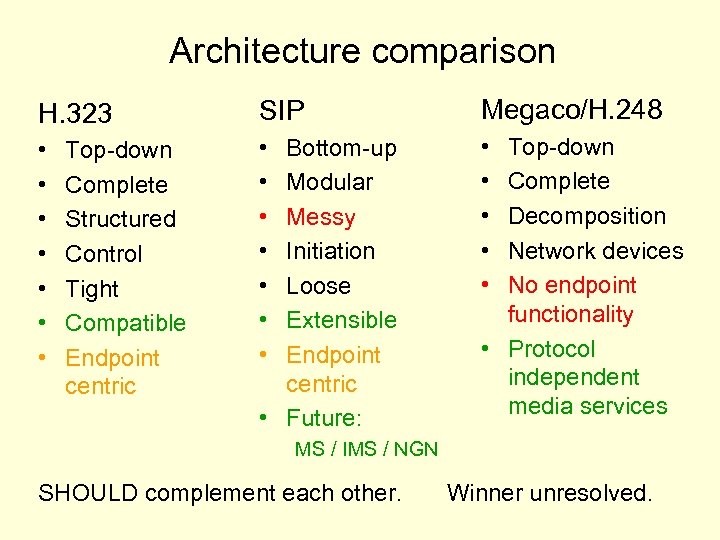
Architecture comparison H. 323 SIP Megaco/H. 248 • • • • • Top-down Complete Structured Control Tight Compatible Endpoint centric Bottom-up Modular Messy Initiation Loose Extensible Endpoint centric • Future: Top-down Complete Decomposition Network devices No endpoint functionality • Protocol independent media services MS / IMS / NGN SHOULD complement each other. Winner unresolved.
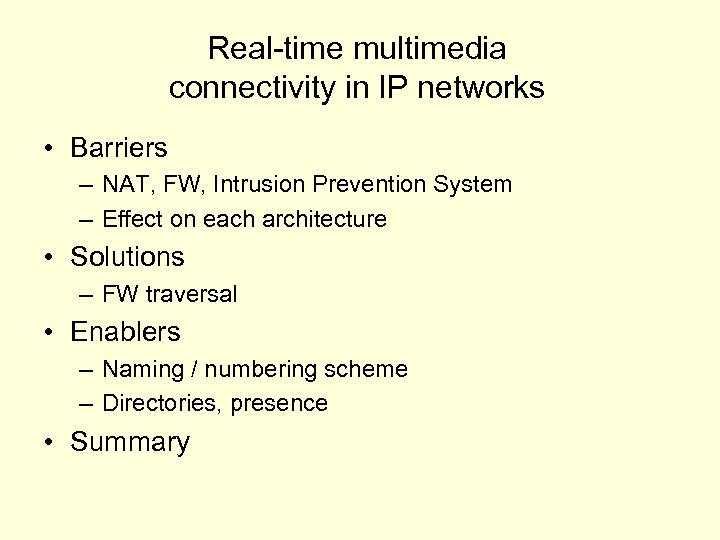
Real-time multimedia connectivity in IP networks • Barriers – NAT, FW, Intrusion Prevention System – Effect on each architecture • Solutions – FW traversal • Enablers – Naming / numbering scheme – Directories, presence • Summary
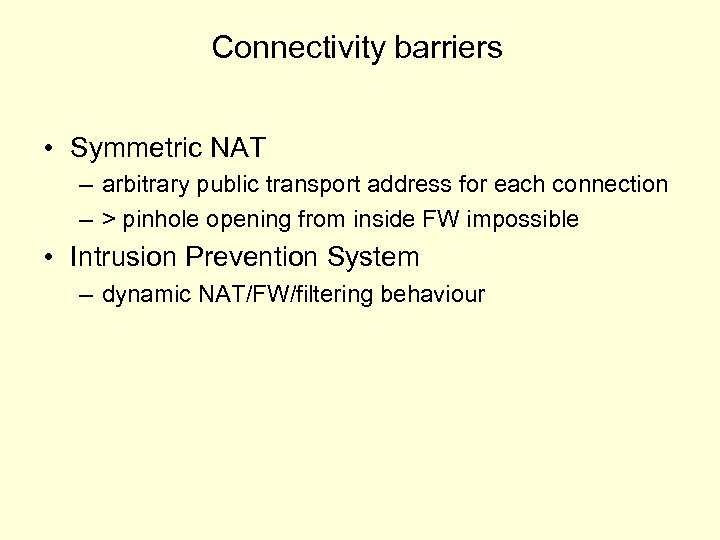
Connectivity barriers • Symmetric NAT – arbitrary public transport address for each connection – > pinhole opening from inside FW impossible • Intrusion Prevention System – dynamic NAT/FW/filtering behaviour
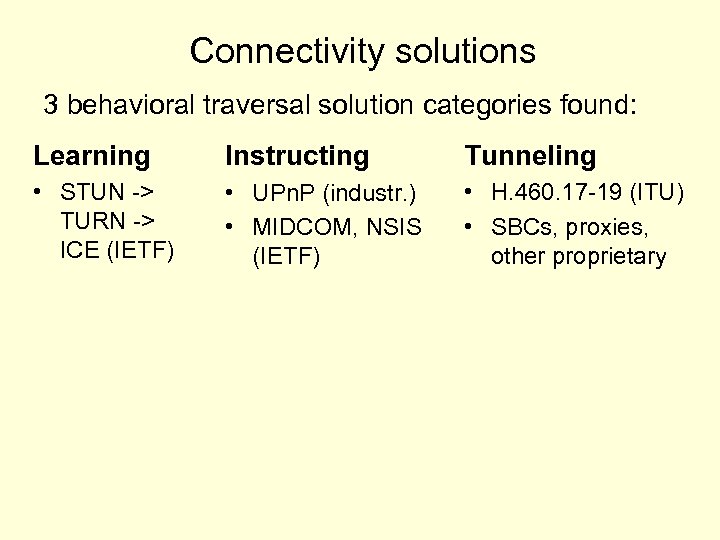
Connectivity solutions 3 behavioral traversal solution categories found: Learning Instructing Tunneling • STUN -> TURN -> ICE (IETF) • UPn. P (industr. ) • MIDCOM, NSIS (IETF) • H. 460. 17 -19 (ITU) • SBCs, proxies, other proprietary
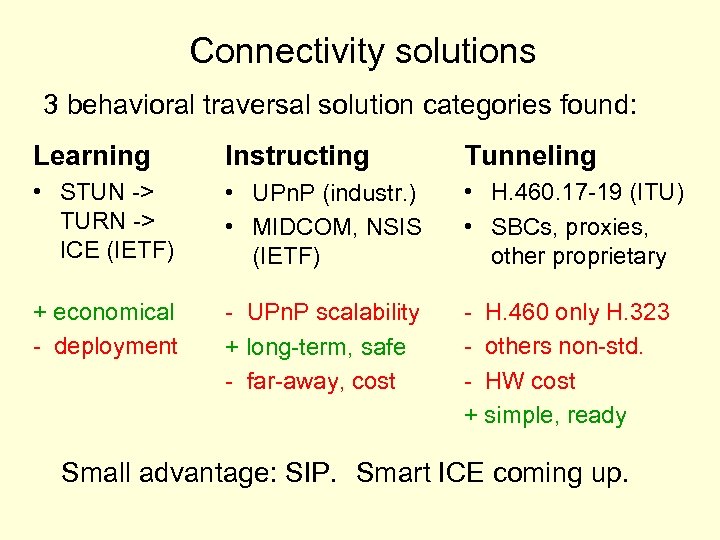
Connectivity solutions 3 behavioral traversal solution categories found: Learning Instructing Tunneling • STUN -> TURN -> ICE (IETF) • UPn. P (industr. ) • MIDCOM, NSIS (IETF) • H. 460. 17 -19 (ITU) • SBCs, proxies, other proprietary + economical - deployment - UPn. P scalability + long-term, safe - far-away, cost - H. 460 only H. 323 - others non-std. - HW cost + simple, ready Small advantage: SIP. Smart ICE coming up.
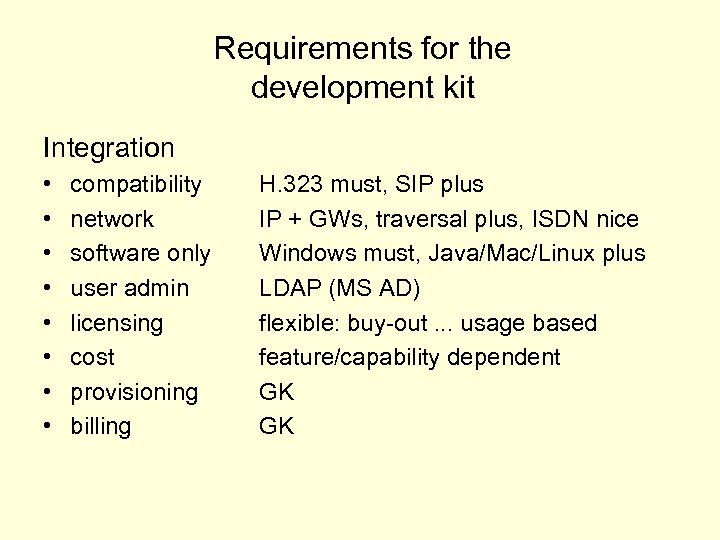
Requirements for the development kit Integration • • compatibility network software only user admin licensing cost provisioning billing H. 323 must, SIP plus IP + GWs, traversal plus, ISDN nice Windows must, Java/Mac/Linux plus LDAP (MS AD) flexible: buy-out. . . usage based feature/capability dependent GK GK
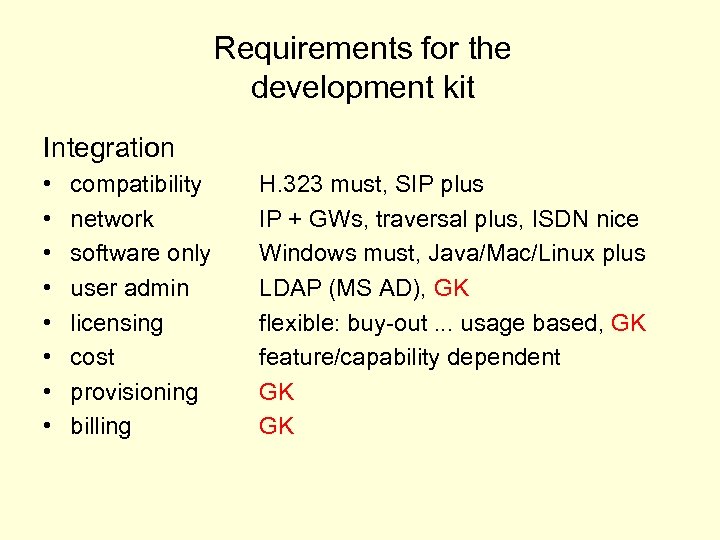
Requirements for the development kit Integration • • compatibility network software only user admin licensing cost provisioning billing H. 323 must, SIP plus IP + GWs, traversal plus, ISDN nice Windows must, Java/Mac/Linux plus LDAP (MS AD), GK flexible: buy-out. . . usage based, GK feature/capability dependent GK GK
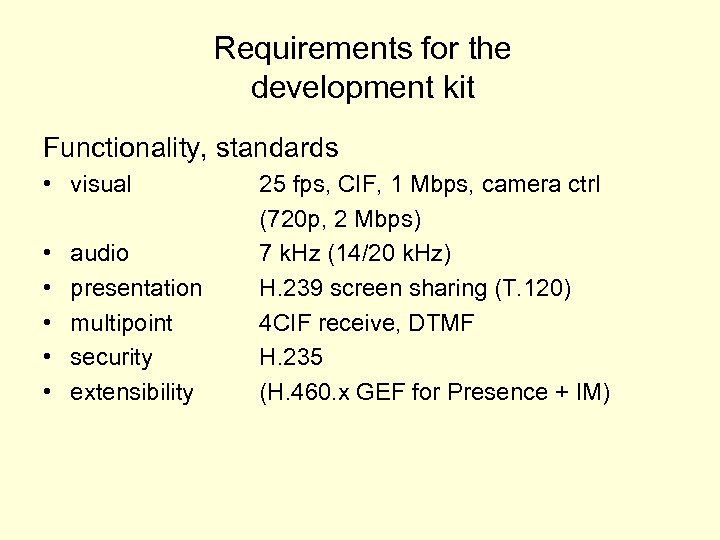
Requirements for the development kit Functionality, standards • visual • • • audio presentation multipoint security extensibility 25 fps, CIF, 1 Mbps, camera ctrl (720 p, 2 Mbps) 7 k. Hz (14/20 k. Hz) H. 239 screen sharing (T. 120) 4 CIF receive, DTMF H. 235 (H. 460. x GEF for Presence + IM)
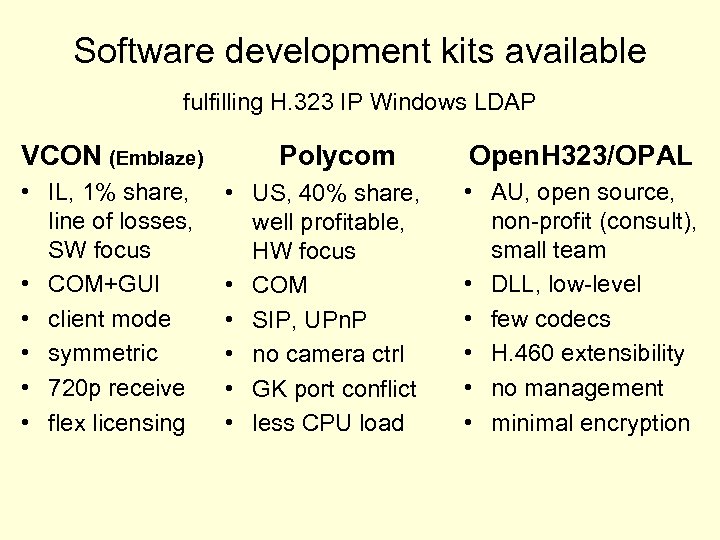
Software development kits available fulfilling H. 323 IP Windows LDAP VCON (Emblaze) • IL, 1% share, line of losses, SW focus • COM+GUI • client mode • symmetric • 720 p receive • flex licensing Polycom • US, 40% share, well profitable, HW focus • COM • SIP, UPn. P • no camera ctrl • GK port conflict • less CPU load Open. H 323/OPAL • AU, open source, non-profit (consult), small team • DLL, low-level • few codecs • H. 460 extensibility • no management • minimal encryption
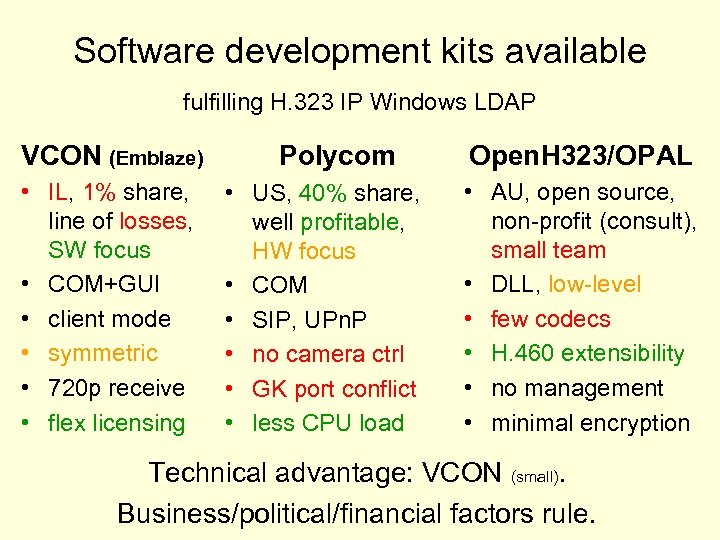
Software development kits available fulfilling H. 323 IP Windows LDAP VCON (Emblaze) • IL, 1% share, line of losses, SW focus • COM+GUI • client mode • symmetric • 720 p receive • flex licensing Polycom • US, 40% share, well profitable, HW focus • COM • SIP, UPn. P • no camera ctrl • GK port conflict • less CPU load Open. H 323/OPAL • AU, open source, non-profit (consult), small team • DLL, low-level • few codecs • H. 460 extensibility • no management • minimal encryption Technical advantage: VCON (small). Business/political/financial factors rule.
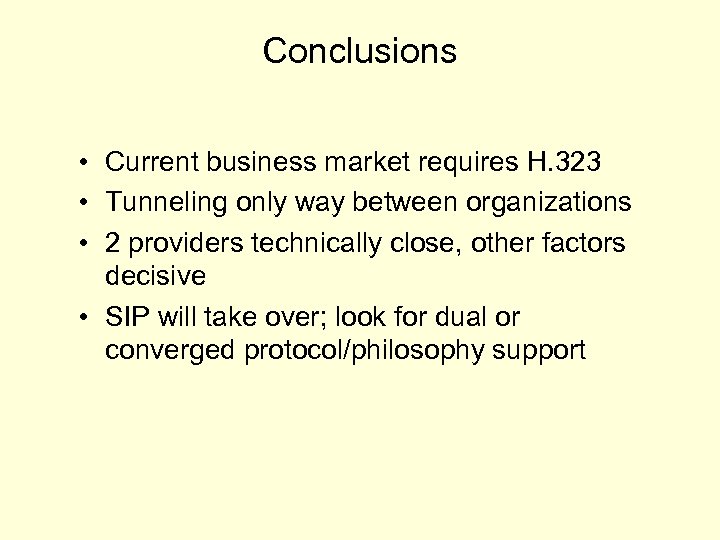
Conclusions • Current business market requires H. 323 • Tunneling only way between organizations • 2 providers technically close, other factors decisive • SIP will take over; look for dual or converged protocol/philosophy support
Скачать презентацию Visual Communication Development Kits for Business Application Integration
2d69d935f832302fdbf299b972c8c1a8.ppt