


 Скачать презентацию Viscous Hydro URQMD Huichao Song The Ohio State
7c76a77e1c8bd44e922394e206b96f4d.ppt
- Количество слайдов: 35
 Viscous Hydro +URQMD Huichao Song The Ohio State University Lawrence Berkeley National Lab Quantifying the Properties of Hot QCD Matter May 24 - July 16, INT Seattle, WA In collaboration with S. Bass, U. Heinz, C. Shen, P. Huovinen & T. Hirano (? ) Supported by DOE 06/14/2004
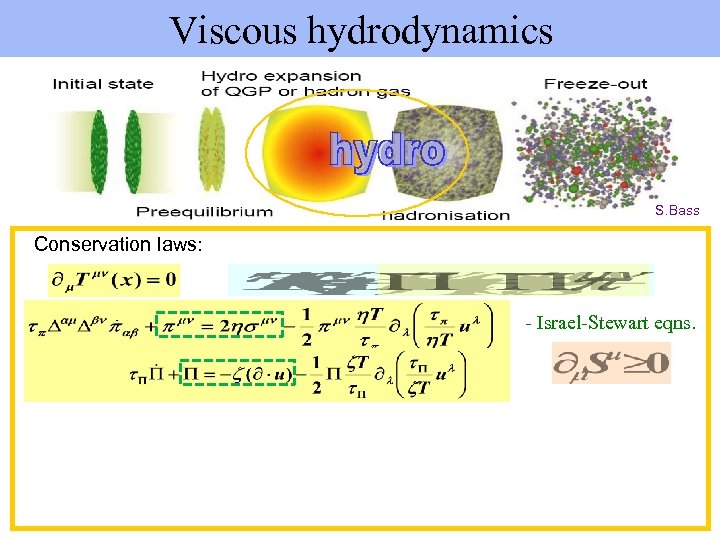 Viscous hydrodynamics S. Bass Conservation laws: - Israel-Stewart eqns.
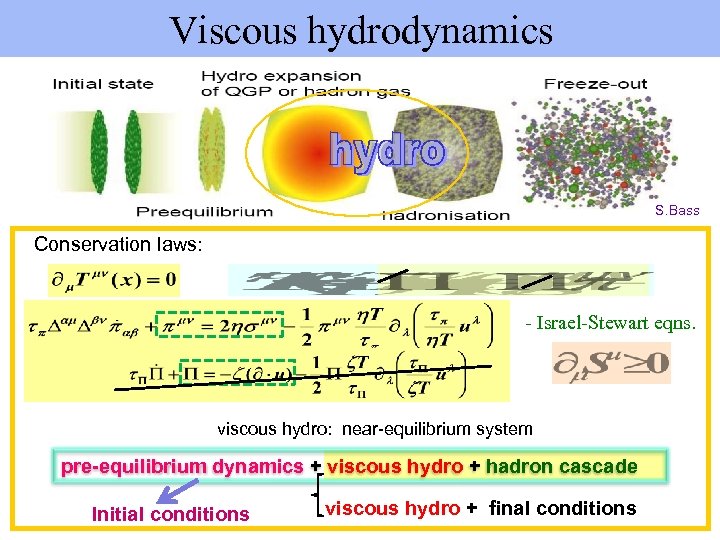 Viscous hydrodynamics S. Bass Conservation laws: - Israel-Stewart eqns. viscous hydro: near-equilibrium system pre-equilibrium dynamics + viscous hydro + hadron cascade Initial conditions viscous hydro + final conditions
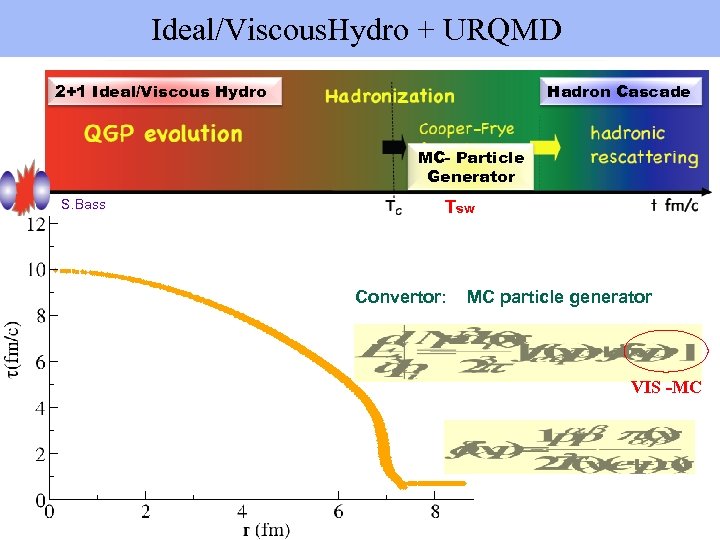 Ideal/Viscous. Hydro + URQMD 2+1 Ideal/Viscous Hydro Hadron Cascade MC- Particle Generator S. Bass Tsw Convertor: MC particle generator VIS -MC
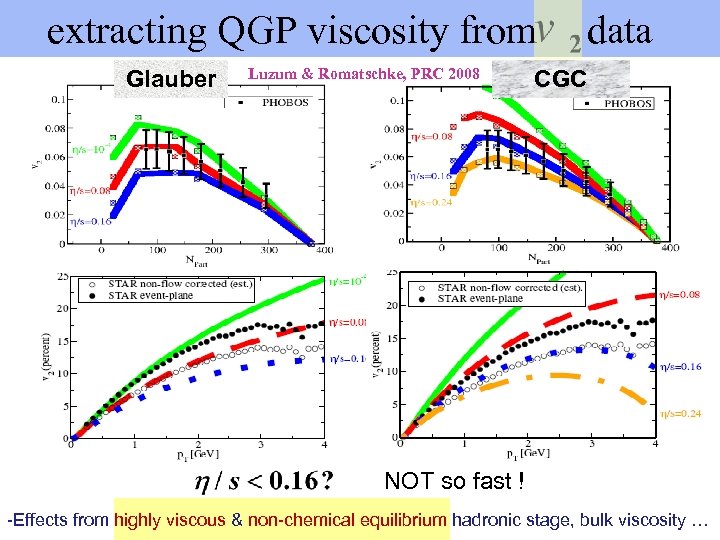 extracting QGP viscosity from data Glauber Luzum & Romatschke, PRC 2008 CGC NOT so fast ! -Effects from highly viscous & non-chemical equilibrium hadronic stage, bulk viscosity …
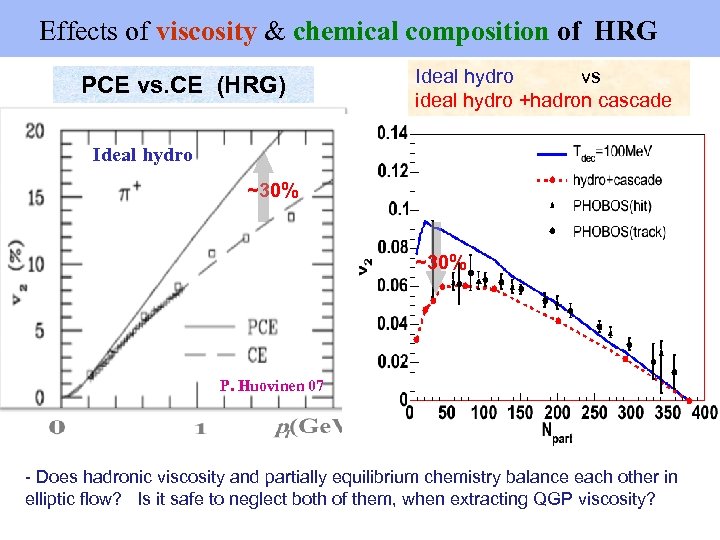 Effects of viscosity & chemical composition of HRG PCE vs. CE (HRG) Ideal hydro vs ideal hydro +hadron cascade Ideal hydro ~30% P. Huovinen 07 - Does hadronic viscosity and partially equilibrium chemistry balance each other in elliptic flow? Is it safe to neglect both of them, when extracting QGP viscosity?
 Ideal / viscous hydro+URQMD SM-EOS Q (CE) vs. EOSL-PCE
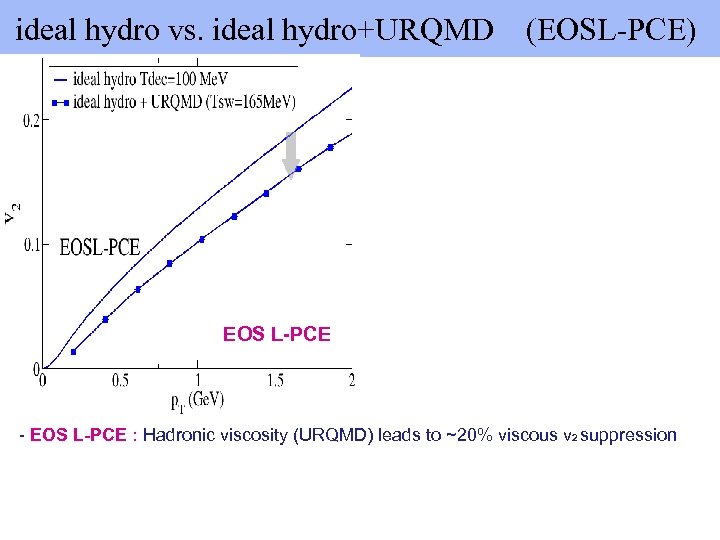 ideal hydro vs. ideal hydro+URQMD (EOSL-PCE) EOS L-PCE - EOS L-PCE : Hadronic viscosity (URQMD) leads to ~20% viscous v 2 suppression
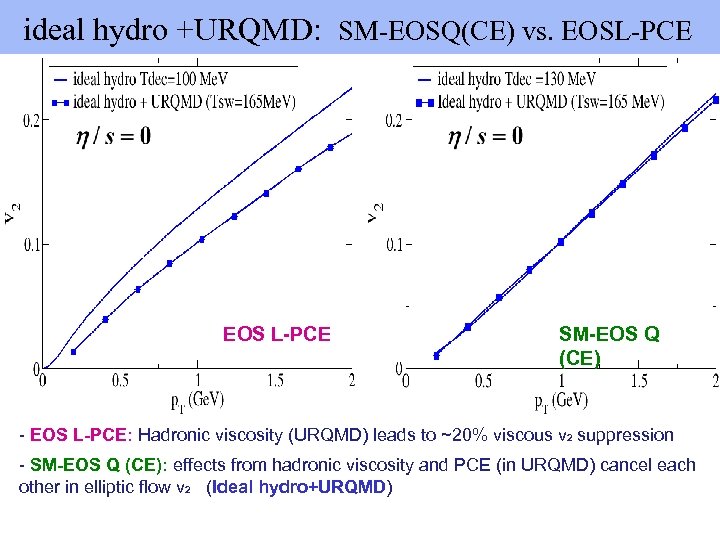 ideal hydro +URQMD: SM-EOSQ(CE) vs. EOSL-PCE EOS L-PCE SM-EOS Q (CE) - EOS L-PCE: Hadronic viscosity (URQMD) leads to ~20% viscous v 2 suppression - SM-EOS Q (CE): effects from hadronic viscosity and PCE (in URQMD) cancel each other in elliptic flow v 2 (Ideal hydro+URQMD)
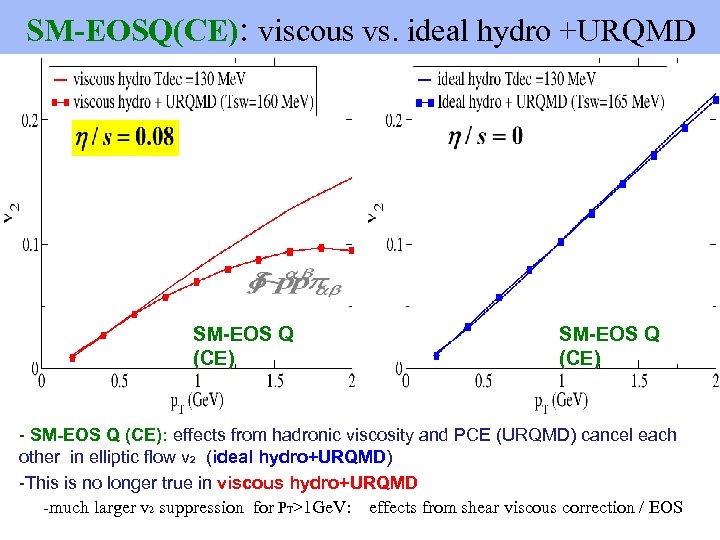 SM-EOSQ(CE): viscous vs. ideal hydro +URQMD SM-EOS Q (CE) - SM-EOS Q (CE): effects from hadronic viscosity and PCE (URQMD) cancel each other in elliptic flow v 2 (ideal hydro+URQMD) -This is no longer true in viscous hydro+URQMD -much larger v 2 suppression for PT>1 Ge. V: effects from shear viscous correction / EOS
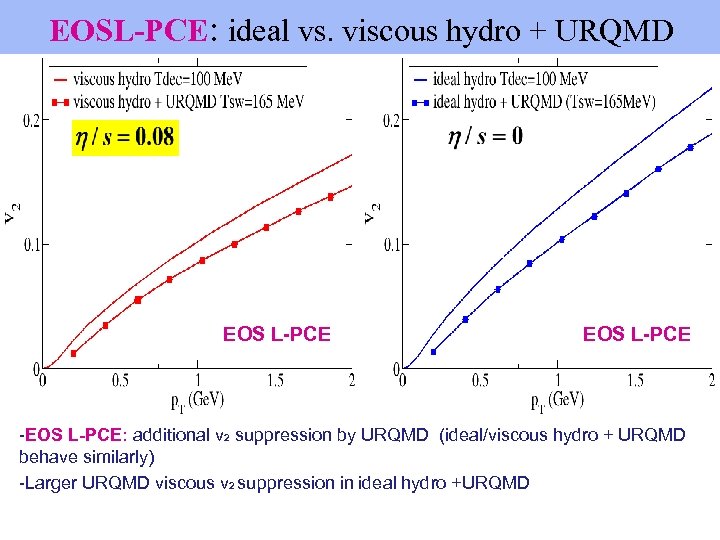 EOSL-PCE: ideal vs. viscous hydro + URQMD EOS L-PCE -EOS L-PCE: additional v 2 suppression by URQMD (ideal/viscous hydro + URQMD behave similarly) -Larger URQMD viscous v 2 suppression in ideal hydro +URQMD
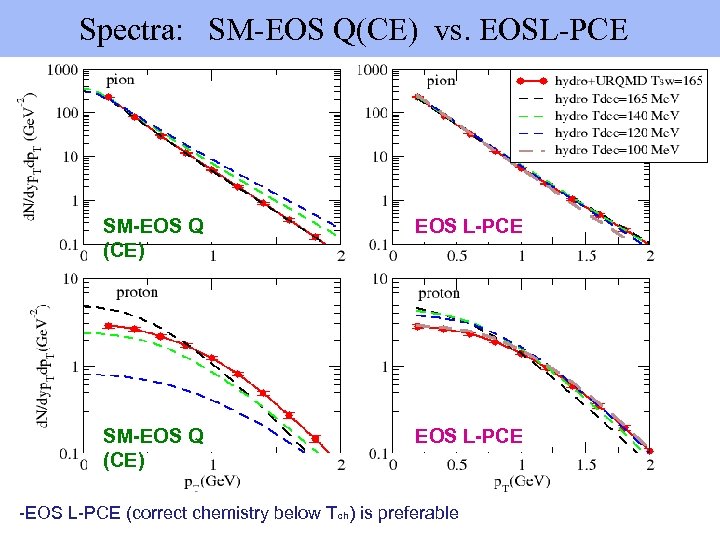 Spectra: SM-EOS Q(CE) vs. EOSL-PCE SM-EOS Q (CE) EOS L-PCE -EOS L-PCE (correct chemistry below Tch) is preferable
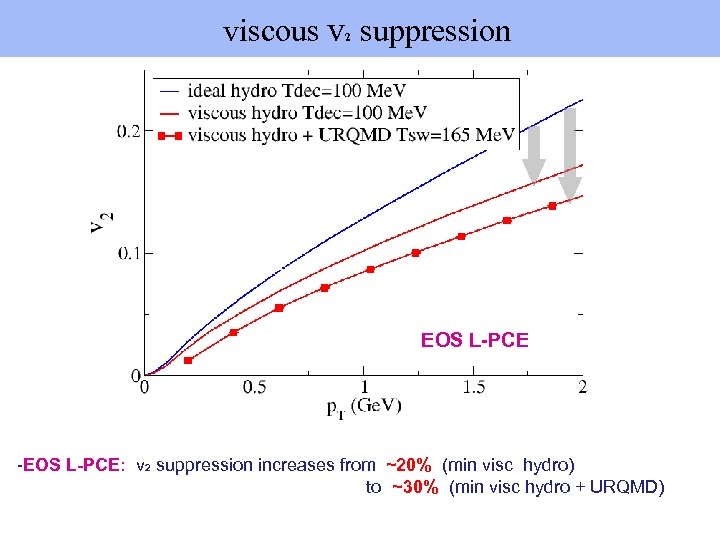 viscous v suppression 2 EOS L-PCE -EOS L-PCE: v 2 suppression increases from ~20% (min visc hydro) to ~30% (min visc hydro + URQMD)
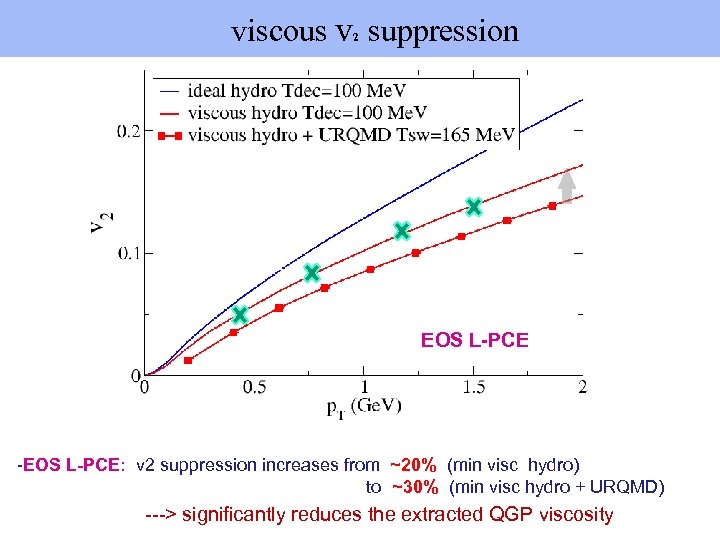 viscous v suppression 2 EOS L-PCE -EOS L-PCE: v 2 suppression increases from ~20% (min visc hydro) to ~30% (min visc hydro + URQMD) ---> significantly reduces the extracted QGP viscosity
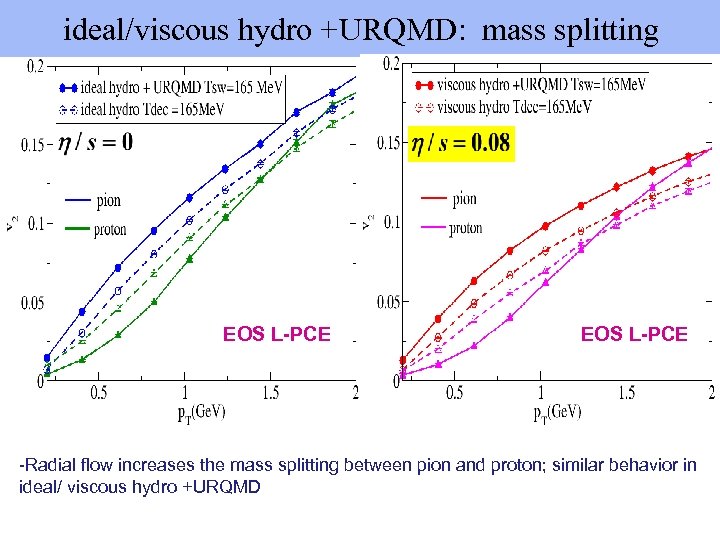 ideal/viscous hydro +URQMD: mass splitting EOS L-PCE -Radial flow increases the mass splitting between pion and proton; similar behavior in ideal/ viscous hydro +URQMD
 More Systematic study
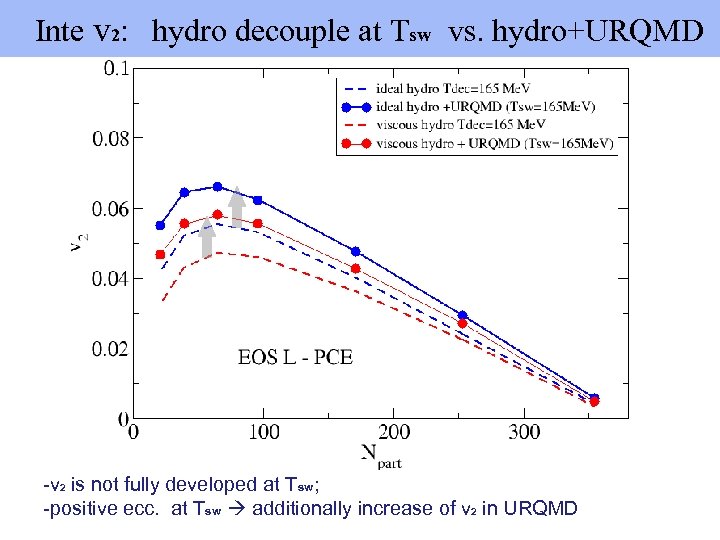 Inte v 2: hydro decouple at Tsw vs. hydro+URQMD -v 2 is not fully developed at Tsw; -positive ecc. at Tsw additionally increase of v 2 in URQMD
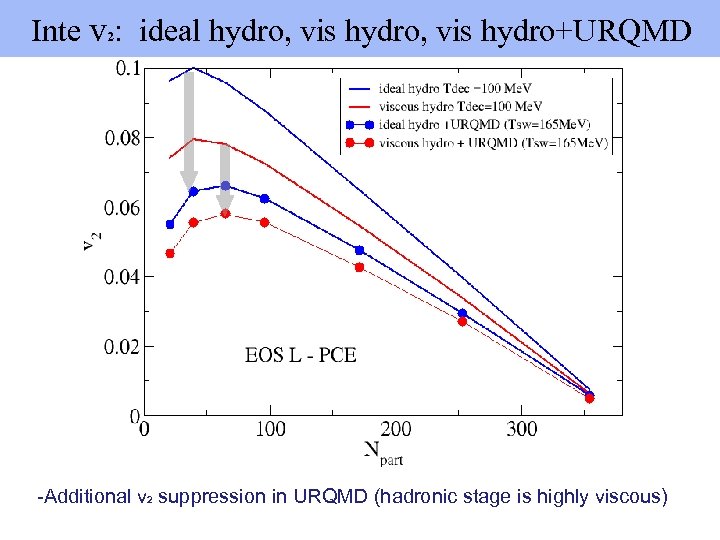 Inte v 2: ideal hydro, vis hydro+URQMD -Additional v 2 suppression in URQMD (hadronic stage is highly viscous)
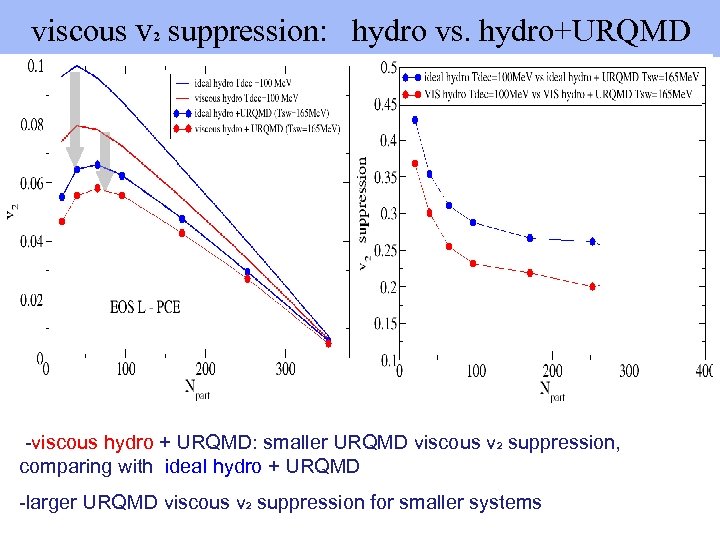 viscous v 2 suppression: hydro vs. hydro+URQMD -viscous hydro + URQMD: smaller URQMD viscous v 2 suppression, comparing with ideal hydro + URQMD -larger URQMD viscous v 2 suppression for smaller systems
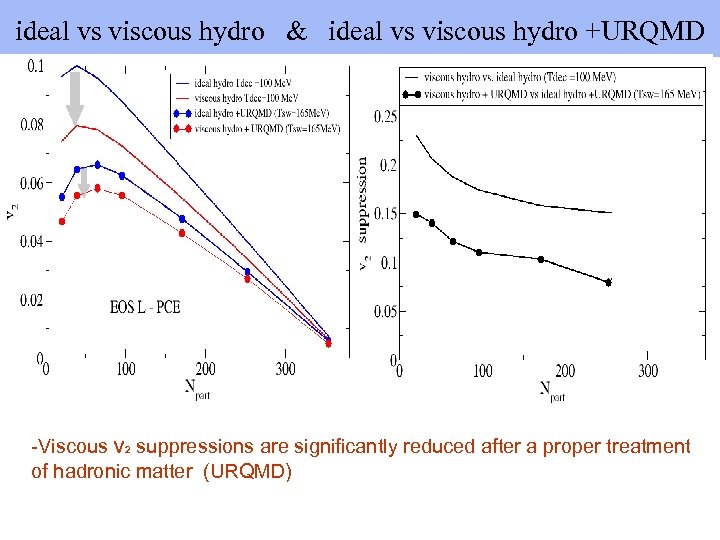 ideal vs viscous hydro & ideal vs viscous hydro +URQMD -Viscous v 2 suppressions are significantly reduced after a proper treatment of hadronic matter (URQMD)
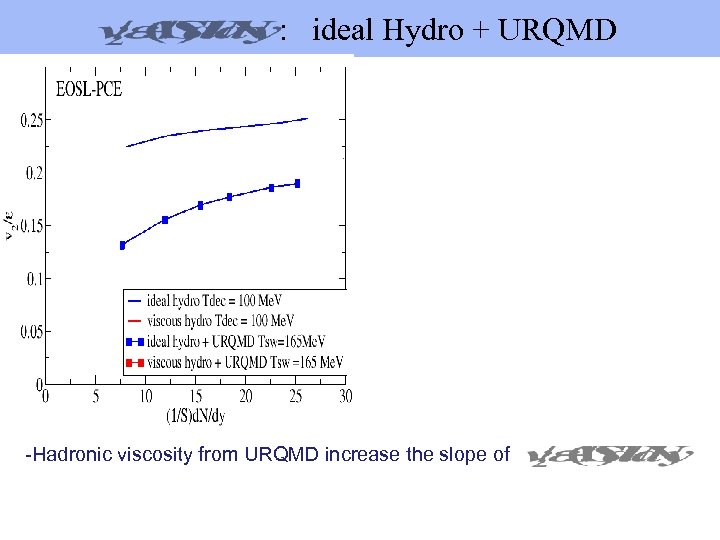 : ideal Hydro + URQMD -Hadronic viscosity from URQMD increase the slope of
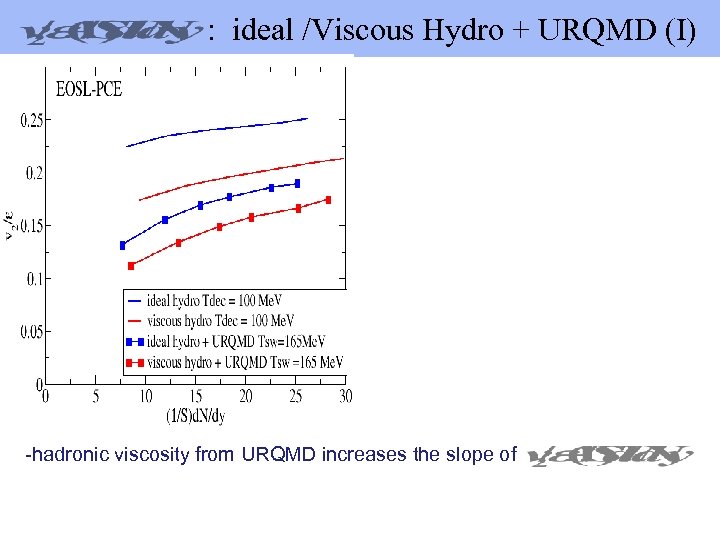 : ideal /Viscous Hydro + URQMD (I) -hadronic viscosity from URQMD increases the slope of
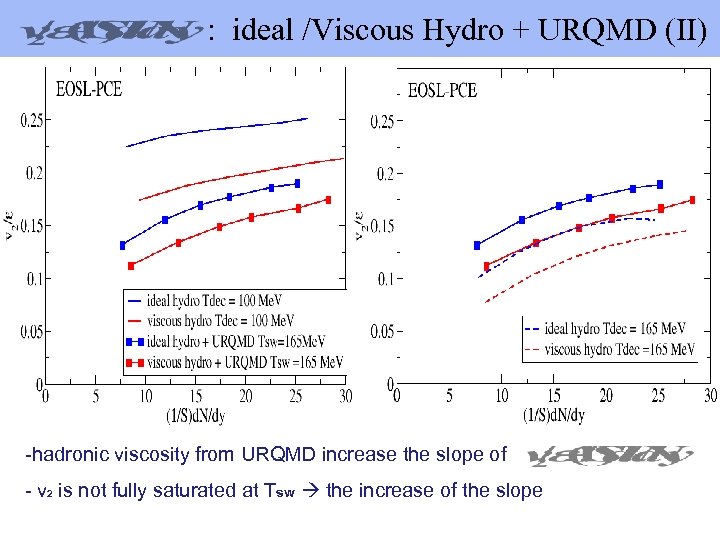 : ideal /Viscous Hydro + URQMD (II) -hadronic viscosity from URQMD increase the slope of - v 2 is not fully saturated at Tsw the increase of the slope
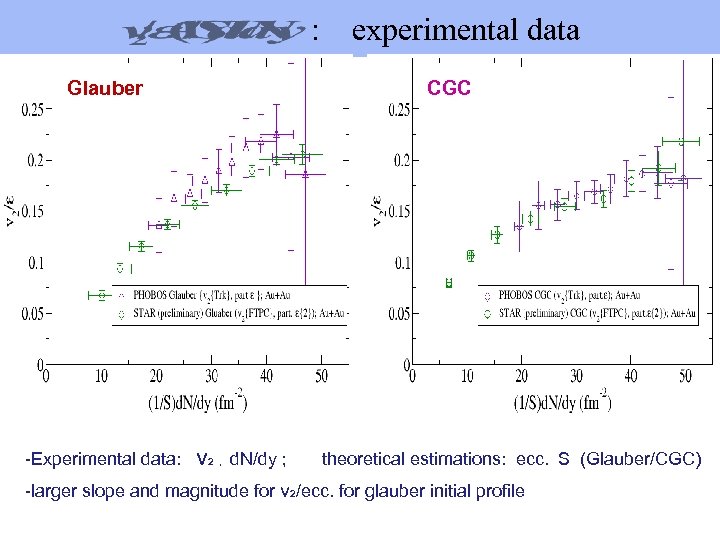 : experimental data Glauber -Experimental data: CGC v 2 , d. N/dy ; Thanks for A. Tang for Exp data theoretical estimations: ecc. S (Glauber/CGC) -larger slope and magnitude for v 2/ecc. for glauber initial profile
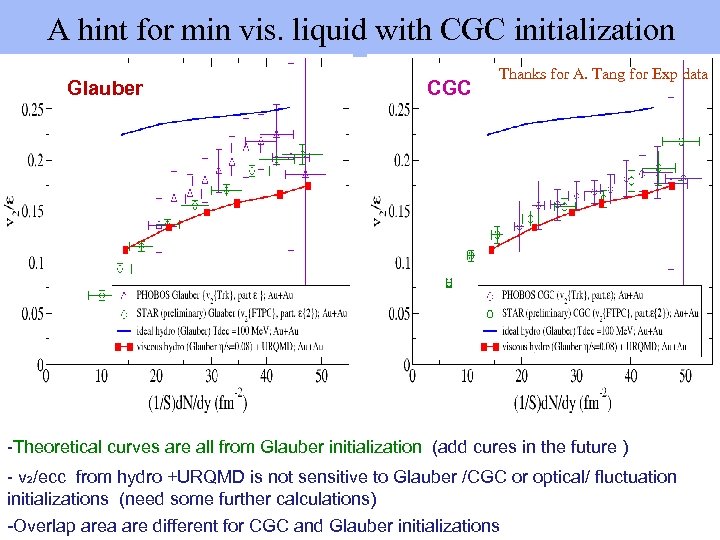 A hint for min vis. liquid with CGC initialization Glauber CGC Thanks for A. Tang for Exp data -Theoretical curves are all from Glauber initialization (add cures in the future ) - v 2/ecc from hydro +URQMD is not sensitive to Glauber /CGC or optical/ fluctuation initializations (need some further calculations) -Overlap area are different for CGC and Glauber initializations
 viscous hydro+URQMD vs. viscous hydro with -- a try to extract the hadronic viscosity EOSL-PCE is an essential input for the calculations here
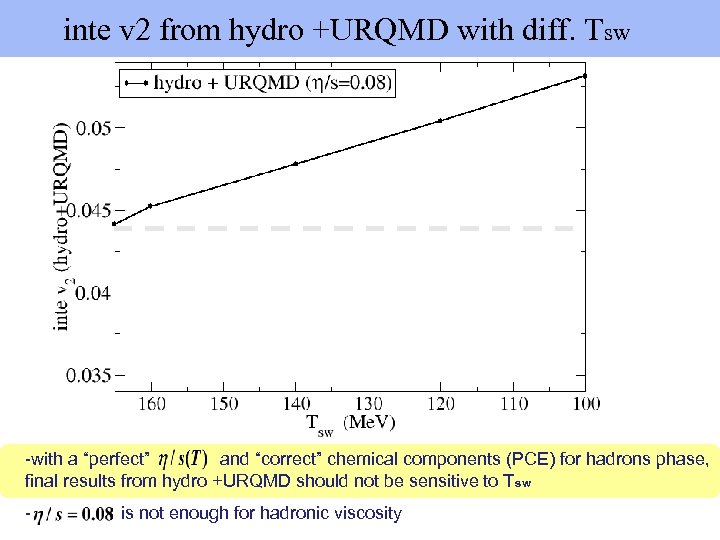 inte v 2 from hydro +URQMD with diff. Tsw -with a “perfect” and “correct” chemical components (PCE) for hadrons phase, final results from hydro +URQMD should not be sensitive to Tsw - is not enough for hadronic viscosity
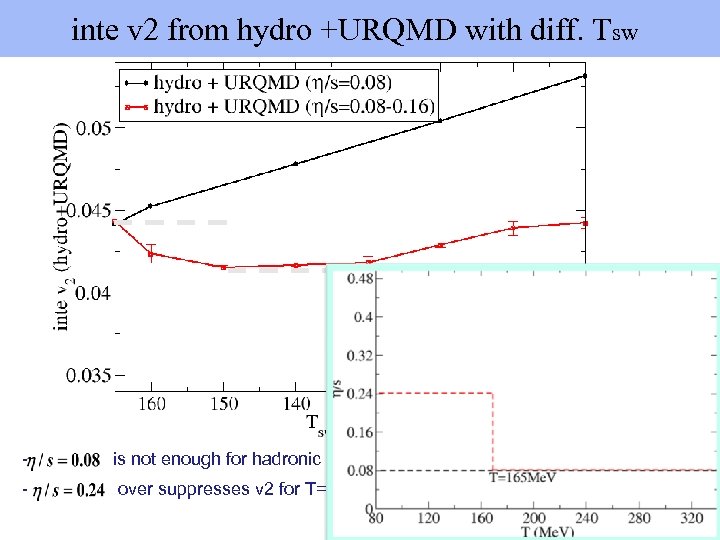 inte v 2 from hydro +URQMD with diff. Tsw - is not enough for hadronic viscosity - over suppresses v 2 for T=165 -150 Me. V, but not enough for T<130 Me. V
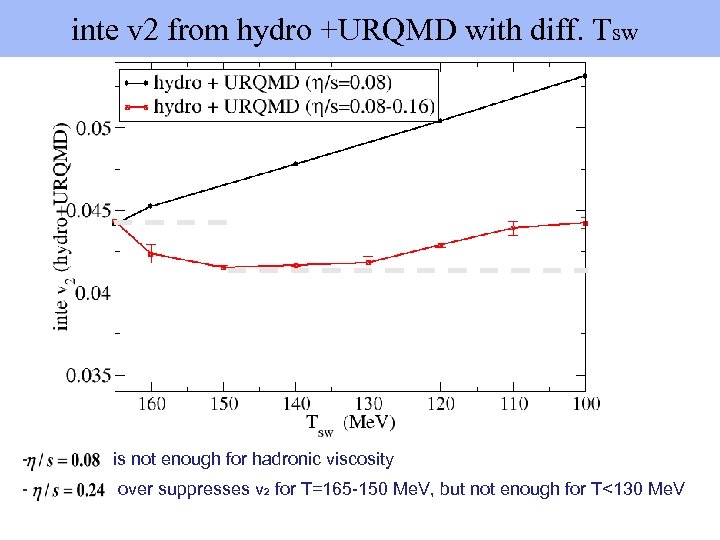 inte v 2 from hydro +URQMD with diff. Tsw - is not enough for hadronic viscosity - over suppresses v 2 for T=165 -150 Me. V, but not enough for T<130 Me. V
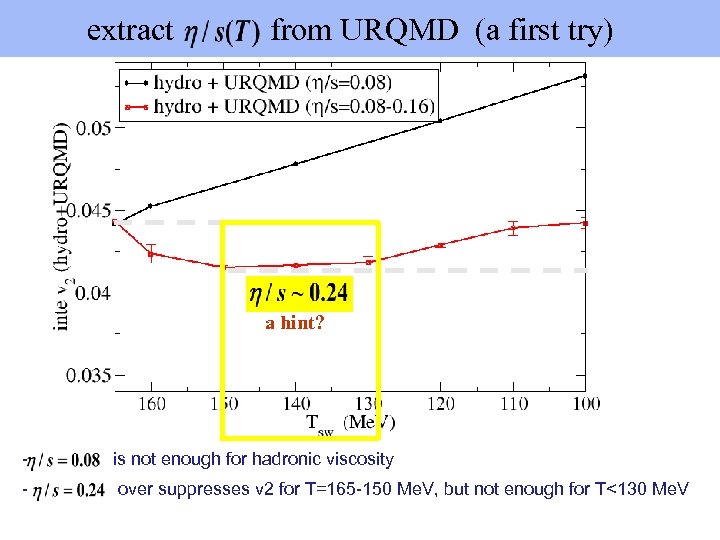 extract from URQMD (a first try) a hint? - is not enough for hadronic viscosity - over suppresses v 2 for T=165 -150 Me. V, but not enough for T<130 Me. V
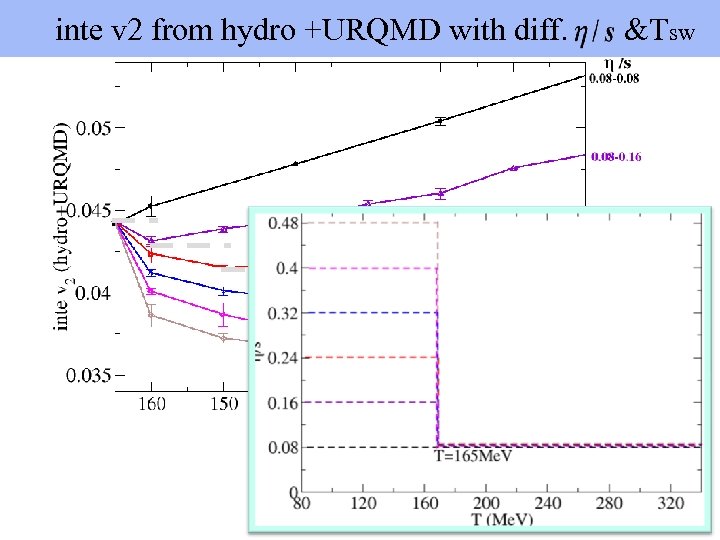 inte v 2 from hydro +URQMD with diff. &Tsw
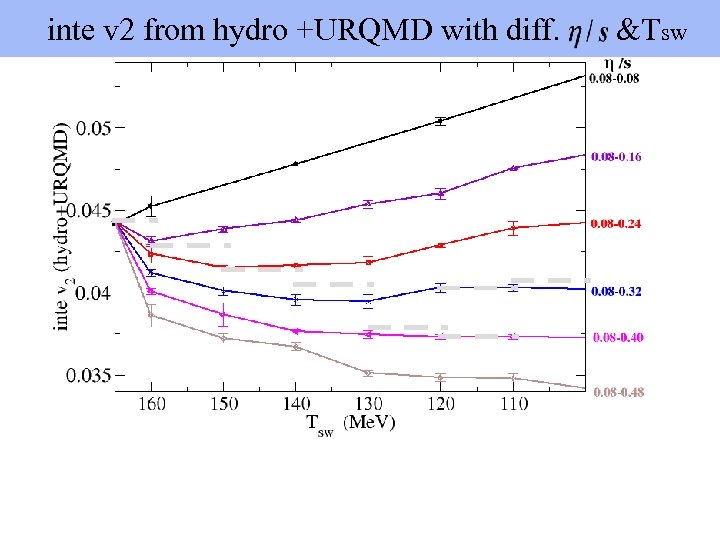 inte v 2 from hydro +URQMD with diff. &Tsw
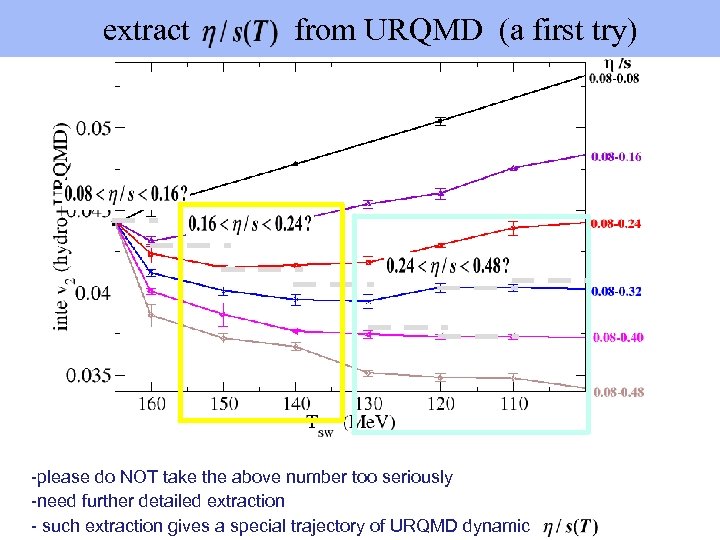 extract from URQMD (a first try) -please do NOT take the above number too seriously -need further detailed extraction - such extraction gives a special trajectory of URQMD dynamic
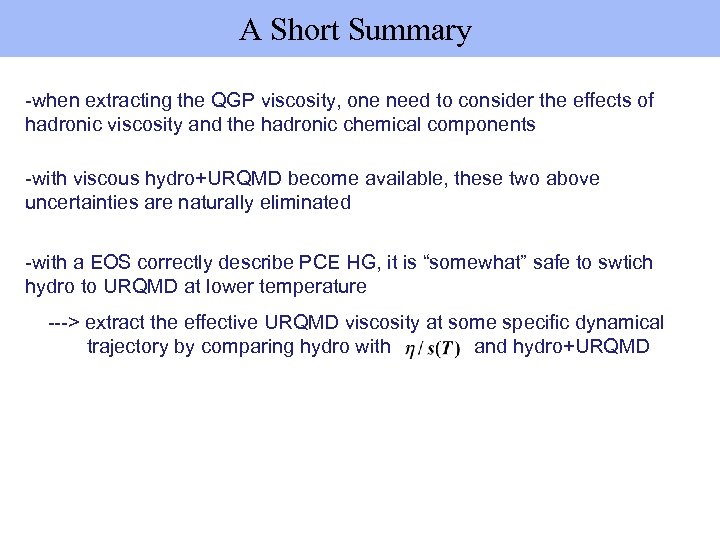 A Short Summary -when extracting the QGP viscosity, one need to consider the effects of hadronic viscosity and the hadronic chemical components -with viscous hydro+URQMD become available, these two above uncertainties are naturally eliminated -with a EOS correctly describe PCE HG, it is “somewhat” safe to swtich hydro to URQMD at lower temperature ---> extract the effective URQMD viscosity at some specific dynamical trajectory by comparing hydro with and hydro+URQMD
 Thank You