


 Скачать презентацию VIRTUAL REALITY INTERNET RETAILING VRIR EXPERIMENTAL INVESTIGATION OF
aecfd89be5d4018fd75360d80ab82dee.ppt
- Количество слайдов: 17
 VIRTUAL REALITY INTERNET RETAILING (VRIR): EXPERIMENTAL INVESTIGATION OF INTERACTIVE SHOPPING INTERFACE – STORE ATMOSPHERE EFFECTS ON USERCONSUMER BEHAVIOR Krasonikolakis Ioannis & Vrechopoulos Adam ELTRUN - IMES DEPARTMENT OF MANAGEMENT SCIENCE & TECHNOLOGY ATHENS UNIVERSITY OF ECONOMICS AND BUSINESS Thursday, 23 April 2009 1
 OUTLINE Research Positioning Introduction Literature Review Current Business Practice Research Questions and Objectives Key Research Hypothesis Research Methodology Expected Contribution References 2
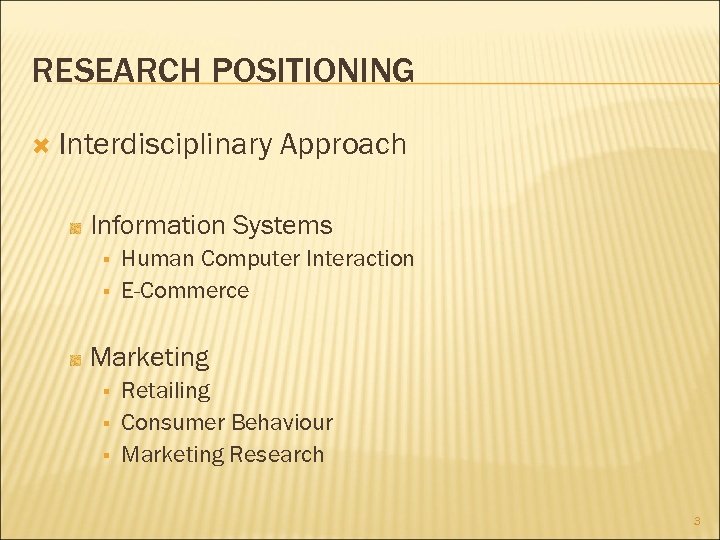 RESEARCH POSITIONING Interdisciplinary Approach Information Systems § § Human Computer Interaction E-Commerce Marketing § § § Retailing Consumer Behaviour Marketing Research 3
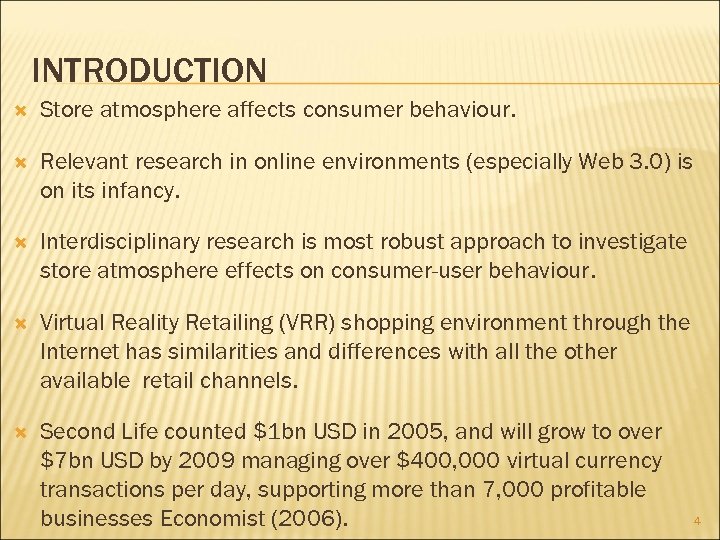 INTRODUCTION Store atmosphere affects consumer behaviour. Relevant research in online environments (especially Web 3. 0) is on its infancy. Interdisciplinary research is most robust approach to investigate store atmosphere effects on consumer-user behaviour. Virtual Reality Retailing (VRR) shopping environment through the Internet has similarities and differences with all the other available retail channels. Second Life counted $1 bn USD in 2005, and will grow to over $7 bn USD by 2009 managing over $400, 000 virtual currency transactions per day, supporting more than 7, 000 profitable businesses Economist (2006). 4
 LITERATURE REVIEW (1/5) As Kotler (1973 -4) first stated, retailers design their stores in ways that produce specific emotional effects to buyers, which influence their behavior. According to Lewison (1994) store atmosphere is the overall emotional and aesthetic effect which is created by a store’s physical features. Burke (1996), stated that 3 D effectiveness in e-commerce lies in their ability to generate a virtual environment for the end-user in which his/her experiences will affect patronizing the physical environment. 5
 LITERATURE REVIEW (2/5) Dailey (1999) first discussed about web atmospherics and Vrechopoulos, O’ Keefe and Doukidis (2000) introduced the term Virtual Store Atmosphere (VSA) and Vrechopoulos et al. (2004) investigated web store layout effects on consumer behaviour. Similarly, Siomkos and Vrechopoulos (2002) first defined “Virtual Store Atmosphere” of a web retail store as an element of the virtual retail mix. Manganari, et al. (2007) introduced the term m-servicescape for mobile commerce while Koutsiouris et al. (2007) first discussed store atmosphere for location based retail (LBS) mobile services (LAtmosphere). Finally, Mantzari et al. (2008) discussed the potential of manipulating Digital Interactive TV shopping environment. All studies call for further research on investigating e-atmosphere effects on consumer behaviour. 6
 LITERATURE REVIEW (3/5) Online retailers could provide an atmosphere via their website which can affect shoppers’ image and experience with the online store (Eroglu et al. , 2000). The field of consumer behaviour is the study of individuals or groups and the processes they use to select, use and dispose of products, services and experiences to satisfy needs and impacts that processes have on the consumer and society (Hawkins et al. , 2007). Highly vivid interfaces such as 3 D virtual stores provide motives, emotions, meanings and communication which are represented objectively (Mazursky & Vinitzky, 2005). 7
 LITERATURE REVIEW (4/5) O’Reilly (2006), reports that in recent years it has become a real phenomenon for many people to interact within Virtual Retailing Environments (VREs) for real economic purposes. While retailing activity in the VRR context is quite active, research on designing the atmosphere of virtual reality retail stores is generally deficient (Apostolou, Koutsiouris and Vrechopoulos 2008). 8
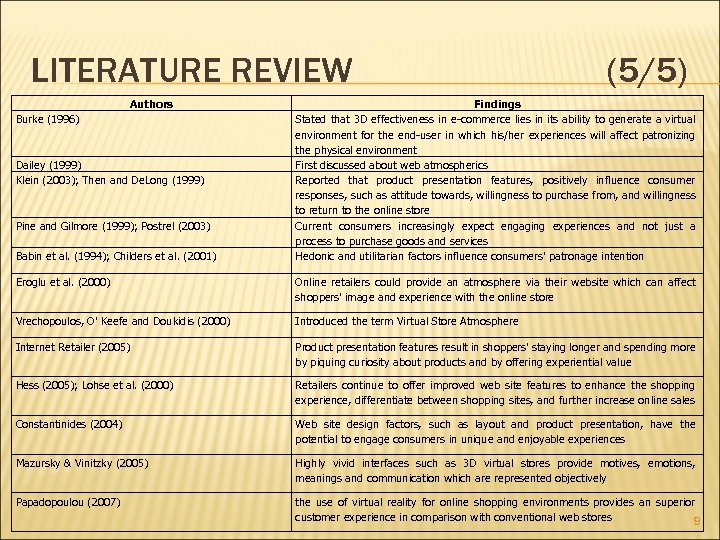 LITERATURE REVIEW Authors Burke (1996) Dailey (1999) Klein (2003); Then and De. Long (1999) Pine and Gilmore (1999); Postrel (2003) Babin et al. (1994); Childers et al. (2001) (5/5) Findings Stated that 3 D effectiveness in e-commerce lies in its ability to generate a virtual environment for the end-user in which his/her experiences will affect patronizing the physical environment First discussed about web atmospherics Reported that product presentation features, positively influence consumer responses, such as attitude towards, willingness to purchase from, and willingness to return to the online store Current consumers increasingly expect engaging experiences and not just a process to purchase goods and services Hedonic and utilitarian factors influence consumers’ patronage intention Eroglu et al. (2000) Online retailers could provide an atmosphere via their website which can affect shoppers’ image and experience with the online store Vrechopoulos, O’ Keefe and Doukidis (2000) Introduced the term Virtual Store Atmosphere Internet Retailer (2005) Product presentation features result in shoppers’ staying longer and spending more by piquing curiosity about products and by offering experiential value Hess (2005); Lohse et al. (2000) Retailers continue to offer improved web site features to enhance the shopping experience, differentiate between shopping sites, and further increase online sales Constantinides (2004) Web site design factors, such as layout and product presentation, have the potential to engage consumers in unique and enjoyable experiences Mazursky & Vinitzky (2005) Highly vivid interfaces such as 3 D virtual stores provide motives, emotions, meanings and communication which are represented objectively Papadopoulou (2007) the use of virtual reality for online shopping environments provides an superior customer experience in comparison with conventional web stores 9
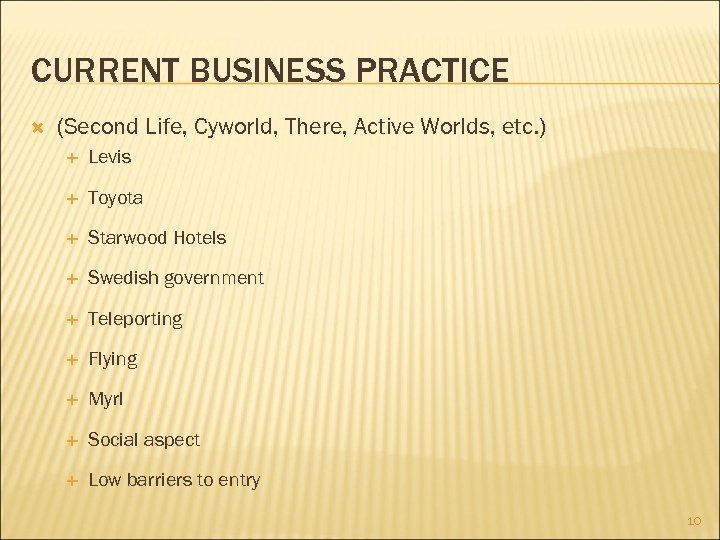 CURRENT BUSINESS PRACTICE (Second Life, Cyworld, There, Active Worlds, etc. ) Levis Toyota Starwood Hotels Swedish government Teleporting Flying Myrl Social aspect Low barriers to entry 10
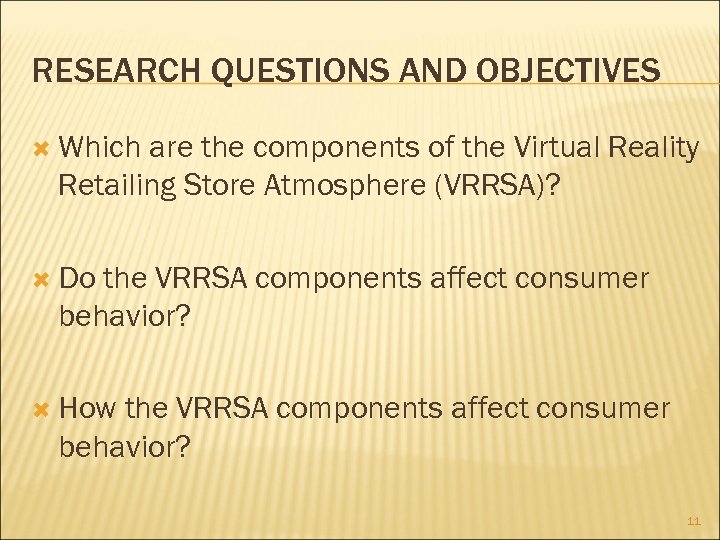 RESEARCH QUESTIONS AND OBJECTIVES Which are the components of the Virtual Reality Retailing Store Atmosphere (VRRSA)? Do the VRRSA components affect consumer behavior? How the VRRSA components affect consumer behavior? 11
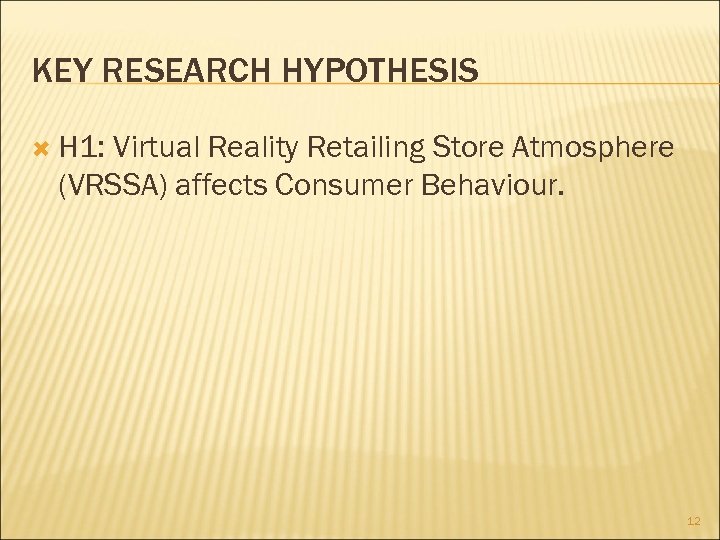 KEY RESEARCH HYPOTHESIS H 1: Virtual Reality Retailing Store Atmosphere (VRSSA) affects Consumer Behaviour. 12
 RESEARCH METHODOLOGY Literature review (emphasis on relevant empirical studies) Sector selection (e. g. clothing vs. tourism – virtual vs. “real” goods) Initial exploratory research Specific research hypotheses formulation Virtual reality retail store implementation Final conclusive causal research through lab experiment in the context of a virtual reality environment (e. g. Second Life) 13
 EXPECTED CONTRIBUTION Theoretical § Definition of VRRSA § Development of the VRRSA Components’ Theoretical Framework § Provide evidence regarding causal relationships between VRRSA components and Consumer Behaviour Managerial § Effective designing of VRR shopping environments (i. e. interfaces) towards meeting customer needs and preferences § Provision of guidelines regarding VRRSA customization in order to meet needs and preferences of different groups of individuals 14
 REFERENCES (1/2) Apostolou, K. , Koutsiouris, V. , & Vrechopoulos, A. (2008). Retail Store Atmosphere Effects on Consumer Behavior in the Context of Virtual Reality. 5 th Student Research Conference of Management Science and Technology, Athens, 8 May 2008 (in greek). Bitner, M. J. (1992). Servicescapes: the impact of physical surroundings on customers and employees. Journal of Marketing, 56(2), 57 -71. Booms, B. H. , & Bitner M. J. (1981). Marketing strategies and organization structures for service firms. In Donnelly JH George WR (Eds. ) Marketing of Services, American Marketing Association, Chicago IL: publisher, 47 -51. Boyd, G. , & Moersfelder, M. (2007). Global business in the metaverse: money laundering and securities fraud. The Sci. Tech Lawyer 3 (3), 4 -7. Burke, R. R. (1996). Virtual shopping: breakthrough in marketing research. Harvard Business Review, 74, 2, 120– 31. Dailey, L. C. (1999). Designing the World We Surf In: A Conceptual Model of Web Atmospherics. Chicago: American Marketing Association. Eroglu, S. A. , Machleit, K. A. , & Davis, L. M. (2000). Online Retail Atmospherics: Empirical Test of a Cue Typology. In J. R. Evans & B. Berman (Eds), Retailing 2000: launching the new millennium. Proceedings of the Sixth Triennial National Retailing Conference presented by the Academy of Marketing Science and the American Collegiate Retailing Association. 144 -150. Kotler, P. (1973 -4). Atmospherics as a Marketing Tool. Journal of Retailing, 49, 48 -63. Lewison, D. M. (1994). Retailing. 5 th edition. New York: Macmillan Publishing Company. Mazursky, D. , & Vinitzky, G. (2005). Modifying consumer search processes in enhanced on-line interfaces. Journal of Business Research, 58, 1299 – 1309. Mothersbaugh L. , Hawkins D. , Best R. . (2007). Consumer Behavior. Irwin Professional Pub 15
 REFERENCES (2/2) O’Reilly, T. (2006). What is Web 2. 0: Design Patterns and Business Models for the Next Generation of Software. O’Reilly website, 30 th September 2005. O’Reilly Media Inc. Available at: http: //www. oreillynet. com/pub/a/oreilly/tim/news/2005/09/30/whatis-Web-20. html Shin, H. D. (2008). Understanding purchasing behaviors in a virtual economy: Consumer behavior involving virtual currency in Web 2. 0 communities. Interacting with Computers, 20, 433 -446. Siomkos, G. , & Vrechopoulos, A. (2002). Strategic Marketing Planning for Competitive Advantage in Electronic Commerce. International Journal of Services Technology and Management, 3(1), 22 -38. The Economist (2006). Living a Second Life: Virtual economy. The Economist, 28 April, 2006. Vrechopoulos, P. A. , O’ Keefe, M. R. , & Doukidis, I. G. (2000). Virtual Store atmosphere in internet retailing. 13 th International Bled Electronic Commerce Conference Bled, Slovenia, June 19 -21. URL References: http: //www. secondlife. com http: //www. whyville. net/smmk/nice http: //play. toontown. com/web. Home. php http: //www. virtualworldsreview. com/soracity/ http: //www. myrl. com 16
 Thank you for your attention… QUESTIONS… 17