


 Скачать презентацию VIRTUAL ENTERPRISE NEW PARADIGM FOR MANUFACTURING SYSTEMS ENGINEERING
df96216c2bf2870066afa4324a8c4f6e.ppt
- Количество слайдов: 30
 VIRTUAL ENTERPRISE: NEW PARADIGM FOR MANUFACTURING SYSTEMS ENGINEERING Prof. Dr. Tibor Tóth Prof. Dr. Ferenc Erdélyi University of Miskolc Department of Information Engineering 2010. 0.
 Contents 1. Globalization 2. ICT (Information and Communication Technology) 3. Paradigms 4. Computer Integrated Manufacturing 5. Virtual Enterprise 6. VE characteristics 7. Architecture, functions, content, goal 8. Benefits 9. Infrastructure 10. Case study VIRTUAL ENTERPRISE 1.
 Globalization General environment for Virtual Organisations Globalization is an economic and social tendency of great importance, which has effect on the world as a whole. Globalization is an objective process the sources of which are to be searched in the objective tendencies of sciences, technologies, economy and world politics. The main benefit of globalization is that it provides opportunities for a faster development of relatively undeveloped countries. Economic organisations appearing on global market have been forced by globalisation to improve their competitiveness and innovation capabilities in a short while. The main disadvantage of globalization is the danger of the global extension of any local crisis symptoms. VIRTUAL ENTERPRISE 2.
 ICT Information and Communication Technology of primary importance for science, economy, and society One of the most important phenomena of globalized economy is the widespread application of new information and communication technologies in social, economical, technical and business processes. The implementation of world-wide computer network, the Internet has brought the vision of “information society” into a real closeness. The fast progress of Internet has resulted in a qualitative change in the environmental circumstances of economic processes: • The technical possibility of accessing information has been increased to a great extent; • Information is a fundamental value, which does not decrease proportionally when shared; • Political, management, business and technical decision making processes have drastically accelerated; • Cooperation and coordination between business partners have became fast and more effective even if they are at long distance. VIRTUAL ENTERPRISE 3.
 Paradigms Science does not progress via a linear accumulation of new knowledge, but undergoes periodic revolutions, also called "paradigm shifts". Thomas Kuhn (famous historian of science) Paradigm is a set of assumptions, concepts, values, and practices that constitutes a way of viewing reality for the community that shares them, especially in an intellectual discipline. Paradigm is a set of exemplary solution, expedient or experiments that are likely used, to be copied or emulated. In this scientific context, the prevailing paradigm often represents a more specific way of viewing reality, solving problems or limitations on acceptable tools and methods or systems for future applications. The traditional industrial management was based on the paradigm of the division of labour into areas of specialization and the domination of mass production. ICT progress has permitted of changing paradigm to CIM (Computer Integrated Manufacturing) and toward a lot of further new paradigms. VIRTUAL ENTERPRISE 4.
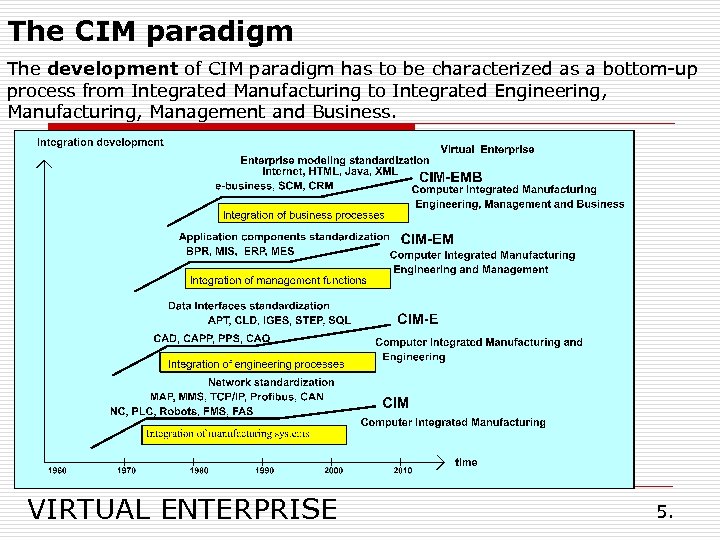 The CIM paradigm The development of CIM paradigm has to be characterized as a bottom-up process from Integrated Manufacturing to Integrated Engineering, Manufacturing, Management and Business. VIRTUAL ENTERPRISE 5.
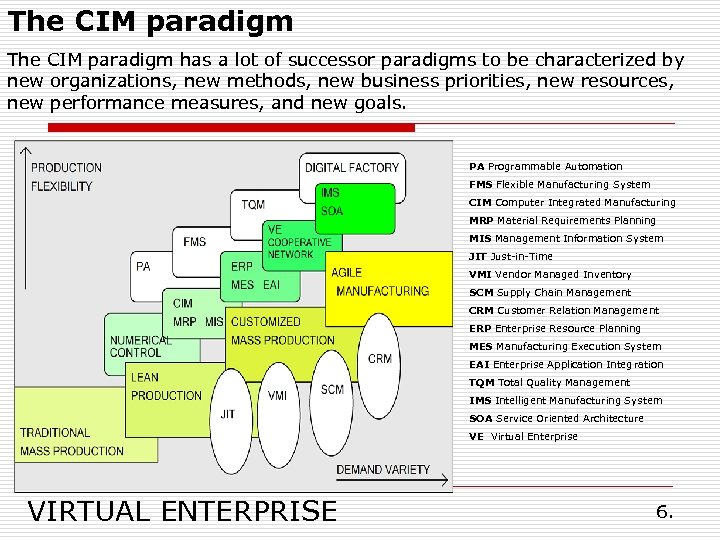 The CIM paradigm has a lot of successor paradigms to be characterized by new organizations, new methods, new business priorities, new resources, new performance measures, and new goals. PA Programmable Automation FMS Flexible Manufacturing System CIM Computer Integrated Manufacturing MRP Material Requirements Planning MIS Management Information System JIT Just-in-Time VMI Vendor Managed Inventory SCM Supply Chain Management CRM Customer Relation Management ERP Enterprise Resource Planning MES Manufacturing Execution System EAI Enterprise Application Integration TQM Total Quality Management IMS Intelligent Manufacturing System SOA Service Oriented Architecture VE Virtual Enterprise VIRTUAL ENTERPRISE 6.
 Virtual Enterprise There a lot of discussions regarding the definition of virtual enterprises International Association of Virtual Organizations A Virtual Enterprise (VE) is a temporary alliance of enterprises that come together to share skills or core competencies and resources in order to better respond to business opportunities, and whose cooperation is supported by computer networks. It is a manifestation of Collaborative and Distributed Working by computer network. Virtual Enterprise (VE) refers to a new organisational form characterised by a temporary or permanent collection of geographically dispersed individuals, groups or organisation departments not belonging to the same organisation – or entire organisations that are dependent on electronic communication for carrying out their operational processes. Virtual Enterprise is a dynamic alliance between organisations that bring in complementary competencies and resources and that are collectively available to each other, with the objective of delivering a product or service to the market as a collective. VIRTUAL ENTERPRISE 7.
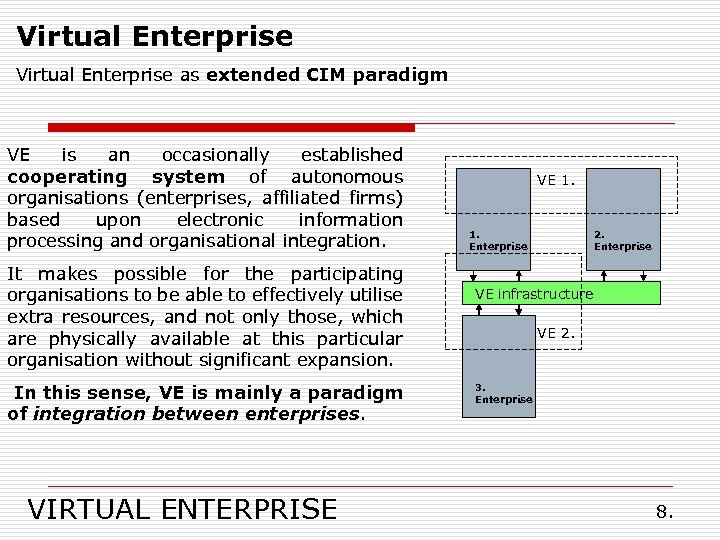 Virtual Enterprise as extended CIM paradigm VE is an occasionally established cooperating system of autonomous organisations (enterprises, affiliated firms) based upon electronic information processing and organisational integration. It makes possible for the participating organisations to be able to effectively utilise extra resources, and not only those, which are physically available at this particular organisation without significant expansion. In this sense, VE is mainly a paradigm of integration between enterprises. VIRTUAL ENTERPRISE VE 1. Enterprise 2. Enterprise VE infrastructure VE 2. 3. Enterprise 8.
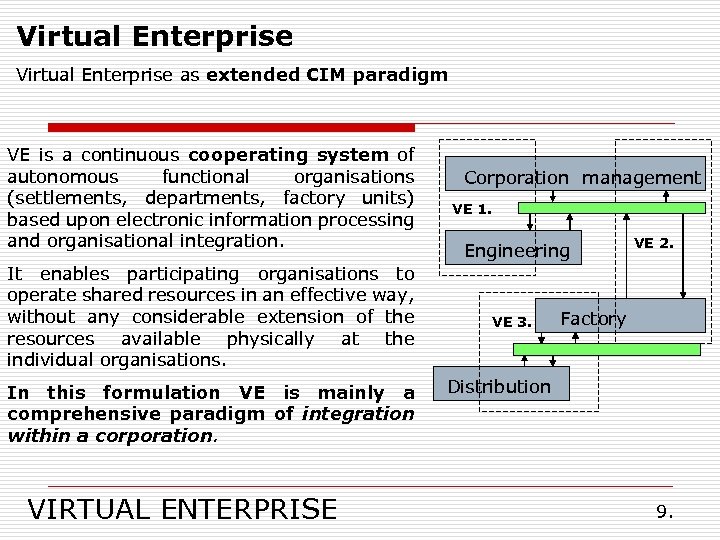 Virtual Enterprise as extended CIM paradigm VE is a continuous cooperating system of autonomous functional organisations (settlements, departments, factory units) based upon electronic information processing and organisational integration. It enables participating organisations to operate shared resources in an effective way, without any considerable extension of the resources available physically at the individual organisations. In this formulation VE is mainly a comprehensive paradigm of integration within a corporation. VIRTUAL ENTERPRISE Corporation management VE 1. Engineering VE 3. VE 2. Factory Distribution 9.
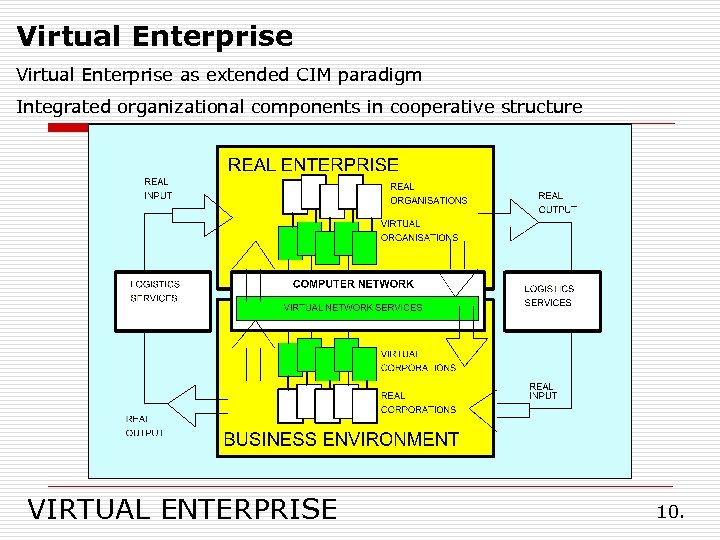 Virtual Enterprise as extended CIM paradigm Integrated organizational components in cooperative structure VIRTUAL ENTERPRISE 10.
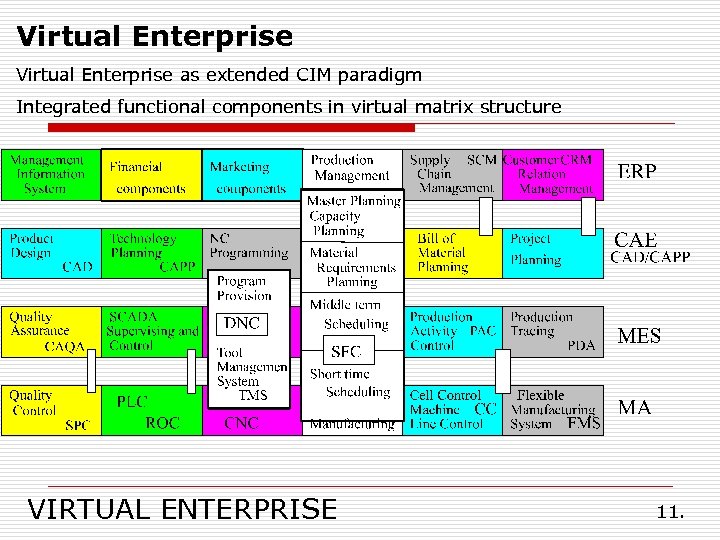 Virtual Enterprise as extended CIM paradigm Integrated functional components in virtual matrix structure VIRTUAL ENTERPRISE 11.
 VE characteristics Characteristics of VE are determined by the requirements of flexibility, adaptability, agility, cooperation and integration. Virtual Enterprise has several characteristics that distinguish it from a conventional one. The most unconventional characteristic is its virtuality. A Virtual Enterprise lacks many of the management and facility structures of a conventional business even if it can work like a conventional business. Another important characteristic is the adaptability of the enterprise activities; it must be able to change according to market and customer demands. VIRTUAL ENTERPRISE 12.
 VE characteristics Characteristics of VE are determined by the requirements of flexibility, adaptability, agility, cooperation and integration. Virtual Enterprise must be created for temporary alliance therefore it is cost effective. Investments in personnel and facilities are optimized. It evolves and dissolves over time. Virtual Enterprise forms in order to elaborate a project, and disbands when the project is complete. The use of ICT plays a vital role in the Virtual Enterprise. It is not limited geographically. Employees may be located anywhere in the world and still can support the organization effectively. Virtual Enterprise use ICT tools and methods, client workplaces, servers, data warehouse, cooperation platform, services and Internet protocol. VIRTUAL ENTERPRISE 13.
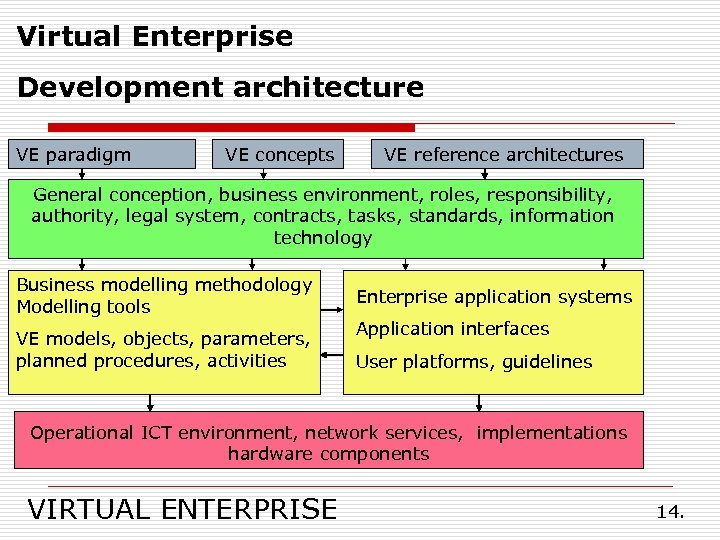 Virtual Enterprise Development architecture VE paradigm VE concepts VE reference architectures General conception, business environment, roles, responsibility, authority, legal system, contracts, tasks, standards, information technology Business modelling methodology Modelling tools VE models, objects, parameters, planned procedures, activities Enterprise application systems Application interfaces User platforms, guidelines Operational ICT environment, network services, implementations hardware components VIRTUAL ENTERPRISE 14.
 Virtual Enterprise Functions, contents, goals Cooperation among internal and external participants: Managers, designers, planners, dispatchers, operators, partners, suppliers, distributors, customers; VE functions support: • Dynamic grouping for cooperations • Knowledge sharing and collaborations • Work flow syncronisation (concurrent engineering) • Existence of organizational and geographic dividing • Different types of communication • All the kinds of group-work and undertaking of different roles • Exchange of information with different form as much as possible • Changing organizational frames and the different life-duration of groups • Determination of authority and responsibility • Measuring performance of work group • Reporting results and problems. VIRTUAL ENTERPRISE 15.
 Virtual Enterprise Functions, contents, goals Integration of business and technology processes, including all the connections with internal and external participants. Deeper knowing, modelling and harmonising the business processes, revising the goals, the constraints and formal objectives in order to create the conditions and framework for optimization. VE functions support: • Modelling business and technology processes • Using unified modelling tools • Creating semantically coherent business identities • Simulating systems and processes • Integration of existing working tools and working methods • Shared use of resources • Determination of authority and responsibility • Continuous exchange of data and messages • Assembling product from components. VIRTUAL ENTERPRISE 16.
 Virtual Enterprise Benefits Service sphere: More efficient customer relationships with expanded revenue opportunities: • The Virtual Enterprise enables multiple business entities to join together to offer consumers anywhere-anytime access to a variety of related services through one convenient portal. • The multiple entities may be completely independent businesses, such as airlines, hotels, and car rental companies on a travel Web site, or business segments of the same organization, such as banking and investment branches of financial services companies. VIRTUAL ENTERPRISE 17.
 Virtual Enterprise Benefits Government sphere: More efficient citizen relationships with faster and streamlined services and operations: • Diverse officies within federal, state, or local governments can integrate operations to make it easier and more efficient to deliver services to constituents. • Simplifying services delivery for multiple agencies in areas such as health and human services creates opportunities to simultaneously improve the user experience and control administrative costs. • The Virtual Enterprise can also serve to streamline IT and operational administration when multiple agencies are working together toward a common goal, for example, homeland security. VIRTUAL ENTERPRISE 18.
 Virtual Enterprise Benefits Manufacturing sphere: More efficient partner relationships • Being able to integrate supplier operations with manufacturers’ internal information systems creates new opportunities for cost efficiencies in areas such as inventory control. • A key materials supplier, for example, can access information about a customer’s supply of a particular material to schedule reordering and delivery at the optimal time. • Previously, this would have been done through an expensive proprietary electronic data interchange (EDI) network. But today’s services-oriented architectures (SOA) make it possible for systems to work together in the Virtual Enterprise through secure, flexible Web services. More efficient engineering area relationships: • VE integrates CAD-CAPP-PPC-CAM agents in the framework of concurrent engineering. VIRTUAL ENTERPRISE 19.
 Virtual Enterprise Benefits Improved customer service This business goal is top priority. Keeping the market and attracting new customers is a precondition of realization of every other business goal. This goal can only be obtained by means of guaranteed quality of products, meeting deadlines and product specifications, and offering a low price-level. Increasing revenue This business goal, at the level of production planning and control, requires continuous improvement and control of the macro-parameters of the socalled production triangle (readiness for delivery, stocks level, capacity utilization). Lowering working capital This goal can also be achieved by simultaneously and in a synchronized way improving the macro-parameters (production indices) of the production triangle. Meeting deadlines and minimizing the stocks level under reasonable constraints have a direct effect on working capital demand. VIRTUAL ENTERPRISE 20.
 Virtual Enterprise Benefits Managing fixed assets Utilization of the existing capacities invested in earlier is a fundamental condition to realize effective production capable of ensuring the profit expected. In case of well-proven products, successful accomplishment of the accepted external orders depends on, in most cases, the capacities available. Reducing operation costs Under the conditions of the prices agreed and fixed in contracts the net profit can mainly be influenced by decreasing the operation costs and lead times, as well as by optimal utilization of the resources (machines, workers, materials). Achieving higher level environment protection Total product life cycle management and reuse of unmaintanable or overtime devices and materials are the main industrial activities of sustainable development. VIRTUAL ENTERPRISE 21.
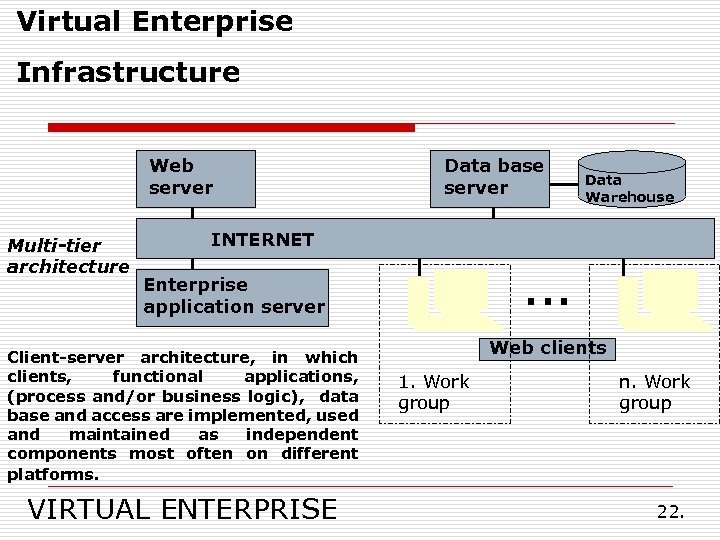 Virtual Enterprise Infrastructure Web server Multi-tier architecture Data base server INTERNET … Enterprise application server Client-server architecture, in which clients, functional applications, (process and/or business logic), data base and access are implemented, used and maintained as independent components most often on different platforms. VIRTUAL ENTERPRISE Data Warehouse Web clients 1. Work group n. Work group 22.
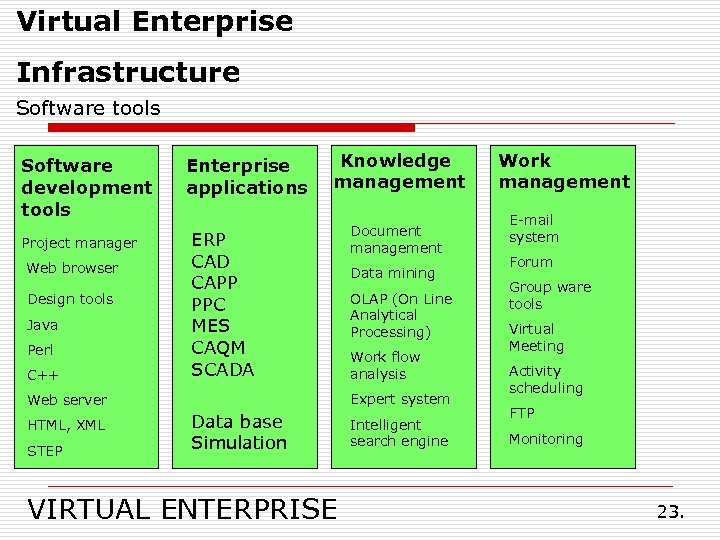 Virtual Enterprise Infrastructure Software tools Software development tools Project manager Web browser Design tools Java Perl C++ Enterprise applications Knowledge management ERP CAD CAPP PPC MES CAQM SCADA STEP Data mining OLAP (On Line Analytical Processing) Work flow analysis Expert system Web server HTML, XML Document management Data base Simulation VIRTUAL ENTERPRISE Intelligent search engine Work management E-mail system Forum Group ware tools Virtual Meeting Activity scheduling FTP Monitoring 23.
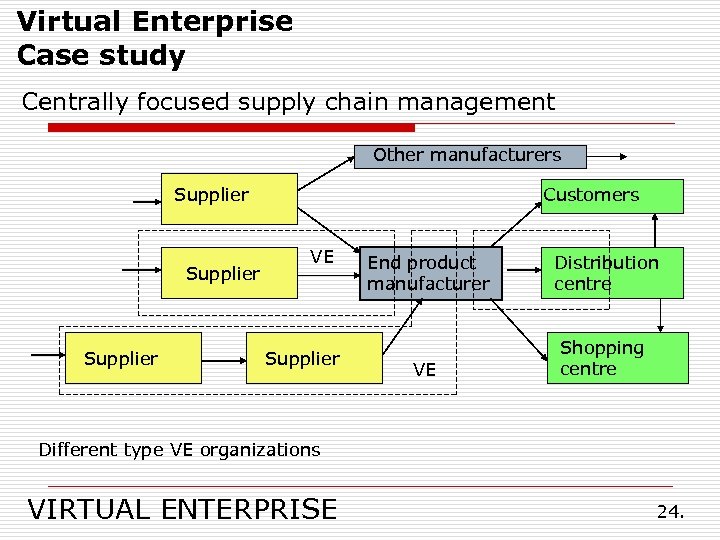 Virtual Enterprise Case study Centrally focused supply chain management Other manufacturers Supplier Customers VE Supplier End product manufacturer Distribution centre VE Shopping centre Different type VE organizations VIRTUAL ENTERPRISE 24.
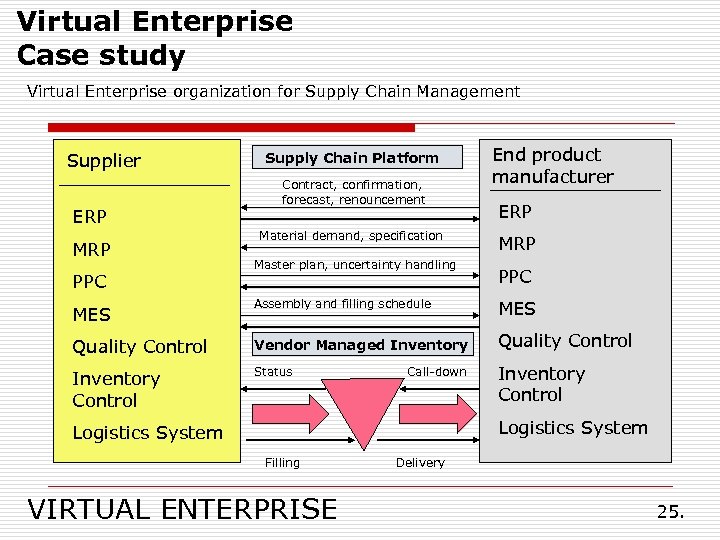 Virtual Enterprise Case study Virtual Enterprise organization for Supply Chain Management Supplier ERP MRP PPC Supply Chain Platform Contract, confirmation, forecast, renouncement Material demand, specification Master plan, uncertainty handling End product manufacturer ERP MRP PPC Assembly and filling schedule MES Quality Control Vendor Managed Inventory Quality Control Inventory Control Status MES Call-down Inventory Control Logistics System Filling VIRTUAL ENTERPRISE Delivery 25.
 Virtual Enterprise Standards Virtual Enterprise organisations demand the application of syntactic, semantic and pragmatic standards. • Syntactic standards enable sources to have similar formats (e. g. DXF, Java RMI, XML, Html, TCP/IP). • Semantic standards help using coherent models and applications (IDEF, UML, STEP). • Pragmatic standard enable business and engineering applications (ERP, CAD, CAPP, PPC, MES, SCM) to have harmonized or unified functions and services for optimized planning and control of business processes (eg. ISA 95). Life cycle of Virtual Enterprise has configuration, design, implementation, operation and disbandment phases. Life cycle can have several reconfiguration phases. VIRTUAL ENTERPRISE 26.
 Virtual Enterprise Conclusions Virtual Enterprise is a new paradigm to support building and operating temporary but closed co-operation between firms or organizations to achieve new business goals. It has been successfully used at the area of manufacturing and researching corporations as well as at the area of different organizations. Keywords that characterise this paradigm are as follows: coordination, cooperation, collaboration, (CCC) and integration with information and communication technology (ICT). CCC can appear between human users, software applications, as well as production and logistics system components. VIRTUAL ENTERPRISE 27.
 Virtual Enterprise Conclusions Virtual Enterprise is a new alternative way to differentiate and share resources, business operations and services under complex and dynamic conditions and requirements. Virtual Enterprise can permanently adapt to actual tasks, assumptions, real conditions and constraints. It can follow variable business policies and business priorities so that solutions satisfy multi objective features. The growing number of successfully virtualized companies shows that the main advantages such as high utilization rate, lower WIP level, instant reaction on needs and reduction in cost and delivery time make these companies stronger competitors in the global market. VIRTUAL ENTERPRISE 28.
 Virtual Enterprise Thank you for your kind attention! VIRTUAL ENTERPRISE 29.