 Скачать презентацию VIRTUAL ASTRONOMICAL OBSERVATORY Data Standards in Astronomy Dr
59dfef611acebcce8b70520ec1e76b37.ppt
- Количество слайдов: 14



VIRTUAL ASTRONOMICAL OBSERVATORY Data Standards in Astronomy Dr. Robert J. Hanisch Director, US Virtual Astronomical Observatory Space Telescope Science Institute Baltimore, MD R. J. Hanisch: Astronomy Data Standards CERN 7 Dec 2009 1
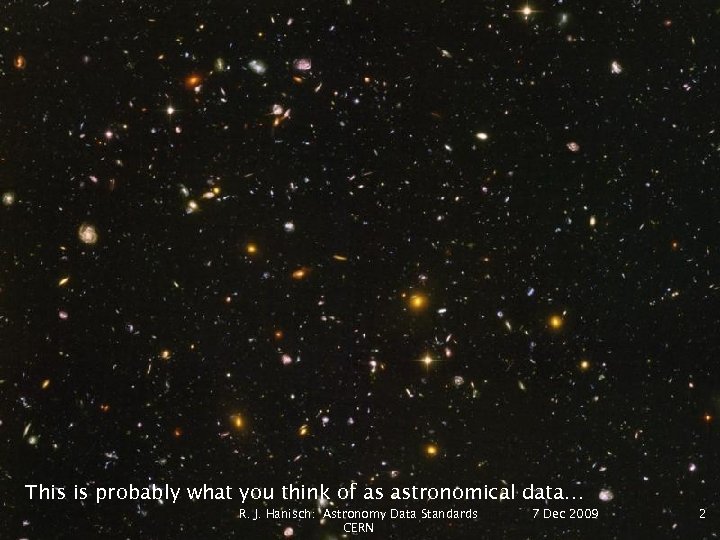
This is probably what you think of as astronomical data… R. J. Hanisch: Astronomy Data Standards CERN 7 Dec 2009 2

A variety of data types 1 -d, 2 -d, 3 -d: intensity/polarization vs. energy, time, position, velocity tables: catalogs, x-ray event lists, radio visibility measurements R. J. Hanisch: Astronomy Data Standards CERN 7 Dec 2009 3
Quantity and distribution • ~50 major data centers and observatories with substantial on-line data holdings • ~10, 000 data “resources” (catalogs, surveys, archives) • data centers host from a few to ~100 TB each, currently ~1 PB total • current growth rate ~0. 5 PB/yr, expected to increase soon • current request rate ~1 PB/yr • for Hubble Space Telescope, data retrievals are 3 X data ingest; papers based on archival data constitute 2/3 of refereed publications R. J. Hanisch: Astronomy Data Standards CERN 7 Dec 2009 4
Common data representations • Flexible Image Transport System – FITS – 25 -year heritage – Worldwide adoption for both archival and run-time applications – International review and endorsement, IAU – n-dim arrays, ASCII tables, binary tables, compound constructs – Simple syntax, limited semantics (primarily for coordinates) Examples: – Single image: 2 -dim array with coordinate system metadata – Multiple images: set of N 2 -dim arrays each with coordinate system metadata (sometimes called an “association”) – X-ray event list: binary table of photon arrival times, positions, and energies – Spectrum: 1 -dim array of fluxes with spectral dispersion metadata, or ASCII table of wavelengths, flux values, and flux uncertainties, or binary table of same – Data cube: 3 -dim stack of 2 -dim image planes (all share the same coordinate system metadata) with third axis R. J. Hanisch: 7 Dec 2009 representing velocity Astronomy Data Standards CERN 5
Common data representations • VOTable – XML-based standard for tabular data – Standard schema – Java, C++, and Perl software libraries – Complements FITS – Incorporates semantics Examples: – Object catalog: e. g. , positions, fluxes, and morphological measurements of galaxies – Result of database query: rows/columns that satisfy a constraint – Observation catalog: list of images taken with a particular instrument with pointing positions, image extents, bandpasses, etc. – Spectral energy distribution: composite “spectrum” based on both spectral and photometric measurements R. J. Hanisch: Astronomy Data Standards CERN 7 Dec 2009 6
Semantics • Unified Content Descriptors – A generic syntax and agreed-upon vocabulary for astronomical quantities – Derived from maintenance of thousands of astronomical catalogs, where many names used to represent the same quantities Examples: instr. bandpass, time. interval, stat. error; phot. flux. density; em • RDF/SKOS-based standard vocabulary • VOEvent – Standard representation of transient event (gamma ray burst, supernova, flaring star, discovery of solar system object, etc. ) – Represented as XML schema R. J. Hanisch: Astronomy Data Standards CERN 7 Dec 2009 7
Data discovery • Resource Metadata – Descriptions of data collections and the organizations responsible for them, data delivery services, computational services, software, etc. – Based on Dublin Core (library community standard) with astronomy-specific extensions – Represented as XML schema; extensible – Contents stored in Resource Registries that exchange metadata records through the Open Archives Initiative Protocol for Metadata Harvesting (OAI-PMH) • Space-Time Coordinates – Standard representations of locations of astronomical objects in space, wavelength (energy), and time – Represented as XML schema • Identifiers – Rules for constructing URIs for IVOA resources R. J. Hanisch: Astronomy Data Standards CERN 7 Dec 2009 8

Data access • Cone Search – Simplest possible astronomical query: return a list of objects or observations within a certain radius of a given position on the sky – Response is encoded as VOTable • Simple Image Access Protocol – Extends Cone Search to allow specification of image size – Response includes metadata about images, encoded as VOTable – Images are referenced by URL, delivered as FITS for analysis or GIF/JPG, etc. , for embedded display • Simple Spectrum Access Protocol – Astronomical spectra have more subtleties and variations in representation than images access protocol is more complicated – Query supports more qualifiers and response adds more metadata, again encoded as VOTable – Spectra referenced by URL or encoded in-line in the VOTable R. J. Hanisch: Astronomy Data Standards CERN 7 Dec 2009 9
Data access • Astronomical Data Query Language – Standard grammar for database queries – Core SQL functions plus astronomy-specific extensions – String and XML representations • Open. Sky. Node Table Access Protocol – – Standard interface wrapper for relational databases Accepts ADQL or parameterized query “Full” Sky. Nodes support positional cross-match function Open. Sky. Query portal provides users with interface for understanding database structure and contents and for constructing queries – TAP implementations in progress, will supercede Sky. Nodes R. J. Hanisch: Astronomy Data Standards CERN 7 Dec 2009 10

The International Virtual Observatory Alliance • IVOA began in June 2002 http: //ivoa. net – Self-organizing – No funds of its own, no dues; relies 100% on project participation – Rotating chair (18 -month term) • IVOA now has 17 member projects – Aggregate funding ~$50 M (sinception) – Projects range from 2 -3 people to ~20 FTE • Forum for discussion and sharing of experience • Twice per year “Interoperability” workshops bring together ~100 participants • Adopted a standards process based on W 3 C – – Note Working Draft Proposed Recommendation IAU endorsement See http: //ivoa. net/Documents/ R. J. Hanisch: Astronomy Data Standards CERN 7 Dec 2009 11
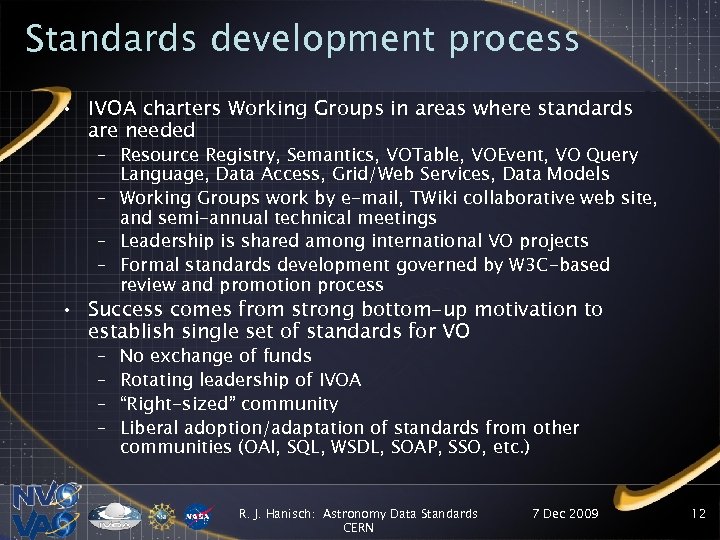
Standards development process • IVOA charters Working Groups in areas where standards are needed – Resource Registry, Semantics, VOTable, VOEvent, VO Query Language, Data Access, Grid/Web Services, Data Models – Working Groups work by e-mail, TWiki collaborative web site, and semi-annual technical meetings – Leadership is shared among international VO projects – Formal standards development governed by W 3 C-based review and promotion process • Success comes from strong bottom-up motivation to establish single set of standards for VO – – No exchange of funds Rotating leadership of IVOA “Right-sized” community Liberal adoption/adaptation of standards from other communities (OAI, SQL, WSDL, SOAP, SSO, etc. ) R. J. Hanisch: Astronomy Data Standards CERN 7 Dec 2009 12

IVOA documents R. J. Hanisch: Astronomy Data Standards CERN 7 Dec 2009 13

What does this cost? • Data management activities at major astronomy facilities are typically 3 -5% of annual operating budget, including h/w, s/w, and staff. Staff accounts for ~85% of total. • VO development and operations are ~20% additional to baseline data management costs (international aggregate) R. J. Hanisch: Astronomy Data Standards CERN 7 Dec 2009 14
Скачать презентацию VIRTUAL ASTRONOMICAL OBSERVATORY Data Standards in Astronomy Dr
59dfef611acebcce8b70520ec1e76b37.ppt