


 Скачать презентацию Virgo commissioning update VSR 1 first month summary
e891186e0fb8fe61ed40f4a178643227.ppt
- Количество слайдов: 28
 Virgo commissioning update VSR 1 first month summary E. Tournefier WG 1 meeting, Cascina June 20 th , 2007
 Activities since last WG 1 meeting (March 28 th) • Virgo complete electrical shutdown (April 6 th -> 18 th) Infrastructure works: – Electrical works: UPS replacement, reorganisation, … – Computing: civil work, re-organisation, new file server, … Detector improvements - Acoustic enclosure around external detection bench - Replacement of Brewster window with a larger one Restart went ok: ITF relocked within ~2 days • 1 month of commissioning before the run – Acoustic enclosures at end benches – Diffused light investigations + some noise reduction – Improvements of controls (longitudinal, angular, suspensions) – Change of naming convention (V 1: channel_name)for easier data exchange with LSC • VSR 1 started on May 18 th as planned – Short commissioning breaks for improvements / problem fixing
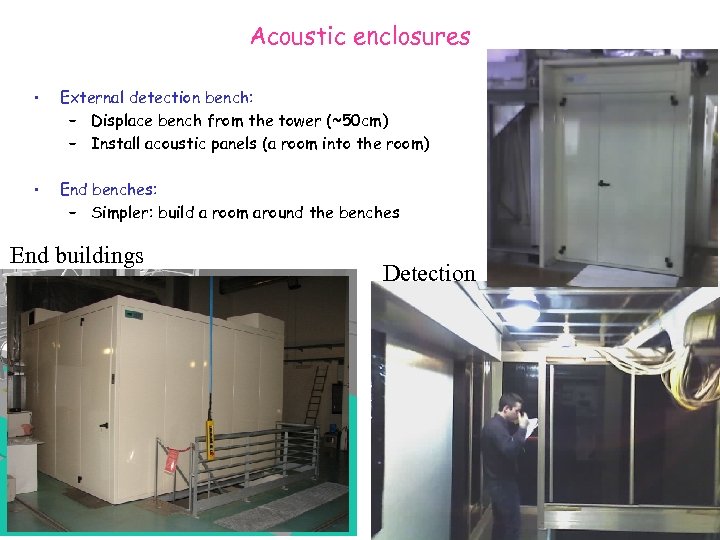 Acoustic enclosures • External detection bench: – Displace bench from the tower (~50 cm) – Install acoustic panels (a room into the room) • End benches: – Simpler: build a room around the benches End buildings Detection
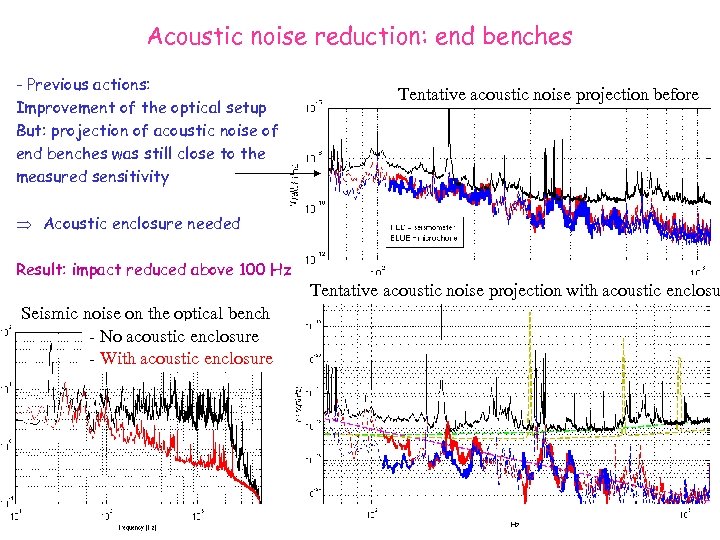 Acoustic noise reduction: end benches - Previous actions: Improvement of the optical setup But: projection of acoustic noise of end benches was still close to the measured sensitivity Tentative acoustic noise projection before Þ Acoustic enclosure needed Result: impact reduced above 100 Hz Tentative acoustic noise projection with acoustic enclosu Seismic noise on the optical bench - No acoustic enclosure - With acoustic enclosure
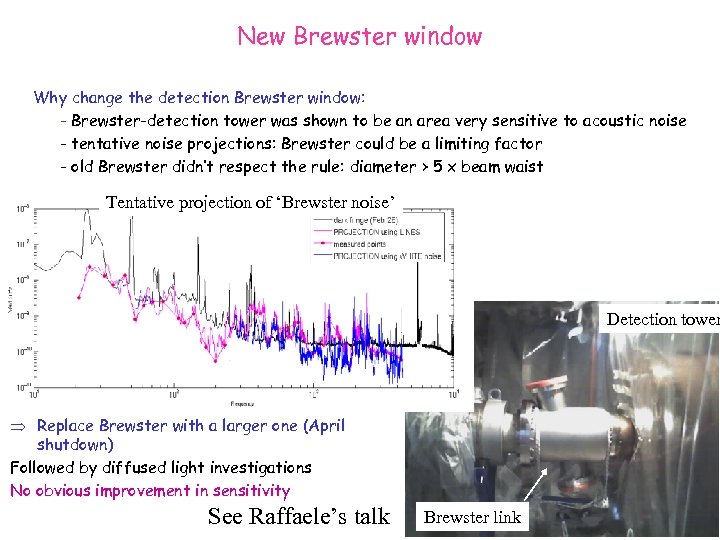 New Brewster window Why change the detection Brewster window: - Brewster-detection tower was shown to be an area very sensitive to acoustic noise - tentative noise projections: Brewster could be a limiting factor - old Brewster didn’t respect the rule: diameter > 5 x beam waist Tentative projection of ‘Brewster noise’ Detection tower Þ Replace Brewster with a larger one (April shutdown) Followed by diffused light investigations No obvious improvement in sensitivity See Raffaele’s talk Brewster link
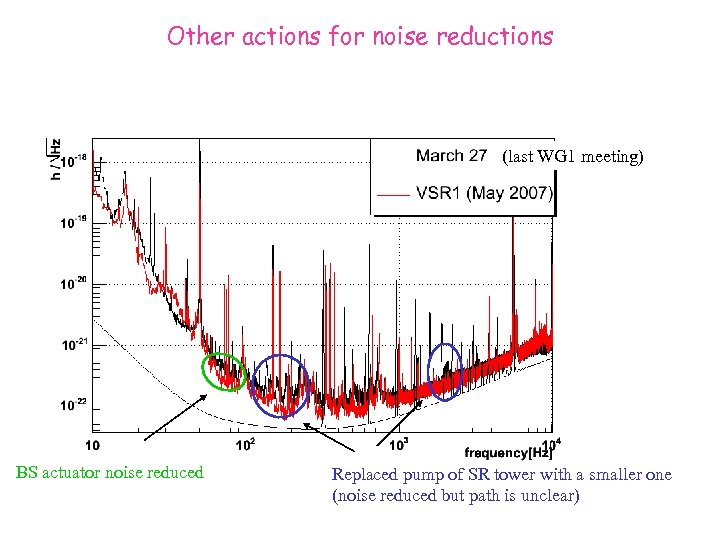 Other actions for noise reductions (last WG 1 meeting) BS actuator noise reduced Replaced pump of SR tower with a smaller one (noise reduced but path is unclear)
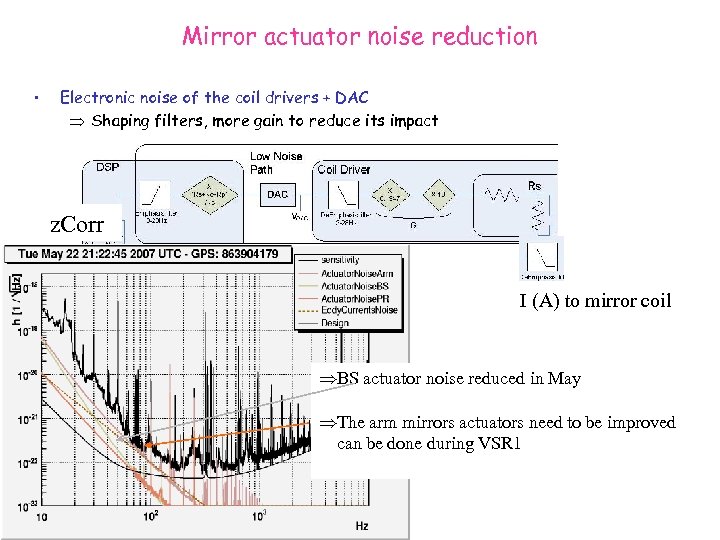 Mirror actuator noise reduction • Electronic noise of the coil drivers + DAC Þ Shaping filters, more gain to reduce its impact z. Corr I (A) to mirror coil ÞBS actuator noise reduced in May ÞThe arm mirrors actuators need to be improved can be done during VSR 1
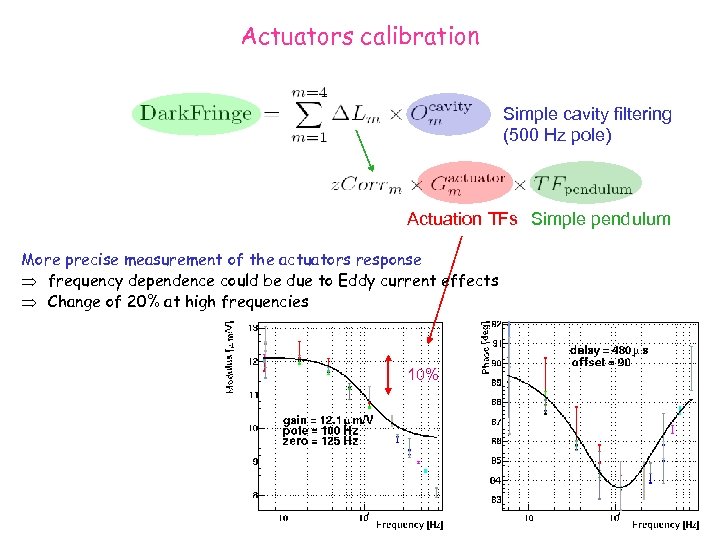 Actuators calibration Simple cavity filtering (500 Hz pole) Actuation TFs Simple pendulum More precise measurement of the actuators response Þ frequency dependence could be due to Eddy current effects Þ Change of 20% at high frequencies 10%
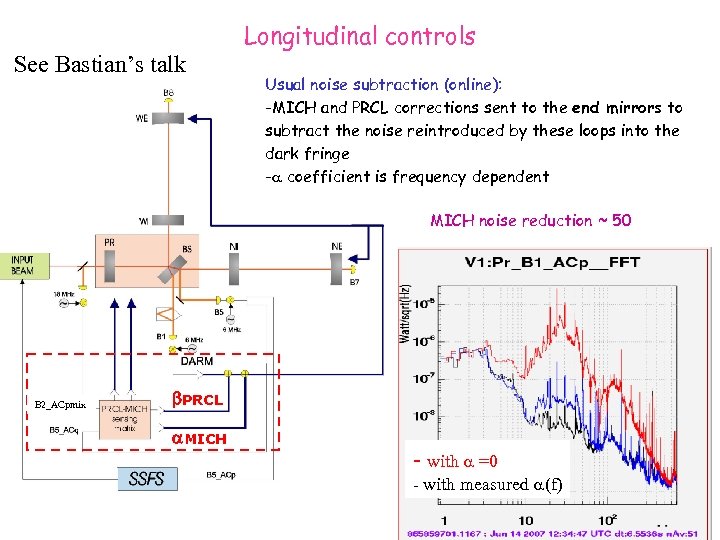 See Bastian’s talk Longitudinal controls Usual noise subtraction (online): -MICH and PRCL corrections sent to the end mirrors to subtract the noise reintroduced by these loops into the dark fringe - coefficient is frequency dependent MICH noise reduction ~ 50 B 2_ACpmix PRCL MICH - with =0 - with measured (f)
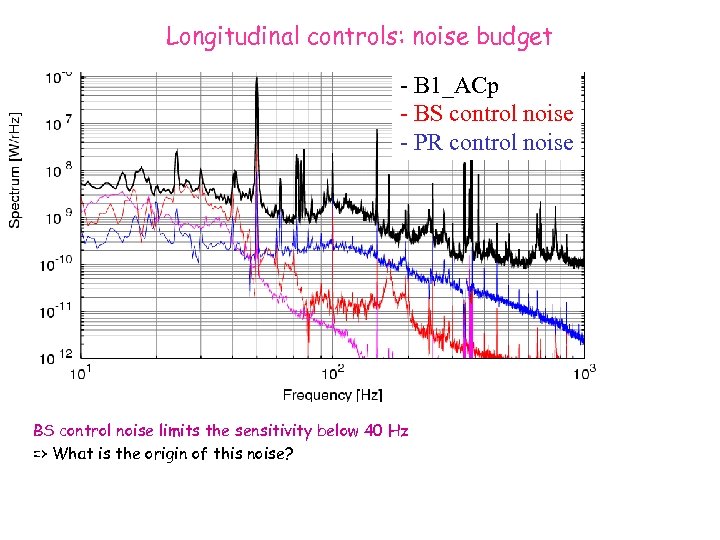 Longitudinal controls: noise budget - B 1_ACp - BS control noise - PR control noise BS control noise limits the sensitivity below 40 Hz => What is the origin of this noise?
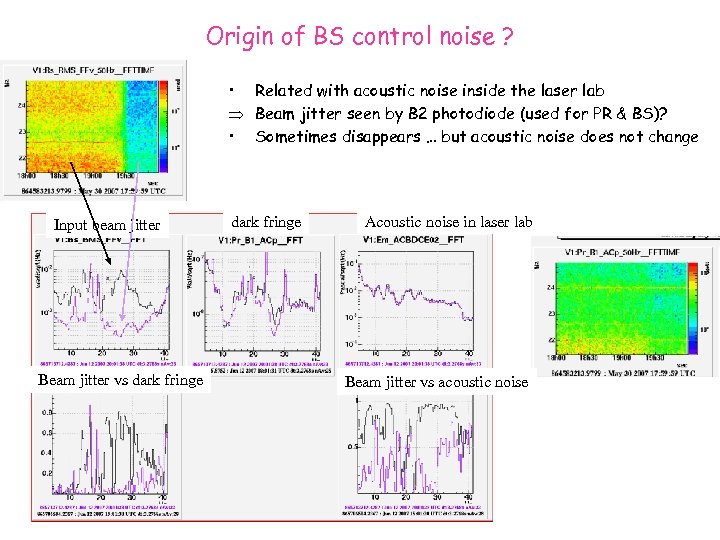 Origin of BS control noise ? • Related with acoustic noise inside the laser lab Þ Beam jitter seen by B 2 photodiode (used for PR & BS)? • Sometimes disappears … but acoustic noise does not change Input beam jitter Beam jitter vs dark fringe Acoustic noise in laser lab Beam jitter vs acoustic noise
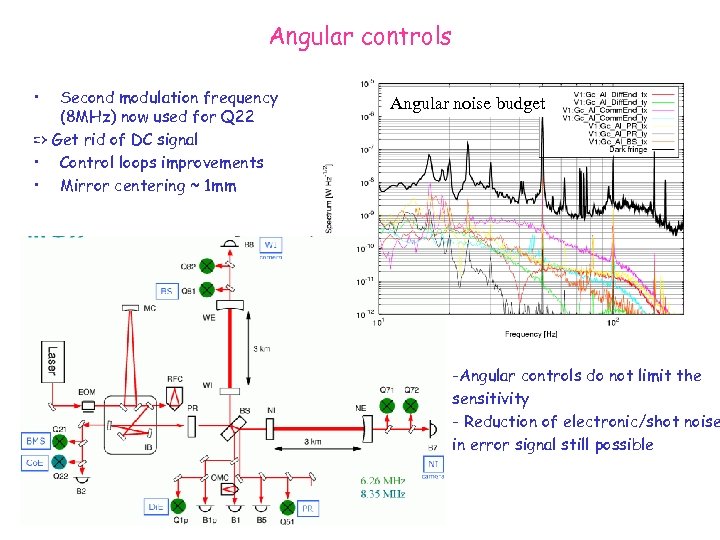 Angular controls • Second modulation frequency (8 MHz) now used for Q 22 => Get rid of DC signal • Control loops improvements • Mirror centering ~ 1 mm Angular noise budget -Angular controls do not limit the sensitivity - Reduction of electronic/shot noise in error signal still possible
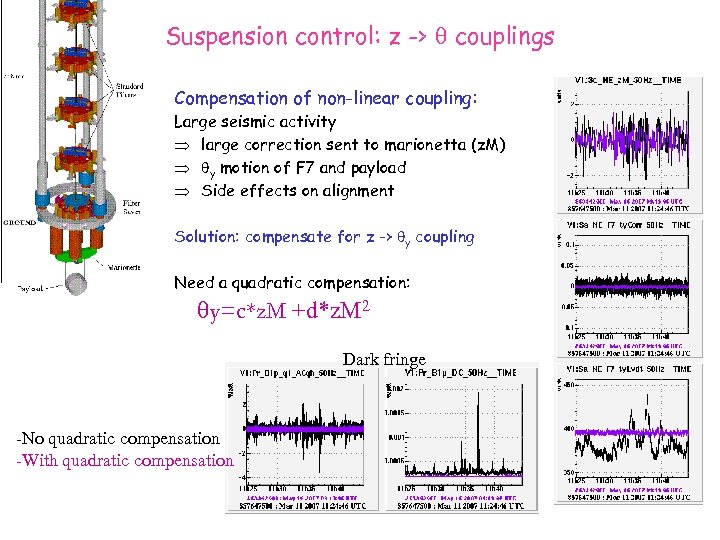 Suspension control: z -> couplings Compensation of non-linear coupling: Large seismic activity Þ large correction sent to marionetta (z. M) Þ y motion of F 7 and payload Þ Side effects on alignment Solution: compensate for z -> y coupling Need a quadratic compensation: y=c*z. M +d*z. M 2 Dark fringe -No quadratic compensation -With quadratic compensation
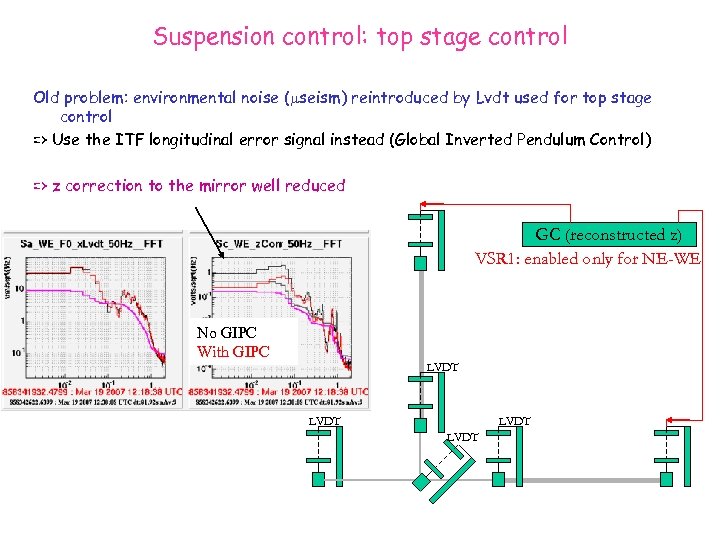 Suspension control: top stage control Old problem: environmental noise ( seism) reintroduced by Lvdt used for top stage control => Use the ITF longitudinal error signal instead (Global Inverted Pendulum Control) => z correction to the mirror well reduced GC (reconstructed z) VSR 1: enabled only for NE-WE No GIPC With GIPC LVDT
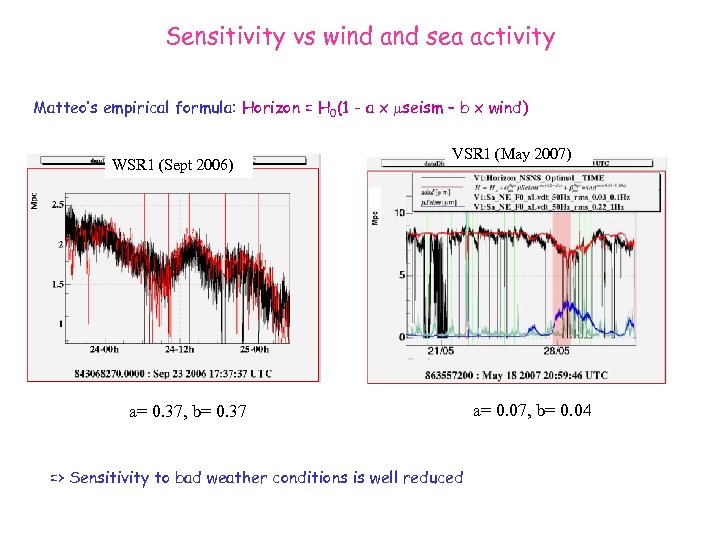 Sensitivity vs wind and sea activity Matteo’s empirical formula: Horizon = H 0(1 - a x seism – b x wind) WSR 1 (Sept 2006) VSR 1 (May 2007) a= 0. 37, b= 0. 37 => Sensitivity to bad weather conditions is well reduced a= 0. 07, b= 0. 04
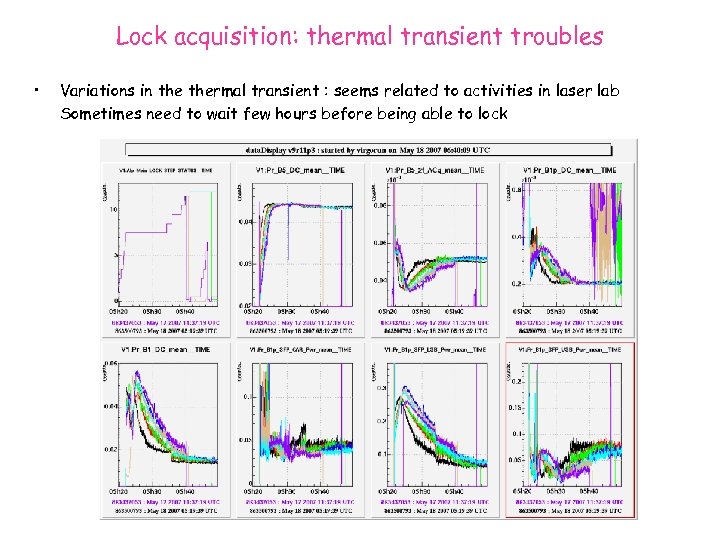 Lock acquisition: thermal transient troubles • Variations in thermal transient : seems related to activities in laser lab Sometimes need to wait few hours before being able to lock
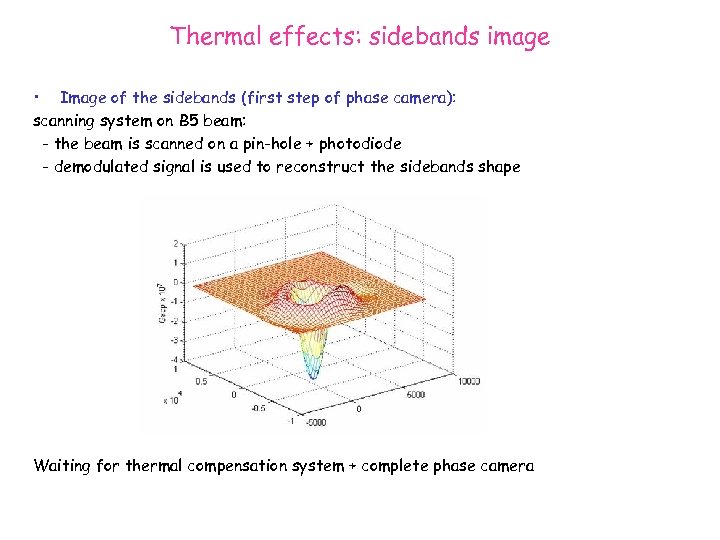 Thermal effects: sidebands image • Image of the sidebands (first step of phase camera): scanning system on B 5 beam: - the beam is scanned on a pin-hole + photodiode - demodulated signal is used to reconstruct the sidebands shape Waiting for thermal compensation system + complete phase camera
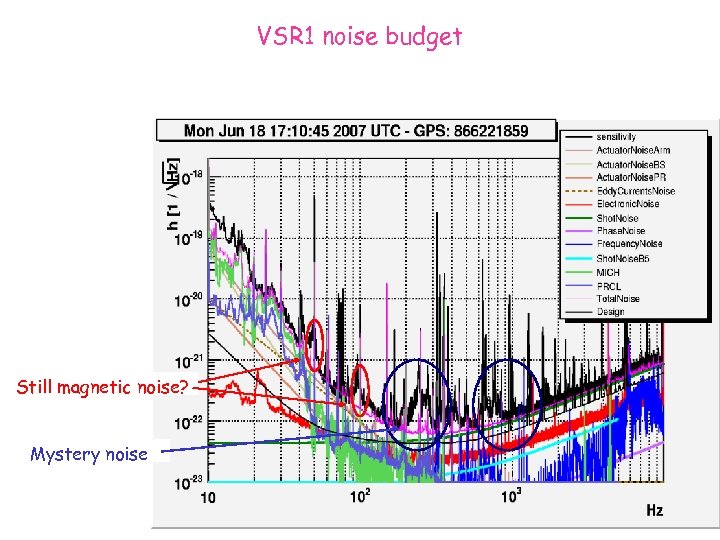 VSR 1 noise budget Still magnetic noise? Mystery noise
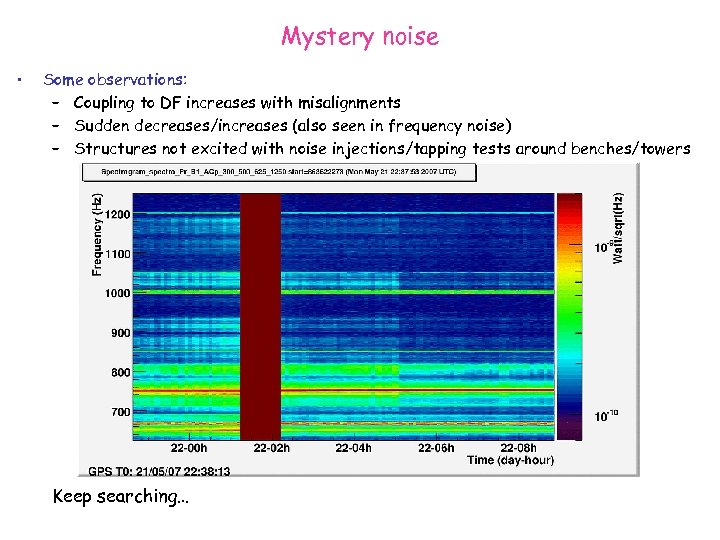 Mystery noise • Some observations: – Coupling to DF increases with misalignments – Sudden decreases/increases (also seen in frequency noise) – Structures not excited with noise injections/tapping tests around benches/towers Keep searching…
 VSR 1: first month summary Thanks to Roberto for the material
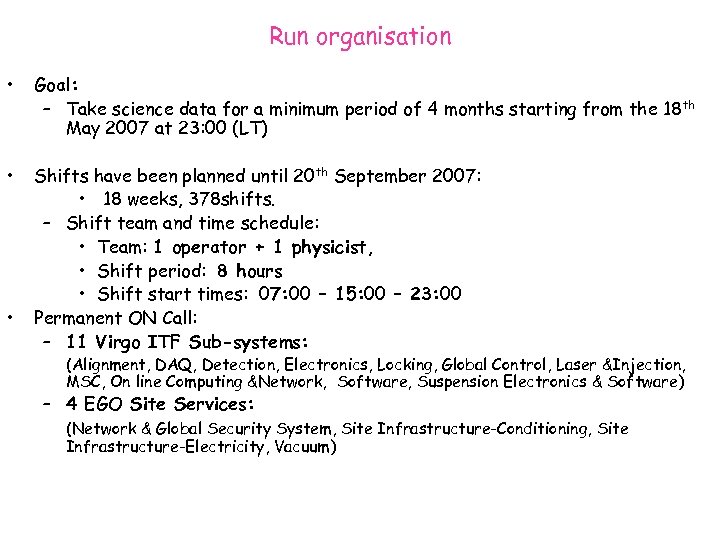 Run organisation • Goal: – Take science data for a minimum period of 4 months starting from the 18 th May 2007 at 23: 00 (LT) • Shifts have been planned until 20 th September 2007: • 18 weeks, 378 shifts. – Shift team and time schedule: • Team: 1 operator + 1 physicist, • Shift period: 8 hours • Shift start times: 07: 00 – 15: 00 – 23: 00 Permanent ON Call: – 11 Virgo ITF Sub-systems: • (Alignment, DAQ, Detection, Electronics, Locking, Global Control, Laser &Injection, MSC, On line Computing &Network, Software, Suspension Electronics & Software) – 4 EGO Site Services: (Network & Global Security System, Site Infrastructure-Conditioning, Site Infrastructure-Electricity, Vacuum)
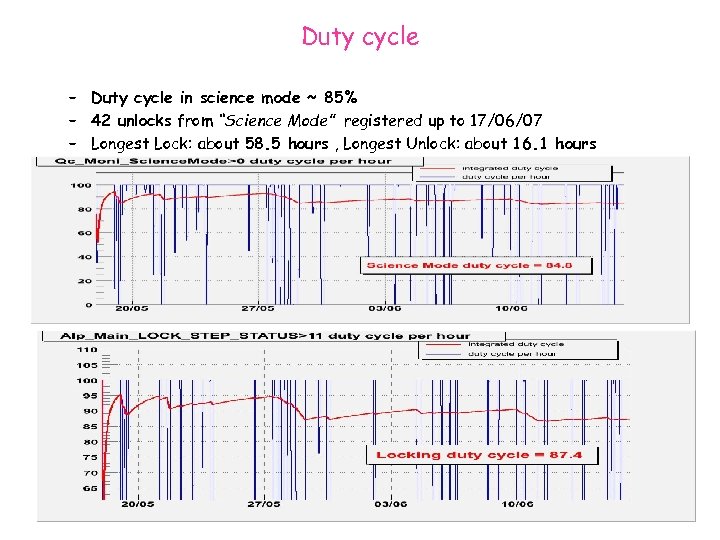 Duty cycle – Duty cycle in science mode ~ 85% – 42 unlocks from “Science Mode” registered up to 17/06/07 – Longest Lock: about 58. 5 hours , Longest Unlock: about 16. 1 hours
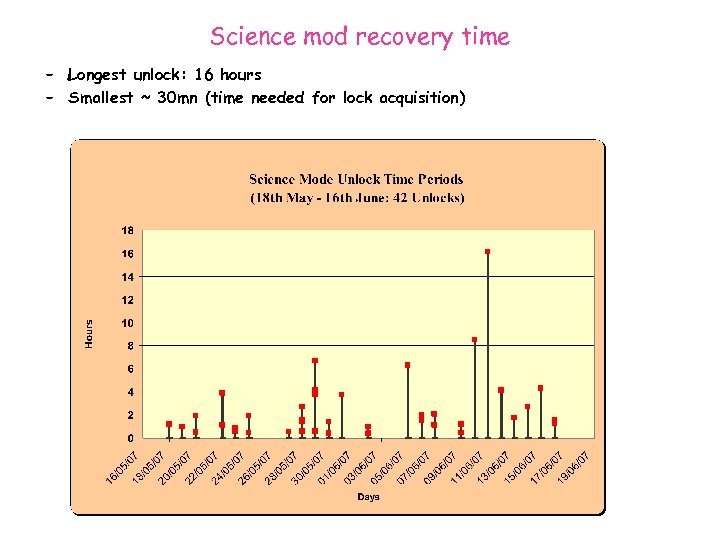 Science mod recovery time – Longest unlock: 16 hours – Smallest ~ 30 mn (time needed for lock acquisition)
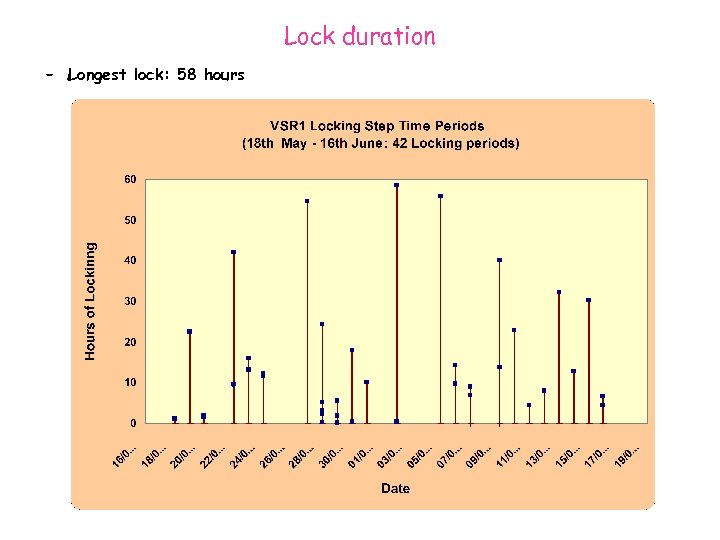 Lock duration – Longest lock: 58 hours
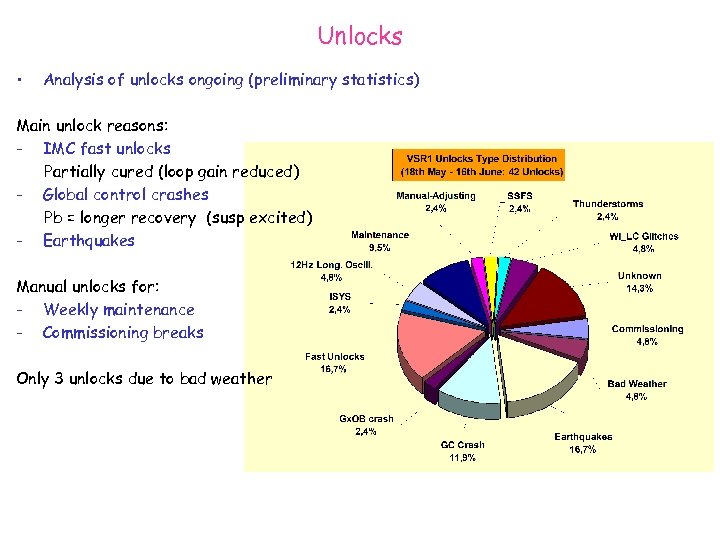 Unlocks • Analysis of unlocks ongoing (preliminary statistics) Main unlock reasons: - IMC fast unlocks Partially cured (loop gain reduced) - Global control crashes Pb = longer recovery (susp excited) - Earthquakes Manual unlocks for: - Weekly maintenance - Commissioning breaks Only 3 unlocks due to bad weather
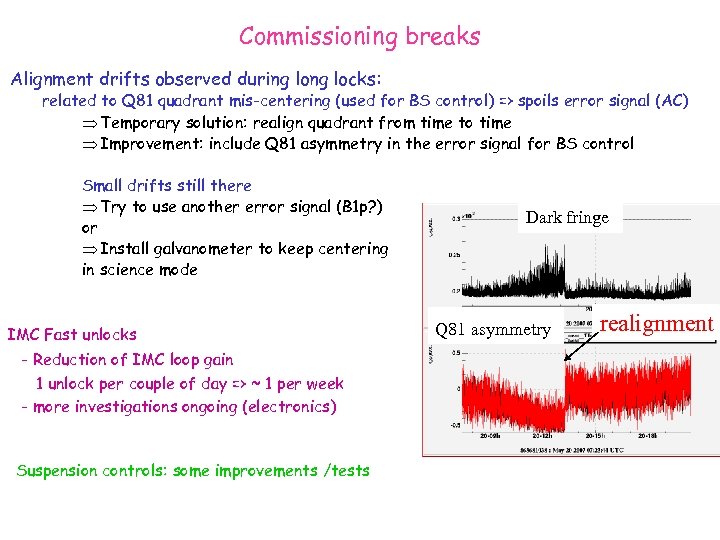 Commissioning breaks Alignment drifts observed during locks: related to Q 81 quadrant mis-centering (used for BS control) => spoils error signal (AC) Þ Temporary solution: realign quadrant from time to time Þ Improvement: include Q 81 asymmetry in the error signal for BS control Small drifts still there Þ Try to use another error signal (B 1 p? ) or Þ Install galvanometer to keep centering in science mode IMC Fast unlocks - Reduction of IMC loop gain 1 unlock per couple of day => ~ 1 per week - more investigations ongoing (electronics) Suspension controls: some improvements /tests Dark fringe Q 81 asymmetry realignment
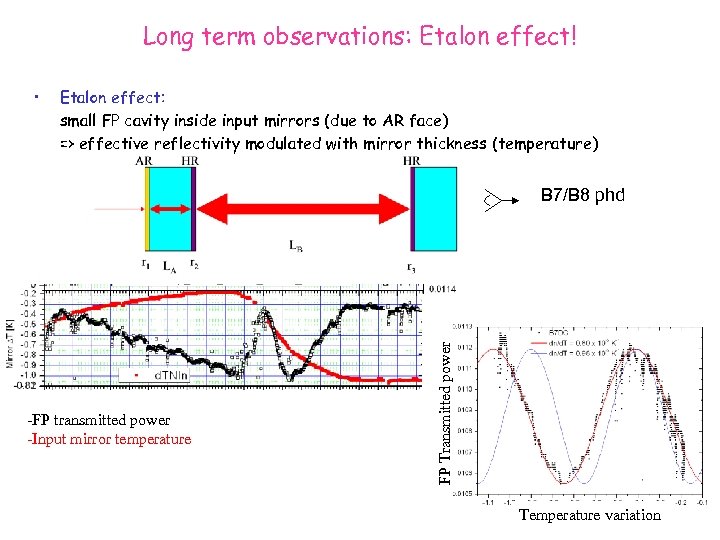 Long term observations: Etalon effect! • Etalon effect: small FP cavity inside input mirrors (due to AR face) => effective reflectivity modulated with mirror thickness (temperature) -FP transmitted power -Input mirror temperature FP Transmitted power B 7/B 8 phd Temperature variation
 Some short term plans • Continue noise investigations – ‘Mystery noise’ ( 200 Hz) – Magnetic noise (50 - 100 Hz) – Low frequency noise in laser lab (=> BS error signal) – Reduce mirror actuator noise (cavity mirrors) • Controls: – Alignment drifts: get rid of Q 81 or use galvanometer – Suspension control improvements in preparation