


 Скачать презентацию Virginia Woolf 1882 -1941 Compact Performer — Culture
7090e616938a08dfdbbb179e1749f634.ppt
- Количество слайдов: 17
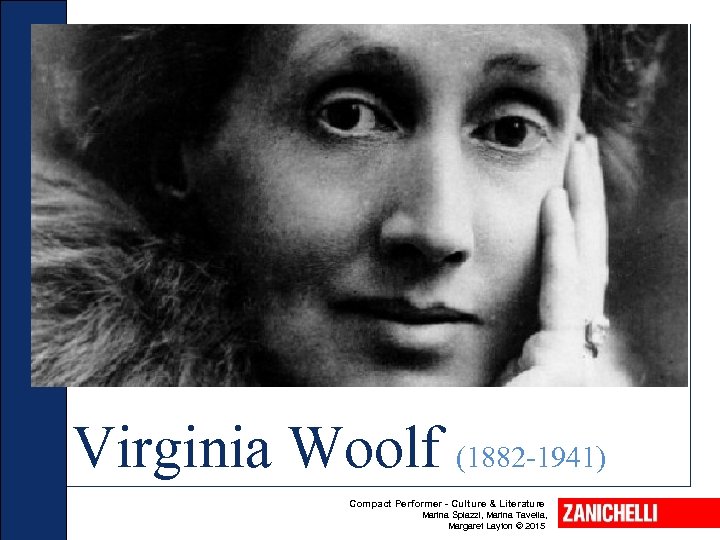 Virginia Woolf (1882 -1941) Compact Performer - Culture & Literature Marina Spiazzi, Marina Tavella, Margaret Layton © 2015
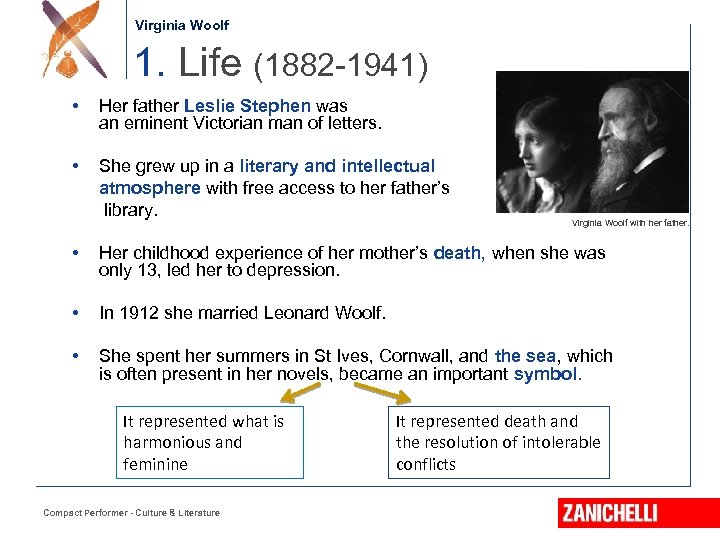 Jonathan Swift Virginia Woolf 1. Life (1882 -1941) • Her father Leslie Stephen was an eminent Victorian man of letters. • She grew up in a literary and intellectual atmosphere with free access to her father’s library. Virginia Woolf with her father. • Her childhood experience of her mother’s death, when she was only 13, led her to depression. • In 1912 she married Leonard Woolf. • She spent her summers in St Ives, Cornwall, and the sea, which is often present in her novels, became an important symbol. It represented what is harmonious and feminine Compact Performer - Culture & Literature It represented death and the resolution of intolerable conflicts
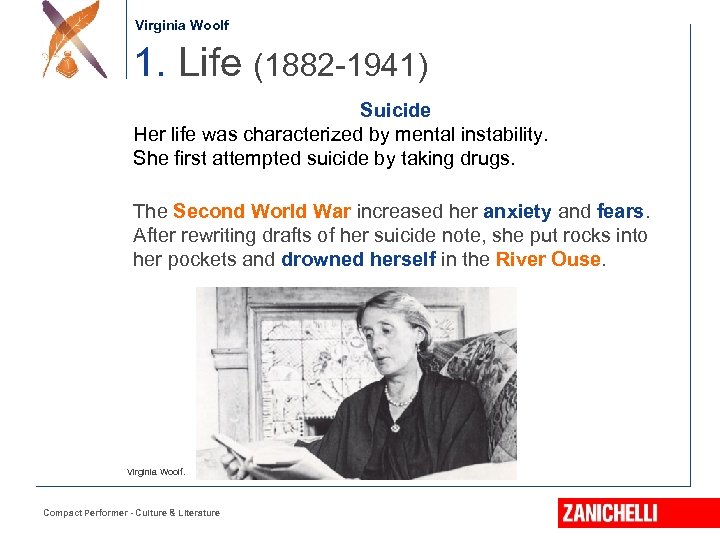 Jonathan Swift Virginia Woolf 1. Life (1882 -1941) Suicide Her life was characterized by mental instability. She first attempted suicide by taking drugs. The Second World War increased her anxiety and fears. After rewriting drafts of her suicide note, she put rocks into her pockets and drowned herself in the River Ouse. Virginia Woolf. Compact Performer - Culture & Literature
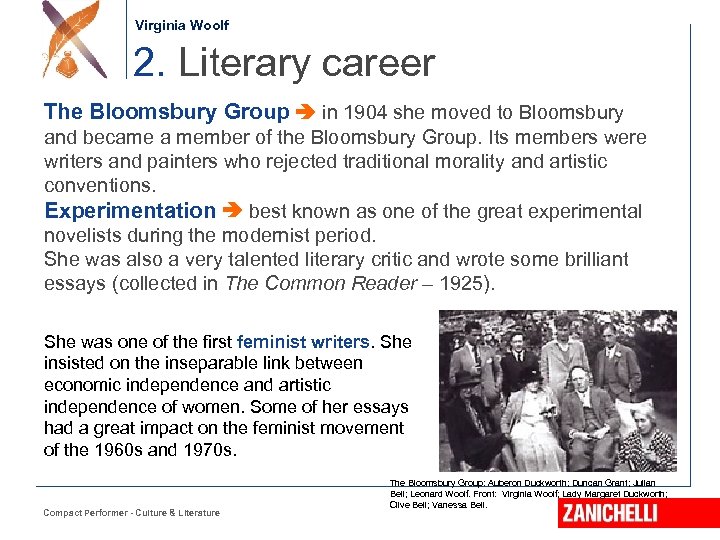 Jonathan Swift Virginia Woolf 2. Literary career The Bloomsbury Group in 1904 she moved to Bloomsbury and became a member of the Bloomsbury Group. Its members were writers and painters who rejected traditional morality and artistic conventions. Experimentation best known as one of the great experimental novelists during the modernist period. She was also a very talented literary critic and wrote some brilliant essays (collected in The Common Reader – 1925). She was one of the first feminist writers. She insisted on the inseparable link between economic independence and artistic independence of women. Some of her essays had a great impact on the feminist movement of the 1960 s and 1970 s. Compact Performer - Culture & Literature The Bloomsbury Group: Auberon Duckworth; Duncan Grant; Julian Bell; Leonard Woolf. Front: Virginia Woolf; Lady Margaret Duckworth; Clive Bell; Vanessa Bell.
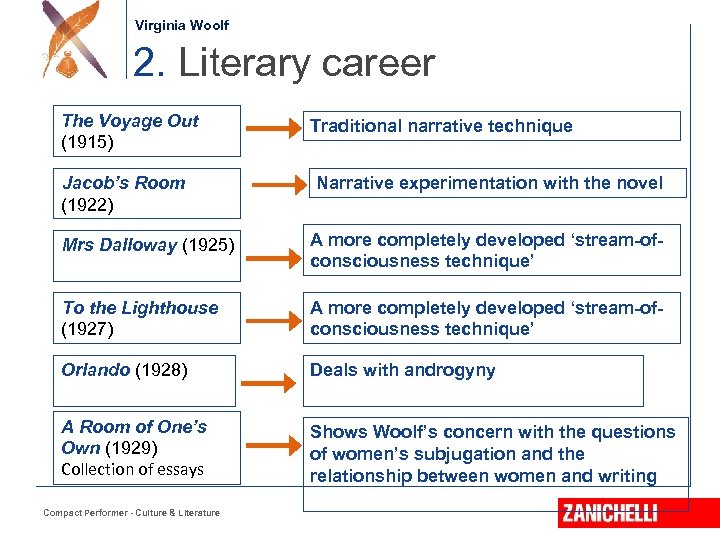 Jonathan Swift Virginia Woolf 2. Literary career The Voyage Out (1915) Jacob’s Room (1922) Traditional narrative technique Narrative experimentation with the novel Mrs Dalloway (1925) A more completely developed ‘stream-ofconsciousness technique’ To the Lighthouse (1927) A more completely developed ‘stream-ofconsciousness technique’ Orlando (1928) Deals with androgyny A Room of One’s Own (1929) Collection of essays Shows Woolf’s concern with the questions of women’s subjugation and the relationship between women and writing Compact Performer - Culture & Literature
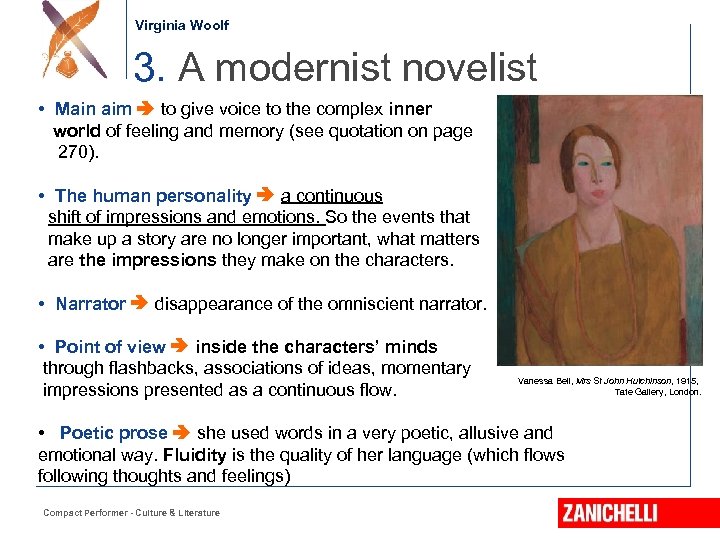 Jonathan Swift Virginia Woolf 3. A modernist novelist • Main aim to give voice to the complex inner world of feeling and memory (see quotation on page 270). • The human personality a continuous shift of impressions and emotions. So the events that make up a story are no longer important, what matters are the impressions they make on the characters. • Narrator disappearance of the omniscient narrator. • Point of view inside the characters’ minds through flashbacks, associations of ideas, momentary impressions presented as a continuous flow. Vanessa Bell, Mrs St John Hutchinson, 1915, Tate Gallery, London. • Poetic prose she used words in a very poetic, allusive and emotional way. Fluidity is the quality of her language (which flows following thoughts and feelings) Compact Performer - Culture & Literature
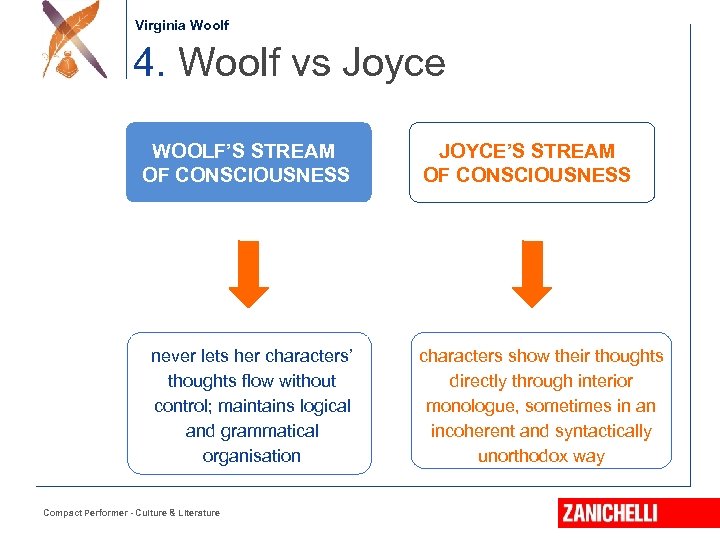 Jonathan Swift Virginia Woolf 4. Woolf vs Joyce WOOLF’S STREAM OF CONSCIOUSNESS never lets her characters’ thoughts flow without control; maintains logical and grammatical organisation Compact Performer - Culture & Literature JOYCE’S STREAM OF CONSCIOUSNESS characters show their thoughts directly through interior monologue, sometimes in an incoherent and syntactically unorthodox way
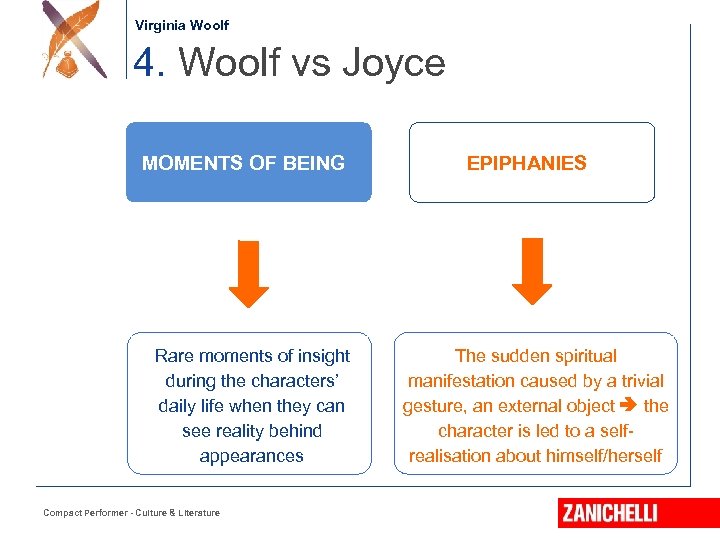 Jonathan Swift Virginia Woolf 4. Woolf vs Joyce MOMENTS OF BEING Rare moments of insight during the characters’ daily life when they can see reality behind appearances Compact Performer - Culture & Literature EPIPHANIES The sudden spiritual manifestation caused by a trivial gesture, an external object the character is led to a selfrealisation about himself/herself
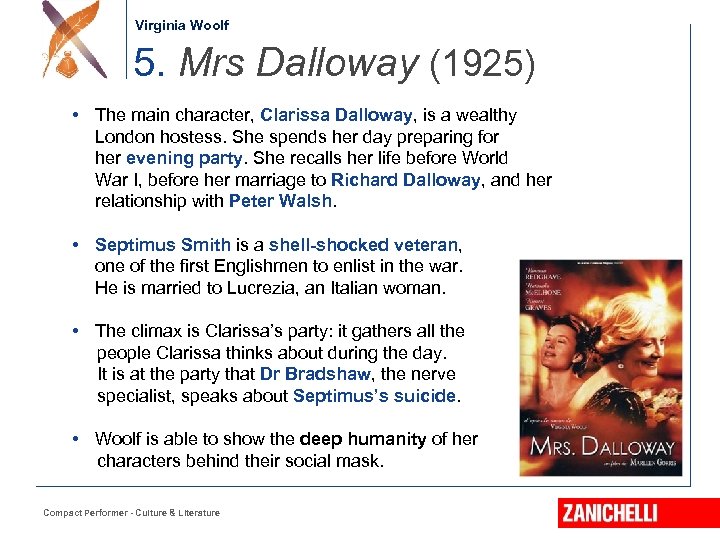 Jonathan Swift Virginia Woolf 5. Mrs Dalloway (1925) • The main character, Clarissa Dalloway, is a wealthy London hostess. She spends her day preparing for her evening party. She recalls her life before World War I, before her marriage to Richard Dalloway, and her relationship with Peter Walsh. • Septimus Smith is a shell-shocked veteran, one of the first Englishmen to enlist in the war. He is married to Lucrezia, an Italian woman. • The climax is Clarissa’s party: it gathers all the people Clarissa thinks about during the day. It is at the party that Dr Bradshaw, the nerve specialist, speaks about Septimus’s suicide. • Woolf is able to show the deep humanity of her characters behind their social mask. Compact Performer - Culture & Literature
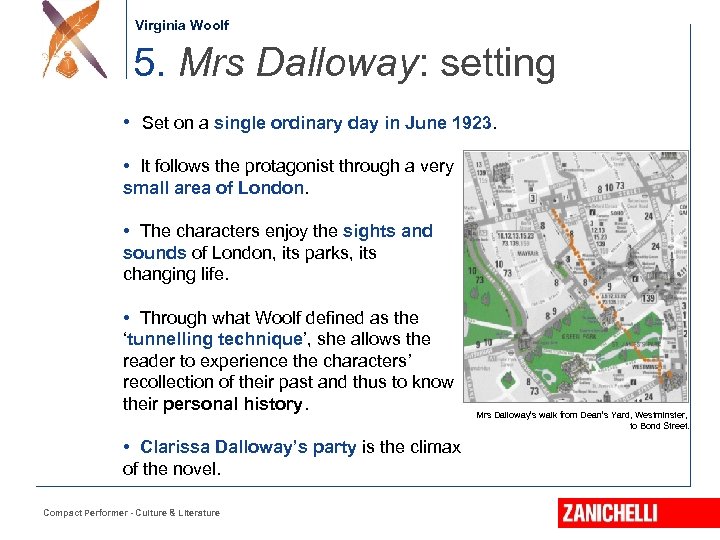 Jonathan Swift Virginia Woolf 5. Mrs Dalloway: setting • Set on a single ordinary day in June 1923. • It follows the protagonist through a very small area of London. • The characters enjoy the sights and sounds of London, its parks, its changing life. • Through what Woolf defined as the ‘tunnelling technique’, she allows the reader to experience the characters’ recollection of their past and thus to know their personal history. • Clarissa Dalloway’s party is the climax of the novel. Compact Performer - Culture & Literature Mrs Dalloway’s walk from Dean’s Yard, Westminster, to Bond Street.
 Jonathan Swift Virginia Woolf 5. Mrs Dalloway: a changing society Significant changes in the social life of the time represented in the novel: • the spread of newspapers • the increasing use of cars and planes • the new standards in the marital relationship • the success of the cinema A motif the striking of Big Ben and of clocks in general: it’s a structural connection and a symbol. It reminds the reader of chronological time passing by. Compact Performer - Culture & Literature
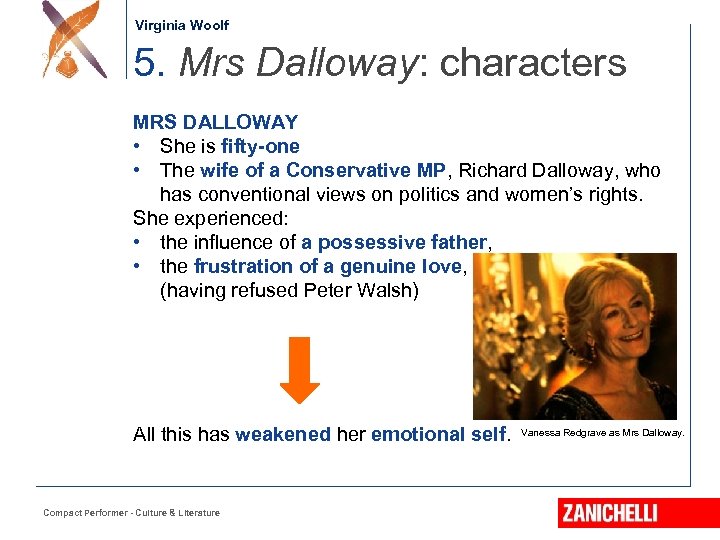 Jonathan Swift Virginia Woolf 5. Mrs Dalloway: characters MRS DALLOWAY • She is fifty-one • The wife of a Conservative MP, Richard Dalloway, who has conventional views on politics and women’s rights. She experienced: • the influence of a possessive father, • the frustration of a genuine love, (having refused Peter Walsh) All this has weakened her emotional self. Compact Performer - Culture & Literature Vanessa Redgrave as Mrs Dalloway.
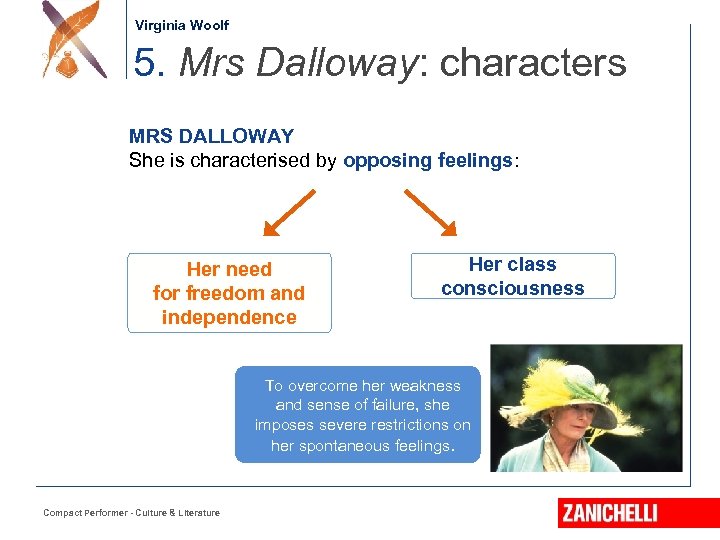 Jonathan Swift Virginia Woolf 5. Mrs Dalloway: characters MRS DALLOWAY She is characterised by opposing feelings: Her need for freedom and independence Her class consciousness To overcome her weakness and sense of failure, she imposes severe restrictions on her spontaneous feelings. Compact Performer - Culture & Literature
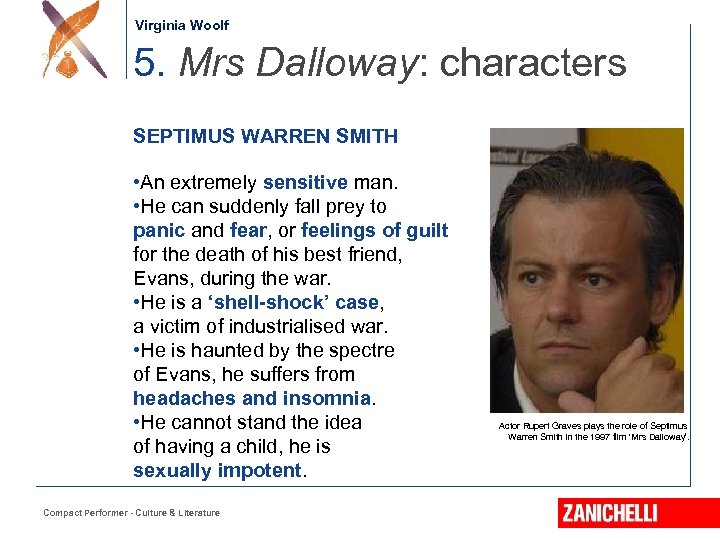 Jonathan Swift Virginia Woolf 5. Mrs Dalloway: characters SEPTIMUS WARREN SMITH • An extremely sensitive man. • He can suddenly fall prey to panic and fear, or feelings of guilt for the death of his best friend, Evans, during the war. • He is a ‘shell-shock’ case, a victim of industrialised war. • He is haunted by the spectre of Evans, he suffers from headaches and insomnia. • He cannot stand the idea of having a child, he is sexually impotent. Compact Performer - Culture & Literature Actor Rupert Graves plays the role of Septimus Warren Smith in the 1997 film ‘Mrs Dalloway’.
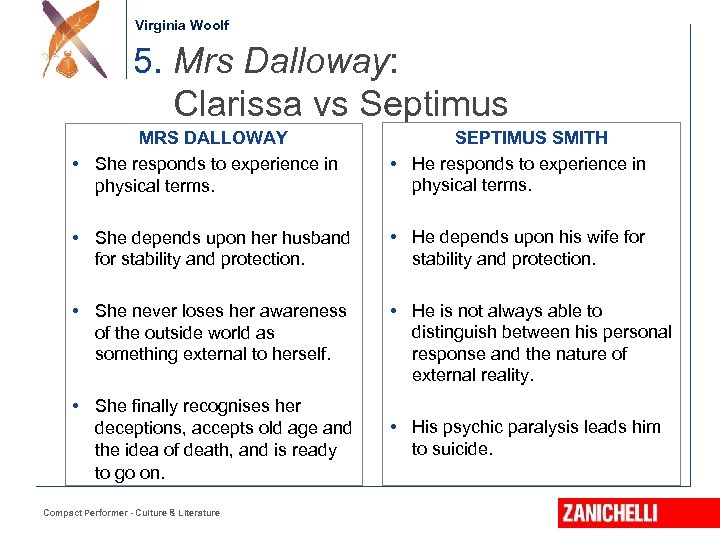 Jonathan Swift Virginia Woolf 5. Mrs Dalloway: Clarissa vs Septimus MRS DALLOWAY • She responds to experience in physical terms. SEPTIMUS SMITH • He responds to experience in physical terms. • She depends upon her husband for stability and protection. • He depends upon his wife for stability and protection. • She never loses her awareness of the outside world as something external to herself. • He is not always able to distinguish between his personal response and the nature of external reality. • She finally recognises her deceptions, accepts old age and the idea of death, and is ready to go on. Compact Performer - Culture & Literature • His psychic paralysis leads him to suicide.
 Jonathan Swift Clarissa and Septimus page 272 This passage opens with Mrs Dalloway entering the flower shop in Bond Street to buy flowers. • In the first part (lines 1 -25) the reader is put directly into Mrs Dalloway’s mind, following her thoughts and associations of ideas while she’s smelling the flowers, looking at them and at Mrs Pym. There a lot of references to the senses, especially smell and sight, but also hearing and touch. Woolf is able to insert into this flow of thoughts also a brief physical description of the character (line 3: she advanced light, tall, very upright…) and some specific time details of that day ( line 16: summer day; line 17: between six and seven). • The second part (lines 26 -44) refers to the main event in the passage: a violent explosion (due to the bursting tyre of a car). Instead of describing the event, Woolf describes various people’s reactions to the explosion. The car is surrounded by mystery. A very important person must be in it, but nobody knows because of the window-blinds. A very important place detail is given in lines 35 -35: from the middle of Bond street to Oxford Street… Compact Performer - Culture & Literature
 Jonathan Swift • In lines 45 -49 Septimus Warren Smith is introduced and described. • Lines 50 – 62 describe a busy traffic road and Septimus’s thoughts. We find a lot of references to the new technologies introduced in the 20 th century: the throb of the motor engines, omnibuses, traffic accumulated… Septimus is presented as very confused, afraid of what’s happening around him. He even feels guilty because he’s afraid of blocking the traffic. • The last part (lines 63 -86) focuses on the description of Lucrezia, Septimus’s Italian wife, and her thoughts: she is concerned about what people may think of her and her husband. NARRATIVE TECHNIQUE: in this passage the voice of the narrator appears occasionally among the subjective thoughts of the characters. The point of view shifts constantly from one character’s stream of consciousness to another. Woolf follows the interior thoughts of characters (interior monologue). She wants to convey reality through subjective impressions and emotions. Compact Performer - Culture & Literature