


 Скачать презентацию Virginia Foundation for Educational Leadership Virginia Department of
24a4052d1f0e626444814eb6a1c5865e.ppt
- Количество слайдов: 29
 Virginia Foundation for Educational Leadership Virginia Department of Education Webinar Series 2012 Welcome to Webinar 6
 Virginia Foundation of Educational Leadership (VFEL) Webinar Faculty: Dr. Roger E. Jones Dr. Carol C. Robinson 2
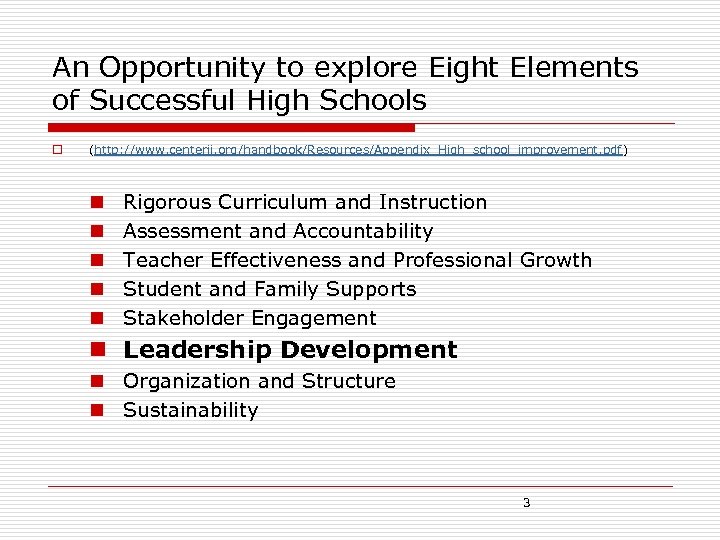 An Opportunity to explore Eight Elements of Successful High Schools o (http: //www. centerii. org/handbook/Resources/Appendix_High_school_improvement. pdf) n n n Rigorous Curriculum and Instruction Assessment and Accountability Teacher Effectiveness and Professional Growth Student and Family Supports Stakeholder Engagement n Leadership Development n Organization and Structure n Sustainability 3
 Do Not Overwhelm Your Staff o Help them see the “big picture” and interrelations of the elements o Every school has its own DNA o Assess the elements in your school as foundation for developing a plan 4
 Today’s Agenda 1. Welcome 2. Research regarding Element 6: Effective Leadership 3. Reflections/Next Steps 5
 Objectives o Participants will be able to identify the defined practices in their school relative to effective leadership. 6
 Effective Leadership Element 6 o A distributed leadership approach is in place to promote high school improvement. o High school improvement strategies and initiatives are guided by an effective high school improvement plan. o School leaders possess the prerequisite knowledge of school change to support high school initiatives and improvement strategies. 7
 What it is all about … o “To date we have not found a single documented case of a school improving its student achievement record in the absence of talented leadership. ” Leithwood, p. 3 8
 From Linking Leadership to Student Learning (p. 11) o Principals and district leaders have the most influence on decisions in all schools, and they do not lose influence as others gain influence. o School leaders have an impact on student achievement primarily through their influence on teachers’ motivation and working conditions. 9
 10
10
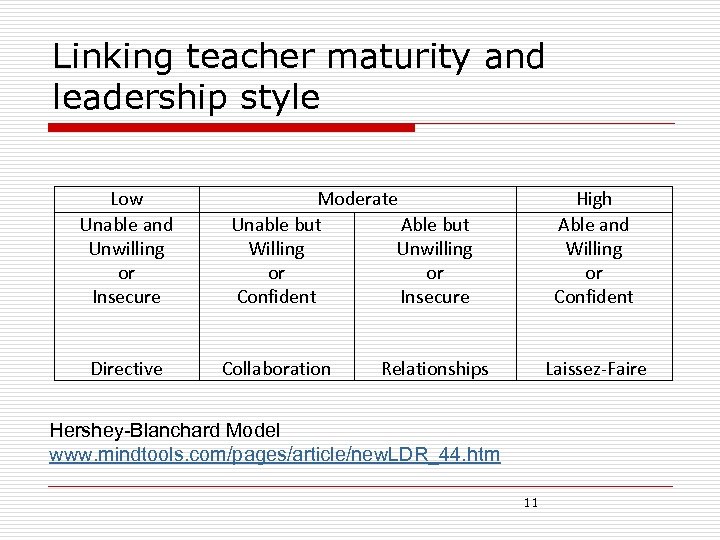 Linking teacher maturity and leadership style Low Unable and Unwilling or Insecure Directive Moderate Unable but Able but Willing Unwilling or or Confident Insecure Collaboration High Able and Willing or Confident Relationships Laissez-Faire Hershey-Blanchard Model www. mindtools. com/pages/article/new. LDR_44. htm 11
 The Truth About Leadership James M. Kouzes & Barry Z. Posner 10 Fundamental Truths about Leadership
 Truth 1: You Make a Difference o You have to want to lead o You have to lead yourself o The question is not “Will I make a difference? ” –the question is “What difference will I make? ” o Leadership is accessible to anyone with a passion and purpose to change o Change begins in your own backyard, in your school, classroom, organization 13
 Truth 2: Credibility o Leadership starts with you but continues only if you have followers o Leadership emerges when someone “willingly” follows you 14
 Truth 4: Focusing on the Future Sets Leaders Apart o Capacity to imagine and articulate an exciting future is a defining competence of leaders o Being forward looking is the quality that separates leaders and followers o Creating a compelling vision is the life blood of the organization o Focus on what you want to become 15
 Truth 5: You Can’t Do It Alone Develop followers Build relationships Listen empathically Unite around a shared vision and how vision connects to each person o Convince them of their potential o o 16
 Truth 8: You Either Lead By Example Or You Don’t Lead At All o DWYSYWD o “The greatest distance you travel in leadership is from your mouth to your feet” o In organizations where leaders exhibit “behavioral integrity” – doing what you say you will do – achievement/profit is higher o Check your verbal and non-verbal communication 17
 You are not a leader until you can reach inside the minds of your followers and convince them they can accomplish something they did not believe they could accomplish. Until then, you are a placeholder occupying a position of leadership. 18
 Distributed Leadership o Leadership is the province of all, not just a privileged few n It is an interactive process in which leaders and followers engage in mutual interaction in a complex environment to achieve mutual goals n Must acknowledge all elements of the process, not just the actions of the leader 19
 Distributed Leadership o High school improvement strategies and initiatives are guided by an effective school improvement team o Indistar® is a useful tool 20
 Building a Team o The Five Dysfunctions of a Team by Patrick Lencioni (Jossey-Bass, 2002) 21
 A Few “Takeaways” o Build trust o Engage in conflict around ideas o Commit to decisions and plans of action (must allow all to weigh in before they buy in!) o Hold each other accountable (do not tolerate low expectations) o Focus on the achievement of collective results 22
 o Expect the language of the responsible, not the language of the victim o Know how you come across to others o Be intentional about what is important o Confront negativity o Create a vision 23
 o Entire school needs to know how the vision and plan is being implemented within each discipline o Have courageous conversations o Team success is important, if the team loses, everyone loses (focus must be on collective results not on individual ego and status) 24
 Resources for Building a Team o “Team Life Cycle” (available on the web site) o “Team Performance Assessment” (available on the web site) 25
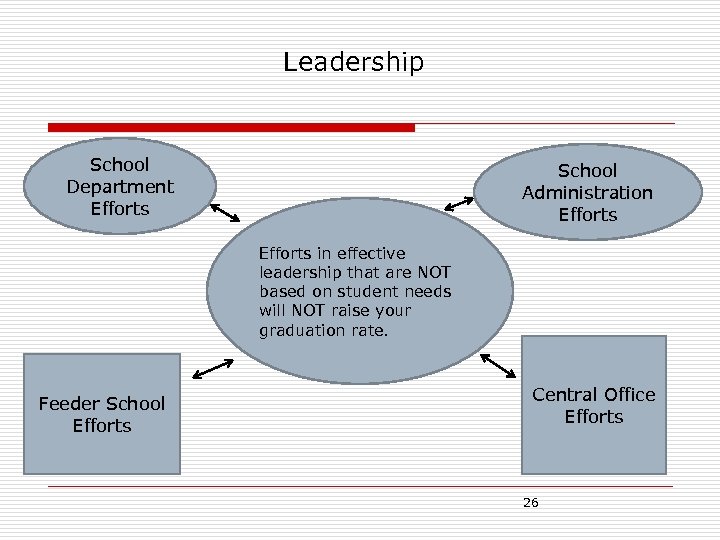 Leadership School Department Efforts School Administration Efforts in effective leadership that are NOT based on student needs will NOT raise your graduation rate. Feeder School Efforts Central Office Efforts 26
 Next Steps o How is leadership distributed at our school? o To what degree are staff involved as partners in the improvement process? o What are you doing specifically to develop the leaders around you? 27
 Resources for Element 6 Hargreaves, A. & Fink, D. (2006). Sustainable leadership. San Francisco: Jossey-Bass. Kouzes, James M. and Barry Z. Posner (2010). The Truth About Leadership. San Francisco: Jossey-Bass. Leithwood, Kenneth and Karen Seashore Louis (2012). Linking Leadership to Student Learning. San Francisco: Jossey-Bass. National Association of Secondary Principals. (2004). Breaking ranks II: Strategies for leading high school reform. Reston, VA: NASSP. Noguera, P. Presentation made at the Virginia Middle and High School Principals Conference and Exposition, June 27 -29, 2011 Reeves. D. B. & Allison, E. (2009). Renewal coaching: Sustainable change for individuals and organizations. San Francisco: Jossey-Bass. Squire, K. D. & Reigeluth, C. M. (2000). The many faces of systemic change. Educational Horizons, 78(3), 145 -154. Wheatley, M. & Frieze, D. (2007). Beyond networking: How large-scale change really happens. School Administrator, 64(4), 35 -38. 28
 The ultimate goal in school improvement is for the people attached to the school to drive its continuous improvement for the sake of their own children and students. Dr. Sam Redding 29