 Скачать презентацию VIRGINIA DEPARTMENT OF LABOR AND INDUSTRY Tree Trimming
cf0caaabe29b0f704a777540c18f4804.ppt
- Количество слайдов: 182



VIRGINIA DEPARTMENT OF LABOR AND INDUSTRY Tree Trimming Operations 16 VAC 25– 73 1
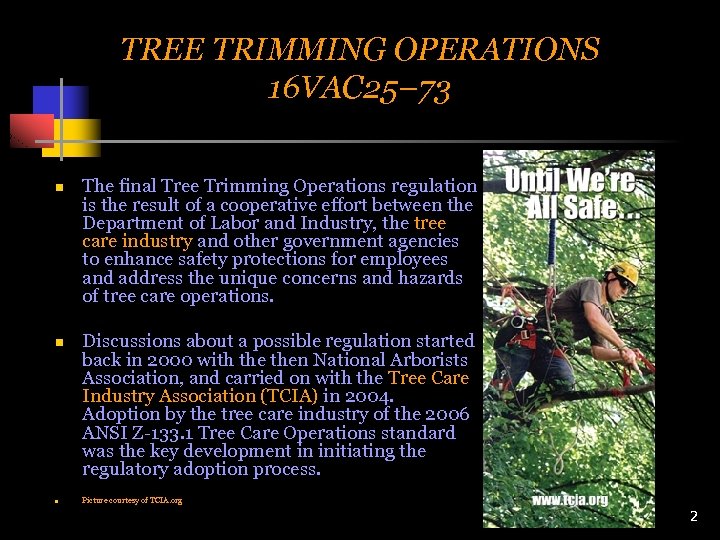
TREE TRIMMING OPERATIONS 16 VAC 25– 73 n The final Tree Trimming Operations regulation is the result of a cooperative effort between the Department of Labor and Industry, the tree care industry and other government agencies to enhance safety protections for employees and address the unique concerns and hazards of tree care operations. n n Discussions about a possible regulation started back in 2000 with then National Arborists Association, and carried on with the Tree Care Industry Association (TCIA) in 2004. Adoption by the tree care industry of the 2006 ANSI Z-133. 1 Tree Care Operations standard was the key development in initiating the regulatory adoption process. Picture courtesy of TCIA. org 2
TREE TRIMMING OPERATIONS 16 VAC 25– 73 n n From 1993 through 2010, 59 tree trimmers were killed in Virginia, an average of three fatal accidents per year (7% of VOSH fatalities). Eight (8) tree trimmers alone were killed in 2006 (another fifteen (15) were killed between 2007 and 2010). Tree Trimming Fatalities: Number Hazard 33 Tree trimming 15 Power lines 4 Struck by vehicle 3 Chipper 3 Site clearance 1 Aerial lift 3
TREE TRIMMING OPERATIONS 16 VAC 25– 73 n NIOSH Fatal Accident Circumstances Epidemiology (FACE) Investigation of Fatal Accident in Virginia: Tree Trimmer/Climber Dies After Falling 40 Feet With an Uprooted Tree Trunk – Virginia n http: //www. cdc. gov/niosh/face/In-house/full 9615. html n OSHA Fact Sheet: Hazards of Wood Chippers n http: //www. osha. gov/dts/shib 041608. html 4
TREE TRIMMING OPERATIONS 16 VAC 25– 73 n The regulation is the result of three years of work involving input from employer and employee representatives and associations: n n n n n Bryan Giere, CTSP, Northern Virginia Tree Experts, Inc. Peter Gerstenberger, Senior Advisor for Safety, Compliance & Standards Tree Care Industry Association (TCIA) Andrew T. Ross, CTSP, President, RTEC Treecare Sten Compe, Big "O" Tree & Lawn Service Inc. M. Scott Turner, CTSP, President, True. Timber Tree Service, Inc. David G. Marren, Vice President of Regulatory Affairs, F. A. Bartlett Tree Expert Co. Peter Girardi, True. Timber Tree Service, Inc. Thomas R. Scallorn, CSP, Virginia Department of Transportation Kristina Villaire, City of Virginia Beach 5
TREE TRIMMING OPERATIONS 16 VAC 25– 73 n History: n n n A Notice of Intended Regulatory Action (NOIRA) was adopted by Board on October 18, 2007, and. The NOIRA was published on February 4, 2008, with 30 -day comment period ending March 4, 2008. The Department held a meeting with interested parties on June 10, 2008. The Board adopted proposed regulatory language on July 10, 2008. The proposed regulation was published on March 16, 2009, with a 60 -day comment period ending on May 15, 2009. A public hearing was held by the Board on April 16, 2009. The Board adopted a final regulation on August 13, 2009. The final regulation was approved by the Governor December 16, 2010, published in final form March 28, 2011, with an effective date of April 27, 2011. 6
TREE TRIMMING OPERATIONS 16 VAC 25– 73 n n OUTREACH AND PHASED ENFORCEMENT: Outreach and training materials on Department website: http: //www. doli. virginia. gov/vosh_enforcement/tree_trimming. ht ml From April 27 to May 26, 2011, VOSH operating in non-enforcement mode for new regulation, but current protections for employees remain in place. n If violations of the new regulation are noted during an inspection, the employer will receive one “warning”, but not receive a citation. The warning will be provided to an on-site supervisor along with outreach materials. The inspector will verify the violation is corrected and note it in the case file. If the inspector returns to the site and finds the same violation recurring, or if the employer refuses to correct the violation, the employer can be cited under the new regulation. 7
TREE TRIMMING OPERATIONS 16 VAC 25– 73 n OUTREACH AND PHASED ENFORCEMENT: n From May 27 to June 26, 2011, and thereafter, VOSH will discontinue enforcement of existing protections that are superseded by the new regulation and fully enforce the following sections of the new regulation: n n n n § 10, Scope § 20, Definitions § 30, General Safety Requirements § 50, Electrical Hazards § 60, Safe Use of Equipment and Vehicles in Arboriculture § 70, Portable Power Hand Tools § 80, Hand Tools and Ladders § 90, Work Procedures 8
TREE TRIMMING OPERATIONS 16 VAC 25– 73 n n n OUTREACH AND PHASED ENFORCEMENT: From May 27 to June 26, 2011, § 30, Training, will not be cited to provide employers and employees time to access the training materials that are being provided. On June 27, 2011, VOSH inspectors will fully enforce the training provisions in § 30 as well as all other parts of the regulation. VOSH has established a Local Emphasis Program (LEP) to inspect tree trimming operations (see VOSH Directive 14 -234 on Virginia Regulatory Townhall: http: //www. townhall. state. va. us/L/View. GDoc. cfm? gdid=443 6 n VOSH inspectors will be on the lookout for tree trimming operations on general industry and construction worksites and will open an inspection in accordance with the LEP. 9
OUTREACH AND TRAINING MATERIALS VOSH Tree Trimming webpage: http: //www. doli. virginia. gov/vosh_enforcement/tree_trim ming. html n n n n n Text of Regulation (English and Spanish) Outreach and Phased Enforcement Explanation (English and Spanish) Quick Card Text of Regulation Sections (English and Spanish) Training Certification Form (English and Spanish) Interpretations (English) Powerpoint Presentation – Short Version (English) Powerpoint Presentation – Long Version (English) VOSH Directive 14 -234, Local Emphasis Program (LEP) Link to Virginia Regulatory Townhall VOSH Directive 02 -244, Tree Trimming Operations, 16 VAC 25 -73, Inspection Procedures and Interpretations 10
TREE TRIMMING OPERATIONS 16 VAC 25– 73 n The final regulation is closely based on ANSI Z-133. 1 -2006. Changes or additions were as limited as possible and generally only made to address issues unique to Virginia’s legal and regulatory environment: n Clarification is provided with regard to the following areas: n Line-clearance tree-trimming (see 1910. 269), and the Overhead High Voltage Line Safety Act, Va. Code §§ 59. 1 -406 to -414 n Logging operations (see 1910. 266) n Lot clearing activities involving felling of trees (see 1910. 266) 11
TREE TRIMMING OPERATIONS 16 VAC 25– 73 n Clarification is provided with regard to: n n The original text contained “should” or “may” language in some provisions, which are legally unenforceable. Prescriptive language such as “shall” or “will” was added. VOSH currently enforces VOSH Administrative Regulations Manual (ARM) § 120 (16 VAC 25 -60 -120) requiring that employers comply with manufacturer’s specifications and limitations applicable to the operation, training, use, installation, inspection, testing, repair and maintenance of machinery, vehicles, tools, materials and equipment. ANSI Z 133. 1 -2006 contains provisions that address the use and operation of machinery, vehicles, tools, etc. , so any conflicts with 16 VAC 25 -60 -120 have been corrected. 12
TREE TRIMMING OPERATIONS 16 VAC 25– 73 n Clarification is provided with regard to (continued): n n The original text contains provisions addressing traffic safety and references the U. S. Department of Transportation (DOT) Manual on Uniform Traffic Control Devices (MUTCD) and applicable state and local laws and regulations. Although the MUTCD has been adopted by OSHA and VOSH, it has been found to contain a great deal of “should” or “may” language, which means those provisions are not enforceable in a compliance setting. In its stead, the Virginia Department of Transportation (VDOT) Manual on Uniform Traffic Control Devices has been substituted as it contains fewer “shoulds” and “mays”. 13
TREE TRIMMING OPERATIONS 16 VAC 25– 73 n Clarification is provided with regard to (continued): n n n The original text addresses the issue of exposure to noise hazards. Reference is made in the final regulation to requirements contained in the VOSH Noise Standard, 1910. 95. The original text addresses the use of personal protective equipment (PPE). Reference is made in the final regulation to requirements contained in the VOSH PPE Standards, 1910. 132 through 138. The Board’s final rulemaking which changed general industry and construction requirements for reverse signal operation of vehicles is incorporated by reference, 16 VAC 25 -97. 14
TREE TRIMMING OPERATIONS 16 VAC 25– 73 Clarification is provided with regard to (continued): n n The original text contains provisions addressing proper use of personal fall arrest systems while working from an aerial lift (permits use of either a full body harness and lanyard or a body belt and lanyard). In light of advances in PPE and current manufacturer’s requirements for use of PPE in aerial lifts (full body harness and energy absorbing lanyard are normally required while working from aerial lifts), the option to allow an employee to use a body belt and lanyard in an aerial lift has been removed. 15
TREE TRIMMING OPERATIONS 16 VAC 25– 73 n Clarification is provided with regard to (continued): n n The original text addresses the use of cranes. In light of certain requirements contained in VOSH Standards 1910. 180, Crawler, Locomotive and Truck Cranes, and 1910. 184, Slings, certain additions have been made (e. g. the prohibition against employees working under a suspended load of a crane). Certain arborist-related terms used in the original text were not defined in (e. g. , “split-tail system” and “split tails”). Definitions have been added. 16
TREE TRIMMING OPERATIONS 16 VAC 25– 73 n Scope of the regulation. n 16 VAC 25 -73 -10. C. The regulation applies to all employers engaged in arboriculture activities, including tree pruning, repairing, maintaining; removing trees; cutting brush; or performing pest or soil management during tree care operations. This regulation may require situational modifications in response to personnel emergencies and is not intended to limit the options available to emergency responders. 17
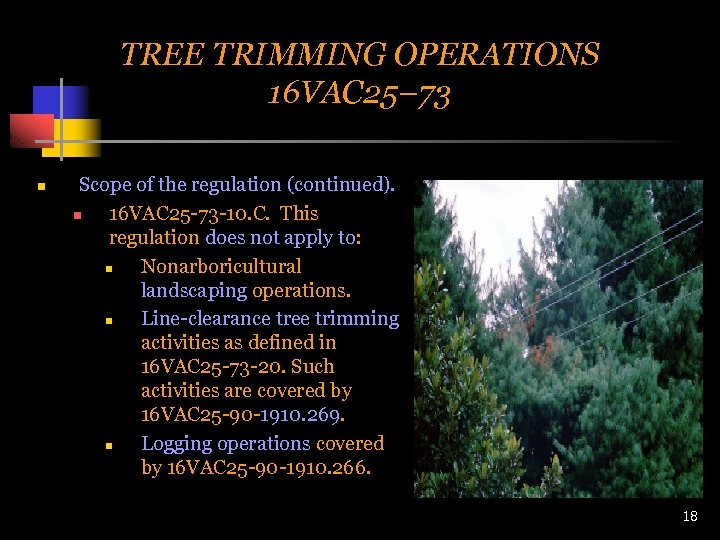
TREE TRIMMING OPERATIONS 16 VAC 25– 73 n Scope of the regulation (continued). n 16 VAC 25 -73 -10. C. This regulation does not apply to: n Nonarboricultural landscaping operations. n Line-clearance tree trimming activities as defined in 16 VAC 25 -73 -20. Such activities are covered by 16 VAC 25 -90 -1910. 269. n Logging operations covered by 16 VAC 25 -90 -1910. 266. 18
TREE TRIMMING OPERATIONS 16 VAC 25– 73 n Tree Trimming or Logging Regulation? n Generally, tree trimming activities include: n Work being performed in residential neighborhoods and commercial areas, not in a forest. n Teams of workers are being used in directional felling of trees (e. g. , with the use of ropes or other directional felling techniques). n Workers are “piecing out” trees or cutting trees in sections (loggers usually do not piece out trees) 19
TREE TRIMMING OPERATIONS 16 VAC 25– 73 n Tree Trimming or Logging Regulation? n Generally, tree trimming activities include (continued): n IF SUPERVISED BY A QUALIFIED ARBORIST OR QUALIFIED LINE-CLEARANCE ARBORIST, tree removal activities where the primary objective is land clearing in preparation for construction, real estate development, rights-ofway for new utility installations or other related activities. OTHERWISE, Such activities are covered by 16 VAC 25 -90 -1910. 266. 20
TREE TRIMMING OPERATIONS 16 VAC 25– 73 n Scope of the regulation (continued). n 16 VAC 25 -73 -10. C. This regulation does not apply to: n Tree removal activities where the primary objective is land clearing in preparation for construction, real estate development, rights-ofway for new utility installations or other related activities, unless directly supervised by a qualified arborist or qualified line-clearance arborist. Such activities are covered by 16 VAC 25 -90 -1910. 266. 21
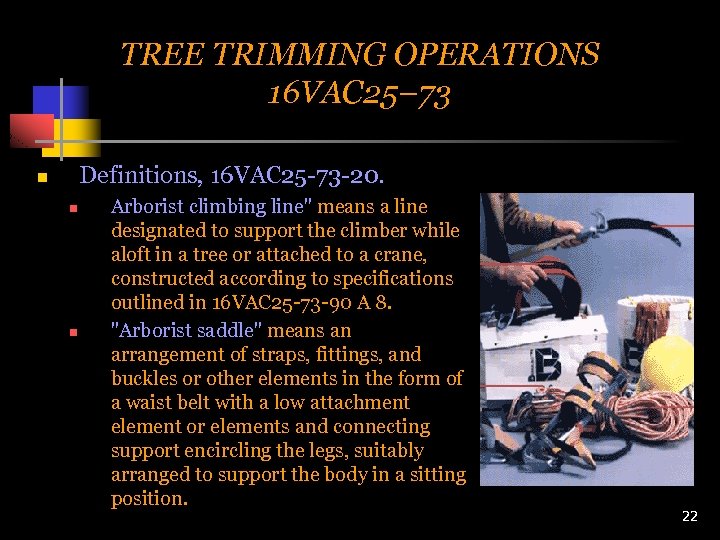
TREE TRIMMING OPERATIONS 16 VAC 25– 73 Definitions, 16 VAC 25 -73 -20. n n n Arborist climbing line" means a line designated to support the climber while aloft in a tree or attached to a crane, constructed according to specifications outlined in 16 VAC 25 -73 -90 A 8. "Arborist saddle" means an arrangement of straps, fittings, and buckles or other elements in the form of a waist belt with a low attachment element or elements and connecting support encircling the legs, suitably arranged to support the body in a sitting position. 22
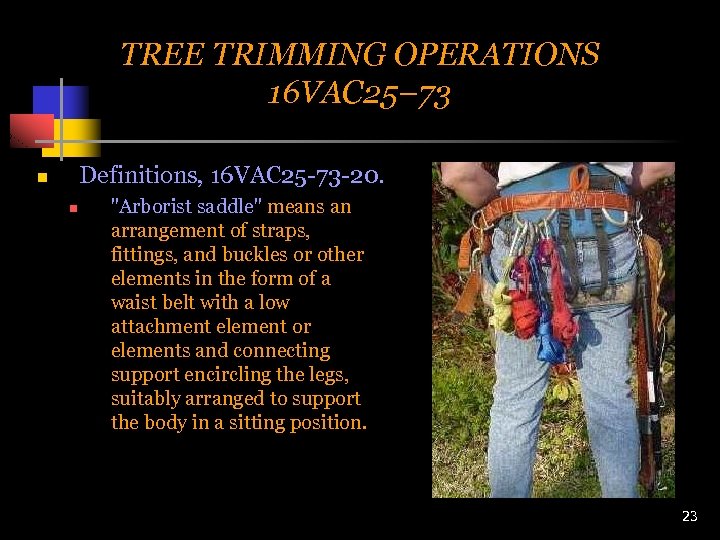
TREE TRIMMING OPERATIONS 16 VAC 25– 73 Definitions, 16 VAC 25 -73 -20. n n "Arborist saddle" means an arrangement of straps, fittings, and buckles or other elements in the form of a waist belt with a low attachment element or elements and connecting support encircling the legs, suitably arranged to support the body in a sitting position. 23
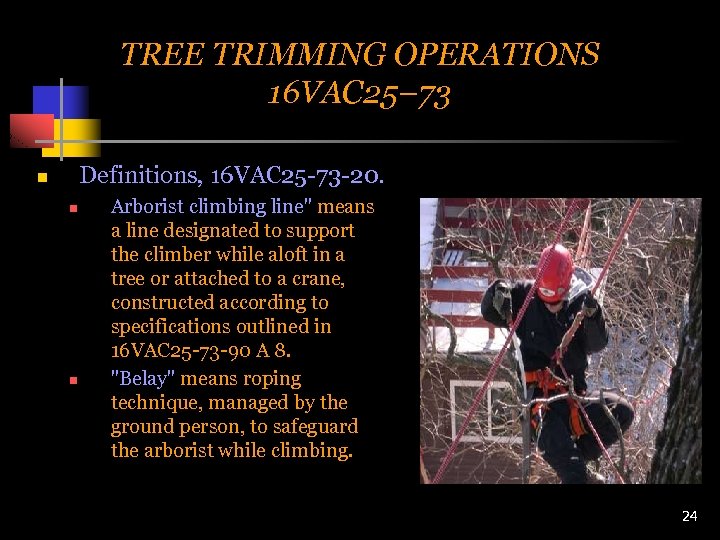
TREE TRIMMING OPERATIONS 16 VAC 25– 73 Definitions, 16 VAC 25 -73 -20. n n n Arborist climbing line" means a line designated to support the climber while aloft in a tree or attached to a crane, constructed according to specifications outlined in 16 VAC 25 -73 -90 A 8. "Belay" means roping technique, managed by the ground person, to safeguard the arborist while climbing. 24
TREE TRIMMING OPERATIONS 16 VAC 25– 73 Definitions, 16 VAC 25 -73 -20 (continued) n [SELECTED DEFINITIONS, SEE REGULATION FOR ALL DEFINITIONS]. n n n "Ascender" means a mechanical device used for climbing rope. "Back cut" means the cut made in a tree limb or trunk on the side opposite the intended direction of fall. "Carabiner" means a connector generally composed of a trapezoidal or oval-shaped body with a closed gate or similar arrangement that may be opened to receive an object and, when released, automatically closes to retain the object. "Climbing/friction hitch" means a hitch used for securing a tree climber to the climbing line, permitting controlled ascent, descent, and work positioning. Examples of climbing hitches include, but are not limited to, the tautline hitch, Blake's hitch, and the Prusik hitch/knot. 25
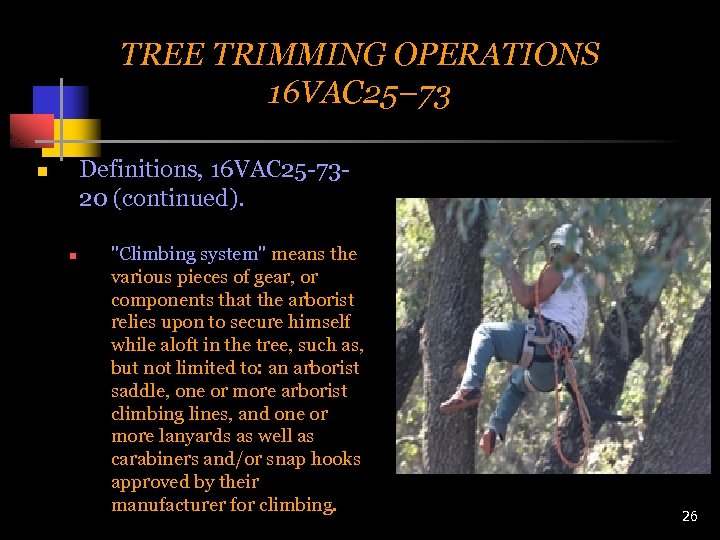
TREE TRIMMING OPERATIONS 16 VAC 25– 73 Definitions, 16 VAC 25 -7320 (continued). n n "Climbing system" means the various pieces of gear, or components that the arborist relies upon to secure himself while aloft in the tree, such as, but not limited to: an arborist saddle, one or more arborist climbing lines, and one or more lanyards as well as carabiners and/or snap hooks approved by their manufacturer for climbing. 26
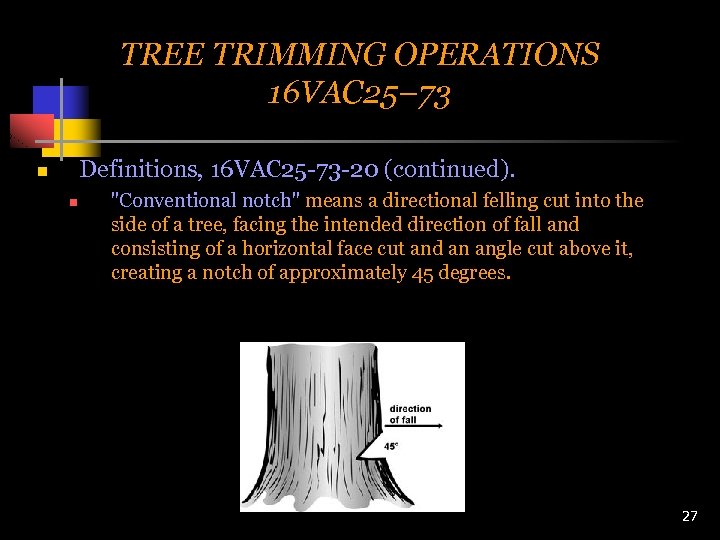
TREE TRIMMING OPERATIONS 16 VAC 25– 73 Definitions, 16 VAC 25 -73 -20 (continued). n n "Conventional notch" means a directional felling cut into the side of a tree, facing the intended direction of fall and consisting of a horizontal face cut and an angle cut above it, creating a notch of approximately 45 degrees. 27
TREE TRIMMING OPERATIONS 16 VAC 25– 73 Definitions, 16 VAC 25 -73 -20 (continued). n n "Crotch" (n. ) means branch union; the angle formed by two branches in the tree. "Crotch" (v. ) means to place a line through a branch union. "Damaged" means a defect, impairment or injury to machinery, vehicle, tool, material or equipment that would meet the manufacturer's criteria for removal from service, or in the absence of such criteria, would materially effect the safe operation or safe use of the item during tree trimming operations. "DBH" means acronym for diameter at breast height; diameter of a tree measured at 4. 5 feet (1. 3 m) above ground. 28
TREE TRIMMING OPERATIONS 16 VAC 25– 73 Definitions, 16 VAC 25 -73 -20 (continued). n n n "Direct supervision" means direct supervision occurs when a qualified arborist or a qualified arborist supervisor is physically present on the jobsite. "Drop-starting" means the act of starting a chain saw by pushing the saw away from the body with one hand while simultaneously pulling on the starter cord handle with the other. "False crotch" means a device installed in a tree to set ropes during climbing or rigging because there is not a suitable natural crotch available, or to protect an available crotch, and/or to reduce wear on ropes. "False crotch for rigging" means a pulley, block, sling, lashing, or metal ring affixed to a tree's leader or limb, through which a load line is passed, to lower or raise limbs or equipment. 29
TREE TRIMMING OPERATIONS 16 VAC 25– 73 Definitions, 16 VAC 25 -73 -20 (continued). n n "False crotch redirect" means the use of a false crotch in conjunction with either a natural crotch or a second false crotch in instances where the arborist is working away from the trunk of the tree and could otherwise be subject to an uncontrolled pendulum swing in the event of a slip. "Footlock" means to climb up a suspended rope by pulling with the hands and arms and pushing upward with the feet. The loose end of the rope is wrapped under the middle and over the top of one foot and is locked in place with pressure from the other foot. "Handline" means a length of rope designated as a tool to leverage, lift, and hold tools, equipment, wood, or other objects; the proper rope strength is specified for each particular 30 use.
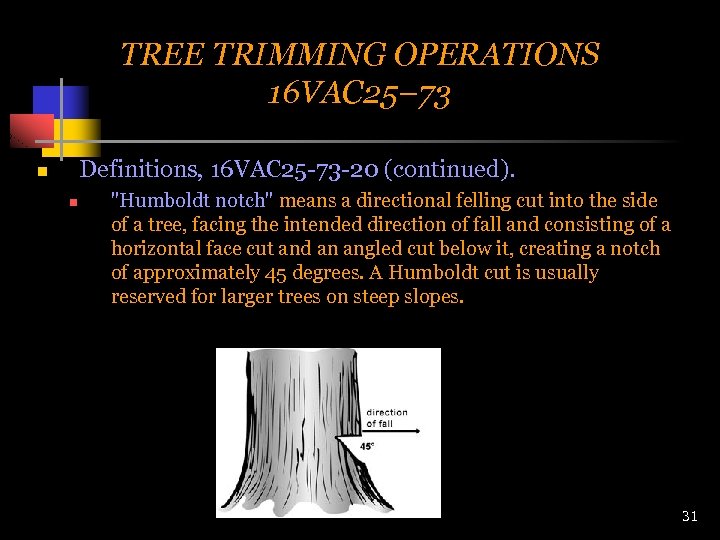
TREE TRIMMING OPERATIONS 16 VAC 25– 73 Definitions, 16 VAC 25 -73 -20 (continued). n n "Humboldt notch" means a directional felling cut into the side of a tree, facing the intended direction of fall and consisting of a horizontal face cut and an angled cut below it, creating a notch of approximately 45 degrees. A Humboldt cut is usually reserved for larger trees on steep slopes. 31
TREE TRIMMING OPERATIONS 16 VAC 25– 73 Definitions, 16 VAC 25 -73 -20 (continued). n n "Job briefing" means the communication before work begins of at least the following subjects for arboricultural operations: hazards associated with the job, work procedures involved, special precautions, electrical hazards, job assignments, and personal protective equipment. 32
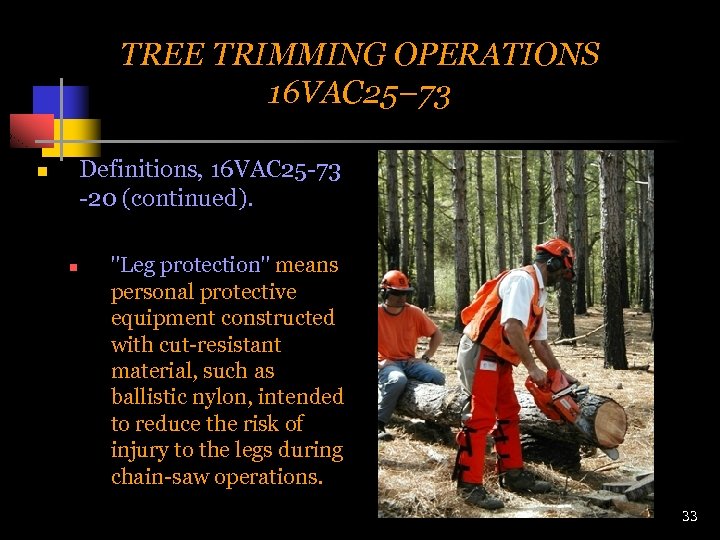
TREE TRIMMING OPERATIONS 16 VAC 25– 73 Definitions, 16 VAC 25 -73 -20 (continued). n n "Leg protection" means personal protective equipment constructed with cut-resistant material, such as ballistic nylon, intended to reduce the risk of injury to the legs during chain-saw operations. 33
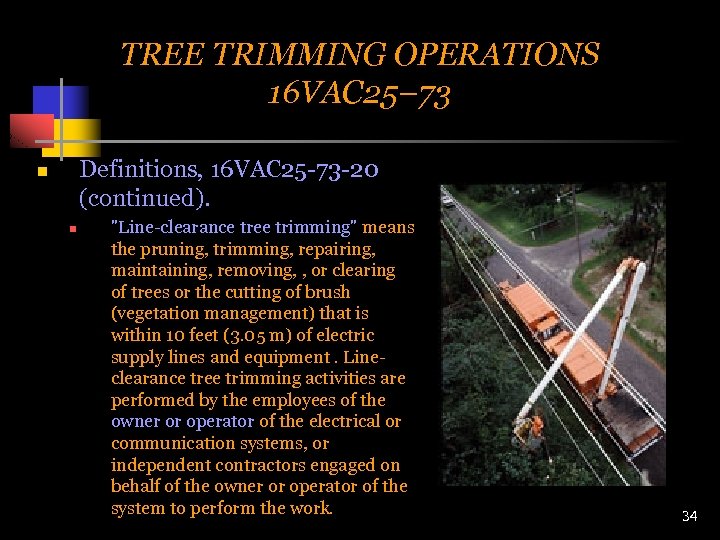
TREE TRIMMING OPERATIONS 16 VAC 25– 73 Definitions, 16 VAC 25 -73 -20 (continued). n n "Line-clearance tree trimming" means the pruning, trimming, repairing, maintaining, removing, , or clearing of trees or the cutting of brush (vegetation management) that is within 10 feet (3. 05 m) of electric supply lines and equipment. Lineclearance tree trimming activities are performed by the employees of the owner or operator of the electrical or communication systems, or independent contractors engaged on behalf of the owner or operator of the system to perform the work. 34
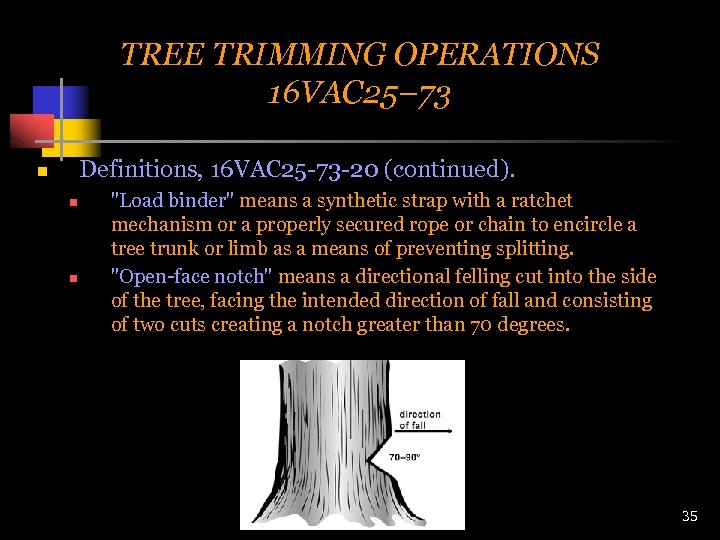
TREE TRIMMING OPERATIONS 16 VAC 25– 73 Definitions, 16 VAC 25 -73 -20 (continued). n n n "Load binder" means a synthetic strap with a ratchet mechanism or a properly secured rope or chain to encircle a tree trunk or limb as a means of preventing splitting. "Open-face notch" means a directional felling cut into the side of the tree, facing the intended direction of fall and consisting of two cuts creating a notch greater than 70 degrees. 35
TREE TRIMMING OPERATIONS 16 VAC 25– 73 Definitions, 16 VAC 25 -73 -20 (continued). n n n "Prusik knot" means a sliding friction knot, as in a work-positioning lanyard. "Prusik loop" means an endless loop of rope used to fashion a Prusik knot. The endless loop may be spliced or knotted with, at minimum, a double fisherman's knot. "Qualified arborist" means an individual who, through related training and on-the-job experience, is familiar with the equipment and hazards involved in arboricultural operations and who has demonstrated ability in the performance of the special techniques involved. "Qualified arborist trainee" means an individual undergoing on-thejob training under the direct supervision of a qualified arborist. In the course of such training, the trainee becomes familiar with the hazards and equipment involved in arboricultural operations and demonstrates ability in the performance of the special techniques involved. 36
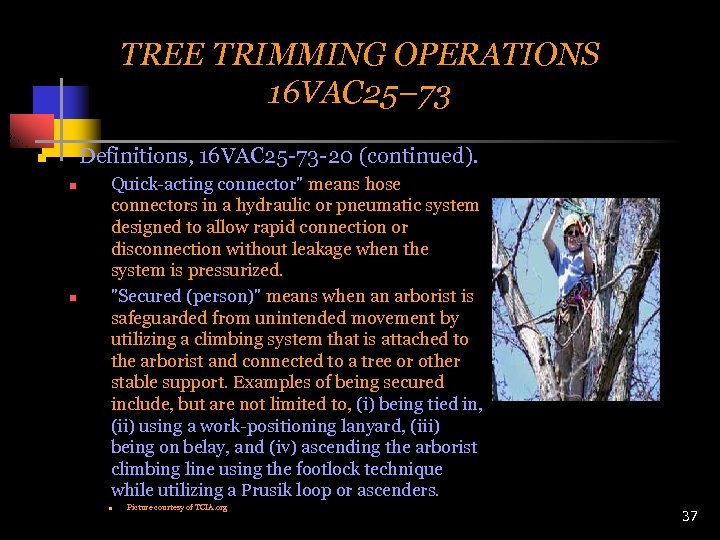
TREE TRIMMING OPERATIONS 16 VAC 25– 73 Definitions, 16 VAC 25 -73 -20 (continued). n n n Quick-acting connector" means hose connectors in a hydraulic or pneumatic system designed to allow rapid connection or disconnection without leakage when the system is pressurized. "Secured (person)" means when an arborist is safeguarded from unintended movement by utilizing a climbing system that is attached to the arborist and connected to a tree or other stable support. Examples of being secured include, but are not limited to, (i) being tied in, (ii) using a work-positioning lanyard, (iii) being on belay, and (iv) ascending the arborist climbing line using the footlock technique while utilizing a Prusik loop or ascenders. n Picture courtesy of TCIA. org 37
TREE TRIMMING OPERATIONS 16 VAC 25– 73 Definitions, 16 VAC 25 -73 -20 (continued). n n n "Snap hook" means a self-locking or double-locking rope snap. The locking type (required by this regulation for climbing) has a self-closing, self-locking gate that remains closed and locked until intentionally opened by the user for connection or disconnection. A captive eye is an integral part of a snap hook but is independent of the hook and gate portion. "Split tail system and split tail" refers to a system in which the climbing line is tied to the saddle, preferably indirectly with an ANSI-compliant carabiner or locking rope snap, without leaving a tail beyond the termination. The climbing/friction hitch is then tied onto the climbing line with a separate short section of climbing line called a split tail. The split tail is separately connected to a designated anchor point on the saddle. 38
TREE TRIMMING OPERATIONS 16 VAC 25– 73 Definitions, 16 VAC 25 -73 -20 (continued). n n n "Tackle blocks and pulleys" means equipment used in most tree situations to take a strain rather than move a load. Critical components of the system are the appropriate ropes, blocks, and, especially, the lock or connecting link. "Termination knot" means any knot suitable for rope termination, including, but not limited to, double fisherman's loop (scaffold hitch), anchor hitch, and buntline hitch. 39
TREE TRIMMING OPERATIONS 16 VAC 25– 73 Definitions, 16 VAC 25 -73 -20 (continued). n n "Tied in" means the term that describes an arborist whose climbing line has been run through a natural or false crotch attached to an arborist's saddle and completed with a climbing hitch or mechanical device, permitting controlled movement and work positioning. "Tool lanyard" means short line or strap used to secure a tool while working aloft. "Tripod/orchard ladder" means a three-legged ladder that utilizes the third leg to form a tripod to stabilize itself among orchard trees and/or shrubs. It is recommended for use on turf for better stability and to avoid slippage of the legs. Not recommended for use on hard surfaces. 40
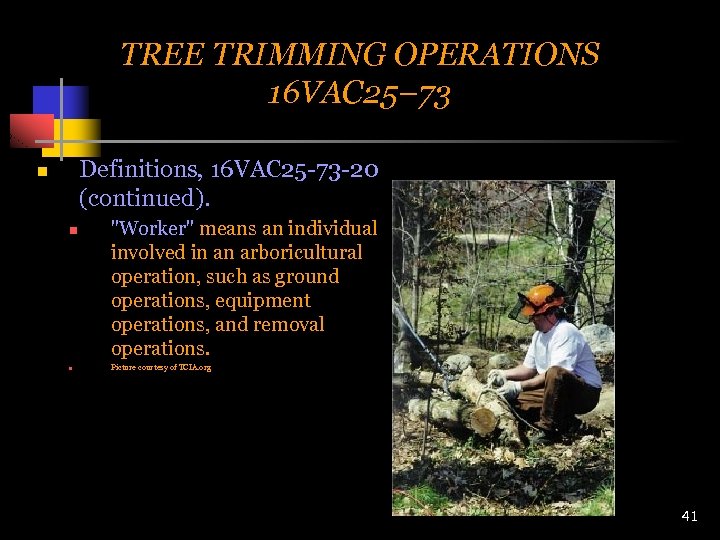
TREE TRIMMING OPERATIONS 16 VAC 25– 73 Definitions, 16 VAC 25 -73 -20 (continued). n n n "Worker" means an individual involved in an arboricultural operation, such as ground operations, equipment operations, and removal operations. Picture courtesy of TCIA. org 41
TREE TRIMMING OPERATIONS 16 VAC 25– 73 n Definitions, 16 VAC 25 -73 -20 (continued). n n "Working load" means limiting load values derived from the minimum breaking strength of a cord or rope divided by the design factor. For example, given a minimum breaking strength of 10, 000 pounds (44. 48 k. N) and a design factor of 10: 10, 000/10 = 1, 000 (working load, in pounds) or given a minimum breaking strength of 10, 000 pounds (44. 48 k. N) and a design factor of 5: 10, 000/5 = 2, 000 (working load, in pounds). "Working-load limit" means the working load that must not be exceeded for a particular application as established by a regulatory or standards-setting agency. 42
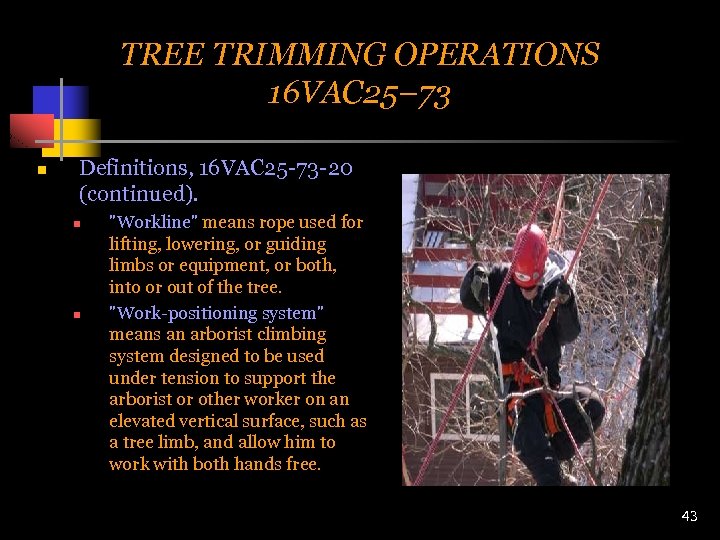
TREE TRIMMING OPERATIONS 16 VAC 25– 73 n Definitions, 16 VAC 25 -73 -20 (continued). n n "Workline" means rope used for lifting, lowering, or guiding limbs or equipment, or both, into or out of the tree. "Work-positioning system" means an arborist climbing system designed to be used under tension to support the arborist or other worker on an elevated vertical surface, such as a tree limb, and allow him to work with both hands free. 43
TREE TRIMMING OPERATIONS 16 VAC 25– 73 n Training, 16 VAC 25 -73 -30. n n A. Prior to permitting an employee to engage in any arboricultural activity covered by this regulation, the employer shall ensure that each employee receives orientation and training on the requirements of this regulation. B. Refresher training on applicable provisions of this regulation shall be provided by the employer for any employee who has: n 1. Been observed to violate the requirements of this regulation; n 2. Been involved in an accident or near miss accident; or n 3. Received an evaluation that reveals the employee is not working in a safe manner in accordance with the requirements of this regulation. 44
TREE TRIMMING OPERATIONS 16 VAC 25– 73 Training Resources. VOSH Tree Trimming webpage: n n n http: //www. doli. virginia. gov/vosh_enforcement/tree_trimmin g. html OSHA Tree Care Industry webpage: n n http: //www. osha. gov/SLTC/treecare/index. html OSHA/Tree Care Industry Association (TCIA) Alliance: n n http: //www. osha. gov/dcsp/alliances/tcia_new/tcia. html 45
TREE TRIMMING OPERATIONS 16 VAC 25– 73 n General Safety Requirements, 16 VAC 25 -73 -40. n A. General. n n 1. Machinery, vehicles, tools, materials and equipment shall conform to the requirements of this regulation. 16 VAC 25 -60 -120 is hereby incorporated by reference. 2. Employers shall instruct their employees in the proper use, inspection, and maintenance of tools and equipment, including ropes and lines, and shall require that appropriate working practices be followed. 3. A qualified arborist shall determine whether direct supervision is needed on a jobsite. 4. A job briefing shall be performed by the qualified arborist in charge before the start of each job. The briefing shall be communicated to all affected workers. An employee working alone need not conduct a job briefing. However, the employer shall ensure that the tasks are being performed as if a briefing were required. 46
TREE TRIMMING OPERATIONS 16 VAC 25– 73 n General Safety Requirements, 16 VAC 25 -73 -40. n B. Traffic control around the jobsite. n 1. High-visibility safety apparel and headgear, when required, shall conform to the Virginia Department of Transportation's (VDOT) Virginia Work Area Protection Manual. n 2. Effective means for controlling pedestrian and vehicular traffic shall be instituted on every jobsite where necessary, in accordance with the VDOT's Virginia Work Area Protection Manual and applicable state and local laws and regulations. 47
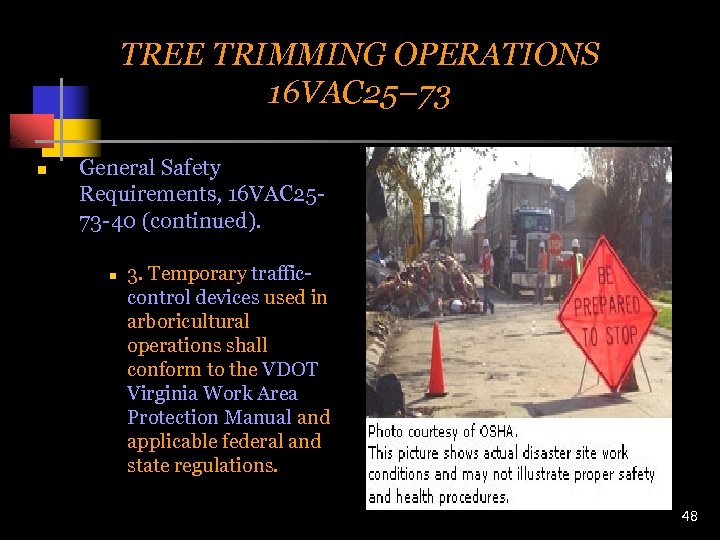
TREE TRIMMING OPERATIONS 16 VAC 25– 73 n General Safety Requirements, 16 VAC 2573 -40 (continued). n 3. Temporary trafficcontrol devices used in arboricultural operations shall conform to the VDOT Virginia Work Area Protection Manual and applicable federal and state regulations. 48
TREE TRIMMING OPERATIONS 16 VAC 25– 73 n General Safety Requirements, 16 VAC 25 -73 -40. n C. Emergency procedures and readiness. n 1. Emergency phone numbers shall be available when and where arboricultural operations are being carried out. Arborists and other workers shall be instructed as to the specific location of such information. n n 2. A first-aid kit, adequately stocked and maintained in accordance with 16 VAC 25 -90 -1910. 151, shall be provided by the employer, when and where arboricultural operations are being carried out. Arborists and other workers shall be instructed in its use and specific location. 5. First-aid training shall be provided in accordance with 16 VAC 25 -90 -1910. 151. 49
TREE TRIMMING OPERATIONS 16 VAC 25– 73 n General Safety Requirements, 16 VAC 25 -73 -40. n C. Emergency procedures and readiness. n 3. Instruction shall be provided in the identification, preventive measures, and first-aid treatment of common poisonous plants (poison ivy, poison oak, and poison sumac), stinging and biting insects, and other pests indigenous to the area in which work is to be performed. n TCIA/OSHA Alliance Fact Sheet, Lyme Disease: n http: //www. tcia. org/PDFs/Lyme Disease. Fact. Sheet. pdf 50
TREE TRIMMING OPERATIONS 16 VAC 25– 73 n General Safety Requirements, 16 VAC 2573 -40. n C. Emergency procedures and readiness. n n 4. Employees who may be faced with a rescue decision shall receive training in emergency response and rescue procedures appropriate and applicable to the work to be performed, as well as training to recognize the hazards inherent in rescue efforts (see 16 VAC 25 -73 -140, Appendix E). Picture courtesy of TCIA. org 51
TREE TRIMMING OPERATIONS 16 VAC 25– 73 n General Safety Requirements, 16 VAC 25 -73 -40. n D. Personal Protective Equipment. n n 16 VAC 25 -73 -40. D. 1 through D. 7. PPE required in accordance with 1910. 132 through 1910. 135 in the areas of head protection, body protection (clothing and footwear), face protections, respiratory protection, hearing protection and eye protection. 16 VAC 25 -73 -40. D. 8. Chain-saw resistant leg protection shall be worn while operating a chain saw during ground operations. 52
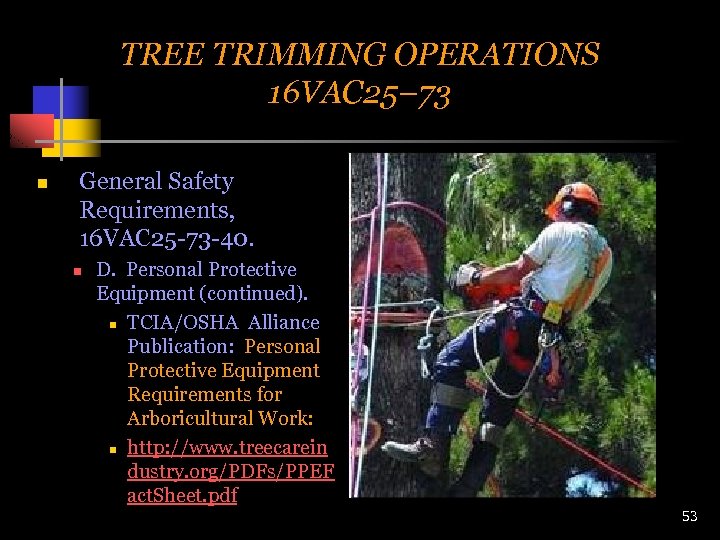
TREE TRIMMING OPERATIONS 16 VAC 25– 73 n General Safety Requirements, 16 VAC 25 -73 -40. n D. Personal Protective Equipment (continued). n TCIA/OSHA Alliance Publication: Personal Protective Equipment Requirements for Arboricultural Work: n http: //www. treecarein dustry. org/PDFs/PPEF act. Sheet. pdf 53
TREE TRIMMING OPERATIONS 16 VAC 25– 73 n General Safety Requirements, 16 VAC 25 -73 -40. n E. Fire protection. n n n 1. Equipment shall be refueled only after the engine has stopped. Spilled fuel shall be removed from equipment before restarting. 2. Equipment shall not be operated within 10 feet (3. 05 m) of refueling operations or areas in which refueling has recently taken place. 3. Flammable liquids shall be stored, handled, and dispensed from approved containers. 4. Smoking shall be prohibited when handling or working around flammable liquids. 5. Clothing contaminated by flammable liquid shall be changed as soon as possible. 6. Open flame and other sources of ignition shall be avoided. 54
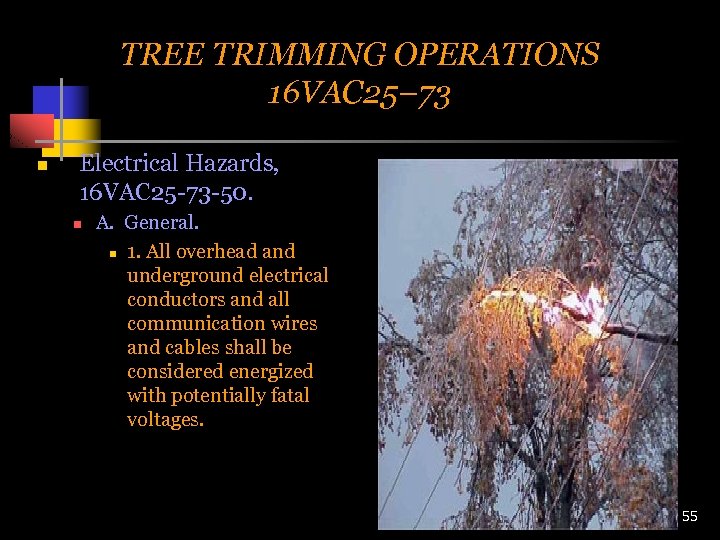
TREE TRIMMING OPERATIONS 16 VAC 25– 73 n Electrical Hazards, 16 VAC 25 -73 -50. n A. General. n 1. All overhead and underground electrical conductors and all communication wires and cables shall be considered energized with potentially fatal voltages. 55
TREE TRIMMING OPERATIONS 16 VAC 25– 73 n Electrical Hazards, 16 VAC 25 -73 -50. n A. General. n This section does not apply to line-clearance tree trimming as defined in 16 VAC 25 -73 -20, that shall be conducted in accordance with 16 VAC 25 -90 -1910. 269. n n Nonline-clearance tree trimming work around overhead high voltage lines covered by §§ 59. 1 -406 through 59. 1 -414 of the Code of Virginia, Overhead High Voltage Line Safety Act (Act) (voltage in excess of 600 volts as defined in the Act), shall be conducted in accordance with the Act. Nonline-clearance tree trimming work around overhead electrical lines of 600 volts or less not covered by the Act shall be conducted in accordance with 16 VAC 25 -901910. 333(c)(1). 56
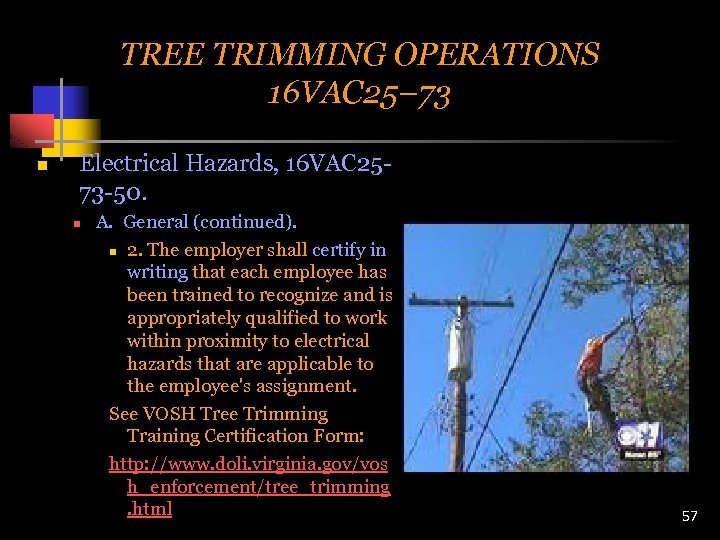
TREE TRIMMING OPERATIONS 16 VAC 25– 73 n Electrical Hazards, 16 VAC 2573 -50. n A. General (continued). n 2. The employer shall certify in writing that each employee has been trained to recognize and is appropriately qualified to work within proximity to electrical hazards that are applicable to the employee's assignment. See VOSH Tree Trimming Training Certification Form: http: //www. doli. virginia. gov/vos h_enforcement/tree_trimming. html 57
TREE TRIMMING OPERATIONS 16 VAC 25– 73 n Electrical Hazards, 16 VAC 25 -73 -50. n B. Working in proximity to electrical hazards. n 1. The items contained in subsection A of this section shall always be included in the review of this section. Sections 59. 1406 through 59. 1 -414 of the Code of Virginia, Overhead High Voltage Line Safety Act (Act), are hereby incorporated by reference, and apply as specified in the Act anytime the voltage of overhead high voltage lines exceeds 600 volts as defined in the Act. The Act does not apply anytime lineclearance activities are performed by the employees of the owner or operator of the electrical or communication systems, or independent contractors engaged on behalf of the owner or operator of the system to perform the work. 58
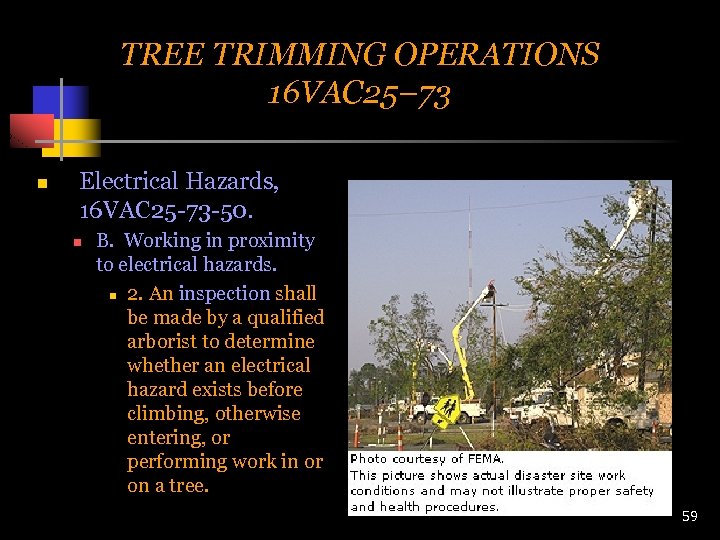
TREE TRIMMING OPERATIONS 16 VAC 25– 73 n Electrical Hazards, 16 VAC 25 -73 -50. n B. Working in proximity to electrical hazards. n 2. An inspection shall be made by a qualified arborist to determine whether an electrical hazard exists before climbing, otherwise entering, or performing work in or on a tree. 59
TREE TRIMMING OPERATIONS 16 VAC 25– 73 n Electrical Hazards, 16 VAC 25 -73 -50. n B. Working in proximity to electrical hazards. n 3. Only qualified line-clearance arborists or qualified line-clearance arborist trainees shall be assigned to work where an electrical hazard exists. Qualified line-clearance arborist trainees shall be under the direct supervision of qualified line-clearance arborists. A qualified line-clearance arborist trainee shall not serve as a ground observer for another qualified line-clearance arborist trainee who is engaged in line clearing operations aloft, unless a qualified arborist is also present at the work site. n 4. All other arborists and other workers shall maintain a minimum approach distance from energized electrical conductors in accordance with Table 1. 60
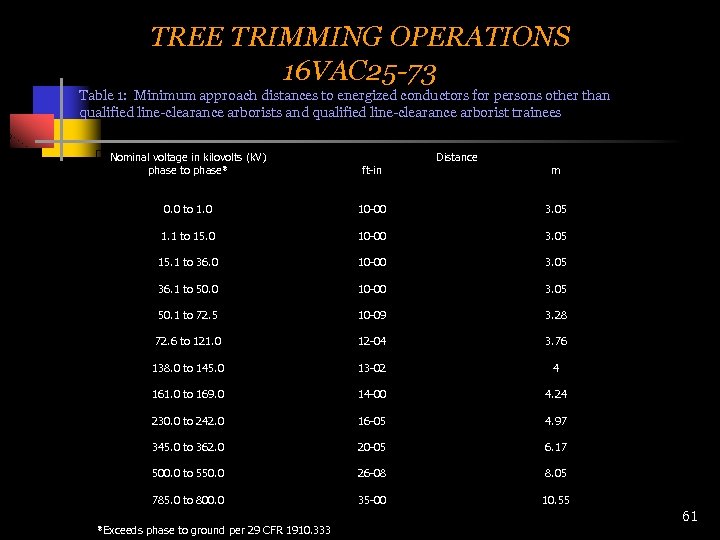
TREE TRIMMING OPERATIONS 16 VAC 25 -73 Table 1: Minimum approach distances to energized conductors for persons other than qualified line-clearance arborists and qualified line-clearance arborist trainees Nominal voltage in kilovolts (k. V) phase to phase* ft-in 0. 0 to 1. 0 10 -00 3. 05 1. 1 to 15. 0 10 -00 3. 05 15. 1 to 36. 0 10 -00 3. 05 36. 1 to 50. 0 10 -00 3. 05 50. 1 to 72. 5 10 -09 3. 28 72. 6 to 121. 0 12 -04 3. 76 138. 0 to 145. 0 13 -02 4 161. 0 to 169. 0 14 -00 4. 24 230. 0 to 242. 0 16 -05 4. 97 345. 0 to 362. 0 20 -05 6. 17 500. 0 to 550. 0 26 -08 8. 05 785. 0 to 800. 0 35 -00 10. 55 *Exceeds phase to ground per 29 CFR 1910. 333 Distance m 61
TREE TRIMMING OPERATIONS 16 VAC 25– 73 Electrical Hazards, 16 VAC 25 -73 -50. n n B. Working in proximity to electrical hazards. n 5. Branches hanging on an energized electrical conductor shall be removed using nonconductive equipment. n 6. The tie-in position shall be above the work area and located in such a way that a slip would swing the arborist away from any energized electrical conductor or other identified hazard. n 7. While climbing, the arborist shall climb on the side of the tree that is away from energized electrical conductors while maintaining the required distances shown in Table 1. n 8. Footwear, including lineman's overshoes or those with electrical-resistant soles, shall not be considered as providing any measure of safety from electrical hazards. 62
TREE TRIMMING OPERATIONS 16 VAC 25– 73 n Safe use of vehicles and mobile equipment used in arboriculture, 16 VAC 25 -73 -60. n A. General. n 1. Prior to daily use of any vehicles and mobile equipment (units), visual walk-around inspections and operational checks shall be made in accordance with manufacturers' and owners' instructions (see 16 VAC 25 -60 -120) and applicable federal, state, and local requirements. n 2. Units shall be equipped and maintained with manufacturers' safety devices, instructions, warnings, and safeguards. Arborists and other workers shall follow instructions provided by manufacturers. n 3. Manufacturers' preventive maintenance inspections and parts replacement procedures shall be followed. n 4. Manufacturers' instructions shall be followed in detecting hydraulic leaks. No part of the body shall be used to locate or stop 63 hydraulic leaks.
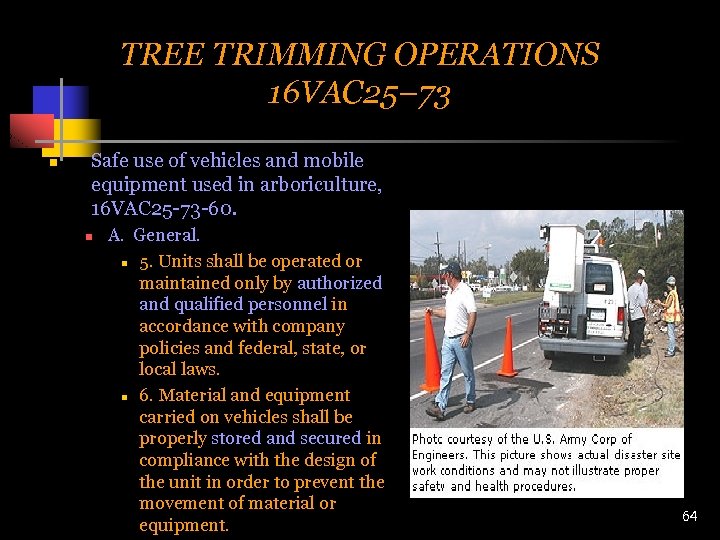
TREE TRIMMING OPERATIONS 16 VAC 25– 73 n Safe use of vehicles and mobile equipment used in arboriculture, 16 VAC 25 -73 -60. n A. General. n 5. Units shall be operated or maintained only by authorized and qualified personnel in accordance with company policies and federal, state, or local laws. n 6. Material and equipment carried on vehicles shall be properly stored and secured in compliance with the design of the unit in order to prevent the movement of material or equipment. 64
TREE TRIMMING OPERATIONS 16 VAC 25– 73 n Safe use of vehicles and mobile equipment used in arboriculture, 16 VAC 25 -73 -60. n A. General (continued). n n n 7. If previously installed by the manufacturer, step surfaces and platforms on mobile equipment shall be properly maintained. 8. Safety seat belts, when provided by the manufacturer, shall be worn while a unit is being operated. 9. Riding or working outside or on top of units shall not be permitted unless the units are designed for that purpose or the operator is performing maintenance or inspection. Fall protection shall be provided for employees performing maintenance on top of units six feet or more above a lower level. Fall protection is not required when performing inspections on top of units six feet or more above a lower level. 65
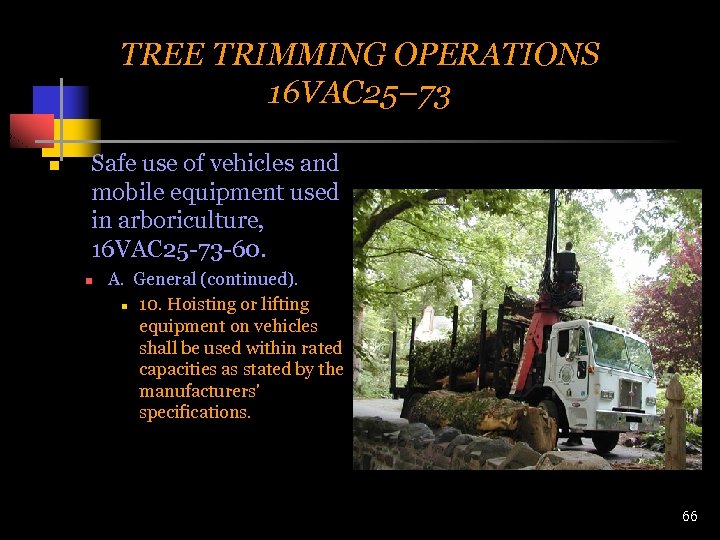
TREE TRIMMING OPERATIONS 16 VAC 25– 73 n Safe use of vehicles and mobile equipment used in arboriculture, 16 VAC 25 -73 -60. n A. General (continued). n 10. Hoisting or lifting equipment on vehicles shall be used within rated capacities as stated by the manufacturers' specifications. 66
TREE TRIMMING OPERATIONS 16 VAC 25– 73 n Safe use of vehicles and mobile equipment used in arboriculture, 16 VAC 25 -73 -60. n A. General (continued). n 11. Units with obscured rear vision, particularly those with towed equipment, shall be backed up in accordance with 16 VAC 25 -97. See Virginia Unique Regulation: Reverse Signal Operation Safety Requirements for Vehicles, Machinery and Equipment for General Industry and the Construction Industry, 16 VAC 25 -97 http: //www. doli. virginia. gov/vosh_enforcement/reverse_sign al. html 67
TREE TRIMMING OPERATIONS 16 VAC 25– 73 n Safe use of vehicles and mobile equipment used in arboriculture, 16 VAC 25 -73 -60. n A. General (continued). n n n 12. When units are left unattended, keys shall be removed from ignition, the wheels chocked, and, if applicable, the parking brake applied. 13. Units shall be turned off, keys removed from the ignition, and rotating parts at rest prior to making repairs or adjustments, except where manufacturers' procedures require otherwise. Defects or malfunctions affecting the safe operation of equipment shall be corrected before such units are placed into use. 14. Personal protective equipment (for example, eye, head, hand, and ear protection) shall be worn in accordance with 68 16 VAC 25 -73 -40 D.
TREE TRIMMING OPERATIONS 16 VAC 25– 73 n Safe use of vehicles and mobile equipment used in arboriculture, 16 VAC 25 -73 -60. n A. General. n n 15. When towing, safety chains shall be crossed under the tongue of the unit being towed and connected to the towing vehicle. 16. The unit's exhaust system shall not present a fire hazard. 17. Towed units that detach from another unit (for example, a motorized vehicle) shall be chocked or otherwise secured in place. 18. Units operated off-road shall be operated in the proper gear and at the proper speed relative to the operating environment and the manufacturers' instructions and guidelines. 69
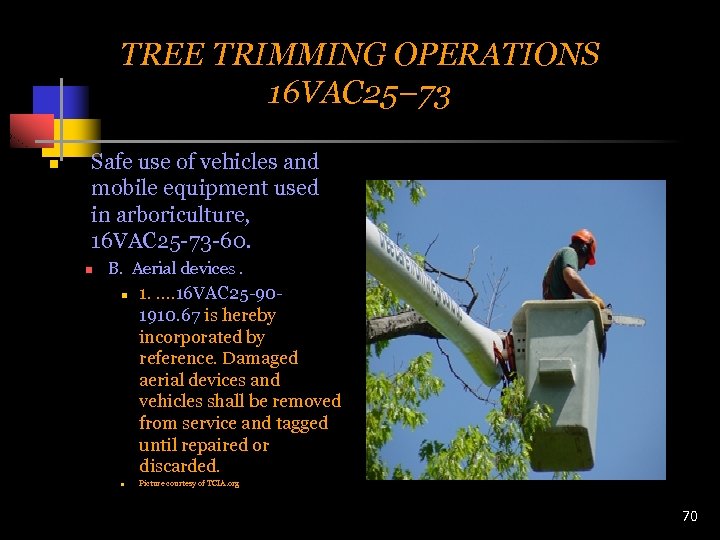
TREE TRIMMING OPERATIONS 16 VAC 25– 73 n Safe use of vehicles and mobile equipment used in arboriculture, 16 VAC 25 -73 -60. n B. Aerial devices. n n 1. …. 16 VAC 25 -901910. 67 is hereby incorporated by reference. Damaged aerial devices and vehicles shall be removed from service and tagged until repaired or discarded. Picture courtesy of TCIA. org 70
TREE TRIMMING OPERATIONS 16 VAC 25– 73 n Safe use of vehicles and mobile equipment used in arboriculture, 16 VAC 25 -73 -60. n B. Aerial devices (continued). n n n 1. The items contained in subsection A of this section shall always be included in the review of this section. 16 VAC 25 -90 -1910. 67 is hereby incorporated by reference. Damaged aerial devices and vehicles shall be removed from service and tagged until repaired or discarded. 2. Aerial devices shall be provided with an approved point of attachment on which to secure a full-body harness with an energyabsorbing lanyard, which shall be worn when aloft. 3. Booms, buckets, or any other part of the aerial device shall not be allowed to make contact or violate minimum approach distances with energized electrical conductors, poles, or similar conductive objects. See Table 1 of 16 VAC 25 -73 -50 or §§ 59. 1 -406 through 59. 1414 of the Code of Virginia (Overhead High Voltage Line Safety Act), as applicable. 71
TREE TRIMMING OPERATIONS 16 VAC 25– 73 n Safe use of vehicles and mobile equipment used in arboriculture, 16 VAC 25 -73 -60. n B. Aerial devices (continued). n n n 4. Aerial devices or aerial ladders shall not be used as cranes or hoists to lift or lower materials or tree parts, unless they were specifically designed by the manufacturer to do so (see 16 VAC 25 -60 -120). 5. Wheel chocks shall be set before using an aerial device unless the device has no wheels on the ground or is designed for use without chocks. 7. The operator shall ensure adequate clearance exists and give warning to all employees in the work area prior to lowering outriggers. Pads shall be placed under outrigger feet when they are needed to ensure stable footing. 72
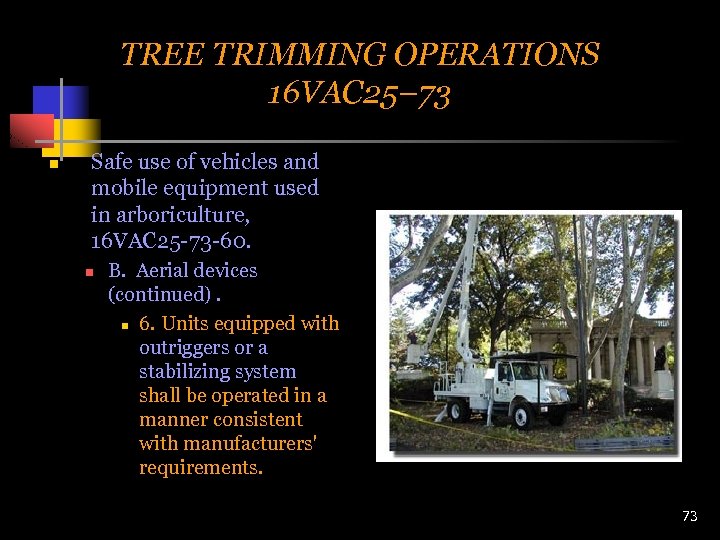
TREE TRIMMING OPERATIONS 16 VAC 25– 73 n Safe use of vehicles and mobile equipment used in arboriculture, 16 VAC 25 -73 -60. n B. Aerial devices (continued). n 6. Units equipped with outriggers or a stabilizing system shall be operated in a manner consistent with manufacturers' requirements. 73
TREE TRIMMING OPERATIONS 16 VAC 25– 73 n Safe use of vehicles and mobile equipment used in arboriculture, 16 VAC 25 -73 -60. n B. Aerial devices (continued). n n 8. When operating aerial devices, the operator shall look in the direction the bucket is traveling and be aware of the location of the booms in relation to all other objects and hazards. 9. Clearances from passing vehicles shall be maintained, or traffic control shall be provided when booms or buckets are operated over roads in accordance with VDOT's Virginia Work Area Protection Manual. 10. One-person buckets shall not have more than one person in them during operations. 11. Hydraulic/pneumatic tools shall be disconnected when they are being serviced or adjusted, except where manufacturers' procedures require otherwise. 74
TREE TRIMMING OPERATIONS 16 VAC 25– 73 n Safe use of vehicles and mobile equipment used in arboriculture, 16 VAC 25 -73 -60. n B. Aerial devices (continued). n n 12. To avoid flying particles or whipping hydraulic/pneumatic hoses, pressure shall be released before connections are broken, except where quick-acting connectors are used. Hydraulic/pneumatic hoses shall never be kinked in order to cut off pressure. 13. No part of the body shall be used to locate or stop hydraulic leaks. 14. Hoses affecting dielectric characteristics of equipment shall meet manufacturers' requirements. 15. The flash point of hydraulic fluid shall meet the minimum set by the manufacturer. 75
TREE TRIMMING OPERATIONS 16 VAC 25– 73 n Safe use of vehicles and mobile equipment used in arboriculture, 16 VAC 25 -73 -60. n B. Aerial devices (continued). n 16. Combined loads shall not exceed rated lift capacities. Load ratings shall be conspicuously and permanently posted on aerial devices in accordance with ANSI A 92. 2. n 17. Electric cables/cords used with electric saws or lights, or other conductive material shall not be run from the vehicle to the bucket when arborists are working in proximity to energized electrical conductors. n 18. Aerial devices shall not be moved with an arborist on an elevated platform (for example, a bucket) except when equipment is specifically designed for such operation. 76
TREE TRIMMING OPERATIONS 16 VAC 25– 73 n Safe use of vehicles and mobile equipment used in arboriculture, 16 VAC 25 -73 -60. n B. Aerial devices (continued). n n n 19. Holes shall not be drilled in buckets or liners. 20. During aerial device operations, arborists and other workers who are not qualified line-clearance arborists shall maintain a minimum approach distance from energized electrical conductors in accordance with Table 1 of 16 VAC 25 -73 -50. Only qualified line-clearance arborists or qualified line-clearance arborist trainees using an insulated aerial device may operate in accordance with minimum approach distances provided in Table 1. 22. All underground hazards shall be located prior to operating aerial lift devices off-road. These hazards could include natural 77 gas tanks, underground oil tanks, and septic systems.
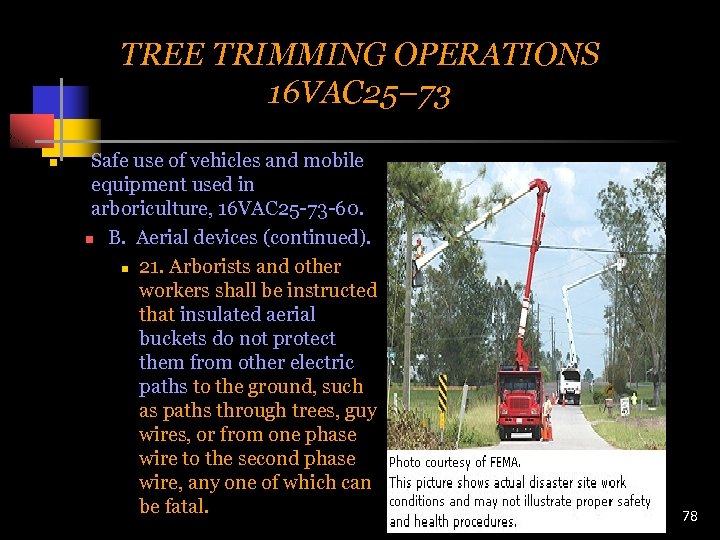
TREE TRIMMING OPERATIONS 16 VAC 25– 73 n Safe use of vehicles and mobile equipment used in arboriculture, 16 VAC 25 -73 -60. n B. Aerial devices (continued). n 21. Arborists and other workers shall be instructed that insulated aerial buckets do not protect them from other electric paths to the ground, such as paths through trees, guy wires, or from one phase wire to the second phase wire, any one of which can be fatal. 78
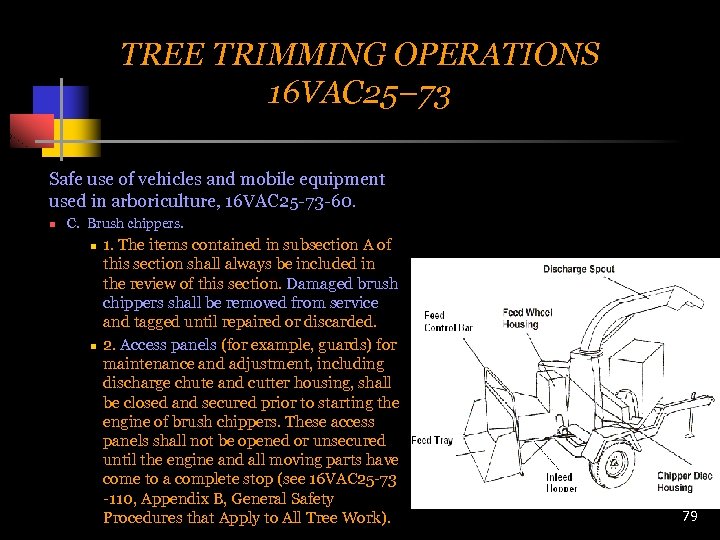
TREE TRIMMING OPERATIONS 16 VAC 25– 73 Safe use of vehicles and mobile equipment used in arboriculture, 16 VAC 25 -73 -60. n C. Brush chippers. n n 1. The items contained in subsection A of this section shall always be included in the review of this section. Damaged brush chippers shall be removed from service and tagged until repaired or discarded. 2. Access panels (for example, guards) for maintenance and adjustment, including discharge chute and cutter housing, shall be closed and secured prior to starting the engine of brush chippers. These access panels shall not be opened or unsecured until the engine and all moving parts have come to a complete stop (see 16 VAC 25 -73 -110, Appendix B, General Safety Procedures that Apply to All Tree Work). 79
TREE TRIMMING OPERATIONS 16 VAC 25– 73 n Safe use of vehicles and mobile equipment used in arboriculture, 16 VAC 25 -73 -60. n C. Brush chippers [selected provisions, refer to regulation]. n n 3. Rotary drum or disc brush chippers not equipped with a mechanical infeed system shall be equipped with an infeed hopper not less than 85 inches (2. 15 m) measured from the blades or knives to ground level over the center line of the hopper. Side members of the infeed hopper shall have sufficient height so as to prevent workers from contacting the blades or knives during operations. 4. Rotary drum or disc brush chippers not equipped with a mechanical infeed system shall have a flexible anti-kickback device installed in the infeed hopper to reduce the risk of injury from flying chips and debris. 80
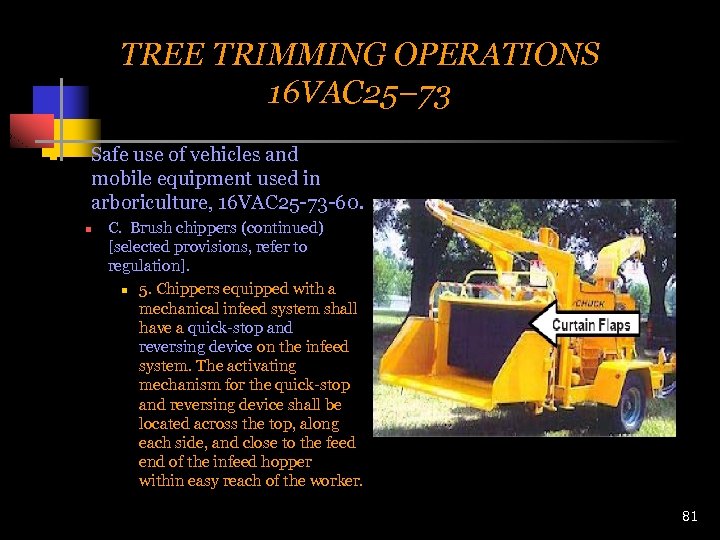
TREE TRIMMING OPERATIONS 16 VAC 25– 73 n Safe use of vehicles and mobile equipment used in arboriculture, 16 VAC 25 -73 -60. n C. Brush chippers (continued) [selected provisions, refer to regulation]. n 5. Chippers equipped with a mechanical infeed system shall have a quick-stop and reversing device on the infeed system. The activating mechanism for the quick-stop and reversing device shall be located across the top, along each side, and close to the feed end of the infeed hopper within easy reach of the worker. 81
TREE TRIMMING OPERATIONS 16 VAC 25– 73 n Safe use of vehicles and mobile equipment used in arboriculture, 16 VAC 25 -73 -60. n C. Brush chippers (continued) [selected provisions, refer to regulation]. n n n 6. Vision, hearing, and other appropriate personal protective equipment shall be worn when in the immediate area of a brush chipper in accordance with 16 VAC 25 -73 -40 D. 7. Arborists, mechanics, and other workers shall not, under any circumstances, reach into the infeed hopper when the cutter disc, rotary drum, or feed rollers are moving. 8. When trailer chippers are detached from the vehicles, they shall be chocked or otherwise secured in place. 9. When in a towing position, chipper safety chains shall be crossed under the tongue of the chipper and properly affixed to the towing vehicle. 82 10. See 16 VAC 25 -73 -90 F, for additional requirements.
TREE TRIMMING OPERATIONS 16 VAC 25– 73 n Safe use of vehicles and mobile equipment used in arboriculture, 16 VAC 25 -73 -60. n D. Sprayers and related equipment [selected provisions, refer to regulation]. n n 1. The items contained in subsection A of this section shall always be included in the review of this section. Damaged sprayers and related equipment shall be removed from service and tagged until repaired or discarded. 2. Walking and working surfaces of all sprayers and related equipment shall be covered with skid-resistant material. 3. Equipment on which the applicator/operator stands while the vehicle is in motion shall be equipped with guardrails around the working area. Guardrails shall be constructed in accordance with 16 VAC 25 -90 -1910. 23. 4. The applicator/operator shall make a visual inspection of hoses, fittings, exposed plumbing, tanks, covers, and related equipment prior to its use each workday. 83
TREE TRIMMING OPERATIONS 16 VAC 25– 73 n Safe use of vehicles and mobile equipment used in arboriculture, 16 VAC 25 -73 -60. n D. Sprayers and related equipment (continued). n 5. The applicator/operator shall not allow hoses or other parts of the equipment to create a tripping hazard for coworkers or the public. n 6. The applicator/operator shall have a firm grip on the spray gun/excavation tool when pulling the trigger. n 7. The operator of high-pressure excavation equipment shall wear a face shield in addition to eye protection. n 8. Related equipment: n a. The applicator/operator shall be aware of underground utility locations when drilling holes in the ground for fertilizer or pesticide applications. n b. The equipment shall have splash guards, and the applicator shall wear eye protection when injecting liquid fertilizer or pesticides into the ground. n c. The applicator shall wear eye protection and follow label instructions 84 when injecting liquids into trees.
TREE TRIMMING OPERATIONS 16 VAC 25– 73 n Safe use of vehicles and mobile equipment used in arboriculture, 16 VAC 25 -73 -60. n E. Stump cutters. n 1. The items contained in subsection A of this section shall always be included in the review of this section. Damaged stump cutters shall be removed from service and tagged until repaired or discarded. n 2. Stump cutters shall be equipped with enclosures or guards that reduce the risk of injury during operation. Enclosures or guards shall be kept in place when stump cutters are operative. n 3. Arborists and other workers in the immediate stumpcutting work zone shall wear vision, hearing, and other personal protective equipment in accordance with 16 VAC 2573 -40 D. 85
TREE TRIMMING OPERATIONS 16 VAC 25– 73 n Safe use of vehicles and mobile equipment used in arboriculture, 16 VAC 25 -73 -60. n E. Stump cutters (continued). n n n 4. When in a towing position, stump-cutter safety chains shall be crossed under the tongue of the stump cutter and properly affixed to the towing vehicle. 5. Towable stump cutters or stump-cutter trailers, when detached from the vehicle, shall be chocked or otherwise secured in place. 6. The operator shall be aware of underground utility locations prior to performing work. 86
TREE TRIMMING OPERATIONS 16 VAC 25– 73 n Safe use of vehicles and mobile equipment used in arboriculture, 16 VAC 25 -73 -60. n F. Vehicles. n n n 1. The items contained in subsection A of this section shall always be included in the review of this section. (See 16 VAC 25 -60 -120. ) Damaged vehicles shall be removed from service and tagged until repaired or discarded. 2. A steel bulkhead or equivalent protective devices shall be provided to protect workers from load shifts in vehicles carrying logs or other material. 5. To avoid the hazard of spontaneous combustion or the generation of undesirable odors, wood chips shall not be left in vehicles for extended periods. 87
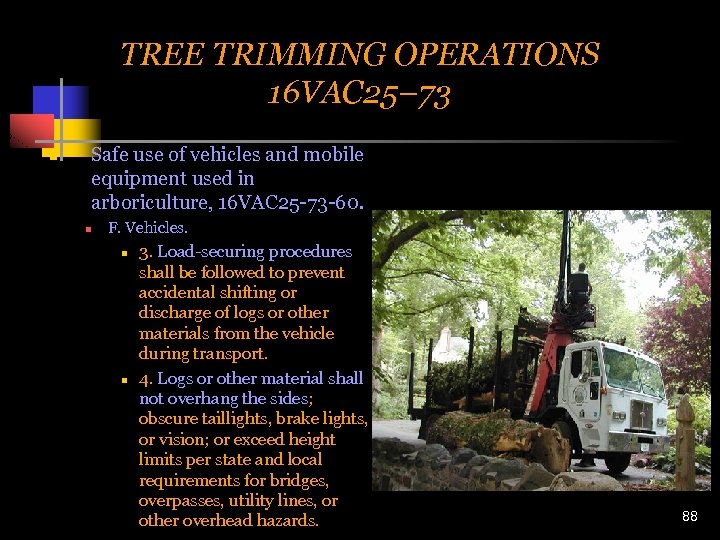
TREE TRIMMING OPERATIONS 16 VAC 25– 73 n Safe use of vehicles and mobile equipment used in arboriculture, 16 VAC 25 -73 -60. n F. Vehicles. n n 3. Load-securing procedures shall be followed to prevent accidental shifting or discharge of logs or other materials from the vehicle during transport. 4. Logs or other material shall not overhang the sides; obscure taillights, brake lights, or vision; or exceed height limits per state and local requirements for bridges, overpasses, utility lines, or other overhead hazards. 88
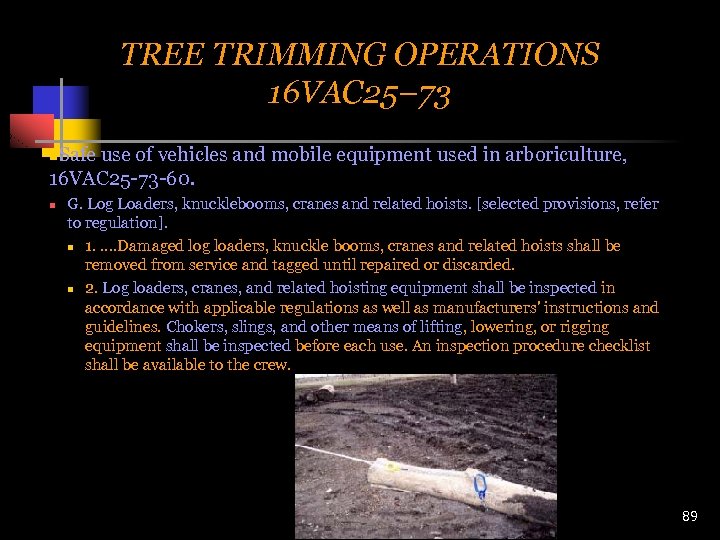
TREE TRIMMING OPERATIONS 16 VAC 25– 73 Safe use of vehicles and mobile equipment used in arboriculture, 16 VAC 25 -73 -60. n n G. Log Loaders, knucklebooms, cranes and related hoists. [selected provisions, refer to regulation]. n 1. …. Damaged log loaders, knuckle booms, cranes and related hoists shall be removed from service and tagged until repaired or discarded. n 2. Log loaders, cranes, and related hoisting equipment shall be inspected in accordance with applicable regulations as well as manufacturers' instructions and guidelines. Chokers, slings, and other means of lifting, lowering, or rigging equipment shall be inspected before each use. An inspection procedure checklist shall be available to the crew. 89
TREE TRIMMING OPERATIONS 16 VAC 25– 73 n Safe use of vehicles and mobile equipment used in arboriculture, 16 VAC 25 -73 -60. n G. Log Loaders, knucklebooms, cranes and related hoists (continued). n 3. Operators of hoisting equipment shall be trained and shall maintain a minimum approach distance from energized conductors in accordance with Table 1 of 16 VAC 25 -73 -50, or §§ 59. 1 -406 through 59. 1 -414, Overhead High Voltage Line Safety Act, as applicable. A spotter shall be used when work is being performed in proximity to electrical conductors. Personnel assigned to work in proximity to the tree removal shall be trained and follow guidelines for electrical hazards (see 16 VAC 25 -7350). 90
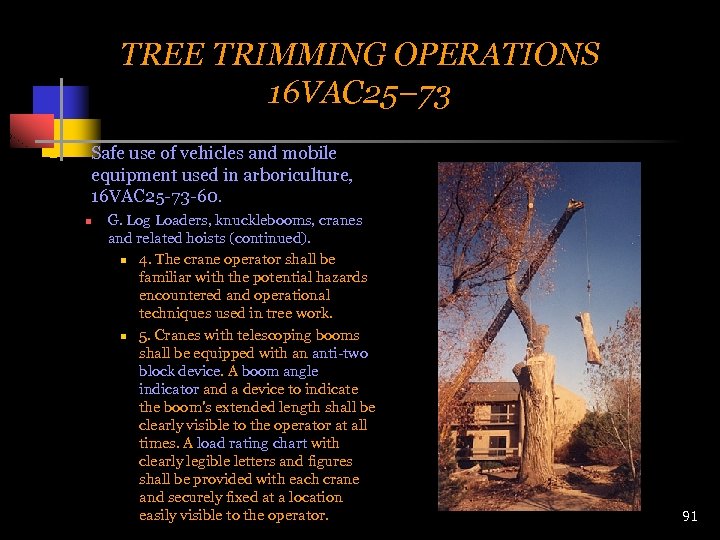
TREE TRIMMING OPERATIONS 16 VAC 25– 73 n Safe use of vehicles and mobile equipment used in arboriculture, 16 VAC 25 -73 -60. n G. Log Loaders, knucklebooms, cranes and related hoists (continued). n 4. The crane operator shall be familiar with the potential hazards encountered and operational techniques used in tree work. n 5. Cranes with telescoping booms shall be equipped with an anti-two block device. A boom angle indicator and a device to indicate the boom's extended length shall be clearly visible to the operator at all times. A load rating chart with clearly legible letters and figures shall be provided with each crane and securely fixed at a location easily visible to the operator. 91
TREE TRIMMING OPERATIONS 16 VAC 25– 73 n Safe use of vehicles and mobile equipment used in arboriculture, 16 VAC 25 -73 -60. n G. Log Loaders, knucklebooms, cranes and related hoists (continued). n 6. Operators of hoisting equipment shall remain at the controls while a load is lifted, suspended, or lowered. n 7. Tree sections shall be rigged to minimize load shifting. Controlled load lowering shall be employed. Shock-loading shall be avoided, and free fall is prohibited. A green log weight chart (see 16 VAC 25 -73 -130, Appendix D), shall be available to the crew. All workers shall be kept clear of loads about to be lifted and of suspended loads. n 8. Riding the load line of a crane while it is under load tension is prohibited. 92
TREE TRIMMING OPERATIONS 16 VAC 25– 73 n Safe use of vehicles and mobile equipment used in arboriculture, 16 VAC 25 -73 -60. n G. Log Loaders, knucklebooms, cranes and related hoists. (continued). n 9. The use of a crane to hoist a qualified arborist into position is prohibited, except when the use of conventional means of reaching the work area, such as, but not limited to, an aerial lift, would be more hazardous or is not physically possible because of worksite conditions. If the above exception applies, a qualified arborist may be hoisted into position utilizing a crane if the crane manufacturer's specifications and limitations do not prohibit such use, and any fall protection requirements of the crane manufacturer are complied with, and the arborist is tied in with an arborist climbing line and arborist saddle and secured to a designated anchor point on the boom line or crane. n THIS IS A RARE SITUATION, SEE 16 VAC 25 -73 -60. G. 9. a - j. FOR DETAILED PROCEDURES. 93
TREE TRIMMING OPERATIONS 16 VAC 25– 73 n Safe use of vehicles and mobile equipment used in arboriculture, 16 VAC 25 -73 -60. n G. Log Loaders, knucklebooms, cranes and related hoists. (continued). n 9. …. The following procedures shall be followed when an arborist is to be lifted by a crane: n a. The qualified crane operator, the signal person, the person responsible for the work to be performed and the arborist to be lifted shall meet prior to the work to review the procedures to be followed. A job briefing shall be done before any work begins, in accordance with 16 VAC 25 -73 -40 A 4. n b. The arborist climbing line shall be secured to the crane in such a way that it does not interfere with the function of any damage-prevention or warning device on the crane and so that no part of the crane compromises the climbing line or 94 any component of the climbing system.
TREE TRIMMING OPERATIONS 16 VAC 25– 73 n Safe use of vehicles and mobile equipment used in arboriculture, 16 VAC 25 -73 -60. n G. Log Loaders, knucklebooms, cranes and related hoists. (continued). n 9. …. The following procedures shall be followed when an arborist is to be lifted by a crane: n c. The crane operator shall test the adequacy of footing prior to any lifting, and shall conduct a trial lift immediately before lifting the arborist into position. The crane operator shall determine that all systems, controls and safety devices are activated and functioning properly; that no interferences exist; and that all configurations necessary to reach the intended work location will allow the operator to remain under the 50% limit of the hoist's rated capacity. The crane shall be uniformly level and located on firm footing. If necessary, blocking shall be used so that the support system does not exceed its load-bearing capabilities. Cranes equipped with outriggers shall have them all fully extended and properly set, as applicable, before lifting and lowering operations begin and/or 95 before the qualified arborist is lifted.
TREE TRIMMING OPERATIONS 16 VAC 25– 73 n Safe use of vehicles and mobile equipment used in arboriculture, 16 VAC 25 -73 -60. n G. Log Loaders, knucklebooms, cranes and related hoists. (continued). n 9. …. The following procedures shall be followed when an arborist is to be lifted by a crane: n d. Lifting and supporting shall be done under controlled conditions and under the direction of a qualified arborist or an appointed signal person. Lifting and supporting operations shall not be performed during adverse weather conditions such as thunderstorms, high winds, and snow and ice storms. n e. The load-line hoist drum shall have a system or other device on the power train, other than the load hoist brake, that regulates the lowering speed of the hoist mechanism. Load lines shall be capable of supporting, without failure, at least seven times the maximum intended load, except that where rotation resistant rope is used, the lines shall be capable of supporting without failure, at least 10 times the maximum intended load. The required design factor is achieved by taking the current safety factor of 3. 5 and applying 50% de-rating of the crane 96 capacity.
TREE TRIMMING OPERATIONS 16 VAC 25– 73 n Safe use of vehicles and mobile equipment used in arboriculture, 16 VAC 25 -73 -60. n G. Log Loaders, knucklebooms, cranes and related hoists. (continued). n 9. …. The following procedures shall be followed when an arborist is to be lifted by a crane: n n f. Communication between the crane operator and the arborist being lifted shall be maintained either directly or through the appointed signal person. This communication shall either be visual, using the accepted hand signals, or audible, using voice or radio. Radio communication shall be used to control blind picks. The crew members shall know and follow hand signals for standard crane operations (see 16 VAC 25 -73 -150, Appendix F). g. The crane operator shall remain at the controls when the qualified arborist is attached to the crane and during lifting and lowering operations. 97
TREE TRIMMING OPERATIONS 16 VAC 25– 73 n Safe use of vehicles and mobile equipment used in arboriculture, 16 VAC 25 -73 -60. n G. Log Loaders, knucklebooms, cranes and related hoists. (continued). n 9. …. The following procedures shall be followed when an arborist is to be lifted by a crane: n h. The crane boom and load line shall be moved in a slow, controlled, cautious manner when the arborist is attached. Lifting or lowering speed shall not exceed 100 feet/minute (0. 5 m/sec), and any sudden movements shall be avoided. The crane shall be operated so that lowering is power controlled. n i. The crane carrier shall not travel at any time while the qualified arborist is attached. An accurate determination of the load radius to be used during lifting shall be made before the qualified arborist is hoisted. n j. The qualified arborist shall be detached from the crane any time it comes under load tension. 98
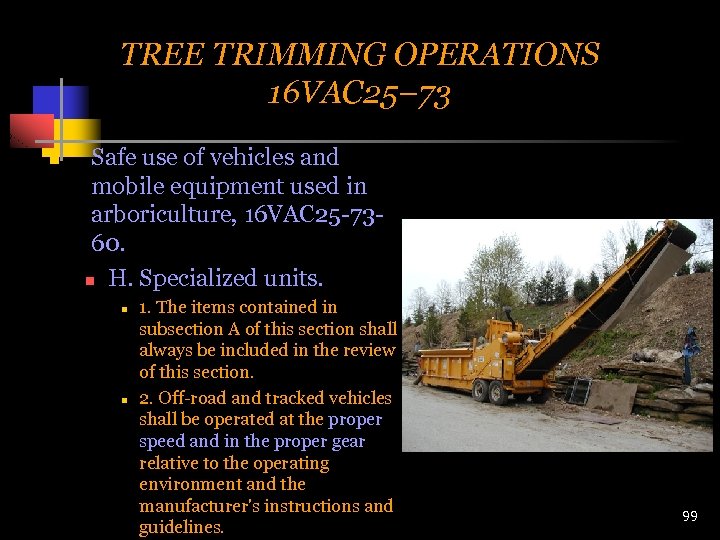
TREE TRIMMING OPERATIONS 16 VAC 25– 73 n Safe use of vehicles and mobile equipment used in arboriculture, 16 VAC 25 -7360. n H. Specialized units. n n 1. The items contained in subsection A of this section shall always be included in the review of this section. 2. Off-road and tracked vehicles shall be operated at the proper speed and in the proper gear relative to the operating environment and the manufacturer's instructions and guidelines. 99
TREE TRIMMING OPERATIONS 16 VAC 25– 73 n Safe use of vehicles and mobile equipment used in arboriculture, 16 VAC 25 -73 -60. n H. Specialized units (continued). n 3. Deadman controls on towing equipment for brush hogs and similar implements shall be used and maintained in good working condition. If the deadman control is malfunctioning or not operational, the equipment shall be removed from service and tagged until it has been repaired or discarded. When deadman controls were not provided by the manufacturer, the worker shall disengage the power source to the rotary or cutter head before dismounting. 100
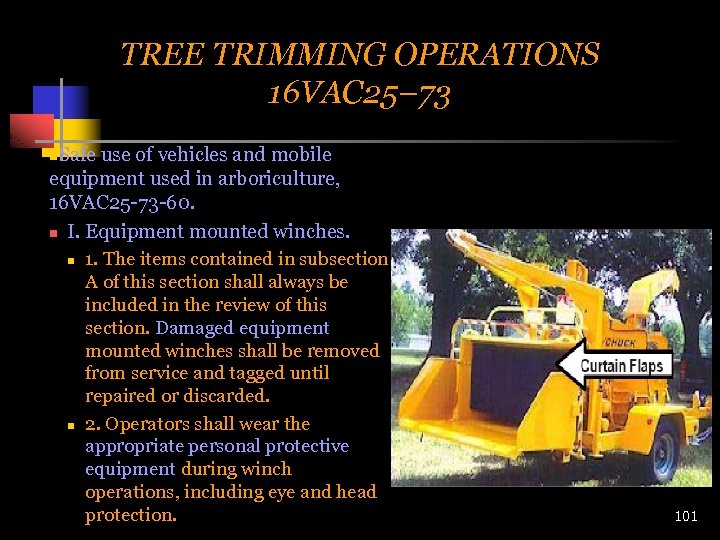
TREE TRIMMING OPERATIONS 16 VAC 25– 73 Safe use of vehicles and mobile equipment used in arboriculture, 16 VAC 25 -73 -60. n I. Equipment mounted winches. n n n 1. The items contained in subsection A of this section shall always be included in the review of this section. Damaged equipment mounted winches shall be removed from service and tagged until repaired or discarded. 2. Operators shall wear the appropriate personal protective equipment during winch operations, including eye and head protection. 101
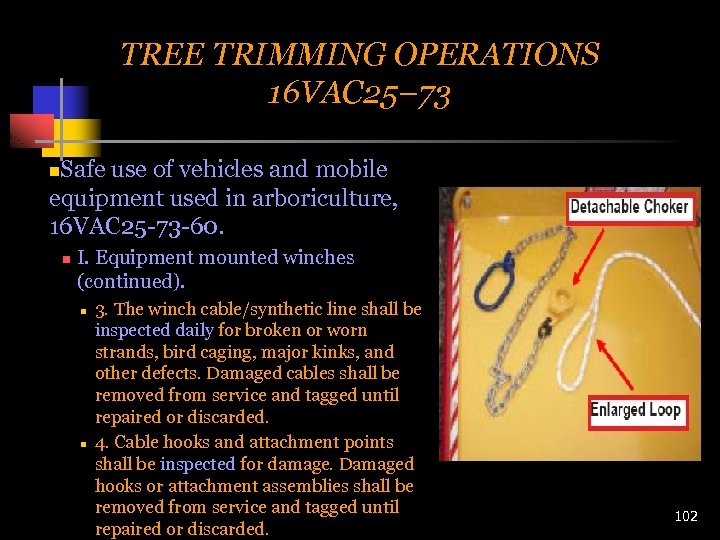
TREE TRIMMING OPERATIONS 16 VAC 25– 73 Safe use of vehicles and mobile equipment used in arboriculture, 16 VAC 25 -73 -60. n n I. Equipment mounted winches (continued). n n 3. The winch cable/synthetic line shall be inspected daily for broken or worn strands, bird caging, major kinks, and other defects. Damaged cables shall be removed from service and tagged until repaired or discarded. 4. Cable hooks and attachment points shall be inspected for damage. Damaged hooks or attachment assemblies shall be removed from service and tagged until repaired or discarded. 102
TREE TRIMMING OPERATIONS 16 VAC 25– 73 n Safe use of vehicles and mobile equipment used in arboriculture, 16 VAC 25 -73 -60. n I. Equipment mounted winches (continued). n n n 5. All mounting bolts and hardware shall be inspected for loose or missing components. The winch shall not be used until complete repairs are made to damaged or missing bolts and hardware. 6. Operators shall be aware of the dangers of load or cable breakage and ensure that all personnel remain clear of the recoil area in the event of load or cable breakage. 7. All winch operators shall be properly trained and be aware of the inherent dangers associated with winch operations. 103
TREE TRIMMING OPERATIONS 16 VAC 25– 73 n Safe use of vehicles and mobile equipment used in arboriculture, 16 VAC 25 -73 -60. n I. Equipment mounted winches (continued). n 8. Operators shall be aware of the winch cable at all times during extension and ensure that it does not become a hazard to personnel or machinery. n 9. Winch systems and cables shall be used only as intended and instructed by the manufacturer. n 10. The winch shall never be used with personnel, including the operator, within the span of the winch cable and the winch. n 11. Pinch point hazards develop during winching operations; therefore, all operators involved in the winching operation shall constantly be aware of such hazards and stand clear of 104 these areas.
TREE TRIMMING OPERATIONS 16 VAC 25– 73 n Safe use of vehicles and mobile equipment used in arboriculture, 16 VAC 25 -73 -60. n I. Equipment mounted winches (continued). n n 12. All loads shall be pulled in such a manner as to avoid angles that may result in tipping, cause the vehicle to become unstable, or result in unintended movement of the vehicle. 13. Pulling loads from the side requires special equipment and techniques. Therefore, loads shall be pulled in line with the winch unless the winch is properly equipped with a fair lead and the operator 105 is trained to pull loads at an angle.
TREE TRIMMING OPERATIONS 16 VAC 25– 73 n Safe use of vehicles and mobile equipment used in arboriculture, 16 VAC 25 -73 -60. n I. Equipment mounted winches (continued). n n n 14. The operator shall ensure that the vehicle supporting the winch is secured to avoid unintended movement. 15. The operator shall ensure that all rigging points comply with 16 VAC 25 -73 -90 D. 16. To ensure precise communication, an effective means of communication shall be established and used with all workers involved in the winching operations (see 16 VAC 25 -73 -90 D 14). 106
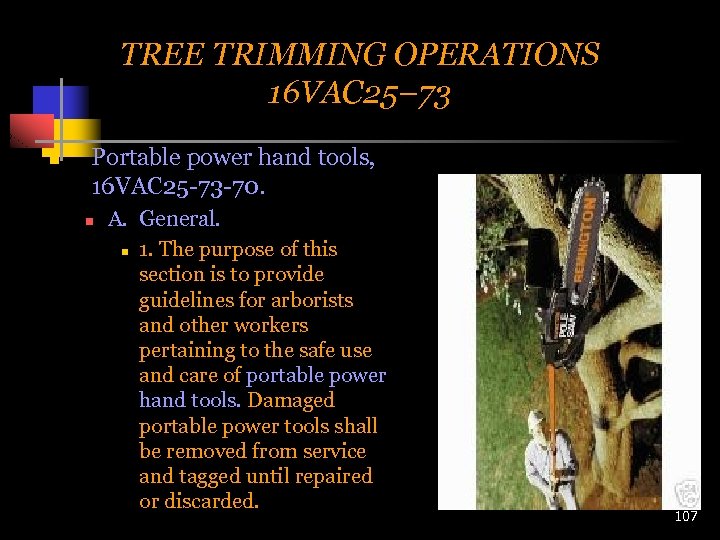
TREE TRIMMING OPERATIONS 16 VAC 25– 73 n Portable power hand tools, 16 VAC 25 -73 -70. n A. General. n 1. The purpose of this section is to provide guidelines for arborists and other workers pertaining to the safe use and care of portable power hand tools. Damaged portable power tools shall be removed from service and tagged until repaired or discarded. 107
TREE TRIMMING OPERATIONS 16 VAC 25– 73 n Portable power hand tools, 16 VAC 25 -73 -70. n A. General (continued). n n 2. Manufacturers' operating and safety instructions shall be followed (see 16 VAC 25 -60 -120). 3. Before starting or otherwise using any portable power tools, a communication system shall be established in accordance with the requirements of 16 VAC 25 -73 -90 B 1. 108
TREE TRIMMING OPERATIONS 16 VAC 25– 73 n Portable power hand tools, 16 VAC 25 -73 -70. n B. Portable electric power tools. n n n 1. …. Damaged portable electric power tools shall be removed from service and tagged until repaired or discarded. 2. Corded electric power tools shall not be used in trees or aerial devices near energized electrical conductors where there is a possibility of power tools or supply cords contacting the conductor. 3. All corded portable electric power tools shall be: n a. Equipped with three-wire cords having the ground wire permanently connected to the tool frame and a means for grounding the other end; n b. Double insulated and permanently labeled as "double insulated"; or n c. Connected to power supplies by means of an isolating transformer or other isolated power supply. 109
TREE TRIMMING OPERATIONS 16 VAC 25– 73 n Portable power hand tools, 16 VAC 25 -73 -70. n B. Portable electric power tools (continued). n n 4. Extension cords shall be maintained in safe condition. Exposed metal sockets shall not be used. Worn or frayed extension cords shall be removed from service and tagged until repaired or discarded. 5. Arborists and other workers shall: n a. Prevent cords from becoming entangled, damaged, or cut by blades and bits; n b. Not lay extension cords in water; and n c. Support electric power tools and supply cords by a tool lanyard or separate line, when used aloft. 110
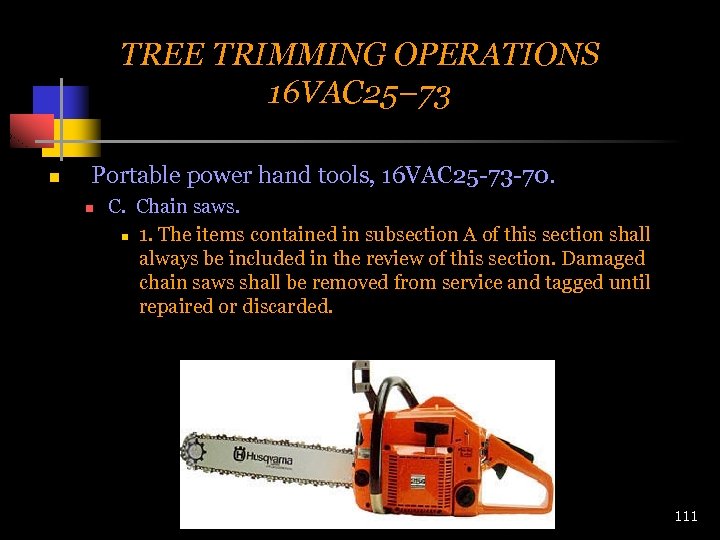
TREE TRIMMING OPERATIONS 16 VAC 25– 73 n Portable power hand tools, 16 VAC 25 -73 -70. n C. Chain saws. n 1. The items contained in subsection A of this section shall always be included in the review of this section. Damaged chain saws shall be removed from service and tagged until repaired or discarded. 111
TREE TRIMMING OPERATIONS 16 VAC 25– 73 n Portable power hand tools, 16 VAC 25 -73 -70. n C. Chain saws (continued). n n n 2. Chain saws shall not be operated unless the manufacturer's safety devices are in proper working order. Chain-saw safety devices shall not be removed or modified. 3. When an arborist or other worker is working in a tree other than from an aerial device, chain saws weighing more than 15 pounds (6. 8 kg) service weight shall be made safe against falling (i. e. , supported by a separate line or tool lanyard). 4. Secure footing shall be maintained when starting the 112 chain saw.
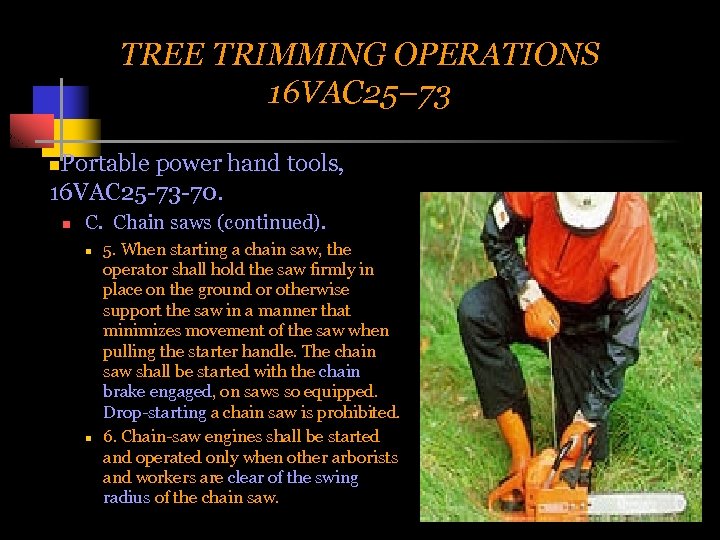
TREE TRIMMING OPERATIONS 16 VAC 25– 73 Portable power hand tools, 16 VAC 25 -73 -70. n n C. Chain saws (continued). n n 5. When starting a chain saw, the operator shall hold the saw firmly in place on the ground or otherwise support the saw in a manner that minimizes movement of the saw when pulling the starter handle. The chain saw shall be started with the chain brake engaged, on saws so equipped. Drop-starting a chain saw is prohibited. 6. Chain-saw engines shall be started and operated only when other arborists and workers are clear of the swing radius of the chain saw. 113
TREE TRIMMING OPERATIONS 16 VAC 25– 73 n Portable power hand tools, 16 VAC 25 -73 -70. n C. Chain saws (continued). n n 7. When operating a chain saw, the arborist or other worker shall hold the saw firmly with both hands, keeping the thumb and fingers wrapped around the handle. 8. Arborists shall use a second point of attachment (for example, lanyard or doublecrotched climbing line) when operating a chain saw in a tree, unless the employer demonstrates that a greater hazard is posed by using a second point of attachment while operating a chain saw in that particular situation. Using both ends of a two-in-one lanyard shall not be considered two points of attachment when using a chain saw. 114
TREE TRIMMING OPERATIONS 16 VAC 25– 73 n Portable power hand tools, 16 VAC 25 -73 -70. n C. Chain saws (continued). n n n 9. Chain-saw mufflers and spark arresters (if the latter are provided) shall be maintained in good condition. 10. The chain brake shall be engaged, or the engine shut off, before setting a chain saw down. 11. When a chain saw is being carried more than two steps, the chain brake shall be engaged or the engine shut off. The chain saw shall be carried in a manner that will prevent operator contact with the cutting chain and the muffler. 115
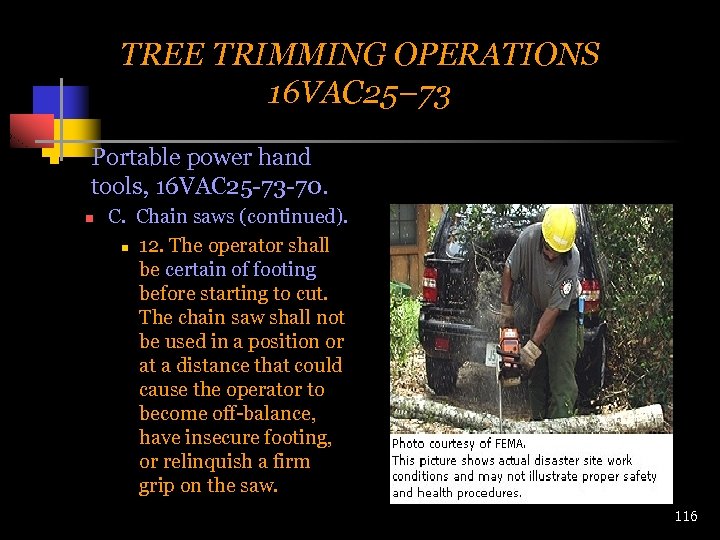
TREE TRIMMING OPERATIONS 16 VAC 25– 73 n Portable power hand tools, 16 VAC 25 -73 -70. n C. Chain saws (continued). n 12. The operator shall be certain of footing before starting to cut. The chain saw shall not be used in a position or at a distance that could cause the operator to become off-balance, have insecure footing, or relinquish a firm grip on the saw. 116
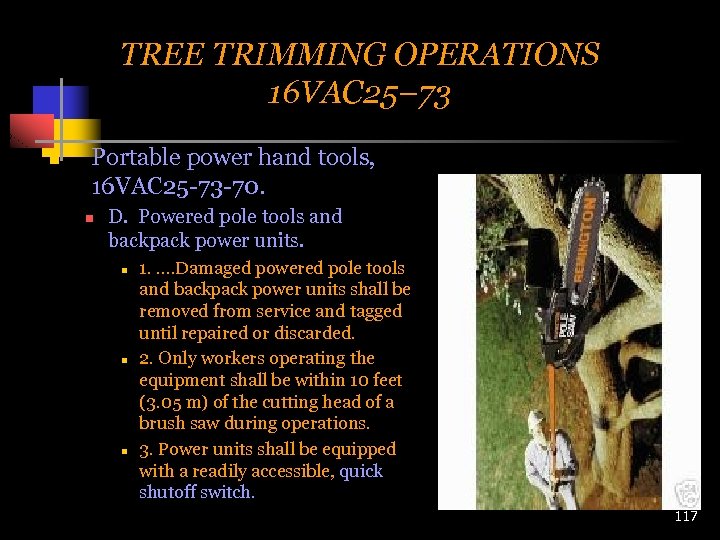
TREE TRIMMING OPERATIONS 16 VAC 25– 73 n Portable power hand tools, 16 VAC 25 -73 -70. n D. Powered pole tools and backpack power units. n n n 1. …. Damaged powered pole tools and backpack power units shall be removed from service and tagged until repaired or discarded. 2. Only workers operating the equipment shall be within 10 feet (3. 05 m) of the cutting head of a brush saw during operations. 3. Power units shall be equipped with a readily accessible, quick shutoff switch. 117
TREE TRIMMING OPERATIONS 16 VAC 25– 73 n Portable power hand tools, 16 VAC 25 -73 -70. n D. Powered pole tools and backpack power units. n n n 4. Operators shall observe the position of all other workers in the vicinity while the equipment is running. 5. Engines shall be stopped for all cleaning, refueling, adjustments, and repairs to the saw or engine, except where manufacturers' procedures require otherwise. 6. Powered pole tools with poles made of metal or other conductive material shall not be used in 118 operations where electrical hazards exist.
TREE TRIMMING OPERATIONS 16 VAC 25– 73 n Hand tools and ladders, 16 VAC 25 -73 -80. n A. General. n n 1. Correct hand tools and equipment shall be selected for the job. 2. Hand tools and equipment that have been made unsafe by damage or defect, including tools with loose or cracked heads or cracked, splintered, or weakened handles, shall be removed from service and tagged until repaired or discarded. 3. Workers shall maintain a safe working distance from other workers when using hand tools and equipment. 4. When climbing into a tree, arborists shall not carry hand tools and equipment in their hands unless the tools are used to assist them in climbing. Tools other than ropes or throwlines shall not be thrown into a tree or between workers aloft. 119
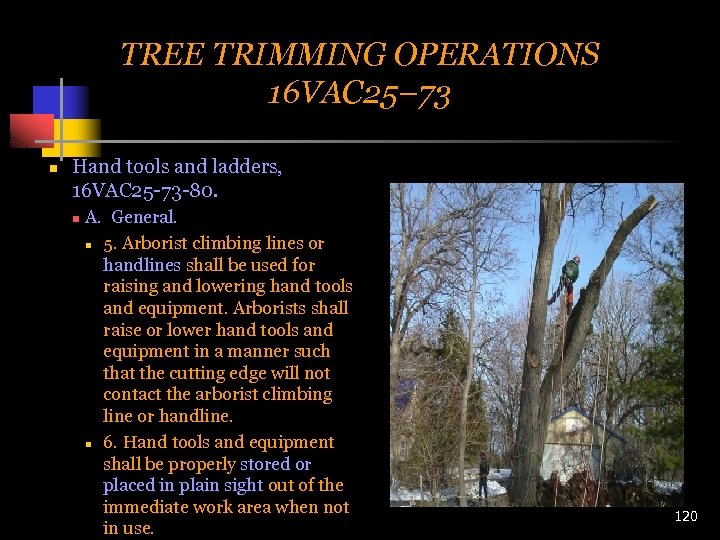
TREE TRIMMING OPERATIONS 16 VAC 25– 73 n Hand tools and ladders, 16 VAC 25 -73 -80. n A. General. n 5. Arborist climbing lines or handlines shall be used for raising and lowering hand tools and equipment. Arborists shall raise or lower hand tools and equipment in a manner such that the cutting edge will not contact the arborist climbing line or handline. n 6. Hand tools and equipment shall be properly stored or placed in plain sight out of the immediate work area when not in use. 120
TREE TRIMMING OPERATIONS 16 VAC 25– 73 n Hand tools and ladders, 16 VAC 25 -73 -80. n B. Cant hooks, cant dogs, peaveys, and tongs. n n 1. The items contained in subsection A of this section shall always be included in the review of this section. Damaged cant hooks, cant dogs, peaveys and tongs shall be removed from service and tagged until repaired or discarded. 2. Cant hooks shall be firmly set before applying force. 3. Points of hooks shall be at least two inches (5 cm) long and kept sharp. 4. Arborists and other workers shall always stand uphill from rolling logs, and all workers shall be warned and in the clear before logs are moved. 121
TREE TRIMMING OPERATIONS 16 VAC 25– 73 n Hand tools and ladders, 16 VAC 25 -73 -80. n C. Wedges, chisels, and gouges. n n n n 1. The items contained in subsection A of this section shall always be included in the review of this section. 2. Wedges, chisels, and gouges shall be inspected for cracks and flaws before use. Tools with damaged heads shall be removed from service and tagged until repaired or discarded. 3. Wedges and chisels shall be properly pointed and tempered. 4. Eye protection shall be used during impact operations. 5. Only wood, plastic, or soft-metal wedges shall be used while operating chain saws. 6. Wood-handled chisels shall be protected with a ferrule on the striking end. 7. Wood, rubber, or high-impact plastic mauls, sledges, or hammers shall be used when striking wood-handled chisels or gouges. 122
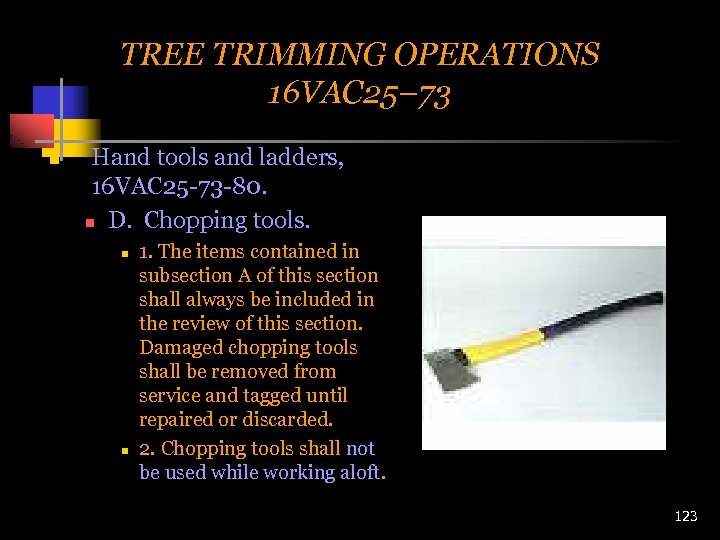
TREE TRIMMING OPERATIONS 16 VAC 25– 73 n Hand tools and ladders, 16 VAC 25 -73 -80. n D. Chopping tools. n n 1. The items contained in subsection A of this section shall always be included in the review of this section. Damaged chopping tools shall be removed from service and tagged until repaired or discarded. 2. Chopping tools shall not be used while working aloft. 123
TREE TRIMMING OPERATIONS 16 VAC 25– 73 n Hand tools and ladders, 16 VAC 25 -73 -80. n D. Chopping tools (continued). n n n 3. Chopping tools shall not be used as wedges or used to drive metal wedges. 4. Chopping tools shall be swung away from the feet, legs, and body, using the minimum force practical for function and control. 5. When swinging tools such as grub hoes, mattocks, and axes, a secure grip, firm footing, and clearance of workers and overhead hazards shall be maintained. 124
TREE TRIMMING OPERATIONS 16 VAC 25– 73 n Hand tools and ladders, 16 VAC 25 -73 -80. n E. Ladders. n n 1. The items contained in subsection A of this section shall always be included in the review of this section. 2. Ladders made of metal or other conductive material shall not be used where electrical hazards exist. Only wooden ladders or nonconductive ladders made of synthetic material equal to or exceeding the strength of wooden ladders shall be used. Portable wooden ladders shall be used in accordance with 16 VAC 25 -90 -1910. 25. 3. Metal ladders used where no electrical hazard exists shall be used in accordance with 16 VAC 25 -90 -1910. 26. 4. All ladders shall be inspected before use and removed from service if found defective, and tagged until repaired or 125 discarded.
TREE TRIMMING OPERATIONS 16 VAC 25– 73 n Hand tools and ladders, 16 VAC 25 -73 -80. n E. Ladders (continued). n n 5. Cleats, metal points, skid-resistant feet, lashing, or other effective means of securing the ladder shall be used. 6. Ladders shall not be used as bridges or inclined planes to load or handle logs or other material. 7. Ladders shall be supported while in storage to prevent sagging. Except when on mobile equipment, ladders shall be stored under suitable cover, protected from the weather, and kept in a dry location away from excessive heat. 8. The third, or hinged, leg of a tripod/orchard ladder shall be braced or fastened when on hard or slick surfaces. 126
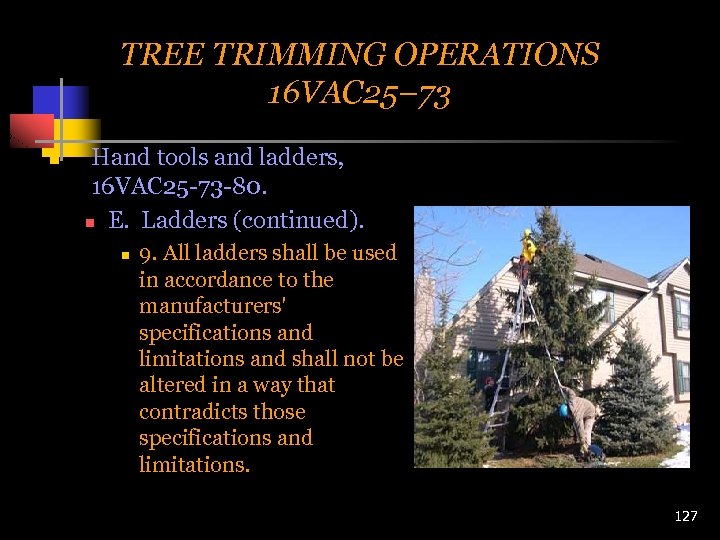
TREE TRIMMING OPERATIONS 16 VAC 25– 73 n Hand tools and ladders, 16 VAC 25 -73 -80. n E. Ladders (continued). n 9. All ladders shall be used in accordance to the manufacturers' specifications and limitations and shall not be altered in a way that contradicts those specifications and limitations. 127
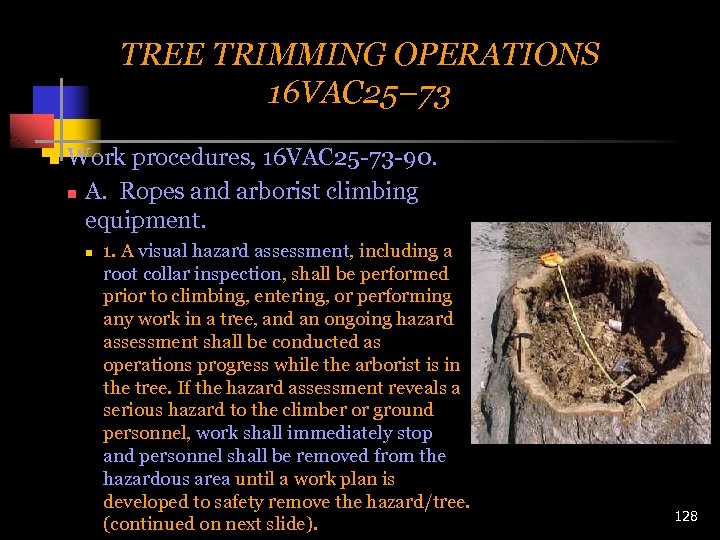
TREE TRIMMING OPERATIONS 16 VAC 25– 73 n Work procedures, 16 VAC 25 -73 -90. n A. Ropes and arborist climbing equipment. n 1. A visual hazard assessment, including a root collar inspection, shall be performed prior to climbing, entering, or performing any work in a tree, and an ongoing hazard assessment shall be conducted as operations progress while the arborist is in the tree. If the hazard assessment reveals a serious hazard to the climber or ground personnel, work shall immediately stop and personnel shall be removed from the hazardous area until a work plan is developed to safety remove the hazard/tree. (continued on next slide). 128
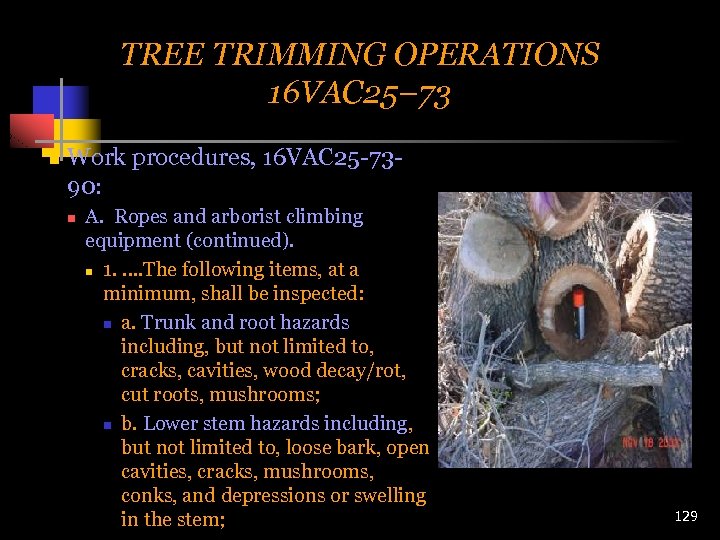
TREE TRIMMING OPERATIONS 16 VAC 25– 73 n Work procedures, 16 VAC 25 -7390: n A. Ropes and arborist climbing equipment (continued). n 1. …. The following items, at a minimum, shall be inspected: n a. Trunk and root hazards including, but not limited to, cracks, cavities, wood decay/rot, cut roots, mushrooms; n b. Lower stem hazards including, but not limited to, loose bark, open cavities, cracks, mushrooms, conks, and depressions or swelling in the stem; 129
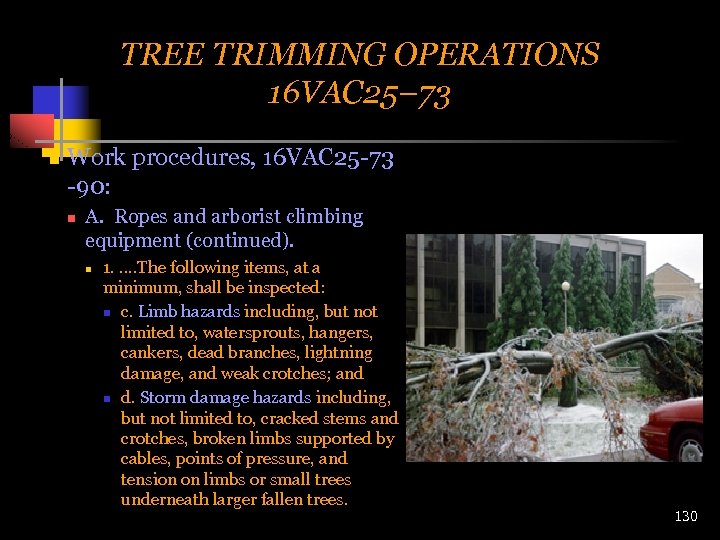
TREE TRIMMING OPERATIONS 16 VAC 25– 73 n Work procedures, 16 VAC 25 -73 -90: n A. Ropes and arborist climbing equipment (continued). n 1. …. The following items, at a minimum, shall be inspected: n c. Limb hazards including, but not limited to, watersprouts, hangers, cankers, dead branches, lightning damage, and weak crotches; and n d. Storm damage hazards including, but not limited to, cracked stems and crotches, broken limbs supported by cables, points of pressure, and tension on limbs or small trees underneath larger fallen trees. 130
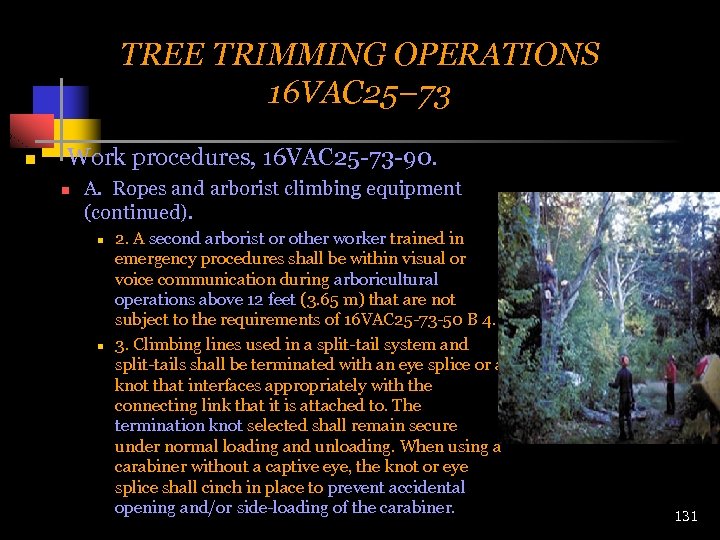
TREE TRIMMING OPERATIONS 16 VAC 25– 73 n Work procedures, 16 VAC 25 -73 -90. n A. Ropes and arborist climbing equipment (continued). n n 2. A second arborist or other worker trained in emergency procedures shall be within visual or voice communication during arboricultural operations above 12 feet (3. 65 m) that are not subject to the requirements of 16 VAC 25 -73 -50 B 4. 3. Climbing lines used in a split-tail system and split-tails shall be terminated with an eye splice or a knot that interfaces appropriately with the connecting link that it is attached to. The termination knot selected shall remain secure under normal loading and unloading. When using a carabiner without a captive eye, the knot or eye splice shall cinch in place to prevent accidental opening and/or side-loading of the carabiner. 131
TREE TRIMMING OPERATIONS 16 VAC 25– 73 n Work procedures, 16 VAC 25 -73 -90. n A. Ropes and arborist climbing equipment (continued). n n n 4. Arborists shall inspect climbing lines, worklines, lanyards, and other climbing equipment for damage, cuts, abrasion, and/or deterioration before each use and shall remove them from service if signs of excessive wear or damage are found. The items removed from service shall be tagged until repaired or discarded. 5. Arborist saddles and lanyards used for work positioning shall be identified by the manufacturer as suitable for tree climbing. 6. Arborist saddles and lanyards used for work positioning shall not be altered in a manner that would compromise the integrity of the equipment. 132
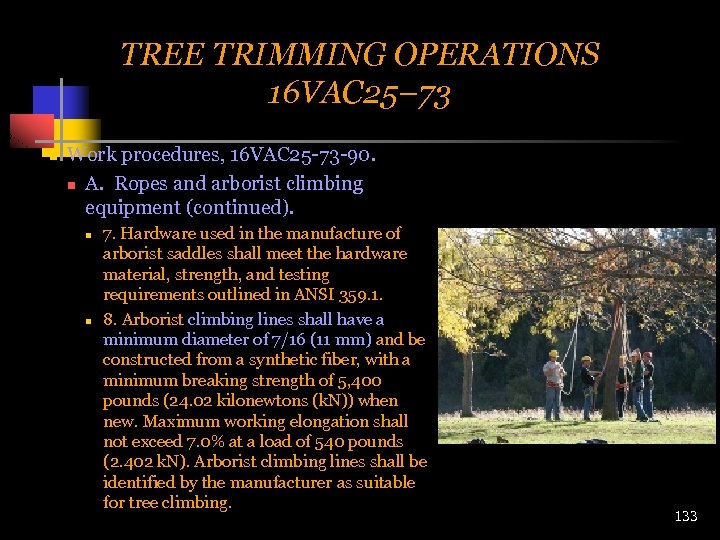
TREE TRIMMING OPERATIONS 16 VAC 25– 73 n Work procedures, 16 VAC 25 -73 -90. n A. Ropes and arborist climbing equipment (continued). n n 7. Hardware used in the manufacture of arborist saddles shall meet the hardware material, strength, and testing requirements outlined in ANSI 359. 1. 8. Arborist climbing lines shall have a minimum diameter of 7/16 (11 mm) and be constructed from a synthetic fiber, with a minimum breaking strength of 5, 400 pounds (24. 02 kilonewtons (k. N)) when new. Maximum working elongation shall not exceed 7. 0% at a load of 540 pounds (2. 402 k. N). Arborist climbing lines shall be identified by the manufacturer as suitable for tree climbing. 133
TREE TRIMMING OPERATIONS 16 VAC 25– 73 n Work procedures, 16 VAC 25 -73 -90. n A. Ropes and arborist climbing equipment (continued). n n n 9. The qualified arborist shall assure that each component of the climbing system is approved by the manufacturer for its intended use as well as its compatibility with other components of the climbing system. 10. Prusik loops, split-tails, and work-positioning lanyards used in a climbing system shall meet the minimum strength standards for arborist climbing lines. 11. Snap hooks (rope snaps) used in climbing shall be self-closing and self-locking, with a minimum tensile strength of 5, 000 pounds (22. 24 k. N). 134
TREE TRIMMING OPERATIONS 16 VAC 25– 73 n Work procedures, 16 VAC 25 -73 -90. n A. Ropes and arborist climbing equipment (continued). n n n 12. Carabiners used in climbing shall be self-closing and self-locking, with a minimum tensile strength of 5, 000 pounds (22. 24 k. N). Carabiners shall be designed to release the load by requiring at least two consecutive, deliberate actions to prepare the gate for opening. 13. Splicing shall be done in accordance with cordage manufacturers' specifications. 14. All load-bearing components of the climbing system shall meet the minimum standards for arborist climbing equipment. 135
TREE TRIMMING OPERATIONS 16 VAC 25– 73 n Work procedures, 16 VAC 25 -73 -90. n A. Ropes and arborist climbing equipment (continued). n n n 15. Equipment used to secure an arborist in the tree or from an aerial lift shall not be used for anything other than its intended purpose. The arborist climbing line may be used to raise and lower tools. 16. Rope ends shall be finished in a manner to prevent raveling. 17. Ropes and climbing equipment shall be stored and transported in such a manner to prevent damage through contact with sharp tools, cutting edges, gas, oil, or chemicals. 18. Arborist climbing lines shall never be left in trees unattended. 19. Arborists shall have available a climbing line and at least one other means of being secured while working aloft; for example, an arborist climbing line and a work-positioning lanyard. 136
TREE TRIMMING OPERATIONS 16 VAC 25– 73 n Work procedures, 16 VAC 25 -73 -90. n B. Pruning and trimming. n 1. Voice communications among arborists aloft and among arborists and other workers on the ground shall be established before cutting and dropping limbs. The communication method shall be clearly understood and used by all workers during all operations. The command "stand clear" from aloft and the response "all clear, " "Underneath, " or "No" from the ground are terms that may be used for this purpose. Prearranged, two-way hand signals may also be used when verbal communication is not possible because of distance or surrounding noise levels. Arborists and other workers returning to the work area shall be acknowledged by arborists aloft. 137
TREE TRIMMING OPERATIONS 16 VAC 25– 73 n Work procedures, 16 VAC 25 -73 -90. n B. Pruning and trimming. n n 2. Pole pruners and pole saws, when hung, shall be securely positioned to prevent dislodgment. Pole pruners or pole saws shall not be hung on electrical conductors or left in a tree unattended. Pole saws and pole pruners shall be hung so that sharp edges are away from the arborist and shall be removed when the arborist leaves the tree. 3. Scabbards or sheaths shall be used to carry handsaws when not in use. Folding saws, when not in use, shall be closed and hooked to the arborist saddle. 138
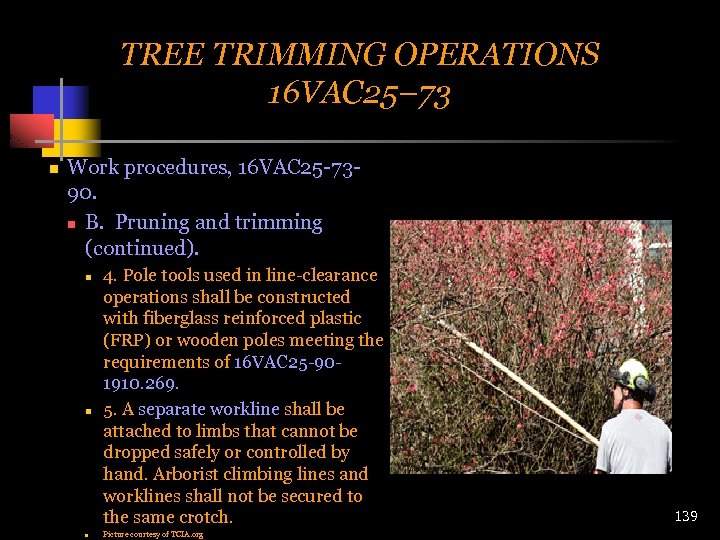
TREE TRIMMING OPERATIONS 16 VAC 25– 73 n Work procedures, 16 VAC 25 -7390. n B. Pruning and trimming (continued). n n n 4. Pole tools used in line-clearance operations shall be constructed with fiberglass reinforced plastic (FRP) or wooden poles meeting the requirements of 16 VAC 25 -901910. 269. 5. A separate workline shall be attached to limbs that cannot be dropped safely or controlled by hand. Arborist climbing lines and worklines shall not be secured to the same crotch. Picture courtesy of TCIA. org 139
TREE TRIMMING OPERATIONS 16 VAC 25– 73 n Work procedures, 16 VAC 25 -73 -90. n B. Pruning and trimming (continued). n n 6. Dry conditions and dead palm fronds present an extreme fire hazard. When dry conditions exist, arborists and other workers shall not smoke while working in or near dead palm fronds. All chain saws used under such conditions shall have mufflers and spark arresters in good working condition. 8. Cut branches shall not be left in trees upon completion of work. 140
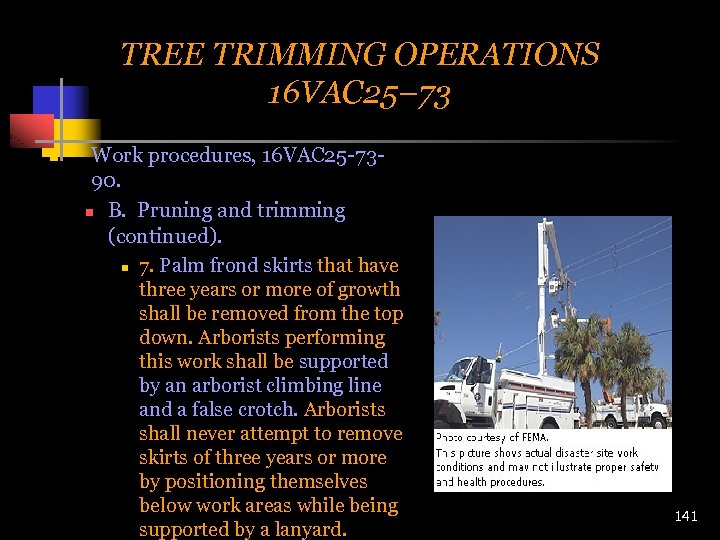
TREE TRIMMING OPERATIONS 16 VAC 25– 73 n Work procedures, 16 VAC 25 -7390. n B. Pruning and trimming (continued). n 7. Palm frond skirts that have three years or more of growth shall be removed from the top down. Arborists performing this work shall be supported by an arborist climbing line and a false crotch. Arborists shall never attempt to remove skirts of three years or more by positioning themselves below work areas while being supported by a lanyard. 141
TREE TRIMMING OPERATIONS 16 VAC 25– 73 n Work procedures, 16 VAC 25 -73 -90. n C. Cabling. n n n 1. Arborists and other workers on the ground shall not stand under the work area of a tree when a cabling system is being installed. 2. Tools used for cabling, bark tracing, and cavity work shall be carried in a bag, on a belt designed to hold such tools, or attached to a tool lanyard. 3. Arborists installing cabling systems in trees shall be positioned off to one side in order to avoid injury in case of cable system failure that could occur when a block and tackle or a hand winch is released. 4. When removing a cable from a tree, a block and tackle or comealong system shall be installed before removing the existing cable. 5. When installing a replacement cable, the replacement cable shall be fully installed before removing the outdated cable. 142
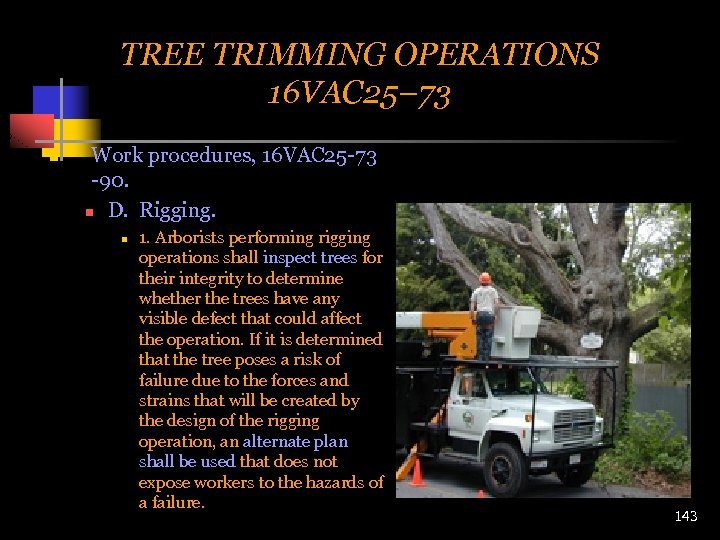
TREE TRIMMING OPERATIONS 16 VAC 25– 73 n Work procedures, 16 VAC 25 -73 -90. n D. Rigging. n 1. Arborists performing rigging operations shall inspect trees for their integrity to determine whether the trees have any visible defect that could affect the operation. If it is determined that the tree poses a risk of failure due to the forces and strains that will be created by the design of the rigging operation, an alternate plan shall be used that does not expose workers to the hazards of a failure. 143
TREE TRIMMING OPERATIONS 16 VAC 25– 73 n Work procedures, 16 VAC 25 -73 -90. n D. Rigging. n 2. The number of connecting links used for connecting components of a rigging system shall be minimized when possible. Connecting links shall interface properly and be in compliance with manufacturers' specifications and limitations (16 VAC 26 -60 -120). n 3. The qualified arborist shall ensure that load ratings shown on the rigging equipment or provided by the manufacturer for all ropes, connecting links, and rigging equipment are observed in all rigging operations. Rigging equipment shall be chosen for the specific task based on working-load limits and design specifications. 144
TREE TRIMMING OPERATIONS 16 VAC 25– 73 n Work procedures, 16 VAC 25 -73 -90. n D. Rigging (continued). n n 4. All equipment used for rigging operations shall be in good working condition. Equipment that has been damaged or overloaded shall be removed from service. Items removed from service shall be tagged until repaired or discarded. 5. To avoid confusion between rigging equipment and climbing equipment, the equipment shall be clearly marked to indicate their different purposes. 145
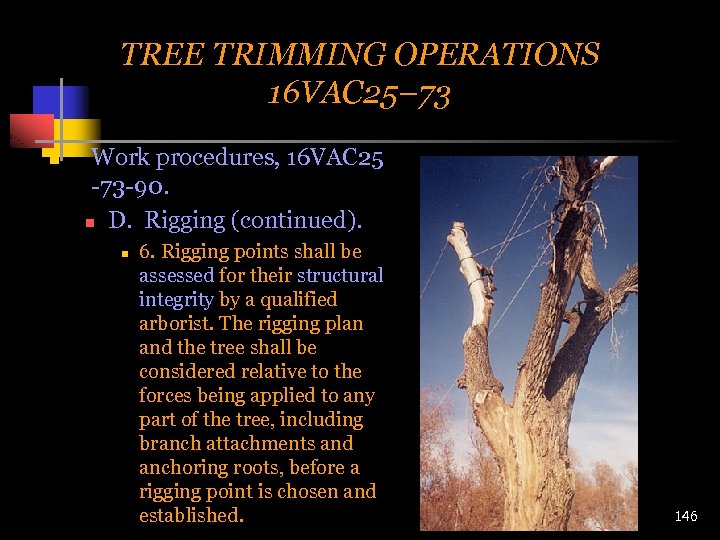
TREE TRIMMING OPERATIONS 16 VAC 25– 73 n Work procedures, 16 VAC 25 -73 -90. n D. Rigging (continued). n 6. Rigging points shall be assessed for their structural integrity by a qualified arborist. The rigging plan and the tree shall be considered relative to the forces being applied to any part of the tree, including branch attachments and anchoring roots, before a rigging point is chosen and established. 146
TREE TRIMMING OPERATIONS 16 VAC 25– 73 n Work procedures, 16 VAC 25 -73 -90. n D. Rigging (continued). n n n 7. Climbers shall choose tie-in points that will provide proper protection while allowing for a separation between the rigging system and the climbing system. Running rigging lines shall not be allowed to come into contact with any part of the climbing system. 8. Arborists performing rigging operations shall be educated to understand trained to estimate the potential forces at any point in the rigging system being used. The system components shall comply with working-load limits relative to the operation and the maximum potential forces. 9. Careful consideration shall be given to the potential forces resulting from the specific influences of rope angles as well as the number of lines and/or line parts that will act on any rigging point. 147
TREE TRIMMING OPERATIONS 16 VAC 25– 73 n Work procedures, 16 VAC 25 -73 -90. n D. Rigging (continued). n n 10. Prior to the start of removal/rigging operations, a communication system shall be established in accordance with the requirements in subdivision B 1 of this section. 11. A work zone shall be established prior to the start of rigging operations. Workers not directly involved in the rigging operation shall stay out of the pre-established work zone until it has been communicated by a qualified arborist or qualified arborist trainee directly involved in the rigging operation that it is safe to enter the work zone. Workers shall be positioned and their duties organized so that the actions of one worker will not create a hazard for any other worker. 148
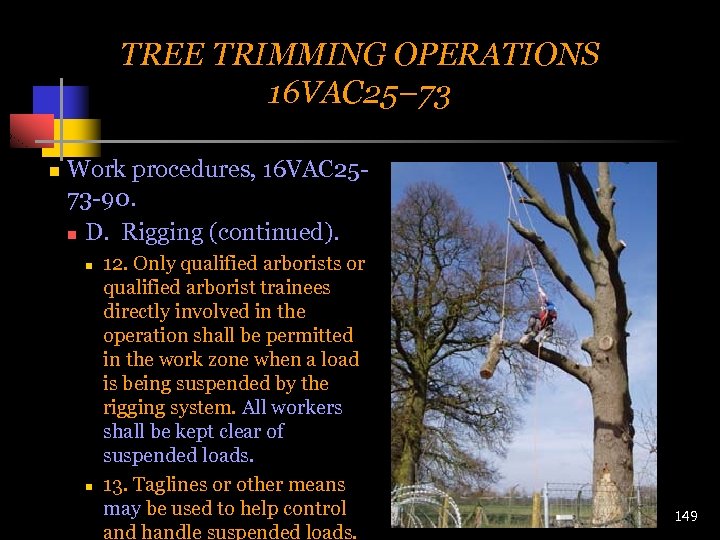
TREE TRIMMING OPERATIONS 16 VAC 25– 73 n Work procedures, 16 VAC 2573 -90. n D. Rigging (continued). n n 12. Only qualified arborists or qualified arborist trainees directly involved in the operation shall be permitted in the work zone when a load is being suspended by the rigging system. All workers shall be kept clear of suspended loads. 13. Taglines or other means may be used to help control and handle suspended loads. 149
TREE TRIMMING OPERATIONS 16 VAC 25– 73 n Work procedures, 16 VAC 25 -73 -90. n D. Rigging (continued). n 14. Arborists working aloft shall position themselves so as to be above or to the side of the piece being rigged and out of the path of movement of the piece when it has been cut. Climbers and their climbing systems shall be positioned outside of the rigging system itself when a cut is being made or a load is being moved or lowered. Climbers shall have an escape plan prepared. n 15. The spars, limbs, or leaders being worked on and the spars being used for tie-in and/or rigging points shall be assessed for structural integrity and potential reaction forces that could cause a spar to split when it is cut. 150
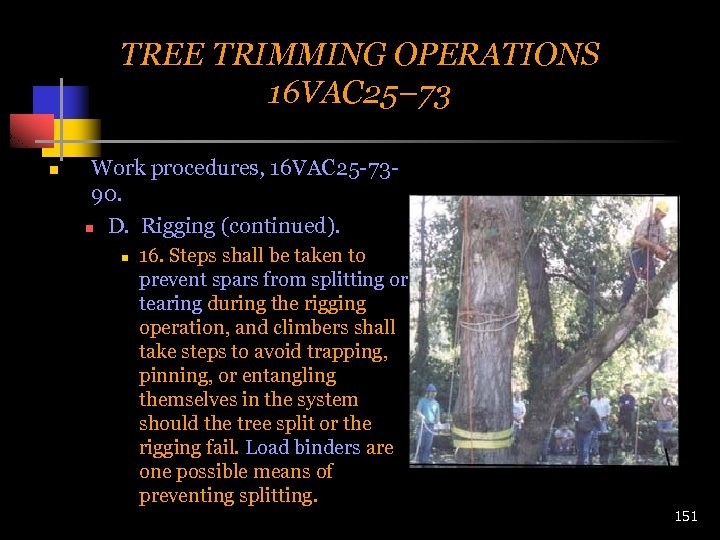
TREE TRIMMING OPERATIONS 16 VAC 25– 73 n Work procedures, 16 VAC 25 -7390. n D. Rigging (continued). n 16. Steps shall be taken to prevent spars from splitting or tearing during the rigging operation, and climbers shall take steps to avoid trapping, pinning, or entangling themselves in the system should the tree split or the rigging fail. Load binders are one possible means of preventing splitting. 151
TREE TRIMMING OPERATIONS 16 VAC 25– 73 n Work procedures, 16 VAC 25 -73 -90. n E. Tree removal. n 1. Before beginning any tree removal operation, the chain-saw operator and/or crew leader shall carefully consider all relevant factors pertaining to the tree and site and shall take appropriate actions to ensure a safe removal operation. The following factors shall be considered: n a. The area surrounding the tree to be removed, including nearby trees; n b. Species and shape of the tree; n c. Lean of the tree; n d. Loose limbs, chunks, or other overhead material; 152
TREE TRIMMING OPERATIONS 16 VAC 25– 73 n Work procedures, 16 VAC 25 -73 -90. n E. Tree removal. n 1. …. The following factors shall be considered (continued): n e. Wind force and direction; n f. Decayed or weak spots throughout the tree (be aware of additional hazards if these conditions exist in the hinge area); n g. Location and means to protect other persons, property, and electrical conductors; n h. Size and terrain characteristics or limitations of the work area; and 153 n i. Evidence of bees or wildlife habitation in the tree.
TREE TRIMMING OPERATIONS 16 VAC 25– 73 n Work procedures, 16 VAC 25 -73 -90. n E. Tree removal (continued). n 2. Work plans for removal operations shall be communicated to all workers in a job briefing before commencing work. n 3. Workers not directly involved in the removal operation shall be clear of the work area, beyond the length of the tree, unless a team of workers is necessary to remove a particular tree. n 5. When it is necessary to shorten or remove branches before removing the tree, the arborist shall determine whether the tree can withstand the strain of the lowering procedures. If not, other means of removing the tree shall 154 be considered and used.
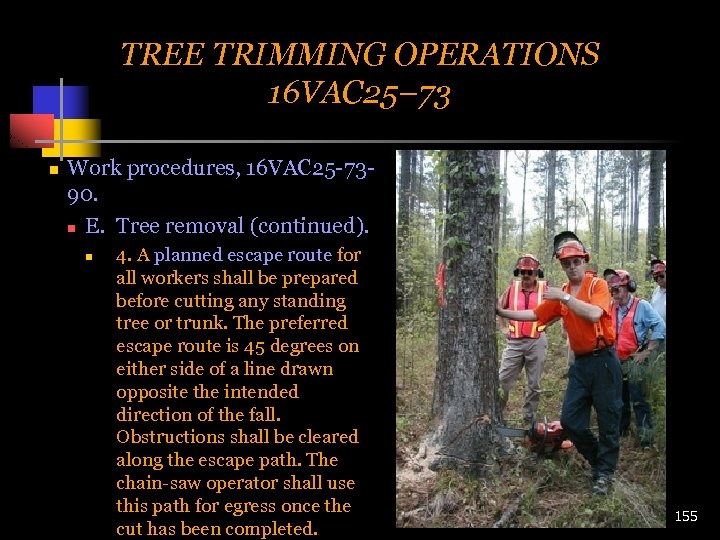
TREE TRIMMING OPERATIONS 16 VAC 25– 73 n Work procedures, 16 VAC 25 -7390. n E. Tree removal (continued). n 4. A planned escape route for all workers shall be prepared before cutting any standing tree or trunk. The preferred escape route is 45 degrees on either side of a line drawn opposite the intended direction of the fall. Obstructions shall be cleared along the escape path. The chain-saw operator shall use this path for egress once the cut has been completed. 155
TREE TRIMMING OPERATIONS 16 VAC 25– 73 n Work procedures, 16 VAC 25 -73 -90. n E. Tree removal (continued). n n 6. The crew leader shall determine the number of workers necessary for tree removal operations. 7. The crew leader shall develop a work plan so that operations do not conflict with each other, thereby creating a hazard. 8. Climbing spurs shall have gaffs of a type and length compatible for the tree being climbed. 9. Wedges, block and tackle, rope, wire cable (except where an electrical hazard exists), or other appropriate devices shall be used when there is a danger that the tree or trees being removed may fall in the wrong direction or damage property. All limbs shall be removed to a height and width sufficient to allow the tree to fall clear of any wires and other objects in the vicinity. 156
TREE TRIMMING OPERATIONS 16 VAC 25– 73 n Work procedures, 16 VAC 25 -73 -90. n E. Tree removal (continued). n 10. Tackle blocks and pulleys and their connecting links shall be inspected immediately before use and removed from service if they are found to be defective. n n 11. Workers returning to the work area shall not enter until the chain-saw operator has acknowledged that it is safe to do so. 12. When a pull line is being used, workers involved in removing a tree or trunk shall be clear by a minimum of one tree length. 157
TREE TRIMMING OPERATIONS 16 VAC 25– 73 n Work procedures, 16 VAC 25 -73 -90: n E. Tree removal (continued). n 13. All workers other than the individual engaged in manual land -clearing operations shall be at least two tree lengths away from the tree or trunk being removed. This requirement does not apply in the presence of site restrictions, such as waterways or cliffs. Other arborists and workers shall be beyond the trees' striking range and at a distance as close to twice the tree's height as possible. n NOTE: This regulation does not apply to tree removal activities where the primary objective is land clearing in preparation for construction, real estate development, or other related activities, unless directly supervised by a certified arborist. Such activities are covered by 16 VAC 25 -90 -1910. 266. 158
TREE TRIMMING OPERATIONS 16 VAC 25– 73 n Work procedures, 16 VAC 25 -73 -90. n E. Tree removal (continued). n n 14. Notches shall be used on all trees and trunks greater than five inches (12. 7 cm) in diameter at breast height. 15. Notches and back cuts shall be made at a height that enables the chain-saw operator to safely begin the cut, control the tree or trunk, and have freedom of movement for escape: n a. The notch cut used shall be a conventional notch, an open -face notch, or a Humboldt notch. n b. Notches shall be 45 degrees or greater and large enough to guide the fall of the tree or trunk to prevent splitting. n c. Notch depth shall not exceed one-third the diameter of the tree. n d. The back cut shall not penetrate into the predetermined 159 hinge area.
TREE TRIMMING OPERATIONS 16 VAC 25– 73 n Work procedures, 16 VAC 25 -7390. n E. Tree removal (continued). n n 16. With a conventional notch or Humboldt notch, the back cut shall be one to two inches (2. 5 to 5 cm) above the apex of the notch to provide an adequate platform to prevent kickback of the tree or trunk. With an open-face notch (greater than 70 degrees), the back cut shall be at the same level as the apex of the notch. 17. The two cuts that form the notch shall not cross at the point where they meet. 160
TREE TRIMMING OPERATIONS 16 VAC 25– 73 n Work procedures, 16 VAC 25 -73 -90. n E. Tree removal (continued). n n 18. Before making the back cut, there shall be a command such as "stand clear" from the arborist operating the chain saw and a response such as "all clear" from the workers supporting the removal operation. Pre-arranged, two-way hand signals may also be used in accordance with subdivision B 1 of this section. Only designated persons shall give such signals. All workers in the vicinity shall be out of range when the tree or trunk falls. Visual contact shall be maintained with the tree or trunk until it is on the ground. 19. When the back cut has been completed, the chain-saw operator shall immediately move a safe distance away from the tree or trunk using the planned escape route. 161
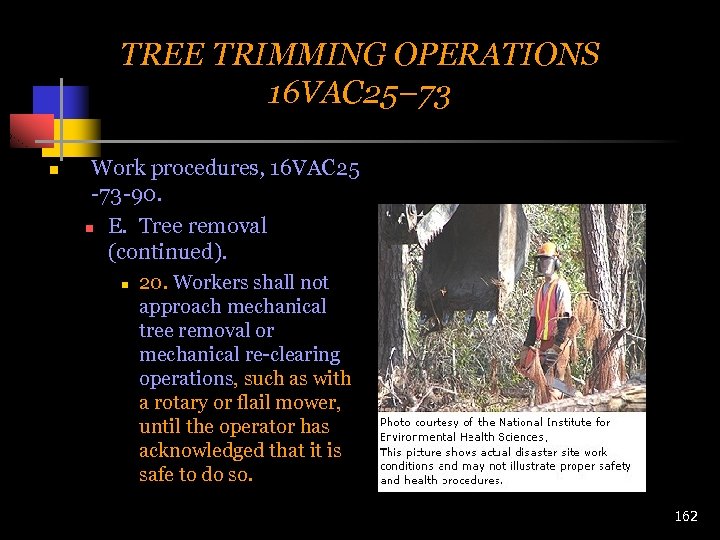
TREE TRIMMING OPERATIONS 16 VAC 25– 73 n Work procedures, 16 VAC 25 -73 -90. n E. Tree removal (continued). n 20. Workers shall not approach mechanical tree removal or mechanical re-clearing operations, such as with a rotary or flail mower, until the operator has acknowledged that it is safe to do so. 162
TREE TRIMMING OPERATIONS 16 VAC 25– 73 n Work procedures, 16 VAC 25 -73 -90. n F. Brush removal and chipping. n 1. Traffic control around the jobsite shall be established prior to the start of chipping operations along roads and highways (see 16 VAC 25 -73 -40 B). n n 2. Brush and logs shall not be allowed to create hazards in the work areas. 3. To prevent an entanglement hazard, loose clothing, climbing equipment, body belts, harnesses, lanyards, or gauntlet-type gloves (for example, long-cuffed lineman's or welder's gloves) shall not be worn while operating chippers. 163
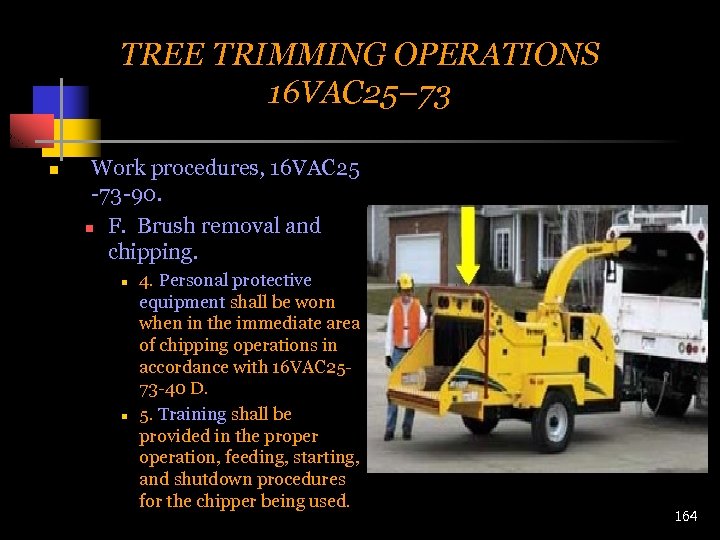
TREE TRIMMING OPERATIONS 16 VAC 25– 73 n Work procedures, 16 VAC 25 -73 -90. n F. Brush removal and chipping. n n 4. Personal protective equipment shall be worn when in the immediate area of chipping operations in accordance with 16 VAC 2573 -40 D. 5. Training shall be provided in the properation, feeding, starting, and shutdown procedures for the chipper being used. 164
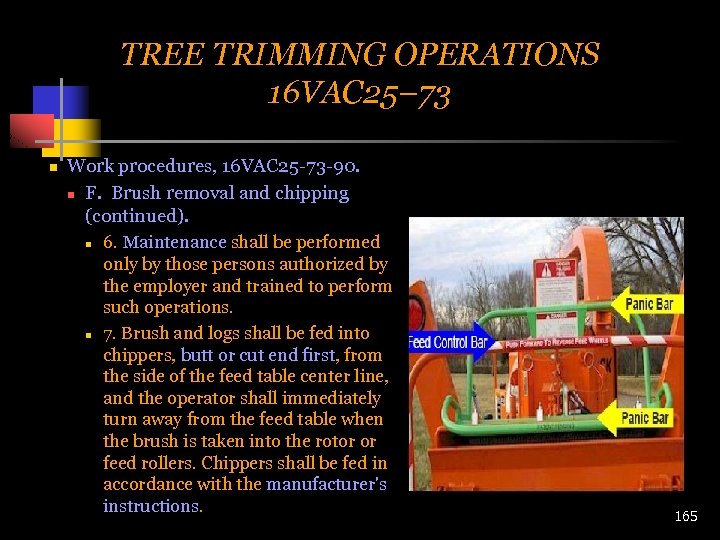
TREE TRIMMING OPERATIONS 16 VAC 25– 73 n Work procedures, 16 VAC 25 -73 -90. n F. Brush removal and chipping (continued). n n 6. Maintenance shall be performed only by those persons authorized by the employer and trained to perform such operations. 7. Brush and logs shall be fed into chippers, butt or cut end first, from the side of the feed table center line, and the operator shall immediately turn away from the feed table when the brush is taken into the rotor or feed rollers. Chippers shall be fed in accordance with the manufacturer's instructions. 165
TREE TRIMMING OPERATIONS 16 VAC 25– 73 n Work procedures, 16 VAC 25 -73 -90. n F. Brush removal and chipping (continued). n n 8. The brush chipper discharge chute or cutter housing cover shall not be raised or removed while any part of the chipper is turning or moving. Chippers shall not be used unless a discharge chute of sufficient length or design is provided that prevents personal contact with the blades (see 16 VAC 25 -73 -110, Appendix B, General Safety Procedures that Apply to All Tree Work). 9. Foreign material, such as stones, nails, sweepings, and rakings, shall not be fed into 166 chippers.
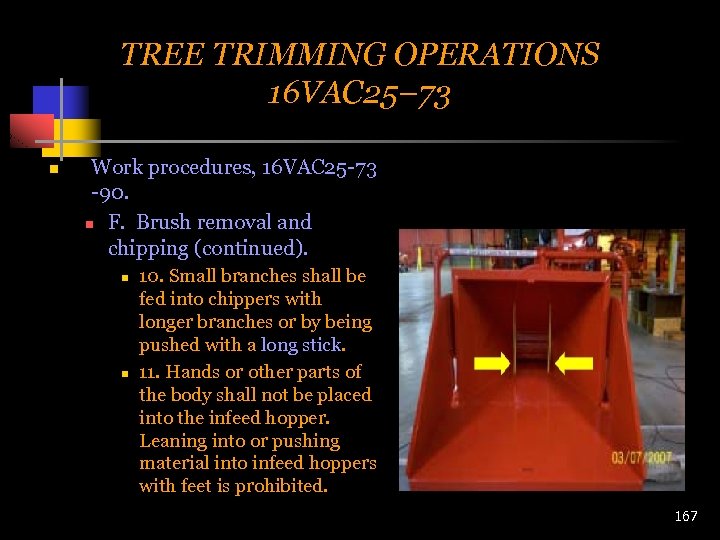
TREE TRIMMING OPERATIONS 16 VAC 25– 73 n Work procedures, 16 VAC 25 -73 -90. n F. Brush removal and chipping (continued). n n 10. Small branches shall be fed into chippers with longer branches or by being pushed with a long stick. 11. Hands or other parts of the body shall not be placed into the infeed hopper. Leaning into or pushing material into infeed hoppers with feet is prohibited. 167
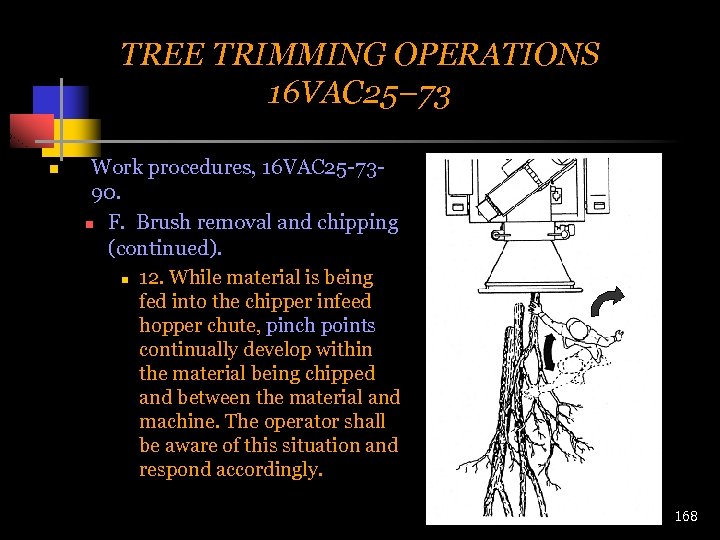
TREE TRIMMING OPERATIONS 16 VAC 25– 73 n Work procedures, 16 VAC 25 -7390. n F. Brush removal and chipping (continued). n 12. While material is being fed into the chipper infeed hopper chute, pinch points continually develop within the material being chipped and between the material and machine. The operator shall be aware of this situation and respond accordingly. 168
TREE TRIMMING OPERATIONS 16 VAC 25– 73 n Work procedures, 16 VAC 25 -73 -90. n F. Brush removal and chipping (continued). n n n 13. When feeding a chipper during roadside operations, the operator shall do so in a manner that prevents him from stepping into traffic or being pushed into traffic by the material that is being fed into the chipper. 14. When using a winch in chipper operations, the operator shall ensure that the winch cable is properly stored before initiating chipper operations. 15. Refer to 16 VAC 25 -73 -60 C, for additional 169 information.
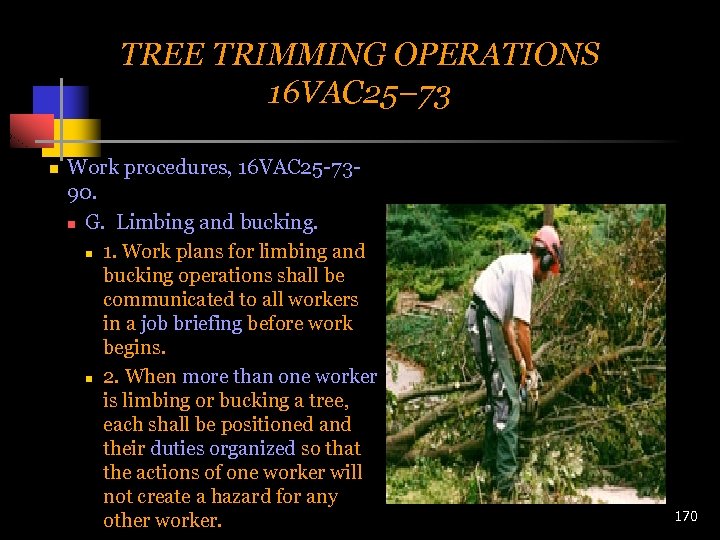
TREE TRIMMING OPERATIONS 16 VAC 25– 73 n Work procedures, 16 VAC 25 -7390. n G. Limbing and bucking. n 1. Work plans for limbing and bucking operations shall be communicated to all workers in a job briefing before work begins. n 2. When more than one worker is limbing or bucking a tree, each shall be positioned and their duties organized so that the actions of one worker will not create a hazard for any other worker. 170
TREE TRIMMING OPERATIONS 16 VAC 25– 73 n Work procedures, 16 VAC 25 -73 -90. n G. Limbing and bucking (continued). n 3. Chain saws shall be operated away from the vicinity of the legs and feet. Natural barriers, such as limbs between the saw and the body, shall be employed where possible, while ensuring proper balance. While operating a chain saw, the preferred working position is on the uphill side of the work. n 4. The worker shall make sure of firm footing before and during limbing and bucking. The worker shall not stand on loose chunks or logs that will roll when the log being bucked is sawed off. n 5. Trees, limbs, or saplings under tension shall be considered hazardous. Appropriate cutting techniques and precautions shall be followed. 171
TREE TRIMMING OPERATIONS 16 VAC 25– 73 n Work procedures, 16 VAC 25 -73 -90. n G. Limbing and bucking. n n n 6. Wedges shall be used as necessary to prevent binding of the guide bar or chain when bucking trunks of trees. 7. Cant hooks or peaveys shall be used as an aid in rolling large or irregular logs to complete bucking. 8. If mechanized equipment is to be used, the equipment operator shall establish an effective means of communication with other workers (see subdivisions B 1 and D 10 of this section). 172
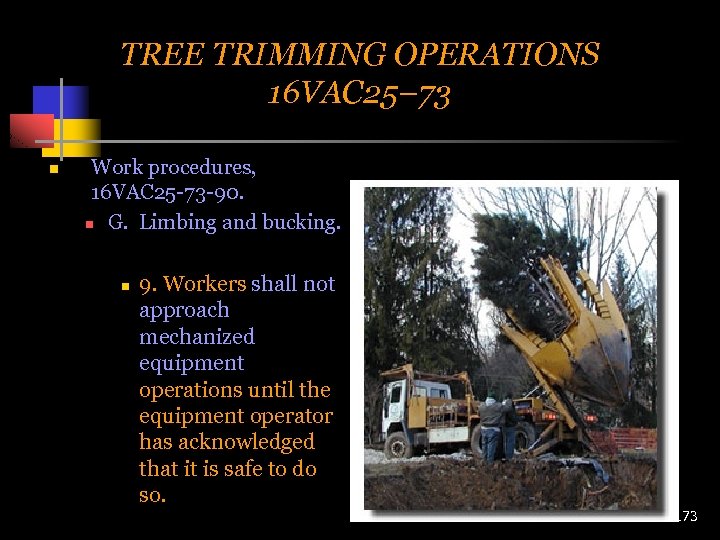
TREE TRIMMING OPERATIONS 16 VAC 25– 73 n Work procedures, 16 VAC 25 -73 -90. n G. Limbing and bucking. n 9. Workers shall not approach mechanized equipment operations until the equipment operator has acknowledged that it is safe to do so. 173
TREE TRIMMING OPERATIONS 16 VAC 25– 73 n Work procedures, 16 VAC 25 -73 -90. n H. Pesticide application. n n n 1. The applicator shall follow label instructions in regard to pesticide applications. 2. The applicator shall follow pesticide label instructions in regard to laundering his clothing. 3. The applicator shall comply with the manufacturer's instructions with regard to showering or bathing at the end of each workday. 4. The employer shall provide a clean water source at the worksite, which can be used for emergency personal decontamination. Precautions shall be taken to prevent contamination of the clean water source. Drinking water and decontamination water shall be kept in separate containers. 5. The applicator shall not direct a solid spray column into contact 174 with electrical conductors.
TREE TRIMMING OPERATIONS 16 VAC 25– 73 -100 SEE: Appendix A, Guidelines A. B. C. D. E. General Requirements General Safety Personal Safety Equipment Safety Operational Safety 175
TREE TRIMMING OPERATIONS 16 VAC 25– 73 -110 SEE: Appendix B, General Safety Procedures That Apply to All Tree Work A. Lifting B. Control of Hazardous Energy Sources 176
TREE TRIMMING OPERATIONS 16 VAC 25– 73 -120 SEE: Appendix C, Additional Resources A. ANSI Standards B. Cordage Institute Rope Standards C. VOSH/USDOLI/VDOT/Federal Motor Carrier Safety Administration Regulations 177
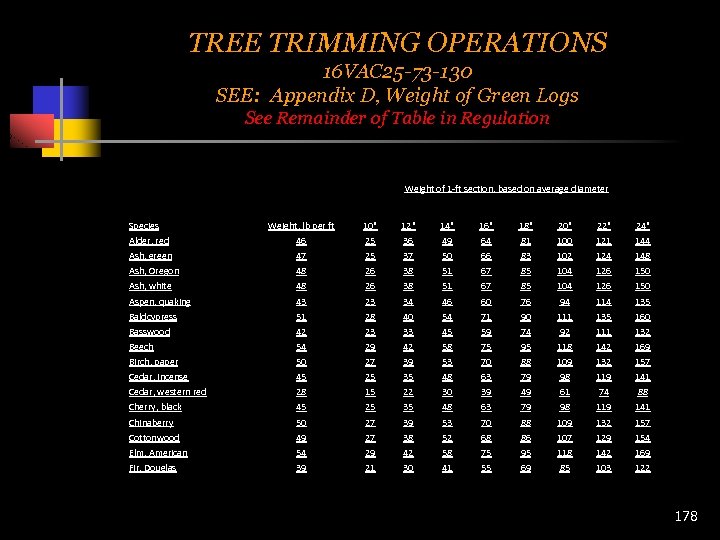
TREE TRIMMING OPERATIONS 16 VAC 25 -73 -130 SEE: Appendix D, Weight of Green Logs See Remainder of Table in Regulation Weight of 1 -ft section, based on average diameter Species Weight, lb per ft 10" 12" 14" 16" 18" 20" 22" 24" Alder, red 46 25 36 49 64 81 100 121 144 Ash, green 47 25 37 50 66 83 102 124 148 Ash, Oregon 48 26 38 51 67 85 104 126 150 Ash, white 48 26 38 51 67 85 104 126 150 Aspen, quaking 43 23 34 46 60 76 94 114 135 Baldcypress 51 28 40 54 71 90 111 135 160 Basswood 42 23 33 45 59 74 92 111 132 Beech 54 29 42 58 75 95 118 142 169 Birch, paper 50 27 39 53 70 88 109 132 157 Cedar, incense 45 25 35 48 63 79 98 119 141 Cedar, western red 28 15 22 30 39 49 61 74 88 Cherry, black 45 25 35 48 63 79 98 119 141 Chinaberry 50 27 39 53 70 88 109 132 157 Cottonwood 49 27 38 52 68 86 107 129 154 Elm, American 54 29 42 58 75 95 118 142 169 Fir, Douglas 39 21 30 41 55 69 85 103 122 178
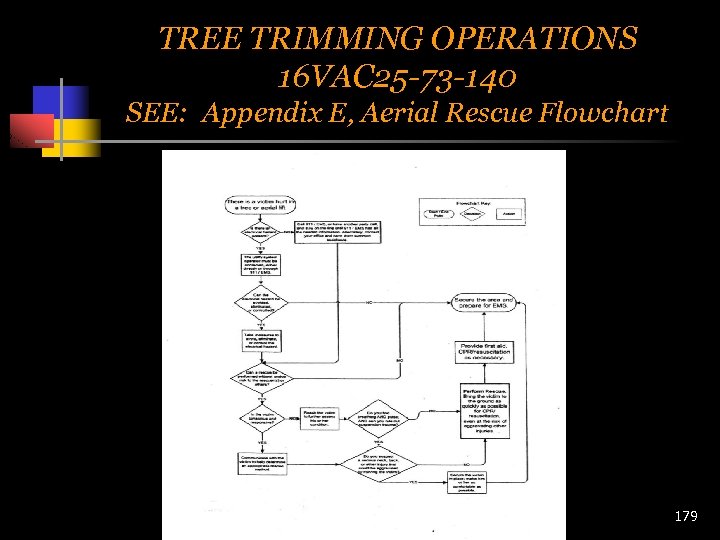
TREE TRIMMING OPERATIONS 16 VAC 25 -73 -140 SEE: Appendix E, Aerial Rescue Flowchart 179
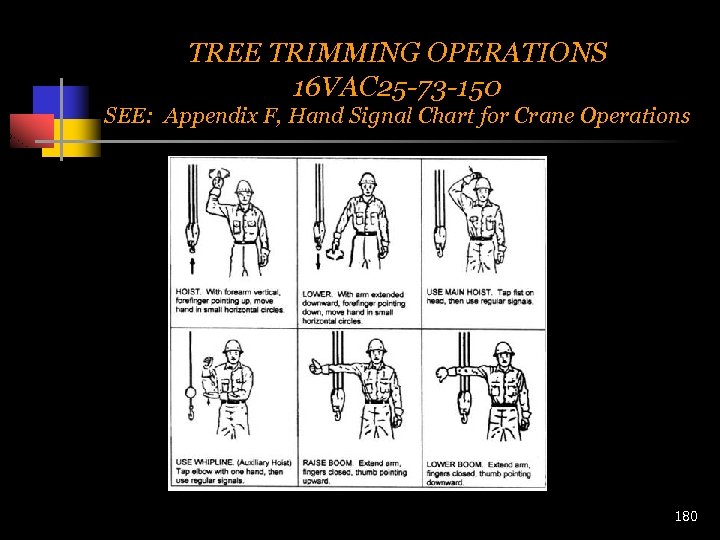
TREE TRIMMING OPERATIONS 16 VAC 25 -73 -150 SEE: Appendix F, Hand Signal Chart for Crane Operations 180
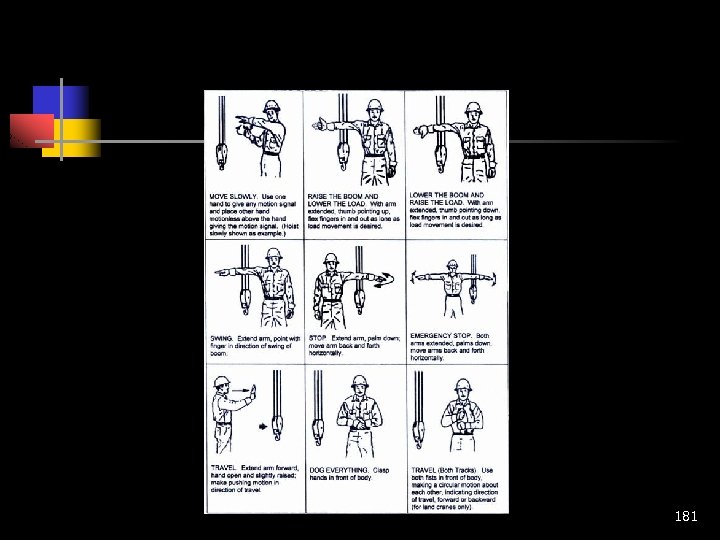
181
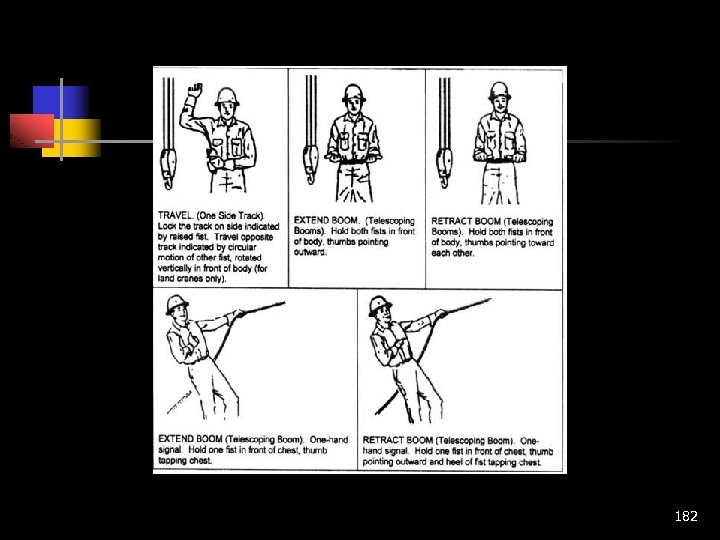
182
Скачать презентацию VIRGINIA DEPARTMENT OF LABOR AND INDUSTRY Tree Trimming
cf0caaabe29b0f704a777540c18f4804.ppt