


 Скачать презентацию Virginia Department of Emergency Management 2011 Emergency Management
fb47abaf08022771d3512e94cc6335e8.ppt
- Количество слайдов: 26
 Virginia Department of Emergency Management 2011 Emergency Management Procurement Forum & Workshop Federal Emergency Management Agency Mission Support Bureau Office of the Chief Procurement Officer Cliff Oliver Director, Acquisition Program and Planning Division June 6, 2011 Presenter’s Name June 17, 2003
 Acknowledgements I thank the Virginia Department of Emergency Management for this opportunity and invitation to speak to you today. . Presenter’s Name June 17, 2003
 Agenda AAAA § FEMA’s Mission § Office of Chief Procurement Officer (OCPO) Mission § Disaster Operations Overview § Whole Community Concept § Acquisition Trends § Acquisition Disaster Support Initiatives § Disaster Acquisition Response Team (DART) § Industry Liaison Program/Local Business Transition Team (LBTT) Presenter’s Name June 17, 2003 3
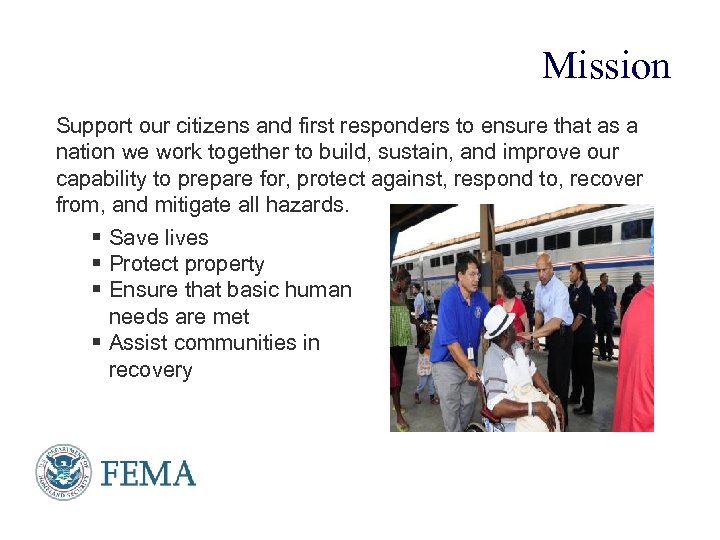 Mission Support our citizens and first responders to ensure that as a nation we work together to build, sustain, and improve our capability to prepare for, protect against, respond to, recover from, and mitigate all hazards. § Save lives § Protect property § Ensure that basic human needs are met § Assist communities in recovery Presenter’s Name June 17, 2003 4
 OCPO Mission To deliver the best business solutions by providing the full range of acquisition services to FEMA’s programs, partners and the public. § Responsible for overall oversight and execution of FEMA’s acquisition mission § Consists of 3 Divisions § Acquisition Operations § Acquisition Program and Planning § Acquisition Policy and Legislation § Staff located throughout FEMA at: § § HQ FEMA Regional Offices Joint Field Offices (JFO) Long Term Recovery Officer Presenter’s Name June 17, 2003 5
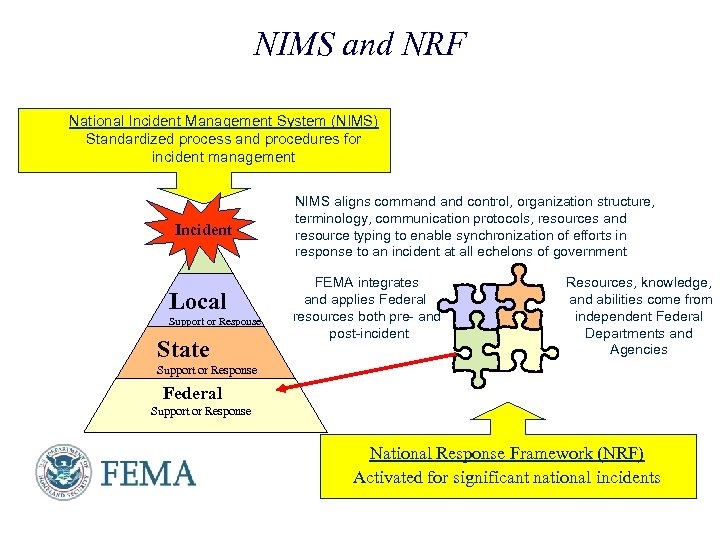 NIMS and NRF National Incident Management System (NIMS) Standardized process and procedures for incident management Incident Local Support or Response State NIMS aligns command control, organization structure, terminology, communication protocols, resources and resource typing to enable synchronization of efforts in response to an incident at all echelons of government FEMA integrates and applies Federal resources both pre- and post-incident Resources, knowledge, and abilities come from independent Federal Departments and Agencies Support or Response Federal Support or Response National Response Framework (NRF) Activated for significant national incidents FEMA is not the team. It. Presenter’s Name June 17, 2003 is part of 6
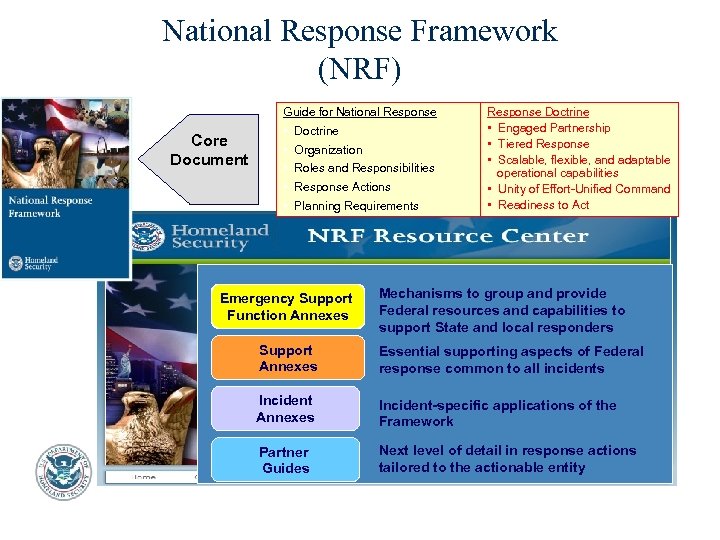 National Response Framework (NRF) Guide for National Response Core Document • Doctrine • Organization • Roles and Responsibilities • Response Actions • Planning Requirements Emergency Support Function Annexes Response Doctrine • Engaged Partnership • Tiered Response • Scalable, flexible, and adaptable operational capabilities • Unity of Effort-Unified Command • Readiness to Act Mechanisms to group and provide Federal resources and capabilities to support State and local responders Support Annexes Essential supporting aspects of Federal response common to all incidents Incident Annexes Incident-specific applications of the Framework Partner Guides Next level of detail in response actions tailored to the actionable entity Presenter’s Name June 17, 2003 7
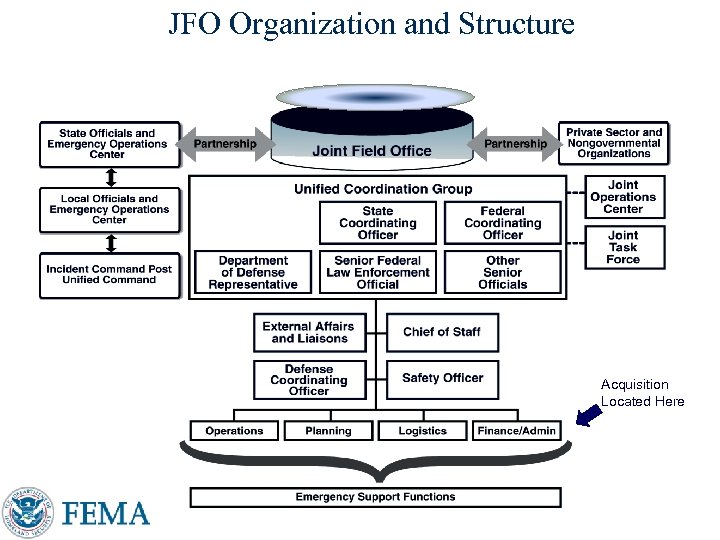 JFO Organization and Structure Acquisition Located Here Presenter’s Name June 17, 2003 8
 “It Takes the Whole Community” FEMA Administrator Fugate often says that “FEMA is not the nation’s emergency management team – FEMA is part of the team. ” The team is made up of our Federal partners, State, Territorial, Tribal, and local government, the private sector, non-profits, the faith-based community, and most importantly – the public. No matter how much everyone does, we will only be as prepared for a disaster as the public is. The public is the most important part of the team. Presenter’s Name June 17, 2003 9
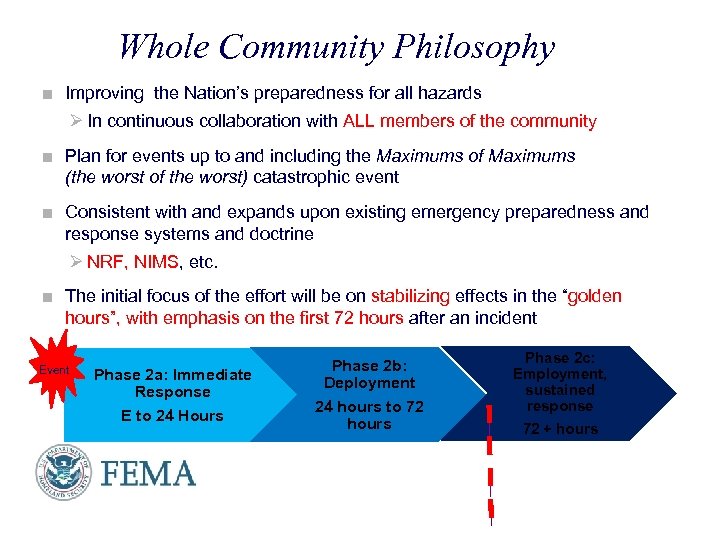 Whole Community Philosophy ■ Improving the Nation’s preparedness for all hazards Ø In continuous collaboration with ALL members of the community ■ Plan for events up to and including the Maximums of Maximums (the worst of the worst) catastrophic event ■ Consistent with and expands upon existing emergency preparedness and response systems and doctrine Ø NRF, NIMS, etc. ■ The initial focus of the effort will be on stabilizing effects in the “golden hours”, with emphasis on the first 72 hours after an incident Event Phase 2 a: Immediate Response E to 24 Hours Phase 2 b: Deployment 24 hours to 72 hours Phase 2 c: Employment, sustained response 72 + hours Presenter’s Name June 17, 2003
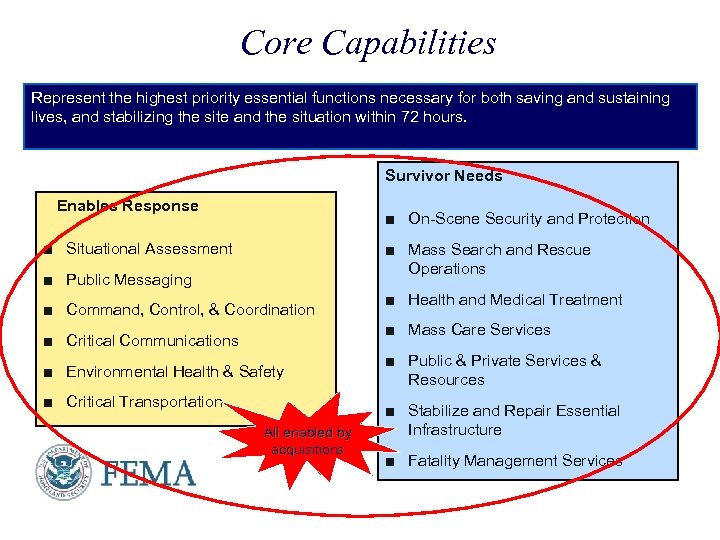 Core Capabilities Represent the highest priority essential functions necessary for both saving and sustaining lives, and stabilizing the site and the situation within 72 hours. Survivor Needs Enables Response ■ On-Scene Security and Protection ■ Situational Assessment ■ Mass Search and Rescue Operations ■ Public Messaging ■ Command, Control, & Coordination ■ Health and Medical Treatment ■ Mass Care Services ■ Critical Communications ■ Environmental Health & Safety ■ Critical Transportation All enabled by acquisitions ■ Public & Private Services & Resources ■ Stabilize and Repair Essential Infrastructure ■ Fatality Management Services Presenter’s Name June 17, 2003
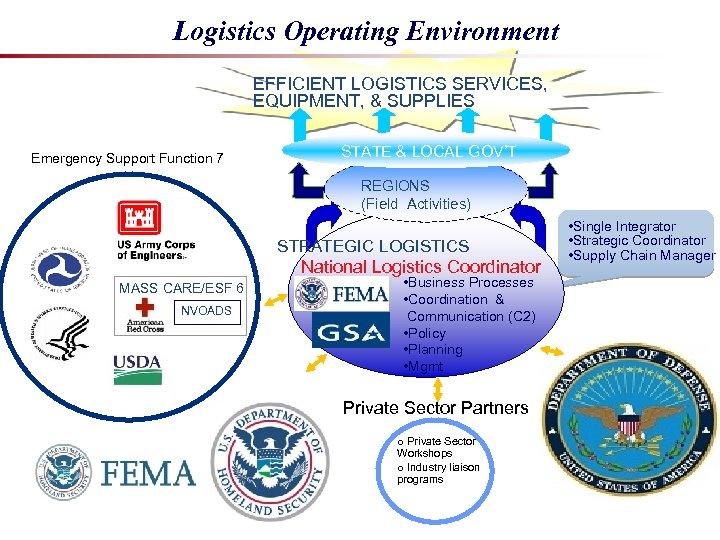 Logistics Operating Environment EFFICIENT LOGISTICS SERVICES, EQUIPMENT, & SUPPLIES STATE & LOCAL GOV’T Emergency Support Function 7 REGIONS (Field Activities) STRATEGIC LOGISTICS National Logistics Coordinator MASS CARE/ESF 6 NVOADS DHS • Business Processes • Coordination & Communication (C 2) • Policy • Planning • Mgmt • Single Integrator • Strategic Coordinator • Supply Chain Manager DOD Private Sector Partners o Private Sector Workshops o Industry liaison programs Presenter’s Name June 17, 2003
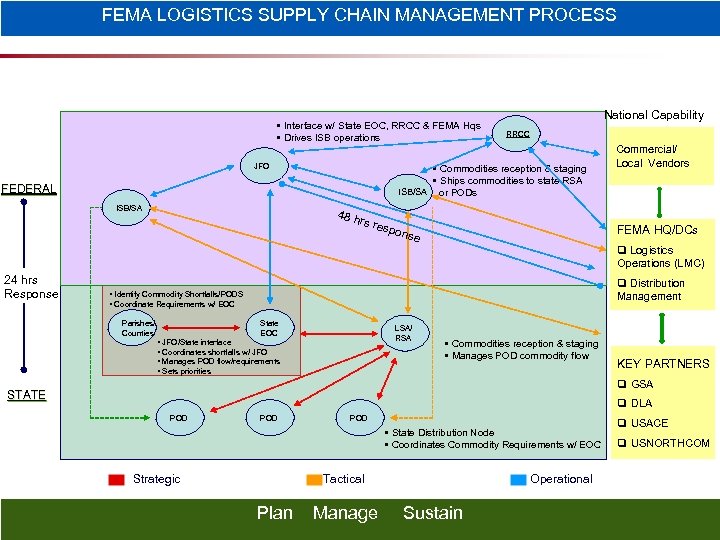 FEMA LOGISTICS SUPPLY CHAIN MANAGEMENT PROCESS • Interface w/ State EOC, RRCC & FEMA Hqs • Drives ISB operations JFO RRCC • Commodities reception & staging • Ships commodities to state RSA ISB/SA or PODs FEDERAL ISB/SA National Capability 48 h rs re spon 24 hrs Response FEMA HQ/DCs se q Logistics Operations (LMC) q Distribution Management • Identify Commodity Shortfalls/PODS • Coordinate Requirements w/ EOC Parishes/ Counties Commercial/ Local Vendors State EOC LSA/ RSA • JFO/State interface • Coordinates shortfalls w/ JFO • Manages POD flow/requirements • Sets priorities • Commodities reception & staging • Manages POD commodity flow KEY PARTNERS q GSA STATE q DLA POD POD • State Distribution Node • Coordinates Commodity Requirements w/ EOC q USACE q USNORTHCOM Strategic Tactical Operational Plan Manage Sustain. Presenter’s Name June 17, 2003 6
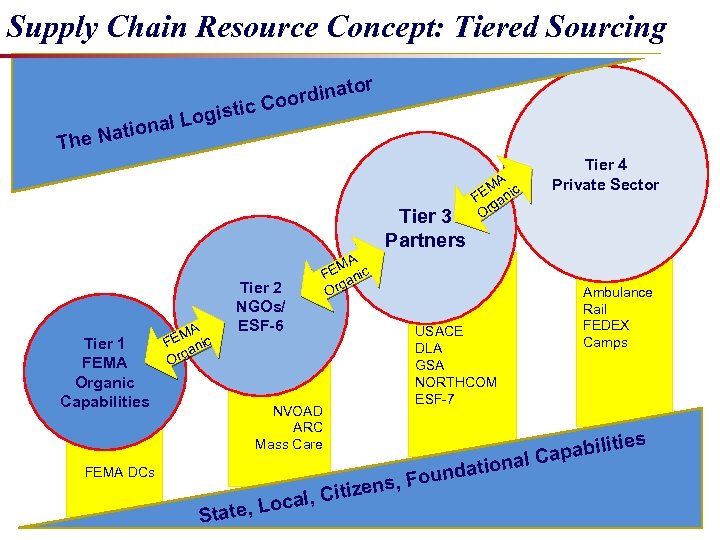 Supply Chain Resource Concept: Tiered Sourcing at The N t ordina Co tic is al Log ion or A Tier 1 FEMA Organic Capabilities MA c FE ani g Or Tier 2 NGOs/ ESF-6 A EM nic F a g Or NVOAD ARC Mass Care USACE DLA GSA NORTHCOM ESF-7 Ambulance Rail FEDEX Camps ies pabilit l Ca ationa nd s, Fou zen al, Citi c FEMA DCs Lo State, Tier 3 Partners M c FE ani g Or Tier 4 Private Sector
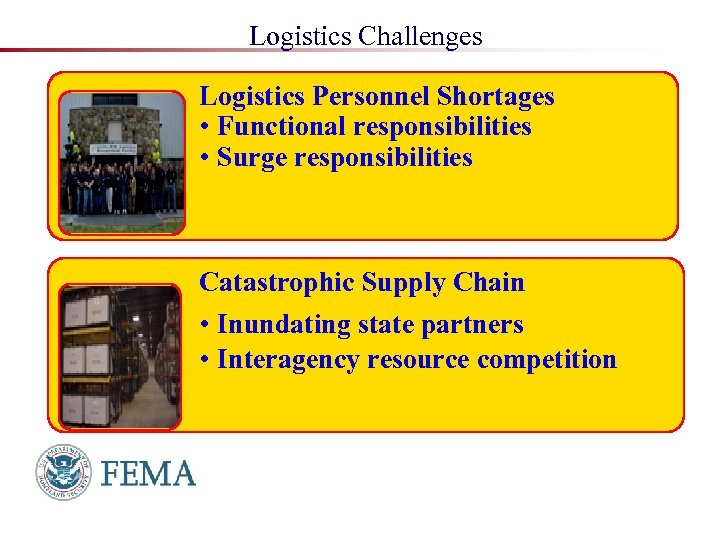 Logistics Challenges Logistics Personnel Shortages • Functional responsibilities • Surge responsibilities Catastrophic Supply Chain • Inundating state partners • Interagency resource competition Presenter’s Name June 17, 2003
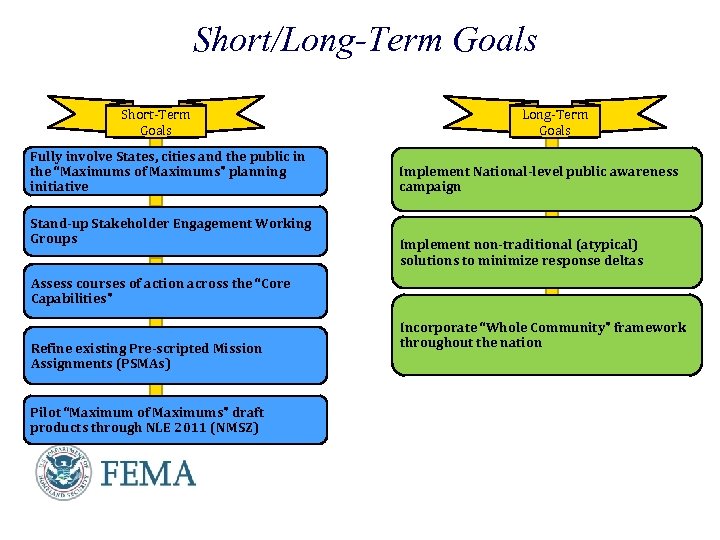 Short/Long-Term Goals Short-Term Goals Fully involve States, cities and the public in the “Maximums of Maximums” planning initiative Stand-up Stakeholder Engagement Working Groups Long-Term Goals Implement National-level public awareness campaign Implement non-traditional (atypical) solutions to minimize response deltas Assess courses of action across the “Core Capabilities” Refine existing Pre-scripted Mission Assignments (PSMAs) Incorporate “Whole Community” framework throughout the nation Pilot “Maximum of Maximums” draft products through NLE 2011 (NMSZ) Presenter’s Name June 17, 2003
 Acquisition Trends § Moving toward DHS department-wide acquisitions versus individual component acquisitions § An increase in performance-based contracting § Opportunities for industry: § to participate in reverse auctions, and § to make recommendations to solve mission and budget challenges § Increased collaboration with other DHS components § Improve partnerships and coordination with states, VOLAGs, and the private sector Presenter’s Name June 17, 2003 17
 Ongoing Acquisition Disaster Support Initiatives § Disaster Assistance Response Team (DART) – Regional Administrative Contracting Officers and Quality Assurance Representatives who provide disaster contract oversight from execution to closeout. FEMA is currently filling 26 positions to support this team. § Local Business Transition Team (LBTT) – An established team that assists with maximizing federal business opportunities with local firms following a federally declared disaster. Four LBTT members are currently located in FEMA Regional offices, who provide national coverage. The regional staff are supported by staff at HQ that also deploy in large-scale events. Presenter’s Name June 17, 2003 18
 “Buy Locally” Section 307 of the Robert T. Stafford Disaster Relief and Emergency Assistance Act. Section 307 requires Federal agencies, in response to a declared Major Disaster to maximize the use of organizations, firms, and individuals, where feasible and practical, residing or doing business in the areas affected by major disasters. § FAR Part 26. 201 – “Local firms” means a private organization, firm, or individual residing or doing business primarily in a major disaster or emergency area. § Interpreted as firm’s headquarters, majority of firm’s works, and/or majority of a firm’s employees are located within the declared areas. Presenter’s Name June 17, 2003 19
 Industry Liaison Program/ Local Business Transition Team § The FEMA Industry Liaison Program (ILP) establishes strategic relationships with vendor-supporting industry partners and stakeholders and serves as an information provider for vendors seeking to do business with FEMA. In addition, the ILP connects vendors with the appropriate program offices to discuss products and services which could support of FEMA’s mission. § The Local Business Transition Team (LBTT), the deployable component of ILP, was established after Hurricane Katrina in response to Section 307 of the Robert T. Stafford Disaster Relief and Emergency Assistance Act. LBTT is available to support all disaster responses, whether the LBTT is deployed to a disaster or not. When not deployed, the LBTT can support disasters from the regional offices and/or HQ Presenter’s Name June 17, 2003 20
 LBTT Business Outreach § Educate local vendors through procurement education seminars to foster successful business participation during recovery efforts § Establish partnerships with state purchasing counterparts within our regions to identify local vendors to assist in disaster response of rebuilding local communities § Establish partnerships with local Procurement Technical Assistance Centers (PTACs) to assist with educating vendors on how to do business with the Federal Government Presenter’s Name June 17, 2003 21
 LBTT Business Outreach § Provide market research for Contracting Officers, who are supporting disasters, to identify local vendors capable of meeting requirements § Form diverse partnerships and collaborate with area stakeholders – Federal, State, local and Tribal governmental entities, State and local business groups, and professional organizations Presenter’s Name June 17, 2003 22
 LBTT Outreach Events § Sponsor Vendor Educational Seminars - The seminars (“Disaster Contracting with Local Vendors” and “Bid and Proposal Preparation”) cover a wide range of topics including, but not limited to: • Introduction to Federal Contracting • Central Contractor Registration (CCR) • Writing Strong Proposals • FEMA Vendor Processes Presenter’s Name June 17, 2003 23
 ILP/LBTT Outreach Events § Host Industry Day Events § The events present specific acquisition and procurement requirements to vendors interested in doing business with FEMA § Industry Day events are synchronized with the Portfolio Management Activity release of the requirements’ Statement of Objectives (SOO) and/or Statement of Work (SOW) Presenter’s Name June 17, 2003 24
 Procurement Technical Assistance Centers Congress created the Procurement Technical Assistance Program (PTAP) to help businesses seeking to compete successfully in federal, state and local government contracting. Funded through Cooperative agreements between Do. D and state/local entities, 94 PTACs provide a range of expert services at little or no charge. http: //www. aptac-us. org/new/index. php Presenter’s Name June 17, 2003 25
 Questions? Presenter’s Name June 17, 2003 26