


 Скачать презентацию Virginia Department of Education Module Ten Transparencies Driver
1559dac804fc81560f96f0fbaca392a3.ppt
- Количество слайдов: 41
 Virginia Department of Education Module Ten Transparencies Driver Responsibilities: Making Informed Choices Topic 1 -- Insuring Vehicle Topic 2 -- Purchasing Vehicle Topic 3 -- Trip Planning Topic 4 – Virginia’s Conservation Concerns Provided in cooperation with the Virginia Department of Motor Vehicles
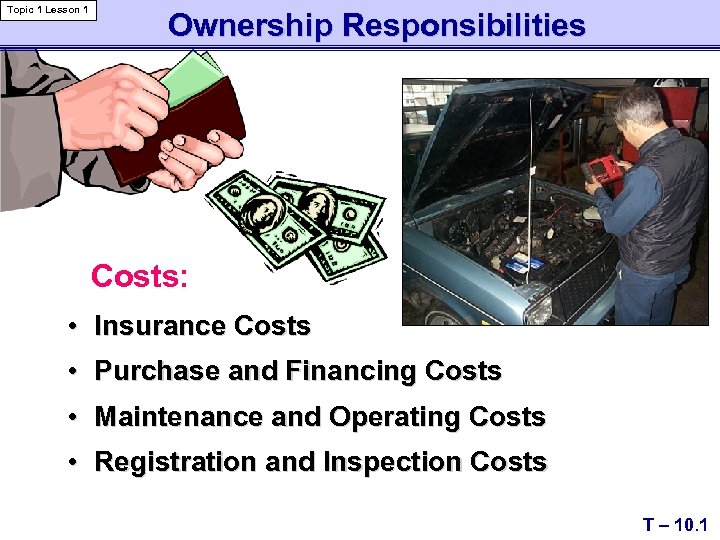 Topic 1 Lesson 1 Ownership Responsibilities Costs: • Insurance Costs • Purchase and Financing Costs • Maintenance and Operating Costs • Registration and Inspection Costs T – 10. 1
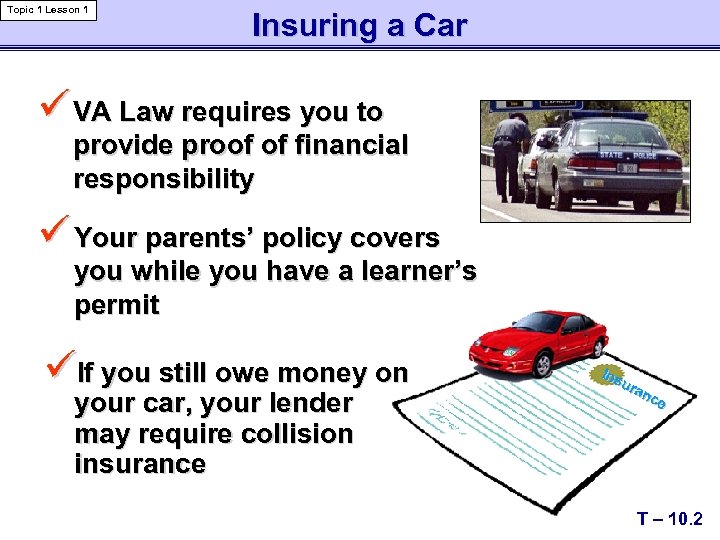 Topic 1 Lesson 1 Insuring a Car ü VA Law requires you to provide proof of financial responsibility ü Your parents’ policy covers you while you have a learner’s permit üIf you still owe money on your car, your lender may require collision insurance T – 10. 2
 Topic 1 Lesson 2 Financial Responsibility Law $ Minimum liability coverage $ Alternatives to insurance coverage $ Types of proof of financial responsibility $ When you must show proof of financial responsibility $ Penalties for driving without insurance T – 10. 3
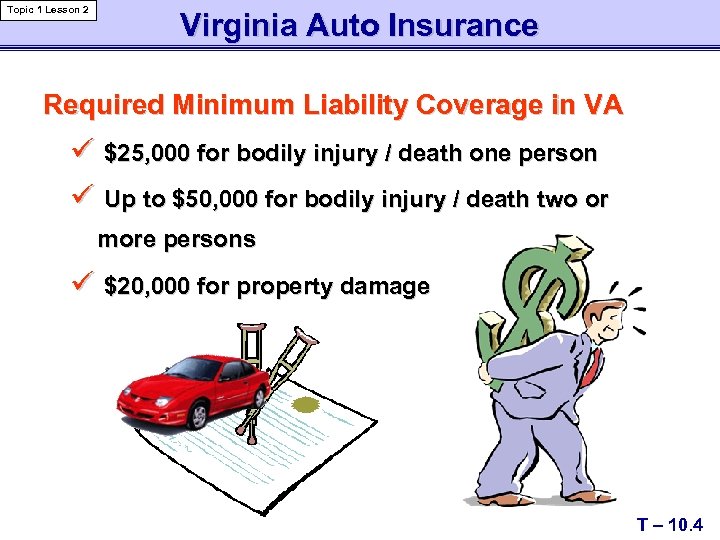 Topic 1 Lesson 2 Virginia Auto Insurance Required Minimum Liability Coverage in VA ü $25, 000 for bodily injury / death one person ü Up to $50, 000 for bodily injury / death two or more persons ü $20, 000 for property damage T – 10. 4
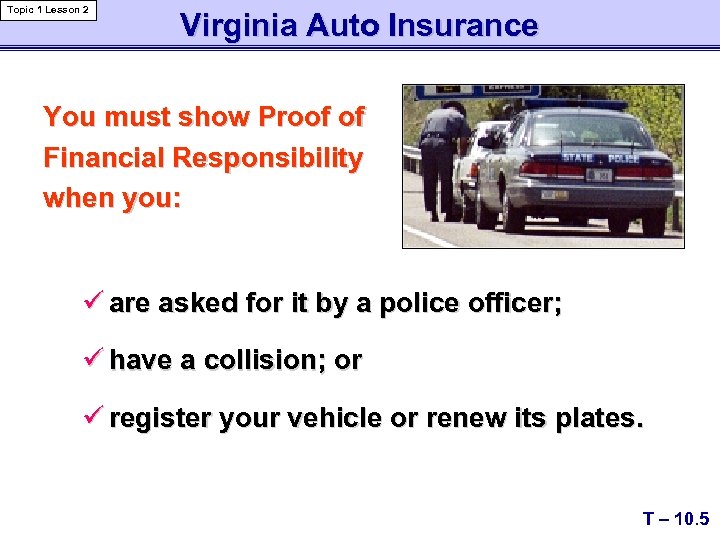 Topic 1 Lesson 2 Virginia Auto Insurance You must show Proof of Financial Responsibility when you: ü are asked for it by a police officer; ü have a collision; or ü register your vehicle or renew its plates. T – 10. 5
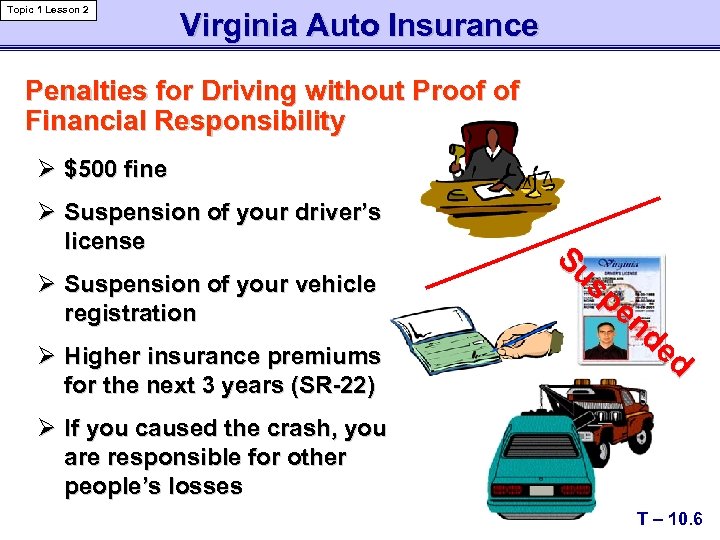 Topic 1 Lesson 2 Virginia Auto Insurance Penalties for Driving without Proof of Financial Responsibility Ø $500 fine Ø Suspension of your driver’s license Ø Suspension of your vehicle registration Ø Higher insurance premiums for the next 3 years (SR-22) Su sp en de d Ø If you caused the crash, you are responsible for other people’s losses T – 10. 6
 Topic 1 Lesson 3 Virginia Auto Insurance Facts on the Declaration Page of Your Policy v The exact name of your insurance company v The policy number v Your coverage and how much it costs v Your deductibles, if any v The vehicles insured on the policy, their vehicle identification numbers and their classifications for rating purposes T – 10. 7
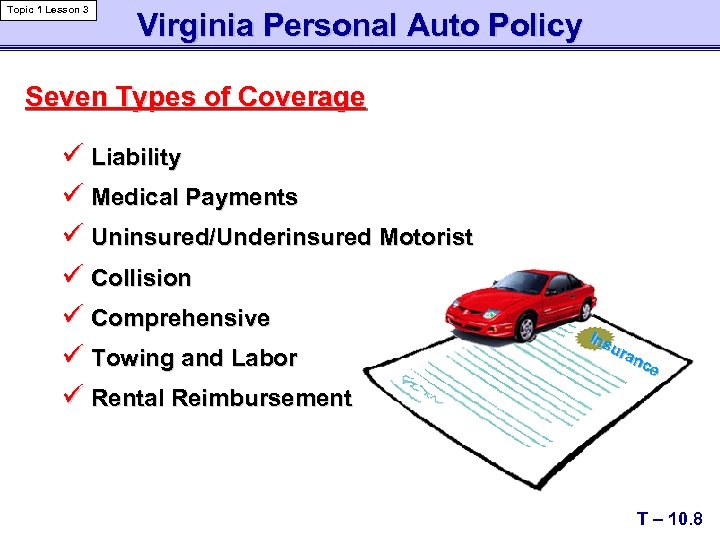 Topic 1 Lesson 3 Virginia Personal Auto Policy Seven Types of Coverage ü Liability ü Medical Payments ü Uninsured/Underinsured Motorist ü Collision ü Comprehensive ü Towing and Labor ü Rental Reimbursement T – 10. 8
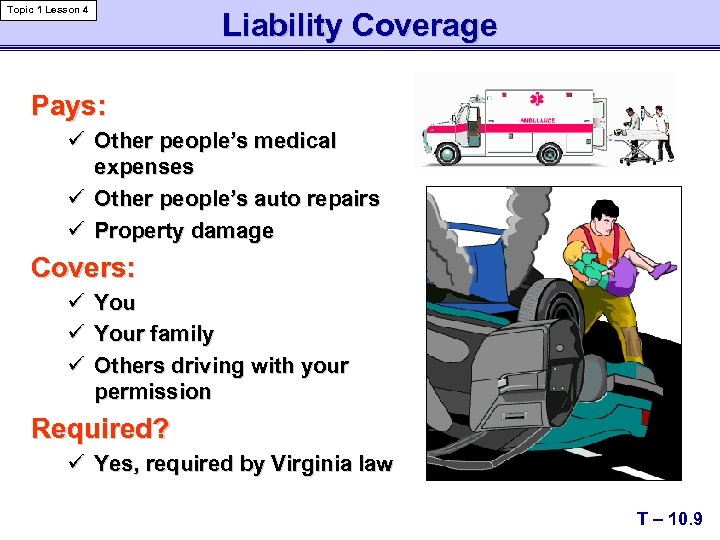 Topic 1 Lesson 4 Liability Coverage Pays: ü Other people’s medical expenses ü Other people’s auto repairs ü Property damage Covers: ü Your family ü Others driving with your permission Required? ü Yes, required by Virginia law T – 10. 9
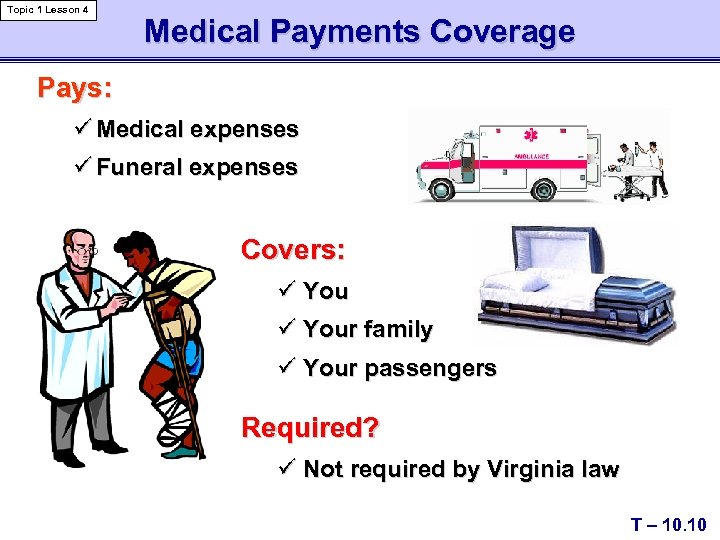 Topic 1 Lesson 4 Medical Payments Coverage Pays: ü Medical expenses ü Funeral expenses Covers: ü Your family ü Your passengers Required? ü Not required by Virginia law T – 10. 10
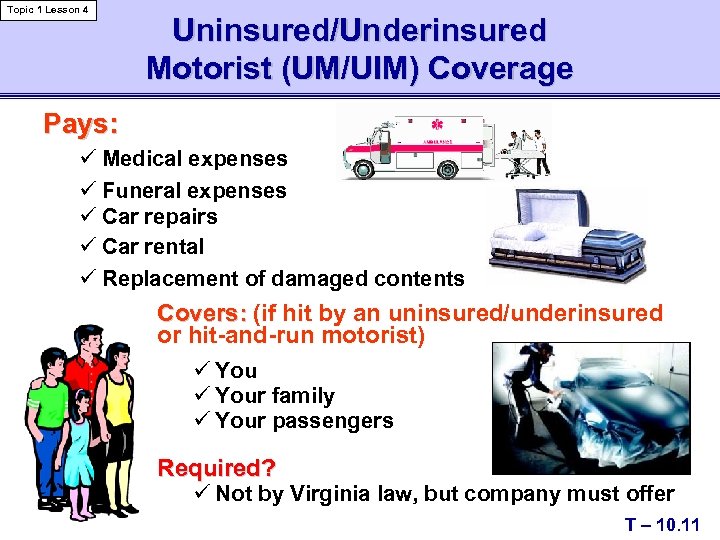 Topic 1 Lesson 4 Uninsured/Underinsured Motorist (UM/UIM) Coverage Pays: ü Medical expenses ü Funeral expenses ü Car repairs ü Car rental ü Replacement of damaged contents Covers: (if hit by an uninsured/underinsured or hit-and-run motorist) ü Your family ü Your passengers Required? ü Not by Virginia law, but company must offer T – 10. 11
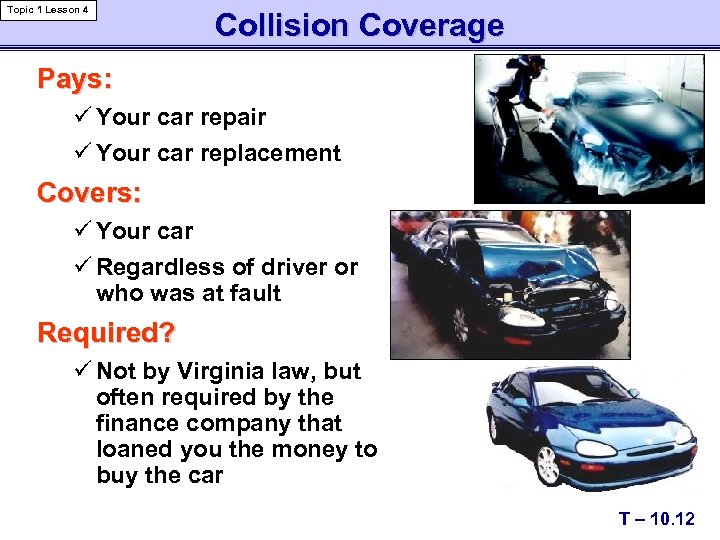 Topic 1 Lesson 4 Collision Coverage Pays: ü Your car repair ü Your car replacement Covers: ü Your car ü Regardless of driver or who was at fault Required? ü Not by Virginia law, but often required by the finance company that loaned you the money to buy the car T – 10. 12
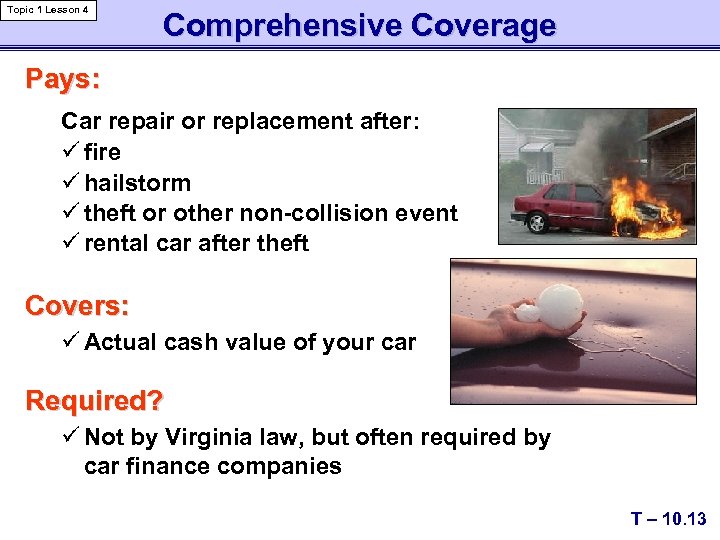 Topic 1 Lesson 4 Comprehensive Coverage Pays: Car repair or replacement after: ü fire ü hailstorm ü theft or other non-collision event ü rental car after theft Covers: ü Actual cash value of your car Required? ü Not by Virginia law, but often required by car finance companies T – 10. 13
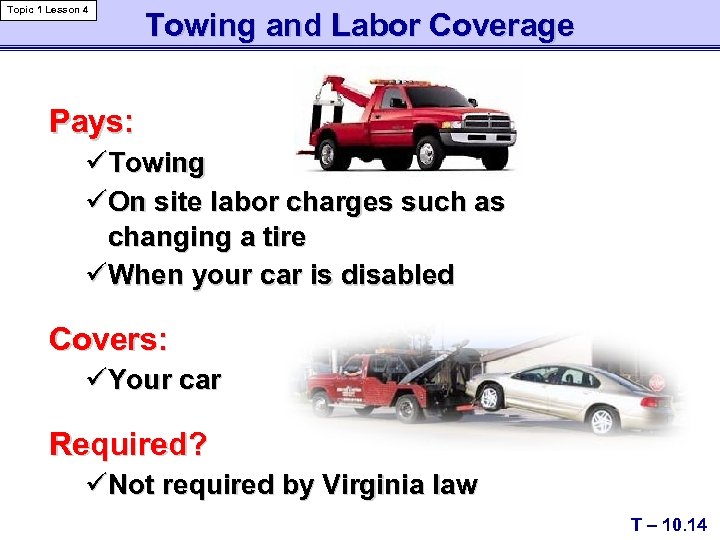 Topic 1 Lesson 4 Towing and Labor Coverage Pays: üTowing üOn site labor charges such as changing a tire üWhen your car is disabled Covers: üYour car Required? üNot required by Virginia law T – 10. 14
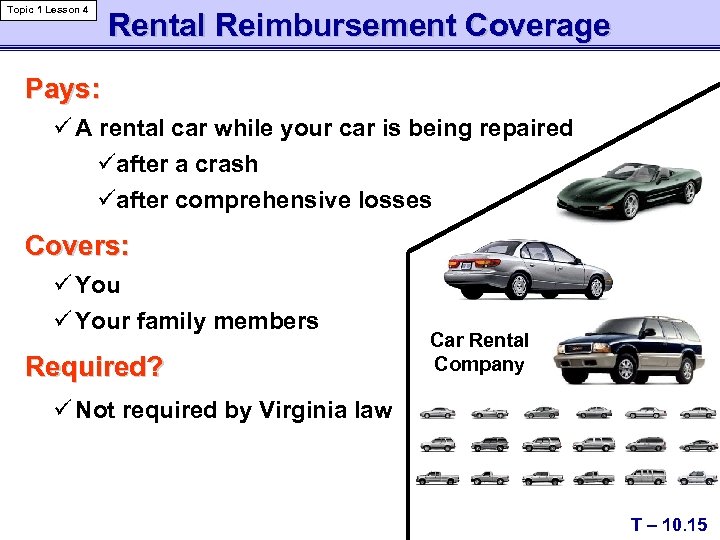 Topic 1 Lesson 4 Rental Reimbursement Coverage Pays: ü A rental car while your car is being repaired üafter a crash üafter comprehensive losses Covers: ü Your family members Required? Car Rental Company ü Not required by Virginia law T – 10. 15
 Topic 1 Lesson 5 Insurance Costs Ø How are car insurance rates determined? Ø What factors are used in establishing rates? Ø Discounts? T – 10. 16
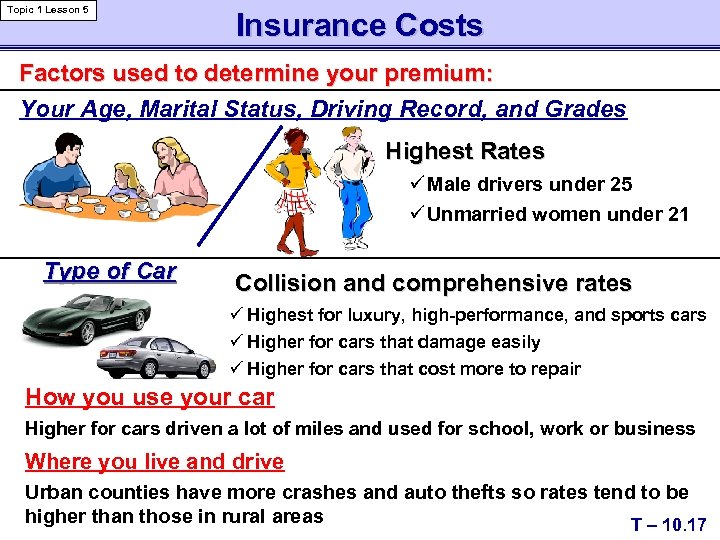 Topic 1 Lesson 5 Insurance Costs Factors used to determine your premium: Your Age, Marital Status, Driving Record, and Grades Highest Rates ü Male drivers under 25 ü Unmarried women under 21 Type of Car Collision and comprehensive rates ü Highest for luxury, high-performance, and sports cars ü Higher for cars that damage easily ü Higher for cars that cost more to repair How you use your car Higher for cars driven a lot of miles and used for school, work or business Where you live and drive Urban counties have more crashes and auto thefts so rates tend to be higher than those in rural areas T – 10. 17
 Topic 1 Lesson 5 Insurance Costs Factors used to determine your individual premium: Your Deductibles üYour share of the cost of a collision or comprehensive claim üYou can reduce your premium by raising your deductibles Surcharges üPenalties added for accidents and certain traffic violations Discounts üSome are required by the state, while others are incentives offered by insurance companies T – 10. 18
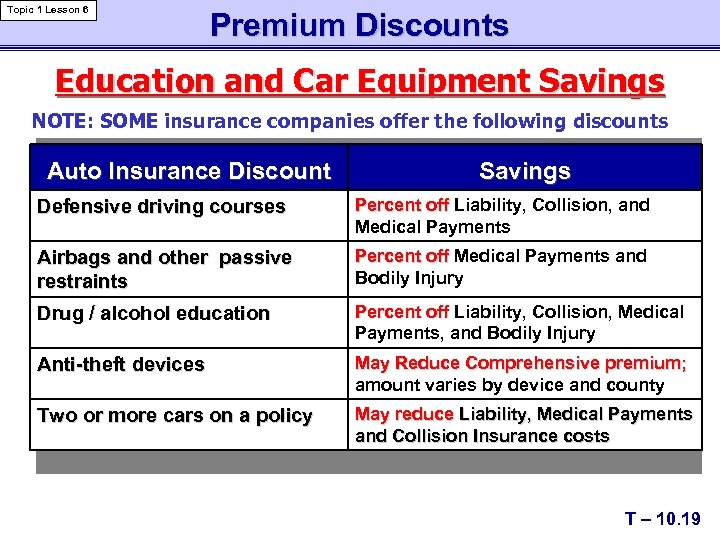 Topic 1 Lesson 6 Premium Discounts Education and Car Equipment Savings NOTE: SOME insurance companies offer the following discounts Auto Insurance Discount Savings Defensive driving courses Percent off Liability, Collision, and Medical Payments Airbags and other passive restraints Percent off Medical Payments and Bodily Injury Drug / alcohol education Percent off Liability, Collision, Medical Payments, and Bodily Injury Anti-theft devices May Reduce Comprehensive premium; amount varies by device and county Two or more cars on a policy May reduce Liability, Medical Payments and Collision Insurance costs T – 10. 19
 Topic 1 Lesson 6 Insurance Premium Discounts Some companies may give discounts for: • Your age and annual mileage driven • Policy renewal, no claims, good driving record anti-lock brakes • A parent or family whose young driver is away at school without a car • Full-time college and high school students with a "B" or 3. 0 grade point average • Cars with automatic daytime running lights • Membership or adult leadership in certain youth organizations T – 10. 20
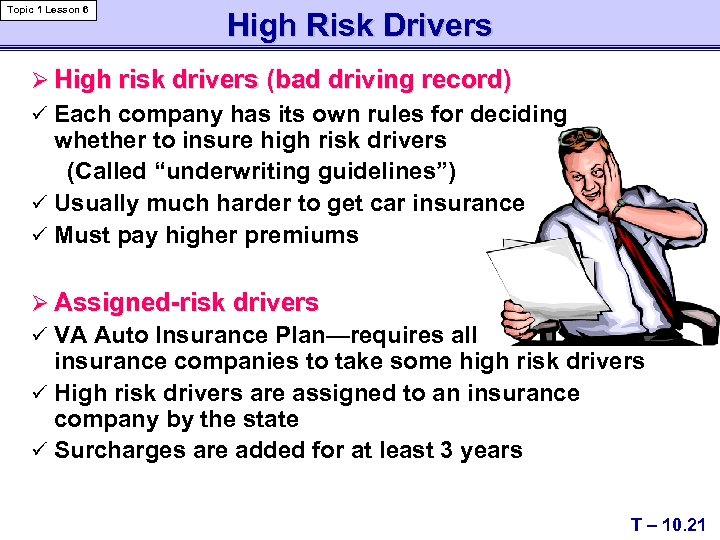 Topic 1 Lesson 6 High Risk Drivers Ø High risk drivers (bad driving record) ü Each company has its own rules for deciding whether to insure high risk drivers (Called “underwriting guidelines”) ü Usually much harder to get car insurance ü Must pay higher premiums Ø Assigned-risk drivers ü VA Auto Insurance Plan—requires all insurance companies to take some high risk drivers ü High risk drivers are assigned to an insurance company by the state ü Surcharges are added for at least 3 years T – 10. 21
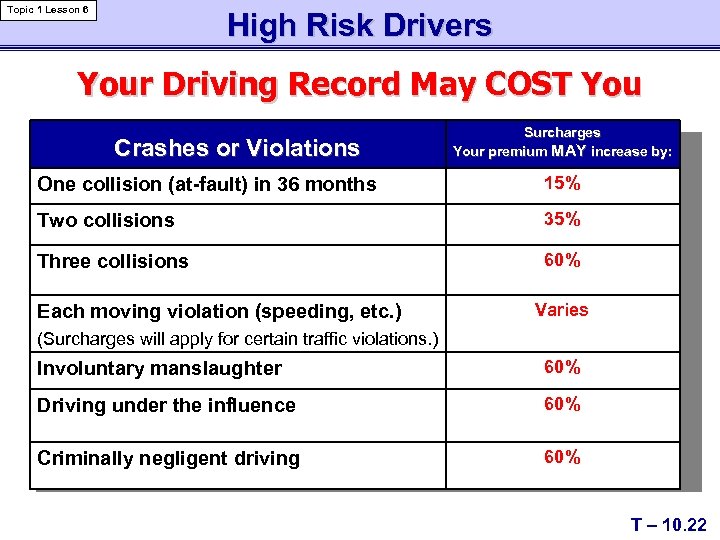 Topic 1 Lesson 6 High Risk Drivers Your Driving Record May COST You Crashes or Violations Surcharges Your premium MAY increase by: One collision (at-fault) in 36 months 15% Two collisions 35% Three collisions 60% Each moving violation (speeding, etc. ) Varies (Surcharges will apply for certain traffic violations. ) Involuntary manslaughter 60% Driving under the influence 60% Criminally negligent driving 60% T – 10. 22
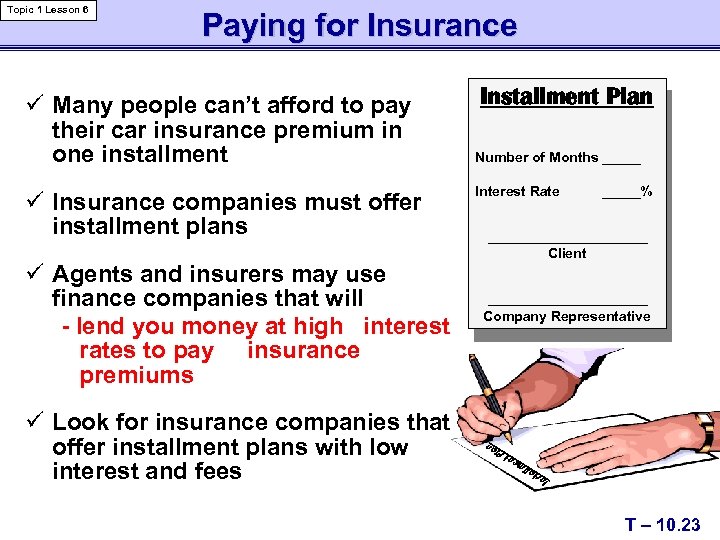 Paying for Insurance _____% ____________ Client ____________ Company Representative m ü Look for insurance companies that offer installment plans with low interest and fees Interest Rate all ü Agents and insurers may use finance companies that will - lend you money at high interest rates to pay insurance premiums Number of Months _____ Ins t ü Insurance companies must offer installment plans Installment Plan ü Many people can’t afford to pay their car insurance premium in one installment en t. P Topic 1 Lesson 6 T – 10. 23
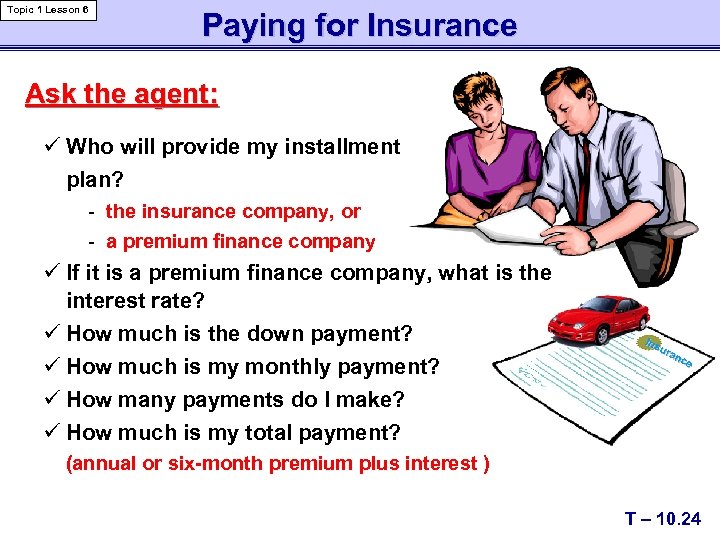 Topic 1 Lesson 6 Paying for Insurance Ask the agent: ü Who will provide my installment plan? - the insurance company, or - a premium finance company ü If it is a premium finance company, what is the interest rate? ü How much is the down payment? ü How much is my monthly payment? ü How many payments do I make? ü How much is my total payment? (annual or six-month premium plus interest ) T – 10. 24
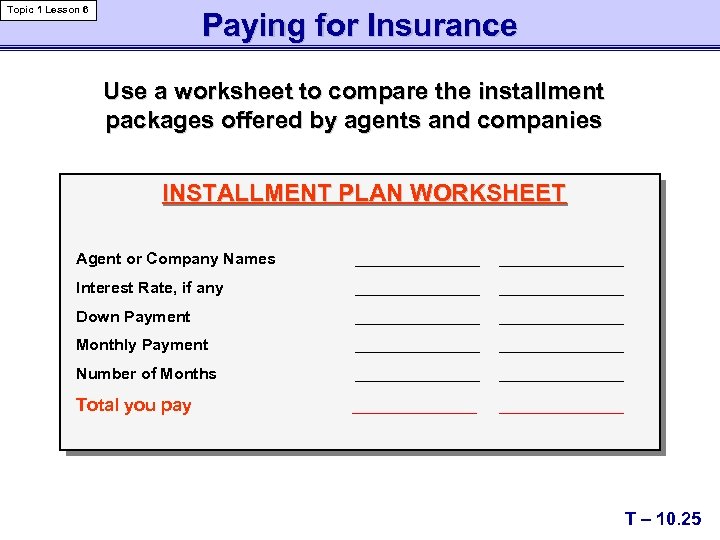 Topic 1 Lesson 6 Paying for Insurance Use a worksheet to compare the installment packages offered by agents and companies INSTALLMENT PLAN WORKSHEET Agent or Company Names ______________ Interest Rate, if any ______________ Down Payment ______________ Monthly Payment ______________ Number of Months ______________ Total you pay ______________ T – 10. 25
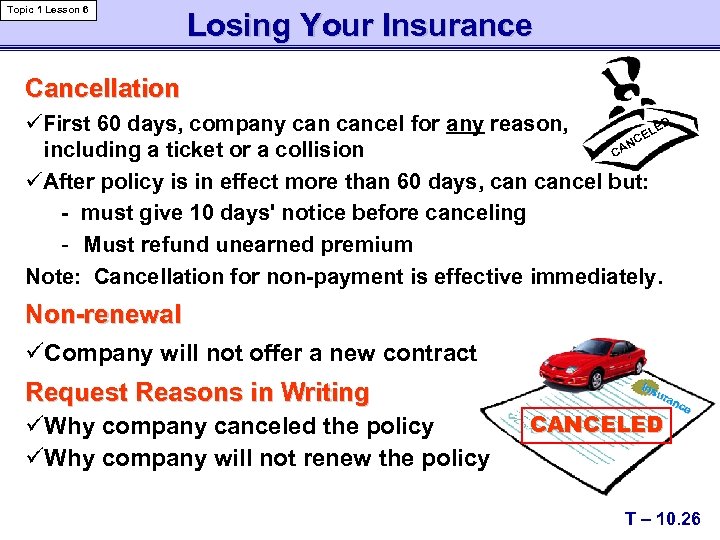 Topic 1 Lesson 6 Losing Your Insurance Cancellation üFirst 60 days, company cancel for any reason, ED EL NC including a ticket or a collision CA üAfter policy is in effect more than 60 days, cancel but: - must give 10 days' notice before canceling - Must refund unearned premium Note: Cancellation for non-payment is effective immediately. Non-renewal üCompany will not offer a new contract Request Reasons in Writing üWhy company canceled the policy üWhy company will not renew the policy CANCELED T – 10. 26
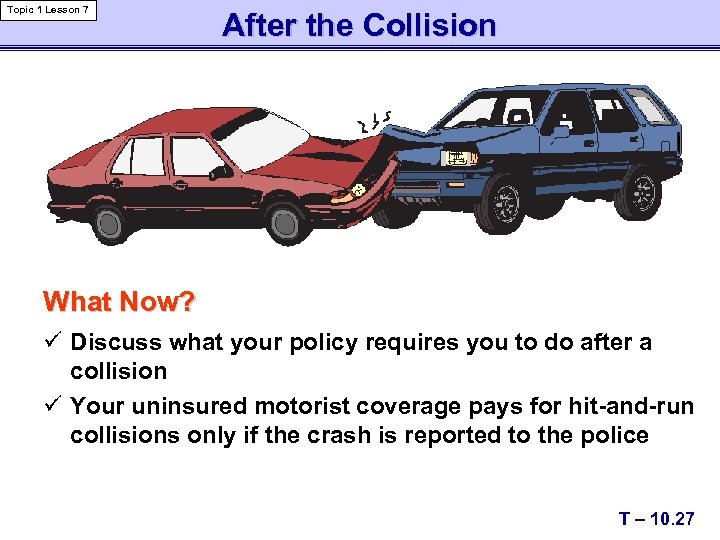 Topic 1 Lesson 7 After the Collision What Now? ü Discuss what your policy requires you to do after a collision ü Your uninsured motorist coverage pays for hit-and-run collisions only if the crash is reported to the police T – 10. 27
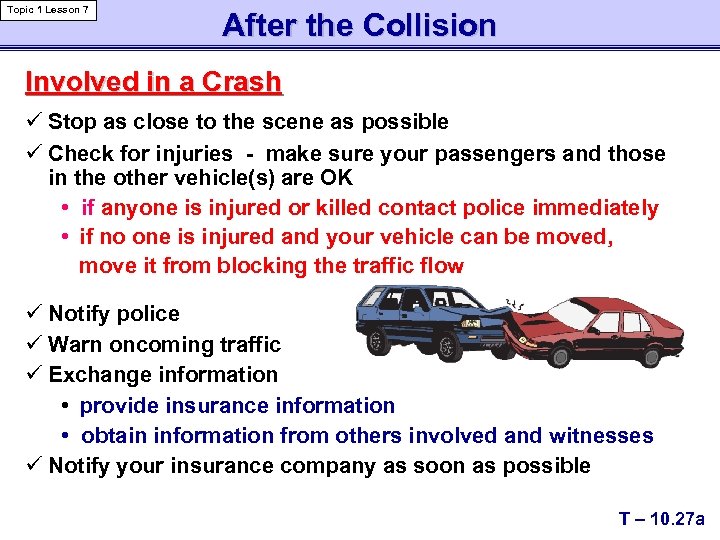 Topic 1 Lesson 7 After the Collision Involved in a Crash ü Stop as close to the scene as possible ü Check for injuries - make sure your passengers and those in the other vehicle(s) are OK • if anyone is injured or killed contact police immediately • if no one is injured and your vehicle can be moved, move it from blocking the traffic flow ü Notify police ü Warn oncoming traffic ü Exchange information • provide insurance information • obtain information from others involved and witnesses ü Notify your insurance company as soon as possible T – 10. 27 a
 Topic 1 Lesson 7 After the Collision What should you do when you are involved in a crash and have a claim? ü Notify your insurance company promptly ü Your agent can help you file the claim correctly and completely fill out any forms needed to verify your claim ü Keep a copy of the forms for your records If the company rejects your claim or pays only part of it, you should be given an explanation for that decision. T – 10. 27 b
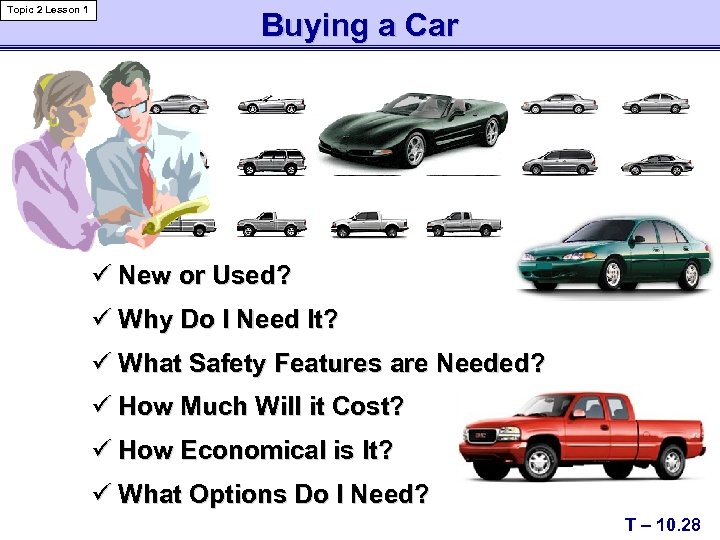 Topic 2 Lesson 1 Buying a Car ü New or Used? ü Why Do I Need It? ü What Safety Features are Needed? ü How Much Will it Cost? ü How Economical is It? ü What Options Do I Need? T – 10. 28
 Topic 2 Lesson 1 Your Monthly Payment Vehicle Price Formula Purchase Price x Interest Rate x Length of Finance Purchase Price Interest Rate Length of Finance - $10, 000 8 percent 24 months Purchase Price + Sales Taxes + Interest = Total Price Approximately 11, 592. 00 What is your monthly payment? T – 10. 29
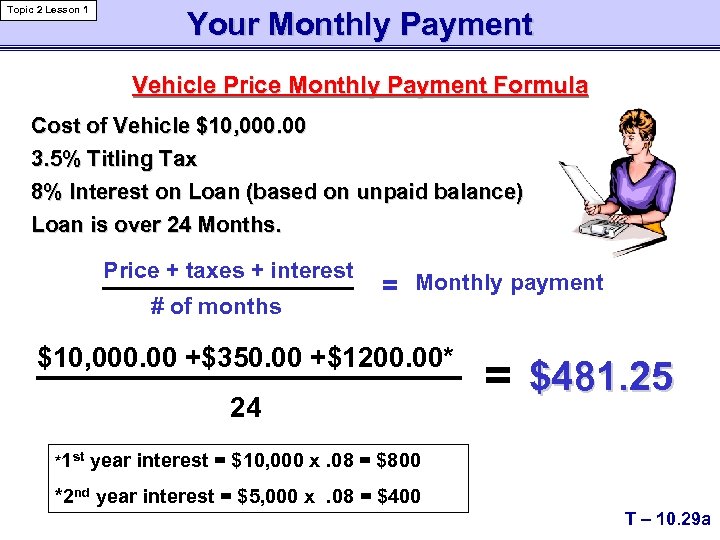 Topic 2 Lesson 1 Your Monthly Payment Vehicle Price Monthly Payment Formula Cost of Vehicle $10, 000. 00 3. 5% Titling Tax 8% Interest on Loan (based on unpaid balance) Loan is over 24 Months. Price + taxes + interest # of months = Monthly payment $10, 000. 00 +$350. 00 +$1200. 00* 24 *1 st = $481. 25 year interest = $10, 000 x. 08 = $800 *2 nd year interest = $5, 000 x. 08 = $400 T – 10. 29 a
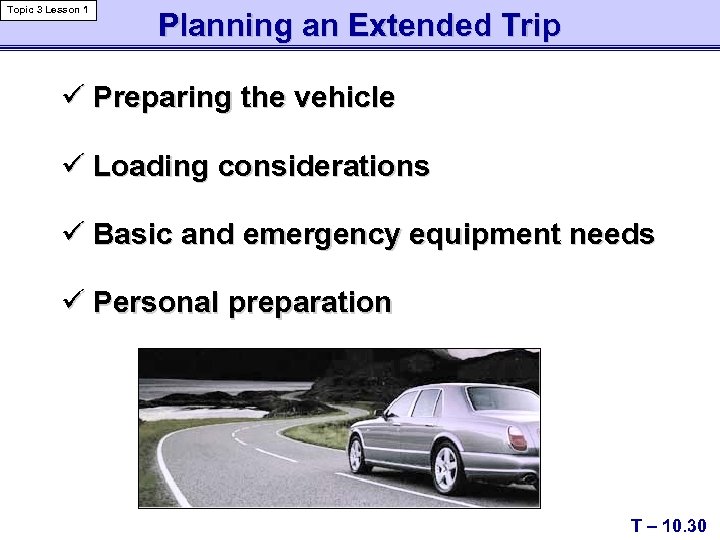 Topic 3 Lesson 1 Planning an Extended Trip ü Preparing the vehicle ü Loading considerations ü Basic and emergency equipment needs ü Personal preparation T – 10. 30
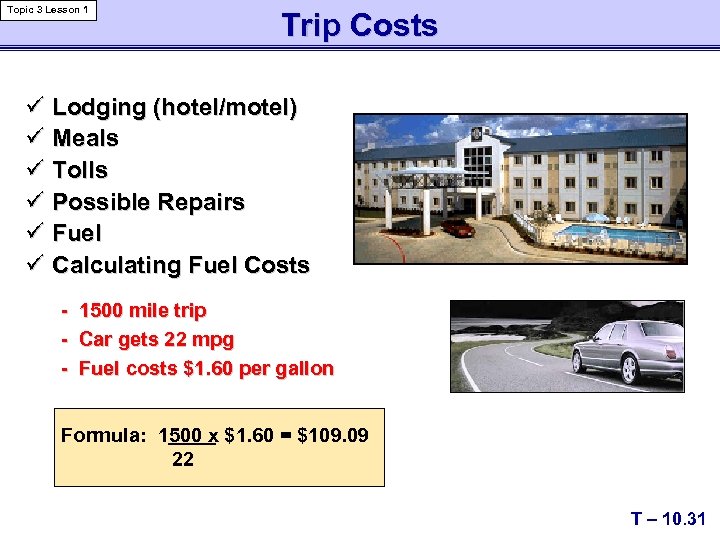 Topic 3 Lesson 1 Trip Costs ü Lodging (hotel/motel) ü Meals ü Tolls ü Possible Repairs ü Fuel ü Calculating Fuel Costs - 1500 mile trip - Car gets 22 mpg - Fuel costs $1. 60 per gallon Formula: 1500 x $1. 60 = $109. 09 22 T – 10. 31
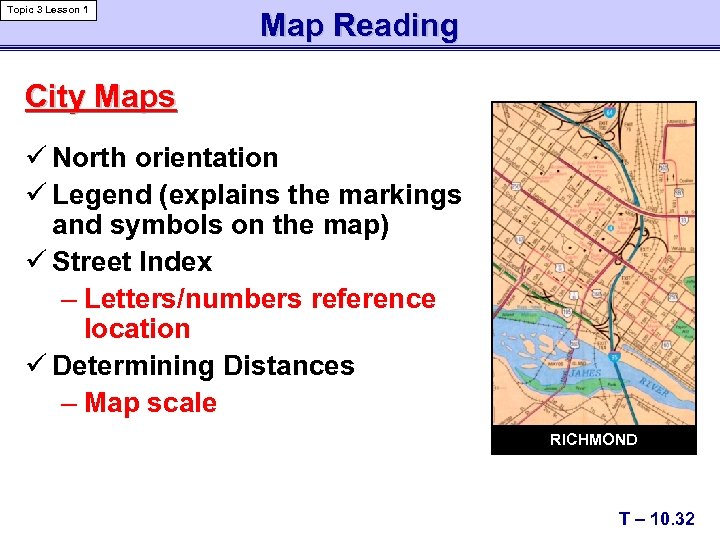 Topic 3 Lesson 1 Map Reading City Maps ü North orientation ü Legend (explains the markings and symbols on the map) ü Street Index – Letters/numbers reference location ü Determining Distances – Map scale RICHMOND T – 10. 32
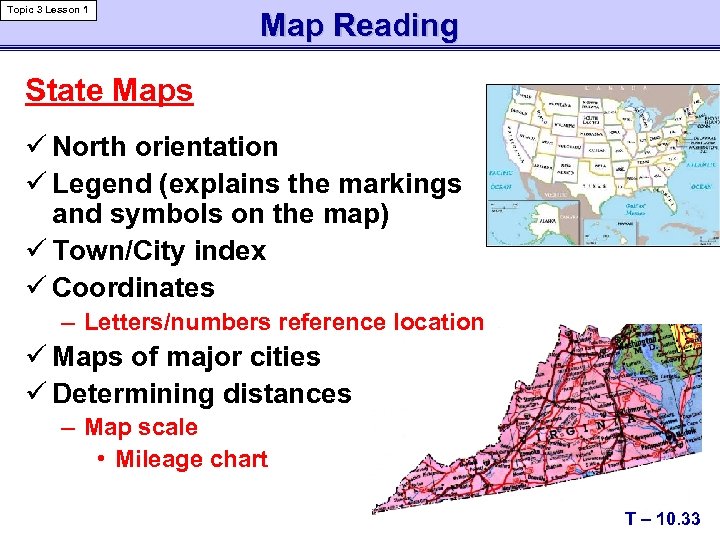 Topic 3 Lesson 1 Map Reading State Maps ü North orientation ü Legend (explains the markings and symbols on the map) ü Town/City index ü Coordinates – Letters/numbers reference location ü Maps of major cities ü Determining distances – Map scale • Mileage chart T – 10. 33
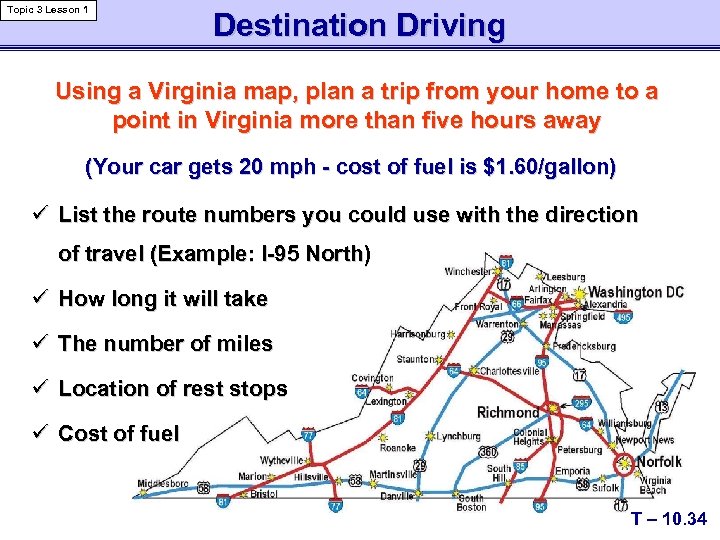 Topic 3 Lesson 1 Destination Driving Using a Virginia map, plan a trip from your home to a point in Virginia more than five hours away (Your car gets 20 mph - cost of fuel is $1. 60/gallon) ü List the route numbers you could use with the direction of travel (Example: I-95 North) ü How long it will take ü The number of miles ü Location of rest stops ü Cost of fuel T – 10. 34
 Topic 4 Lesson 1 Conserving Virginia’s Natural Resources When operating your vehicle ü Accelerate smoothly. ü Drive at moderate speeds. ü Avoid unnecessary braking and try to anticipate the traffic ahead. ü Avoid excessive idling. ü Join a car pool for commuting to and from school or work. ü Keep your vehicle in good working order. ü Recycle old oil and fluids. ü Recycle old vehicle parts. T – 10. 35
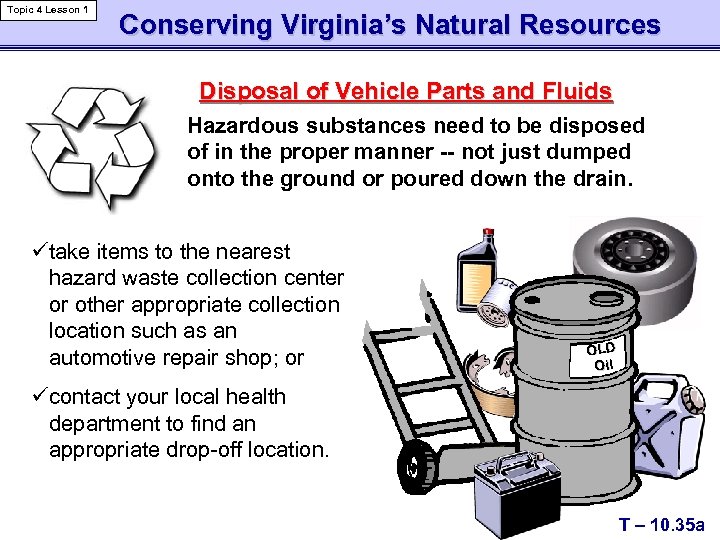 Topic 4 Lesson 1 Conserving Virginia’s Natural Resources Disposal of Vehicle Parts and Fluids Hazardous substances need to be disposed of in the proper manner -- not just dumped onto the ground or poured down the drain. ütake items to the nearest hazard waste collection center or other appropriate collection location such as an automotive repair shop; or OLD Oil ücontact your local health department to find an appropriate drop-off location. T – 10. 35 a
 Topic 4 Lesson 1 Conserving Virginia’s Natural Resources Tips for handling toxic substances ü call your local recycling center, service station, sanitation center, or local health department to review proper recycling procedures ü read all labels carefully to ensure you are using the correct container ü monitor and fix automotive fluid leaks ü to prevent spills, use a funnel for pouring automotive fluids ü whenever possible, avoid leaving leftover liquids in the container ü catch any drained fluid and store in a container, or a well-sealed and labeled plastic jug ü never discard used automotive fluid in sinks, storm drains, the garbage, or on the ground ü store automotive fluids separately — NEVER mix them together T – 10. 35 b