



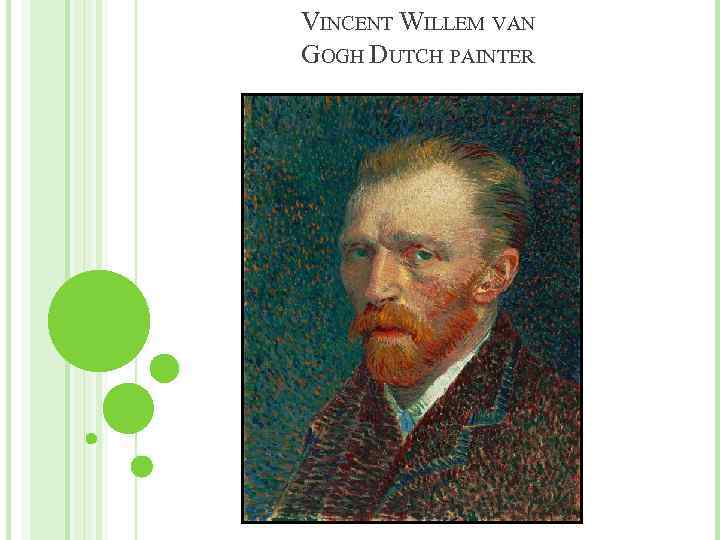
 VINCENT WILLEM VAN GOGH DUTCH PAINTER
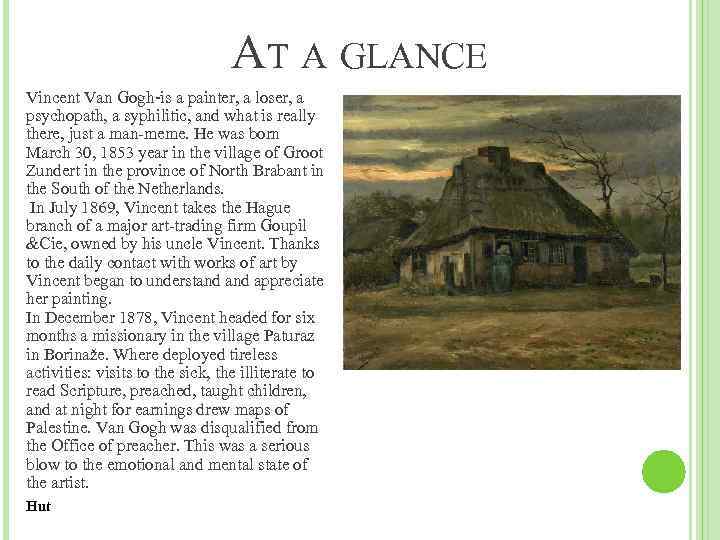 AT A GLANCE Vincent Van Gogh-is a painter, a loser, a psychopath, a syphilitic, and what is really there, just a man-meme. He was born March 30, 1853 year in the village of Groot Zundert in the province of North Brabant in the South of the Netherlands. In July 1869, Vincent takes the Hague branch of a major art-trading firm Goupil &Cie, owned by his uncle Vincent. Thanks to the daily contact with works of art by Vincent began to understand appreciate her painting. In December 1878, Vincent headed for six months a missionary in the village Paturaz in Borinaže. Where deployed tireless activities: visits to the sick, the illiterate to read Scripture, preached, taught children, and at night for earnings drew maps of Palestine. Van Gogh was disqualified from the Office of preacher. This was a serious blow to the emotional and mental state of the artist. Hut
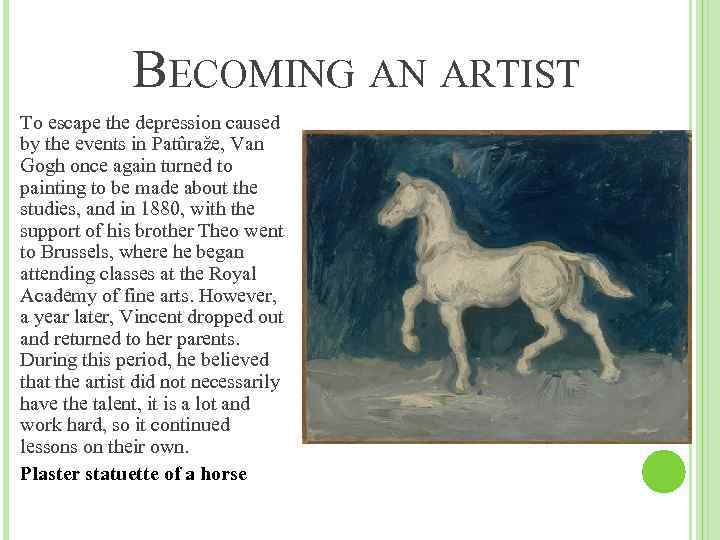 BECOMING AN ARTIST To escape the depression caused by the events in Patûraže, Van Gogh once again turned to painting to be made about the studies, and in 1880, with the support of his brother Theo went to Brussels, where he began attending classes at the Royal Academy of fine arts. However, a year later, Vincent dropped out and returned to her parents. During this period, he believed that the artist did not necessarily have the talent, it is a lot and work hard, so it continued lessons on their own. Plaster statuette of a horse
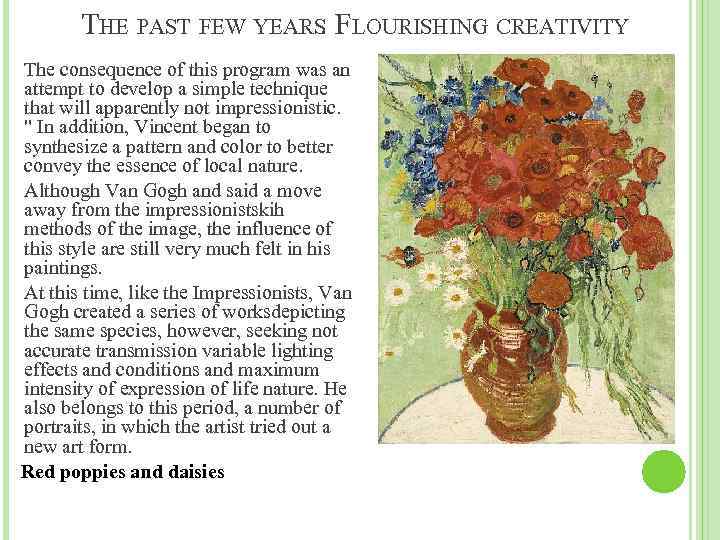 THE PAST FEW YEARS. FLOURISHING CREATIVITY The consequence of this program was an attempt to develop a simple technique that will apparently not impressionistic. " In addition, Vincent began to synthesize a pattern and color to better convey the essence of local nature. Although Van Gogh and said a move away from the impressionistskih methods of the image, the influence of this style are still very much felt in his paintings. At this time, like the Impressionists, Van Gogh created a series of worksdepicting the same species, however, seeking not accurate transmission variable lighting effects and conditions and maximum intensity of expression of life nature. He also belongs to this period, a number of portraits, in which the artist tried out a new art form. Red poppies and daisies
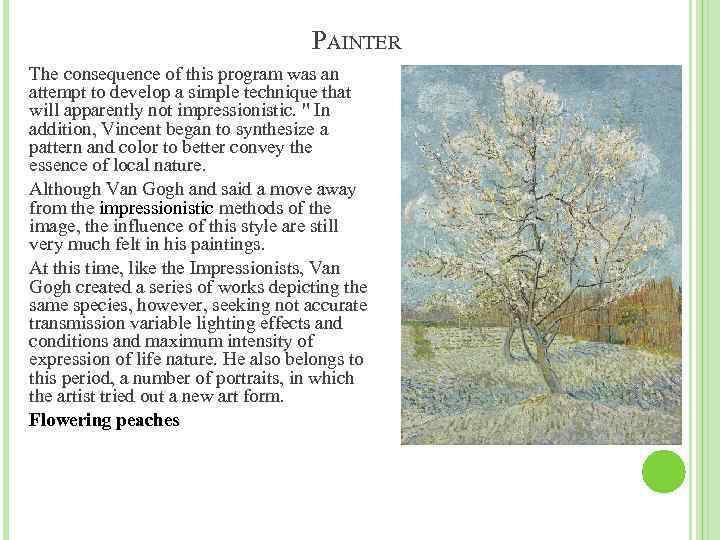 PAINTER The consequence of this program was an attempt to develop a simple technique that will apparently not impressionistic. " In addition, Vincent began to synthesize a pattern and color to better convey the essence of local nature. Although Van Gogh and said a move away from the impressionistic methods of the image, the influence of this style are still very much felt in his paintings. At this time, like the Impressionists, Van Gogh created a series of works depicting the same species, however, seeking not accurate transmission variable lighting effects and conditions and maximum intensity of expression of life nature. He also belongs to this period, a number of portraits, in which the artist tried out a new art form. Flowering peaches
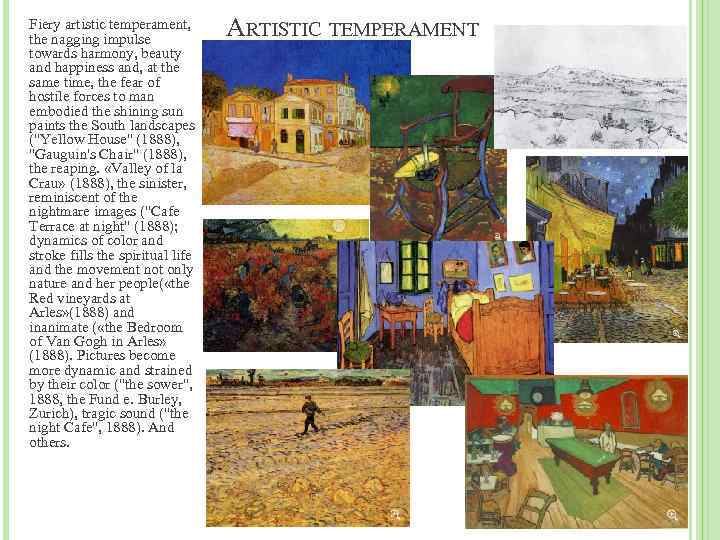 Fiery artistic temperament, the nagging impulse towards harmony, beauty and happiness and, at the same time, the fear of hostile forces to man embodied the shining sun paints the South landscapes ("Yellow House" (1888), "Gauguin's Chair" (1888), the reaping. «Valley of la Crau» (1888), the sinister, reminiscent of the nightmare images ("Cafe Terrace at night" (1888); dynamics of color and stroke fills the spiritual life and the movement not only nature and her people( «the Red vineyards at Arles» (1888) and inanimate ( «the Bedroom of Van Gogh in Arles» (1888). Pictures become more dynamic and strained by their color ("the sower", 1888, the Fund e. Burley, Zurich), tragic sound ("the night Cafe", 1888). And others. ARTISTIC TEMPERAMENT
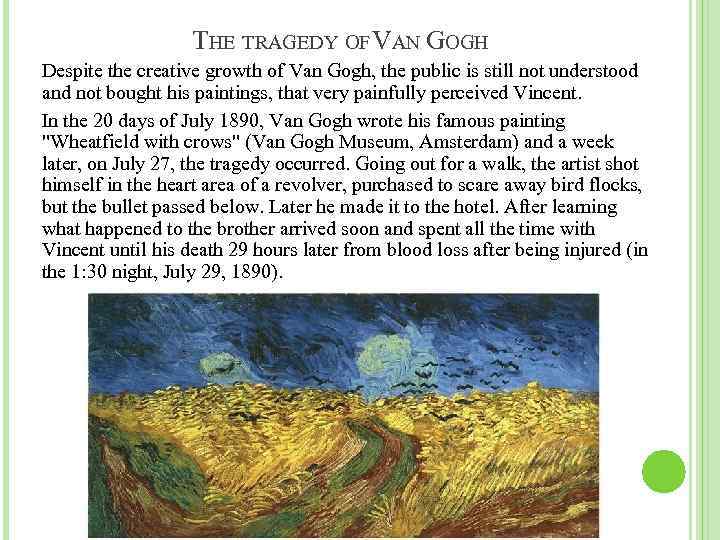 THE TRAGEDY OF VAN GOGH Despite the creative growth of Van Gogh, the public is still not understood and not bought his paintings, that very painfully perceived Vincent. In the 20 days of July 1890, Van Gogh wrote his famous painting "Wheatfield with crows" (Van Gogh Museum, Amsterdam) and a week later, on July 27, the tragedy occurred. Going out for a walk, the artist shot himself in the heart area of a revolver, purchased to scare away bird flocks, but the bullet passed below. Later he made it to the hotel. After learning what happened to the brother arrived soon and spent all the time with Vincent until his death 29 hours later from blood loss after being injured (in the 1: 30 night, July 29, 1890).
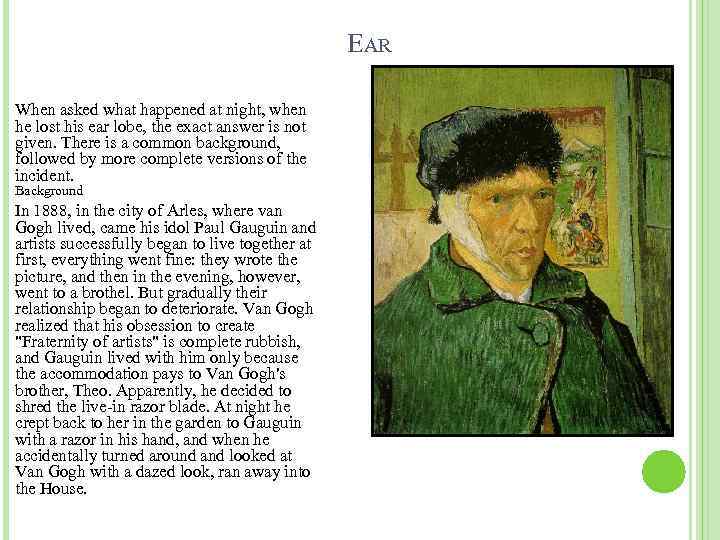 EAR When asked what happened at night, when he lost his ear lobe, the exact answer is not given. There is a common background, followed by more complete versions of the incident. Background In 1888, in the city of Arles, where van Gogh lived, came his idol Paul Gauguin and artists successfully began to live together at first, everything went fine: they wrote the picture, and then in the evening, however, went to a brothel. But gradually their relationship began to deteriorate. Van Gogh realized that his obsession to create "Fraternity of artists" is complete rubbish, and Gauguin lived with him only because the accommodation pays to Van Gogh's brother, Theo. Apparently, he decided to shred the live-in razor blade. At night he crept back to her in the garden to Gauguin with a razor in his hand, and when he accidentally turned around and looked at Van Gogh with a dazed look, ran away into the House.
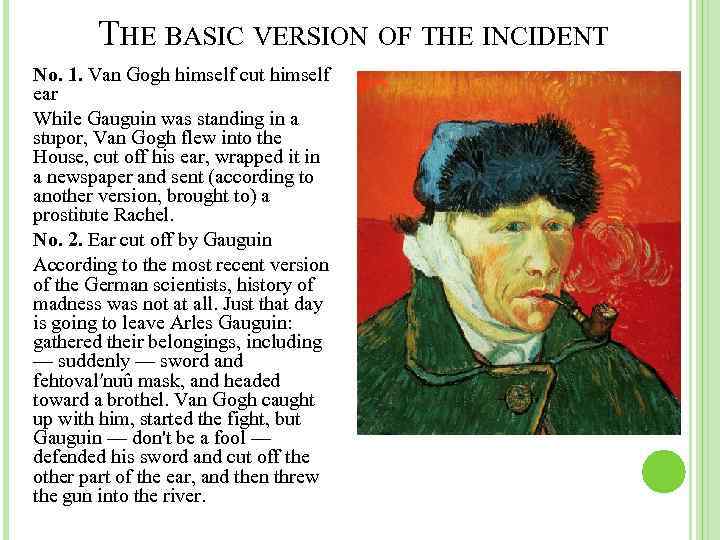 THE BASIC VERSION OF THE INCIDENT No. 1. Van Gogh himself cut himself ear While Gauguin was standing in a stupor, Van Gogh flew into the House, cut off his ear, wrapped it in a newspaper and sent (according to another version, brought to) a prostitute Rachel. No. 2. Ear cut off by Gauguin According to the most recent version of the German scientists, history of madness was not at all. Just that day is going to leave Arles Gauguin: gathered their belongings, including — suddenly — sword and fehtoval′nuû mask, and headed toward a brothel. Van Gogh caught up with him, started the fight, but Gauguin — don't be a fool — defended his sword and cut off the other part of the ear, and then threw the gun into the river.
 THANK YOU FOR YOUR ATTENTION! Learn more about Vincent Willem van Gogh, as well as the works of his contemporaries, you can get in the van Gogh Museum in Amsterdam is a Museum in Amsterdam, holds the world's largest collection of paintings and drawings by Vincent van Gogh, as well as the work of his contemporaries, including Paul Gauguin, Georges Seurat, Paul Signac, Claude Monet, Henri Toulouse-Lautrec, Pablo Picasso.