


 Скачать презентацию Viking Dawn 790 -980 Danish warships were first
Viking.pptx
- Количество слайдов: 28
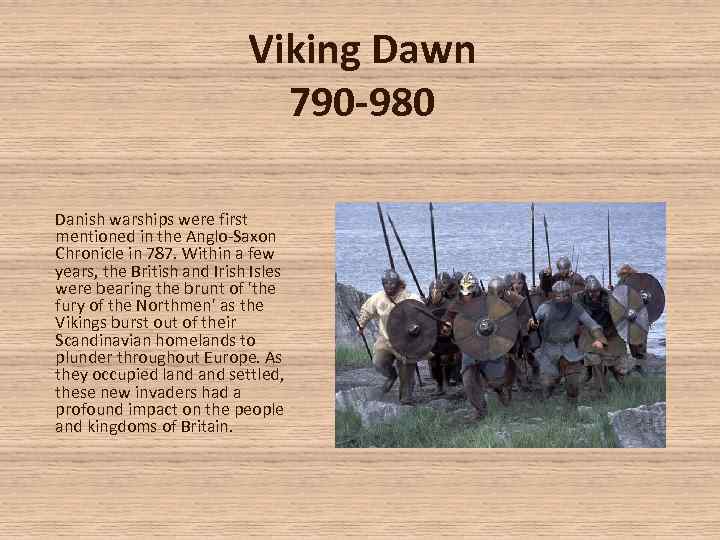 Viking Dawn 790 -980 Danish warships were first mentioned in the Anglo-Saxon Chronicle in 787. Within a few years, the British and Irish Isles were bearing the brunt of 'the fury of the Northmen' as the Vikings burst out of their Scandinavian homelands to plunder throughout Europe. As they occupied land settled, these new invaders had a profound impact on the people and kingdoms of Britain.
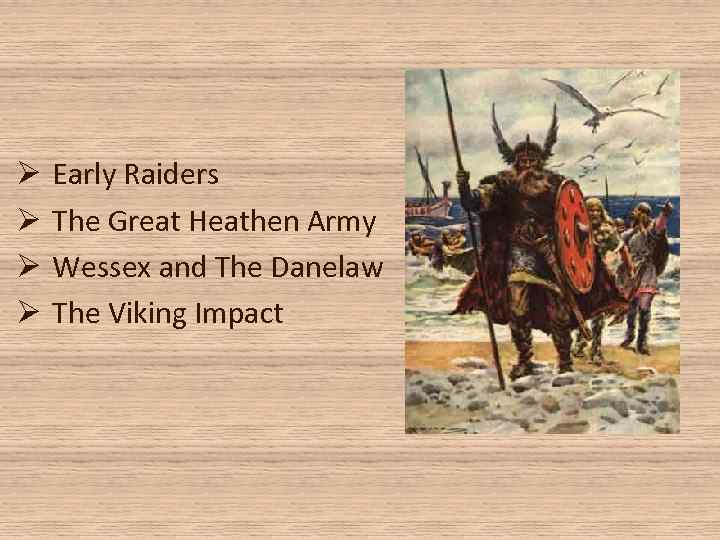 Ø Ø Early Raiders The Great Heathen Army Wessex and The Danelaw The Viking Impact
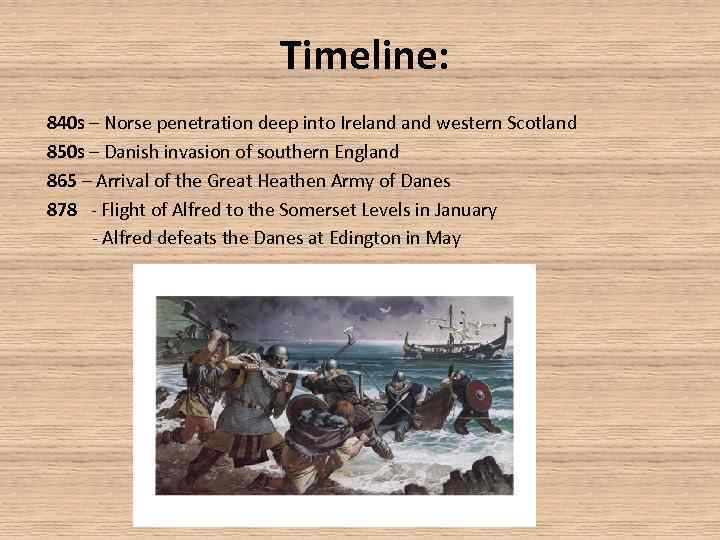 Timeline: 840 s – Norse penetration deep into Ireland western Scotland 850 s – Danish invasion of southern England 865 – Arrival of the Great Heathen Army of Danes 878 - Flight of Alfred to the Somerset Levels in January - Alfred defeats the Danes at Edington in May
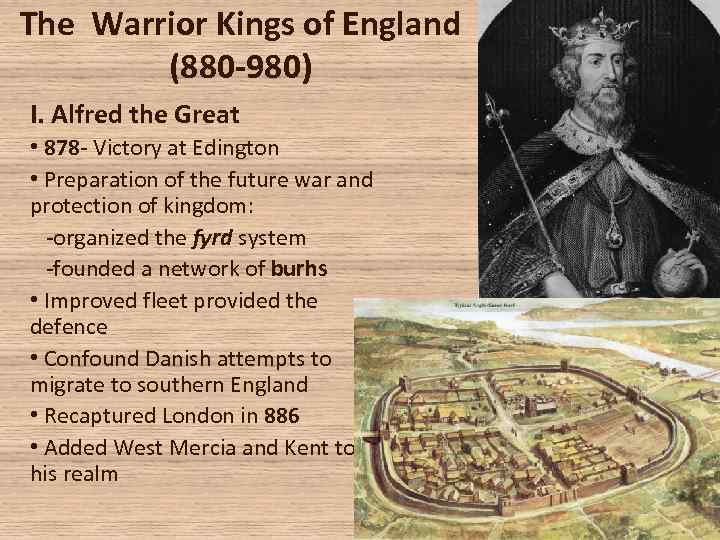 The Warrior Kings of England (880 -980) I. Alfred the Great • 878 - Victory at Edington • Preparation of the future war and protection of kingdom: -organized the fyrd system -founded a network of burhs • Improved fleet provided the defence • Confound Danish attempts to migrate to southern England • Recaptured London in 886 • Added West Mercia and Kent to his realm
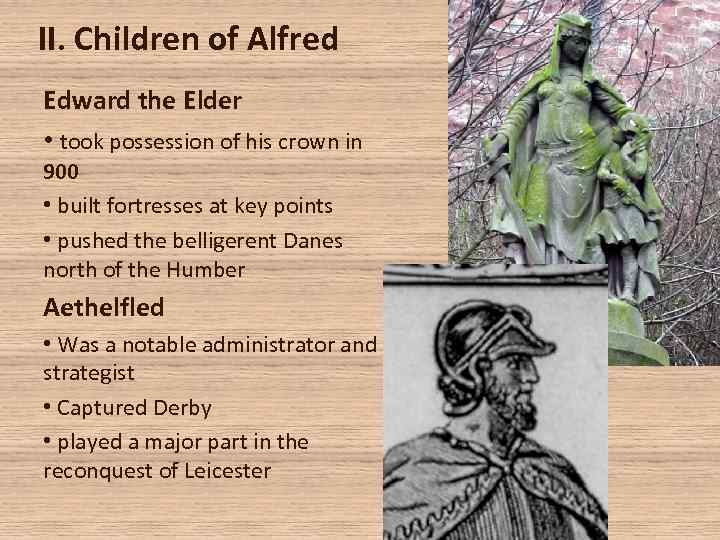 II. Children of Alfred Edward the Elder • took possession of his crown in 900 • built fortresses at key points • pushed the belligerent Danes north of the Humber Aethelfled • Was a notable administrator and strategist • Captured Derby • played a major part in the reconquest of Leicester
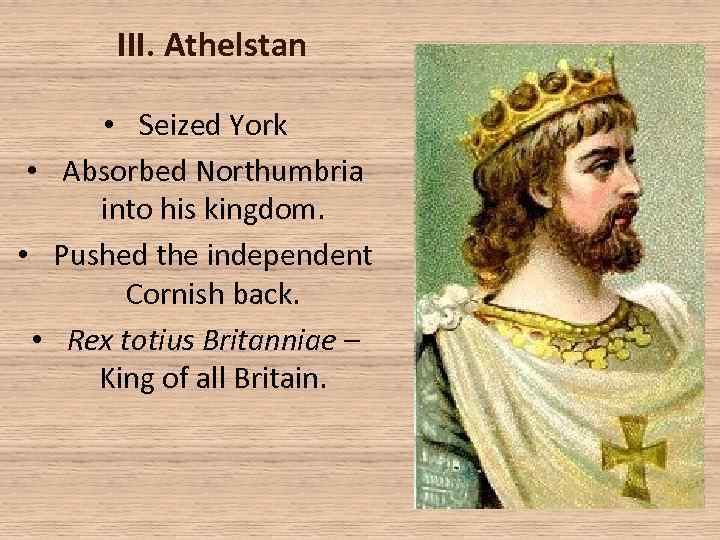 III. Athelstan • Seized York • Absorbed Northumbria into his kingdom. • Pushed the independent Cornish back. • Rex totius Britanniae – King of all Britain.
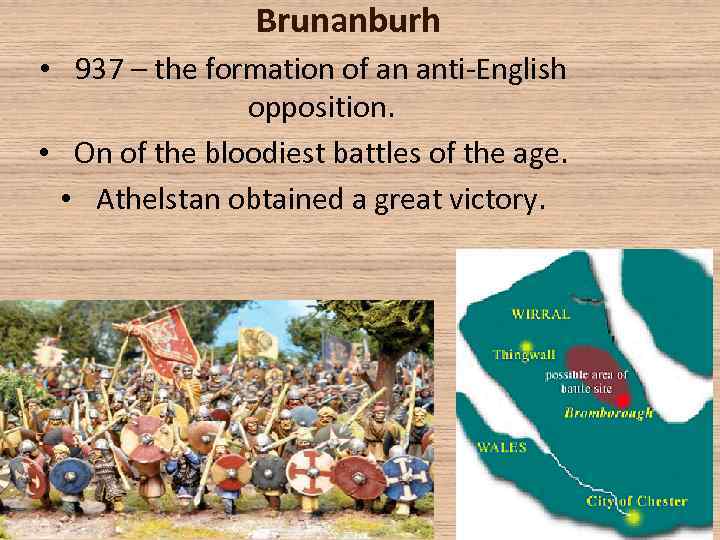 Brunanburh • 937 – the formation of an anti-English opposition. • On of the bloodiest battles of the age. • Athelstan obtained a great victory.
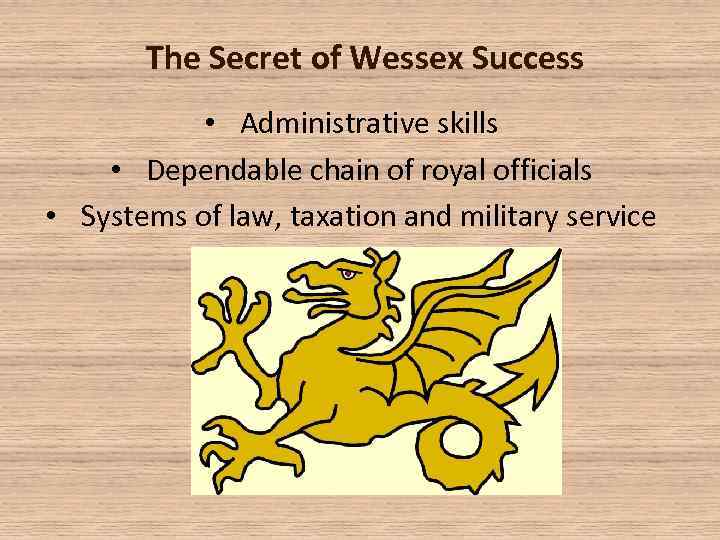 The Secret of Wessex Success • Administrative skills • Dependable chain of royal officials • Systems of law, taxation and military service
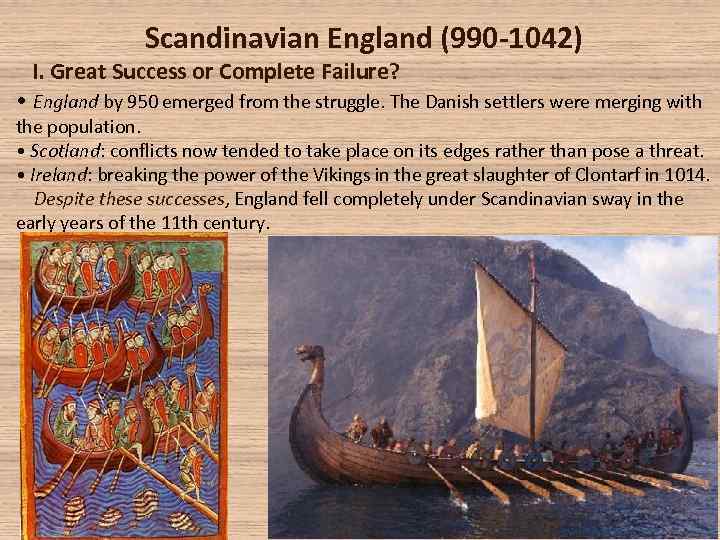 Scandinavian England (990 -1042) I. Great Success or Complete Failure? • England by 950 emerged from the struggle. The Danish settlers were merging with the population. • Scotland: conflicts now tended to take place on its edges rather than pose a threat. • Ireland: breaking the power of the Vikings in the great slaughter of Clontarf in 1014. Despite these successes, England fell completely under Scandinavian sway in the early years of the 11 th century.
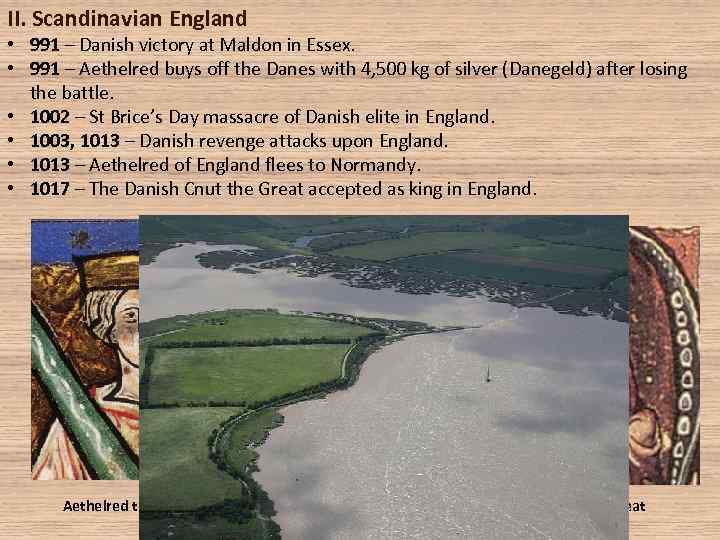 II. Scandinavian England • 991 – Danish victory at Maldon in Essex. • 991 – Aethelred buys off the Danes with 4, 500 kg of silver (Danegeld) after losing the battle. • 1002 – St Brice’s Day massacre of Danish elite in England. • 1003, 1013 – Danish revenge attacks upon England. • 1013 – Aethelred of England flees to Normandy. • 1017 – The Danish Cnut the Great accepted as king in England. Aethelred the Unready Sweyn Forkbeard Cnut the Great
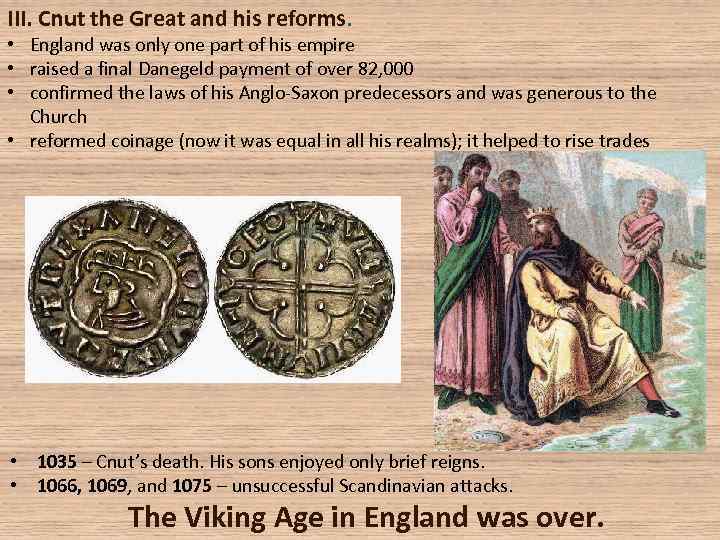 III. Cnut the Great and his reforms. • England was only one part of his empire • raised a final Danegeld payment of over 82, 000 • confirmed the laws of his Anglo-Saxon predecessors and was generous to the Church • reformed coinage (now it was equal in all his realms); it helped to rise trades • 1035 – Cnut’s death. His sons enjoyed only brief reigns. • 1066, 1069, and 1075 – unsuccessful Scandinavian attacks. The Viking Age in England was over.
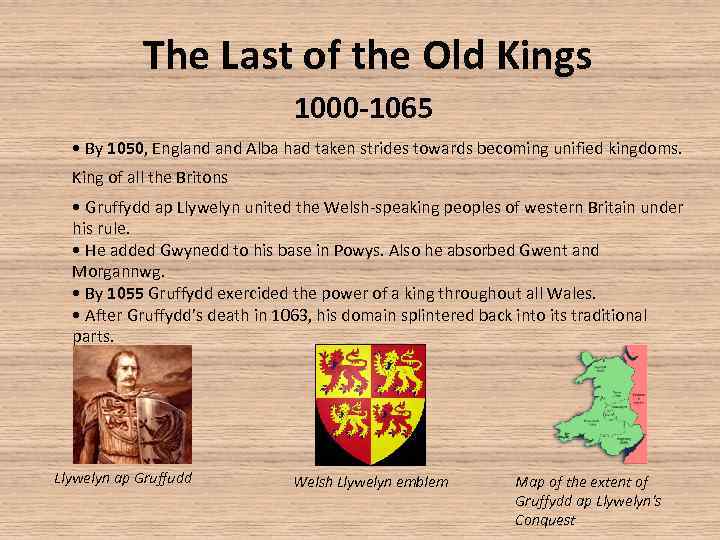 The Last of the Old Kings 1000 -1065 • By 1050, England Alba had taken strides towards becoming unified kingdoms. King of all the Britons • Gruffydd ap Llywelyn united the Welsh-speaking peoples of western Britain under his rule. • He added Gwynedd to his base in Powys. Also he absorbed Gwent and Morgannwg. • By 1055 Gruffydd exercided the power of a king throughout all Wales. • After Gruffydd’s death in 1063, his domain splintered back into its traditional parts. Llywelyn ap Gruffudd Welsh Llywelyn emblem Map of the extent of Gruffydd ap Llywelyn's Conquest
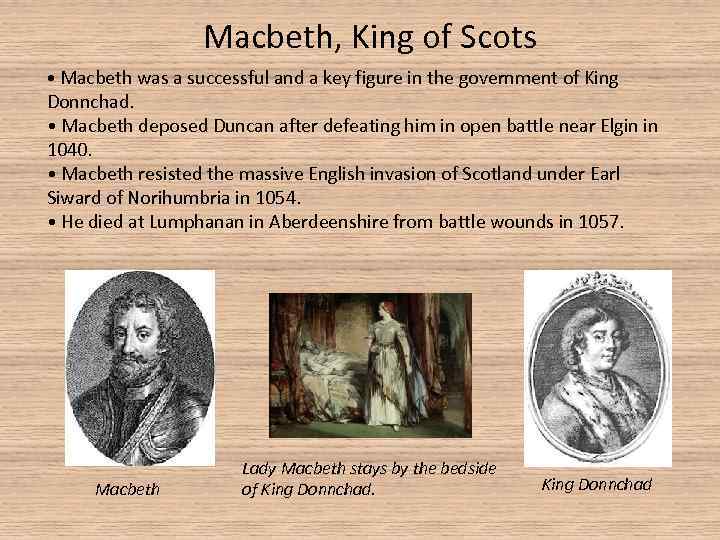 Macbeth, King of Scots • Macbeth was a successful and a key figure in the government of King Donnchad. • Macbeth deposed Duncan after defeating him in open battle near Elgin in 1040. • Macbeth resisted the massive English invasion of Scotland under Earl Siward of Norihumbria in 1054. • He died at Lumphanan in Aberdeenshire from battle wounds in 1057. Macbeth Lady Macbeth stays by the bedside of King Donnchad
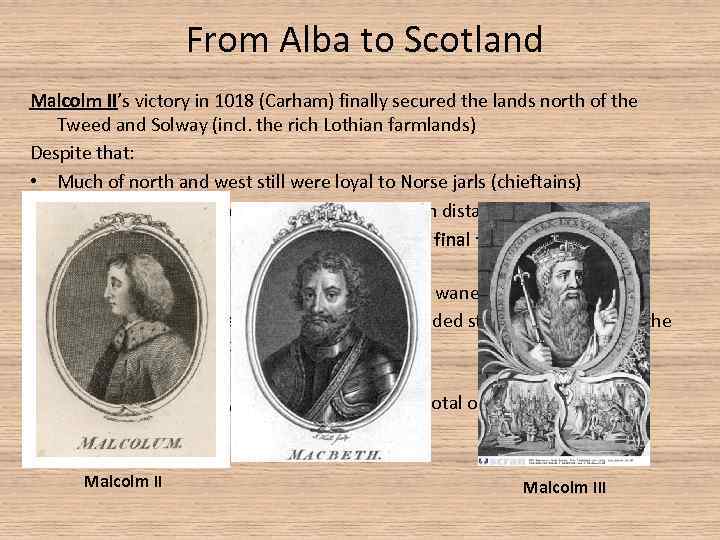 From Alba to Scotland Malcolm II’s victory in 1018 (Carham) finally secured the lands north of the Tweed and Solway (incl. the rich Lothian farmlands) Despite that: • Much of north and west still were loyal to Norse jarls (chieftains) • The writ of King of Scots was seldom obeyed in distant Galloway the kingdom of Scotland had assumed most of its final form by the mid 11 th century - The ancient divisions btw Pict and Scot almost waned - The system of mormaers (regional earls) provided stable government in the provinces and the supply of military force - Malcolm II, Macbeth, Malcolm III ruled for a total of 81 years in the 11 th century Malcolm III
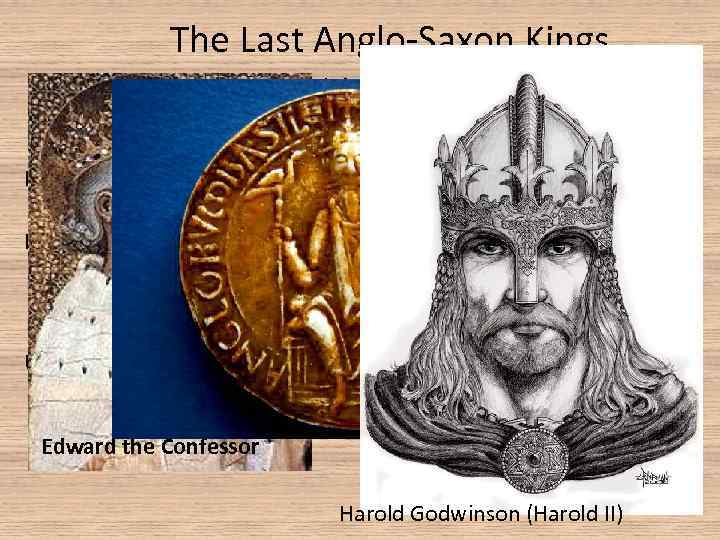 The Last Anglo-Saxon Kings In 11 th kings of England used the marcher earls (lords with special powers over the border lands) to good effect against the Welsh, Scots and Vikings During the rule of Edward the Confessor(for 24 years) lots of links with Europe prospered. Normans soon took power in Church and State under Edward (who grew up in Normandy) (as they did in Scotland under Malcolm III). However it was resented by the Saxon and Danish among the nobility. Upon Edward’s death in 1066, Harold Godwinson was his successor (the king had no heirs). And in January 1066 the Witanagemot (ancient convocation of wise and senior men) approved his Edward the Confessor accession as Harold II. Harold Godwinson (Harold II)
 Timeline • • • 1018 – Scottish victory at Carham secures the Tweed-Solway border 1039 – Expansion of Llywelyn power over Gwynedd 1040 -1057 – Rule of Macbeth of Alba 1042 – Edward the Confessor becomes King of England 1058 – Malcolm III, Canmore or Great Chief (the nicknames of Malcolm III of Scotland), becomes King of Scots 1060 – High point of Gruffydd ap Llywelyn’s rule in Wales 1063 – Harold Godwinson becomes the strongest figure in England 1065 – Consecration of Westminster Abbey (founded by Edward the Confessor) 1066 – Death of the childless Edward the Confessor on Jan 4 1066 – Godwinson crowned as Harold II on Jan 5
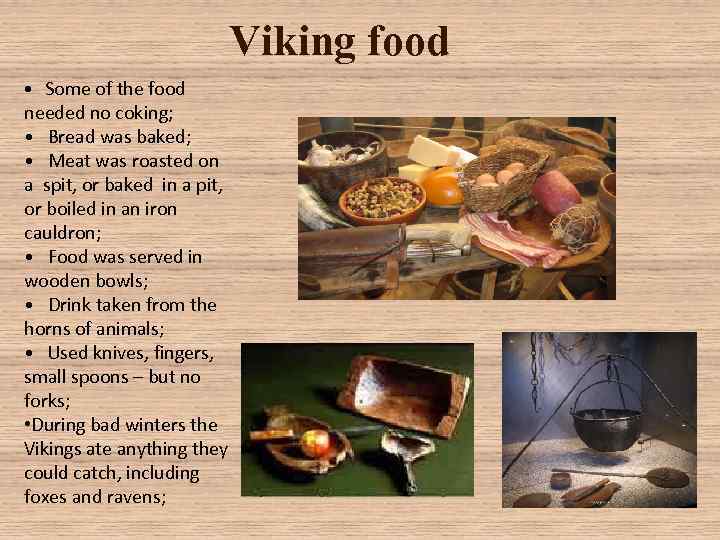 Viking food • Some of the food needed no coking; • Bread was baked; • Meat was roasted on a spit, or baked in a pit, or boiled in an iron cauldron; • Food was served in wooden bowls; • Drink taken from the horns of animals; • Used knives, fingers, small spoons – but no forks; • During bad winters the Vikings ate anything they could catch, including foxes and ravens;
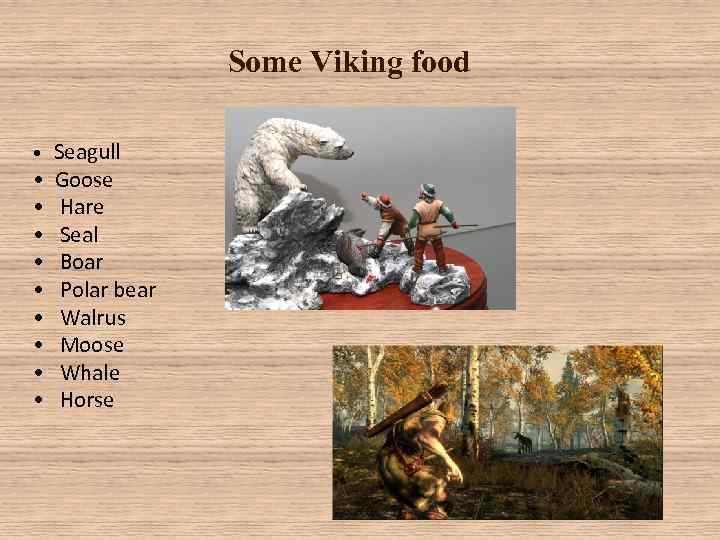 Some Viking food • Seagull • Goose • Hare • Seal • Boar • Polar bear • Walrus • Moose • Whale • Horse
 Advantages of eating these food • Easily netted, tasty in stew; • Feathers were used for bedding and quilts; • A great alternative to chicken and goose; • Skins used for clothing; • The fur made into clothes or used for trade; • Walrus ivory was in great demand from those in foreign countries; • Antlers were used as knife handles and hair combs; • The Vikings - the first whale hunters; the whale often overturned their ships, so it deserved to die;
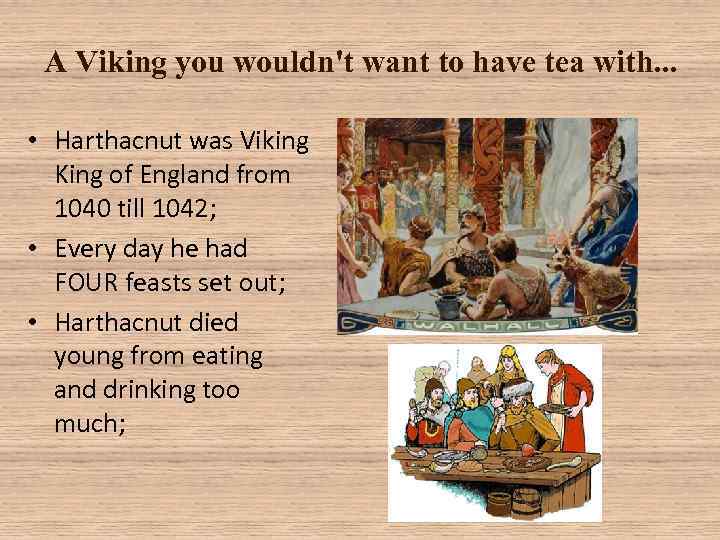 A Viking you wouldn't want to have tea with. . . • Harthacnut was Viking King of England from 1040 till 1042; • Every day he had FOUR feasts set out; • Harthacnut died young from eating and drinking too much;
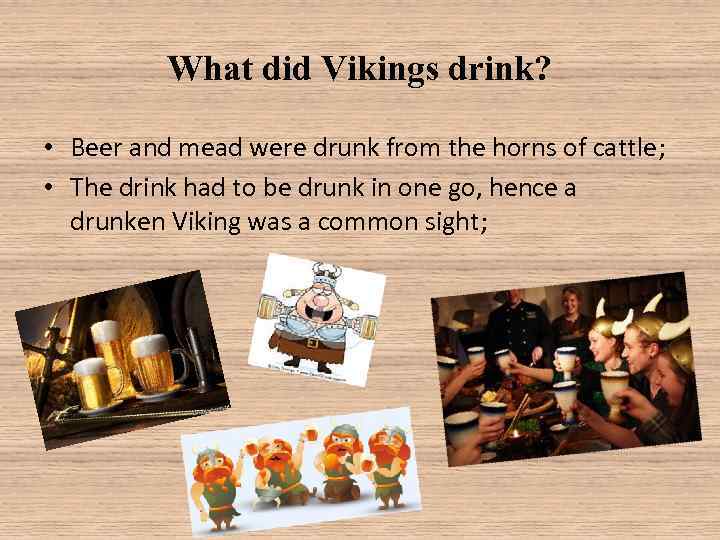 What did Vikings drink? • Beer and mead were drunk from the horns of cattle; • The drink had to be drunk in one go, hence a drunken Viking was a common sight;
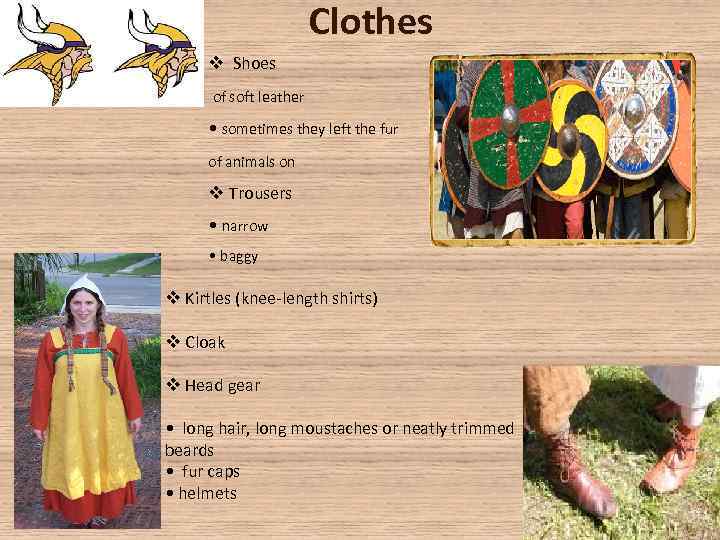 Clothes v Shoes of soft leather • sometimes they left the fur of animals on v Trousers • narrow • baggy v Kirtles (knee-length shirts) v Cloak v Head gear • long hair, long moustaches or neatly trimmed beards • fur caps • helmets
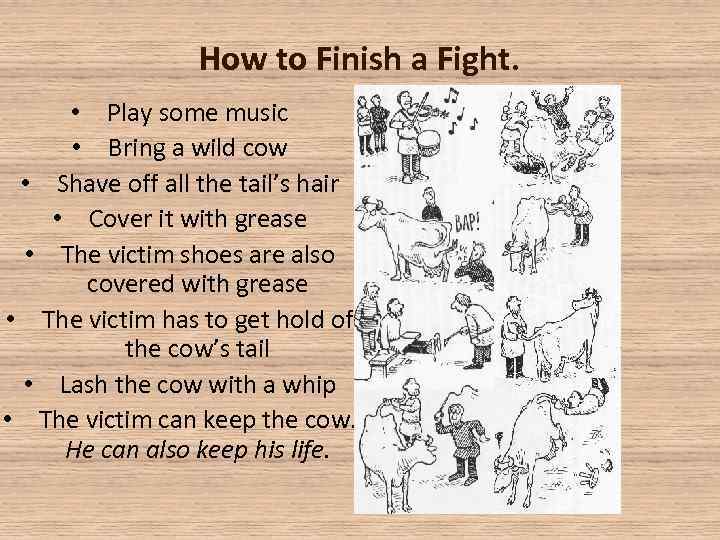 How to Finish a Fight. • Play some music • Bring a wild cow • Shave off all the tail’s hair • Cover it with grease • The victim shoes are also covered with grease • The victim has to get hold of the cow’s tail • Lash the cow with a whip • The victim can keep the cow. He can also keep his life.
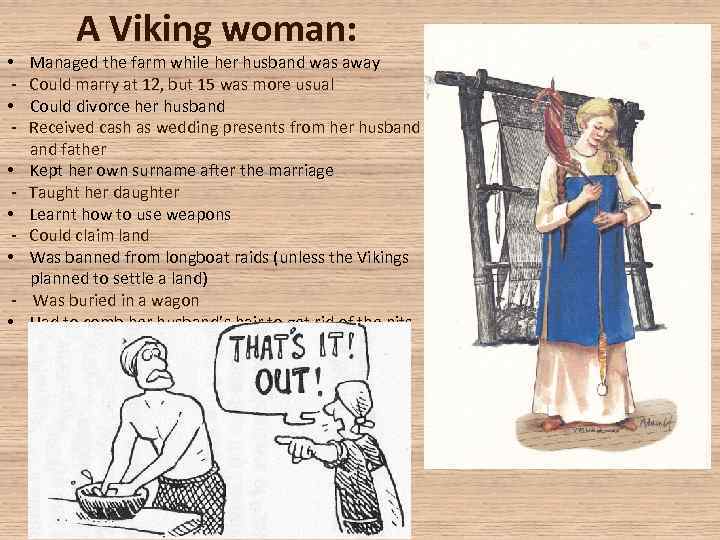 A Viking woman: • Managed the farm while her husband was away - Could marry at 12, but 15 was more usual • Could divorce her husband - Received cash as wedding presents from her husband father • Kept her own surname after the marriage - Taught her daughter • Learnt how to use weapons - Could claim land • Was banned from longboat raids (unless the Vikings planned to settle a land) - Was buried in a wagon • Had to comb her husband’s hair to get rid of the nits
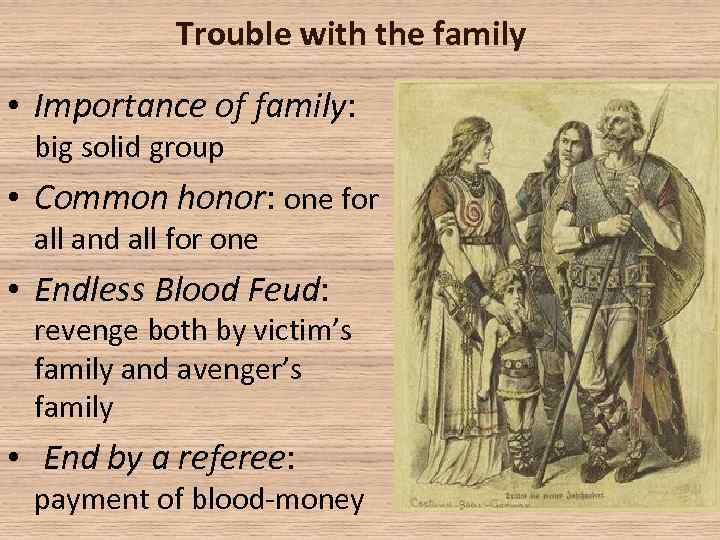 Trouble with the family • Importance of family: big solid group • Common honor: one for all and all for one • Endless Blood Feud: revenge both by victim’s family and avenger’s family • End by a referee: payment of blood-money
 Questions. • When did the first Vikings appear? • What was the Viking impact? • Were Alfreds children Edward and Aethelfled worthy successors and why? • Why was the battle of Brunanburh so important? • Who won the Battle of Maldon? • What is Danegeld? • What is Cnut the Great known for? • What changes have occurred in Wales during the reign of Llywelyn ap Gruffudd? • How did Macbeth become a king? • Who were the last Anglo-Saxon kings? • How did the Vikings use fur and animal skins in their clothes? • What hairstyle did the Vikings like? • What did the Viking women teach to their daughters? • Did the Viking women have to take their husbands’ surnames? • What is a blood feud? How long could it last? • How could a referee end a blood feud?
 Glossary • Shetland - a group of about 100 islands off the north coast of Scotland, north-east of the Orkneys, constituting a council area of Scotland • Mercia - a former kingdom of central England. • Fyrd – a militia called up from the districts threatened with attack. • Burhs - a fortified town or other defended site, its origin was in military defence; • Aethelred – a king of England who lost the battle of Maldon and initiated St Brice’s Day massacre Battle of Maldon – the battle in which Anglo-Saxons were defeated by the Norse • Danegeld - a tax raised to pay tribute to the Viking invaders to placate them • St Brice’s Day massacre - the killing of Danes in England, ordered by King Aethelred the Unready Sweyn Forkbeard – a king of Denmark and England who took revenge on Anglo-Saxon for St Brice’s Day massacre • Cnut the Great – Sweyn’s successor, a king of Denmark, England, Norway and parts of Sweden
 • • • • Jarl – chieftain - a Norse or Danish chief Mormaer – a regional earl Marcher earl – a lord with special power over the border lands Nobility - [nə'bɪlətɪ] дворянство; родовая знать - the group of people belonging to the highest social class in a country Successor – преемник - a person that succeeds another The Witanagemot - a political institution in Anglo-Saxon England to advise the king Accession - вступление на престол – an act of taking up a position as the ruler of a country Kirtles - knee-length shirts Cloak - a piece of clothes like a coat without sleeves that hangs loosely from your shoulders Forefathers – people a person derives his origin from Concept of common honor – idea of being responsible for what other family members do Blood Feud – revenge for killed family member Blood money – payment Vikings gave to victim’s family as a compensation